
The holidays quickly came and went, along with December 7th, which is the end of Medicare’s annual enrollment period. Some folks missed their opportunity to add, change or drop their Medicare plan, and they want to know if they have any options now that the annual enrollment period is over.
There are several opportunities to change at this date and we are going to explain each one.
Annual Disenrollment Period:
Each year from January 1st – February 14th is the annual dis-enrollment period. During this time if you are in a Medicare Advantage Plan (AlohaCare, HMSA, Humana, Kaiser Permanent, Ohana Health Plan and UnitedHealthcare), you have a one-time opportunity to change back to Original/Traditional Medicare (only) and enroll in a Medicare Part D plan if your Medicare Advantage plan included drug coverage. You cannot use this opportunity to add or drop prescription drug coverage. If you decide to use this option, please check with your health care providers (favorite physician, therapists) and make sure that they will accept Original/Traditional Medicare and continue to see you as a patient.
New Five-Star Special Enrollment Period:
This is a new benefit in 2012. Medicare has been collecting data on the Medicare Health and Drug Plans and has rated them on a five “star” scale, based on standard performance measures. Five Star being excellent performance and one star being poor performance. Some of the measures include: member satisfaction, managing chronic conditions, staying healthy, customer service and pharmacy benefits. Medicare gets some of this data from the “member satisfaction” surveys that you sometimes receive from your health plan after a visit to the doctor. Also, if you’ve called 1-800-Medicare and registered a “concern or complaint,” they take those calls very seriously.
Not every state and county has access to a five-star plan. In 2012 there are approximately nine health plans in the nation that are “5 stars.” Hawai‘i, be proud, we have one of them. Hopefully in 2013 all of our health and drug plans will be rated with 5 stars.
This special enrollment period is available December 8, 2011– 2012. It is a one-time opportunity to change to a 5 star plan, if it is available in your area. You can do this at anytime beginning December 8, 2011. This special enrollment period again is not an opportunity to add or drop health and drug coverage.
Other Special Enrollment Periods:
If you receive “Extra Help” (also known as low-income subsidy), you have a continuous special enrollment period throughout the year.
Working Individuals. If you didn’t sign up for Medicare Part A and/or Part B when you were first eligible for Medicare (at 65 years of age) and you were covered under an employer group health plan based on current employment (either you or your spouse or family member if you are disabled) and that coverage ends, you have an 8-month window to enroll in Medicare Part B and 63 days to enroll in drug coverage. If you miss either of those windows then you have to wait until the general or annual enrollment periods. COBRA benefits (federal law which allows you to purchase your employer health coverage) is not considered “creditable coverage” for Medicare Part B and you may not be eligible for a special enrollment period and may have to pay higher premiums when you do enroll.
If you would like to know more about special enrollment periods, you can view the Medicare & You handbook (paper form or on-line). For more information about enrolling in Medicare Part B, please visit www.socialsecurity.gov. And for information about Medicare and the health plans available in Hawai‘i, please call Sage PLUS Program, also known as the Hawai‘i SHIP (State Health Insurance Assistance Program). This program is a federal grant from Medicare to assist you in understanding the benefits of the Medicare Program.
 Thanks in part to convincing commercials on TV, many people are sold on the benefits of scooters and powerchairs before they even enter a showroom.
 Hawai‘i Life Flight is an air ambulance provider serving the Hawaiian Islands, transporting patients from pediatrics to geriatrics. It’s scope of care ranges from cardiac and trauma to neurological and burn patients.
 In 2006, Hunt got to work right away hiring an entirely new management team. He replaced the older Cessna fleet with newer, faster aircraft, opting for Raytheon King Air C90B models. More than $2 million of custom reconfiguration work was done to prepare the fleet for the demands of Hawai‘i’s medical community. The company also raised the bar when selecting pilots, aircraft maintenance and medical personnel to above current FAA and industry standards. In addition, new positions were created to monitor and ensure quality management and safety, compliance, efficient communications and risk assessment.
 Long before the phrase “evidence based” became a buzzword, Child & Family Service (CFS) was providing award-winning evidence-based services. Founded in 1980, the Honolulu Gerontology Program, as it was then known, was incorporated into Child & Family Service in 1985. The following year the program received both the Department of Human Service’s Secretary’s Award for Excellence in Health Promotion and the Administration on Aging’s Project Health Award. In 1999, it received the Best Practice Award from the Health Promotion Institute of the National Council on Aging, and in 2002, CFS developed the No Fear of Falling program.
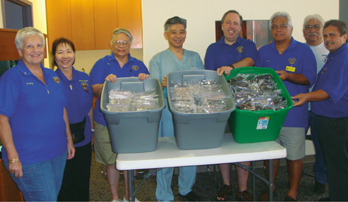 Most of them are quickly diagnosed and easy to treat with corrective lenses. Still, millions of people in developing nations are pushed deeper into poverty, simply because they don’t have glasses. For children, clear vision means a better education, healthier development and a better quality of life. For adults, it means greater employment opportunity and economic strength. For seniors, it means less dependence on others. Sunglasses that offer protection against harmful UVA/UVB rays are also important to preserve eye health.
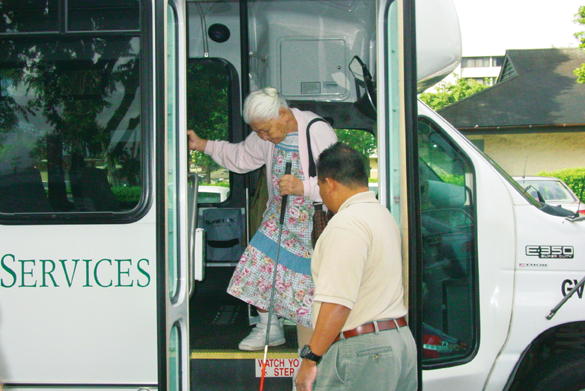 Rita Lontayao grew up on Kaua‘i. She married her husband in 1935 and lived with him in plantation housing, where they worked and raised their family. After many years on the plantation, her husband passed away. Then a few months later, the plantation closed, forcing her to move to alternate housing. She recalls the uncertainty of that time when she did not know how she would make ends meet without her husband, or his source of income.
 Recently, Meals On Wheels Association of America President and CEO, Enid Borden, visited Lanakila Meals on Wheels in Liliha.