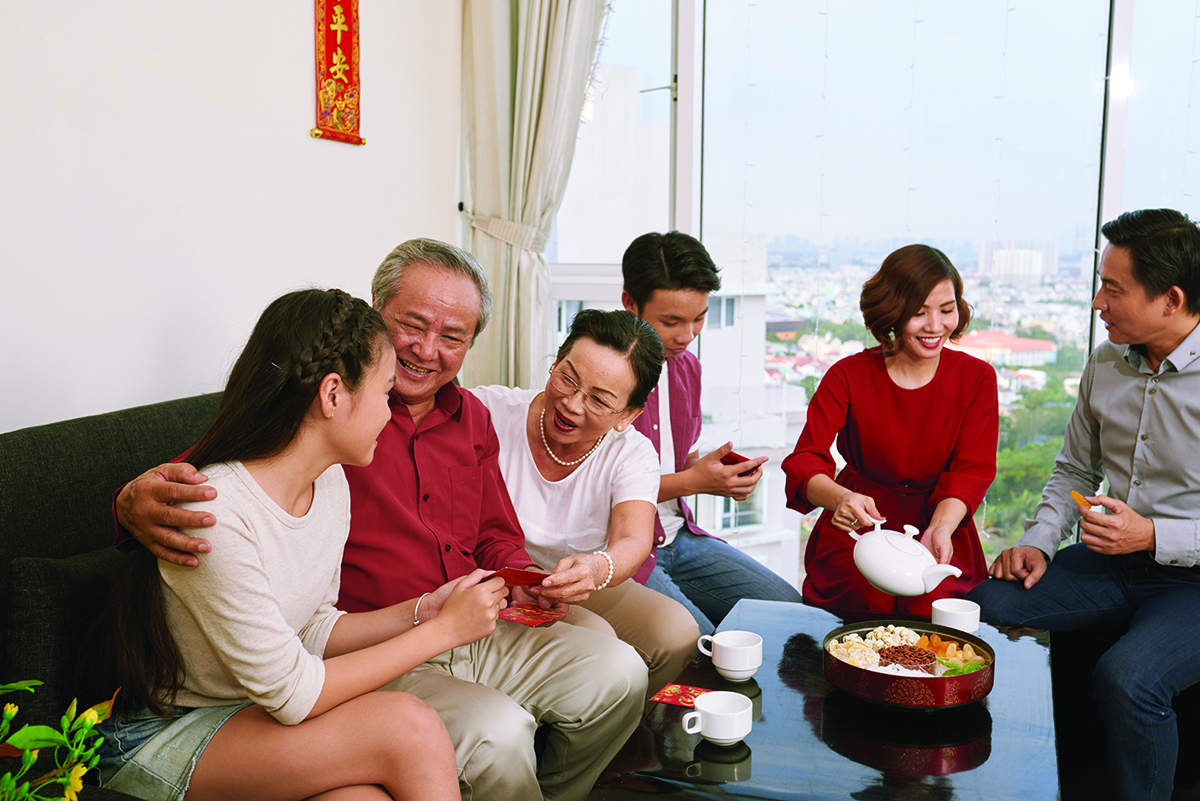
As an adult daughter, do you ever feel like a little girl when conversations with your mother end in misfires, teary rants or silence? You’re not alone — it happens this way for 43.5 percent of us. However, there’s hope. By using ASK Presetting, you can stop walking on eggshells.
ASK Presetting is a precise communication method that involves pre-framing and rehearsing questions, comments, words and tones to avoid emotional collateral damage. When presetting tough topics with your mother, for example, appeal to her sweet side; don’t make her feel wrong.
Using this method, you can head off hurtful words in as little as seven minutes and stop feeling verbally attacked. Start by sprinkling your conversations with these two-word phrases: “I feel,” “I’m open,” “I’m confused,” and “Tell me more,” when your mother’s (or father’s and siblings’) words cause anxiety.
If you’re discussing tough and tender topics, but she keeps pinpointing your mistakes, you can calmly express yourself using this method without squabbling. And you won’t require years of therapy, either. Instead, you’ll be communicated with her respectfully and with love.
ANNETTE PANG-LIFE COACH VILLAGE, LLC
2383 Beckwith St., Honolulu, HI 96822
808-372-3478 | ap@annettepang.com
www.annettepang.com
As an adult daughter, do you ever feel like a little girl when conversations with your mother end in misfires, teary rants or silence? You’re not alone — it happens this way for 43.5 percent of us. However, there’s hope. By using ASK Presetting, you can stop walking on eggshells.
The Hawaii Pacific Gerontological Society will honor Emmet White at its virtual fundraiser on Nov. 4. His service and dedication to so many families, and his professional career serving kūpuna through the Arcadia Family of Companies, Hawaii Long Term Care Association, Hawaii Healthcare Association and the Central Union Church are legendary.
After 23 years of service, Emmet retired as president and CEO from Arcadia. He chaired the Hawaii Long Term Care Association, now reunited with the Healthcare Association of Hawaii, and also served on the State Health Coordinating Council for the State Health, Planning & Development Agency. Emmet was also a member of the Oahu Workforce Development Board.
A retired Army Reserve colonel, Emmet served as an ombudsman for the Department of Defense Employer Support of the Guard and Reserve Program. Prior to joining Arcadia, Emmet practiced law in Honolulu for 23 years and was appointed to the Court Annexed Arbitration Program in its early years. During that time he also served Central Union Church as moderator, trustee and deacon, as a member of the church’s Arcadia Committee, and then as a member and chair of Arcadia’s governing board.
HAWAII PACIFIC GERONTOLOGICAL SOCIETY (501(c) 3 nonprofit)
P.O. Box 3714, Honolulu, HI 96812
Sherry Goya, HPGS Executive Director 808-722-8487 | sgoyallc@aol.com www.hpgs.org
The Hawaii Pacific Gerontological Society will honor Emmet White at its virtual fundraiser on Nov. 4. His service and dedication to so many families, and his professional career serving kūpuna through the Arcadia Family of Companies, Hawaii Long Term Care Association, Hawaii Healthcare Association and the Central Union Church are legendary.
For the past 20-plus years at midnight on the 23rd of December, a gathering of veterans has taken place near the Capitol, by the memorial for our Korean and Vietnam brethren. The group includes men and women who have served in various campaigns. It is a big crowd.
There is usually some coffee, water and a snack or two. Mostly, it is a gathering to check in and renew “welcome home” greetings. It is also a time to notice who is not in attendance.
Our voices are softer and our hearing isn’t quite 100 percent, so the words of those leading prayers or the roll call of our missing companions becomes more personal as we lean in and turn up hearing aids.
Our midnight gathering leads into the 24th of December in Hawai‘i and Christmas Day in Vietnam.
Many recall our Christmas in Vietnam — where we were, who we were with, whether the cease fire remained intact that day and what was for dinner (hot chow, and if Santa was generous, one or two bottles of beer).
COVID-19 had us cancel the 2020 event. Sadly, four of us will not be at the 2021 celebration. Please join us in remembrance on Dec. 23 at midnight at the Hawai‘i State Capitol Korea-Vietnam Veterans Memorial.
For the past 20-plus years at midnight on the 23rd of December, a gathering of veterans has taken place near the Capitol, by the memorial for our Korean and Vietnam brethren. The group includes men and women who have served in various campaigns. It is a big crowd.
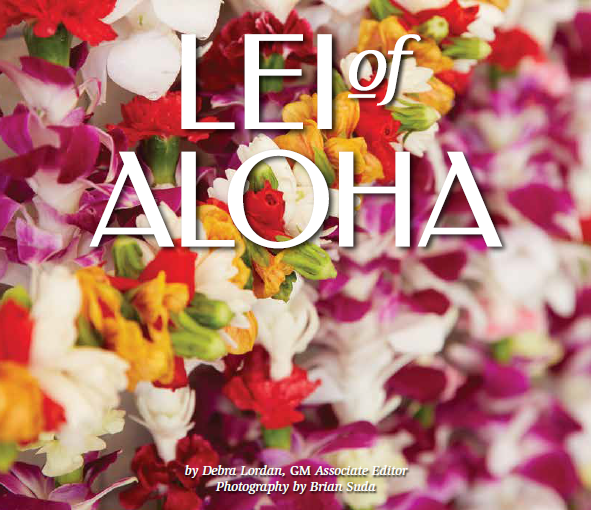
In Hawai‘i, any occasion can be made more special by the giving of a lei. Whether it’s for love, a celebration or to honor someone, you can choose the one that symbolizes the sentiment you want to convey or select the one that suits your taste. All represent the rich heritage of the lei.
Lei Day, May 1, is dedicated to the Hawaiian tradition of making and giving lei. But some may not know the the tradition entails much more than the officially dedicated day. The traditions that surround lei make them appropriate for many occasions. Hawaiian tradition also offers particular lei for celebrations and seasonal events.
Giving a lei symbolizes friendship, love, respect and honor. It is a gift for greeting someone warmly. It represents the spirit of aloha. Its beauty and meaning flow from the heart of the giver.
A Hawaiian Tradition
The tradition of adorning themselves with wreaths of local vines and flowers to honor their gods came to Hawai‘i with the Polynesians who settled here long ago. They brought with them many of the plants they needed for daily life — plants for medicinal use, plants for food and plants that they brought for their sweet scent for use as a personal embellishment.
In their new island home, lei came to signify royalty, rank, status and wealth. The geography of the area, the religion of its people and the tradition of the hula were all associated with the lei they wore. As time passed, they developed their own unique culture and traditions.
The new Native Hawaiians found many other items, including hala and maile, that could be fashioned into adornments. In Old Hawai‘i, lei were created with the lush flowers, vines and leaf stems of every kind from every island — even seaweed from the rich Hawaiian waters. Lei were also made with ivory, bone, seeds, kukui nuts, hair, teeth, shells and feathers.
The pupu lei was made from shells and the hulu manu lei was made from feathers. Niho palaoa lei were made of the bones of the walrus and whale held together by human hair, which were passed down through generations.
Other plants and materials were introduced later, such as the carnation, orchid and plumeria.
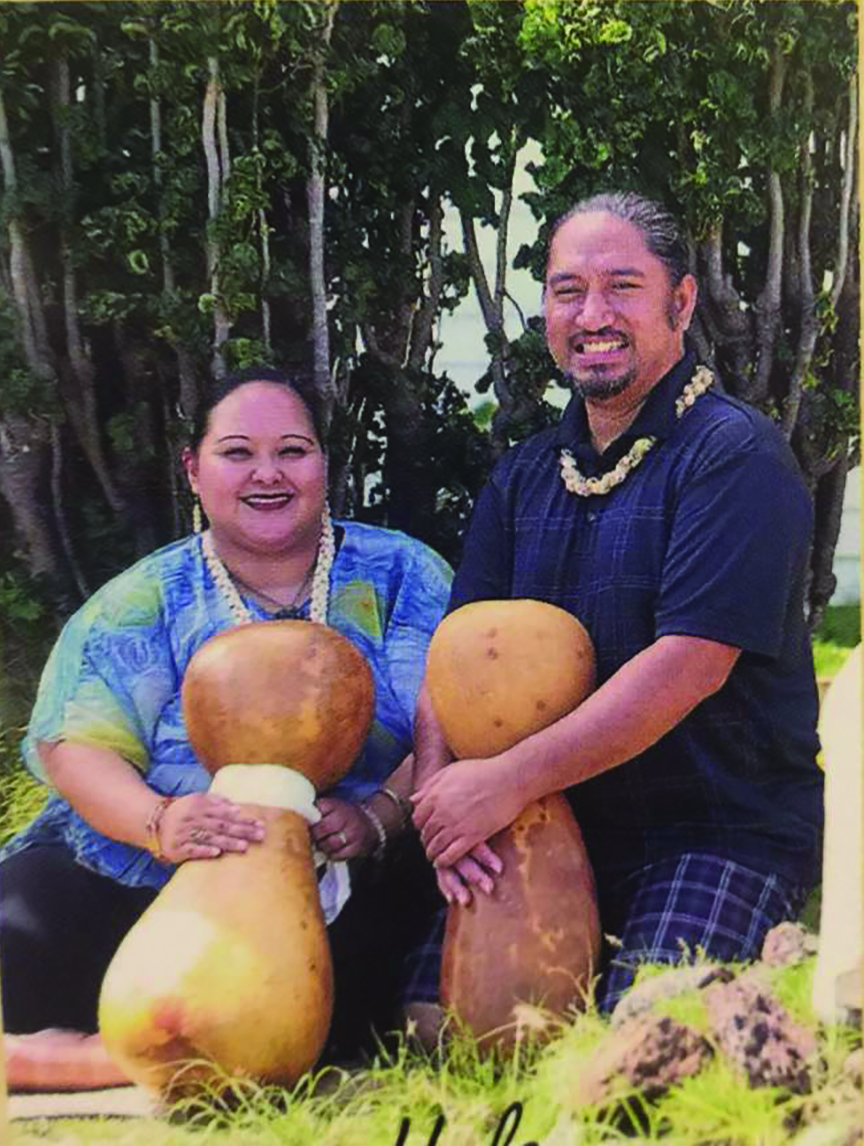
Kapono Kamaunu learned about Hawaiian culture, hula, chanting and more from Kumu Hula Keli‘i Tau‘ā.
Lei and Hula
What Kapono Kamaunu knows about lei and Hawaiian culture, he didn’t learn growing up. He was raised on O‘ahu, where his childhood activities and interests mostly revolved around Waikīkī Beach and sports. When he moved to Maui in 1993, he met Kumu Hula Keli‘i Tau‘ā, a teacher at Baldwin High School. As a freshman, he not only learned about hula and chanting, but other aspects of the Hawaiian culture, as well.
Kapono and his wife, Priscilla, became kumu hula 10 years later, offering training for hālau hula on Zoom since the pandemic began. They own and run a home-based hula implement-making business called “Na Kani O Hula.” Kapono works as a cultural advisor at the Fairmont Kealani and performs at the Old Lāhainā Lū‘au, as well.
“Through hula, we learned about lei-making, Hawaiian history and culture,” he says.
In Old Hawai‘i, the major types of lei were each related to different spirits and used for different reasons. Many were related to Hawaiian myths and religious customs, Kapono says.
“It goes back to hula,” says Kapono. “For most of the year, the lives of the Hawaiian people were strictly governed by a set of laws called ‘kapu.’ Everything they did was directed by these kapu, including hula. But during the Makahiki season (October or November through February or March), the ancient Hawaiian New Year festival in honor of Lono, many kapu were suspended. This time of year, kane (men) were allowed to perform hula on heiau, traditional religious temples. Makahiki was a time of peace, gathering and hula performances without restriction. For ceremonial purposes, hula dancers would wear lei.”
Kapono and his wife Priscilla own and run a home-based hula implement-making business.
Traditionally, hula dancers wear specific lei to reflect the dance they are performing, especially in a competition setting. Dancers tie in the story — the chant or mo‘ōlelo — its setting and the flowers, ferns and other materials found in the location relevant to the story, says Kapono.
“In hula, we say kinolau — the divine is everywhere, and everything is the divine. It is the physical embodiment of the many Hawaiian gods and goddesses.”
“After asking permission from Laka first, hula dancers would gather ferns, such as palapalai, laua‘e ferns and maile, for their adornments in ceremonial performances and other practices as well,” says Kapono. “The gathered vines, leaves or flowers were placed on the kuahu hula (hula altar) dedicated to Laka.”
“Whatever is in the song, we aim for the closest possible representation.”
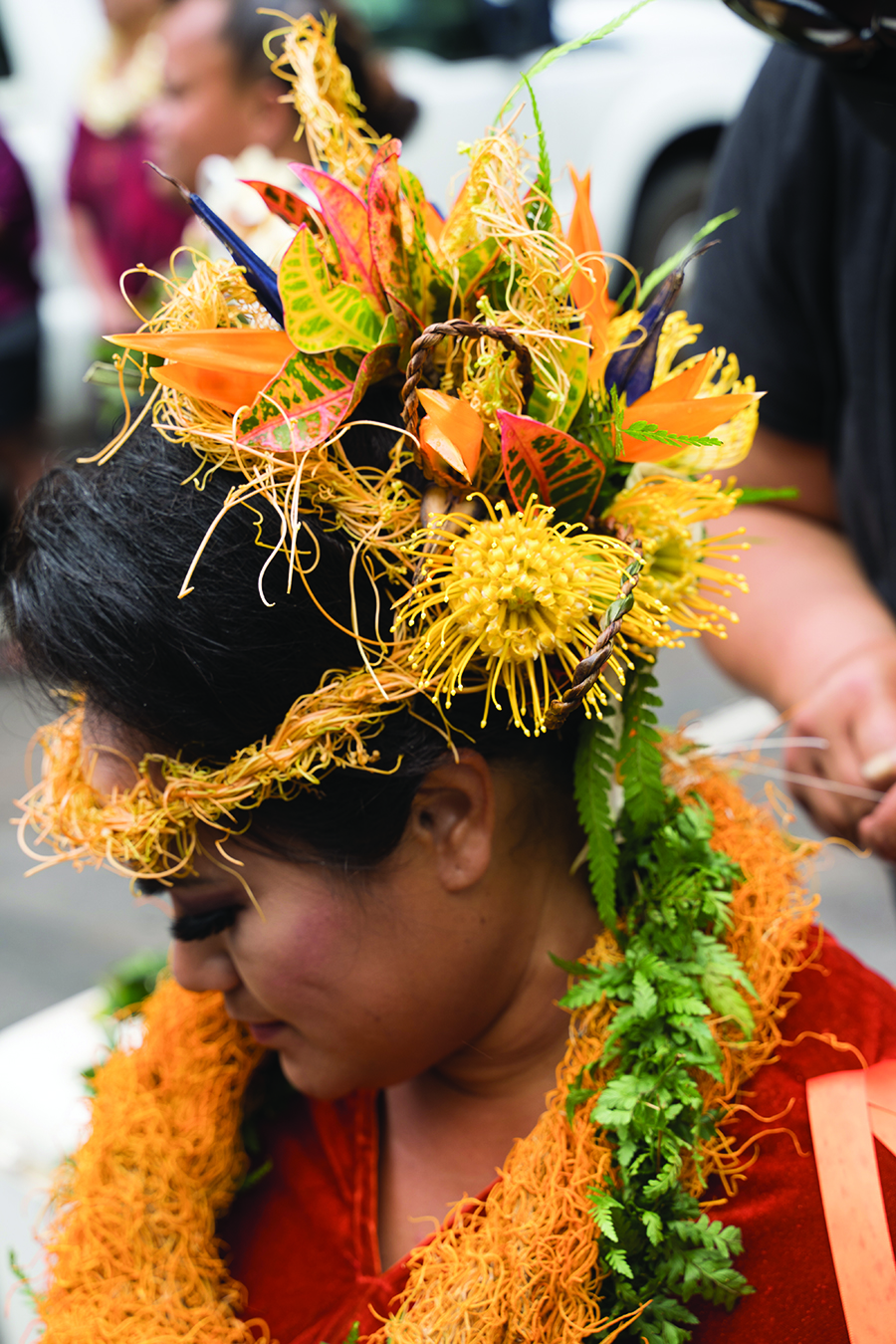
“For example, Pele and her sister Hi‘iaka are represented by the red flowers of the ‘ohi‘a lehua brought to the islands by the Polynesians settlers. So when you do a dance about Pele, you would wear a haku (braided) lei or a lei po‘o made of ‘ohi‘a lehua, as well as a lei a‘i (a neck lei).”
For centuries, lei made from the fragrant leaves of maile have been used to communicate love, respect, blessing, enduring devotion, reverence, friendship and a desire for peace.
Traditional Meanings and Uses of Lei
One of the most popular of all the lei varieties was the maile lei, made from a leaf-covered vine with a sweet and spicy scent. This vine was worn around the neck, draping freely down to the waist. The maile lei was related to the spirit of the hula dance and represented Laka, the goddess of hula, as well as other sacred spirits.
For chieftains and members of royalty, the ilima was preferred. The full, lush lei was made from hundreds of delicate orange blossoms.
The ti plant has a long tradition of being planted outside homes to keep evil spirits away. Ti stalks were used to proclaim peace and to call a truce. A lei was made by tying ti leaves together. The open lei was worn by physicians and priests.
Limu kala, a type of seaweed, was gathered and used in many different ways — for religious purposes, as medicine, for consumption or as a lei. Traditionally, limu kala was gathering, fashioned into a lei and worn by a person suffering from an illness. The ill person or a kahuna would then pray to Kanaloa. When prayers were completed, the wearer of the lei would fully immerse him or herself in the ocean. In time, the lei would be swept into the sea as an offering to Kanaloa, in hopes of cleansing the wearer of the aliment.
Lei Traditions of Yesterday and Today
By fusing their island lifestyle with their sacred rituals and the natural elements around them, Hawaiians created lei that began to be worn for virtually every occasion by both commoners (maka‘ainānā) and chiefs (ali‘i) alike.
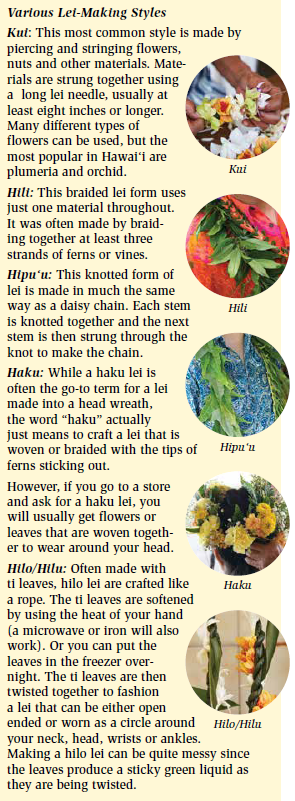
A lei po‘o is any lei that is worn around the head. What is often referred to as a haku lei is actually a lei po‘o crafted in the haku style.
“Today, lei are used for an array of occasions and it is widely accepted throughout Hawai‘i Nei that any type of lei can be worn by anyone and everyone,” says Kapono. “One thing that hasn’t changed is that the giving of a lei symbolizes giving your mana to someone else.”
Mana is a supernatural force that may be ascribed to persons, spirits or inanimate objects. It may be good or evil; beneficial or dangerous.
“When we are making lei, we want to ensure that we are putting the best of our spiritual energy into the lei,” says Kapono, “so when we give it to someone, we are giving them good energy, connection and love. Lei are the quintessential symbol
of love; of aloha.”
The type of flower made into a lei and gifted to a loved one has more to do with personal preference and seasonal availability than symbolism, says Kapono.
Although the lei of today are much like those worn in Old Hawai‘i when the first Polynesians settled the islands, their meaning and presentation has changed over the years.
Lei in Old Hawai‘i symbolized the status of the wearer and were presented by bowing and holding out the lei for the recipient to take.
“Traditionally, it was disrespectful to drape a lei over a person’s head, particularly when that someone was royalty,” says Kapono. “You do not want someone to interfere with your connection to Akua by having them cut off your mana.” This presentation method gave the recipient the option of taking it and putting it on themselves, giving it away, putting it on an altar or taking it to the ocean. “Because, just as lei are made and presented with love, they can also have bad intentions.”
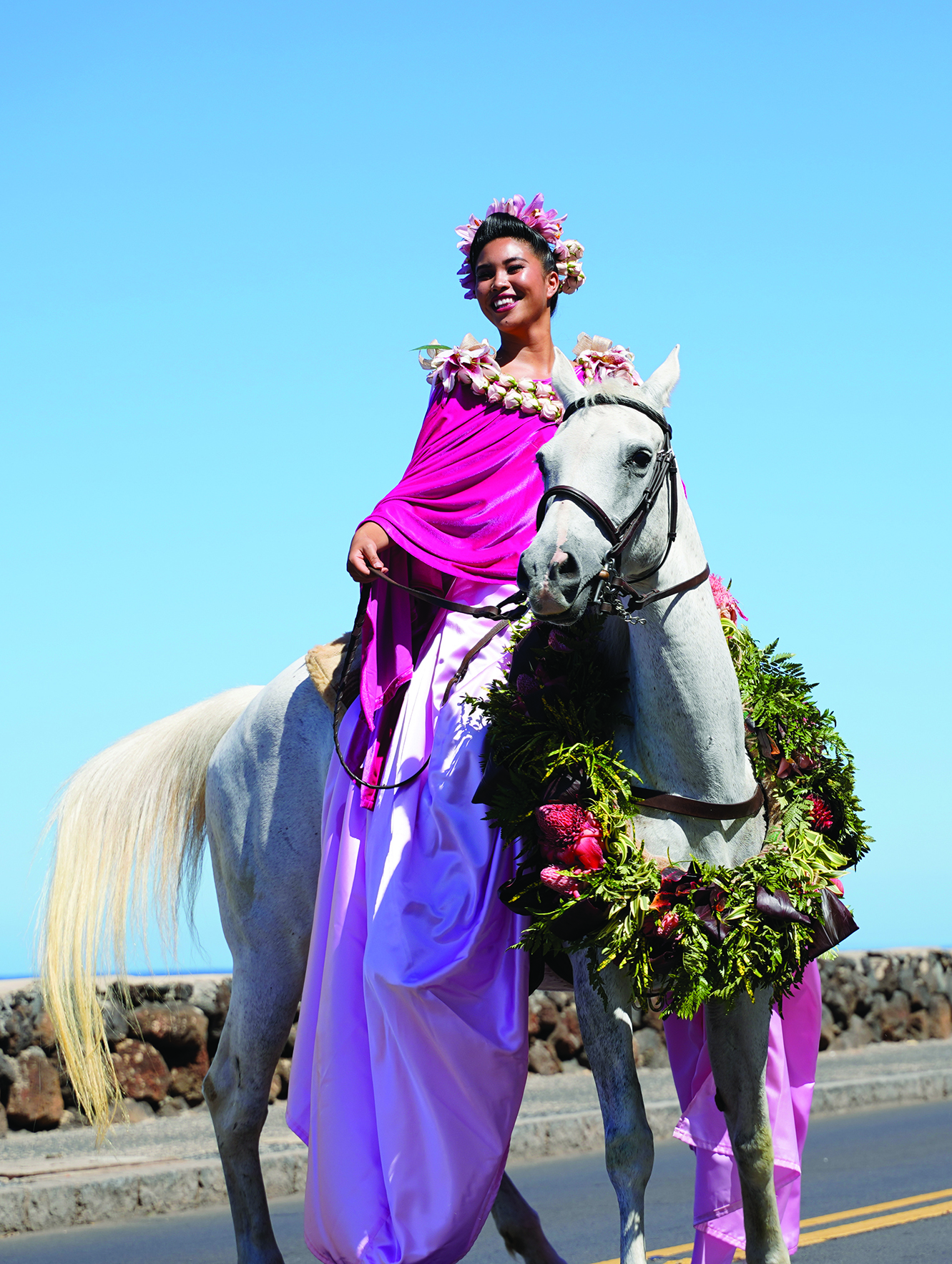
Adorned with a bounty of colorful lei, the regal pa‘u riders and their horses are the highlight of every parade
Around the 1840s, when Steamer Days or Boat Days began at Aloha Tower and Honolulu Harbor, visitors were greeted with armloads of lei. It may have been at this time that lei began to be placed over the heads of those arriving or departing, accompanied by a kiss on the cheek. That particular tradition came to a halt with the arrival of jet planes in the 1950s. To accommodate visitors, Daniel K. Inouye International Airport’s lei stands are located in the area.
Although most islanders believe that anyone can wear any type of lei for any occasion, Hawaiian tradition dictates the use of specific lei that are symbolic of the occasion, related to the season and dependent on the time of year the flower is in bloom. Worn at other times, it can bring the wearer bad luck.
For example, a lei made from the yellow, orange and red keys of the pineapple-like hala fruit interlaced with maile leaf or laua‘e fern can be worn at the beginning of Makahiki season, the Hawaiian New Year. Worn at this time, the hala lei invites good luck, pushes bad luck aside and prompts the wearer to forgive past grudges. However, worn at other times of the year, it can bring the wearer bad luck. The lei is associated with death and is often worn at funerals.
Although there is significant meaning associated with the giving of a lei, it is open to different interpretations by the maker, seller, giver or recipient. But it may be wise to be aware of certain traditional details.
“Some people still believe that it is inappropriate to give a pregnant woman a closed lei,” says Kapono. “An open lei may be given, as it symbolizes that the baby will be unencumbered and unharmed by the umbilical cord, ensuring it will not be tangled around its neck in the womb.”
Lei are often referenced as being created in a circle to symbolize love and the family circle. “Lei, like many of our nāmea Hawai‘i (Hawaiian arts), have grown and evolved into priceless artifacts that are shared around the world. Whether it’s an heirloom feather lei, a lei pupu that is passed down from generation to generation, or lei made from fragrant flowers and beautiful ferns, the joy of gifting and receiving a lei filled with the aloha spirit can brighten anyone’s day — even during the darkest of times.”
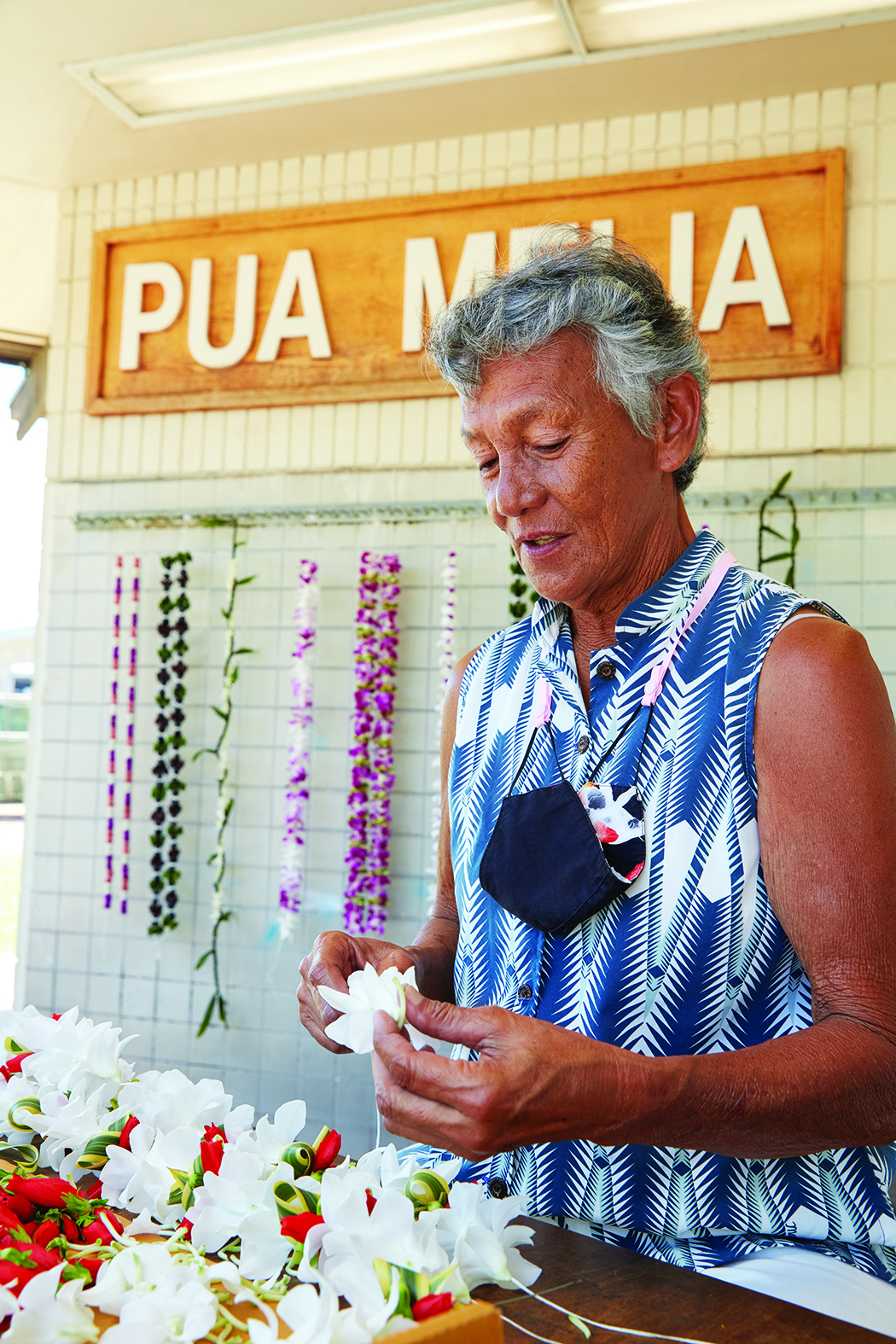
Ku‘ulei Ka‘ae makes and sells lei from Pua Melia, her stand near Daniel K. Inouye International Airport. Ku‘ulei’s family began selling lei four generations ago, beginning with her great-grandparents. The other women selling lei here are also descendants of the original Native Hawaiian airport lei sellers.Ku‘ulei Ka‘ae
A Family Tradition: Love From the Lei-Sellers
“That is what we have to offer in this pandemic — love. I know that when people receive lei, they feel the love we put into them,” says Ku‘ulei Ka‘ae, who makes and sells lei from her stand near Daniel K. Inouye International Airport. “I don’t think a lot of people realize what a lei can do for a person. The type of lei you give is a personal choice. Whether it is pikake, plumeria, ginger, pakalana or double tuberose, the giver must love the flower as it is a symbol and extension of their love for the recipient.”
Ku‘ulei’s family began selling lei four generations ago, beginning with her great-grandparents. They sold in different locations, such as Chinatown and Aloha Tower. Their daughter, Sophia Ventura, Ku‘ulei’s grandmother, had a 1932 Ford truck that her husband equipped with hooks for displaying the lei. She also sold lei at Fort DeRussy — the only lei seller there. She was later invited to set up shop near the access road of the then Aeronautics Aviation Airport.
Ku‘ulei was around 9 when the stands moved to Lagoon Drive in 1963. “My mother and I were the first ones to open our doors in this new building.” In the early 1990s, they were relocated to the concrete building they now occupy.
The women selling lei at this location are descendants of the original Native Hawaiian airport lei sellers. Since Ku‘ulei is the only daughter in her family, her mother gave her Pua Melia, the Airport Lei Stand she operates to this day.
“The only time I ever got a lei growing up was when my mom brought home a plumeria lei for May Day. I wondered, why a plumeria? I asked my mom why I couldn’t have a double carnation lei or pikake. She said, ‘Because the plumeria is the most beautiful flower. One day you will understand.’ The point was, when you get a lei, it is from the heart. It is aloha; it is love. When you are younger, you don’t really understand the depth and meaning.”
“Then when I was in ninth grade, she brought me a double carnation. I was so thrilled! When I went to school, I put it on. I took it off about a half-hour later and gave it to a friend because I realized it didn’t mean anything to me. It wasn’t from my mother’s heart. She only got it for me because I asked for it. Oh how I wished I had that plumeria lei — it meant the world to me! I realized what my mother was saying. The most beautiful lei comes from the heart.”
“I will wear your love as a lei,” Ku‘ulei recited in Hawaiian.”
Hawai‘i’s lei have become revered all over the world for their beauty and fragrance. “Today, many lei or hula practitioners teach the traditional art and practices of lei, continuing to strengthen our heritage through our younger generation, visitors and practitioners abroad so we can wrap a lei of peace and aloha around the entire world,” says Kapono.
Lei Day, May 1, is dedicated to the Hawaiian tradition of making and giving lei. But some may not know the the tradition entails much more than the officially dedicated day. The traditions that surround lei make them appropriate for many occasions. Hawaiian tradition also offers particular lei for celebrations and seasonal events.
According to the book, Preparing Heirs: Five Steps to a Successful Transition of Family Wealth and Values, “60 percent of transition failures were caused by a breakdown of communication and trust within the family unit.” With the aging demographic of baby boomers, the high cost of living in Hawai‘i and the increase in multigenerational homes, the potential influx in trust litigation is foreseeable. Where it is appropriate, I believe that encouraging clients to partake in difficult and potentially messy family discussions about their legacy and explaining “the why” behind their intentions is an integral part of preventing unwanted litigation. It may protect the overall health of the family. When willing clients feel the need for assistance in engaging in family discussions, a mediator may be effective in resolving any family disputes.
I also recommend that clients further solidify their intentions by writing them down as the foundation of their estate plan. Those creating a trust should prepare written guidance as to its underlying intentions. Having a well-defined estate plan will help give you and your family more peace of mind and promote harmony. But please make sure that when you are working with your estate planning attorney that your intentions are clearly defined. It can make all the difference.
According to the book, Preparing Heirs: Five Steps to a Successful Transition of Family Wealth and Values, “60 percent of transition failures were caused by a breakdown of communication and trust within the family unit.” With the aging demographic of baby boomers, the high cost of living in Hawai‘i and the increase in multigenerational homes,…
In the dozen-plus years I have specialized in prosecuting elder financial fraud cases at the Prosecutor’s Office, it has become pretty easy for me to spot and disassemble how the majority of scams work. Like how a master chef can taste a dish and tell you the ingredients he tastes, I can smell a “business opportunity” or a get rich quick scheme and identify the individual parts of it that will reveal it to be an actual scam.
There are always certain ingredients present in a successful con. These elements, or red flags, of a scam can include anything from creating a sense of urgency in the victim, to playing on strong emotions, like fear or joy. The more of these elements present in the con, the more likely the con will be successful.
For example, the lottery scam (where you are told you won a prize but have to pay a fee to collect it or lose it) has a lot of these scam components. First, you are told you won a prize (getting something for nothing and the strong emotion of joy created). You have to keep the winning of the lottery a secret because of “reasons” (secrecy and isolating the victim from seeking advice). You have to pay taxes or a fee very soon before you collect your winnings (create a sense of urgency and the strong emotion of fear of losing your prize). You make a payment, only to be told there are more unexpected payments to be made (fear of losing out on your initial investment — you start chasing your money).
Once you recognize individual components of a deal, it becomes easier to realize when something may be actually a scam as opposed to a deal of a lifetime. The IRS is calling to say you are going to be arrested unless you pay them with a gift card immediately, or you receive a message from someone claiming to be a family member in peril in need of money, aka, the Grandma Scam (sense of urgency, creation of fear and isolating the victim from seeking good advice).
The one main ingredient that all cons seem to share is that the scam artist wants a person to make an emotional decision about money. If you find yourself about to take any action where you are about to give up anything of value and you are doing it in response to a strong emotion, stop, take a breath and see if you can smell any scam ingredients that may be present.
In the dozen-plus years I have specialized in prosecuting elder financial fraud cases at the Prosecutor’s Office, it has become pretty easy for me to spot and disassemble how the majority of scams work. Like how a master chef can taste a dish and tell you the ingredients he tastes, I can smell a “business…
Kingdom Advisors founder Ron Blue takes an interesting approach to estate planning. He advocates lifetime giving as a way to assure that the objects of your bounty are worthy recipients of your wealth. This could play out in a couple of different ways.
Making gifts to your loved ones during your lifetime will enable you to see how your beneficiaries handle newfound wealth. This could be a great way to “test drive” your estate plan and determine how well it works while you are still able to make adjustments. If one beneficiary turns out to be a poor steward of your wealth, you can always direct assets to other beneficiaries upon your death.
The same principles apply to charitable gifts. Your favorite charity could turn out to be a poor manager of donated assets. It would be far better to find that out during your lifetime than to leave your loved ones regretting your philanthropic choices. If a charity does what you hope it will do with your gift, you can add to it upon your death. Not only that, but your gift may have far greater impact the sooner you make it.
As Ron Blue says, you should consider “giving while you’re living so you’re knowing where it’s going.” It’s sound advice for anyone who prefers to test the water before diving in head first.
Making gifts to your loved ones during your lifetime will enable you to see how your beneficiaries handle newfound wealth. This could be a great way to “test drive” your estate plan and determine how well it works while you are still able to make adjustments. If one beneficiary turns out to be a poor…
The COVID-19 pandemic reminded Americans how fragile life is. Applications for life insurance policies in the United States increased 4 percent in 2020, according to the MIB Life Index. If you’re thinking about purchasing life insurance coverage, here’s some basic information to help you make an informed decision.
Why you need it
Death can occur when we least expect it. Life insurance provides financial support for loved ones left behind after a death from illness, accident or natural causes. Dependents or other named beneficiaries receive the proceeds of the policy, which are intended to compensate for lost income.
Clearly, breadwinners should have life insurance to protect those who depend upon their income. But life insurance is also appropriate for others. A child with a life insurance policy is guaranteed coverage into adulthood, regardless of pre-existing health conditions. For families with young children, if a non-income-earning spouse pre-deceases the working spouse, life insurance proceeds can help cover the cost of childcare. Single people without dependents should consider purchasing a policy that covers funeral costs and any outstanding debts, so these responsibilities are not left to family members.
Types of life insurance
There are two main types of life insurance:
• Term life insurance — Term life insurance covers a set period of time, such as 10, 20 or 30 years. If the policyholder dies during the term of the policy, the named beneficiaries receive the death benefit. There is no residual benefit to this type of policy if the term expires and the policyholder is still living. All the money paid over the years of the term belongs to the life insurance company. On the plus side, term policies are less expensive than whole policies. Many workers choose a term policy during their working years to provide income protection to their dependents.
• Whole life insurance — Whole life insurance offers permanent, lifelong coverage. It does not end at a certain age. Once you have a whole life policy, the state of your health does not impact what you pay (whereas with a term policy, if you want to extend your coverage, your health and age determine how much more you pay each month and whether you even qualify for continued coverage). A portion of your whole life premium is invested and grows in a tax-deferred account, managed by the life insurance company, and accumulates what is called “cash value.”
Whole life is more expensive than a term life policy, but the policyholder retains the option to borrow money against the cash value or cash in the policy. High net worth individuals sometimes use this type of policy to offset estate taxes for their heirs. Families with a special needs child may prefer this type of policy for the guaranteed income it can provide. Others simply prefer whole life for the flexibility it offers as both an investment and life insurance product.
Get covered
Life insurance is an important aspect of a comprehensive overall financial plan. Your financial advisor can help you review your life insurance options and select a suitable level of coverage. Buying while you are young and healthy can help you lock in a more affordable rate.
MICHAEL W. K. YEE, CFP,® CFS,® CLTC, CRPC®
1585 Kapiolani Blvd., Ste. 1100, Honolulu, HI 96814 808-952-1222, ext. 1240 | michael.w.yee@ampf.com https://www.ameripriseadvisors.com/michael.w.yee
Michael W. K. Yee, CFP,® CFS,® CLTC, CRPC,® is a Private Wealth Advisor, Certified Financial Planner™ practitioner with Ameriprise Financial Services Inc. in Honolulu, Hawai‘i. He specializes in fee-based financial planning and asset management strategies, and has been in practice for 36 years. Investment products are not federally or FDIC-insured, are not deposits or obligations of, or guaranteed by any financial institution, and involve investment risks including possible loss of principal and fluctuation in value. Investment advisory products and services are made available through Ameriprise Financial Services LLC., a registered investment advisor.
The COVID-19 pandemic reminded Americans how fragile life is. Applications for life insurance policies in the United States increased 4 percent in 2020, according to the MIB Life Index. If you’re thinking about purchasing life insurance coverage, here’s some basic information to help you make an informed decision.
Turning 65? Congratulations! You are now eligible for Medicare! But what do you do next? Firstly, it’s important to know that your Initial Enrollment Period or IEP begins three months before you turn 65 and ends three months after your 65th birthday. Secondly, you aren’t required to sign up for Medicare. However, if you enroll after your IEP, a Late Enrollment Penalty will be added to your monthly premiums for life. Lastly, you must sign up for Medicare with the Social Security Administration (SSA), a Hawaii SHIP (State Health Insurance Assistance Program) partner. SSA.gov provides instructions on how to enroll online for Original Medicare Part A (hospital insurance) and Part B (medical insurance). {Play}
Once you’ve enrolled, contact the Department of Health, Hawaii SHIP to schedule a one-on-one counseling session to find the best plan option that meets your healthcare needs. Our Medicare-certified counselors will walk you through your IEP. They will explain Parts A through D, the differences between Original Medicare and Medicare Advantage and how to avoid late enrollment penalties. You may also learn that you qualify for financial assistance to pay prescription drug costs, premiums, co-payments and coinsurances. Best of all, the service is free, unbiased and confidential.
HAWAII SHIP
Free, local, one-on-one Medicare counseling provided by the Hawai‘i State Health Insurance Assistance Program.
250 South Hotel St., Ste. 406, Honolulu, HI 96813
Oahu: 808-586-7299 | Toll free: 888-875-9229 www.hawaiiship.org
Turning 65? Congratulations! You are now eligible for Medicare! But what do you do next? Firstly, it’s important to know that your Initial Enrollment Period or IEP begins three months before you turn 65 and ends three months after your 65th birthday. Secondly, you aren’t required to sign up for Medicare.
The Social Security Administration’s Advance Designation program allows you to pre-select a trusted individual if a time comes when you need a representative payee to help manage your money. Advance Designation enables you to identify up to three people, in priority order, who you would like to serve as your potential representative payee.
SSA recently celebrated the one-year anniversary of its Advanced Designation program. Since its launch in March 2020, more than one million eligible individuals have opted to participate.
You may choose an Advance Designation if you are capable of making your own decisions and are:
• An adult or emancipated minor applying for benefits and do not have a representative payee.
• An adult or emancipated minor beneficiary/recipient and do not have a representative payee.
You can submit your Advance Designation information when you:
• File a claim for benefits online at www.ssa.gov/benefits.
• Use the application available in your personal my SSA account at www.ssa.gov/myaccount.
• Call SSA directly.
In the event that you can no longer make your own decisions, you and your family will have peace of mind knowing you already chose someone you trust to manage your benefits.
The Social Security Administration’s Advance Designation program allows you to pre-select a trusted individual if a time comes when you need a representative payee to help manage your money. Advance Designation enables you to identify up to three people, in priority order, who you would like to serve as your potential representative payee.
The Benefits Enrollment Center program helps low-income kūpuna 65-plus and disabled Medicare beneficiaries to access food benefits.
At the onset of the COVID-19 pandemic, kūpuna were encouraged to stay home and self-isolate. Dining in restaurants or grocery shopping became difficult for all of us, but particularly for seniors who were most vulnerable. The Kupuna Food Security Coalition was formed to address the nutritional needs of seniors. Community organizations stepped up to provide emergency meals and grocery buying assistance.
Over a year later, some of the temporary emergency meal programs have ended and the focus has turned to long-term food security solutions. The Supplemental Nutrition Assistance Program (SNAP) can help seniors stretch their dollars and give them access to nutritious food.
The Benefits Enrollment Center (BEC) assists Medicare recipients in applying for SNAP and other benefits. The BEC team can help with eligibility guidelines, applications, information gathering and follow-up services to ensure that they have access to the benefits they are eligible for.
CATHOLIC CHARITIES HAWAI‘I (501(c) 3 nonprofit)
1822 Keeaumoku St., Honolulu, HI 96822 808-527-4777 | peter.reyes@catholiccharitieshawaii.org www.CatholicCharitiesHawaii.org
The Benefits Enrollment Center program of Catholic Charities Hawai‘i is made possible through grants from the National Council on Aging (NCOA) and the Walmart Foundation. Medicare recipients can contact the Benefit Enrollment Center at 808-527-4777 to learn more.
The Benefits Enrollment Center program helps low-income kūpuna 65-plus and disabled Medicare beneficiaries to access food benefits. At the onset of the COVID-19 pandemic, kūpuna were encouraged to stay home and self-isolate. Dining in restaurants or grocery shopping became difficult for all of us, but particularly for seniors who were most vulnerable.
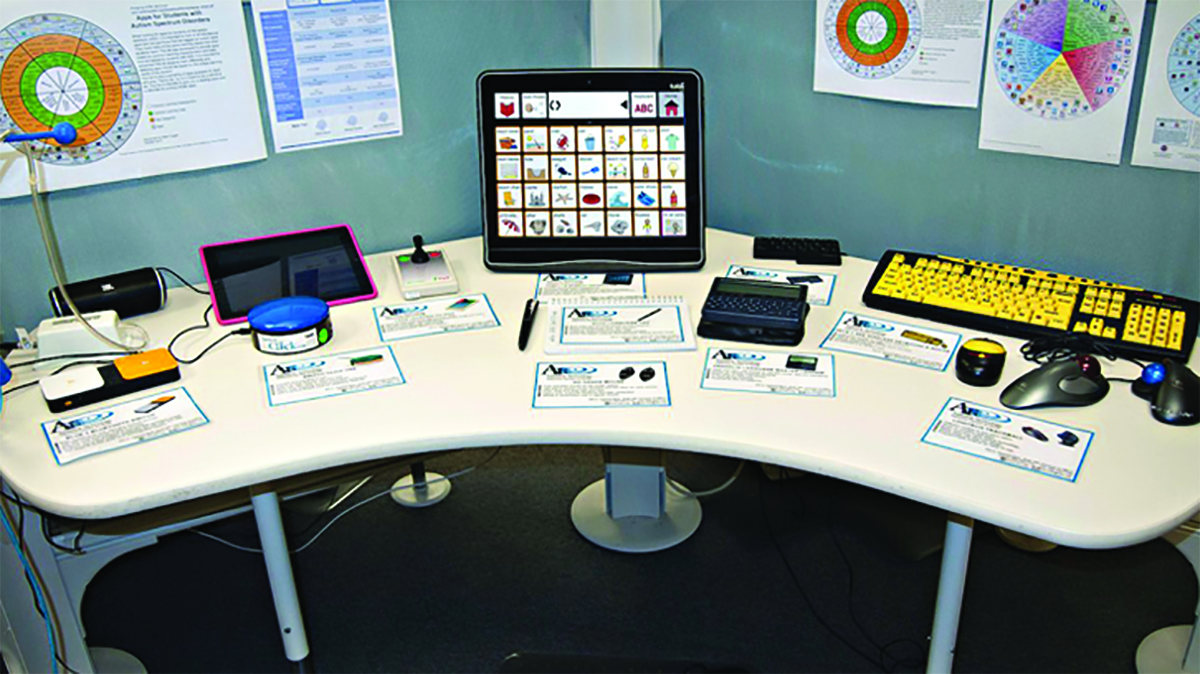
Assistive Technology Resource Centers of Hawai‘i (ATRC) is a nonprofit resource center that provides information about assistive technology (AT) to persons with disabilities, as well as their family members, employers and educators. Its mission is to link people with AT and empower individuals through its use.
As Hawai‘i’s designated Assistive Technology Act agency since 1991, ATRC provides technical assistance throughout the state to ensure persons with disabilities can get what they need. ATRC services include assessment, training, program information, public awareness programs, technical assistance, rehabilitation technology services, financial loans and more. ATRC reps also speak to organizations and demonstrate technology.
ATRC is providing limited access during the pandemic. Remote assessment, training, learning groups (peer), professional learning opportunities, information and referrals are still available.
ASSISTIVE TECHNOLOGY RESOURCE CENTERS OF HAWAII (501(c) 3 nonprofit) 808-532-7110 | barbara@atrc.org www.atrc.org
ATRC does not sell products, but recommends vendors. Device demonstration and lending programs give individuals and groups the opportunity to make an informed choice about an AT device prior to acquiring one.
Assistive Technology Resource Centers of Hawai‘i (ATRC) is a nonprofit resource center that provides information about assistive technology (AT) to persons with disabilities, as well as their family members, employers and educators. Its mission is to link people with AT and empower individuals through its use.

 As an adult daughter, do you ever feel like a little girl when conversations with your mother end in misfires, teary rants or silence? You’re not alone — it happens this way for 43.5 percent of us. However, there’s hope. By using ASK Presetting, you can stop walking on eggshells.