Just like it’s important to maintain your physical health by adopting an in-home exercise regime, it is important to maintain your mental health by engaging in challenging activities that promote cognitive function. Changes in cognitive function are a natural part of aging. With time, your brain loses agility and can deteriorate further if you don’t take steps to maintain it. The changes are complex and varied. But aging doesn’t have to mean an inevitable decline as individual factors like genetics, health and lifestyle come into play.
According to the Alzheimer’s Association, Alzheimer’s is the most common cause of dementia and accounts for 60 to 80% of dementia cases. Cases will almost double every 20 years. Due to the disease’s progressive nature, dementia symptoms gradually worsen over several years. Early signs of Alzheimer’s can include a decline in processing speed, working memory and long-term memory.
Although there is no cure, there are many activities that may help reduce the risk and support cognitive health in older adults. While they should not be seen as sole preventative measures, research has demonstrated that several lifestyle modifications and even participating in games and activities may lower your risk of cognitive decline to help keep your brain as healthy as possible as you age. Research has shown that activities that provide social engagement are the best in terms of boosting cognitive function.
Variety is Key
Taking proactive steps like maintaining a physically active lifestyle and engaging socially with others can significantly influence your cognitive well-being throughout life and may prevent the onset of symptoms of Alzheimer’s, according to the Alzheimer’s Association. Whether you are trying to retain or increase cognitive function, it is also important to remember that variety is key. Engaging in an interactive and diverse range of activities is vital to challenging different areas of the brain. Finding activities you enjoy and can stick with also allows you to form and maintain healthier and sustainable habits.
“To keep your mind active, it is important to seek out stimulating activities that expose your mind to new topics,” says Ivy. “When these activities include loved ones—friends, grandchildren, neighbors and other community members—there’s the added benefit of social engagement, which is associated with reduced rates of disability and mortality, and may also reduce the risk for depression.”
Activities and Apps
The following offer fun and engaging ways for families and grandchildren to train their brains together with their grandparents:
A person solving a sudoku puzzle
WORDLE is a word puzzle that gives players six tries to guess a five letter word. Each guess gives you color coded clues: green for correct letters in the right spot, yellow for correct ones in the wrong spot, and gray for ones not in the word at all. You use this feedback to strategize your next guesses. There’s a secret word each day, so everyone around the world is trying to guess the same one! Wordle is recommended for ages 14 and up, but statistically, older adults are the best Wordle players, with an average win percentage of 81%.
Wordle promotes working memory, logic and reasoning, vocabulary building and concentration— all things that help increase cognitive function. The Wordle Together function enables you to play with friends and family. There are different versions of Wordle available online and in app stores, all of which are free; many players prefer The New York Times Wordle.
SUDOKU is a brainteaser played on a grid. The goal is to fill the squares with numbers 1 through 9, ensuring no row, column or subgrid contains a duplicate number. It requires logical deduction.
Regular Sudoku practice can benefit your cognitive function because it strengthens working memory by keeping track of potential placements, and improves logic and reasoning as you analyze the grid and make deductions.
Usdoku lets multiple players play sudoku on the same board with their own devices simultaneously. Once you select the difficulty level, you take turns making moves on the grid. Sudoku and Usdoku challenge your brain and keep your cognitive skills sharp. Find free Sudoku and Usdoku online or purchase the puzzle books on Amazon or at your local bookstore.
LIFE STORY INTERVIEW KIT is a 150-question card deck created to help capture and preserve your stories or those of your loved ones. The conversation-based card game’s questions/prompts are categorized by early life, midlife, and later life and reflection, sparking recollections of past experiences. It is a fun way to preserve memories, spend quality time with your loved ones, deepen your connection with them, and learn new things about them. Although maintaining brain fitness through challenging activities is important, activities that prompt human connection and interaction are best—no matter the age.
The Life Story Interview Kit and similar card kits can be purchased on Amazon. Downloadable apps are also available, some of which are free.
LUMOSITY is a popular, free brain training app designed to target and improve various cognitive skills. It offers a variety of games and activities that challenge memory, attention span, processing speed, flexibility and problem-solving.
Lumosity promotes cognitive function in several ways. By regularly performing these targeted exercises, you can strengthen your working memory, improve your ability to focus and filter out distractions, and enhance your mental agility by tackling the game’ challenges.
Non-apps
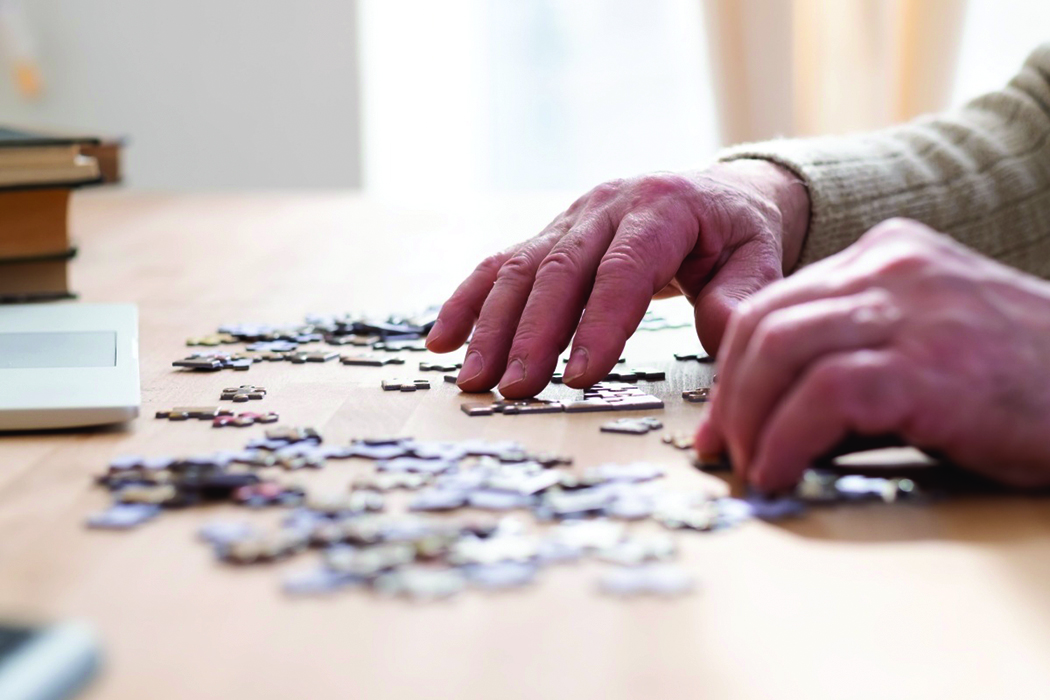
Legos, puzzles, board games and word searches are also activities younger children and grandparents who don’t have or want access to electronic devices can participate in together.
Whatever game, activity or app you choose to enhance cognitive health, remember that “Remaining socially active supports brain health and may possibly delay the onset of dementia,” says Ivy.
Just like it’s important to maintain your physical health by adopting an in-home exercise regime, it is important to maintain your mental health by engaging in challenging activities that promote cognitive function. Changes in cognitive function are a natural part of aging. With time, your brain loses agility and can deteriorate further if you don’t…
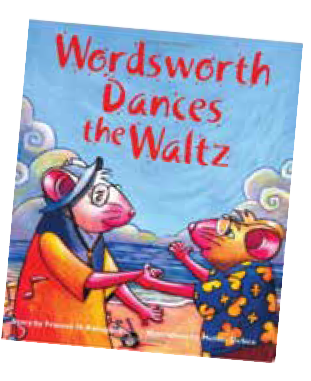
Frances H. Kakugawa, a Hawai‘i Island native, began writing poetry a half-century ago, then stopped for some years to work for the public school system. But when she became the primary caregiver for her mother, she found that writing poetry helped ease her stress.
Her multiple award-winning 2007 children’s book, Wordsworth Dances the Waltz, is dedicated to her mother, who was afflicted with Alzheimer’s disease. It is about families living with elders impacted by dementia. In this book, children are introduced to the concept that as grandparents age, they may behave differently and sometimes forget things.
The book illustrates aspects of dementia and how the disease affects the entire family through Wordsworth, a Hawaiian mouse, who remembers a time when he and Grandma danced around the room. But now, Wordsworth must walk softly as not to disturb her.
Because Wordsworth loves poetry, he finds comfort in writing verses that express his confusion over his grandma’s changing behaviors, and by recalling memories of more vibrant days. His poems also help his family understand that Grandma is still his loving grandparent and an important part of the family.
If you are looking for an excellent tool to ease fears and explain changes in an elder loved one’s behavior, this book may be helpful.
The book is illustrated by Melissa DeSica and available through Amazon. Call your nearest bookstore to purchase a copy locally. For children 9 and older.
Frances H. Kakugawa, a Hawai‘i Island native, began writing poetry a half-century ago, then stopped for some years to work for the public school system. But when she became the primary caregiver for her mother, she found that writing poetry helped ease her stress.
If your pet is healthy, is pet insurance still necessary? The American Veterinary Association suggests pet insurance to defray costs, which can be around $250 for a simple treatment to over $8,000 if the condition is more serious. The over 85 million pet households in the US spend a whopping $75 billion on pet care annually.
During the summer months, one of the biggest dangers for dogs is heat. They don’t sweat like humans and can suffer from heatstroke. Signs to look for are fatigue and loss of appetite. In addition, seeds found in grassy areas during the summer can cause skin problems, such as hives or rashes. If your pet can’t stop scratching, the area can become tender and an infection can set in, making matters worse, so it’s important to keep ticks and fleas under control, too.
A recent PetMD article notes that a new medication for canines with osteoarthritis is available. Without insurance, a course of treatment can cost around $100 monthly.
So do your homework regarding your particular furry or feathered friend. Closely review insurance coverage details for limitations and exclusions.
Always check with your veterinarian about insurance options in order to provide a financial safety net for your beloved family member.
If your pet is healthy, is pet insurance still necessary? The American Veterinary Association suggests pet insurance to defray costs, which can be around $250 for a simple treatment to over $8,000 if the condition is more serious. The over 85 million pet households in the US spend a whopping $75 billion on pet care…
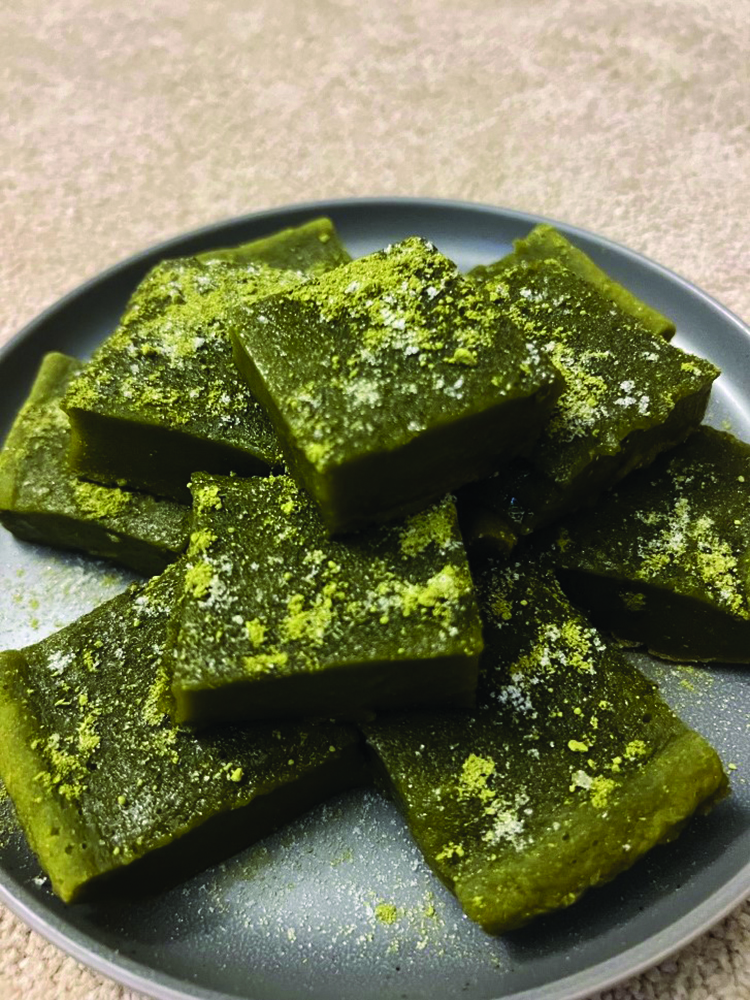
Matcha is a powdered green tea that is rich in antioxidant compounds due to its special cultivation method. Traditionally, the tea bushes are covered with bamboo mats to shade the leaves from direct sunlight, therefore producing higher amounts of amino acids, chlorophyll and theanine. Matcha is known for its vibrant color and unique, bitter taste. Matcha is low-calorie and fat-free. Compared to other green teas, matcha is relatively high in caffeine.
Consumption of matcha green tea is regarded as an effective dietary intervention to promote cognitive function. Studies also suggest that it has cardioprotective effects. Matcha green tea may also aid in lowering blood glucose levels.
Try this matcha mochi recipe:
Ingredients:
1 box (16 oz.) mochiko flour
2 cups white granulated sugar
1 tsp baking powder
4 Tbsp matcha powder (ceremonial grade)
1 can (12 oz.) coconut milk
1 tsp pure vanilla extract
2 cups water
Directions
1) Preheat a conventional oven to 350 degrees.
2) Thoroughly coat a 9-by-13-inch pan with avocado oil spray or just line the pan with parchment paper instead.
3) In a mixing bowl, add the mochiko flour, sugar, baking powder and matcha powder, then blend well.
4) In another mixing bowl, whisk the coconut milk, vanilla extract and water together.
5) In the dry ingredients bowl, make a gaping hole in the middle of the ingredients. Pour the liquid ingredients in the hole, then incorporate everything together with a spoon spatula. Whisk well until smooth, then pour the batter into the well-greased pan.
6) Cover securely with foil.
7) Bake for one hour.
8) When done, a toothpick inserted into the mochi should exit dry with few to no crumbs.
9) Let mochi cool completely.
Optional: Sprinkle the mochi lightly with matcha powder for enhanced matcha flavor. Cut with a plastic knife when ready to serve. (Yield: 24 squares)
Do you have a favorite recipe and story to share? For consideration in the next issue, include a photo and mail them to Generations Recipe, PO Box 4213, Honolulu, HI 96812, or email them to Cynthia@generations808.com.
Matcha is a powdered green tea that is rich in antioxidant compounds due to its special cultivation method. Traditionally, the tea bushes are covered with bamboo mats to shade the leaves from direct sunlight, therefore producing higher amounts of amino acids, chlorophyll and theanine. Matcha is known for its vibrant color and unique, bitter taste.…
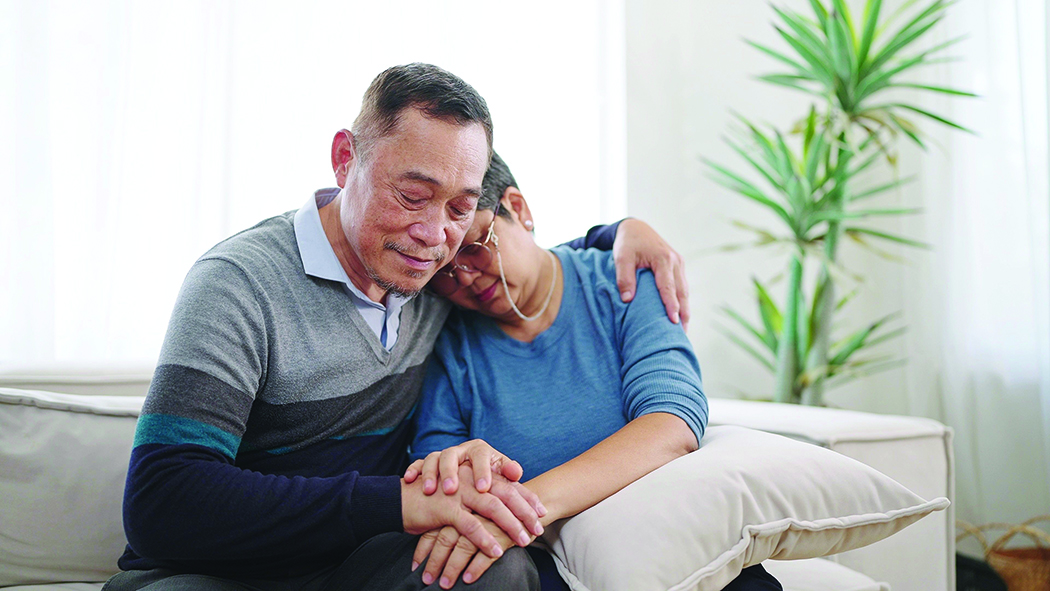
As a society, we have faced much grief over the last few years. When in the mode of navigating care for ourselves or others, we often run into misconceptions about what we should or shouldn’t do.
Often, the confusing part is actually clarifying the differences between empathy and sympathy. An online search reveals that “Empathy involves feeling what someone else feels, while sympathy doesn’t. Sympathy, instead, involves understanding someone else’s emotions, but from your own perspective.” Both are beautiful and healing for different reasons.
But there is a raw beauty in empathy. It’s not about us trying to relate from our own lens, but rather, by stepping into the space or fear with the other person, hearing where they are coming from and connecting to that.
When stepping into other’s grief or brokenness, it’s tempting to try to be optimistic and uplifting, and to start problem-solving. But what most of us need in times of sadness or grief is to feel heard, feel love and feel we are not alone. The gift of connection is healing.
Check out professor, author and podcast host Brené Brown’s “Empathy vs Sympathy and the Power of Connection” on YouTube.
As a society, we have faced much grief over the last few years. When in the mode of navigating care for ourselves or others, we often run into misconceptions about what we should or shouldn’t do.
Most customers read online reviews before purchasing a product or service. But when was the last time you wrote one? Remember, when you write a review, you are helping others and yourself.
Expressing your gratitude for good experiences or sharing constructive feedback about less-than-stellar experiences both contribute to a company’s online reputation. Writing an authentic and constructive review about a brand’s products or services educates other consumers and alerts the business about any issues with your purchase.
Don’t use reviews for revenge. Instead, focus on productive ways to address shortcomings. Complaint processes like those used at the Better Business Bureau encourage positive change.
Where Should You Write a Review?
BBB reviews go through a verification process. Businesses are always encouraged to respond, which helps paint a more balanced picture. When you read or write a BBB review, know that it’s hosted on a platform committed to authenticity and responsiveness.
Your voice matters, so share your experiences and help others by contributing to a better shopping environment for everyone.
Most customers read online reviews before purchasing a product or service. But when was the last time you wrote one? Remember, when you write a review, you are helping others and yourself.
It has been nearly a year since wildfires fueled by powerful winds from Hurricane Dora destroyed the town of Lahaina and parts of Kula. The wildfire that killed at least 101 people is the deadliest in the US in more than a century, and the most lethal natural disaster to occur in Hawai‘i since statehood in 1959.
The Lahaina fire has caused extensive damage and significant financial losses. The fire affected 2,719 structures in the area—86% of them residential, leaving thousands displaced. The estimated cost to rebuild Lahaina is $5.52 billion.
It makes sense that studies, assessments, evaluations, action plans, advisory committees, and planning boards mindful of history and culture will all be required to tackle the complex, monumental task of reconstructing an entire town.
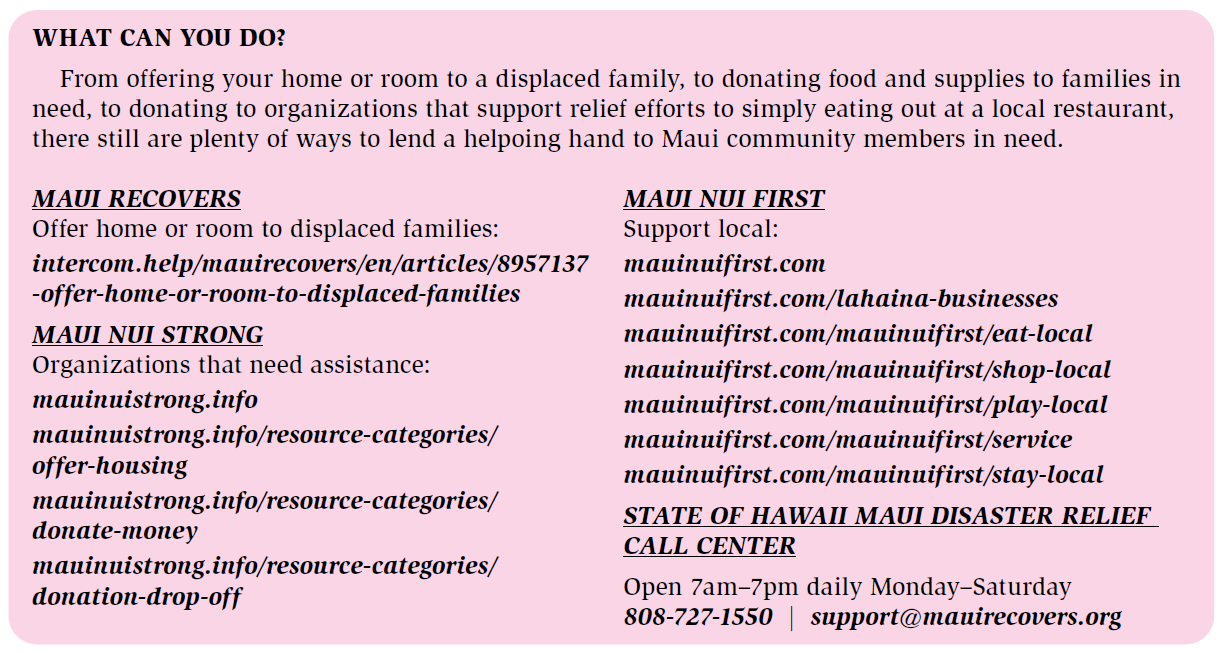
But what can one person do that would have a positive impact in the aftermath of such devastation? Plenty. There are still many opportunities to lend a hand or open your pocketbook to those in need and help with the expiation of this disaster and the mitigation of future occurrences. Mālama Kula
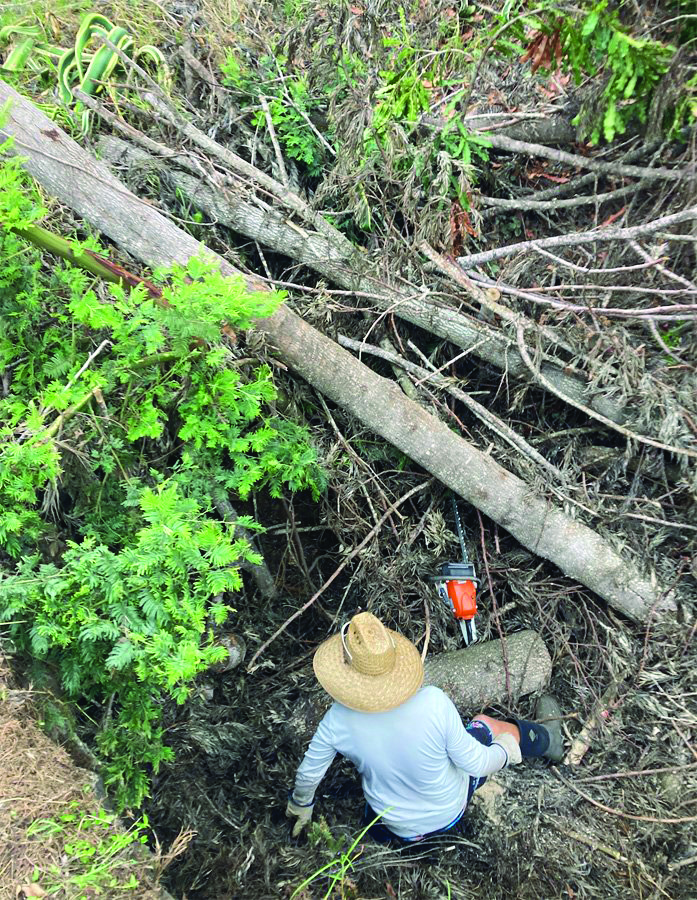
In Kula, Kyle Ellison, who nearly lost his own home to the Upcountry fire, has emerged as a changemaker in his community. A big eucalyptus tree was blown down and fell on some power lines, which started a fire in the gulch near his home. While much of the focus has understandably been on Lahaina, sparks from the August fires were still flaring in Kula months later. Despite his own plight, or maybe because of it, he continues his battle on the front lines.
Kyle founded Mālama Kula, an action-oriented, results-driven nonprofit organization, in order to provide disaster relief in response to the Kula fire, but he also aims to address many other challenges facing his community.
Based in Kula, Mālama Kula helps provide programs, funding and services for community cleanup, and disaster relief and mitigation.
“From day one of the Kula fire, our team had boots on the ground and rallied to help serve our neighbors,” says Kyle. “People donated whatever they had and rose up to help at a time when the community needed them most. During the Kula fire, we all became firefighters.”
Twenty Kula homes were lost, Kyle says. In the days that followed, Kula residents rallied and gathered by the hundreds, helping to save properties and homes, and coming to the aid of neighbors, family and strangers dealing with what was left… and what was lost.
“The Kula community is not going to wait until the next time we hear the crackling of burning trees 200 yards behind our houses to suddenly start thinking it’s time to do something,” says Kyle. “We need to make the changes now and take action to prevent what is threatening us. That is my mission and commitment. We’re not going to wait around for studies or a grant or the government. Instead, we will get up, put our boots on and go out and fix the problem ourselves. That has really been the silver lining in all of this—that the community has really banded together to fix our own problems and take care of ourselves.”
Thanks to the ensuing Kona storms, the fires were finally doused, but the heavy rains brought their own set of problems. Without proper vegetation and watersheds, the rains caused landslides, rockslides and erosion hazards, with debris-tainted runoff flowing into gulches and eventually into the ocean via Kealia Pond and Ma‘alaea Bay.
“We are scattering wood chips from the downed trees on the burn zones to mitigate erosion and help the soil retain moisture,” says Kyle. “We also are working with the Kula Community Watershed Alliance to replant with native vegetation before invasive species can reestablish themselves. We’re turning back the hands of time by planting things that will create a thriving native watershed and keep moisture in the ground.”
They are also working to establish an Upcountry green waste facility, clearing fire fuel from gulches and pushing for better infrastructure.
Kyle has created tools, solutions and a structure for success. So roll up your sleeves and get out your wallet—there is still much we all can do.
“Show up with a chainsaw or your checkbook. Either means we are going to get work done.” Get updates on workdays via email or Instagram.
MĀLAMA KULA (nonprofit)
A program of Ka ‘Ike Mau Loa O Ke Kai Hohonu
PO Box 1134, Kula, HI 96790 MalamaKula.org | malamakula@gmail.com
instagram.com/malamakula
It has been nearly a year since wildfires fueled by powerful winds from Hurricane Dora destroyed the town of Lahaina and parts of Kula. The wildfire that killed at least 101 people is the deadliest in the US in more than a century, and the most lethal natural disaster to occur in Hawai‘i since statehood…
My mother and father lived to 92 and 94, respectively, and as the years passed, it was sometimes difficult to choose gifts for them, so I had to be creative. For Mother’s Day and Father’s Day, I want to share some special gift ideas for seniors like my parents.
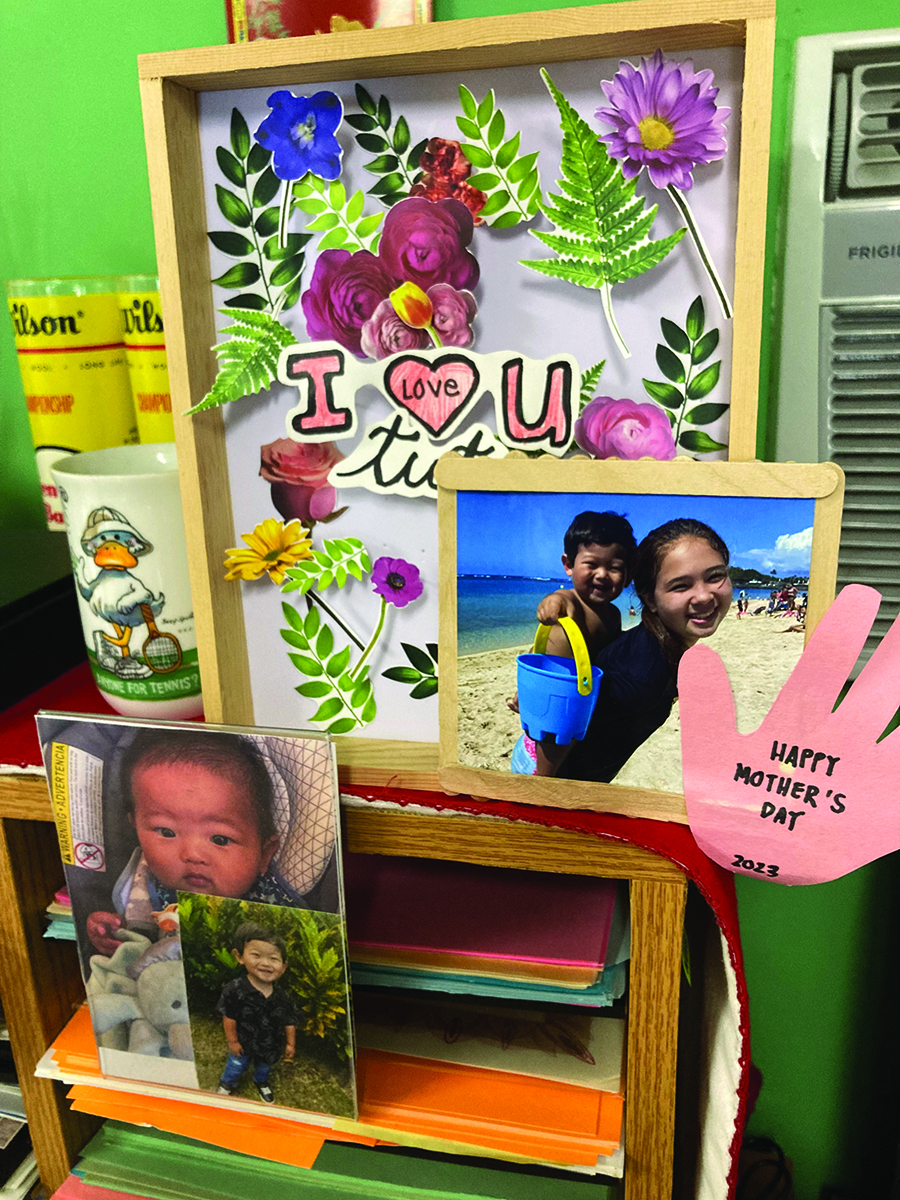
Our smart phones are capable of storing thousands of photos, but scrolling through the memories brings us only fleeting satisfaction. How about a printed photo of the grandchildren in a special frame, on a mug, a key chain or even a blanket? Handmade cards with pictures could be placed on a table, shelf or dresser; many of mine are in my home office and I look at them often.
I have heard that digital photo frames are also a great way to share multiple photos and videos, which can be loaded and updated remotely. This is a perfect gift for parents who are far away.
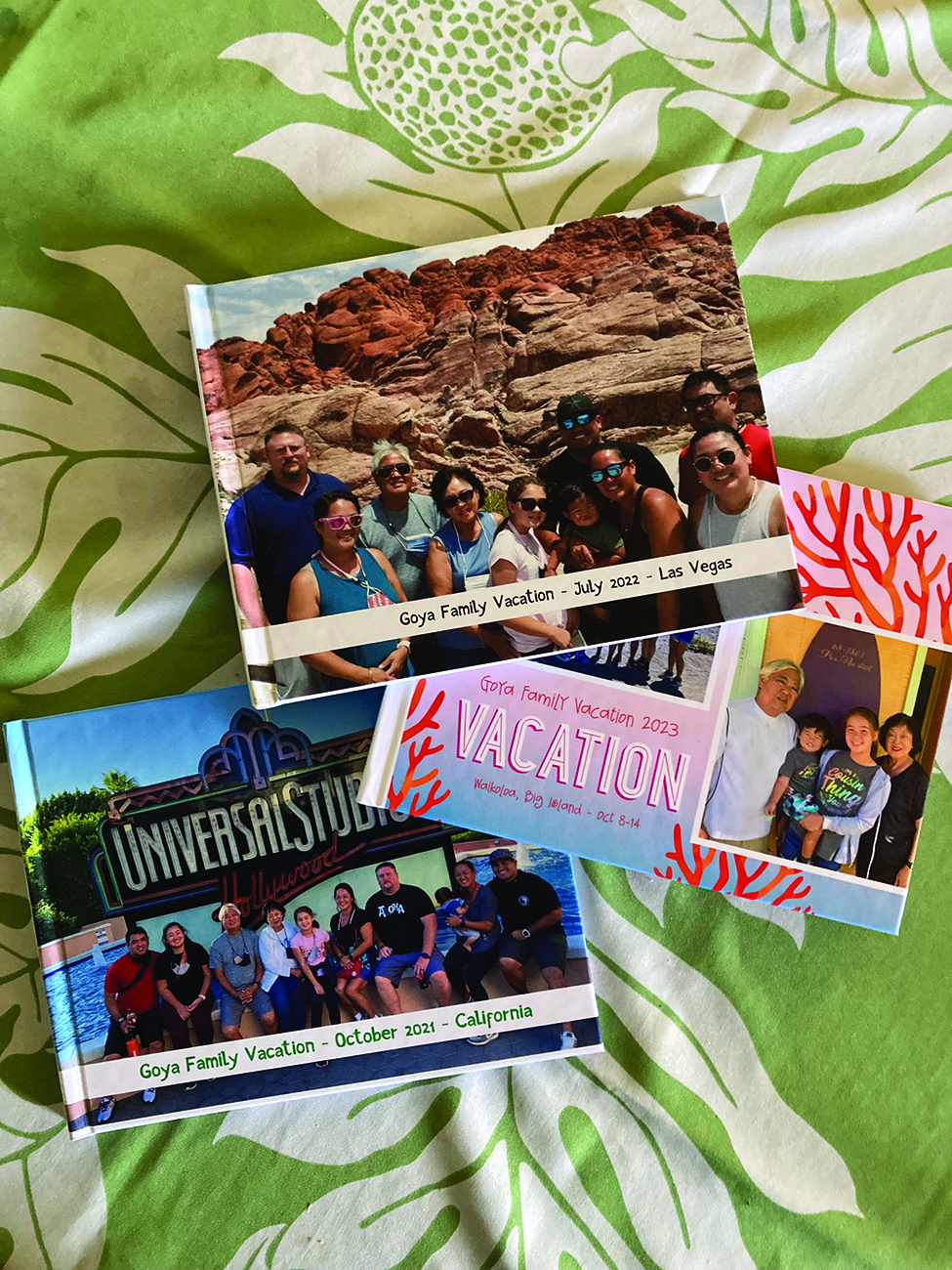
Some of the best gifts I have received are professionally bounded books of photos of our family vacations, given to me by my daughter. Everyone in our family enjoys reminiscing about the good times we had as they pore over these books filled with photos, funny captions, stories and very precious memories.
If you have a story you’d like to share or know of someone celebrating their centenarian year, contact Sherry Goya at 808-722-8487 or email sgoyallc@aol.com.
My mother and father lived to 92 and 94, respectively, and as the years passed, it was sometimes difficult to choose gifts for them, so I had to be creative. For Mother’s Day and Father’s Day, I want to share some special gift ideas for seniors like my parents.
A fireproof safe may not be 100% effective, as evidenced during Maui’s wildfires last year. In parts of Lahaina, the heat was so intense that safes were found melted.
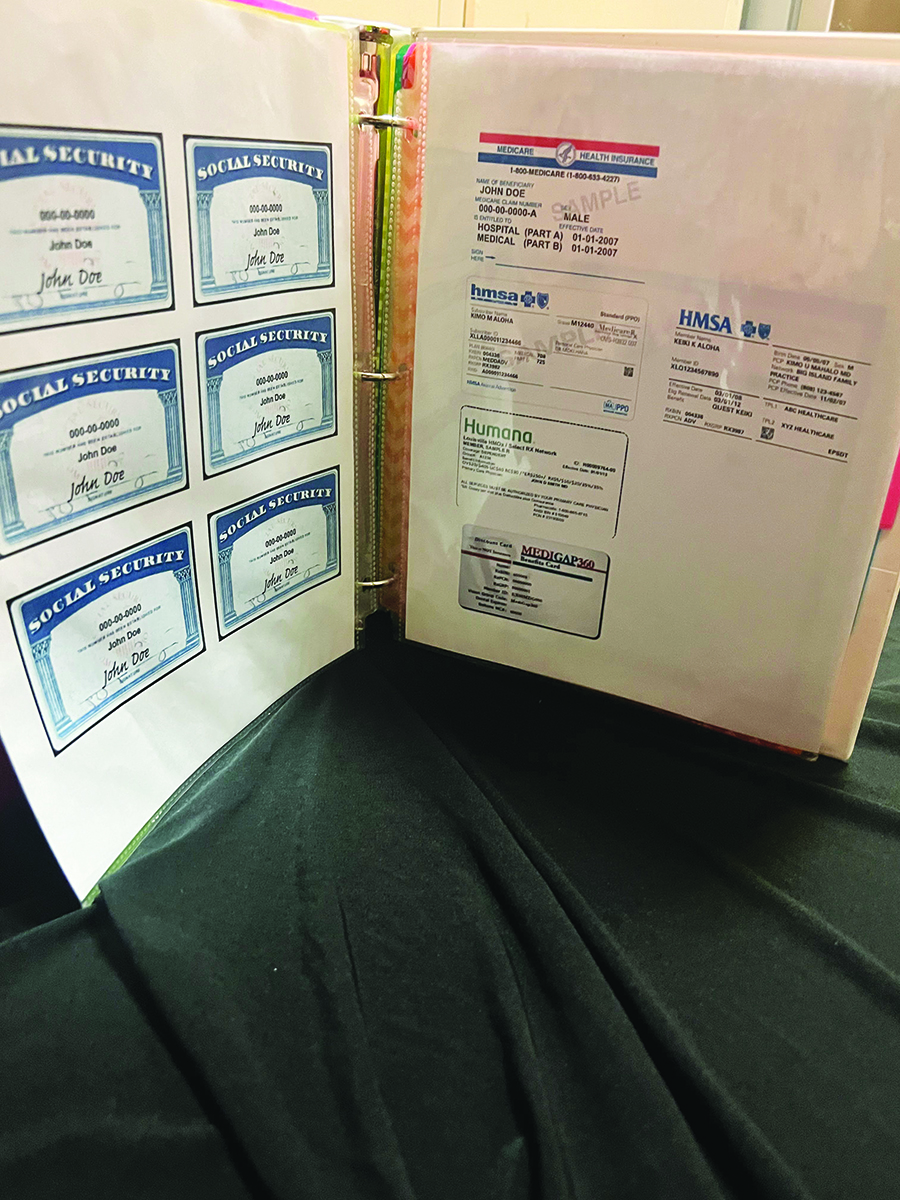
The Moloka‘i Public Health Nursing staff worked with the Kupuna Care Program and the community to create the Book of Life or Nā Palapala Ko‘iko‘i, a portable organizational binder for important documents. The binders, sheet protectors and cardholders were distributed to 200 senior families during a senior baseball tournament on Maui just before the fire. But families who weren’t prepared lost everything, including vital documents.
Families can better expedite services for their kūpuna who have all their important documents in one place. Therefore, the Moloka‘i Public Health Nursing staff encourages the public to use the Nā Palapala Ko‘iko‘i binder, or an accordion folder or a bag to hold important documents that is kept in an easily accessible location.
It is highly recommended that everyone start a similar portable binder in which to keep important documents. Documents can include but are not limited to legal, tax, medical and insurance records. This grab-and-go binder could be invaluable in lessening the stress during an emergency that forces you to flee from your home quickly.
DEPARTMENT OF HEALTH
Moloka‘i Public Health Nursing
P.O. Box 2007, Kaunakakai, HI 96748 808-553-7882 | F: 808-553-7888
A fireproof safe may not be 100% effective, as evidenced during Maui’s wildfires last year. In parts of Lahaina, the heat was so intense that safes were found melted.
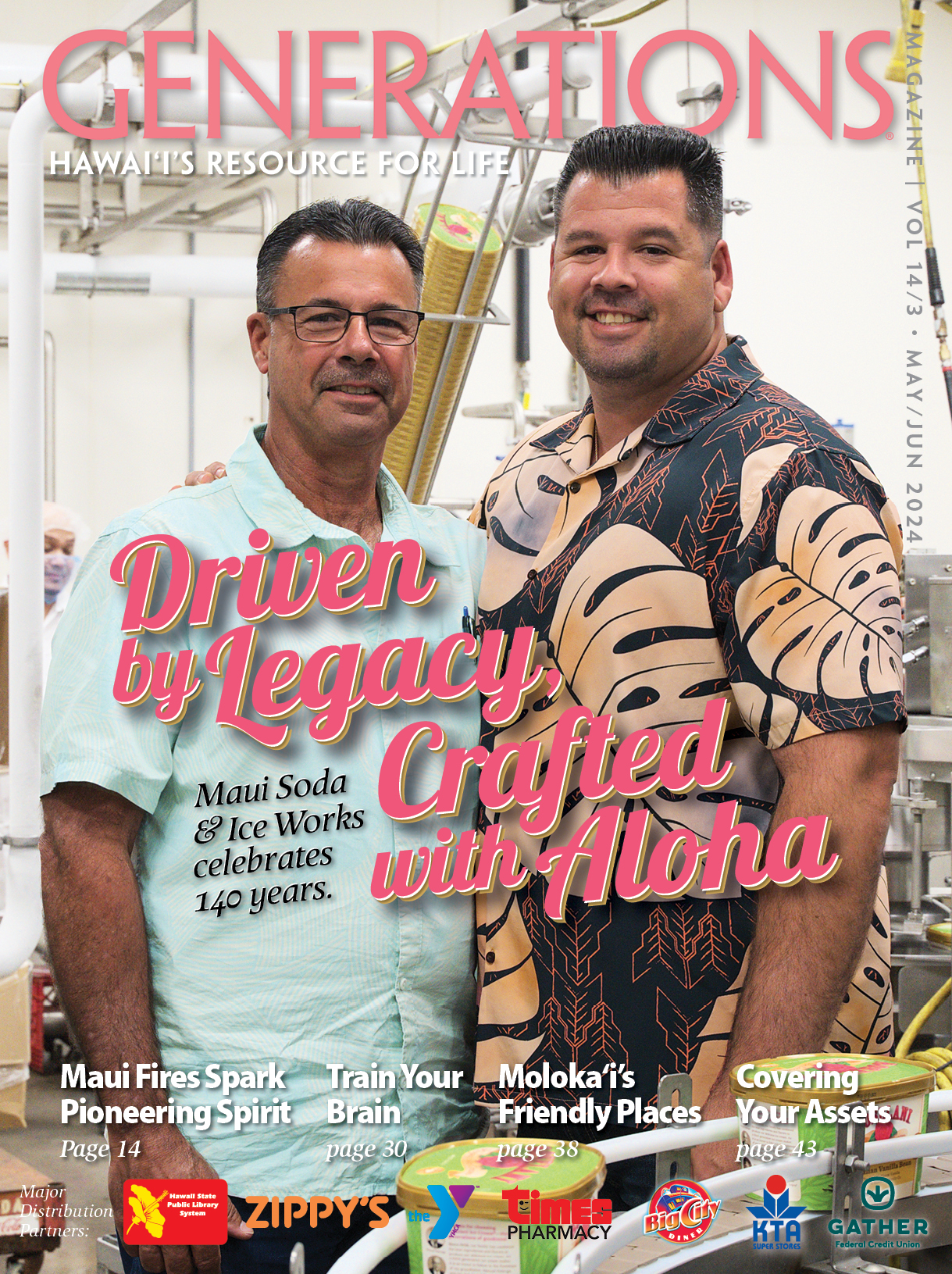
Did Manuel Nobriga know when he began crafting ice cream from scratch at Maui Soda & Ice Works in Wailuku in 1932 that he would be leaving an enduring legacy that would be perpetuated and celebrated for many generations?
Well, as it turns out, Manuel’s ideas, formulas and methods have become the blueprint for a cherished family recipe that would expand to more than 70 flavors over time. “Roselani” was to become a household name on Maui and their family’s delicious dessert would become an integral part of special occasions across the islands for nearly a century. Through four generations of hard work, consistency, integrity and heart, Maui Soda & Ice Works, LTD, remains a truly remarkable family business.
A Rose by Any Other Name
Strolling the frozen food aisle of your local grocer, you can’t miss the iconic, bright pink Lokelani Rose on the carton of Roselani Ice Cream. The Lokelani Rose, or “heavenly rose,” is the official flower of Maui. “Roselani” is the combination of “Lokelani” and “Rose.”
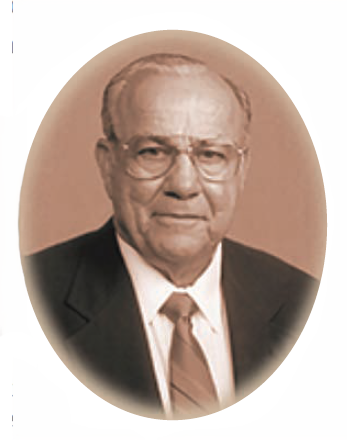
“It honors my grandfather’s and my father’s identity,” said Catherine Nobriga Kim—or Auntie Cathy, as many called her— the late company leader and beloved granddaughter of Manuel, when receiving Honolulu Magazine’s Hale ‘Aina Award.
It remains a premier accolade in Hawai‘i’s food industry and one among many honors this family business holds dear. Cathy, her four brothers and her cousins ran and expanded this division of Maui Soda & Ice Works after her father and respected business pioneer, David “Buddy” Nobriga, retired in 2000.
“A rose is the best you can give for every special occasion,” said Cathy. “It’s the queen of perfection.”
The Nobrigas continue to create their recipe for success through time-honored traditions, quality ingredients, loyal relationships and local revenues.
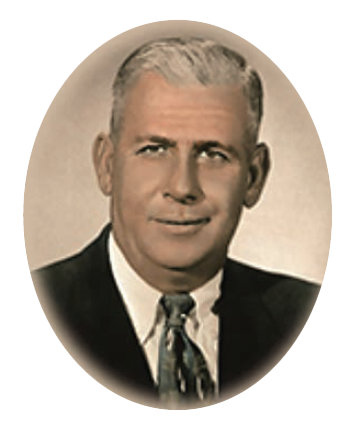
Manuel Nobriga laid the foundation for his family’s legacy
A Family Tradition of Excellence Begins
Loyal fans of this sweet staple will find comfort in knowing this is a true local business, crafted with aloha on Maui, right on Lower Main Street in Wailuku, with radiant ‘Īao Valley as a backdrop. The family has spent millions of dollars on renovations, including a facelift and expansion of the factory and grounds where rice paddies existed over 100 years ago.
The foundation of the business was built with blocks of ice 140 years ago. Iceboxes were our first refrigerators. The blocks of ice that filled them were big business in the tropics. Kahului was the portal through which this revolutionary good was delivered throughout the middle of the Pacific. Maui Soda & Ice Works was birthed from a business model focusing on being the ice company, delivering blocks by horse and cart from what is now Kahului Harbor.
Manuel started working at Maui Soda & Ice Works in 1922, and over the next decade, he would plant the seeds that his family would grow over the next century. Maui Ice Cream leased space at Maui Soda in 1931 when Manuel was working there. Maui Soda & Ice Works bought it the following year.
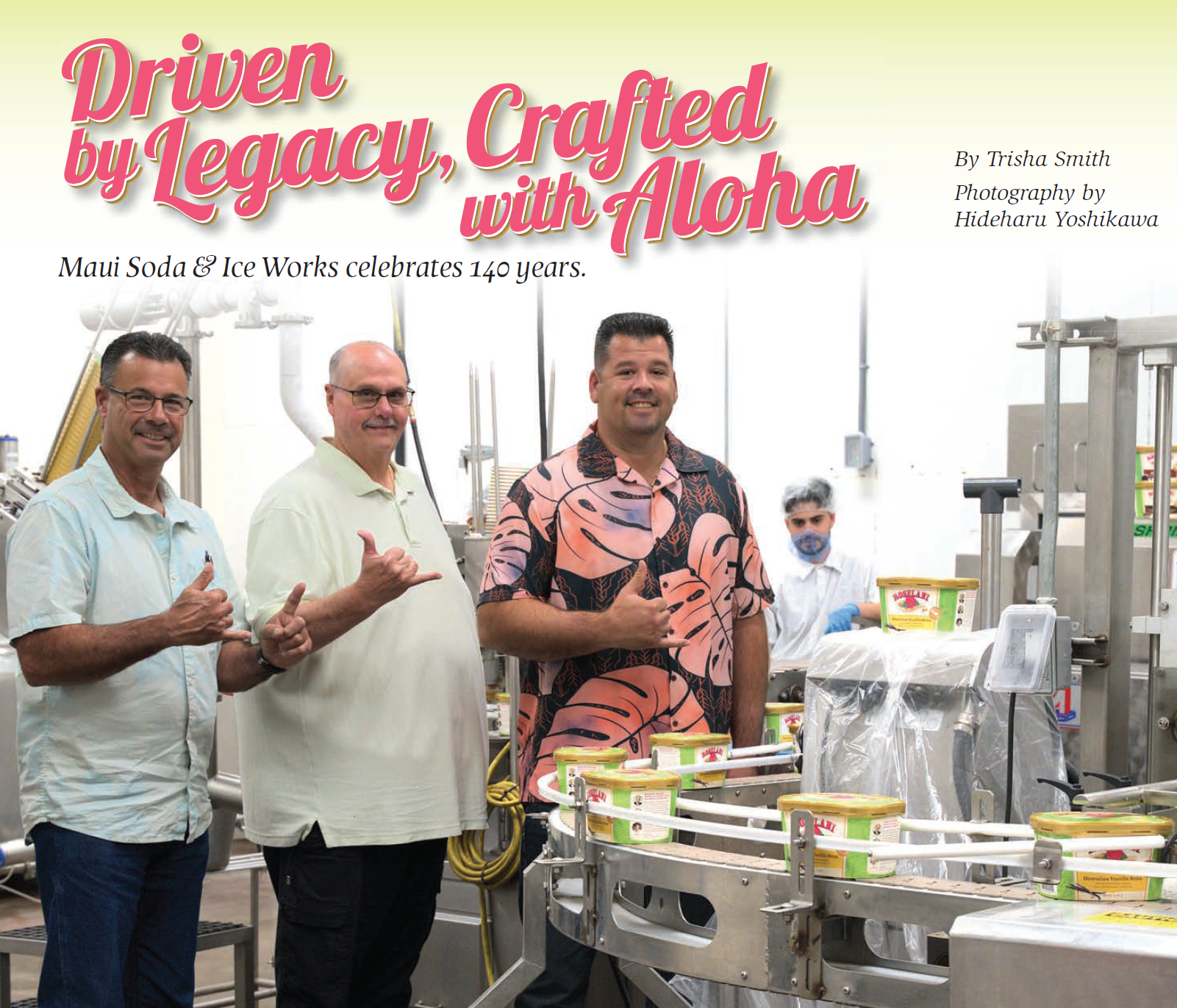
“The Wadsworth family brought refrigeration to Maui and it was a total gamechanger,” says Cathy’s brother, James Nobriga, vice president of distribution and
facilities at Maui Soda & Ice Works.
The Nobriga family acquired the Maui Soda & Ice Works company and property from the revered Wadsworth Family in 1946. The Wailuku headquarters continues to grow successfully under their careful watch.
“We fortunately got their equipment for making ice cream and were able to keep it going,” says James.
David “Buddy” Nobriga expanded business and connected with the community.
Manuel and son David, James and Cathy’s father, researched ice cream and experimented for many years, but it was Auntie Cathy who was known as the Nobriga with the best hand at ice cream making and tastebuds for creating flavors. In 1972, they introduced the Roselani Ice Cream brand name, using the same methods and base recipe Manuel crafted in that facility 40 years prior.
Their commitment to excellence and tradition, along with being in the right place at the right time, has provided tasty opportunities for the Nobrigas.
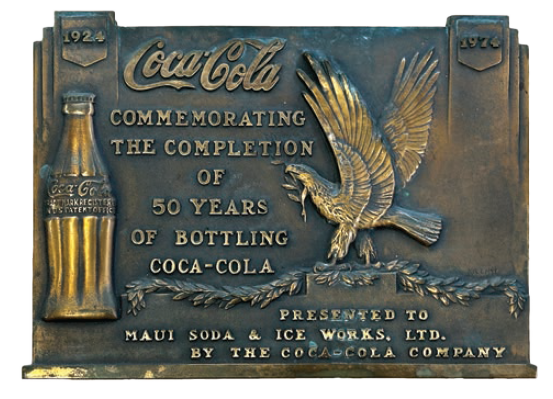
The Maui Soda & Ice Works of today is comprised of three divisions: ready-to-drink beverages, food service beverages and frozen fare. Locally owned and operated since 1884, the company just commemorated 140 years on Maui and a century with Coca-Cola.
The ice cream division is in its 92nd year. Presently, Maui Soda & Ice Works distributes 463 items, including 42 flavors of Roselani’s premium ice cream and sherbet.
Coca-Cola Connection & Centennial
If you have enjoyed a fountain Coca-Cola on Maui, say mahalo to Maui Soda & Ice. But without its relationship to Coca-Cola for the last century, the “Coca-Cola True, Roselani Proud!” company’s ice cream may have not been widely distributed.
Coca-Cola came to town via the harbor during WWI and WWII. Maui Soda & Ice Works was its official bottling manufacturer from 1924 until the end of the 1980s. Since then, the business model with Coca-Cola has been both manufacturing and distribution. The Nobrigas are responsible for keeping the bubbly beverage flowing across Maui.
Inside the facility are display cases full of Coca-Cola artifacts, plaques and ribbons.
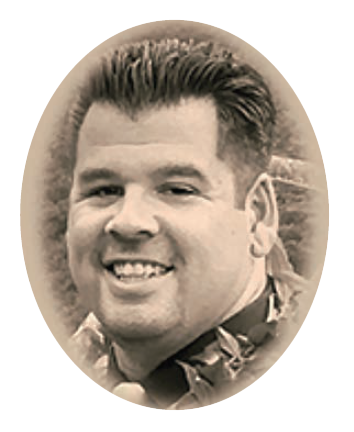
Buddy James Makana Aloha Nobriga, aka, “Buddy,” James’s son, is the fourth generation to steer the ship, serving as operations manager of Roselani, and the director of sales and marketing for Maui Soda & Ice Works, so he oversees Coca-Cola distribution, as well.
The key to growth is in its retail and foodservice business while maintaining the authenticity of their original ice cream. Ice cream is not as big of a business as soda and beverage distribution, and Buddy shared how difficult it can be to find refrigeration and frozen storage on Maui. “It makes business sense, so we also store and distribute bigger brand names since we are already delivering,” he explains.
“We’re looking forward to a gala this year for our 100 years with Coke, which will be held on Nov. 16, with Coca-Cola presenting us with a 100 Years plaque,” says Buddy.
Steered by Stewardship
The Nobrigas believe in taking care of its people and the community that supports them. Those cherry-red refrigeration trucks with the classic Coca-Cola logo cruising the Valley Isle are integral to Maui Soda & Ice Works. They rolled right into action following the tragic fires in Lahaina in August 2023, delivering cold goods and donations, doing what they could at hubs distributing food and supplies for those affected.
Before that, during the struggles of COVID, the company donated products and gave back to the community in any way it could, even while dealing with supply and workforce issues of its own.
“Growing up, my grandfather really instilled in us community stewardship,” said Buddy. “We understand we wouldn’t be here without those people in the community that support us. We take it seriously in our company culture and family culture. Giving back isn’t in question—it is part of our framework.”
Everyone in the family extends their aloha— from serving the community to sitting on school boards. Buddy served as board chair for the County of Maui Department of Water Supply. He took his shot at a Maui County Council seat a few years ago, but in reality, there may not have been enough hours in the day to accomplish that goal. He focuses on family and business operations, and of course, being the head taste tester at Roselani. “I got ice cream to test,” he says.
Generations of Goodness
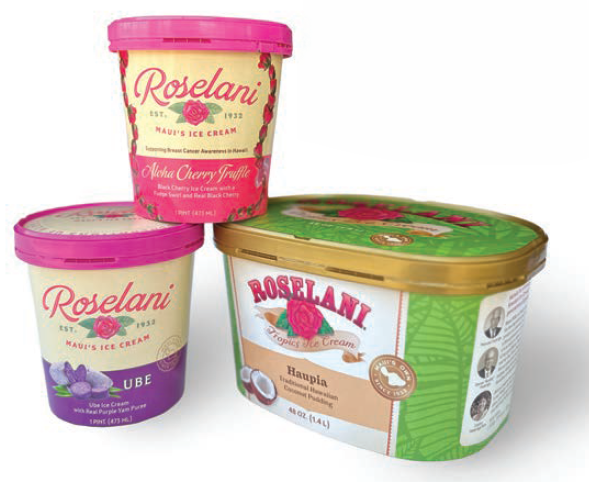
Roselani Ice Cream, a family business founded on flavor, celebrations and history, has a motto that is printed on each carton of ice cream: “Driven by legacy, crafted with Aloha, one batch at a time.” For 92 years, powered by four generations, the Nobriga family continues to create “Maui’s Own Ice Cream,” slow-cooked to perfection in their historic plant, utilizing Manuel’s template for making a one-of-a-kind ice cream with velvety texture and rich flavor.
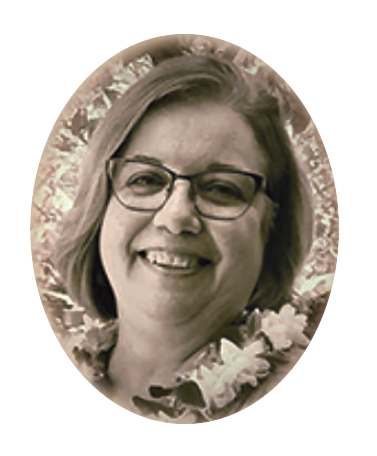
Catherine Nobriga Kim remains the heart and soul of Roselani
Manuel’s flavor formulas were so well received on Maui from 1932 onward, that he continued to create his recipes for ice cream parlors and wholesale alike until he retired in 1971. He passed the apron onto his son David “Buddy” Nobriga, who assumed the leadership roles of running the cattle ranch and the trucking company. He worked tirelessly to make his dad’s ice cream more accessible. By the mid-1980s, Roselani’s ice cream was being produced in half-gallon “bricks” to be sold in mom-and-pop grocery stores on Maui.
David later appointed his daughter (Catherine Nobriga Kim, Auntie Cathy) as vice president of the company and operations manager of Roselani. She elevated and diversified Roselani during her time, including developing the renowned Roselani Tropics line in 1989 and starting neighbor island distribution in 1999 with O‘ahu. In 2019, she helped lead the introduction of a new retail carton for the Tropics line, a 48-ounce carton more compliant with industry standards and a more practical size for consumers.
She appointed Buddy, her godson and eldest nephew, as operations manager in 2017, and he remains the driving force, taking Roselani into a new era for the next generation.
Never sacrificing quality by cutting corners is one of the reasons Roselani is also known as “Maui’s Best Ice Cream,” as evidenced by the array of accolades gracing their headquarter walls and spilling across tabletops.
Buddy James Nobriga keeps the recipes safe for the next generation
One of their many awards is the prominent 2015 TASTE Award, the Governor’s Lifetime Achievement Award from Hawai‘i Food Manufacturers Association for Roselani Ice Cream’s history of distinguished service, industry inspiration and lasting contributions.
“In a world of corporate consolidation, it’s pretty tough to keep going, but we do,” says Buddy. “As my grandfather said, ‘For the Portuguese, sometimes that stubbornness works out.’”
Keeping It Local
Although the notion of mom-and-pop business gets thrown around a lot across the Aloha State, year after year, more of them are either disappearing or expanding so rapidly that they lose their essence by forfeiting control.
The Nobrigas are committed to keeping local families and individuals employed for many years. Maui Soda & Ice Works employs just under 80 employees, all on Maui and Lāna‘i, with 40% employed 25 years or more.
“For me personally, it has been a family standard in all our businesses,” says Buddy. “I take great pride in being a locally owned business with all of our staff from here or living here, and the revenue generated staying here. That’s so important. In these unprecedented times of transition and rebuilding, we owe it to one another, but moreover, to those who worked so hard. We have an opportunity to keep making this magic happen on Maui.”
Maintaining relationships with suppliers is also part of their model, but it has been challenging at times. COVID and the recent fires have closed a variety of small businesses, including one they worked with for over 35 years. “It’s really tough. Our hearts go out to the businesses and the people whose lives were forever changed. We need to be here for them and stand strong—onipa‘a. All will be better as we honomua—move forward together as one Maui Strong for all generations.”
“We source locally as much as possible, but sometimes that can get you into trouble,” said Buddy. They honor the recipe and ingredients as true to the original as possible. “If I can’t get the exact same ingredients, our customers will notice. They will call and hold you accountable.”
“We are very ingredient sensitive, and our customers will let us know if there is even a slight difference,” said Buddy. “Our customers have always had a voice, and we listen… I think it’s one of the reasons we stay successful.”
Buddy is not only the main ice cream taste tester, he also tends multiple email inboxes of customer inquiries and answers phone calls. “I’m never afraid to talk to a customer… we’re the kind of business where they talk to the source.”
Three cartons of Roselani Ice Cream
Family Matters
From the 1970s through the early 2000s, multiple siblings from multiple Nobriga families worked at Maui Soda & Ice Works at the same time, plus in-laws. “They laid the foundation for what we have today,” says Buddy.
“Half of our company have been here over 20 years, and some people I work with now—my aunties and uncles— have been here 40-plus years,” says Buddy. “They knew me when I rode my bicycle around the Wailuku site. This was our playground.”
James and his siblings also grew up there. Nobriga keiki were always part of the business.
Today, Buddy’s father, James, has an office across the hall from him. Buddy’s cousin and brother also work within the company.
And now, Buddy’s keiki are running around the lot and completing homework onsite. Buddy fell for an O‘ahu girl and they have four beautiful keiki under the age of 12 who consider themselves “official taste tasters” for Roselani Ice Cream.
Although his children are still young, he hopes they will eventually continue the family legacy. The future of its growth will be in their hands.
A Godmother’s Legacy
Auntie Cathy
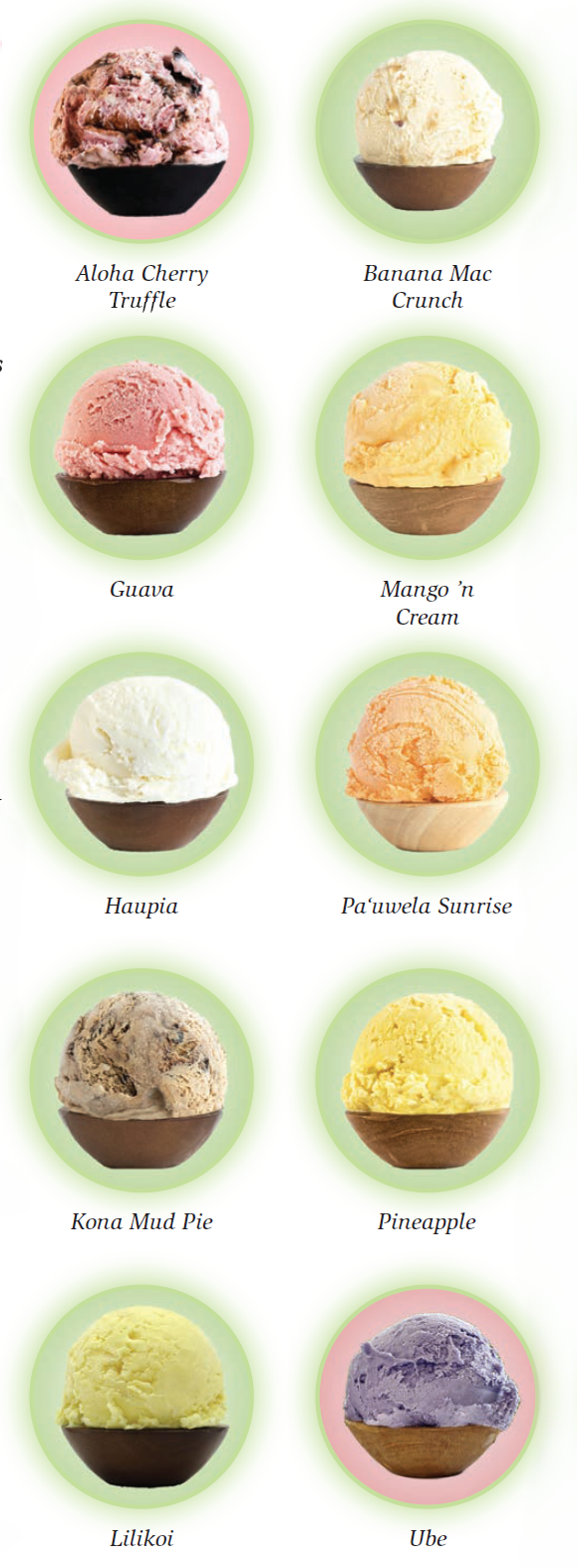
Auntie Cathy diligently studied how to make their ice cream. She created their Tropics line— a go-to for residents and visitors alike. Favorites include the Banana Mac Crunch, Chocolate Mac Nut, Kona Mud Pie and the most sought-after flavor, Haupia, a coconut pudding creation.
Buddy took the reins of the ice cream division “by default and choice” in 2017. His godmother, Auntie Cathy, had to take on a bigger role in the company. “She took me under her wing,” said Buddy. “She’s still the heartbeat of the business.”
Cathy worked at the plant since she was 15, later leading as president and general manager. Brian Fevella, who has been with the company for 46 years, took over after Auntie Cathy suddenly passed away from cancer in 2020. The Nobrigas are forever grateful for Brian and the ‘ohana who dedicate themselves to this business.
Lokelani Rose bushes bloom outside the Wailuku home of Roselani Ice Cream, and Auntie Cathy’s bright spirit and incredible work continue. One of their latest and most special flavors honors her with a pink rose lei gracing the cartons, in support of breast cancer awareness. Aloha Cherry Truffle is black cherry ice cream with fudge swirl and black cherries—a fantastic flavor developed by Cathy. The lei honors their company angel, whose spirit can still be felt within the walls of the team’s historic plant on Lower Main Street.
“My grandfathers and aunt shine down on us,” says Buddy. “She is missed, but it is a privilege to carry on. It’s much more than pride—the word ‘pride’ is not enough.”
Auntie Cathy created many of the recipes, so Buddy is now in charge of them. He works hard to keep each and every flavor as true as possible to the original.
His first creation was ube, purple sweet potato goodness, which has been going over well.
The Nobriga family has crafted something so special and shared it with so many, their customers and supporters develop a sense of pride and appreciate its dependable consistency.
The variety of flavors offered by Roselani
What’s the Scoop? Modern Moves & Future Plans
Buddy’s idea of the pint line was a welcome addition to the company, attracting a whole new group of fans. COVID had halted its release in 2020, but Roselani was able to launch pints in May 2023, after four members of the Nobriga family from Buddy’s generation collaborated with designers to give the packaging a fresh facelift.
“It was a drastic change from the original packaging, but we made it through,” says Buddy. “I swing for the fences. I don’t have time to bunt.”
The company completely overhauled its production facility to make it a reality. The pint allows a new group to taste the flavors they normally wouldn’t, as many were only available through wholesale outlets.
As with any artisanal, quality product made from scratch on Maui, the price point is higher than many mainstream brands.
“We could definitely bring down the price by making it on the mainland, but it wouldn’t be the same,” says Buddy. “Not everything is about the dollar, but rather, keeping quality.”
Roselani is distributed statewide for now, with a dream of going national. They are always exploring opportunities and vowing to never sacrifice taste.
A Recipe for Success
With a goal to be Hawai‘i’s best ice cream for generations to come, it’s vital to protect precious recipes.
“We hold our recipe secrets close, including our traditional process for creating the ice cream,” says Buddy. “I like to say we make it just how great-grandfather made
it 92 years ago.”
They honor the game plan, maintain the great taste and keep the same high standards since the beginning. Three generations of their family have studied physics. Crafting Maui’s favorite ice cream for over 90 years takes brilliance.
It’s the unique way that the butterfat is crafted that gives Roselani its silky texture and smooth finish. Because of the butterfat content, it is best to place your carton in the refrigerator for a half-an-hour before scooping— or pop it in the microwave for 30 seconds, the Nobrigas advise.
Whatever you are craving, Roselani can satisfy. With this rainbow of flavors, you may think Buddy would have an exotic favorite, but he is in love with Gourmet vanilla. Buddy was taught everything starts with how a good vanilla is made. “As a fourth-generation ice cream maker, I have to have that palate,” he says.
Hawaiian Vanilla Bean is his other favorite. The vanilla has come from a family farm on Hawai‘i Island for the last 20 years. The farm’s orchids, the source of the vanilla beans, is so vital to the recipe, that Roselani cannot produce the flavor without them. Thankfully, this iconic flavor is available via retail sales.
Maui’s Ice Cream
Roselani Ice Cream is not just about a dessert. The stories of celebrations are what it’s all about for the Nobriga ‘ohana.
“It is a part of their lives… that’s what it is to me,” Buddy shares with emotion. “Yeah, it’s an ice cream, but also a part of their fondest memories.”
James Nobriga (Cathy’s brother and Buddy’s dad) is a strong but mild-mannered man who serves as vice president of distribution and facilities. “People allow us to be a part of their celebrations, inviting us to being a part of their lives and their children’s lives,” he says. “It’s humbling.”
Destiny
Buddy played seven sports growing up, doing his best to keep busy so he “didn’t have to work” at the plant in Wailuku. “I tried really hard to avoid it when I was younger, and came back here after attending business school on the mainland,” he says. “Now, I’m in the right place.”
Buddy realizes the pressure of heading operations of a company, but also says that in a family business, job titles don’t mean anything. He understands what “has to be done, has to be done and this is a team effort on every level.”
“It’s my job to steward this, so the next generation has the opportunity,” says Buddy. “It’s not mine, I didn’t start it, I can only add to it, make it better and make sure it’s there for whoever is willing to take it forward.”
Ice, soda and ice cream stand the test of time within the ebb and flow of small business, and the Nobrigas have achieved a historic level of success by walking their talk, staying true to their ancestors and leaders before them, and running a company with ingenuity, a strong work ethic and true aloha.
Buddy loves to be a part of the process. He walks the entire property once a day he when he is not traveling.
“For me, I was raised that kuleana is not a responsibility; it is a gift,” Buddy says, while tearing up. “When things get tough here, I just remember it is a gift. It is special.”
Find markets across the Aloha State that carry Roselani Ice Cream by visiting roselani.com.
Did Manuel Nobriga know when he began crafting ice cream from scratch at Maui Soda & Ice Works in Wailuku in 1932 that he would be leaving an enduring legacy that would be perpetuated and celebrated for many generations? Well, as it turns out, Manuel’s ideas, formulas and methods have become the blueprint for a…
Many may feel that it’s somehow “too late” and that there is some sort of an expiration date for starting to learn an instrument. Both Royal Hawaiian Bandmaster Clarke Bright and Eric Kop, assistant administrator and principal horn, emphasize that it is never too late to get into music, in whatever form it takes. Eric, for one, has calabash aunties and uncles who never played an instrument in their lives, but are now in retirement attending ‘ukulele classes and singing in various groups for enjoyment. “It’s brought satisfaction for them in ways that they didn’t even realize until they started doing it. Whether you do it as a hobby or as a profession — again, music is an emotional language, so if you’re able to tap into that language, it really connects to so many aspects of living a full life. So, if anybody has any inkling at all, I would say the most important thing is to not be afraid to try.”
Additionally, for those who have difficulty with playing an instrument, whether due to mobility, being busy or for other reasons, some may feel that simply enjoying music does not involve them at all. But, if music is a language like Eric says, language and conversation require two parties to be complete. Clarke reflects on this sentiment further. “Even if you don’t think you can, at least be part of the listening environment of music, and that will allow you to be able to feel what music can do. Not everyone can create it, but if you can listen to it, you are really part of music, because it doesn’t make sense for us to play music if nobody is there. We can work on our craft in practice rooms — which we all have done — and we can rehearse for ourselves, but when we share that with others, that becomes the revolving door that really makes music something I think seniors, especially, should be a part of. Never shy away from that.”
Many may feel that it’s somehow “too late” and that there is some sort of an expiration date for starting to learn an instrument. Both Royal Hawaiian Bandmaster Clarke Bright and Eric Kop, assistant administrator and principal horn, emphasize that it is never too late to get into music, in whatever form it takes.
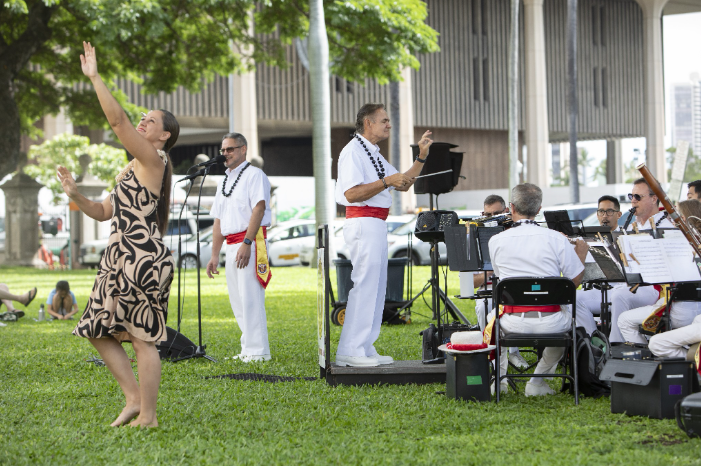
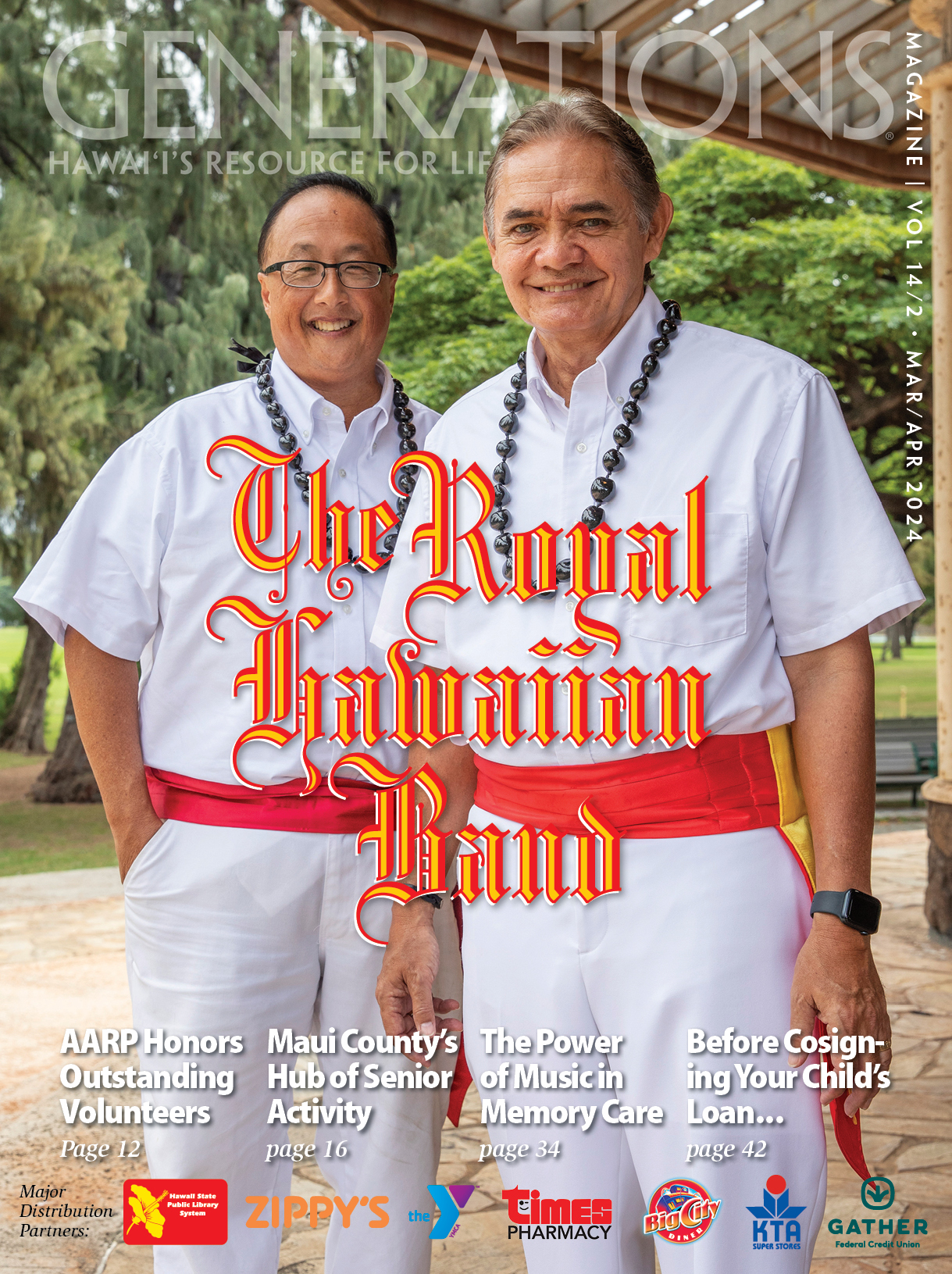
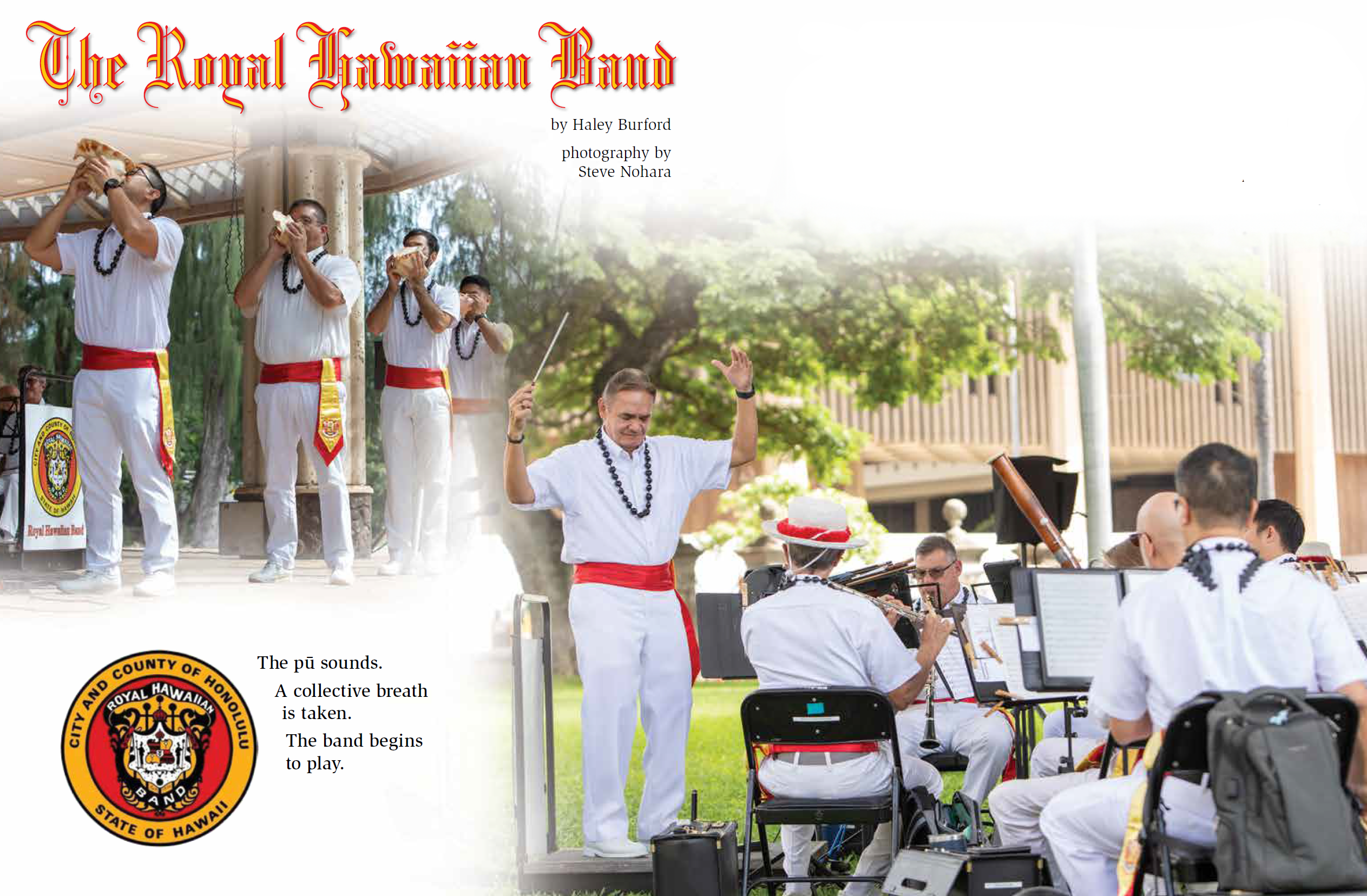
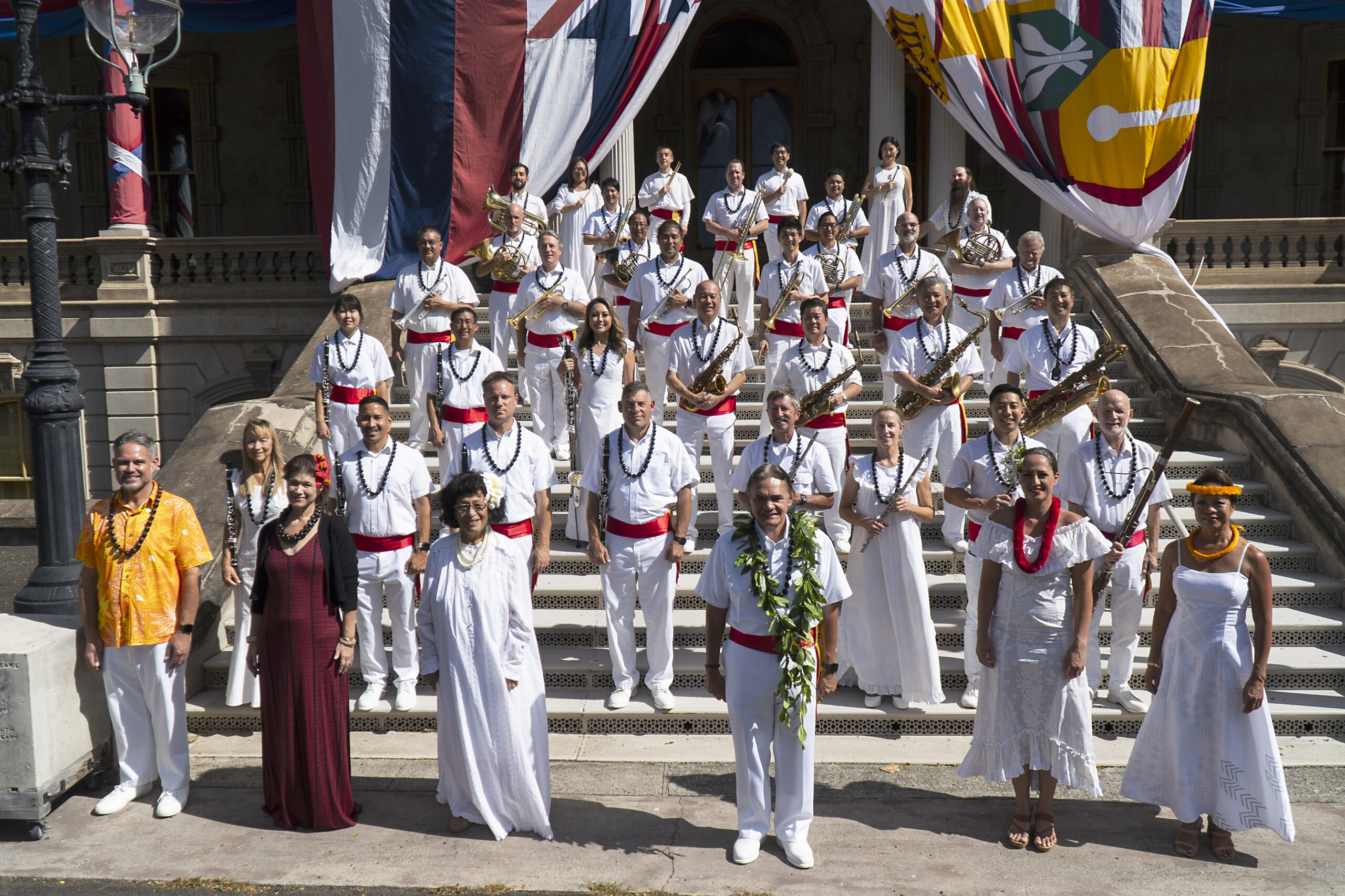
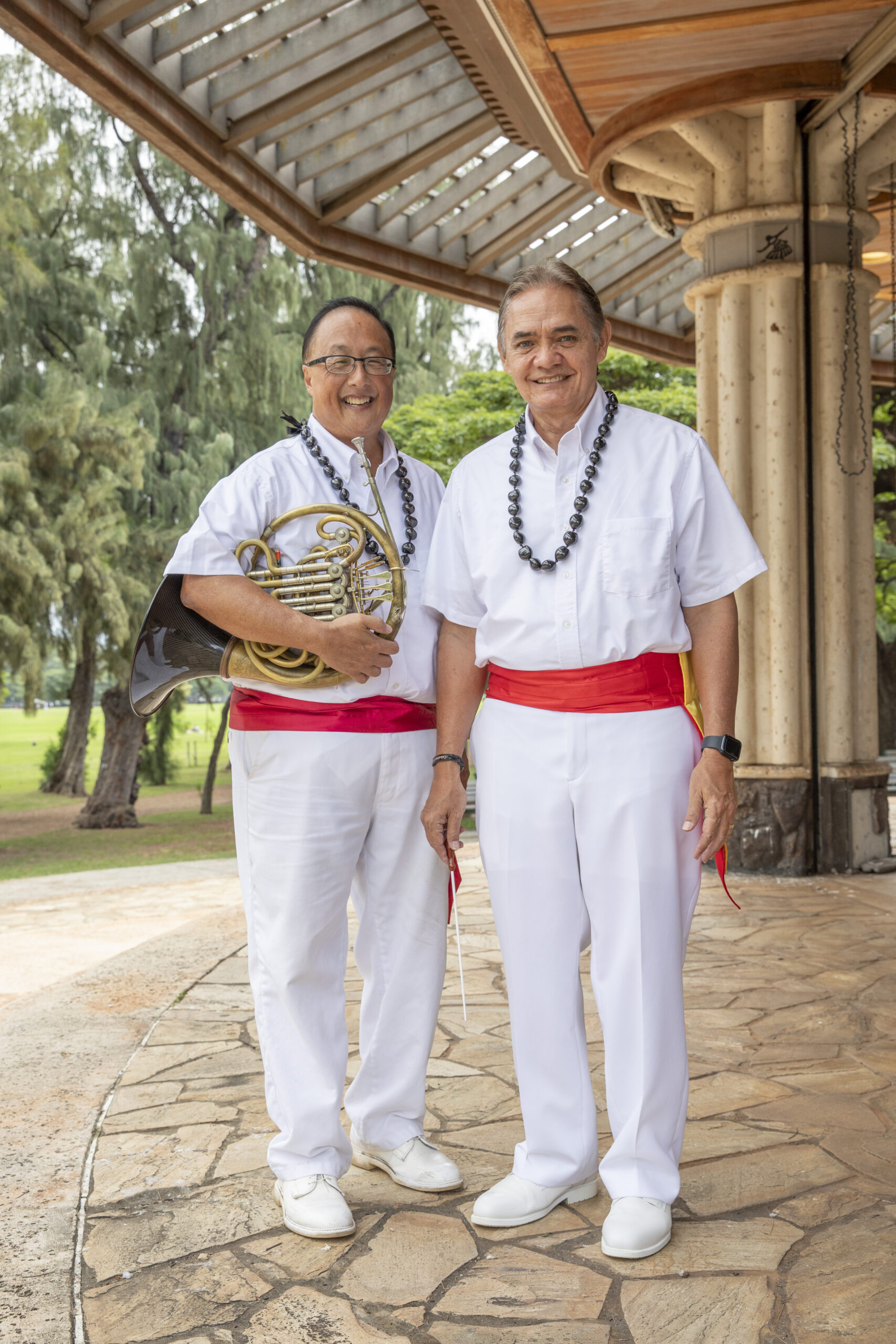
“To promote and foster music, preserve the Hawaiian musical culture, inspire young musicians and enrich the lives of the people of Hawai‘i” is their mission. As the only full-time municipal band in the United States — and the only one with a royal legacy — the Royal Hawaiian Band has touched and continues to move the hearts of people young and old for almost two centuries, beginning with their founding in 1836 by King Kamehameha III, Kauikeaouli. On top of weekly concerts at ‘Iolani Palace and Kapi‘olani Park, the band plays at over 300 events every year. They are led by Bandmaster Clarke Bright, who has conducted the Royal Hawaiian Band since 2011. Next to Clarke is Eric Kop, the assistant administrator and principal horn of the band. Together with other members of their staff, the Royal Hawaiian Band successfully and with great pride serves the people of Hawai‘i and encourages everyone to participate in the universal language of music.
The History
Clarke Bright was appointed bandmaster by then-Mayor Peter Carlisle; the Royal Hawaiian Band is an agency of the City and County of Honolulu. The history of the band is available on their website, but Bandmaster Bright breathes life into the facts through his passionate storytelling.
The Royal Hawaiian Band has always existed under the leadership of the current ruling party. “The Hawaiian culture had lost its voice when they lost the last reigning queen, and it was important to keep that going in some format because we had lost leadership — we lost our kingdom,” says Clarke. “We were then under the rule of a territorial-type government and the Hawaiians knew it was important to preserve their voice.”
Prince Kuhio knew it. “He went to Washington, DC, as a delegate to Congress — he had no voting position, but he did whatever he could to make it known to the American government that the culture needed to continue to be part of who we are. He then came back and he realized that the best way to keep Hawai‘i’s voice going was to have a government, like a city entity, that would be voted on by the people of Hawai‘i. He reengaged the Royal Society — the Royal Order of Kamehameha — to give their voice more prominence. He engaged the Hawaiian Civic Clubs and continued to work for land acquisition in and amongst the Hawaiian area — all of those things he did to continue to give Hawaiians more of a voice.”
Clarke feels that one of the most important things Prince Kuhio did was tag the band onto city leadership. With the band under the auspices of the city, the band’s musical voice, its historical voice, its hula and its prominence in culture would continue to give Hawaiians a voice under a ruling government. “And that’s where we are today,” says Clarke. “From day one, the Royal Hawaiian Band has been part of the city. And we continue, I believe, to give a prominent Hawaiian voice to the culture of Hawai‘i.”
For 188 years, the Royal Hawaiian Band has played for audiences locally and internationally a plethora of musical arrangements — from contemporary and traditional Hawaiian music to Broadway and symphonic compositions. The band also plays music composed by Na Lani ‘Eha — the Royal Four — and pieces of Hawaiian music stylized by former bandmaster Henry Berger to evoke various European musical forms such as marches, polkas and waltzes.
Among the pieces the Royal Hawaiian Band plays that are composed by Hawaiian royalty, the most famous, “Aloha ‘Oe,” was composed by Queen Lili‘uokalani. The heartfelt, moving classic closes every single Royal Hawaiian Band concert. In the early 1900s, the Royal Hawaiian Band adopted many hapa-haole (Hawaiian music with English words) pieces into its repository. These pieces, such as “Waikiki,” “Sophisticated Hula” and “Hukilau” can still be heard today at their concerts.
But, Hawaiian music is not all that they play. The Royal Hawaiian Band also performs and arranges many pieces from the US and across the globe, traversing time and space to bring audiences the wonder and beauty inherent in music. Their concerts today include marches, orchestral transcriptions, standard band repertoire, pop music arrangements, Broadway musicals, movie soundtracks and television show theme songs. The band also is well-versed and takes pride in their extensive catalog of ethnic folk songs when taking part in many of the cultural festivals in Honolulu.
Perhaps one of the most intriguing things about the Royal Hawaiian Band staff, too, is that they have staff arrangers who, at the assignment of the bandmaster, create arrangements of these ethnic folk songs for the band and for the audience’s enjoyment. Eric Kop, assistant administrator and principal horn of the Royal Hawaiian Band, articulates some of the work that is put into these arrangements:
“When we go to the Palolo Chinese Home, we have a library of Chinese folk songs that we’ll play,” says Eric. “Depending on the communities that we are playing for, we will actually tailor the program for the particular ethnicities that are represented there. Most of the arrangements we play are made especially for the Royal Hawaiian Band; no other music entity has those arrangements, so I think that’s a very unique part. Really, when I see the reaction of the audience, whether it’s kūpuna or the youth, I know that we are accomplishing our mission — enhancing life. And just to see the smiles… you know we’re doing what we set out to do, and that’s a great thing.”
The Music
With such an abundance of music to choose from, a lot goes into preparations for their hundreds of annual concerts. According to Clarke, “It really starts with the request from the entity that wants us there. Once the schedule is there, I take a look at what might be appropriate. We create a program and hand it out to our members at least a week before the concert. Then, we meet and decide what’s the best way to serve that concert.”
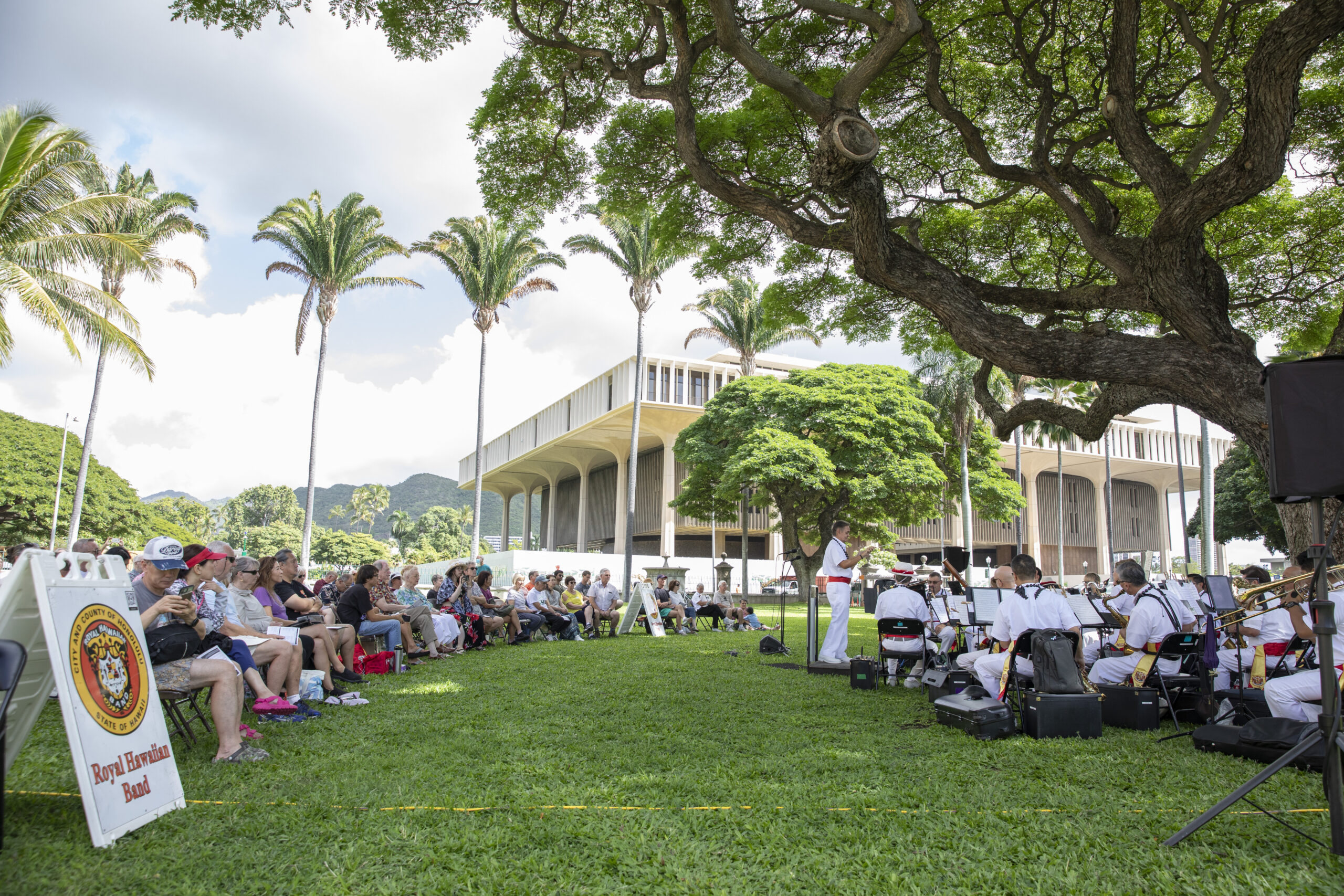
Clarke and Eric go on-site about an hour-and-a-half prior to downbeat. They lay out markers for the design of the band. They unload the equipment from their truck an hour before, set up and the band members warm up a half-hour later. Announcements are made 15 minutes before, and the tuning note sounds five minutes before starting the 45-minute to one-hour concert.
“We usually have an opening involving the pū , or conch, and an ‘oli to welcome the audience,” says Clarke. “And then, depending on where we’re at, we may focus more on contemporary or traditional Hawaiian music. We’ll usually play something that’s good or challenging for the band, like a symphonic piece or a band standalone. We play modern, easy-to-listen-to music, like Broadway or contemporary hits for the audience.”
The Royal Hawaiian Band also performs weekly concerts on top of being available for request. About these routinely scheduled performances, Clarke says, “We have some standing weekly concerts at ‘Iolani Palace on Fridays and at Kapi‘olani Park on Sundays. But other than that, the majority of concerts are requested either by educational institutions, nonprofit organizations, community events or government events of that nature.” The band also reaches out to be a part of other important concerts, including anything that the mayor — or the governor — initiates, as well as meaningful Hawaiian-related events.
“I want to make sure we’re at things like birthdays of kings or queens, celebrations of lei draping, those kinds of things,” says Clarke. “Part of our purpose is to also serve the people who are of early age and those who are more in the latter part of their lives.” From elementary school-type educational concerts to performances for seniors in living and care centers, the Royal Hawaiian Band is eager to reach out to such organizations every single year.
The Leader of the Band
Clarke is the most recent torch-bearer in a legacy of bandmasters for the Royal Hawaiian Band. He grew up in a music-oriented family, helping with his father’s theatrical musical productions growing up then majoring and graduating with a bachelor’s degree in secondary music education from the University of Hawai‘i. He was the band director at Waimanalo Intermediate School for four years, then at Kamehameha Schools for 13½ years, teaching all grade levels, until he was appointed bandmaster of the Royal Hawaiian Band in 2011.
A great leader is one who empowers others. The conviction with which Clarke describes the bandmaster’s responsibilities communicates his ability to move others, not with force, but through and for the love of Hawaiian culture and music. He emphasizes that he finds it important to remember that his main responsibility is service — to the band, to the city and to the people.
“I have to, of course, conduct the band, but I choose the music and we rehearse the organization,” says Clarke. “I’m responsible for the vision and leadership of the organization, as well.” As part of the city’s cabinet, he attends mayoral cabinet events and administrative meetings.
Clarke also makes a point of partaking in the culture that surrounds the band and their music. “The Hawaiian culture is so special… Being Native Hawaiian myself, I think it’s important for the Hawaiian people to know that we are serving them as best as we possibly can. It’s a big responsibility — to show up at all these events, to meet with them, to befriend them and to ensure they know that they can trust that their band can serve them as needed. The community has to see their bandmaster as somebody who wants to serve them — who wants to bring music out to the people. I think that’s important, too. So, the main thing is service. It’s a very diverse position. It really requires many different facets of a person, but it is a position I am honored to participate in.”
The Backbone of the Band
Clarke does not shoulder the responsibilities of maintaining the Royal Hawaiian Band alone — the band has a staff of 10, all of whom play their respective instruments. Another vital position is that of the assistant administrator, covered by Eric Kop, who is also the principal horn.
Eric began with the Royal Hawaiian Band in 1988 at the age of 21. Through his years in music and passionately advocating for music education, he has previously taught horn for the University of Hawai‘i at Mānoa, the Hawai‘i Youth Symphony’s Pacific Music Institute, Mid-Pacific Institute and in his own private instruction studio. Eric has also backed legendary musicians in his time as a freelance musician, including Frank Sinatra, Liza Minnelli, Charlotte Church and others.
As the band’s assistant administrator, Eric works closely with the bandmaster, handling logistics and ensuring the band and their performances run smoothly. “During the concert, I am playing the principal or first horn part. So, I perform as a musician. In the office, I do a lot of the work for the auditions.” He also works with departments outside of the Royal Hawaiian Band regarding fiscal matters, human resources and anything interdepartmental within the city.
At this, the bandmaster speaks up. “Eric basically said what’s supposed to be said on paper, but in addition to all of that, he is directly responsible for our link to the city — probably one of the most important positions in the band,” says Clarke. Clarke stresses how instrumental the assistant administrator is in that Eric communicates with the city to ensure that “this very un-city-like entity,” the Royal Hawaiian Band, is seen by the city how it is supposed to be. Such a position involves quick thinking, and Eric’s masterful way of translating musical to municipal and vice versa is something that Clarke feels really keeps the band on track.
The Business of Music
As part of the band staff working under the city, both Clarke and Eric underline some of the challenges that come with being an arts organization under city jurisdiction. Though they are a city agency, the city does not organize for the band. Eric says, “In order to incorporate city work policies and what employees in other departments do within our arts organization, we have to convert it. When you’re dealing with artists who are not used to a regular 9-to-5 schedule, that’s sometimes a challenge because we work such an odd schedule — it’s all over the place…” A lot of work is put into translation, and when information has to be circulated through different checkpoints and departments, communication is key to the Royal Hawaiian Band’s success.
Though this work of translation can be tough, Eric takes great pride in handling the challenge: “To bridge the translation gap presents a unique challenge.” Clarke adds, “And he does it really well. We take pride in the fact that the city and state understand the importance of perpetuating our culture through music, dance and hula — that they deem it appropriate to have a full-time organization sponsored by city support for the perpetuation of Hawaiian music.”
The Band for Kūpuna
The Royal Hawaiian Band boasts 40 members, with seniors making up about 25% of its roster. Out of over 300 every year, their proudest concerts are for seniors, whether at community centers, housing or at public performances. According to Clarke, “We’re really proud of many things that we do, but that service to the seniors is a very important aspect of who we are. The biggest thing is the genuine appreciation that they have for what we bring. In every single senior environment — because most of the music that we do for them, they know — they’ve either sung to it or danced to it at some point in their lives. The music hits in a certain way that other things cannot.
“Music is so powerful in that aspect,” says Clarke. “It’ll bring back a memory; a season in their life; a time. It’ll do things to your heart that are very hard to describe or quantify in government processes, but the aesthetic value that we bring in our music, singing and hula is special.”
The Royal Hawaiian Band goes out to the people. “The appreciation we get from seeing their faces is really wonderful to us.”
Clarke recounts a story that holds a particularly special place in his heart. “Early in my tenure, we went to one of the senior centers. A lady was walking right in front of the band from one side of the stage to the other with her walker — right before we were going to start. As she labored with her walker, I just waited. I waited and I waited… for maybe four or five minutes. She sat; we started.
“In the concert, we played a song that I believe struck something in her na‘au — her heart or her spirit — and she remembered, I think. She got up from her chair, she moved her walker aside and danced the hula to that song we were playing. I couldn’t believe it. I turned around. It actually made me emotional. Then, she labors back down with her walker into her chair. At that point, I just thought, that’s the power of music. How else will somebody feel a certain part of their past, resurrect it and perform, other than through music of their era or their generation? It’s so important for us to serve that part of the community that needs to be served in the best way possible. I’ll never forget that.”
All throughout history, the human love for music has continued to withstand the test of time. People of all ages can understand and bond over music. “Music is such an emotional language, right?” says Eric. “It represents history; it represents culture; it represents the people. And, like Clarke said, we’ve seen so many of our audiences get very emotional during the performances.” For Clarke and Eric, playing music with the Royal Hawaiian Band is a gift given to the community that also gives back to the band. As a universal language, one without words, music moves us — to a dance or to a memory.
The Legacy of the Band
The Royal Hawaiian Band is meaningful to the community and its members because of the music that they play for others, but the band is precious and an integral part of the individual members and Hawai‘i state pride, too, because of the sentimental value it holds across its history. Eric never tires of growing with the band. “Over the course of 35 years — now at the other side of it — I’ve really cherished and valued how we affect the audience members and for me, personally, that sense of duty. As one of the senior members, I feel a duty to be part of the stewardship of the band and to make sure that its legacy continues.”
Clarke also feels such a responsibility to build the band up to be the best it can be while also maintaining its long-standing reputation as Hawai‘i’s band. “My number one mission is to preserve this organization into perpetuity, and I do that by ensuring we are hitting the mark. If we are being requested by a government agency, hit the mark; a community agency, hit the mark; with the culture, Hawaiian culture especially, or anything to the seniors and young students, hit the mark. Make sure we’re serving them well.
“It’s also to serve the members,” says Clarke. “If I’m thinking of serving them, I’m ensuring they get whatever they need to be successful. We are serving the members who then serve, through their music, the audiences that we play to.”
The Passion for Music
These professional responsibilities are a major part of working with the Royal Hawaiian Band, but what the work also encourages, fosters and requires is a genuine love of music. Both gentlemen found their passion for music very early on in their lives. When asked what fuels their love for music, both Clarke and Eric recall their upbringing fondly.
For Eric, his earliest influence was his mother. “She would always be playing the record player. So, as a young child, I grew up listening to a lot of classic Broadway and light classical music.” As he grew older, what continued to motivate Eric as a brass instrument player — a French horn player, specifically — is the physicality and sound of the horn. “I remember first recognizing what a French horn sounded like when I was watching Star Wars, and that really hooked me into that sound.” As far as music goes, he listens to everything “from Tchaikovsky to K-Pop.” To him, “good music is good music, no matter what the genre is.” He feels that being a part of music production is a thrill that contributes to and strengthens his lifelong love for music.
Clarke tells the story of being told by his parents that he could keep a beat on a pair of bongos gifted to him by his father when he was only 6 months old. His father was a musician and musical theater director, so music was very much present in his home growing up. Through assisting his father with his productions, Clarke saw what the arts — not just music — can do to and for people. Though he wasn’t aware of his bongo-playing at such an early age, Clarke is sure that music has been his life’s calling since the beginning, drawing much inspiration from his father. “I was immersed in all of this music and he, being Hawaiian, played piano and knew a lot of Hawaiian songs. He played often with various Hawaiian singers and would also bring me along, his drummer son, to assist in all of his events or concerts or shows. And when I think back on that rearing, I think I was meant to serve musically, in some capacity, the community at large. That fuels my love for music.”
As he grew older, the simple love for music transformed into scholarly study, learning the names and theories and backgrounds of different transitions, keys and chords. Clarke credits his father for encouraging him to conduct one of the shows. “He had faith in me and kept believing in me, so I did it.” He went on to formally study and teach music, leading up to his work with the Royal Hawaiian Band as the bandmaster. “That passion, the genuine love of music — not only for music itself, but what it can do to serve others — really moves me. That really gets me going. I love to listen to it, I love to perform it, I love to conduct it, but it’s when it serves others that it really fuels me and keeps me going.”
The Community’s Band
The Royal Hawaiian Band loves to serve all the various agencies and communities, but, most of all, they want everyone to know that the Royal Hawaiian Band is their organization. “We want them to feel like they can ask for us to be there whenever they want,” says Eric. “Never be afraid to ask — we are there to serve them.”
“It really is Hawai‘i’s band, because there’s so much of Hawaiian history built into the music that we play,” says Clarke. “When audience members come to hear the band and they listen to the introduction of how a lot of these songs are weaved into Hawaiian history, it really ties into our mission to perpetuate the music and educate people. We hope to get that mission and message out to as many people as we can.”
Aloha ‘Oe
Music knows no age; it knows no boundaries. As the Royal Hawaiian Band continues to play and serve the people of Hawai‘i, they also fulfill their mission statement, going above and beyond to communicate their love for music and performing their arrangements. To promote and foster music, the bandmaster and assistant administrator/first horn Clarke Bright and Eric Kop, together with all the other members of the Royal Hawaiian Band, play their music for the people in Hawai‘i and across the world, from the beginning to now and into the future.
To preserve the Hawaiian musical culture, the band upholds Hawaiian traditions and maintains the legacy of Hawaiian music through passionate performances. To inspire musicians, young and old, and enrich the lives of the people of Hawai‘i, the Royal Hawaiian Band proudly continues to perform at over 300 events annually, giving it their all at every single concert. With the opening notes to Queen Lili‘uokalani’s “Aloha ‘Oe,” the Royal Hawaiian Band’s performance ends with a gesture of love to Hawai‘i and its people. At the very end, a clear promise is made to their audience: Until we meet again.
For more information regarding the Royal Hawaiian Band, the band members, contact information to request an appearance and a running schedule of their upcoming events, visit the Royal Hawaiian Band’s website at rhb-music.com.
“To promote and foster music, preserve the Hawaiian musical culture, inspire young musicians and enrich the lives of the people of Hawai‘i” is their mission. As the only full-time municipal band in the United States — and the only one with a royal legacy — the Royal Hawaiian Band has touched and continues to move…

 Just like it’s important to maintain your physical health by adopting an in-home exercise regime, it is important to maintain your mental health by engaging in challenging activities that promote cognitive function. Changes in cognitive function are a natural part of aging. With time, your brain loses agility and can deteriorate further if you don’t take steps to maintain it. The changes are complex and varied. But aging doesn’t have to mean an inevitable decline as individual factors like genetics, health and lifestyle come into play.
 Variety is Key
 LIFE STORY INTERVIEW KIT is a 150-question card deck created to help capture and preserve your stories or those of your loved ones. The conversation-based card game’s questions/prompts are categorized by early life, midlife, and later life and reflection, sparking recollections of past experiences. It is a fun way to preserve memories, spend quality time with your loved ones, deepen your connection with them, and learn new things about them. Although maintaining brain fitness through challenging activities is important, activities that prompt human connection and interaction are best—no matter the age.