
The role of being a “reverse parent” didn’t occur to me until I dropped off my father on his first day at adult day care. While walking back to my car, I said to myself, I hope the day care doesn’t call me and say they’re sending him home because he soiled his clothing or worse yet; he got into a scuffle with another senior.
I chuckled to myself, Wow, now I’m the parent taking care of my father. The roles have been reversed.
I tell my fellow baby-boomer friends; we’re reverse parents. I get laughter and sometimes I get head shaking. In Hawai‘i and across the nation, there are adult children (like me) who are caring for their parents. A role few of us are prepared to take on. Caregiving blindsides many of us.
My father passed away November 2007, and then the reverse parent role started again two years later with my mother. I tell friends, “I have an 86-year-old daughter.” And just like anyone else — regardless of age — she wants to be heard … and, gratefully, I have learned to listen. This is one thing I’d like to tell my fellow baby boomers to do — ask … and listen. My mother has told me many stories that are “pearls.” For example, her father, my maternal grandfather, was a fisherman on the aku boat. She explained how he had very strong arms and legs, as it wasn’t an option for a him to tell the boat captain that he needed to take a break while the fish were still biting.
Another pearl involved my paternal grandparents who worked for the first governor of Hawai‘i, Joseph B. Poindexter. My grandfather was the chef and my grandmother (“Baba”) was one of the servers. She wore traditional kimono while serving dinner guests at the Governor’s Mansion. President Franklin D. Roosevelt appointed Poindexter for two full terms, 1934 through 1942. He was among the first to advocate Hawai‘i’s statehood, yet that endeavor was interrupted in December of 1941 when the Japanese attacked Pearl Harbor.
My mother told me that on the day of the surprise attack on Pearl Harbor, my grandfather was planning to go out fishing in his small boat that he had moored at Kewalo Basin. For some reason he decided against it, but his friend did go out to sea. In the mayhem that occurred, he was mistaken as being part of the Japanese Navy disguised as a civilian and was killed.
I’m fortunate to own a home care agency and have a brother who puts in just as much time and effort caring for our mother. My brother and I do the night shifts and one of our employees cares for my mother during the day. However, for families that don’t that level of support, there are respite programs, adult day care centers, transportation services and support groups in the community. Each family is unique, and needs different resources. If you want to discuss options available for caring for your parents, feel free to call 545-3700 or visit www.ComfortingHandsHawaii.com.

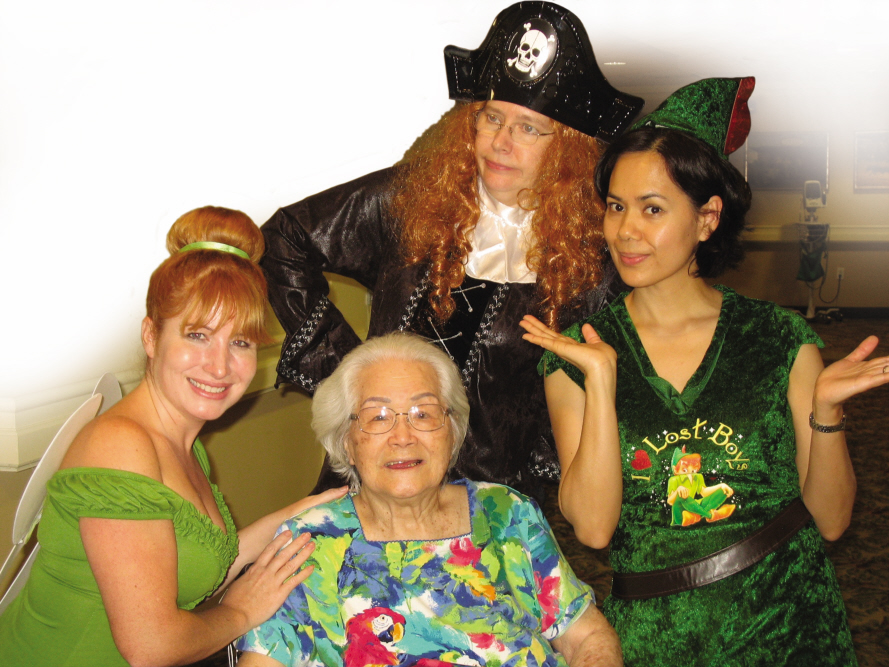 Kahala Nui is a vibrant retirement community where residents enjoy the security of “Life Care,” a holistic approach to senior living that integrates a wellness-centered lifestyle with the peace of mind of onsite continuum of care choices at Hi‘olani Care Center. Kahala Nui’s Life Care plan offers a lifestyle and health care program designed to enhance and promote mental, physical and spiritual wellness throughout life. Hi‘olani Care Center at Kahala Nui offers assisted living, nursing care and memory support options for residents. Through activities such as the annual themed week, residents are given the opportunity to enjoy an active and vital lifestyle.
 Falling down is nothing new. We have been doing it all our lives. We fell as infants, as kids, as teenagers and even, awkwardly, as adults. The price for an active, healthy life has been an occasional fall and normally it is no big deal. When young and strong, you fell and “bounced” right back up. It’s a different story, though, for older adults. Any fall can be very serious.
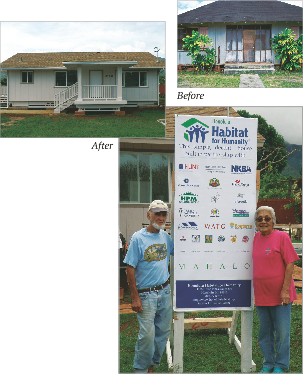 When Lehua Fuller first showed her Waimanalo home to Honolulu Habitat for Humanity staff, they were amazed. She had managed to raise 12 children in her four-bedroom plantation-style home, which was in grave disrepair. There were holes in the floor and roof, severe termite damage and problems with the electrical and plumbing. In Honolulu, Wallace Bailey, a disabled retired veteran, and his wife Frances, decided to contact Habitat for Humanity for help after living in their dilapidated home in Papakolea since 1962. And, JT and Thelma Vasconcellos, a retired couple living in their 60-year-old home in Waialua, knew that their home needed more work than they could afford. Thanks to their partnership with Honolulu Habitat for Humanity, construction started on the Fuller and Bailey homes in July, and JT and Thelma Vasconcellos moved into their new Habitat home in April 2011.