Category: Giving Care

  • Home Care for Stroke Survivors

    Gernations - 2014-12-01 - Homecare for Stroke Survivors - Image 01

    Caring for stroke survivors at home can be overwhelming for anyone. Getting outside help from home care agencies can make a difference in your ability to balance your life with your loved one’s needs.

    Ask the following questions to find a trustworthy company with qualified, reliable caregivers who are also compassionate and dedicated.

    Does the provider send a Registered Nurse (RN) to meet the family and develop a plan of care for the caregivers to follow?

    As part of the admission process, an RN Clinical Manager should meet you and your family at the home, assess the family dynamics, perform a head-to-toe physical assessment, provide a home safety inspection and develop a customized care plan for the caregivers to follow. An RN should be available to you 24/7 to provide support.

    Are caregivers supervised and evaluated by a Registered Nurse?

    On a regular basis an RN should:

    • Perform assessments of the patient and make any changes to the care plan
    • Ensure that the family is satisfied with the caregiver and the services the agency is providing
    • Assure the family that they are there as a resource for all parties


    HiHealthCare, 745 Fort Street, Honolulu, HI 96813
    808-534-7815 | info@hihealthcarehawaii.com
    hihealthcarehawaii.com

    Caring for stroke survivors at home can be overwhelming for anyone. Getting outside help from home care agencies can make a difference in your ability to balance your life with your loved one’s needs. Ask the following questions to find a trustworthy company with qualified, reliable caregivers who are also compassionate and dedicated. Does the…

  • Conversations About Wishes

    Gernations - 2014-12-01 - Conversations About Wishes - Image 01 Auntie K was having trouble breathing at home and her son called 911. She is now in the Intensive Care Unit. The doctor asks the family, “What would your mother want us to do if she could speak for herself right now? She’s having more trouble breathing. Do you want us to “‘do everything?’”

    Unfortunately, this is a very common scenario at hospitals in Hawai‘i. Sometimes, even when people have thought about these things and discussed them with their doctor, they haven’t sat down and talked with their family. And, yet, it is the family that the doctors and nurses turn to for answers.

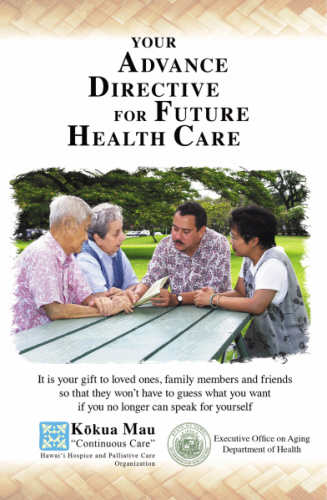
    No one says that conversations about these things are easy. They are not easy. So how do you get started? Who should be involved? In Hawai‘i, one place to turn is Kokua Mau, Hawai‘i Hospice and Palliative Care Organization. Kokua Mau knows these conversations are crucial and it invites you to use its free resources to help explore options and begin the conversation.

    Kokua Mau is a group of volunteers from many organizations and professions who have joined together “to weave a lei of caregiving and support so that the people of Hawai‘i facing serious illness can live in the place of their choice, with relief of pain and suffering and according to their values, beliefs and traditions.” (Kokua Mau Mission Statement)

    Gernations - 2014-12-01 - Conversations About Wishes - Image 02Kokua Mau has information for individuals, families and health professionals. Its website (www.kokuamau.org), has direct links to community resources, such as downloadable Advance Directive forms and printable information that covers topics that we often find difficult to talk about. For instance:

    • If someone is not able to eat, what are the pros and cons of tube feeding? (You can view or download a guide for decision making about tube feeding on Kokua Mau’s website.)
    • What is POLST? (Physicians Orders for Life-Sustaining Treatment, a portable doctor’s order that makes your wishes known.)
    • What are the pros and cons of CPR for someone who is elderly and frail? (Did you know that among this group CPR is less than 5 percent effective?)

    Along with written resources, Kokua Mau has a Speakers Bureau that can meet with your group to start the conversations that we all need to have.

    As our state’s nonprofit hospice and palliative care organization, Kokua Mau recently received national recognition with the 2013 Trailblazer Award from the National Hospice and Palliative Care Organization.

    So, what happened with Auntie K? Fortunately her son and other family members began to remember that when her brother had been hospitalized, Auntie K had spoken of what she would want if that happened to her. Because of this, they were able to come together as a family and follow her wishes. The members of Kokua Mau hope that with the use of its free resources, none of you will ever end up at the bedside of your loved one wondering what she or he would have wanted.


    Kokua Mau, Hawai‘i Hospice & Palliative Care Organization
    808-585-9977 | info@kokuamau.org
    www.kokuamau.org

    Auntie K was having trouble breathing at home and her son called 911. She is now in the Intensive Care Unit. The doctor asks the family, “What would your mother want us to do if she could speak for herself right now? She’s having more trouble breathing. Do you want us to “‘do everything?’” Unfortunately,…

  • Reverse ParentingReverse Parenting

    The role of being a “reverse parent” didn’t occur to me until I dropped off my father on his first day at adult day care. While walking back to my car, I said to myself, I hope the day care doesn’t call me and say they’re sending him home because he soiled his clothing or worse yet; he got into a scuffle with another senior.

    I chuckled to myself, Wow, now I’m the parent taking care of my father. The roles have been reversed.

    I tell my fellow baby-boomer friends; we’re reverse parents. I get laughter and sometimes I get head shaking. In Hawai‘i and across the nation, there are adult children (like me) who are caring for their parents. A role few of us are prepared to take on. Caregiving blindsides many of us.

    My father passed away November 2007, and then the reverse parent role started again two years later with my mother. I tell friends, “I have an 86-year-old daughter.” And just like anyone else — regardless of age — she wants to be heard … and, gratefully, I have learned to listen. This is one thing I’d like to tell my fellow baby boomers to do — ask … and listen. My mother has told me many stories that are “pearls.” For example, her father, my maternal grandfather, was a fisherman on the aku boat. She explained how he had very strong arms and legs, as it wasn’t an option for a him to tell the boat captain that he needed to take a break while the fish were still biting.

    Another pearl involved my paternal grandparents who worked for the first governor of Hawai‘i, Joseph B. Poindexter. My grandfather was the chef and my grandmother (“Baba”) was one of the servers. She wore traditional kimono while serving dinner guests at the Governor’s Mansion. President Franklin D. Roosevelt appointed Poindexter for two full terms, 1934 through 1942. He was among the first to advocate Hawai‘i’s statehood, yet that endeavor was interrupted in December of 1941 when the Japanese attacked Pearl Harbor.

    My mother told me that on the day of the surprise attack on Pearl Harbor, my grandfather was planning to go out fishing in his small boat that he had moored at Kewalo Basin. For some reason he decided against it, but his friend did go out to sea. In the mayhem that occurred, he was mistaken as being part of the Japanese Navy disguised as a civilian and was killed.

    I’m fortunate to own a home care agency and have a brother who puts in just as much time and effort caring for our mother. My brother and I do the night shifts and one of our employees cares for my mother during the day. However, for families that don’t that level of support, there are respite programs, adult day care centers, transportation services and support groups in the community. Each family is unique, and needs different resources. If you want to discuss options available for caring for your parents, feel free to call 545-3700 or visit www.ComfortingHandsHawaii.com.

    The role of being a “reverse parent” didn’t occur to me until I dropped off my father on his first day at adult day care. While walking back to my car, I said to myself, I hope the day care doesn’t call me and say they’re sending him home because he soiled his clothing or…

  • Your Health, Your Home, Your Choice!

    It’s only natural to want to stay at home. So being informed about good caregivers and their services can enrich your home experience by making everyday tasks a little easier and safer. The services you need depends on your and health strategies and type of support, as well as your financial and insurance situation.

    Ask the home care agency how they ensure safe, qualified, professional service:

    Q. What types of screenings are performed before hiring a caregiver?

    A. For your safety and health benefits, be sure the caregiver has been pre-screened properly and is qualified. Here is a checklist to help guide a wise decision:

    □ Federal and State Criminal Background Checks

    □ Drug Screening (ten panel)

    □ Sex Offender Check (all 50 states)

    □ Medical Disciplinary Screening

    □ Employment and Education Verification

    □ Professional and Personal Reference Checks

    □ Office of the Inspector General (OIG)

    □ Social Security Check

    □ Adult / Child Protective Services Screening

    □ DMV Motor Vehicle Report

    Q. Are caregivers bonded and insured through the Home Care Agency?

    A. The agency should provide you proof of current professional liability, general liability, workers’compensation and temporary disability insurance.

    Q. Who is the caregiver employed by?

    A. Caregivers should be employees of the agency and not an independent contractor. If they work more than 20 hours a week on a regular basis they are eligible for health care under the Prepaid Health Care Act.

    Never compromise on quality and safety!


    HiHealthCare, 745 Fort Street, Honolulu, HI 96813
    Main (808) 534-7815 | Fax (808) 356-5014
    info@hihealthcarehawaii.com | hihealthcarehawaii.com

    It’s only natural to want to stay at home. So being informed about good caregivers and their services can enrich your home experience by making everyday tasks a little easier and safer. The services you need depends on your and health strategies and type of support, as well as your financial and insurance situation. Ask…

  • Fall Prevention

    There I was, the Hawai’i State Fall Prevention Coordinator, fallen, spread eagled, with a dent in my car door in the shape of my own forehead. It happened so fast, one second of inattention and I was flat on the ground. And to make matters worse, I had just left the quarterly meeting of the Hawai’i Fall Prevention Consortium.

    First, it’s important to know that falls are the most common fatal unintentional injuries in our state. Second, falls are the leading cause of nonfatal injuries among Hawai’i residents with more than 21,000 emergency room visits per year. That’s more than two falls every single hour. That’s a lot of pain, misery and money. And the majority of the fallers are 65 years or older. One single moment of inattention and, in my case, stupidity, and I fell. However, this fall (like most others) was preventable.

    I use the word “stupidity” because I should know better. Someone called my name, I turned to respond, and continued to walk without looking where I was going as I tripped on a curb and ran my forehead straight into my car door. Had my forehead come in contact with anything other than the soft spot in the side door of my car …say six inches to the left where the steel pillar and door hinges are, I would have been severely injured. I was just lucky.

    At 72 years of age, and with lousy balance, I cannot afford to make these mistakes. I know that we all have friends who have tripped, fallen, collided with their dog, slipped in their bathtub or in some other way fallen and severely injured themselves. We are all old enough to know better … we must stop being inattentive especially while walking. While walking, walk and watch where you put your feet. If you want to chat with a friend while walking make sure you are on a level path with no obstructions. Don’t stop walking, as it is one of the best things we can do to stay active and strong. Just be careful and don’t forget to raise your head and look several feet ahead now and then so that you can respond to obstacles or a change in terrain, grade and, yes, as with my case … curbs.

    Four simple tips:

    You can prevent falls and stay independent by taking these simple precautions.

    1) Medication — Some medications cause dizziness,vwhich can lead to falls. Be proactive andvmake an appointment with your doctor or pharmacistvtoday to review your medications, includingvany over-the-counter drugs and supplements.

    2) Exercise — Balance and strength are essential to preventing falls. Be active and do simple movements — walk, garden, yoga, swim, dance, tai chi — every day to prevent a fall.

    3) Vision — Maintaining good vision helps with balance and safety. Be proactive and have your eyes and eyewear checked at least once a year.

    4) Remove Hazards — Make your home safer by removing fall hazards. Keep pathways clear and the floor free of objects. For a home safety checklist, visit www.nogethurt.hawaii.gov.

    Hawai‘i State Department of Health offices:

    Oahu: 1250 Punchbowl St., Honolulu
    Ph: (808) 586-4400 | Fax: (808) 586-4444
    health.hawaii.gov

    Hilo: 75 Aupuni St., #201, Hilo
    Phone: (808) 974-6006 | Fax: (808) 974-6000

    Kona: 79-1015 Haukapila St., Kealakekua
    Ph: (808) 322-4880 | Fax: (808) 322-1504

    Waimea: 67-5189 Kamamalu St., Kamuela
    Ph: (808) 887-8114 | Fax: (808) 887-8118

    MAUI: 54 South High St., Rm. #301, Wailuku,
    Ph: (808) 984-8200

    Kauai: 3040 Umi St., Lihue, HI 96766
    Ph: (808) 241-3614
    Generations Magazine - Fall Prevention - Image 01

    There I was, the Hawai’i State Fall Prevention Coordinator, fallen, spread eagled, with a dent in my car door in the shape of my own forehead. It happened so fast, one second of inattention and I was flat on the ground. And to make matters worse, I had just left the quarterly meeting of the…

  • A Story to Tell of Life and Love

    Taking good care of ourselves and helping others who suffer from disease is important not only for ourselves but for others who may be impacted by disease. In the context of Chronic Kidney Disease and kidney transplantation even young children can learn much and be shaped by the experience they share with adult members of the family. Consider the following story.

    Hearts - Generations Magazine - February-March 2013

    My Big Surprise
    By Trevor Toma

    “I have been surprised many times in my life, but the absolute greatest surprise was in March 2012 when my mother told me she was going to give away her kidney. When my mother came home from work, she looked way happier than usual. So I asked her, “Why are you so happy?” Then she told me the story of how uncle Gregg’s kidneys were running at 11% efficiency and how he was on the National Kidney Foundation Donor’s list. She told me that it would be a long time for him to get a kidney and maybe he wouldn’t even get one. He would die without a kidney transplant. Then she told me, “I have decided to give uncle Gregg one of my kidneys. Don’t worry because I can live just fine with only one. I am going to have surgery in San Francisco when it is time.” Then she asked me if I had any questions or suspicions about the transplant but I wasn’t worried at all. She decided to give her kidney away because it made her sad to think that he would die and his kids wouldn’t have a father and his wife wouldn’t have a husband. He was shocked, excited, and grateful because he didn’t even know that his wife and my mom were talking about it. He was surprised because he didn’t think that a friend would risk their life to give him a kidney. He was grateful because he knew that this kidney would give him a new life.

    During the tests, my mom took x-rays, blood tests, urine tests, and an IV. Sometimes she was gone for hours then came back with some news – sometimes good, sometimes bad. But my mother knew it was all worth it. Then one day she had to go to San Francisco for 3 days with her co-worker’s family to get more tests. She had a very good time. When she got back, she gave me a baseball cap and showed me pictures of the house she stayed at. After, she told me that there would be only a few more tests to take and then they would have to wait for a kidney match to swap.

    Well, now it’s only a matter of time before my mother and uncle Gregg are ready to swap. Now I see how much love and effort was put into this transplant. I hope to save lives like her one-day. Even now — this very minute — I see how much she cares for uncle Gregg and his family.”

    Hearts - Generations Magazine - February-March 2013

    The decision to donate a kidney so that another person may live is one that is made with much planning, testing, and care. Those who donate one of their kidneys profoundly affect lives besides the life of the recipient.


    National Kidney Foundation of Hawaii
    1314 South King St., #304, Honolulu, Hawai‘i 96814

    808.589.5976 info@kidneyhi.org www.kidneyhi.org

    Taking good care of ourselves and helping others who suffer from disease is important not only for ourselves but for others who may be impacted by disease. In the context of Chronic Kidney Disease and kidney transplantation even young children can learn much and be shaped by the experience they share with adult members of…

  • The Juggling Duck

    I have several friends who are caring for either one or two parents, and when we meet, of course, we ask about each other’s parents. No sooner does the conversation drift to sharing “war” stories about caring for our parents.

    Taking care of my parents has taught me to be a juggler. I needed to learn to juggle my job, my own family and being a caregiver. And there have been countless times I’ve dropped one of the balls I was juggling— whether it be the job ball, family ball or the caregiver ball.

    I would miss a deadline at work because something unexpected happened with my family. Or, I’d need to change a family commitment because of something I needed to do for my parents. Or worse yet, my mother would asked me to pick up a Sunday paper sale item from Longs Drugs and I’d forget to buy it because I was so busy at work.

    I’m not the first adult child learning how to be a juggler. But I’ve come to realize the juggling act I was doing involved three balls of different sizes. As seen on TV, a juggler juggling three baseballs, then he throws out one of the baseballs and his assistant throws to him a bowling ball. To make it more challenging, the juggler then throws out another baseball and the assistant then throws into the mix a bowling pin. So now the juggler is juggling a baseball, a bowling pin and a bowling ball.

    I’ve also mentioned to my friends who are taking care of their parents that I learned to be a duck. Yes, a duck … and it’s not because I’m “quacking” up. There are times when my parents say things that raise my blood pressure, so to keep my sanity I’ve learned to act like a duck. I take the attitude that when they say or do something that pushes a button (and parents can push buttons very well), I visualize that I’m a duck. I make every effort to have whatever they say roll off my back, just like water off a duck’s back.

    So now when I get out of my car when it’s my turn to take care of my mother, I say, “Quack, quack. I’m a duck.” Of course, this hasn’t work 100 percent of the time but the visualization helps. And, so does the smile.

    I have several friends who are caring for either one or two parents, and when we meet, of course, we ask about each other’s parents. No sooner does the conversation drift to sharing “war” stories about caring for our parents. Taking care of my parents has taught me to be a juggler. I needed to…

  • I Never Want to Grow Up

    Disney fun at Hi’olani Care Center

    For the assisted living residents at Kahala Nui’s Hi‘olani Care Center, there is always fun to be had. Thanks to the creative staff, the center always has new, engaging activities and themes for its annual weeklong “theme week.” This year’s theme, the “wonderful world of Disney,” featured a Disney Princess dating game, Peter Pan Pizza Party and Mad Hatter Tea Party – complete with costumes and dé cor. Residents also created heir own Mickey or Minnie ears and used their culinary skills in Minnie’s kitchen to create cake pops. And of course, what’s a Disney week without movies? Each evening the center featured a different Disney movie from the original 1929 Steamboat Willie to Pirates of the Caribbean and everything in between.

    Kahala Nui - Generations Magazine - October-November 2012Kahala Nui is a vibrant retirement community where residents enjoy the security of “Life Care,” a holistic approach to senior living that integrates a wellness-centered lifestyle with the peace of mind of onsite continuum of care choices at Hi‘olani Care Center. Kahala Nui’s Life Care plan offers a lifestyle and health care program designed to enhance and promote mental, physical and spiritual wellness throughout life. Hi‘olani Care Center at Kahala Nui offers assisted living, nursing care and memory support options for residents. Through activities such as the annual themed week, residents are given the opportunity to enjoy an active and vital lifestyle.

    Disney fun at Hi’olani Care Center For the assisted living residents at Kahala Nui’s Hi‘olani Care Center, there is always fun to be had. Thanks to the creative staff, the center always has new, engaging activities and themes for its annual weeklong “theme week.” This year’s theme, the “wonderful world of Disney,” featured a Disney…

  • Exclusive Care for Kupuna

    Kupuna Concierge offers a very effective approach to senior care at home. The beauty of seniors living at home is that they can keep and enjoy the lifestyle they spent decades perfecting.

    Sometimes all it takes to remain independent is a little day-to-day help. Kupuna Concierge provides personal assistants who help with errands, transportation, meals, household chores and personal care. It also offers short-term care when kupuna require assistance during an illness, after surgery, or when their family is away.

    At Your Service

    Kupuna Concierge helps seniors benefit from a vibrant, social and active daily life. Clients enjoy a variety of innovative activity and wellness programs, including technology education, arts and crafts classes, and health and wellness programs.

    A Legacy of Care

    Kupuna Concierge is O‘ahu’s trusted source of service. It has established quality assurance standards from the Council on Accreditation. It is a program of Child & Family Service, a private non-profit, dedicated to strengthening families since 1899. Child & Family Service has been serving the needs of Hawai‘i’s kupuna for more than 30 years.

    Its personal assistants are highly trained in the latest senior care programs. They are bonded, and have passed an extensive background screening.

    Unparalleled hospitality to support a variety of lifestyle choices, Kupuna Concierge provides some of the finest services that support quality senior living.

    For more information: 543-8423, kupunaconcierge@cfshawaii.org, www.childandfamilyservice.org

    Kupuna Concierge offers a very effective approach to senior care at home. The beauty of seniors living at home is that they can keep and enjoy the lifestyle they spent decades perfecting. Sometimes all it takes to remain independent is a little day-to-day help. Kupuna Concierge provides personal assistants who help with errands, transportation, meals,…

  • Five Ways Not to Fall

    Stan Michael - Generations Magazine - October - November 2011Falling down is nothing new. We have been doing it all our lives. We fell as infants, as kids, as teenagers and even, awkwardly, as adults. The price for an active, healthy life has been an occasional fall and normally it is no big deal. When young and strong, you fell and “bounced” right back up. It’s a different story, though, for older adults. Any fall can be very serious.

    Older adults don’t “bounce” anymore … and the result is normally injury. Every five hours in Hawai‘i a senior is injured so severely in a fall he/she must be treated in a hospital. Every five hours. Many of those seniors require extensive rehabilitation, and many never return to their own home after a fall. The loss of independence is immediate.

    But people don’t fall simply because they’re older. We fall for a reason. Perhaps you didn’t notice the dip in the sidewalk because you were talking on your cell phone. You didn’t notice the dog’s toy in the hall because you had your eye on your grandchild. Or even though you know better, you moved too quickly on the slippery bathroom floor. And maybe, as an older adult, you fell because you got dizzy from being tried, or from moving too fast or even from your medications.

    Protect your independence.

    Five ways to prevent falls:

    1. Be active and stay fit: Walk, dance, swim, do yoga, garden or start an exercise program like tai chi. Keep moving to maintain your muscle strength and sense of balance.
    2. Ask your doctor or pharmacist to review all of your medicines. If you take multiple prescriptions, plus other over-the-counter drugs and supplements, they could make you sleepy or dizzy.
    3. Have your eyes checked at least once a year. The doctor can update your eyeglass prescription and check your eyes for glaucoma or cataracts that limit vision.
    4. Make your home safer by removing things you can trip over like papers, books and other clutter. Install handrails on all staircases, and mount grab bars next to your toilet and in the tub or shower. Improve your home’s lighting. As you get older, you need brighter lights to see well.
    5. Stay off the roof and out of trees. Every year, dozens of Hawai‘i residents try to harvest fruits and end up in the emergency room. Never climb a ladder alone. Always have a family or friend hold the ladder, or ask a younger family member to get that last mango.

    For more information, call: Hawai‘i Department of Health, Injury Prevention Program at 733-9202 or 733-9320.

    Falling down is nothing new. We have been doing it all our lives. We fell as infants, as kids, as teenagers and even, awkwardly, as adults. The price for an active, healthy life has been an occasional fall and normally it is no big deal. When young and strong, you fell and “bounced” right back…

  • Building Houses, Building Hope

    Habitat for Humanity - Generations Magazine - October - November 2011When Lehua Fuller first showed her Waimanalo home to Honolulu Habitat for Humanity staff, they were amazed. She had managed to raise 12 children in her four-bedroom plantation-style home, which was in grave disrepair. There were holes in the floor and roof, severe termite damage and problems with the electrical and plumbing. In Honolulu, Wallace Bailey, a disabled retired veteran, and his wife Frances, decided to contact Habitat for Humanity for help after living in their dilapidated home in Papakolea since 1962. And, JT and Thelma Vasconcellos, a retired couple living in their 60-year-old home in Waialua, knew that their home needed more work than they could afford. Thanks to their partnership with Honolulu Habitat for Humanity, construction started on the Fuller and Bailey homes in July, and JT and Thelma Vasconcellos moved into their new Habitat home in April 2011.

    Since 1988, Honolulu Habitat has been partnering with low-income families to provide simple, decent homes in Hawai‘i. It has built 65 homes on O‘ahu. Habitat builds homes with hundreds of skilled and unskilled volunteers who provide the majority of the construction labor. This vibrant, volunteer focused organization serves the sector of the population that faces the greatest challenge achieving homeownership — families that earn between 30% and 60% of the area median income. For the City & County of Honolulu, the 60% of area median income for a family of four is $59,550.

    Many partner families are employed, yet are unable to qualify for a traditional mortgage to build or buy a safe, decent home. Other partner families are retired and living on a fixed income. To further serve these families, Habitat also becomes the mortgage company for partner families, selling the homes to them at no-profit and 0% interest, making mortgage payments affordable.

    Prior to partnering with Habitat, many residents live in substandard structures. These homes are unsafe, termite-eaten and damaged by water or wind. Honolulu Habitat enables partner families to provide a safe home to raise their children and care for their elders, breaking the cycle of poverty housing on O‘ahu. The community benefits by coming together to volunteer for a common cause — to partner with a low-income family to build a simple, decent home they can afford to buy.

    To apply for a Habitat home, make a donation or volunteer for Honolulu Habitat for Humanity, visit www.honoluluhabitat.org or call 538-7070. Volunteers are welcome. Help is needed to build, provide lunches for volunteers and support the office.

    When Lehua Fuller first showed her Waimanalo home to Honolulu Habitat for Humanity staff, they were amazed. She had managed to raise 12 children in her four-bedroom plantation-style home, which was in grave disrepair. There were holes in the floor and roof, severe termite damage and problems with the electrical and plumbing. In Honolulu, Wallace…