Category: Giving Care

  • Na Hoaloha Elder Volunteers

    Na Hoaloha “Go Go” volunteers donate thousands of hours to serve Maui homebound seniors.

    On any given day throughout the year, there are Na Hoaloha volunteers driving a homebound senior, making a visit or helping family caregivers — with a mission to help Maui’s kupuna remain independent and stay in their homes for\ as long as possible.

    Growing old in Hawai’i can be a positive experience. Life expectancy is greater than in any other state, and we stay healther longer. For those embedded in the ‘ohana way of life, volunteering is natural part of growing old. A Hawaii Community Foundation says that 57 percent of adults ages 50 to 75 volunteered in the past six months statewide. In the past year, Na Hoaloha volunteers on Maui have contributed approximately 28,000 hours and have driven 61,000 miles — services valued at approximately $620,000.

    Na Hoaloha’s “Neighbors Helping Neighbors” brings volunteers and the homebound together. “Our volunteers are “Go Go” seniors,” explains Candice Carter, executive director. “More seniors are healthier than ever before and continue to remain active, so we affectionately group people\ by activity level: ‘Go Go’ are healthy and active, ‘Go Slow’ are ones beginning to slow down and ‘No Go’ are homebound that need substantial assistance to remain in their homes.”
    Generations Magazine - Na Hoaloha Elder Volunteers - Image 01
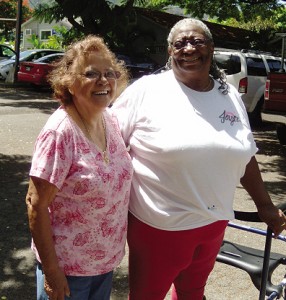
    Executive Director, Candice Carter (left) with 83 year-old Volunteer, Irene Oficial. Photo courtesy of Na Hoaloha.

    The majority of Na Hoaloha “Go Go” volunteers are 60 and older; some are in their 80s and helping others who are much younger. At 83, volunteer Irene Oficial is full of life, energy and kindness. She is helping younger seniors get to their doctor appointments, pick up medications and buy food.

    Irene came to Na Hoaloha when she was 80 and had never before volunteered. When asked why she reached out to Na Hoaloha, Irene said she didn’t want to stay home. She enjoys being around people and wants to help others. At first, she volunteered as a caregiver, giving respite for families who provide around-the clock-care for their loved ones. Irene is no stranger to caregiving; she took care of her own mother.

    Because she loves to drive, today Irene is a Na Hoaloha “Aloha Cruisers” driver (10 of whom are in their 80s) and on the road two or three days a week driving a homebound elder couple. When she talks about her volunteer work, she sparkles.

    If you have a few hours a week to help keep our Maui kupuna in their homes, please volunteer with Na Hoaloha. Helping your neighbors can make a world of difference in someone’s life — ESPECIALLY YOURS.


    Na Hoaloha — Wailuku, Maui
    808-249-2545 | www.nahoaloha.org
    Na Hoaloha “Go Go” volunteers donate thousands of hours to serve Maui homebound seniors. On any given day throughout the year, there are Na Hoaloha volunteers driving a homebound senior, making a visit or helping family caregivers — with a mission to help Maui’s kupuna remain independent and stay in their homes for\ as long…

  • Preserving Dignity and Happiness

    Dignity is vital to self worth throughout our lifetime; in the later stages of life, preserving a sense of respect and honoring the individual is especially important. Rarely will anyone argue this point. However, unless careful planning and clear communication is established early on, issues with regard to health, living situation and end of life decisions can often result in family arguments — that could have been avoided.

    It is crucial that we take the time to think about what is truly important to us concerning our health, where we want to live and how we want to die — some simple, straight-forward tips:

    • Family: it’s our greatest asset but their love for us can be the biggest roadblock when it comes to discussing our wishes with them. When facing chronic illness or cancer, it is important that your family thoroughly understand your illness and how it is affecting your well-being. Always allow your family to express their fears, but be firm with your decisions and take the time to explain your decisions and why they’re important to you.
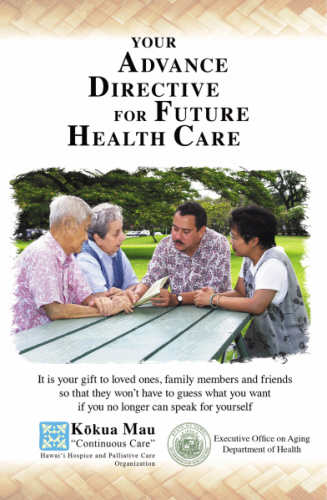
    • Advance Directive: having it is strongly recommended and should be discussed with your doctor. The Advance Directive is a simple form that must be signed by you and your physician. Once established, it provides clear instruction for your doctor should you be unable to speak for yourself during a health crisis. It also removes the pressure for your family on making critical decisions.

    So remember, don’t worry about the things you cannot change, make changes that are needed, then live life to its fullest!


    HiHomeCare, 745 Fort Street, Honolulu, HI 96813
    808-356-HELP (4357) | info@hihealthcarehawaii.com
    hihealthcarehawaii.com

    Dignity is vital to self worth throughout our lifetime; in the later stages of life, preserving a sense of respect and honoring the individual is especially important. Rarely will anyone argue this point. However, unless careful planning and clear communication is established early on, issues with regard to health, living situation and end of life…

  • When Hiring Private Caregivers…

    The first thing that many families face in hiring a private caregiver is whether to use someone referred to them by a friend or to hire from an agency.

    The questions are: How well do you know the person? Who is responsible if there is an untoward incident? How has the caregiver been screened? Were professional references verified? Clinical skills competency testing is generally conducted by the agencies. Some agencies use nationally accredited and validated skill tests.

    Factors to consider on hiring a private caregiver:

    • Carefully examine licenses and certifications. Agencies should be conducting prime source verification with the proper authorities: U.S. Office of the Inspector General (OIG), Racketeer-Influenced and Corrupt Organizations (RICO) and State Boards documentation should be readily available to you, the client.
    • Ask for a criminal history background check (CHBC) or documented drug clearance. Federal law requires nationally certified agencies to conduct CHBC tests. Drug screening is done according to employer or agency policy.
    • Ask for proof of insurance. Professional and Commercial General Liability Insurance is important protection for the patient, family and their personal valuables.
      The management of an agency should be readily available 24/7 when problems arise.

    An agency with a professional Registered Nurse or Nurse Practitioner in charge will have well established quality control of services rendered. And an agency can replace a caregiver who becomes ill or unable to work.


    Kahu Malama Nurses, 1357 Kapiolani Blvd., Suite 850
    808-951-0111 | www.kahumalama.com

    The first thing that many families face in hiring a private caregiver is whether to use someone referred to them by a friend or to hire from an agency. The questions are: How well do you know the person? Who is responsible if there is an untoward incident? How has the caregiver been screened? Were…

  • Elder Advice Day: What Can We Learn?

    Let’s make Thanksgiving the day we celebrate Elder Wisdom by asking older people to tell us their advice for living.

    Our society portrays older persons as sick, frail, unproductive, and even the culprits for busting the federal budget.

    We have become segregated by age such that young people’s contact with elders is almost exclusively within the family. It’s time to make a change. Our elders’ multitude of life experience is a unique source of advice for younger generations. What’s truly valuable are the many lessons our elders have learned in life and their desire to impart their knowledge to younger generations.

    Here are some questions that might be great to ask elders you know:

    What are some of the most important lessons you feel you have learned over the course of your life?

    • As you look back on your life, do you see any turning points, key events or experiences that changed the course of your life?
    • What are the secrets to a happy marriage?
    • What important choices or decisions have you learned from?
    • What do you know now about living a happy and successful life that you didn’t know when you were thirty?
    • What are the major values or principles that you live by?

    Let’s declare Thanksgiving ‘Elder Advice-Giving Day.’ Our elders won’t be here forever, so start this year!


    HiHomeCare, 745 Fort Street, Honolulu, HI 96813
    808-356-HELP (4357) | info@hihealthcarehawaii.com
    hihealthcarehawaii.com

    Let’s make Thanksgiving the day we celebrate Elder Wisdom by asking older people to tell us their advice for living. Our society portrays older persons as sick, frail, unproductive, and even the culprits for busting the federal budget. We have become segregated by age such that young people’s contact with elders is almost exclusively within…

  • We Have To Stop Falling…!

    Senior fall injuries are serious and deadly. One senior will be taken to the ER every hour — for injuries from a fall. Many of these patients will die or never return home to resume a normal life. The pity is that most falls are preventable.

    As we age we lose muscle strength, reaction time is much slower, and balance is compromised. Seniors must take personal responsibility for our own safety.

    Broken hips may set off heart attacks and strokes. Preventing a fall prevents a host of subsequent injuries, so there are big reasons to get serious and prevent falls.

    What can you do to be proactive?

    • Review your medications. Ask your doctor or pharmacist about over-the-counter drugs and supplements too — medications can cause dizziness.
    • Maintain good vision. This helps with balance and safety. Have your eyes checked at least yearly.
    • Balance and strength are essential. Plan exercise activities and do simple movements every day: walk, garden, yoga, swim, dance, Tai Chi.
    • Make your home safer. Things underfoot cause us to trip and fall. Remove fall hazards by keeping pathways open and free of objects.

    For further information call the Department of Health Injury Prevention Program in Honolulu at 808-733-9202. Or go to www.nogethurt.Hawai‘i.gov for educational videos, home safety checklist and a listing of tai chi classes and fall prevention services near you.

    Senior fall injuries are serious and deadly. One senior will be taken to the ER every hour — for injuries from a fall. Many of these patients will die or never return home to resume a normal life. The pity is that most falls are preventable. As we age we lose muscle strength, reaction time…

  • Independence Starts at Home!

    When we celebrate the 4th of july with family, friends, food and fireworks, it is a time to remember what it means to be free.

    With many of our aging, recuperating or ill ‘ohana, independence means being able to receive quality care in the privacy and comfort of their own homes. Home healthcare is not just about doctors, nurses, aides and companions providing safe, quality care in the home; it’s about the right to remain independent as long as possible, even to the end of life.

    Home is familiar. Home is comfortable. Home is where most of us want to be when ill. The ability to age and get well in the comfort of your own home surrounded by family and friends helps keep the spirit of independence alive.

    Fourth of July is also about patriotism. Being patriotic is not just about pledging allegiance to the flag and believing in American values, it is about being proactive in our community, and making things better for the young and the old.

    Nurses, home health aides and companions emulate patriotism by caring for their fellow citizens and providing quality health services rain or shine, most likely without glory or recognition. These caregivers give back by providing all our seniors access to quality home care.

    Let’s commend all the caregivers who are committed to our ‘ohana and by supporting the value and dignity of home healthcare, we are protecting our most vulnerable citizens, our fellow Americans!


    HiHomeCare, 745 Fort Street, Honolulu, HI 96813
    808-356-HELP (4357) | info@hihealthcarehawaii.com
    hihealthcarehawaii.com

    When we celebrate the 4th of july with family, friends, food and fireworks, it is a time to remember what it means to be free. With many of our aging, recuperating or ill ‘ohana, independence means being able to receive quality care in the privacy and comfort of their own homes. Home healthcare is not…

  • Better Support for Family Caregivers

    Hawaii’s family caregivers are starting to get the support they need. These caregivers are among the 247,000 sons, daughters, husbands and wives who help loved ones stay independently at home for as long as possible — providing help with everyday tasks.

    In mid-April nearly 500 Hawaii residents joined elder advocacy groups and resource providers in paying tribute to family caregivers at an event at the Japanese Cultural Center. The event was to recognize the extraordinary contributions they make, highlight helpful community resources and provide an update of recent legislative efforts to support caregivers and their families.

    During the 2014 legislative session AARP supported a measure that would allow family caregivers be more involved in the patient healthcare process. Senate Bill 2264 (the CARE Act) was a Kupuna Caucus bill backed by many House and Senate legislators and community groups. It was intended to give caregivers the instruction needed to safely care for loved ones when they’re discharged from the hospital.

    AARP believes caregivers should be informed and recognized for their role in coordinating the care of loved ones transitioning from hospitals to home. Research found that family caregivers are under pressure to provide increasingly complex medical tasks — like wound care, injections, and medication management — when loved ones return home from the hospital. Caregivers often receive little or no training to provide care and are often the only option available to families, who may not be able to afford professional home care.

    How serious are the challenges facing Hawaii’s caregivers? The answer may be found in personal stories of caregivers like Keri Yamamoto, a caregiver and occupational therapist, whose uncle was admitted twice last year to a local hospital. She was “highly dissatisfied” with the discharge procedure. She testified in Support of SB 2264. On Maui, caregiver Michele Paularena, also supported the bill when her husband was discharged from the hospital without adequate instructions on how to administer the medications prescribed.

    While SB 2264 did not survive this session, the House Finance Committee passed a concurrent resolution (HCR 78) that calls for the establishment of a family caregiving working group to examine and assess the role of caregivers in the hospital discharge process. AARP welcomes the opportunity to work with hospitals and community stakeholders to ensure caregivers are properly instructed in the care of loved ones at discharge.

    Hawaii needs coordinated care putting patients and families first. As our population ages, it’s essential that family caregivers are supported and our community recognizes the limits of what they can do on their own.


    AARP Hawai‘i state office:
    808-545-6024 | Toll-Free: 866-295-7282
    www.aarp.org/hi | facebook.com/AARPHawaii
    twitter.com/AARPHawaii

    Hawaii’s family caregivers are starting to get the support they need. These caregivers are among the 247,000 sons, daughters, husbands and wives who help loved ones stay independently at home for as long as possible — providing help with everyday tasks. In mid-April nearly 500 Hawaii residents joined elder advocacy groups and resource providers in…

  • Doc, Follow My Orders

    Momi and Roland are a retired couple living in Central O‘ahu. Last year Roland learned he has incurable lung cancer and has been in the hospital several times. The couple has had many conversations together and with the doctors. Because of his short life expectancy and desire for quality of life, he has decided to forgo aggressive life-prolonging treatments although he still wants hospitalization if needed. His doctor recommended that he put his wish to let nature take its course in writing in a document called POLST (Physicians Orders for Life-Sustaining Treatment). This form, signed by his doctor, will ensure that his healthcare wishes be carried out if he is not able to speak for himself at anytime. It also helps put Momi at ease, since she is the one who will be called on to make decisions for Roland if he is unable.

    One night, Roland has problems breathing. Momi calls 911 and the paramedics arrive. Knowing her husband’s wishes, Momi wants to be sure that if her husband’s heart or breathing stop en route to the hospital, he can have the natural death he desires. She runs to the kitchen, grabs the completed and signed POLST form hanging on their refrigerator, and hands it to the paramedics. Momi can now feel a sense of relief that her husband’s treatment wishes will be followed, even if she’s not around to tell his medical providers.

    So, what is a POLST, and how does it work? A POLST is a portable doctor’s order that makes you or your loved one’s wishes for treatment known. Portable means that it is valid wherever the patient is, whether it is at home, in an ambulance, in an emergency department or anywhere in the hospital or a nursing home. It is for people with a chronic debilitating illness or a life-limiting disease, such as end-stage lung or heart disease, a terminal cancer or anyone who may be approaching the end of their life.

    How is the POLST different from an Advance Healthcare Directive (AD)? POLST is completed by you and your doctor and turns your healthcare wishes into orders for healthcare providers and ambulance personnel to follow. An AD is a form that you and everyone over 18 should have to document your values and future wishes for healthcare, and allows you to appoint an agent to act as your health care power of attorney in the event you are unable to speak for yourself. The combination of the POLST and AD will help make sure your wishes are known even if you cannot speak for yourself.

    Be just as prepared as Momi and Roland! By talking about these issues ahead of time, you can prevent crisis, relieve stress and ensure that your family’s healthcare wishes are honored. Take action and start the conversations today. To learn more about the POLST and AD or to download forms, visit www.kokuamau.org.


    Kokua Mau
    Hawaii Hospice and Palliative Care Organization
    808-585-997 | info@kokuamau.org
    www.kokuamau.org

    Momi and Roland are a retired couple living in Central O‘ahu. Last year Roland learned he has incurable lung cancer and has been in the hospital several times. The couple has had many conversations together and with the doctors. Because of his short life expectancy and desire for quality of life, he has decided to…

  • Home Care for Stroke Survivors

    Gernations - 2014-12-01 - Homecare for Stroke Survivors - Image 01

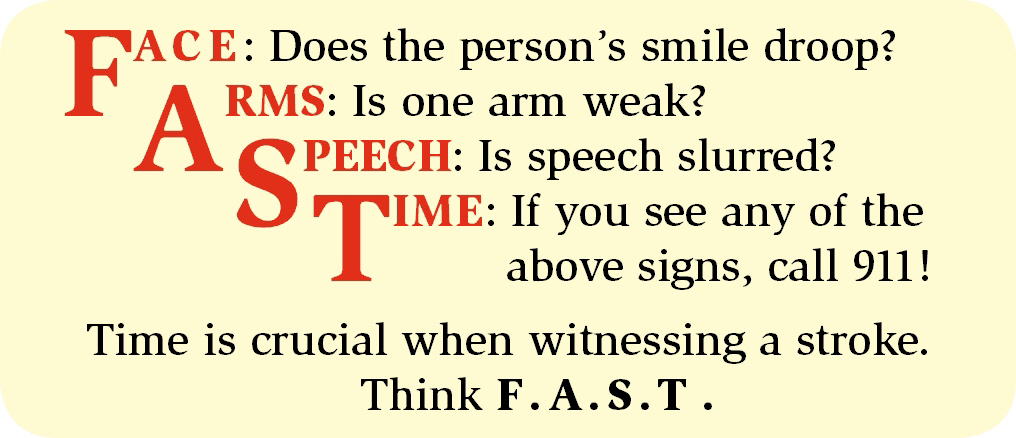
    Caring for stroke survivors at home can be overwhelming for anyone. Getting outside help from home care agencies can make a difference in your ability to balance your life with your loved one’s needs.

    Ask the following questions to find a trustworthy company with qualified, reliable caregivers who are also compassionate and dedicated.

    Does the provider send a Registered Nurse (RN) to meet the family and develop a plan of care for the caregivers to follow?

    As part of the admission process, an RN Clinical Manager should meet you and your family at the home, assess the family dynamics, perform a head-to-toe physical assessment, provide a home safety inspection and develop a customized care plan for the caregivers to follow. An RN should be available to you 24/7 to provide support.

    Are caregivers supervised and evaluated by a Registered Nurse?

    On a regular basis an RN should:

    • Perform assessments of the patient and make any changes to the care plan
    • Ensure that the family is satisfied with the caregiver and the services the agency is providing
    • Assure the family that they are there as a resource for all parties


    HiHealthCare, 745 Fort Street, Honolulu, HI 96813
    808-534-7815 | info@hihealthcarehawaii.com
    hihealthcarehawaii.com

    Caring for stroke survivors at home can be overwhelming for anyone. Getting outside help from home care agencies can make a difference in your ability to balance your life with your loved one’s needs. Ask the following questions to find a trustworthy company with qualified, reliable caregivers who are also compassionate and dedicated. Does the…

  • Conversations About Wishes

    Gernations - 2014-12-01 - Conversations About Wishes - Image 01 Auntie K was having trouble breathing at home and her son called 911. She is now in the Intensive Care Unit. The doctor asks the family, “What would your mother want us to do if she could speak for herself right now? She’s having more trouble breathing. Do you want us to “‘do everything?’”

    Unfortunately, this is a very common scenario at hospitals in Hawai‘i. Sometimes, even when people have thought about these things and discussed them with their doctor, they haven’t sat down and talked with their family. And, yet, it is the family that the doctors and nurses turn to for answers.

    No one says that conversations about these things are easy. They are not easy. So how do you get started? Who should be involved? In Hawai‘i, one place to turn is Kokua Mau, Hawai‘i Hospice and Palliative Care Organization. Kokua Mau knows these conversations are crucial and it invites you to use its free resources to help explore options and begin the conversation.

    Kokua Mau is a group of volunteers from many organizations and professions who have joined together “to weave a lei of caregiving and support so that the people of Hawai‘i facing serious illness can live in the place of their choice, with relief of pain and suffering and according to their values, beliefs and traditions.” (Kokua Mau Mission Statement)

    Gernations - 2014-12-01 - Conversations About Wishes - Image 02Kokua Mau has information for individuals, families and health professionals. Its website (www.kokuamau.org), has direct links to community resources, such as downloadable Advance Directive forms and printable information that covers topics that we often find difficult to talk about. For instance:

    • If someone is not able to eat, what are the pros and cons of tube feeding? (You can view or download a guide for decision making about tube feeding on Kokua Mau’s website.)
    • What is POLST? (Physicians Orders for Life-Sustaining Treatment, a portable doctor’s order that makes your wishes known.)
    • What are the pros and cons of CPR for someone who is elderly and frail? (Did you know that among this group CPR is less than 5 percent effective?)

    Along with written resources, Kokua Mau has a Speakers Bureau that can meet with your group to start the conversations that we all need to have.

    As our state’s nonprofit hospice and palliative care organization, Kokua Mau recently received national recognition with the 2013 Trailblazer Award from the National Hospice and Palliative Care Organization.

    So, what happened with Auntie K? Fortunately her son and other family members began to remember that when her brother had been hospitalized, Auntie K had spoken of what she would want if that happened to her. Because of this, they were able to come together as a family and follow her wishes. The members of Kokua Mau hope that with the use of its free resources, none of you will ever end up at the bedside of your loved one wondering what she or he would have wanted.


    Kokua Mau, Hawai‘i Hospice & Palliative Care Organization
    808-585-9977 | info@kokuamau.org
    www.kokuamau.org

    Auntie K was having trouble breathing at home and her son called 911. She is now in the Intensive Care Unit. The doctor asks the family, “What would your mother want us to do if she could speak for herself right now? She’s having more trouble breathing. Do you want us to “‘do everything?’” Unfortunately,…

  • Reverse ParentingReverse Parenting

    The role of being a “reverse parent” didn’t occur to me until I dropped off my father on his first day at adult day care. While walking back to my car, I said to myself, I hope the day care doesn’t call me and say they’re sending him home because he soiled his clothing or worse yet; he got into a scuffle with another senior.

    I chuckled to myself, Wow, now I’m the parent taking care of my father. The roles have been reversed.

    I tell my fellow baby-boomer friends; we’re reverse parents. I get laughter and sometimes I get head shaking. In Hawai‘i and across the nation, there are adult children (like me) who are caring for their parents. A role few of us are prepared to take on. Caregiving blindsides many of us.

    My father passed away November 2007, and then the reverse parent role started again two years later with my mother. I tell friends, “I have an 86-year-old daughter.” And just like anyone else — regardless of age — she wants to be heard … and, gratefully, I have learned to listen. This is one thing I’d like to tell my fellow baby boomers to do — ask … and listen. My mother has told me many stories that are “pearls.” For example, her father, my maternal grandfather, was a fisherman on the aku boat. She explained how he had very strong arms and legs, as it wasn’t an option for a him to tell the boat captain that he needed to take a break while the fish were still biting.

    Another pearl involved my paternal grandparents who worked for the first governor of Hawai‘i, Joseph B. Poindexter. My grandfather was the chef and my grandmother (“Baba”) was one of the servers. She wore traditional kimono while serving dinner guests at the Governor’s Mansion. President Franklin D. Roosevelt appointed Poindexter for two full terms, 1934 through 1942. He was among the first to advocate Hawai‘i’s statehood, yet that endeavor was interrupted in December of 1941 when the Japanese attacked Pearl Harbor.

    My mother told me that on the day of the surprise attack on Pearl Harbor, my grandfather was planning to go out fishing in his small boat that he had moored at Kewalo Basin. For some reason he decided against it, but his friend did go out to sea. In the mayhem that occurred, he was mistaken as being part of the Japanese Navy disguised as a civilian and was killed.

    I’m fortunate to own a home care agency and have a brother who puts in just as much time and effort caring for our mother. My brother and I do the night shifts and one of our employees cares for my mother during the day. However, for families that don’t that level of support, there are respite programs, adult day care centers, transportation services and support groups in the community. Each family is unique, and needs different resources. If you want to discuss options available for caring for your parents, feel free to call 545-3700 or visit www.ComfortingHandsHawaii.com.

    The role of being a “reverse parent” didn’t occur to me until I dropped off my father on his first day at adult day care. While walking back to my car, I said to myself, I hope the day care doesn’t call me and say they’re sending him home because he soiled his clothing or…

  • Your Health, Your Home, Your Choice!

    It’s only natural to want to stay at home. So being informed about good caregivers and their services can enrich your home experience by making everyday tasks a little easier and safer. The services you need depends on your and health strategies and type of support, as well as your financial and insurance situation.

    Ask the home care agency how they ensure safe, qualified, professional service:

    Q. What types of screenings are performed before hiring a caregiver?

    A. For your safety and health benefits, be sure the caregiver has been pre-screened properly and is qualified. Here is a checklist to help guide a wise decision:

    □ Federal and State Criminal Background Checks

    □ Drug Screening (ten panel)

    □ Sex Offender Check (all 50 states)

    □ Medical Disciplinary Screening

    □ Employment and Education Verification

    □ Professional and Personal Reference Checks

    □ Office of the Inspector General (OIG)

    □ Social Security Check

    □ Adult / Child Protective Services Screening

    □ DMV Motor Vehicle Report

    Q. Are caregivers bonded and insured through the Home Care Agency?

    A. The agency should provide you proof of current professional liability, general liability, workers’compensation and temporary disability insurance.

    Q. Who is the caregiver employed by?

    A. Caregivers should be employees of the agency and not an independent contractor. If they work more than 20 hours a week on a regular basis they are eligible for health care under the Prepaid Health Care Act.

    Never compromise on quality and safety!


    HiHealthCare, 745 Fort Street, Honolulu, HI 96813
    Main (808) 534-7815 | Fax (808) 356-5014
    info@hihealthcarehawaii.com | hihealthcarehawaii.com

    It’s only natural to want to stay at home. So being informed about good caregivers and their services can enrich your home experience by making everyday tasks a little easier and safer. The services you need depends on your and health strategies and type of support, as well as your financial and insurance situation. Ask…