Category: Editorial

  • Aging in Hawai‘i – A Moving Experience

    An interview: Author Dan Ihara, Realtor Associate, The Ihara Team — Keller Williams Honolulu
    An interview: Author Dan Ihara, Realtor Associate, The Ihara Team — Keller Williams Honolulu

    With your experience in working with seniors, what have you discovered about their status in terms of being prepared to age in place?

    There are many questions that families have as their parents age. Many adult children have never had to provide care for a senior. When they begin, they soon find it is not an easy task. Assisting your parents as they age in place seems like a good idea until we realize how much time it takes to provide meals, and clean and maintain an additional house, along with continuing our own career and meeting life’s demands. Also, some seniors need assistance with dressing, personal hygiene or even transferring from a bed to a chair or the dinner table. Fortunately, there are home care companies that can come into the home to provide those services. At some point, many seniors are choosing a retirement community, where all of their needs can be taken care of. Many parents today do not want to burden their children and are opting to learn more about retirement communities and care homes.

    What concerns do you hear expressed at your real estate workshops and what solutions are
    available in Hawai‘i?

    Some of the biggest questions we hear are “Where do I go if my home is not the best place for me? How much does it cost? What does life look like if I moved there?” There are many options for our kūpuna who are seeking living alternatives. Services in Hawai‘i are available to help families in transition. It starts with first identifying the next best residence. The next step is to aid them with planning and making the move. Once settled in their new home, they will need help with preparing their property for a successful sale by helping to remove personal belongings and cleaning, repairing items and staging the home. This is instrumental in their journey as the sale of their home is likely going to be used to pay for their care.

    What are some options to enable parents to pass on their wealth, assets and knowledge on to their children?

    Having a clear, written trust document and sharing your wishes with your children will help mitigate possible family disputes when you’re gone. If you have an investment property and would like to help create generational wealth while you’re living, there are specific strategies that can be utilized to reach those goals. This can be done with a strategic approach by executing a 1031 Exchange. A 1031 Exchange, also called a Starker Exchange or Like-Kind Exchange, is a powerful and effective tax-deferment strategy. This strategy allows an investor to “defer” paying capital gains taxes on an investment property when it is sold as long another “like-kind property” is purchased with the profit gained by the sale of the first property. To use this strategy effectively, you must exchange one property for another property of similar value. Using this process, capital gains will be avoided, at least temporarily. An investor will eventually pay taxes, but in the meantime, can trade properties without incurring a sudden tax obligation. (Due to the COVID pandemic, the IRS is allowing anyone with a 180-day exchange period deadline between April 1 and July 15 an automatic extension to July 15.)

    Why is Generations Magazine so important to our kupuna community?

    Generations Magazine is the only real resource for our kūpuna in Hawai‘i.  Time and time again, we have heard from our seniors that learning how to adjust during this phase of life is valuable. The articles and lessons in the magazine have become a priceless resource for our community. Please keep it up!

    There are many questions that families have as their parents age. Many adult children have never had to provide care for a senior. When they begin, they soon find it is not an easy task. Assisting your parents as they age in place seems like a good idea until we realize how much time it…

  • What I’ve Learned… Thus Far

    What I’ve learned is about just that: What I’ve learned these past 16+ years since I entered this field called “aging.” I was 42 years old and didn’t know a whole lot about retirement planning, Social Security or health issues, let alone caregiving and Alzheimer’s. Most people in that age range don’t think about this stuff; however, it is important to think ahead to when we get older and/or about our parents own aging and health issues.

    As 58-year-olds we begin to have our own health issues. For example, many people over the age of 55 are taking some kind of medication to address high blood pressure and/or cholesterol as those problems are quite common among baby boomers. However, I am working hard to stay off the meds and stay active with playing softball, golf and many other sports-related activities.

    I’ve learned that most women and wives will outlive their spouses

    So guys, be nice to your wives as they will be pushing your wheelchair and driving you to the doctor’s office. You will wake up one morning and say to your wife, “Honey, I made 80 years old! Can I have my favorite breakfast of eggs, Portuguese sausage and rice?” Your wife will say, “No. Your doctors said you need to eat oatmeal and fruit.” Guess what you will eat!

    I’ve learned stress kills and causes such diseases as cancer, and other problems

    Stress can lead to heart attacks and strokes. Why do you think most of the Medicare Advantage health plans come with “Free” YMCA, 24 Hour Fitness or Silver Sneakers memberships? They don’t want you in the hospital and nor should you want that for yourself. Stress from work, your children or caregiving duties causes many of our chronic diseases, so exercise 30-40 minutes a day by walking, jogging, swimming. Play sports — there are a number of senior softball, golf and bowling clubs — even archery, tennis and pickleball leagues.

    I’ve learned that pedestrian safety can’t be taken lightly

    As one of the first volunteer speakers on the topic, I know that all of us have to take pedestrian safety seriously. If you are a pedestrian, you need to be diligent when
    walking our streets, whether you are downtown or in your neighborhood. If a car is coming toward you, you need to look that driver in the eye and make eye contact and do not enter the crosswalk until you know they see you. Living their busy lives, drivers are rushing around to work, picking up their kids and/or on their phones. Just because you are in a crosswalk you are not totally safe as there are no concrete walls protecting you.

    What I’ve learned is about just that: What I’ve learned these past 16+ years since I entered this field called “aging.” I was 42 years old and didn’t know a whole lot about retirement planning, Social Security or health issues, let alone caregiving and Alzheimer’s. Most people in that age range don’t think about this…

  • Is It Time for Medicare?

    Were you a high school senior in 1972, singing Alice Cooper’s classic hit, “School’s Out” (for Summer)? Then you may be turning 65 soon and wondering if you need Medicare insurance. Figuring it out on your own may leave you clicking through a lot of scam websites and staring at a mountain of brochures and flyers that arrived in the mail. Medicare was created in 1965 to provide security and peace of mind, not cause you to lose your mind, patience or your money.

    These tips will help you keep your cool:

    ◆ Call Social Security at 1-800-772-1213 or visit their website at www.ssa.gov, at least three months before your 65th birthday to ask them to determine your Medicare eligibility and enrollment dates.

    ◆ Contact the employee benefits specialist for your own or a spouse’s current or former employer to see if you qualify for retiree medical insurance benefits.

    ◆ Check with Medicare at 1-800-633-4227 or www.medicare.gov to learn about Medicare premiums, late enrollment penalties and Medicare insurance options available in your county.

    The peace of mind that comes with understanding how Medicare works will have you humming a different tune: “Summertime” (and the Living is Easy)!


    MEDICARE MOMENT WITH MARTHA
    A radio program with Martha Khlopin
    KHNR-690AM:
    Sat., 2 pm–2:30 pm, Sun., 9:30 am–10 am

    808-230-3379 | getmartha@aol.com

    Were you a high school senior in 1972, singing Alice Cooper’s classic hit, “School’s Out” (for Summer)? Then you may be turning 65 soon and wondering if you need Medicare insurance. Figuring it out on your own may leave you clicking through a lot of scam websites and staring at a mountain of brochures and…

  • Aging in Place: Community Strategies

    Older adults typically want to live in their own homes for as long as possible. A 2012 report from AARP showed that only 65 percent of persons aged 60-70 and only 43 percent of those aged 70 and older find it very easy to live independently. Besides making physical environments age-friendly, what needs to happen to enable older adults to safely age in place?

    Optimize existing communities

    Some communities with high concentrations of older adults were designed from scratch to address their needs. However, most age-dense neighborhoods or apartments/condominiums were not; residents have simply grown older and aged in place. The density of older residents in some could allow economies of scale and also ease the provision of in-home services for providers.

    Natural helping networks

    The strength of grassroots Aging in Place models or strategies relies on the potential for “natural helping networks” to develop and provide informal support to complement more formal health and social services. Informal support from peers typically entails help with “small services,” such as checking up on a neighbor, initiating a “buddy system,” keeping each other updated on local events, providing companionship, or even developing a volunteer corps of peers to address locally defined needs. Engaging in natural helping networks can transform an older adult from a “passive service recipient” to an active contributor to the wellbeing of neighbors and the community.

    Natural support systems

    For Aging in Place strategies to flourish, we need to develop ways to foster natural support systems in age-dense neighborhoods and apartments or condominiums, and to develop partnerships among the stakeholders of those settings. Such partnerships would include older residents, their peers, volunteers, family, friends, service providers, and building owners and managers. A number of residential managers of local public housing and condominiums in Hawai‘i are taking important first steps by attending brief workshops on various aspects of aging, thus learning to provide more supportive environments for their residents who are aging in place.

    A little extra help is often all that is needed for an older resident to age in place. Aging in Place models advocate the use of local peer networks to provide that extra help, to be supplemented by more extensive formal in-home services as needed. Such a community-based approach could result in an affordable and client-based system to keep older persons in their homes and avoid costly and undesired relocations.

    Grassroots social support models

    Grassroots social models of support such as the Village Model, Cohousing, and Age-Friendly Cities and Communities represent some of the latest efforts to strengthen social environments to allow older adults to live in their homes for as long as desired.

    Learn more

    The Village Model
    www.bit.ly/CreatingAVillage

    Cohousing
    www.bit.ly/WhatIsCohousingAbout

    World Health Organization
    www.bit.ly/AgeFriendlyWorld 


    CENTER ON AGING — University of Hawai‘i at Mānoa
    2430 Campus Road, Gartley Hall, 201B, Honolulu HI 96822

    808-956-6124  |  map3@hawaii.edu
    www.hawaii.edu/aging/

    Older adults typically want to live in their own homes for as long as possible. A 2012 report from AARP showed that only 65 percent of persons aged 60-70 and only 43 percent of those aged 70 and older find it very easy to live independently. Besides making physical environments age-friendly, what needs to happen…

  • The Life of a Centenarian

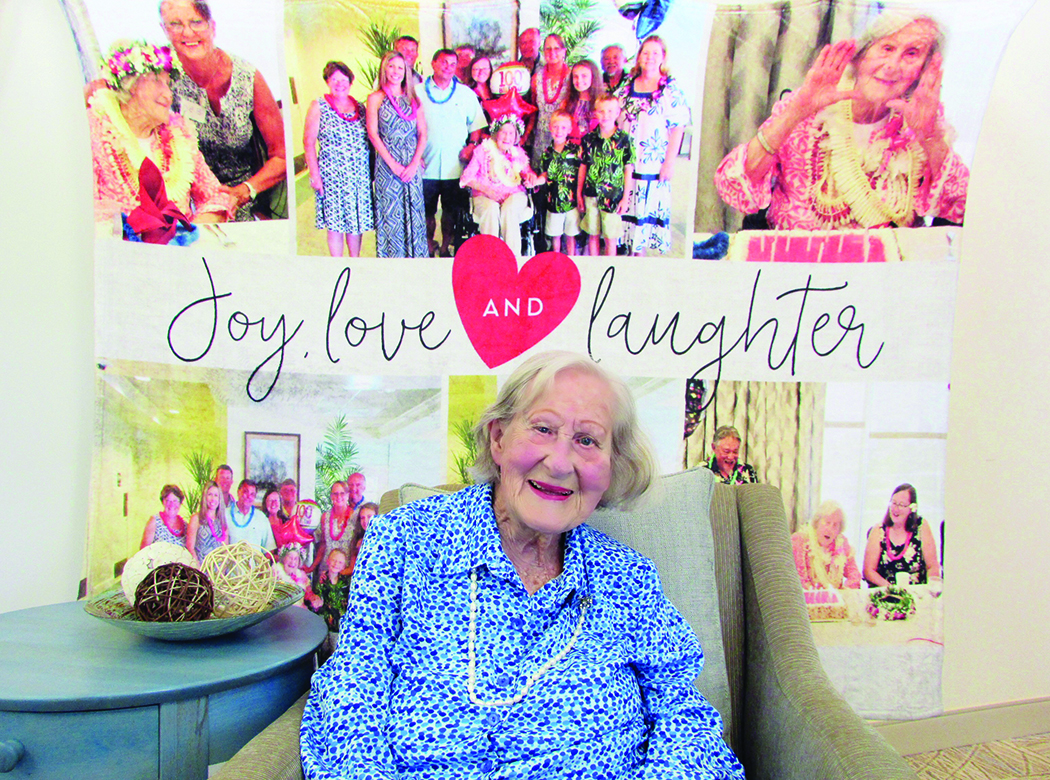
    Turning 100 is no small feat, but Mrs. Lenora Cho made it look easy when she officially became a centenarian in 2017. Lenora, a small-town girl from back East, found ways to stay active early on in life: in high school, she played basketball and softball.

    Upon graduating high school, Lenora took a beautician course, but joined the Army when she was in her 20s, becoming one of the 140,000 women who served and proved vital to the war efforts.

    After another female soldier had to return to the mainland from Hawai‘i when they were en route to Japan, Lenora stayed to do clerical work at Fort Shafter. That is where she met her husband, David Cho, of whom she says with a smile, “He was my boss.” They were married at the Fort Shafter Chapel.

    Lenora’s fondest memories are from serving in the military and the time she spent with her husband. Today, she enjoys staying active by doing regular exercise at her home at Arcadia, where she is honored every Veterans Day for her service to our country.

    To celebrate her milestone 100th birthday last year, Lenora’s family came from the East Coast and now a blanket of photos from that wonderful occasion hangs proudly in her room.

    Turning 100 is no small feat, but Mrs. Lenora Cho made it look easy when she officially became a centenarian in 2017. Lenora, a small-town girl from back East, found ways to stay active early on in life: in high school, she played basketball and softball.

  • Hawai‘i and Hanafuda Pō‘ai

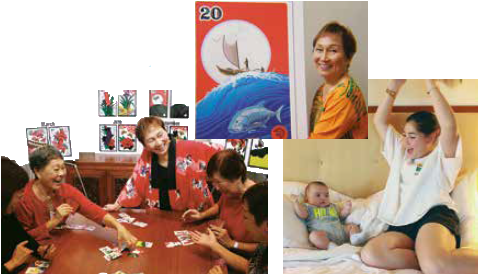
    Helen Nakano, at top, enjoys a game with the ladies and cherishes her grandchildren, Arielle, 15, and Matthew, 10 months.
    Helen Nakano, at top, enjoys a game with the ladies and cherishes her grandchildren, Arielle, 15, and Matthew, 10 months.

    I started Hanafuda Po¯‘ai (friendship circles), where players of all ages can come together to play, socialize. We now have two groups, Na Ku¯puna Makamae at the historic pumping station in Kakaako, and at Lanakila Multi-Purpose Senior Center. We want to grow our po¯‘ai. A lot of seniors live by themselves. When you see a young kid playing with an old person, it’s very magical and wonderful!

    My granddaughter, Arielle Spivack, is 15, but she was just 5 when I taught her to play hanafuda on one of our trips to her home in California.

    I advised Arielle to play hanafuda with boys she was interested in dating later. I told her, “You can find out if they are poor losers, impatient with slower players, or gracious winners.” These are character traits that carry over into their daily interactions with people, young and old.

    My grandson, Matthew Nakano, is just a baby and is great fun. I can’t wait to teach him how to play hanafuda! He giggles a lot and loves people.

    It will be great fun to see if all his “Hanafuda Aunties” and I can develop the winning skills of Hawaii’s youngest hanafuda player!


    HANAFUDA PO‘AI

    808-927-0993   |  www.hanafudahawaii.com

    I started Hanafuda Po¯‘ai where players of all ages can come together to play, socialize. We now have two groups, at the historic pumping station in Kakaako, and at Lanakila Multi-Purpose Senior Center. A lot of seniors live by themselves. When you see a young kid playing with an old person, it’s very magical

  • Healthy Habits of a Centenarian

    Yukiko Murata, who will turn 102 in March, has a sharp wit and sunny outlook on life. To stay healthy, she eats fresh foods, takes classes at the University of Hawai‘i and plays hanafuda (Japanese card game) every Thursday at the Lanakila Senior Center, together with her daughter, Joanne Murata, and son-in-law, James Kramer. Yukiko shared advice with Generations Magazine:

    What’s your secret to a long life?

    I laugh too much. It just comes naturally to me. Every day is another day. Today and tomorrow might be another day. It may be good or bad. You don’t know. Every day is something you look forward to, and I think I enjoy that. I’m 101. Next thing you know, I’m going to be 102.

    What are your healthy habits?

    I eat anything, but I don’t eat too much sugar. I don’t get a mai tai. I say, don’t drink orange juice from a can. Eat a fresh orange. It’s juicy.

    What advice do you have for younger generations?

    Be kind to everybody. You have to be forceful, too, because times are different. Take the time to teach your children. Take the time to be a lifelong learner. Whatever you learn is for your own good. You’ll be happy, really happy.

    What are your goals for 2018?

    I’m going to Vegas! If somebody says, ‘Hey Mom, you’re going to go to Vegas,’ you’re not going to say, ‘What?’ You’ll say, ‘Let’s go next week.’ I’m really lucky, health-wise. I never use a cane, yet. I can walk. I catch The Bus, walk UH campus and go to class. (Agriculture and gardening classes). It’s a good feeling. The younger students call me Grandma.

    ukiko Murata, who will turn 102 in March, has a sharp wit and sunny outlook on life. To stay healthy, she eats fresh foods, takes classes at the University of Hawai‘i and plays hanafuda (Japanese card game) every Thursday at the Lanakila Senior Center, together with her daughter, Joanne Murata, and son-in-law, James Kramer. Yukiko…

  • Age Bias in the Workplace

    Bias is everywhere, including the presumption that you might be too old to work even when lengthening lifetimes allow you to do more for much longer. Nobody says it is easy for those of us in our 50s, 60s, or beyond, to overcome what others may think.

    Age bias is not just a myth but a fact to deal with in this new time of longer life spans. It is our task to learn to deal with common biases and meet the harsh realities of change. Here are some ways:

    BIAS 1: Older workers are too expensive. Forget what you once earned. Your contribution is worth what the market pays. Study marketplace pay scales before interviewing. Demonstrate your skills’ return on investment, based on their priorities and your ability to help their bottom line.

    BIAS 2: Older workers can’t learn as well as younger workers. (This is the “old dogs can’t learn new tricks” bias.) Don’t get caught with your learning down! Demonstrate what you have learned, particularly skills that will help a prospective employer or client.

    BIAS 3: Older workers are inflexible and set in their ways. (Boomers themselves set this myth in stone, and many have reaped what was sown.) Demonstrate how you have adapted to new challenges in work environments. Keep your change examples focused on describing relatively recent workplace efforts and results. Stick with 10 years or less. Nobody cares what you did before then.

    BIAS 4: Older workers are “age discrimination lawsuits” waiting to happen. Although it is more likely that people over the age of 50 will win age discrimination lawsuits than people over the age of 40 (legally protected class by the Feds), proving disparate treatment is not an easy task and a painful outcome for all involved. This is the hidden fear no employer discusses. On the contrary, demonstrate your flexibility to manage challenges the employer (or client) faces.

    BIAS 5: Once people reach their 60s, they really are too old to work. One in four people in Hawai‘i is 60 today. Chronological age bias is a hangover from the past. Don’t volunteer your age. Period. Take a self-marketing class from a qualified, mid-late career coaching expert who will ensure that you have skills to prove your energetic contribution based on relevant knowledge.

    BIAS 6: Older workers cannot adapt to new technologies. What is new in technology today is old tomorrow. Choose to continue to learn throughout your working lifetime. The single  biggest challenge in using technology is your own self-confidence. Take classes at a community college or through a senior center. Dive into the tech pool. The water is fine! And highlight your “technological currency” in your tools and during interviews.  N


    NEW WORKFORCE HAWAI’I

    Carleen MacKay, Co-Founder
    913-316-0143  |  carleenmackayhi@gmail.com
    www.newworkforcehawaii.com

    Bias is everywhere, including the presumption that you might be too old to work even when lengthening lifetimes allow you to do more for much longer. Nobody says it is easy for those of us in our 50s, 60s, or beyond, to overcome what others may think.

  • Love Through the Ages

    As we grow and mature through the years, we learn about different kinds of love.  As children, we received love from our parents and learned about the love we felt for our friends and peers.

    Our 20s was an important time. We learned to love ourselves. Loving who we are prepared us to love others. It was an exciting time, followed by intimate relationships, having children or pets and, later in life, connecting with the community and the world by traveling or volunteering.

    Dr. John Gray, author of Men Are From Mars Women Are From Venus, has written that full, adult maturity happens around age 56. As humans,
    we have so many stages of life to experience that it takes us a long time to master the many varieties of love. By the time we are in our 50s, we have developed a greater capacity. Often, the quality of our relationships improves when we have developed the understanding, acceptance and compassion for the people we share our lives with. We realize how precious love is.

    Let me share an example of how we can live a love-filled life. Sheila came to see me because her husband had died from cancer right after her second daughter got married. Sheila had planned to travel and retire with her husband, but now she was left alone. She had friends, but she didn’t want to bother them with her sadness. Her daughters were busy with their careers and husbands. She wanted to date, but she wasn’t attracted to the men that she met. She thought they all seemed “too old” for her even though they were around her age.

    Everything in her life was a problem. She continually focused on what she didn’t have. As we worked on her “Circle of Life” (from my book), she realized that her life was really good. She had her health. She could still play tennis and loved mahjong, so she called up some friends to play. Her daughters both had babies. She would babysit for them and feel the closeness of their families. She didn’t sleep well, so she’d listen to podcasts so she wouldn’t be so lonely at night.

    Slowly over time, she began to feel more hopeful. Friends invited her for dinner, and she had things to talk about. She began to feel like she could go on in her life. She has been able to build her life in a direction that feels hopeful for her. Her life is an example of how maturity allowed her to shift her love from the loss of her husband to the other people that were in her life.

    Love changes throughout our life span. If we  allow ourselves to love and be loved, we will have love through all the stages of our lives.


    MARS & VENUS COUNSELING CENTER

    www.mitzigold.com 808-737-6277 (737-MARS)

    Our 20s was an important time. We learned to love ourselves. Loving who we are prepared us to love others. It was an exciting time, followed by intimate relationships, having children or pets and, later in life, connecting with the community and the world by traveling or volunteering.

  • Making Sense of Widowhood

    Recently, I was having dinner with a number of close girlfriends and their daughters. Afterwards and on the road home, my daughter commented that I was the only woman at the event who was not widowed. My friends are all in the early to mid-60s. Of course, I knew this about each friend. As a gerontologist, I also know the statistics about widowhood.

    Still, my daughter’s comment shook me. I know that in 2015, roughly one in four, or 25 percent of people 65 and older, was widowed. Of the nearly 14 million widows and widowers in the U.S., 11 million of the widowed are women. The percentage of those widowed dramatically rises with age, for both sexes, but more so for women.

    These numbers sadden me. The thought of losing my husband is something I dread. But widowhood is a statistically ‘‘normal’’ experience for older persons, especially older women. While widowhood is considered one of the most distressing transitions experienced by older adults, we are reminded of other older women — and men — who never have been married or are divorced. Meeting one’s needs for love and intimacy varies substantially by many individual preferences and factors, such as one’s orientation, financial status, disability and even feelings of disapproval by younger family members and society.

    But, for most people, and regardless of age’s life transitions and challenges, we crave intimacy, friendships and love from our partners, our families, our friends and others in our lives. Here are some thoughts to consider.

    First, we acknowledge that there are many ways to meet emotional and intimacy needs. For an interesting book to read, I recommend
    Aging Thoughtfully: Conversations about Retirement, Romance, Wrinkles, and Regret by Martha C. Nussbaum and Saul Levmore, Oxford University Press.

    Second, it is time to debunk all of those denigrating myths about older adults, especially those around older women, that announce that aging women must graciously renounce sexual love, leaving it to the young. Recent research tells us mature love is both sexual and personal and that sexuality in older adults is highly personal, based upon memory, humor and shared history. For that reason, it can have a depth that youthful love can’t have. So, we need more knowledge and healthy attitudes about meeting emotional and sexual needs and feelings of older adults living in the community or in long-term care settings.

    Finally, let’s remember that we are talking about grown-ups here. How you handle this issue should be completely up to you. Don’t let others tell you what you want or don’t want, or what you can do or not do. Between consenting adults, there is no right or wrong way to do this.

    Love doesn’t always endure. We need more women, and men, to move away from stereotypes and to explore their own truths. But that is another story.


    MYRON B. THOMPSON SCHOOL OF SOCIAL WORK
    UNIVERSITY OF HAWAI‘I
    2430 Campus Rd., Gartley Hall, Honolulu, HI 96822

    808-956-6126
    cbrowne@hawaii.edu

    Recently, I was having dinner with a number of close girlfriends and their daughters. Afterwards and on the road home, my daughter commented that I was the only woman at the event who was not widowed. My friends are all in the early to mid-60s. Of course, I knew this about each friend. As a gerontologist,…

  • Hospice Hawai’i Taps New Leader

    In 1979, 11 visionary pioneers founded a non-profit organization dedicated to helping people die with dignity in Hawai‘i. Since then, Hospice Hawai‘i’s remarkable team has been committed to enhancing the quality of life of patients and their families through an interdisciplinary approach to care. The care provided allows individuals to remain at home or in their chosen setting in order to live life to the fullest.

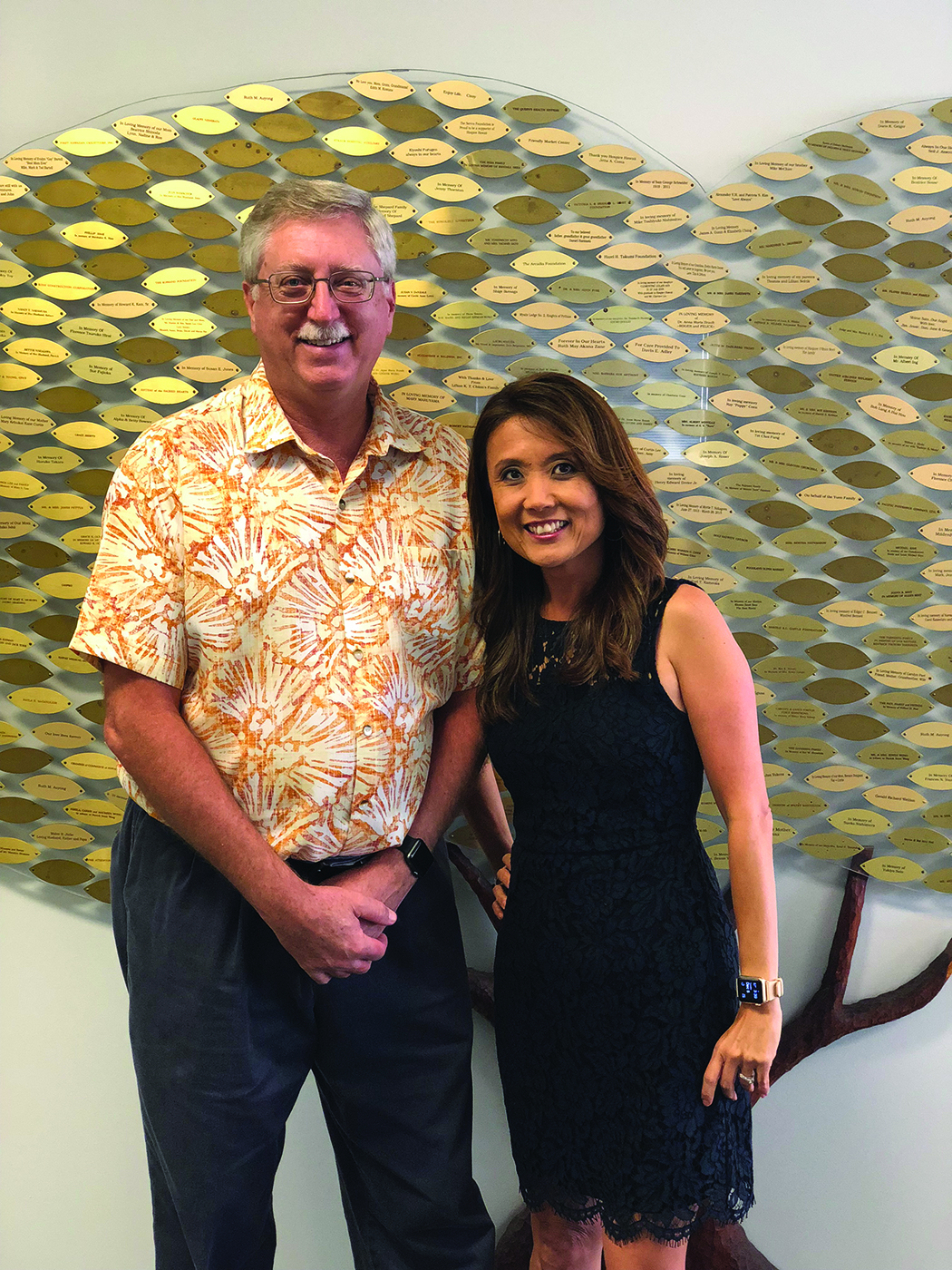
    Photo of Ken Zeri and Tori Abe Carapehlo
    Ken Zeri and Tori Abe Carapehlo

    Hospice Hawai‘i recently welcomed a new president/CEO, Tori Abe Carapelho. She replaces Ken Zeri, who retired after 31 years of service in hospice care. Carapelho looks forward to building upon Zeri’s legacy of shaping community values toward hospice and palliative care, collaborating with other healthcare professions and expanding Hospice Hawai‘i’s services to continue providing high-quality care to patients and their families.

    Carapelho joined Hospice Hawai‘i in 2008 and served as chief strategy officer, overseeing marketing and fundraising, admissions, leadership, special projects and strategy development. Carapelho aims to perpetuate Hospice Hawai‘i’s mission “to bring hope, reduce fears and impact lives,” and dispel certain myths about hospice care.

    “I’ve got big shoes to fill, and it’s important to me to be strategic and thoughtful as we look at future opportunities,” Carapelho says. “It is my hope that people will eventually be comfortable enough to discuss hospice freely.”


    HOSPICE HAWAI‘I
    808-924-9255  |  www.hospicehawaii.org

    In 1979, 11 visionary pioneers founded a non-profit organization dedicated to helping people die with dignity in Hawai‘i. Since then, Hospice Hawai‘i’s remarkable team has been committed to enhancing the quality of life of patients and their families through an interdisciplinary approach to care. The care provided allows individuals to remain at home or in…

  • Where Do Our Seniors Live?

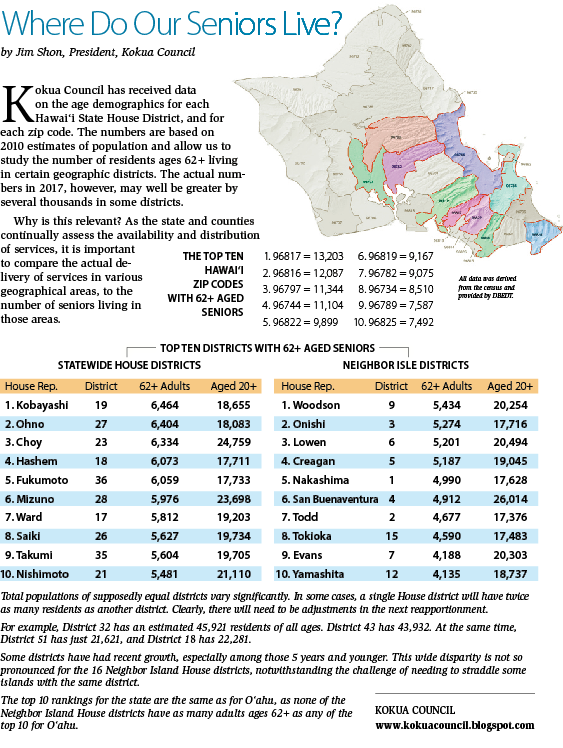
    Kokua Council has received data on the age demographics for each Hawai‘i State House District, and for each zip code. The numbers are based on 2010 estimates of population and allow us to study the number of residents ages 62+ living in certain geographic districts. The actual numbers in 2017, however, may well be greater by several thousands in some districts.

    Why is this relevant? As the state and counties continually assess the availability and distribution of services, it is important to compare the actual delivery of services in various geographical areas, to the number of seniors living in those areas.

    Where do our seniors live?


    KOKUA COUNCIL
    kokuacouncil.blogspot.com

    Kokua Council has received data on the age demographics for each Hawai‘i State House District, and for each zip code. The numbers are based on 2010 estimates of population and allow us to study the number of residents ages 62+ living in certain geographic districts.