Category: November 2010

  • Do You Really Want to be a Trustee?

    You were named as successor Trustee of a trust created by a family member or friend, and that person just died. What now? Before you rush in, think about what awaits.

    Until you sign on the dotted line, the fact that you have been named as a trustee does not obligate you to accept that position. Decide carefully, because once you accept the job, you accept all that goes with it. It is a position of great honor, and it involves great responsibility.

    A trustee is what the law calls a fiduciary. A fiduciary is a person who is responsible for taking care of something that belongs to someone else. Under the law, fiduciaries are answerable to the beneficiaries (and possibly the Court) for the things they do—or fail to do.

    A trust is a legal relationship that results when a person (who we’ll call the trustmaker) makes a written agreement with a trustee to handle stuff for the benefit of beneficiaries. (“Stuff” is what the author calls everything a person owns. It could include real property—land and buildings— and personal property—everything else). Your primary duty as a trustee is to read, understand, and faithfully follow the terms of the trust agreement.

    When the trust agreement is made, the trustmaker transfers stuff to the trustee. The trustee actually becomes the legal owner of the stuff. However, the beneficiaries are the ones who are supposed to benefit from the stuff. Chances are, you will hear from them if they are not receiving the benefits they expect.

    The “dark side” of serving as a trustee is that you can be held personally liable in the event that you do something you shouldn’t have, or you fail to do something you should have, and the trust is harmed as a result. Even if you acted with a pure heart and noble intentions, you could have to reach into your own wallet to restore any losses to the trust.

    Before you rush into the job of trustee, be sure to determine whether you can devote adequate time and attention to the job, be armed with a clear understanding of the trust agreement and your duties, and have a team of legal, accounting, financial, and other advisors at your side to help you do your best by the beneficiaries.


    SCOTT MAKUAKANE is a lawyer whose practice has emphasized estate planning and trust law since 1983. He hosts Est8Planning Essentials, a weekly TV talk show which airs on KWHE (Oceanic channel 11) at 8:30 p.m. on Sunday evenings. For more information about Scott and his law firm, Est8Planning Counsel LLLC, check out www.est8planning.com

    You were named as successor Trustee of a trust created by a family member or friend, and that person just died. What now? Before you rush in, think about what awaits. Until you sign on the dotted line, the fact that you have been named as a trustee does not obligate you to accept that…

  • Decision Time About Benefits

    One of the rites of fall for most employees is the opportunity to review and revise their benefit options for the next year (the next benefits year could start in January or sooner). This is often referred to as the “open enrollment” period. Typically, all employees of a company or organization can make adjustments to their benefit options at this time.

    Although the opportunity is there to make changes, many employees do little more than confirm the benefits they already have in place. Failure to act during the open enrollment period may represent a missed opportunity. For today’s worker, retirement plans, health care coverage and other important benefits represent a significant piece of overall compensation. More effective management of the benefits available to you can, in effect, represent a pay raise.

    Changes in the law that impact your benefits:

    The health care reform law that passed in March includes several changes that will begin to take effect with your employer’s new benefit year (after September 23, 2010). The biggest that impact employee benefits are:

    • Dependent health insurance coverage – parents with adult children no longer in school can now include them as part of their dependent care coverage up to the child’s 26th birthday. To qualify, children must not have access to coverage through another employer (either their own or their spouse’s workplace).
    • Flexible Spending Accounts (FSAs) — FSAs allow individuals to save pre-tax dollars in an account designed to reimburse them for out-of-pocket medical expenses. Beginning in 2011, purchases of overthe-counter medications will no longer qualify for reimbursement from an FSA, except in cases where a physician prescribes them. If you defer income into an FSA, you should consider what is an appropriate amount given the new limitations for over-the-counter medications. It is also a good time to begin preparing for a future change to FSAs. Beginning in 2013, the maximum that can be set aside in an FSA will be limited to $2,500/year. You may want to accelerate spending for costly procedures (such as dental or orthodontic work) in advance of this change. Accurate planning is critical with FSAs, because any money leftover at the end of the plan year is lost.

    Given the important role that benefits play in your overall financial picture, the decisions you make should not occur in a vacuum. Your financial advisor can help assess what changes to your benefits might be advantageous for your overall financial position. An advisor can also provide perspective on how to plan for your long-term goals as they relate to your workplace compensation package.


    Michael W. K. Yee, CFP®, CFS, CRPC® Senior Financial Advisor Ameriprise Financial, Inc. 1585 Kapiolani Blvd., Suite 1100 Honolulu, HI 96814, Tel: 808-952-1222 ext 1240 “This communication is published in the United States for residents of Hawaii only; and this advisor is licensed only in the state of Hawaii.” Brokerage, investment and financial advisory services are made available through Ameriprise Financial Services, Inc. Member FINRA and SIPC. Some products and services may not be available in all jurisdictions or to all clients.

    One of the rites of fall for most employees is the opportunity to review and revise their benefit options for the next year (the next benefits year could start in January or sooner). This is often referred to as the “open enrollment” period. Typically, all employees of a company or organization can make adjustments to…

  • Covering Every Season of Life

    The cool winds and changing leaves are telltale signs—another autumn has arrived. Sometimes it’s hard to believe how quickly the seasons change and the years pass by. Whatever season of life you happen to be in, it may be a good time to reflect on the protection you have through Social Security.

    Each stage of life—from the spring of youth to the summer of middle age to the autumn of retirement—comes with its own set of financial concerns. And in each situation, Social Security is there to help.

    Of the more than 53 million Americans receiving Social Security benefits, nearly one-third are not retired workers or their dependents. They’re disabled workers and their families, or the survivors of a deceased worker. These non-retirement Social Security benefits can be especially important to young workers because about one-in-eight young people will die before retirement, and about one-in-four will become disabled.

    While the death of a husband, wife or parent is emotionally devastating, it often can be financially devastating as well. Social Security provides a monthly survivors benefit payment to help the qualified family members of a deceased worker.

    Social Security disability protection is equally valuable. Few workers have an employer-provided, long-term disability policy. With Social Security, however, the average worker has the equivalent of a disability insurance policy. The policy pays monthly benefits to workers and their families, based on the workers’ lifetime earnings. So you can rest a little easier knowing that Social Security provides some measure of security, if life does not turn out as planned.

    On the other hand, if you do work and retire as planned, Social Security serves as the foundation for a secure retirement. Social Security is the largest source of income for most elderly Americans today, but Social Security was never intended to be your only source of income when you retire. You also will need other savings, investments, pensions or retirement accounts to make sure you have enough money to live comfortably.

    The Social Security Statement that you receive in the mail each year provides an estimate of your retirement, survivors and disability insurance benefits. If you’d like to try out some different scenarios and see how various retirement ages and future earnings may change your retirement picture, visit our online Retirement Estimator at www.socialsecurity.gov/estimator. It provides an instant, personalized estimate of your future benefits.

    And perhaps the best news of all is that it’s easier than ever to apply for retirement benefits. You can do it right from the comfort and convenience of your home or office by visiting www.socialsecurity.gov/applytoretire. It can take as little as 15 minutes.

    Whether you’re young or old, Social Security is there through every season.


    You can find out more at www.socialsecurity.gov.

    The cool winds and changing leaves are telltale signs—another autumn has arrived. Sometimes it’s hard to believe how quickly the seasons change and the years pass by. Whatever season of life you happen to be in, it may be a good time to reflect on the protection you have through Social Security.

  • Medicare and Las Vegas

    Now that we have your attention … Medicare is available in all 50 states and territories, including Las Vegas. Now is the time to review your Medicare options for both health and drug plans. Medicare Open Enrollment is November 15th to December 31, 2010, but you can compare options beginning October 15, 2010.

    Every year, there are new Medicare prescription drug and health plan choices available. Open Enrollment is the time of year when Medicare beneficiaries can review their current health or prescription drug plans, compare what will be available in the new year, and choose the plan that best meets their needs. There’s never been a better time to check out Medicare options. With the new health care law, there are new benefits, including lower prescription costs, wellness check-ups and preventive care. Comparing plans may save Medicare beneficiaries money, get better coverage, or both.

    Information is available several ways and here are three easy steps:

    STEP 1: Have a list of your current prescription medications available. Check with your current providers (doctors office, physical therapist, etc.) to find out what plans they will accept so that you can still see them. Calculate your gross income and assets (so you can be screened for financial assistance to help with some, or all, of your medical costs).

    STEP 2: Compare plans that will be available in Hawai‘i in 2011.

    • Visit www.medicare.gov to get a personalized comparison of the costs and coverage of the plans available in your area.
    • Call 1-800-MEDICARE (1-800-633-4227) 24-hours a day/7 days a week to find out more about your coverage options. TTY users call 1-877-486-2048.
    • Get one-on-one help from the Hawai‘i State Health Insurance Assistance Program (SHIP), also known as the Sage PLUS Program. A certified volunteer can be reached at 808-586-7299 or 1-888-875-9229. You can also pick up a Sage PLUS Medicare Prescription Health/Drug Plan

    Compare Form from your nearest pharmacy or online at www.hawaiiship.org. Mail or fax the form in for a personalized comparison.

    STEP 3: Enroll in a plan early so that you can enjoy the holiday season.

    From January 1, 2011 to February 14, 2011 is a one-time disenrollment opportunity if you want to change from your current Medicare Advantage (MA) Health plan and return to Original/Traditional Medicare. If your MA plan includes drug coverage, you will also have the opportunity to enroll in a supplemental Medicare Prescription Drug Plan.


    If you feel overwhelmed, don’t hesitate to call the Sage PLUS Program for guided assistance through the Medicare Open Enrollment Process. Call us at 808-586-7299 or 1-888-875-9229.

    Now that we have your attention … Medicare is available in all 50 states and territories, including Las Vegas. Now is the time to review your Medicare options for both health and drug plans. Medicare Open Enrollment is November 15th to December 31, 2010, but you can compare options beginning October 15, 2010.

  • Living Beyond…

    Aging is inevitable; it is a process of growing old. However, it should not influence an individual’s life expectancy. We are able to live long and healthy lives if we live a healthy lifestyle by exercising, eating right, and for some, taking medications as prescribed by a health care provider.

    “Healthy aging” helps us take control of a natural part of life. There is no one way to age healthy. It is about making good habits a part of our everyday living. Simple things like drinking more water can have a huge effect on how we age. Do you take the stairs when in a building, or do you ride the elevator? Do you walk to the mailbox, or use your vehicle? Do you limit snacking, or snack on healthier choices, such as fruits, vegetables and items made from whole grains? Making small adjustments to various bad habits benefit us immediately and in the long run.

    Being physically active can involve things like taking walks or outdoor sports. Staying active makes our joints and muscles move, reducing stiffness and further joint pain. Staying active also increases metabolism so that food is not stored as fat. Walter Breuning, the oldest known man in the world whom just celebrated his 114th birthday on September 21, 2010, said that hard work and eating right are both ways to age healthy.

    Another way to age healthy is to get a good night’s sleep. According to the National Institute on Aging, “getting enough sleep helps [us] stay healthy and alert” (Age Page). Sleep gives our body time to recharge and it also prevents us from being tired throughout the next day.

    Already have a chronic condition? You can still “put life back in your life.” Better Choices Better Health, or Chronic Disease Self Management Program (CDSMP) workshops, are being held throughout Hawai‘i. This is an evidence-based program developed through Stanford University. Its research shows that people can have an increased quality of life through self-management skill building.

    The Elderly Affairs Division of the Department of Community Services City & County of Honolulu is currently conducting Better Choices Better Health workshops island wide. These workshops are open to individuals 60 and older with any chronic condition, such asthma, diabetes, heart disease, stroke, arthritis, cancer, high blood pressure, obesity or fibromyalgia. The workshops are also available to caregivers and others who may live with a loved one who has a chronic condition. Support systems are welcomed to register. During these self-management workshops the focus is on staying active and enjoying life even with an ongoing health problem.


    For more information about Better Choices Better Health, or to sign-up for workshops, call the Senior Helpline at (808) 768-7700

    Aging is inevitable; it is a process of growing old. However, it should not influence an individual’s life expectancy. We are able to live long and healthy lives if we live a healthy lifestyle by exercising, eating right, and for some, taking medications as prescribed by a health care provider. “Healthy aging” helps us take…

  • National Hospice Month

    We celebrate hospice care not because of the death of a loved one, but because of the transformative journey each family might experience. At Hospice Hawai‘i, that opportunity for transformation is at the very heart of all we do with a terminally ill person and their family. Hospice staff and volunteers are guides to an entire family as they, together, live out the rest of the life of a loved one. For some families, an expert hospice worker can be a beacon of light in an otherwise dark and fearful situation.

    Hospice staff can provide the setting and opportunity for families to reconnect and, in some cases, reconcile old wounds. They can bring relief of pain and suffering, offering a good night’s rest for both the patient and the family. Hospice also offers very practical support to the family by teaching care giving as a person’s overall condition changes.

    We celebrate hospice because of the profound lessons hospice can share with each individual they work with. Quoting the Rev. Mitsuo Aoki, who recently passed away this summer, the Hospice Hawai‘i Chaplain Clarence Liu reminds us of three such lessons: We must embrace death to find love, we must walk through loneliness to find solitude, and we must walk through anger to find forgiveness.

    As we celebrate National Hospice month we are also reminded of the very practical impact hospice care has on our society. Patients and families who receive hospice care have very high levels of satisfaction and suffer less distressing symptoms, such as pain and achieve a higher degree of preparation for the end of life. Our own experience at Hospice Hawai‘i is that a family who has had hospice care is better prepared to deal with the normal grief. Our emphasis on the whole person and their whole family, with particular attention to each individual’s experience means that their care is individually tailored to them.

    National Hospice month reminds us all that hospice care is not just about keeping someone comfortable until they die…at Hospice Hawai‘i it is about bringing hope, reducing fears and impacting lives.

    Take time this month to reach out to someone in need; your life will be better for it.


    Kenneth L. Zeri, RN, MS, NHA, President & Chief Professional Officer Hospice Hawai‘iHe has more than 25 years of experience in hospice and palliative care. He is the current president of Kokua Mau, a statewide hospice and palliative care organization, and serves on various professional organization committees on a local and national level; including, Aloha United Way, Healthcare Association of Hawaii, the National Hospice and Palliative Care Organization, and Hospice & Palliative Nurses Association.

    For many years, we in Hawai‘i have joined our colleagues across the nation in celebration of National Hospice month. Observed in November, it is a time when we come together to give thanks, reflect on the past year and look forward to the next. We remember those who have passed away and we recall our…

  • Make AARP the Next Chapter in Your Life

    Across the state, Hawai‘i’s AARP chapters offer rewarding opportunities for friendship, education, advocacy and volunteer service. On O‘ahu there are three AARP chapters in Honolulu, Pearlridge and Wai‘anae.

    The Honolulu Chapter (Chapter 60) meets for lunch on the first Wednesday of every month at the Hale Koa Hotel, where guest speakers talk on such diverse topics as legislation and entertainment. Some members enjoy attending special events and engaging in community service activities. Others donate their time teaching AARP Driver Safety classes or preparing tax returns through the AARP Tax-Aide program.

    “Everyone has a different reason for joining a chapter,” says T. J. Davies, treasurer of the Honolulu Chapter, which has more than 100 active members. “I’m not the kind of person to sit around. I’m able to give my time to something that I believe in. I believe in helping people in my community to the best of my ability.”

    Create The Good is another community service initiative offering opportunities for chapter members to get involved. AARP launched Create The Good nationally last year to encourage boomers and older Americans to make a difference in their communities and help solve pressing local problems. Create The Good expands on traditional ways to volunteer. It connects people with simple but meaningful activities, time-flexible opportunities, and a wide variety of areas of interest. Find out more at www.createthegood.org. Or call Jackie Boland at AARP Hawai‘i at 545-6003.

    Whatever you’re interested in, connecting with AARP through one of its O‘ahu chapters is a fun and rewarding way to connect with others in our community.

    Honolulu Chapter Contact: T. J. Davies at 593-1026 Meetings: First Wednesday of the month at the Hale Koa Hotel

    Pearlridge Chapter Contact: Larry Carrasco, Vice President, at 455-5658 Meetings: Second Thursday of the month at Flamingo Restaurant in Pearl City.

    Waianae Chapter Contact Zoe Jarvis at 696-3369 Meetings: First Friday of every month (location to be announced).

    Across the state, Hawai‘i’s AARP chapters offer rewarding opportunities for friendship, education, advocacy and volunteer service. On O‘ahu there are three AARP chapters in Honolulu, Pearlridge and Wai‘anae.

  • Fit for Life

    The objective at Club 50 Fitness is simple and direct: to improve the lives of people who are 40 years of age and above with fitness training and overall good health. As many Club 50 members will tell you, exercise is medicine! Just ask Rose, who says that exercise has been the best thing for her mentally and physically. “The days I’m tired or stressed, I have learned to let it go with exercising. I feel so much better after I leave,” she says. “I have maintained my weight for four years by just exercising. Everyone here is friendly, including the staff.”

    Club 50 Fitness on King St. is just the place to get your blood moving again. Club 50’s low-impact, easy-to-follow, 30-minute workout program can help you achieve your health and fitness goals. Its Hydraulic Resistance Training equipment offers six levels of adjustability with the turn of a knob, offering more challenge as you gain strength.

    For a free tour of Club 50 Fitness give Chris a call at 593-9292. If you are a senior, check your insurance plan’s gym benefits (HMSA, Kaiser, HMAA and Medicare Advantage) to see how you can workout at Club 50 Fitness for free.

    Non-seniors can mention Generations Magazine and get 50% off of the initial membership fee. Plus, courtesy of the gym, the first month’s dues will be waived. For more information, visit www.club50fitnesshawaii.com.

    The objective at Club 50 Fitness is simple and direct: to improve the lives of people who are 40 years of age and above with fitness training and overall good health. As many Club 50 members will tell you, exercise is medicine! Just ask Rose, who says that exercise has been the best thing for…

  • An Introduction to Adult Day Care

    It is 6:55 on Monday morning and a small group is gathering outside Lē‘ahi Hospital. Several women with walkers and wheelchairs wait with their sons or daughters for the Lē‘ahi Adult Day Health Center doors to open. The caregivers converse with each other and the ladies greet each other as they wait. As the doors open at 7:00, Mrs. G heads straight for a pedal exerciser for a morning warm-up. Others gather around a table and begin folding napkins that will be used later in the day. Some are chatting about their weekend activities and the weather. As the family members rush off to work, staff members are greeting new arrivals and assisting them to their seats. Another busy day has begun!

    All around our state, programs like this one are providing a cheerful, social environment in where assistance is available when needed. For family caregivers who have to work, these programs are a vital service to help keep loved ones at home.

    Many people imagine that “adult day care” is much like pre-school. In reality, day care programs are more like a club for seniors. While most newcomers are somewhat reluctant to attend at first, the center quickly becomes a comfortable place to go where friends, assistance and reassurance can always be found. The staff is trained to provide discreet assistance, while activities provide satisfactory outcomes regardless of physical and mental abilities. The predictable routine and familiar faces create a satisfying, normal day, even for individuals with memory loss. Participants often look forward to their days at the program as the highlights of their week.

    In addition to providing a social environment, day centers provide one or two meals per day and nutritious snacks in the morning and afternoon. Day Health programs can usually offer special diets and individual nutritional oversight. Group mealtimes are enjoyable and often foster better nutrition. At Waipahu Hale Adult Day Care, for example, the dining area has been fashioned into a bistro with a restaurant atmosphere.

    Activities in these programs are age appropriate and designed to be purposeful. Sakura House in Honolulu offers a culturally specific program that focuses on Japanese language, culture and food. Some programs feature intergenerational activities on a regular basis. The Seagull Schools Adult Day Care in Kapolei is co-located with a pre-school, resulting in regular interactions between keiki and kuˉpuna. Franciscan Adult Day Center in Maˉnoa enjoys rich interaction with various grade levels at St. Francis School. All-day programs offer a range of activities that offer mental, social, physical and spiritual enrichment.

    As providers of adult day services, our primary goal is to improve quality of life for both seniors and their families. We strive to help older adults maintain their functional abilities and stay safely at home for as long as possible. We never forget that we are also serving the caregivers who often need respite from the demands of giving care. Even when used on a part-time basis, two or three days per week, families have noted improvements in their loved one and increased ability to deal with the care giving task.

    Day Care FAQs

    Cost: Adult day services can range from $40 to $100 per day, depending on the level of assistance needed. Services are not covered by Medicare or medical insurance. Day Health is sometimes covered by Medicaid. Many long-term care insurance policies will cover day services. While the cost may seem high at first, over the course of an 8- or 10-hour service day, the average fee may come out to less than $5 per hour. Most programs do not pro-rate services on an hourly or partial day basis.

    Hours: Most programs are open from about 7 a.m. to 5:30 p.m. or 6 p.m., Monday through Friday. Saturday service is available at some centers and several programs such as Pearl City Hale and Waipahu Hale are open 365 days per year.

    ‘Day Care’ vs. ‘Day Health’: These are two different levels of care. ‘Day Care’ is mostly supportive, social-model care. ‘Day Health’ provides some nursing assistance and is required when a client has more complex medical needs. Those who are not ambulatory, or need help with toileting and/ or medication, may need Day Health.

    Licensing: In Hawai‘i, day service programs are regulated by the State of Hawai‘i and required to meet certain standards for certification. Any adult day care program serving five or more clients is required to have certification from the Department of Human Services. Day Health programs are licensed by the Department of Health.

    Benefits:

    Social stimulation is one of the most beneficial aspects of day programs. Interacting with people other than our own family, and using our social skills, often makes us feel sharper and more alert. This also helps to maintain our sense of identity and self-worth. It also brings us back to “normal” daily routines that we knew during most of our active lives.

    Participants in these programs gain a sense of satisfaction upon completion of their day. Even simple “horizons” like regularly scheduled meals or a 2 p.m. Bingo game help us to maintain our sense of orientation.

    Because activity uses energy during the day, most participants sleep better at night and may experience less waking up during the nights, allowing their caregivers much needed rest.

    Activity and the sense of purpose gained from participation may mean less depression and fewer health complaints. This can sometimes result in fewer doctor visits or emergency room trips.

    The program staff can also provide the family with regular reports, vital signs and other useful health information.

    Caregiver strain is often reduced because there is less worry if the loved one is in a safe, supervised environment and not home alone. Free time for self-care, to take a break or do necessary chores and errands is also important.


    For more information on local day care resources, you can visit the website of our statewide providers’ coalition, Adult Day Services Hawai‘i, Inc. at www.AdultCentersHawaii.com.

    It is 6:55 on Monday morning and a small group is gathering outside Lē‘ahi Hospital. Several women with walkers and wheelchairs wait with their sons or daughters for the Lē‘ahi Adult Day Health Center doors to open.

  • Peopleʻs Open Market

    Founded in 1973, the People’s Open Market (POM) was formed to accomplish three goals:

    1. Provide the opportunity to purchase fresh agricultural and aquacultural products and other food items at low cost.
    2. Support the economic viability of diversified agriculture and aquaculture in Hawai‘i by providing market sites for local farmers, fishermen or their representatives to sell their surplus and off-grade produce.
    3. Provide focal point areas for residents to socialize.

    More than 1 million people shop at the 25 market sites each year. Each market operates once a week and lasts about one hour. Prices are usually 35% lower than retail stores. The POM staff closely regulates the markets. The staff conducts weekly price surveys at various stores to determine a recommended price for the POM vendors to follow. Vendors may sell below, but not over, the recommended prices. The staff also supervises the arrival and departure of the POM vendors to ensure safety for both vendor and consumer. Each vendor is monitored to ensure that they comply with all city, state and federal government rules and regulations, ordinances and laws affecting their participation in the POM.

    TYPES OF PRODUCE

    At the POM, you will find many kinds of ethnic fruits, vegetables and other food items that are not ordinarily available in grocery stores. Depending on the ethnic make-up of the neighborhood, you’ll find a variety of foods associated with the different ethnic groups. Fresh ocean and pond fish, as well as farmed shrimps and prawns, are available—many sold live. In addition, a variety of Hawai‘i-grown flowers, such as ginger, orchids and anthuriums are for sale.

    HISTORY OF THE OPEN MARKETS The beginning of the open markets is attributed to Mrs. Joyce Fasi. After hearing concerns of women in a discussion group regarding the high cost living in Honolulu and in particular the high cost of food, she relayed these thoughts to her husband, then Mayor Frank F. Fasi. Hence, the People’s Open Market was started to assist farmers with selling their “off-grade,” “ungraded” and surplus produce while lowering food costs for the citizens of Honolulu.

    The first People’s Open Market (POM) was started at the Banyan Court Mall location in Kalihi in November, 1973. People in other communities began requesting their own POMs. Soon, a caravan of POM farmer/vendors was traveling to various sites to help the public purchase low-cost food items.

    The city requires all vendors to be authorized to accept food stamps to help those who are on fixed incomes.

    SHOPPING TIPS

    The People’s Open Market (POM) vendors are bound by a set of rules and regulations, which ensure that the POM operates smoothly and fairly for vendors and as well as customers. It is the vendors’ responsibility to see that their customers follow the rules and regulations. They are subject to citations and disciplinary action, including dismissal from the program for failure to comply with the rules and regulations.

    Please cooperate with the POM vendors. Here are some of the POM shopping tips:

    Plan ahead! There will be times that the market will start or end a little earlier or later than officially scheduled (5–10 minutes) due to certain conditions such as traffic, road conditions, school, weather, etc.

    Things to keep in mind:

    • Do NOT bag or ask vendor to reserve items before the start of the market (sound of an air Horn)!
    • Do NOT cut in lines that vendors have formed!
    • Do NOT shoplift!
    • Do NOT squeeze or mistreat fruits and vegetables (papayas, tomatoes, etc.)!
    • Do NOT bring animals (except seeing eye/ working dogs)!
    • Do NOT litter!
    • Do NOT ride bicycles through the shopping area. Park on the sides of the POM.
    • Do NOT park illegally, double park or block driveways!
    • Park in marked stalls ONLY!
    • Bring your own shopping bags, packages and cartons!
    • Be careful when the POM vendors’ trucks and vans are entering or leaving a POM site!
    • Be considerate of other shoppers!
    • Bring small bills and coins!

    More than 1 million people shop at the 25 market sites each year. Each market operates once a week and lasts about one hour. Prices are usually 35% lower than retail stores. The POM staff closely regulates the markets. The staff conducts weekly price surveys at various stores to determine a recommended price for the…

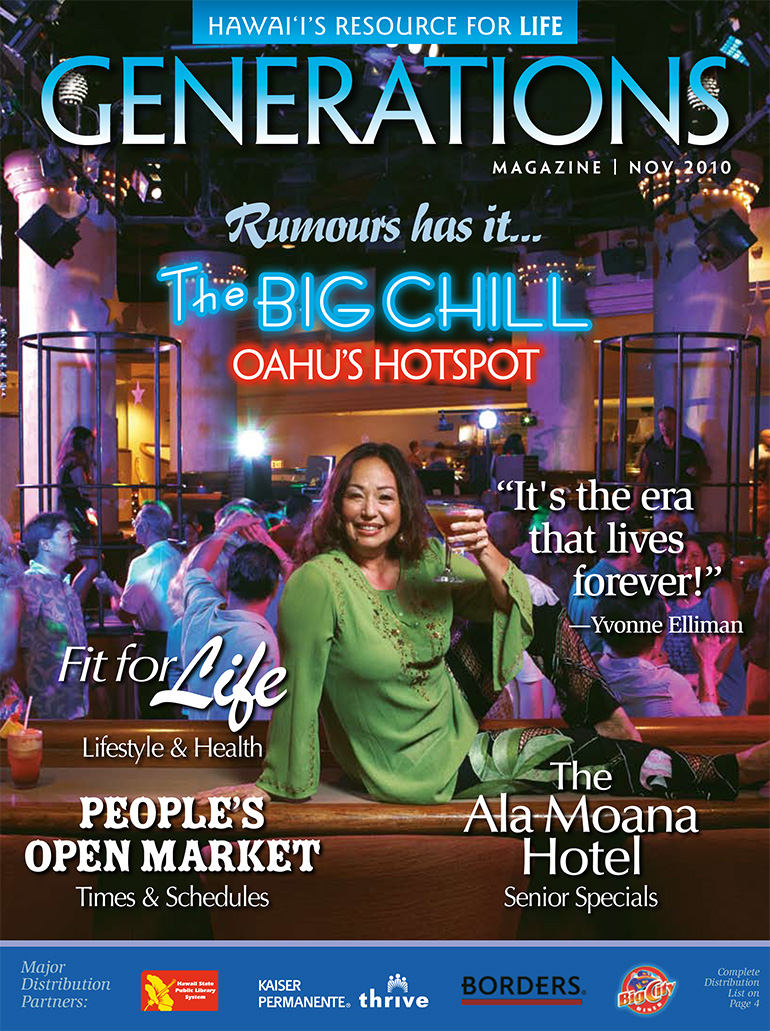
  • Rumours has it: The Big Chill

    Rumours has it: The Big Chill

    Remember watching the classic movie The Big Chill? Yes, it was the movie about a group of idealistic college buddies who had not seen each other for years. They reunite, reconnect and reminisce about the good ol’ days.

    The Big Chill, at Rumours Nightclub at the Ala Moana Hotel, was named after the classic movie. Malcolm Sur, the creator, original DJ and boogie man himself says he named the weekly event “The Big Chill” because he wanted a place where his friends could hang out, have a great time and party— something he felt Honolulu was lacking in the ‘80s.

    The Big Chill, home to the longest running nightclub in the state, is party central every Friday night. “Simply put, it’s all about the music,” Sur says.

    The passion for good music from “back in the day” still lives strong every Aloha Friday, from 5 p.m. to 9 p.m. For Friday-night regular, Jodi from Mililani, who has been coming to The Big Chill for more than 20 years, dancing is the greatest way to stay in good health and enjoy herself with good friends. “I’m with my girls, and no worries about work,” she says. “It’s Friday night!”

    Since 1984, Rumours Night Club has been a hotspot for company parties, class reunions and pau hana with friends. If you like to boogie down, it’s the place to go. The club has an extensive collection of hits from the ‘60s and ‘70s—from Motown and Marvin Gaye to The Temptations and Earth Wind & Fire. Then there are the “let’s get on the dance floor” songs by Rick James, Kool & The Gang and, of course, the King of Pop, Michael Jackson.

    According to Malcolm, there are people who have been coming to the club since day one. He calls them the “Original Chillers.” In fact, he heard of a story about an original chiller who recently passed away on the Mainland and in his obituary headline read, “Original Chiller is Gone.”

    Twenty-four years after opening, Malcom is starting to see some old familiar faces. The 20-somethings from the ‘80s are now empty nesters and are entering retirement. They have more free time … and they’re looking for a good time. Many of them are finding their way back to one of their favorite haunts, dancing the night away to the tunes of their times. Even Yvonne Elliman, a celebrated Hawai‘i recording artist from the ‘70s, still loves to come down to Rumours and groove to tunes like, “Play That Funky Music White Boy.”

    With new general manager Vince Depietro and assistant manager Pauline Keb, expect more to come in terms of parties. “Rumours Night Club and The Big Chill has withstood the test of time and the locals love our easy parking at the Ala Moana Center,” Keb says. She books parties in the club’s two private party rooms, which are always great for celebrating birthdays, class reunions, retirement parties and even yakudoshi.

    As the writer of this article, I’m also a regular patron of Rumours. I love the energy my fellow baby boomers still exhibit in their middle years. In fact, I celebrated my 50th yakudoshi at the Big Chill. What a party we had!

    The Big Chill, at Rumours Nightclub at the Ala Moana Hotel, was named after the classic movie. Malcolm Sur, the creator, original DJ and boogie man himself says he named the weekly event “The Big Chill” because he wanted a place where his friends could hang out, have a great time and party— something he…

  • The 26th Annual Senior Fair Was a Huge Success!

    The event had more than 22,000 attendees and 250 exhibit booths, including free seminars, craft demonstrations, valuable information on travel and leisure, financial advice, exercise equipment, home products, nutrition, seasonal flu shots, reverse mortgages, retirement communities, games and federal, state and city & county services.

    “With a myriad of lifestyles being represented for the 50-plus population of Hawai‘i, this special event has become a barometer of all the advances and improvements made for seniors,” says Mike Rossell, the show’s producer.

    A “Big Mahalo” goes out to this year’s Senior Fair Ambassador, Kirk Matthews, who spent hours signing the inaugural issue of Generations Magazine.

    The event had more than 22,000 attendees and 250 exhibit booths, including free seminars, craft demonstrations, valuable information on travel and leisure, financial advice, exercise equipment, home products, nutrition, seasonal flu shots, reverse mortgages, retirement communities, games and federal, state and city & county services.