Category: March – April 2024

  • The Language of Emotion

    Addendum to the Royal Hawaiian Band feature story

    Many may feel that it’s somehow “too late” and that there is some sort of an expiration date for starting to learn an instrument. Both Royal Hawaiian Bandmaster Clarke Bright and Eric Kop, assistant administrator and principal horn, emphasize that it is never too late to get into music, in whatever form it takes. Eric, for one, has calabash aunties and uncles who never played an instrument in their lives, but are now in retirement attending ‘ukulele classes and singing in various groups for enjoyment. “It’s brought satisfaction for them in ways that they didn’t even realize until they started doing it. Whether you do it as a hobby or as a profession — again, music is an emotional language, so if you’re able to tap into that language, it really connects to so many aspects of living a full life. So, if anybody has any inkling at all, I would say the most important thing is to not be afraid to try.”

    Additionally, for those who have difficulty with playing an instrument, whether due to mobility, being busy or for other reasons, some may feel that simply enjoying music does not involve them at all. But, if music is a language like Eric says, language and conversation require two parties to be complete. Clarke reflects on this sentiment further. “Even if you don’t think you can, at least be part of the listening environment of music, and that will allow you to be able to feel what music can do. Not everyone can create it, but if you can listen to it, you are really part of music, because it doesn’t make sense for us to play music if nobody is there. We can work on our craft in practice rooms — which we all have done — and we can rehearse for ourselves, but when we share that with others, that becomes the revolving door that really makes music something I think seniors, especially, should be a part of. Never shy away from that.”


    Many may feel that it’s somehow “too late” and that there is some sort of an expiration date for starting to learn an instrument. Both Royal Hawaiian Bandmaster Clarke Bright and Eric Kop, assistant administrator and principal horn, emphasize that it is never too late to get into music, in whatever form it takes.

  • The Royal Hawaiian Band

    The Royal Hawaiian Band

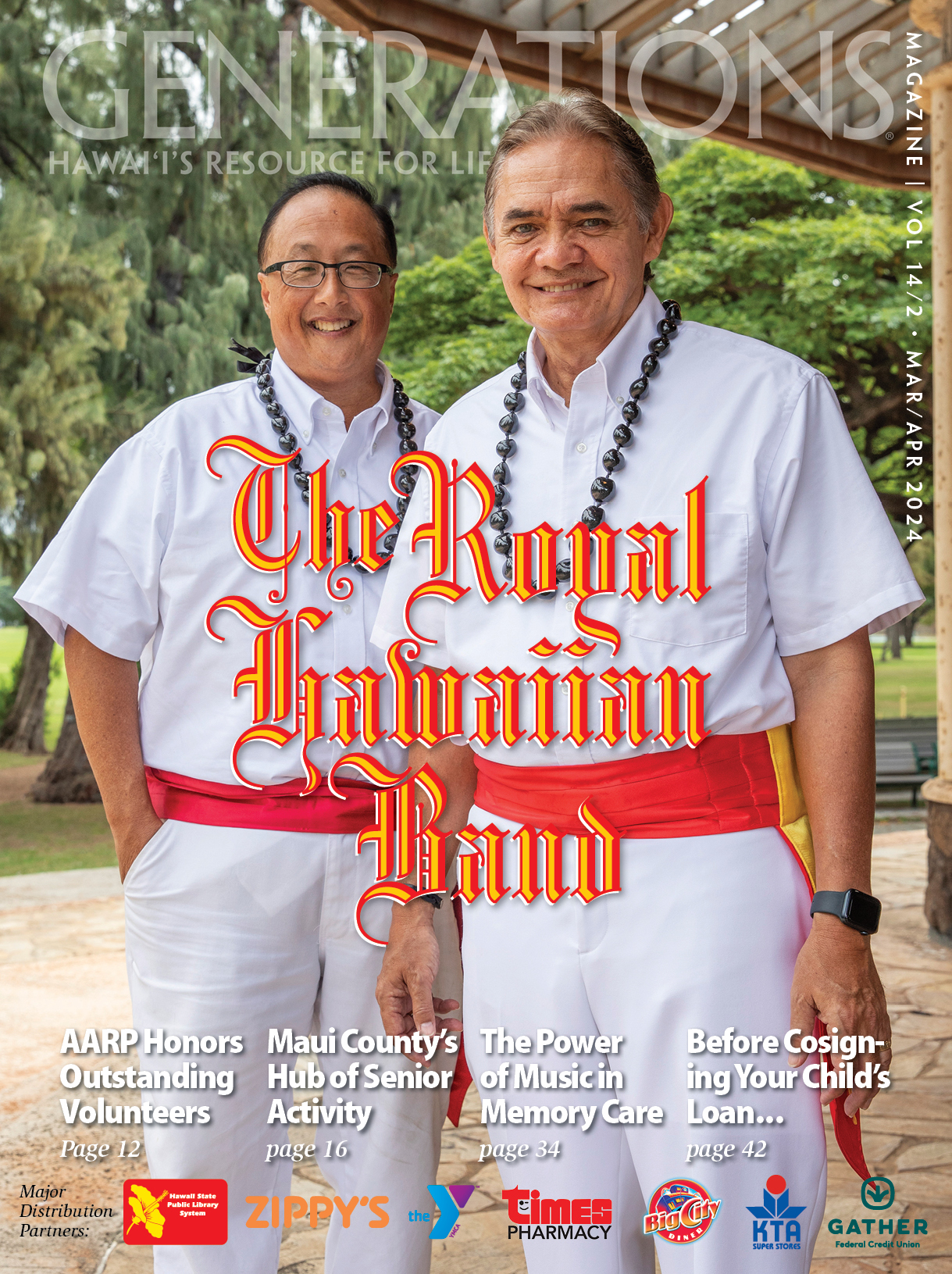
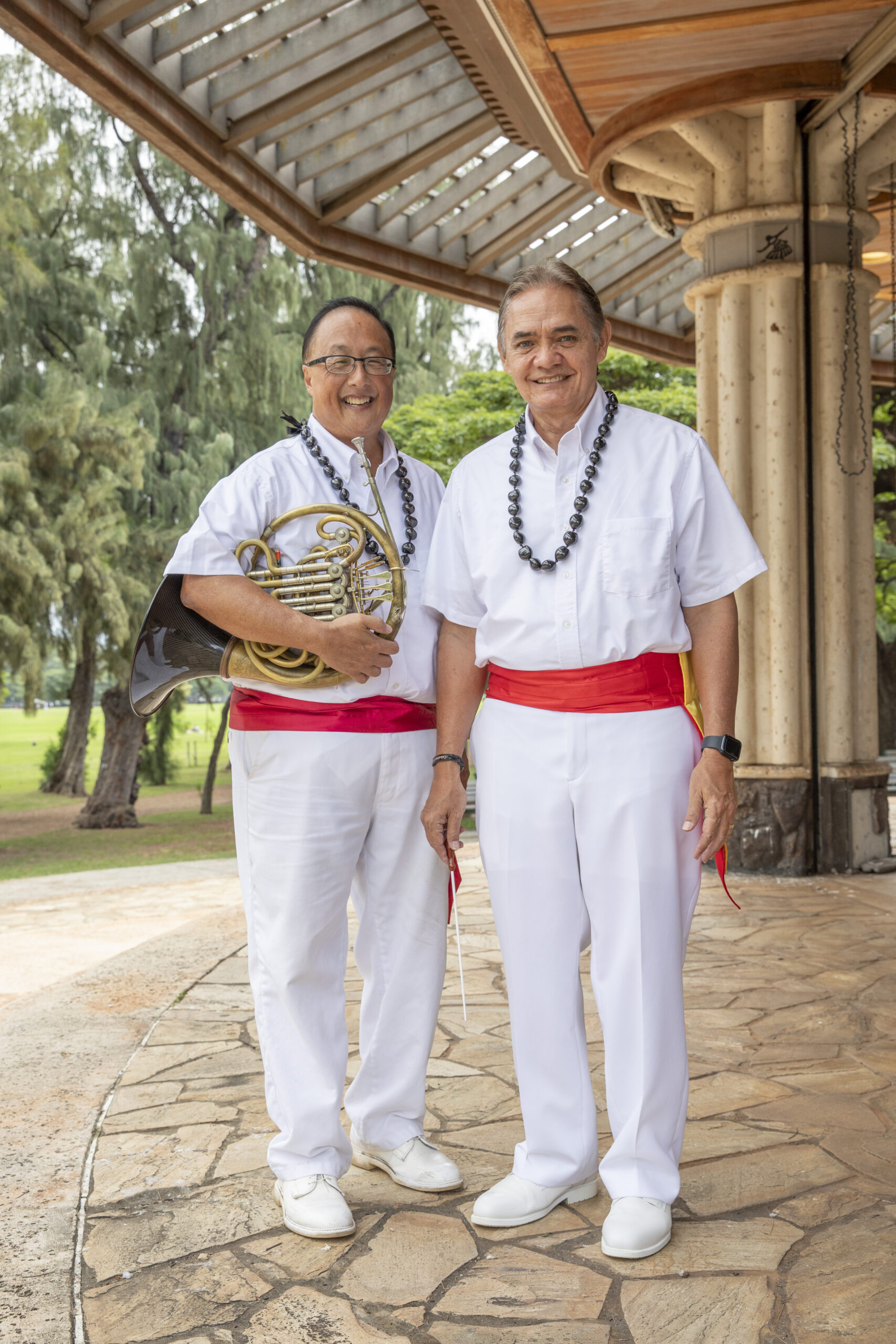
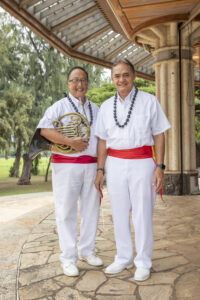
    This is the masthead for our cover story on the Royal Hawaiian Band“To promote and foster music, preserve the Hawaiian musical culture, inspire young musicians and enrich the lives of the people of Hawai‘i” is their  mission. As the only full-time municipal band in the United States — and the only one with a royal legacy — the Royal Hawaiian Band has touched and continues to move the hearts of people young and old for almost two centuries, beginning with their founding in 1836 by King Kamehameha III, Kauikeaouli. On top of weekly concerts at ‘Iolani Palace and Kapi‘olani Park, the band plays at over 300 events every year. They are led by Bandmaster Clarke Bright, who has conducted the Royal Hawaiian Band since 2011. Next to Clarke is Eric Kop, the assistant administrator and principal horn of the band. Together with other members of their staff, the Royal Hawaiian Band successfully and with great pride serves the people of Hawai‘i and encourages everyone to participate in the universal language of music.

    The History

    Clarke Bright was appointed bandmaster by then-Mayor Peter Carlisle; the Royal Hawaiian Band is an agency of the City and County of Honolulu. The history of the band is available on their website, but Bandmaster Bright breathes life into the facts through his passionate storytelling.

    The Royal Hawaiian Band has always existed under the leadership of the current ruling party. “The Hawaiian culture had lost its voice when they lost the last reigning queen, and it was important to keep that going in some format because we had lost leadership — we lost our kingdom,” says Clarke. “We were then under the rule of a territorial-type government and the Hawaiians knew it was important to preserve their voice.”

    Prince Kuhio knew it. “He went to Washington, DC, as a delegate to Congress — he had no voting position, but he did whatever he could to make it known to the American government that the culture needed to continue to be part of who we are. He then came back and he realized that the best way to keep Hawai‘i’s voice going was to have a government, like a city entity, that would be voted on by the people of Hawai‘i. He reengaged the Royal Society — the Royal Order of Kamehameha — to give their voice more prominence. He engaged the Hawaiian Civic Clubs and continued to work for land acquisition in and amongst the Hawaiian area — all of those things he did to continue to give Hawaiians more of a voice.”

    Clarke feels that one of the most important things Prince Kuhio did was tag the band onto city leadership. With the band under the auspices of the city, the band’s musical voice, its historical voice, its hula and its prominence in culture would continue to give Hawaiians a voice under a ruling government. “And that’s where we are today,” says Clarke. “From day one, the Royal Hawaiian Band has been part of the city. And we continue, I believe, to give a  prominent Hawaiian voice to the culture of Hawai‘i.”

    For 188 years, the Royal Hawaiian Band has played for audiences locally and internationally a plethora of musical arrangements — from contemporary and traditional Hawaiian music to Broadway and symphonic compositions. The band also plays music composed by Na Lani ‘Eha — the Royal Four — and pieces of Hawaiian music stylized by former bandmaster Henry Berger to evoke various European musical forms such as marches, polkas and waltzes.

    Among the pieces the Royal Hawaiian Band plays that are composed by Hawaiian royalty, the most famous, “Aloha ‘Oe,” was composed by Queen Lili‘uokalani. The heartfelt, moving classic closes every single Royal Hawaiian Band concert. In the early 1900s, the Royal Hawaiian Band adopted many hapa-haole (Hawaiian music with English words) pieces into its repository. These pieces, such as “Waikiki,” “Sophisticated Hula” and “Hukilau” can still be heard today at their concerts.

    But, Hawaiian music is not all that they play. The Royal Hawaiian Band also performs and arranges many pieces from the US and across the globe, traversing time and space to bring audiences the wonder and beauty inherent in music. Their concerts today include marches, orchestral transcriptions, standard band repertoire, pop music arrangements, Broadway musicals, movie soundtracks and television show theme songs. The band also is well-versed and takes pride in their extensive catalog of ethnic folk songs when taking part in many of the cultural festivals in Honolulu.

    Perhaps one of the most intriguing things about the Royal Hawaiian Band staff, too, is that they have staff arrangers who, at the assignment of the bandmaster, create arrangements of these ethnic folk songs for the band and for the audience’s enjoyment. Eric Kop, assistant administrator and principal horn of the Royal Hawaiian Band, articulates some of the work that is put into these arrangements:

    “When we go to the Palolo Chinese Home, we have a library of Chinese folk songs that we’ll play,” says Eric. “Depending on the communities that we are playing for, we will actually tailor the program for the particular ethnicities that are represented there. Most of the arrangements we play are made especially for the Royal Hawaiian Band; no other music entity has those arrangements, so I think that’s a very unique part. Really, when I see the reaction of the audience, whether it’s kūpuna or the youth, I know that we are accomplishing our mission — enhancing life. And just to see the smiles… you know we’re doing what we set out to do, and that’s a great thing.”
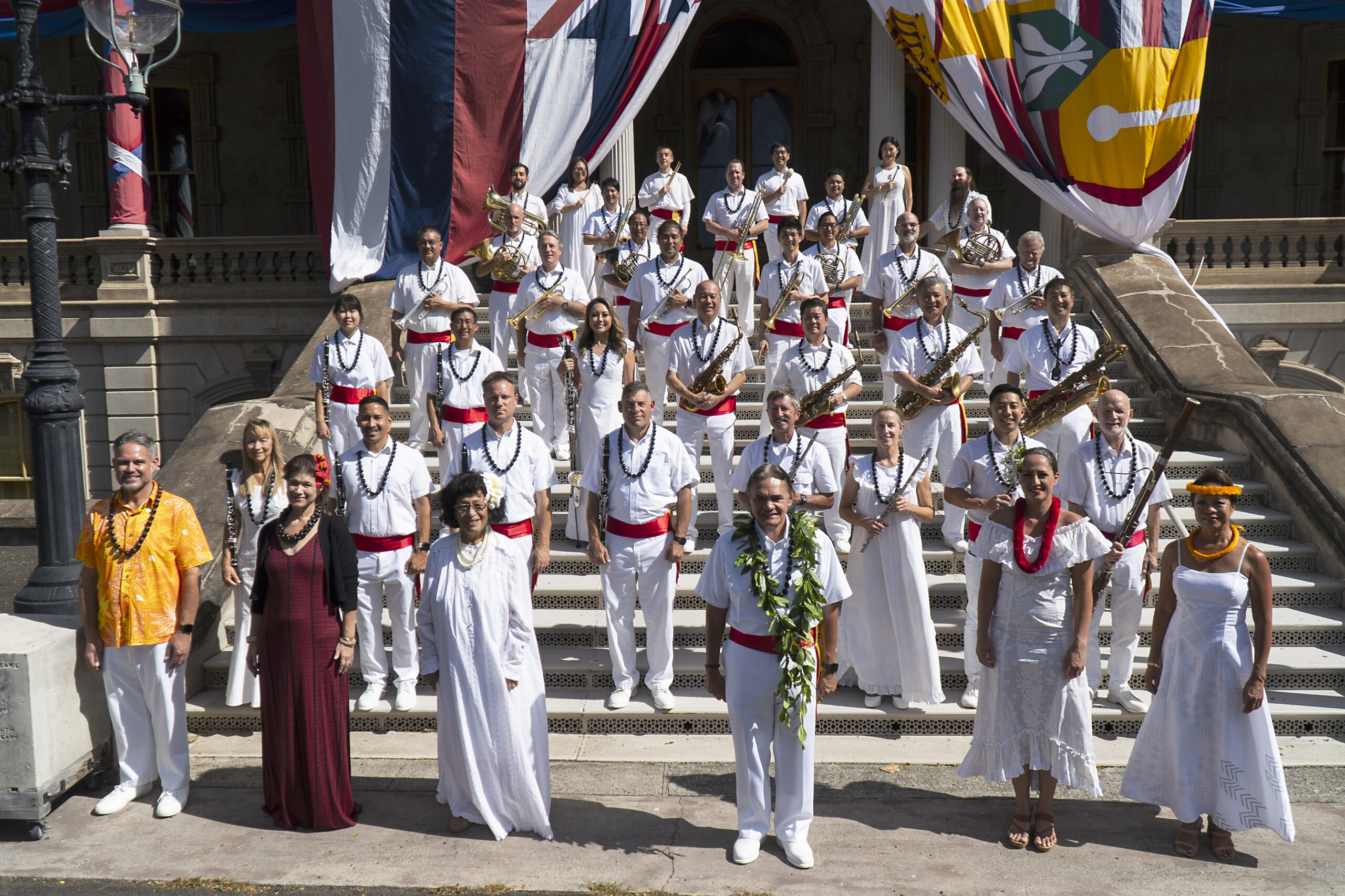
    The Royal Hawaiian Band standing on the steps of Iolani Palace in HonoluluThe Music

    With such an abundance of music to choose from, a lot goes into preparations for their hundreds of annual concerts. According to Clarke, “It really starts with the request from the entity that wants us there. Once the schedule is there, I take a look at what might be appropriate. We create a program and hand it out to our members at least a week before the concert. Then, we meet and decide what’s the best way to serve that concert.”

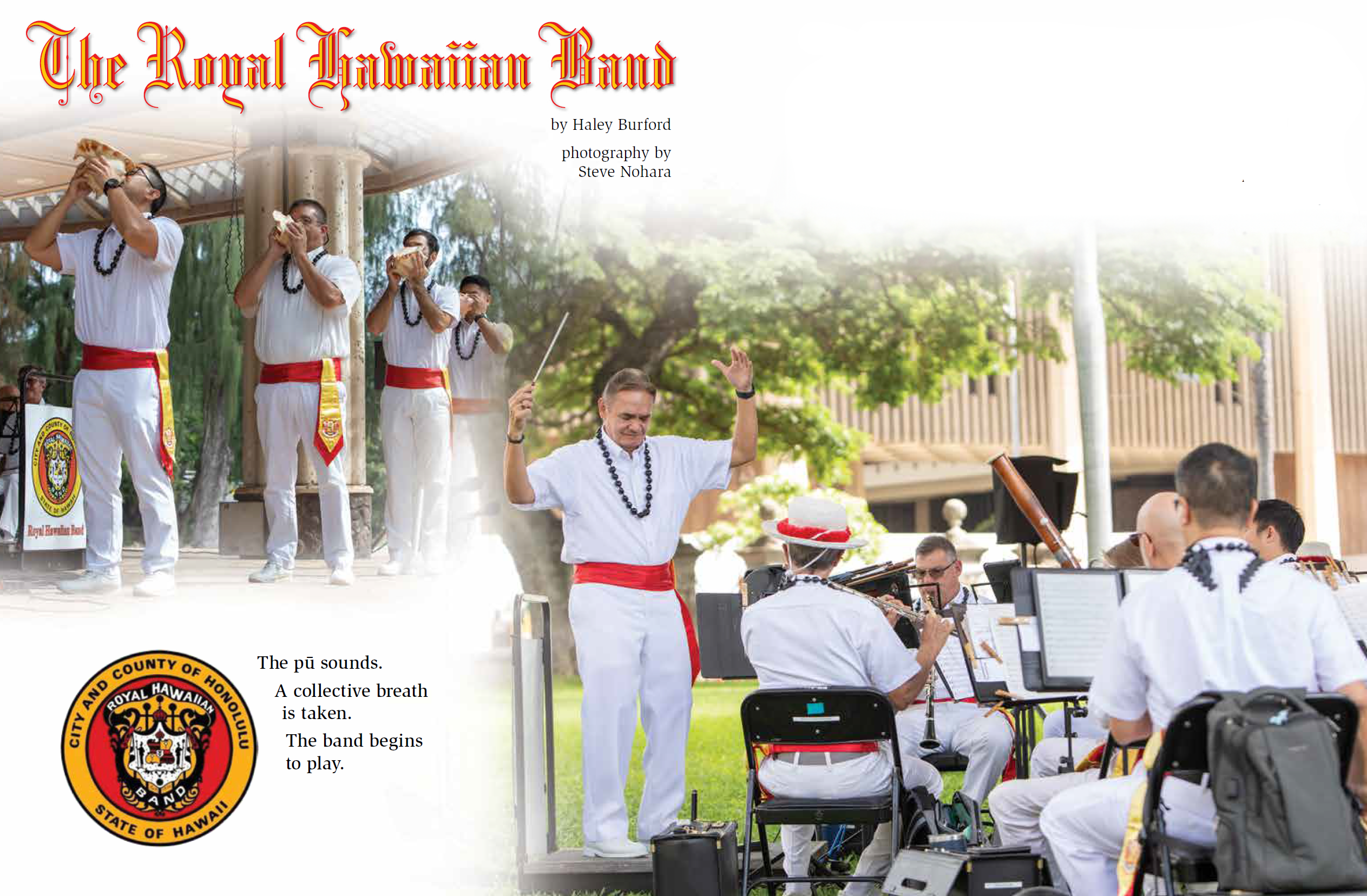
    Clarke and Eric go on-site about an hour-and-a-half prior to downbeat. They lay out markers for the design of the band. They unload the equipment from their truck an hour before, set up and the band members warm up a half-hour later. Announcements are made 15 minutes before, and the tuning note sounds five minutes before starting the 45-minute to one-hour concert.

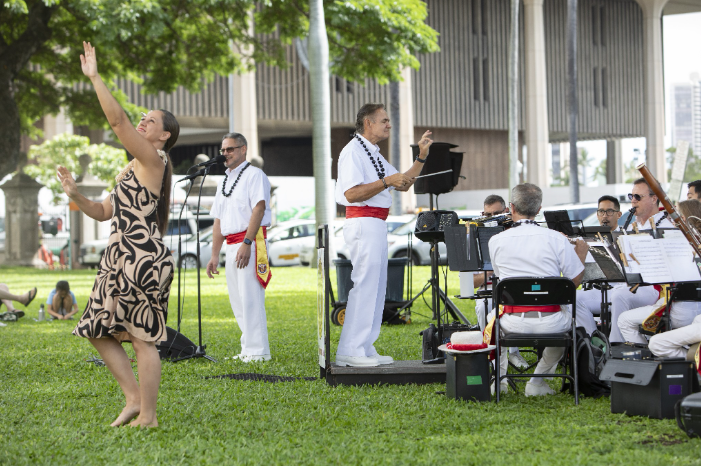
    “We usually have an opening involving the pū , or conch, and an ‘oli to welcome the audience,” says Clarke. “And then, depending on where we’re at, we may focus more on contemporary or traditional Hawaiian music. We’ll usually play something that’s good or challenging for the band, like a symphonic piece or a band standalone. We play modern, easy-to-listen-to music, like Broadway or contemporary hits for the audience.”

    The Royal Hawaiian Band also performs weekly concerts on top of being available for request. About these routinely scheduled performances, Clarke says, “We have some standing weekly concerts at ‘Iolani Palace on Fridays and at Kapi‘olani Park on Sundays. But other than that, the majority of concerts are requested either by educational institutions, nonprofit organizations, community events or government events of that nature.” The band also reaches out to be a part of other important concerts, including anything that the mayor — or the governor — initiates, as well as meaningful Hawaiian-related events.

    “I want to make sure we’re at things like birthdays of kings or queens, celebrations of lei draping, those kinds of things,” says Clarke. “Part of our purpose is to also serve the people who are of early age and those who are more in the latter part of their lives.” From elementary school-type educational concerts to performances for seniors in living and care centers, the Royal Hawaiian Band is eager to reach out to such organizations every single year.
    The Leader of the Band

    Clarke is the most recent torch-bearer in a legacy of bandmasters for the Royal Hawaiian Band. He grew up in a music-oriented family, helping with his father’s theatrical musical productions growing up then majoring and graduating with a bachelor’s degree in secondary music education from the University of Hawai‘i. He was the band director at Waimanalo Intermediate School for four years, then at Kamehameha Schools for 13½ years, teaching all grade levels, until he was appointed bandmaster of the Royal Hawaiian Band in 2011.

    A great leader is one who empowers others. The conviction with which Clarke describes the bandmaster’s responsibilities communicates his ability to move others, not with force, but through and for the love of Hawaiian culture and music. He emphasizes that he finds it important to remember that his main responsibility is service — to the band, to the city and to the people.

    “I have to, of course, conduct the band, but I choose the music and we rehearse the organization,” says Clarke. “I’m responsible for the vision and leadership of the organization, as well.” As part of the city’s cabinet, he attends mayoral cabinet events and administrative meetings.

    Clarke also makes a point of partaking in the culture that surrounds the band and their music. “The Hawaiian culture is so special… Being Native Hawaiian myself, I think it’s important for the Hawaiian people to know that we are serving them as best as we possibly can. It’s a big responsibility — to show up at all these events, to meet with them, to befriend them and to ensure they know that they can trust that their band can serve them as needed. The community has to see their bandmaster as somebody who wants to serve them — who wants to bring music out to the people. I think that’s important, too. So, the main thing is service. It’s a very diverse position. It really requires many different facets of a person, but it is a position I am honored to participate in.”

    The Backbone of the Band

    Clarke does not shoulder the responsibilities of maintaining the Royal Hawaiian Band alone — the band has a staff of 10, all of whom play their respective instruments. Another vital position is that of the assistant administrator, covered by Eric Kop, who is also the principal horn.

    Eric began with the Royal Hawaiian Band in 1988 at the age of 21. Through his years in music and passionately advocating for music education, he has previously taught horn for the University of Hawai‘i at Mānoa, the Hawai‘i Youth Symphony’s Pacific Music Institute, Mid-Pacific Institute and in his own private instruction studio. Eric has also backed legendary musicians in his time as a freelance musician, including Frank Sinatra, Liza Minnelli, Charlotte Church and others.

    As the band’s assistant administrator, Eric works closely with the bandmaster, handling logistics and ensuring the band and their performances run smoothly. “During the concert, I am playing the principal or first horn part. So, I perform as a musician. In the office, I do a lot of the work for the auditions.” He also works with departments outside of the Royal Hawaiian Band regarding fiscal matters, human resources and anything interdepartmental within the city.

    At this, the bandmaster speaks up. “Eric basically said what’s supposed to be said on paper, but in addition to all of that, he is directly responsible for our link to the city — probably one of the most important positions in the band,” says Clarke. Clarke stresses how instrumental the assistant administrator is in that Eric communicates with the city to ensure that “this very un-city-like entity,” the Royal Hawaiian Band, is seen by the city how it is supposed to be. Such a position involves quick thinking, and Eric’s masterful way of translating musical to municipal and vice versa is something that Clarke feels really keeps the band on track.

    The Business of Music

    As part of the band staff working under the city, both Clarke and Eric underline some of the challenges that come with being an arts organization under city jurisdiction. Though they are a city agency, the city does not organize for the band. Eric says, “In order to incorporate city work policies and what employees in other departments do within our arts organization, we have to convert it. When you’re dealing with artists who are not used to a regular 9-to-5 schedule, that’s sometimes a challenge because we work such an odd schedule — it’s all over the place…” A lot of work is put into translation, and when information has to be circulated through different checkpoints and departments, communication is key to the Royal Hawaiian Band’s success.

    Though this work of translation can be tough, Eric takes great pride in handling the challenge: “To bridge the translation gap presents a unique challenge.” Clarke adds, “And he does it really well. We take pride in the fact that the city and state understand the importance of perpetuating our culture through music, dance and hula — that they deem it appropriate to have a full-time organization sponsored by city support for the perpetuation of Hawaiian music.”

    The Band for Kūpuna

    The Royal Hawaiian Band boasts 40 members, with seniors making up about 25% of its roster. Out of over 300 every year, their proudest concerts are for seniors, whether at community centers, housing or at public performances. According to Clarke, “We’re really proud of many things that we do, but that service to the seniors is a very important aspect of who we are. The biggest thing is the genuine appreciation that they have for what we bring. In every single senior environment — because most of the music that we do for them, they know — they’ve either sung to it or danced to it at some point in their lives. The music hits in a certain way that other things cannot.

    “Music is so powerful in that aspect,” says Clarke. “It’ll bring back a memory; a season in their life; a time. It’ll do things to your heart that are very hard to describe or quantify in government processes, but the aesthetic value that we bring in our music, singing and hula is special.”

    The Royal Hawaiian Band goes out to the people. “The appreciation we get from seeing their faces is really wonderful to us.”

    Clarke recounts a story that holds a particularly special place in his heart. “Early in my tenure, we went to one of the senior centers. A lady was walking right in front of the band from one side of the stage to the other with her walker — right before we were going to start. As she labored with her walker, I just waited. I waited and I waited… for maybe four or five minutes. She sat; we started.

    “In the concert, we played a song that I believe struck something in her na‘au — her heart or her spirit — and she remembered, I think. She got up from her chair, she moved her walker aside and danced the hula to that song we were playing. I couldn’t believe it. I turned around. It actually made me emotional. Then, she labors back down with her walker into her chair. At that point, I just thought, that’s the power of music. How else will somebody feel a certain part of their past, resurrect it and perform, other than through music of their era or their generation? It’s so important for us to serve that part of the community that needs to be served in the best way possible. I’ll never forget that.”

    All throughout history, the human love for music has continued to withstand the test of time. People of all ages can understand and bond over music. “Music is such an emotional language, right?” says Eric. “It represents history; it represents culture; it represents the people. And, like Clarke said, we’ve seen so many of our audiences get very emotional during the performances.” For Clarke and Eric, playing music with the Royal Hawaiian Band is a gift given to the community that also gives back to the band. As a universal language, one without words, music moves us — to a dance or to a memory.

    The Legacy of the Band

    The Royal Hawaiian Band is meaningful to the community and its members because of the music that they play for others, but the band is precious and an integral part of the individual members and Hawai‘i state pride, too, because of the sentimental value it holds across its history. Eric never tires of growing with the band. “Over the course of 35 years — now at the other side of it — I’ve really cherished and valued how we affect the audience members and for me, personally, that sense of duty. As one of the senior members, I feel a duty to be part of the stewardship of the band and to make sure that its legacy continues.”

    Clarke also feels such a responsibility to build the band up to be the best it can be while also maintaining its long-standing reputation as Hawai‘i’s band. “My number one mission is to preserve this organization into perpetuity, and I do that by ensuring we are hitting the mark. If we are being requested by a government agency, hit the mark; a community agency, hit the mark; with the culture, Hawaiian culture especially, or anything to the seniors and young students, hit the mark. Make sure we’re serving them well.

    “It’s also to serve the members,” says Clarke. “If I’m thinking of serving them, I’m ensuring they get whatever they need to be successful. We are serving the members who then serve, through their music, the audiences that we play to.”
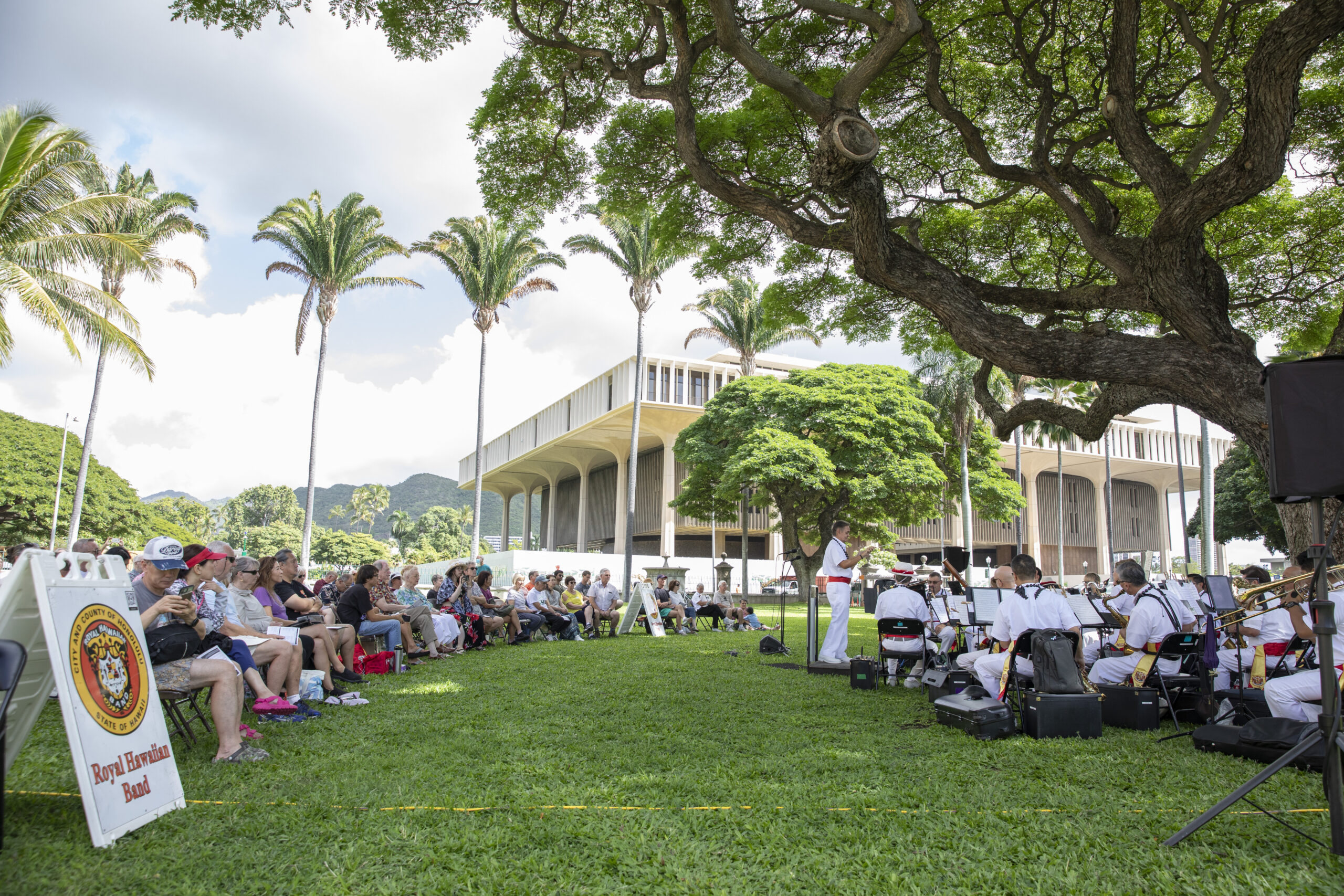
    The Royal Hawaiian Band performing on the lawn of the Hawaii State Capitol in HonoluluThe Passion for Music

    These professional responsibilities are a major part of working with the Royal Hawaiian Band, but what the work also encourages, fosters and requires is a genuine love of music. Both gentlemen found their passion for music very early on in their lives. When asked what fuels their love for music, both Clarke and Eric recall their upbringing fondly.

    For Eric, his earliest influence was his mother. “She would always be playing the record player. So, as a young child, I grew up listening to a lot of classic Broadway and light classical music.” As he grew older, what continued to motivate Eric as a brass instrument player — a French horn player, specifically — is the physicality and sound of the horn. “I remember first recognizing what a French horn sounded like when I was watching Star Wars, and that really hooked me into that sound.” As far as music goes, he listens to everything “from Tchaikovsky to K-Pop.” To him, “good music is good music, no matter what the genre is.” He feels that being a part of music production is a thrill that contributes to and strengthens his lifelong love for music.

    Clarke tells the story of being told by his parents that he could keep a beat on a pair of bongos gifted to him by his father when he was only 6 months old. His father was a musician and musical theater director, so music was very much present in his home growing up. Through assisting his father with his productions, Clarke saw what the arts — not just music — can do to and for people. Though he wasn’t aware of his bongo-playing at such an early age, Clarke is sure that music has been his life’s calling since the beginning, drawing much inspiration from his father. “I was immersed in all of this music and he, being Hawaiian, played piano and knew a lot of Hawaiian songs. He played often with various Hawaiian singers and would also bring me along, his drummer son, to assist in all of his events or concerts or shows. And when I think back on that rearing, I think I was meant to serve musically, in some capacity, the community at large. That fuels my love for music.”

    As he grew older, the simple love for music transformed into scholarly study, learning the names and theories and backgrounds of different transitions, keys and chords. Clarke credits his father for encouraging him to conduct one of the shows. “He had faith in me and kept believing in me, so I did it.” He went on to formally study and teach music, leading up to his work with the Royal Hawaiian Band as the bandmaster. “That passion, the genuine love of music — not only for music itself, but what it can do to serve others — really moves me. That really gets me going. I love to listen to it, I love to perform it, I love to conduct it, but it’s when it serves others that it really fuels me and keeps me going.”

    The Community’s Band

    The Royal Hawaiian Band loves to serve all the various agencies and communities, but, most of all, they want everyone to know that the Royal Hawaiian Band is their organization. “We want them to feel like they can ask for us to be there whenever they want,” says Eric. “Never be afraid to ask — we are there to serve them.”

    “It really is Hawai‘i’s band, because there’s so much of Hawaiian history built into the music that we play,” says Clarke. “When audience members come to hear the band and they listen to the introduction of how a lot of these songs are weaved into Hawaiian history, it really ties into our mission to perpetuate the music and educate people. We hope to get that mission and message out to as many people as we can.”

    Aloha ‘Oe

    Music knows no age; it knows no boundaries. As the Royal Hawaiian Band continues to play and serve the people of Hawai‘i, they also fulfill their mission statement, going above and beyond  to communicate their love for music and performing their arrangements. To promote and foster music, the  bandmaster and assistant administrator/first horn Clarke Bright and Eric Kop, together with all the other members of the Royal Hawaiian Band, play their music for the people in Hawai‘i and across the world, from the beginning to now and into the future.

    To preserve the Hawaiian musical culture, the band upholds Hawaiian traditions and maintains the legacy of Hawaiian music through passionate performances. To inspire musicians, young and old, and enrich the lives of the people of Hawai‘i, the Royal Hawaiian Band proudly continues to perform at over 300 events annually, giving it their all at every single concert. With the opening notes to Queen Lili‘uokalani’s “Aloha ‘Oe,” the Royal Hawaiian Band’s performance ends with a gesture of love to Hawai‘i and its people. At the very end, a clear promise is made to their audience: Until we meet again.

    RELATED STORY: The Language of Emotion by Haley Burford


    For more information regarding the Royal Hawaiian Band, the band members, contact information to request an appearance and a running schedule of their upcoming events, visit the Royal Hawaiian Band’s website at rhb-music.com.



    “To promote and foster music, preserve the Hawaiian musical culture, inspire young musicians and enrich the lives of the people of Hawai‘i” is their  mission. As the only full-time municipal band in the United States — and the only one with a royal legacy — the Royal Hawaiian Band has touched and continues to move…

  • Minimize Asset Distribution Drama

    Minimize Asset Distribution Drama


    Grandfather And Granddaughters Relaxing On Sofa At HomeMinimizing estate asset distribution conflicts among survivors proves to be a challenging consequence of death. Hard-to-divide assets such as a family heirloom or the family home can cause the fracturing of relationships.

    Consider the family home left to several children. The home may have been in the family for generations. Parents live in the family home without arguing about whether to sell or rent it because they share the common goal of living in the home. Consider leaving the home equally to four children and the common goal disappears. One child needs to sell the home to pay for tuition. Another child could use income by renting the house. One child wants to live in the home. Another child wants to keep the home as a place for the family to gather.

    Finally, consider a parent’s strong desire to provide shelter for surviving children, and that due to the housing prices and high cost of living, the surviving children cannot afford to purchase a home on their own.

    While addressing these concerns extends beyond the scope of this article, keep in mind that estate planning attorneys can help clients understand the challenges facing them and can also aid them in beginning to create an intentional plan to leave a legacy that will help make family members’ lives better while preserving familial relationships.


    STEPHEN B. YIM, ATTORNEY AT LAW
    2054 S. Beretania St., Honolulu, HI 96826
    808-524-0251 | stephenyimestateplanning.com

    Minimizing estate asset distribution conflicts among survivors proves to be a challenging consequence of death. Hard-to-divide assets such as a family heirloom or the family home can cause the fracturing of relationships.

  • What’s in YOUR Toolbox?

    Photo of senior man standing with his arms crossedTrusts are tools. Like screwdrivers, they come in a variety of sizes and shapes, each designed to accomplish a defined result. You need a screwdriver with a tip that looks like a straight line for a screw with a head that has a straight slot in it. You need a screwdriver with a tip shaped like a plus symbol for a screw that has a head with a plus-shaped recess.

    There are other kinds of screwdrivers and screws, but you get the point. You need the right set of tools in order to complete your project efficiently and well. However, not every home improvement project calls for a screwdriver and not every estate plan calls for a trust.

    Common Types of Trusts

    Just as there are many kinds of screwdrivers in a well-stocked toolbox, there are lots of different kinds of trusts.

    You can create a trust that works during your lifetime or one that will not take effect until after you are gone. Your trust can be revocable or irrevocable, charitable or private.

    The agreement that governs your trust can control not only the disposition of your assets, but impose your values and your wishes upon your beneficiaries. But don’t get too excited about that last point. A trust can encourage your kids to go to college and stay away from drugs and booze, but it can’t guarantee your kids will actually go to class, or be clean and sober.

    Probably the most common trusts are revocable living trusts, which can provide comprehensive solutions for probate avoidance and for sidestepping conservatorship if you become incapacitated. Probate is a proceeding that typically occurs when an individual dies. The probate process can be long and costly. But a revocable trust can avoid probate in its entirety.

    Trusts can also protect beneficiaries from creditors, ex-spouses, and their own bad habits or inability to hold on to money.

    Talk with your estate planning advisors about how trusts can help you and your family avoid a variety of problems and pitfalls that await unwary travelers along life’s highway.


    EST8PLANNING COUNSEL LLLC
    Scott Makuakane, Counselor at Law
    808-587-8227 | maku@est8planning.com
    Est8planning.com

    Trusts are tools. Like screwdrivers, they come in a variety of sizes and shapes, each designed to accomplish a defined result. You need a screwdriver with a tip that looks like a straight line for a screw with a head that has a straight slot in it. You need a screwdriver with a tip shaped…

  • Before Cosigning Your Child’s Loan…

    Photo of a happy woman holding an Open sign in front her outdoor flower standAs your child heads off to college or starts life as an independent young adult, he or she will likely face new financial responsibilities, such as a car purchase, rent or college tuition payments. Given their lack of credit history, it may be difficult for them to obtain a loan without a parent or another adult cosigning the loan. Your natural inclination may be to help them out and sign the dotted line, but before you do, make sure you’re clear on the terms of the loan and what it may mean for your finances.

    Cosign with your eyes wide open

    Even though you may not consider it “your loan” if you cosign, lenders will identify you as one of the borrowers. That means you may be at risk if different circumstances arise. Keep in mind:

    • If any of the balance remains unpaid by the borrower (in this scenario, your child), you as the cosigner will be required to repay it.
    • If your child defaults or even misses one or two payments, it can damage your credit record.
    • Even without a default, other lenders may look on the cosigned loan as an additional liability you will need to pay, which could also affect your credit record.
    • In some states, the creditor has the right to collect payment from you, as the cosigner, without first trying to collect from your child.
    • If you were to pass away, it could trigger “auto default” provisions in the loan contract. This would require your child to immediately pay the debt. Regulators discourage this practice, but it still exists in some loan agreements.

    Steps to protect your position

    Fortunately, there are often alternatives to cosigning a loan. For example, if your child is enrolled in college, he or she may be eligible for federal student loans or financial aid. Another option, if you can afford it, may be to lend your child money directly — thereby forgoing the paperwork and stipulations introduced by a third-party lender. If you decide to take this action, make sure you and your child have a clear and consistent understanding of the terms of the loan, including a repayment schedule that he or she will be accountable for sticking to. If you do decide to cosign a loan, take steps to help protect yourself:

    • Read the fine print and understand the terms of the loan and the expectations of the lender.
    • Avoid pledging property, such as a car, to secure the loan, as it could create additional risk.
    • Arrange to receive duplicate copies of all paperwork and ensure you have complete online access to the account so you can stay on top of your child’s record of repayment.

    In short, treat the situation with the same diligence that you would if you were borrowing money yourself. Do what you can to ensure your potential act of generosity doesn’t impair your ability to obtain credit in the future.


    MICHAEL W. K. YEE, CFP,® CFS,® CLTC, CRPC®
    1585 Kapiolani Blvd., Ste. 1100, Honolulu, HI 96814
    808-952-1240 | michael.w.yee@ampf.com
    ameripriseadvisors.com/michael.w.yee
    Michael W. K. Yee, CFP®, CFS®, CLTC, CRPC ®, is a Private Wealth Advisor, Certified Financial Planner ™ practitioner, with Ameriprise Financial Services, LLC in Honolulu, HI. He specializes in fee-based financial planning and asset management strategies and has been in practice for 40 years. Investment products are not insured by the FDIC, NCUA or any federal agency, are not deposits or obligations of, or guaranteed by any financial  institution, and involve investment risks including possible loss of principal and fluctuation in value. Investment advisory products and services are made available through Ameriprise Financial Services, LLC, a registered investment adviser. Ameriprise Financial Services, LLC. Member FINRA and SIPC.
    © 2023 Ameriprise Financial, Inc. All rights reserved.

    As your child heads off to college or starts life as an independent young adult, he or she will likely face new financial responsibilities, such as a car purchase, rent or college tuition payments. Given their lack of credit history, it may be difficult for them to obtain a loan without a parent or another…

  • Smart Long-Term Care Search Strategies

    Younger woman talking with senior person about long-term careMore than 50% of us will experience stress and anxiety while seeking long-term care, according to a recent AARP study. Firstly, it is difficult to find information about all the available services. Worse yet, without a way to easily compare them, they are seemingly indistinguishable (after all, there are over 1,800 senior care facilities and providers in Hawai‘i). Lastly, families are often caught off guard and must choose a care provider quickly.

    Given the challenges, follow these strategies to successfully navigate complex and diverse care system:

    • Allow ample time to learn the essentials: The details can be overwhelming and even healthcare professionals have difficulty grasping the ins and outs of senior care.

    • Know your needs: Each family is unique. Even spouses have different care requirements, budgets and preferences. It is easy to get distracted by
    the nice-to-have features.

    • Cast your net wide first, then narrow down options: Every type of care has distinct pros and cons; every provider has strengths and weaknesses. Only you can decide which will fit your needs.

    While it’s impossible to know the future, these strategies are guaranteed to help you when the time comes to seek senior care.


    KUPUNA CARE PAIR
    2383 Beckwith St., Honolulu, HI 96822
    808-779-8871 | hello@kupunacarepair.com
    kupunacarepair.com

    More than 50% of us will experience stress and anxiety while seeking long-term care, according to a recent AARP study. Firstly, it is difficult to find information about all the available services. Worse yet, without a way to easily compare them, they are seemingly indistinguishable (after all, there are over 1,800 senior care facilities and…

  • Mediwhat? Medigap!

    Hand arranging wood block stacking with icon healthcare medical, Insurance for your health conceptFor beneficiaries on Original Medicare (Parts A and B), a Medicare Supplement Insurance plan may provide the extra coverage they need. Also known as “Medigap” plans, these policies which are sold by private insurance companies fill the “gaps” not covered by Original Medicare, such as deductibles, coinsurance and copayments for services.

    To be eligible to purchase a Medigap, an individual must be enrolled into Part B. This kickstarts the Medigap Open Enrollment Period, which lasts for 6 months. During this period, insurance companies can’t deny enrollment and will provide coverage at the best price. Outside this period, one can still buy a Medigap policy, but restrictions may apply. Beneficiaries with Medicare Advantage plans are ineligible to purchase a Medigap.

    Contact Hawaii SHIP to learn more about Medicare Supplement Insurance. Request a free Medigap plan comparison and a list of authorized insurance companies in Hawai‘i. Local, certified SHIP specialists provide unbiased information in one-on-one sessions, compare Medicare Advantage and Part D plans, and help low-income clients apply for Medicaid and Extra Help assistance.


    HAWAII SHIP
    Free, local, one-on-one Medicare counseling is provided by the Hawai‘i State Health Insurance Assistance Program.
    250 South Hotel St., Ste. 406, Honolulu, HI 96813
    Oahu: 808-586-7299 | Toll free: 888-875-9229
    hawaiiship.org

    For beneficiaries on Original Medicare (Parts A and B), a Medicare Supplement Insurance plan may provide the extra coverage they need.

  • Medicare Special Enrollment Period

    Here's a photo of a woman sitting at home reading some information about the Medicare Special enrollment period.A Medicare Special Enrollment Period (SEP) is the time when an eligible Medicare beneficiary may sign up for a Medicare plan under exceptional circumstances.

    It’s vital to understand eligibility for Medicare plan SEP to help avoid a late enrollment penalty.

    SEP is granted to beneficiaries who were unable to enroll in a plan during the General Enrollment Period (GEP) for valid reasons.

    It depends on the personal situation, such as moving out of your existing Medicare plan’s service area, losing employer-provided medical coverage or losing Medicaid eligibility.

    The beginning and end dates of SEP will vary from one qualifying event to the next.

    The SEP rules allow you to do one of the following:

    • Enroll in Medicare Part B any time while you or your spouse are covered by a group health plan based on current employment
    • Enroll in Medicare Part B during the 8-month period that begins the month after the employment ends or the group health plan coverage ends — whichever happens first. If you don’t enroll by the end of the 8-month period, you’ll have to wait until the next GEP, which begins Jan. 1 of the next year.


    COPELAND INSURANCE GROUP
    1360 S. Beretania St., Ste. 209, Honolulu, HI 96814
    808-591-4877 | josie@copelandgroupusa.com
    copelandgroupusa.com

    A Medicare Special Enrollment Period (SEP) is the time when an eligible Medicare beneficiary may sign up for a Medicare plan under exceptional circumstances.

  • Q&A: Retirement Benefits

    Photo of a couple of seniors who are smiling about somethingQ: My cousin and I are both retired and get Social Security. We worked for the same employer for years, but he gets a higher Social Security benefit. Why is that?

    A: Your payments are based on your earnings over your lifetime. Unless you are both the same age, started and stopped work on the exact same dates and earned the very same amount every year of your careers, you wouldn’t get the same benefit as your cousin. Social Security benefits are based on many years of earnings — generally your highest 35 years. To learn more about Social Security retirement benefits, visit ssa.gov/benefits.

    Q: I went back to work after retiring, but now the company I work for is downsizing. I’ll be receiving unemployment benefits in a few weeks. Will this affect my retirement benefits?

    A: When it comes to retirement benefits, Social Security does not count unemployment as earnings, so your retirement benefits will not be affected. However, any income you receive from Social Security may reduce your unemployment benefits. Contact your state unemployment office for information on how your state applies the reduction to your unemployment compensation.

    Q: My neighbor said he applied for Social Security retirement benefits online. Can you really apply for retirement without traveling to an office?

    A: Yes, you can. What’s more exciting is it’s the easiest, fastest and most convenient way to apply for retirement benefits. Our secure website makes it simple, allowing you to apply for retirement benefits in as little as 15 minutes. You can get started now at ssa.gov/applyonline.

    Q: What is the earliest age I can begin receiving Social Security retirement benefits?

    A: The earliest age you can begin receiving Social Security retirement benefits is age 62. If you decide to receive benefits before your full retirement age, which for most people is age 66 or 67, you will receive a reduced benefit. Keep in mind you will not be able to receive Medicare coverage until age 65, even if you decide to retire at an earlier age.

    For more information, go to ssa.gov/retire.


    Social security logoFor questions, online applications or to make an appointment at a SSA office, call between 7am & 5pm, Mon–Fri:
    1-800-772-1213 (toll free) | socialsecurity.gov


    Q: My cousin and I are both retired and get Social Security. We worked for the same employer for years, but he gets a higher Social Security benefit. Why is that?

  • Golden Care for the Golden Years

    Here's a photo of a nurse helping a man in his home Primary care services play a pivotal role in ensuring the well-being of geriatric patients, addressing their unique healthcare needs and promoting a higher quality of life. Access to timely and comprehensive primary care is particularly crucial for this demographic.

    Geriatric patients often face multiple and complex health issues, requiring a coordinated and holistic approach to their care. Primary care providers serve as the frontline defenders, managing chronic conditions, preventive care and addressing emerging health concerns. Timely visits allow for early detection of potential problems, preventing complications and hospitalizations.

    Moreover, accessibility to primary care services is essential for geriatric patients who may have mobility challenges or difficulty accessing healthcare  facilities. Home visits, where available, represent a valuable extension of primary care, ensuring that patients who may struggle with transportation or face limitations in leaving their homes receive the attention they need.

    By emphasizing the importance of primary care for geriatric patients, we not only enhance their overall health outcomes but also contribute to a healthcare system that prioritizes prevention, continuity of care, and the dignified aging of our elderly population.


    MI-CARE PLUS
    1150 S. King St. #1007, Honolulu, HI 96813
    808-930-9858 | info@micareplus.org
    micareplus.org

    Primary care services play a pivotal role in ensuring the well-being of geriatric patients, addressing their unique healthcare needs and promoting a higher quality of life. Access to timely and comprehensive primary care is particularly crucial for this demographic.

  • Homemade Meals to Smile About

    Photo of senior couple making dinner with dental health and tooth decay in mindWhile brushing twice a day, flossing daily and seeing your dentist are essential to maintaining a healthy smile, it’s important to remember that our dietary choices also impact our teeth and gums. Nutritious, home-cooked meals have been linked to a lower risk of tooth decay and gum disease because you can better control the ingredients.

    Meals cooked at home tend to have less salt and cavity-causing sugars. Fast food and beverages  can contain high amounts of sugar, creating an environment for bacteria to grow in our mouths and produce acids that erode tooth enamel, increasing your risk for tooth decay and gum disease. Stocking your kitchen with fresh vegetables and leafy greens such as watercress and spinach (rich in calcium) can help to maintain strong teeth. They also contain folic acid, which is linked to gum health. Crunchy vegetables such as broccoli, carrots and bell peppers require more chewing, stimulating saliva production and neutralizing acids in the mouth. Sweet potatoes are a good source of vitamins A and C, which are essential to tooth enamel formation and help to prevent gingivitis from forming.

    Maintaining a healthy diet of fruits and vegetables is crucial to good oral and overall health, helping you to live well and smile more.


    HAWAII DENTAL SERVICE (Nonprofit)
    Kahala Howser, Wellness & Events Manager
    khowser@hawaiidentalservice.com
    HawaiiDentalService.com

    While brushing twice a day, flossing daily and seeing your dentist are essential to maintaining a healthy smile, it’s important to remember that our dietary choices also impact our teeth and gums. Nutritious, home-cooked meals have been linked to a lower risk of tooth decay and gum disease because you can better control the ingredients.

  • The Power of Music in Memory Care

    Programming for the residents of a memory care facility can be challenging. Everyone is at a different place health-wise. Many activities are not appropriate for everyone. Even one-on-one activities can be challenging with this population.

    I have found great success using programs that involve music. Activities including sing-alongs, musical performances, drum circles, playing instruments and listening to music have provided many positives for residents — and not just because these activities are fun and bring people together. Many studies point to the benefits music offers, including a reduction in agitated behaviors, a decrease in anxiety and depression, an improvement in language skills, and opportunities to trigger positive memories and the emotions tied to them.

    Singing also provides aerobic exercise for residents who can no longer exercise traditionally. Singing releases endorphins (a feel-good hormone) and oxytocin (a stress-relieving hormone). Many benefits continue weeks after the session, demonstrating the possibility of long-term effects.

    You don’t need to be a therapist to use music therapeutically with your loved ones. Sing a song together. Listen to a favorite tune. Play relaxing background music during times of rest. Use music every day and enjoy its results!


    MANOA COTTAGE KAIMUKI
    748 Olokele Ave., Honolulu, HI 96816
    808-800-4089 | info@manoacottage.com
    manoacottage.com

    Programming for the residents of a memory care facility can be challenging. Everyone is at a different place health-wise. Many activities are not appropriate for everyone. Even one-on-one activities can be challenging with this population.