WANT THIS ISSUE?
Download your own personal copy of this issue in PDF format. Click the button below:


WANT THIS ISSUE?
Download your own personal copy of this issue in PDF format. Click the button below:
The June-July 2019 Issue includes stories on caregiving from affair, eating healthy with organic produce, changing lives with community action on Maui and the complete schedule of events at the 2019 Aging in Place workshop that’s coming in August.
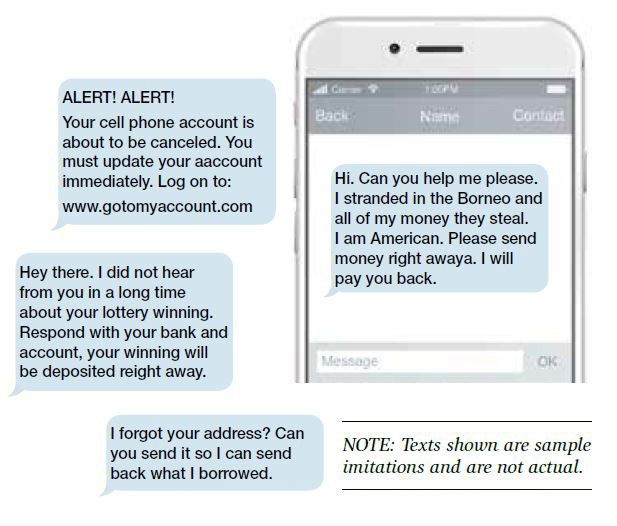
There’s been a marked increase in text messages with a spoofed Caller ID that ask the recipient to click on a hyperlink — that’s always the objective of this type of scam. It is their methodology to hijack your device.
 Two Major Risks
These programs may allow “spying” on your calls and text messages, and stealing personal and financial information and passwords. The program may even take control of the cell phone’s functions, such as the camera and/or microphone.
Signs of Caller ID Spoofing
You should never respond to a text message from an unknown sender.
Prevention Tips
THE DEPARTMENT OF THE PROSECUTING ATTORNEY
1060 Richards St., Honolulu HI 96813
808-768-7400 | Office hrs: Mon – Fri, 7:45 am – 4:30 pm
www.honoluluprosecutor.org/contact-us/
There’s been a marked increase in text messages with a spoofed Caller ID that ask the recipient to click on a hyperlink — that’s always the objective of this type of scam. It is their methodology to hijack your device. Two Major Risks include: The recipient does not know who really sent the message; and…
The term “stealing home” is associated with baseball. It occurs when a runner is on third base and uses guile, speed and luck to make a dash for home plate to score a run. This usually happens when the runner takes advantage of the pitcher being distracted.
In the Elder Abuse Unit, however, my team has come to know the term in a different context. We have seen situations when a homeowner literally has had their residence stolen.
The first time I saw this happen was when I got a call from Mark (story real; names changed) about what his brother, Tony, had done to their mother, Alice. Tony asked if she could co-sign on a loan for him. Given that Tony seemed responsible and had a job, she agreed. The two of them went to an office downtown and Alice was presented with many papers to sign. She didn’t think any more about it, assuming that she would have heard if he defaulted on the loan.
Years later, when Mark and his mother began to plan her estate, they discovered that Alice was no longer the owner of her house. She had signed it over to Tony without realizing it. Tony even let his mother continue paying the mortgage as to not tip her off to what he had done. Tony committed the felony crime of Theft in the First Degree by Deception. Alice was in such shock over this betrayal of trust that she did not know what to do — and that is when Mark made the call to our office for help.
 I wish I could say that Alice’s story is an anomaly, but I have seen houses being stolen by caregivers using powers of attorney and con men using illegal contracts that promise help with foreclosures and debt, only to instead transfer ownership to these charlatans.
I have seen families misuse monies from reverse mortgages and adult children draining bank accounts of home equity loans, leaving the parents to face financial uncertainty and foreclosure.
Your house is the single largest investment you’re likely to make. And the equity in your home (or your actual house itself) is very attractive to others who see it as “free money.” It’s like an amber light at night, attracting mosquitoes, but this time, the bloodsuckers could be family members, or “helpful” friends or even strangers.
When presented with any legal papers to sign, read them carefully or have someone else look them over. You may feel embarrassed asking to do this, but you will feel even more embarrassed if you lose your house. Also, tell your trusted family members and friends, and bring them along. Swindlers hate questions from protective loved ones. If these papers are so good for you, why keep this deal a secret?
If you have questions about elder abuse, call or email: 808-768-7536 | ElderAbuse@honolulu.gov
The term “stealing home” is associated with baseball. It occurs when a runner is on third base and uses guile, speed and luck to make a dash for home plate to score a run. This usually happens when the runner takes advantage of the pitcher being distracted. In the Elder Abuse Unit, however, my team…
A few years ago, I created the Heartfelt Advance Care Plan booklet to provide my clients with a tool to improve their end-of-life care, to honor their choices and to reduce conflict and guilt among surviving family members. Those who do fill it out usually comment about how difficult yet rewarding it was to complete.
Asking and answering detailed questions about end-of-life wishes, regardless of how difficult it may be, is tremendously helpful to both the dying and their survivors.
 For example, a wife and husband discussed in detail his wishes during his last days, as well as what he would like to see happen after he passed. The husband, who was usually not a humorous man, answered the uncomfortable questions with a sense of playfulness and humor. In response to one of the questions about his last meal, he said he would like spam, eggs and rice — and so she prepared this last meal to enjoy with her family. To onlookers, this may appear to be a rather minor thing. To his family, it was profoundly meaningful.
After he passed, she followed his instructions and planned the funeral in accordance with his wishes. She was able to carry out his expressed wishes, allowing him to take control of his life, the end of his life and thereafter, through his answers to the hard questions.
She was able to be by his side during his waning days, fully present and at peace because she knew what he desired during this transitional period of life.
STEPHEN B. YIM, ATTORNEY AT LAW
2054 S. Beretania St., Honolulu HI 96826
808-524-0251 | www.stephenyimestateplanning.com
A few years ago, I created the Heartfelt Advance Care Plan booklet to provide my clients with a tool to improve their end-of-life care, to honor their choices and to reduce conflict and guilt among surviving family members. Those who do fill it out usually comment about how difficult yet rewarding it was to complete.…
 In recent years, financial planners have shown the effectiveness of using a reverse mortgage line of credit to supplement a retirement portfolio. But while a line of credit can be a strategic part of a retirement income plan, there are often misconceptions related to how the credit line grows.
In yet another Forbes article focused on reverse mortgages, *Wade Pfau, Ph.D., CFA, professor of retirement income at The American College, sets the record straight with an in-depth analysis of how a Home Equity Conversion Mortgage (HECM) works, grows and stands to benefit borrowers.
“The ability to have an unused line of credit grow is a valuable consideration for opening a reverse mortgage sooner rather than later,” Pfau writes. “It is also a detail that creates a great deal of confusion for those first learning about reverse mortgages, perhaps because it seems this feature is almost too good to be true.”
Pfau speculates that the motivation for the government’s design of the HECM program is based on the underlying assumption that borrowers would spend from their line of credit sooner as opposed to later.
“Implicitly, the growth in the principal limit would then reflect growth of the loan balance moreso than the growth of the line of credit,” Pfau writes. “In other words, designers assumed the loan balance would be a large percentage of the principal limit.”
The line of credit, however, grows at the same rate as the loan balance, which if left unused, could become quite large.
“There was probably not much expectation that individuals would open lines of credit and then leave them alone for long periods of time,” he writes. “However… the brunt of the research on this matter since 2012 suggests that this sort of delayed gradual use of the line of credit can be extremely helpful in prolonging the longevity of an investment.”
RETIREMENT FUNDING SOLUTIONS
A Mutual of Omaha Bank Company
808-234-3117 | percyihara@hotmail.com
*Pfau, W. (2016, March 1). How Does The Line of Credit For A Reverse Mortgage Work? From http://www.forbes.com/sites/wadepfau Synergy One Lending Inc. dba Retirement Funding Solutions, NMLS 1025894. 3131 Camino Del Rio N 190, San Diego, Calif. 92108. These materials are not from HUD or FHA and the document was not approved by HUD, FHA or any government agency. Subject to credit approval. www.nmlsconsumeraccess.org
In recent years, financial planners have shown the effectiveness of using a reverse mortgage line of credit to supplement a retirement portfolio. But while a line of credit can be a strategic part of a retirement income plan, there are often misconceptions related to how the credit line grows. In yet another Forbes article focused…
 Unless you keep up with critical changes, your estate plan will become ineffective and maybe even become harmful to you and your ‘ohana. What kinds of changes are we talking about?
Changes to your HEALTH
If you lose the capacity to sign legal documents, your family may be stuck with an under performing estate plan that cannot be fixed. The general trend of your health and your ability to make decisions will usually not improve over time, so don’t put off updating your estate plan. You should dust it off and talk about it with your trusted advisors at least once a year for as long as you are in your right mind.
Changes to your ASSETS
All of your assets must be properly titled in order for your estate plan to work properly. If you have a revocable living trust, just about all of your assets should be owned by your trust. If the status of one major asset changes, your whole estate plan could be thrown off course.
Changes to your FAMILY SITUATION
Whenever there is a marriage, divorce, birth or death in your family, you should consider how those events could affect your estate plan. That is unless you are okay with your assets ending up in the hands of someone you would
prefer did not receive them, such as your ex-son-in-law.
Changes to your WISHES
Over time, you will change your mind about who you trust and where you want your assets to go, and your estate plan must reflect those changes. If you do not state your wishes in writing, they will not be carried out.
Changes to the LAW
The law has changed dramatically over the past several years, and while those changes have generated uncertainty, they also give rise to opportunities. You will never seize those opportunities if you ignore them. Not only that, but the law will not always change in ways that benefit you and your loved ones. Especially when “bad” changes happen, you need to be on top of them and adjust your estate plan accordingly.
Review your estate plan at least once a year so you can stay on top of changes and make the updates that could make a huge difference for you and your ‘ohana. Estate planning is an ongoing process, not an event.
SCOTT MAKUAKANE, Counselor at Law
Focusing exclusively on estate planning and trust law.
www.est8planning.com | 808-587-8227 | maku@est8planning.com
Unless you keep up with critical changes, your estate plan will become ineffective and maybe even become harmful to you and your ‘ohana. What kinds of changes are we talking about?
Professionals in many industries tout their education and professional experience as a way to demonstrate their expertise and set themselves apart. The financial industry is a prime example. With almost 200 professional credentials available, advisors can sharpen their ability to serve clients well. If you are searching for a financial advisor and seeking clarity on what the acronyms after each professional’s name means, below is a primer on eight of the most commonly used designations.
 Accredited Estate Planner® — Advisors seek the AEP® designation to learn more about designing an estate plan focused on the accumulation, conservation, preservation and transfer of an estate in a way that also helps individuals achieve their estate and wealth management goals.
Accredited Portfolio Management AdvisorSM — Individuals who hold the APMA® designation have completed a course of study to learn more techniques to create and maintain portfolios for clients. The coursework includes client assessment and suitability, risk/return, investment objectives, bond and equity portfolios, modern portfolio theory and investor psychology.
Chartered Advisor in Philanthropy® — The CAP® designation provides professionals in the nonprofit and financial services fields with the knowledge/tools needed to help clients reach their charitable giving objectives while also helping them achieve their estate planning and wealth management goals. The curriculum addresses the advanced design, implementation and management of charitable gift techniques and strategies.
Certified Divorce Financial Analyst® — The CDFA® designation is growing in popularity because it helps financial and legal professionals support clients going through or managing assets after divorce. Those with this credential are trained to evaluate the tax implications of dividing property, settlement options for dividing pensions, marital property, awarding of child and spousal support and to help determine the financial needs and outcomes for couples after divorce.
Certified Financial Planner™ (CFP®) and Chartered Financial Consultant® (ChFC®) — Advisors with either or both credentials have studied key financial planning topics in-depth — including risk management, tax planning, retirement and employee benefits, estate planning and insurance — to help develop well-balanced financial strategies for their clients.
Certified Long-Term Care® — The CLTC® program is independent of the insurance industry and is designed to provide financial service professionals with expertise and tools to address long-term care planning with their clients.
Certified Retirement Planning CounselorSM — A financial professional seeks the CRPC® credential to learn the finer points of helping clients implement financial strategies to cover pre- and post-retirement needs, asset management and estate planning. Coursework touches on the entire retirement planning process using models and techniques from real client situations.
A professional’s education background is just one factor to consider when deciding who is right for you. For more designation explanations, check out FINRA’s (a financial service industry regulator) website: www.finra.org/investors/professional-designations.
MICHAEL W. K. YEE, CFP
1585 Kapiolani Blvd., Suite 1100, Honolulu HI 96814
808-952-1222, ext. 1240 | michael.w.yee@ampf.com
Michael W. K. Yee, CFP®, CFS®, CLTC, CRPC ®, is a Private Wealth Advisor, Certified Financial Planner ™ practitioner with Ameriprise Financial Services, Inc. in Honolulu, HI. He specializes in fee-based financial planning and asset management strategies and has been in practice for 31 years. Investment advisory products and services are made available through Ameriprise Financial Services, Inc., a registered investment adviser. Ameriprise Financial Services, Inc. Member FINRA and SIPC. ©2019 Ameriprise Financial, Inc. All rights reserved. File #2450617
Professionals in many industries tout their education and professional experience as a way to demonstrate their expertise and set themselves apart. The financial industry is a prime example. With almost 200 professional credentials available, advisors can sharpen their ability to serve clients well. If you are searching for a financial advisor and seeking clarity on…
 According to the Centers for Medicare and Medicaid (CMS), more than 59 million people in the United States have Medicare. That number is expected to grow to close to 80 million by 2030. Currently, people 65 or older and younger people with disabilities who meet all other eligibility requirements may qualify. Therefore, it is important to start becoming familiar with Medicare terms and definitions. Here are a few.
Coinsurance: an amount you may be required to pay as your share of the cost for services after you pay any deductibles. Coinsurance is usually a percentage (for example, 20 percent).
Co-payment: an amount you may be required to pay as your share of the cost for a medical service or supply, like a doctor’s or hospital outpatient visit, or prescription drug. It is usually a set amount rather than a percentage — such as $10 or $20 for a doctor’s visit or prescription drug.
Coverage gap: a period of time in which you pay higher cost sharing for prescription drugs until you spend enough to qualify for catastrophic coverage. The coverage gap (also called the “donut hole”) starts when you and your plan have paid a set dollar amount for prescription drugs during that year.
Custodial care: Non-skilled personal care are activities like bathing, dressing and using the bathroom. It may also include the kind of health related care that most people do themselves, like using eye drops. In most cases, Medicare doesn’t pay for custodial care.
MEDICARE MOMENT WITH MARTHA
A radio program with Martha Khlopin KHNR-690AM: Sundays 9:30am–10am
808-230-3379 | getmartha@aol.com
According to the Centers for Medicare and Medicaid, more than 59 million people in the United States have Medicare. That number is expected to grow to close to 80 million by 2030. Currently, people 65 or older and younger people with disabilities who meet all other eligibility requirements may qualify. Therefore, it is important to…
 Q: My child who gets Social Security will be attending his last year of high school in the fall. He turns 19 in a few months. Do I need to fill out a form for his benefits to continue?
A: Yes. You should receive a SSA-1372-BK form in the mail about three months before your son’s birthday. Your son needs to complete the form and take it to his school’s office for certification. Then, you need to return page two and the certified page three back to Social Security for processing. If you can’t find the form we mailed to you, you can find it online at www.socialsecurity.gov/forms/ssa-1372.pdf.
Q: How can I get a copy of my Social Security Statement?
A: You can get your personal Social Security Statement online by using your personal “my Social Security” account. If you don’t yet have an account, you can easily create one. Your online statement gives you secure and convenient access to your earnings records. It also shows estimates for retirement, disability, and survivors benefits you and your family may be eligible for.
To set up or use your account to get your online Social Security Statement, go to www.socialsecurity.gov/myaccount.
We also mail statements to workers age 60 and over who aren’t receiving Social Security benefits and do not yet have a “my Social Security” account. We mail the statements three months prior to your birthday
For questions, online applications or to make an appointment to visit a SSA office, call from 7am–5pm, Mon–Fri: 1-800-772-1213 (toll free) | www.socialsecurity.gov
My child who gets Social Security will be attending his last year of high school in the fall. He turns 19 in a few months. Do I need to fill out a form for his benefits to continue? Yes. You should receive a SSA-1372-BK form in the mail about three months before your son’s birthday.…
 Our parents may have had an easier time than many of us do now. When they turned 65 years old, they were eligible for full Social Security retirement benefits and Medicare. Today, depending on the year you were born, your full SS may not take effect until you are 67, so you may continue to work and you’re eligible for Medicare. So what should you do?
Below are factors that may affect your decision.
Health Insurance — Is your health insurance from you or your spouse’s retirement benefit? You may need to enroll in Medicare Part A, Part B and Part D (prescription drug plan) to avoid surcharges or penalties. Medicare becomes the primary payer of health benefits (this includes if you are covered through Consolidated Omnibus Budget Reconciliation Act (COBRA).
◆ If you or your spouse are working and covered by employer’s health plan, then the size of the employer group may make a difference.
◆ If your employer has 20 or more employees, the Medicare Secondary Payer (MSP) provisions of the Social Security Act require Group Health Plans (GHP) to make payments before Medicare. Medicare is the secondary payer under the Working Aged provisions of MSP, if all of the following conditions are met: 1) the beneficiary must be age 65 or older and on Medicare, 2) the insured person under the GHP must be either the beneficiary or the spouse of the beneficiary, 3) the GHP coverage must be based upon the current employment status of the insured person, 4) the employer providing the GHP coverage must have 20 or more
employees, or if the GHP is part of a multiple employer or multi-employer plan. When you leave your job, you have eight months to sign up for Part B under a Special Enrollment Period.
◆ If your employer has fewer than 20 employees, then Medicare is the primary payor. There are some federal protections that include the following: The GHP may not offer coverage that pays after Medicare. The GHP may not pay the provider of service a lesser amount, impose limitations on benefits, apply a higher deductible or coinsurance amount, or charge a higher premium because the patient has Medicare. A GHP may not require a person to wait longer for the GHP coverage to begin because they have Medicare. The GHP may not terminate coverage because a person became entitled to Medicare, except as provided in COBRA. Finally, the GHP is prohibited from providing misleading or incomplete information that might induce a Medicare beneficiary to reject coverage under the employer plan.
Medicare Part D — Prescription drug coverage has to be “creditable.”
◆ Part D offers prescription drug coverage. If your employer plan offers what Medicare calls “creditable” coverage, you may be able to delay enrolling in a Part D plan. Creditable means that your employer plan is as good as or better than the coverage provided by Medicare’s prescription drug benefit. If you don’t have this type of coverage and don’t enroll as soon as you’re eligible, there‘s a late enrollment penalty if you go more than 63 days without prescription drug coverage.
◆ If you’re you turning 65 soon, check with your employer’s benefit administrator about Medicare or go to www.socialsecurity.gov.
KAISER FOUNDATION HEALTH PLAN — HAWAII
Medicare Sales Information – 808-432-5915
Information provided by the Hawaii Kaiser Permanente Medicare Team as an educational resource.
Our parents may have had an easier time than many of us do now. When they turned 65 years old, they were eligible for full Social Security retirement benefits and Medicare. Today, depending on the year you were born, your full SS may not take effect until you are 67, so you may continue to…
In 1963, President John Kennedy’s economic advisors drew up proposals to address the problem of American poverty, which led to the Economic Opportunity Act of 1964.The act included a variety of initiatives: Head Start, Job Corps, the Work-Study program for university students, Neighborhood Youth Corps and CAPs (Community Action Programs).
 Maui Economic Opportunity Inc. (MEO), a Community Action Program, was chartered on March 22, 1965.
MEO administers more than 40 programs and provides tools to help people and change lives through five departments: MEO Business Development Center, Community Services, Early Childhood Services, Transportation Services and Youth Services.
Services for low-income seniors are at the core of MEO programs, administered through MEO Community Services. Of the more than 166,000 Maui County residents, nearly 18% are age 65 and older and 10% of those seniors are living in poverty. The poverty income level in Hawai‘i is $14,380 for a single person and $19,460 for a family of two. Studies show that a single person living in Maui County needs an annual income of approximately $32,000 to live. In response to this disparity, MEO provides assistance to low-income seniors in a variety of ways.
 ◊ The Senior Community Service Employment Program enrolls seniors 55 and older with little or no work experience in a paid on-the-job training program, placing them with nonprofits throughout the county. When the training is complete, seniors are placed into unsubsidized employment in a variety of fields, including landscaping, healthcare and more.
◊ Rental assistance helps low-income seniors who are at risk of becoming homeless, providing the first month’s rent and a rental subsidy for up to six months, ensuring their living situation is stable. A rental specialist meets with the senior to review finances and establish a plan for self-sufficiency when the subsidy ends.
◊ The Weatherization Assistance Program enables low-income seniors to reduce their energy bills by making their homes more energy efficient. Funds are used to improve the energy performance of their dwelling.
◊ The Low Income Home Energy Assistance Program (LIHEAP) assists eligible low-income seniors with their heating and cooling energy costs, bill payment assistance and energy crisis assistance.
◊ The MEO Senior Red Card provides seniors age 60 older with discounts on food and merchan- dise at establishments throughout Maui County.
◊ The Senior Planning and Coordinating Council assists 54 senior citizen clubs, representing more than 1,100 seniors with organizing, recruitment and membership enrollment, advocacy, education and social activities and events.
 ◊ The Senior Farmers’ Market Nutrition Program provides low-income seniors with eligible fresh produce with the goal of improving their health and nutritional status. Each senior receives a book of coupons worth $50 to exchange for fresh, nutritious and unprocessed locally grown fruits, vegetables, herbs and honey from an authorized farmer or farmers’ market.
◊ A local attorney provides pro bono legal services for low-income seniors in the form of simple wills or living trusts (no probate), or deeds (to change names on real property), advance care directives and other simple legal matters.
◊ Persons in Need 60Plus assists low-income individuals 60 and older, who have income at or below the 125 percent poverty level, achieve economic security through supportive services to include subsidies for hearing aids, glasses, scooters and dental work.
• The Maui Independent Living Center assists seniors with disabilities and their families to identify community resources and navigate the education and medical systems to remove barriers and empower them to be fully engaged in all aspects of life.
 ◊ MEO Transportation provides specialized transportation services for seniors on the islands of Maui, Moloka‘i and Lāna‘i and in Hāna. Services include senior leisure and nutrition programs, excursions, rural shopping shuttles, Adult Day Care, rides to work for low-income individuals, and to special community events and dialysis. MEO also operates the Maui Bus Paratransit program, providing rides to disabled seniors who reside within .75 miles of the fixed route.
In addition to senior services, in the last fiscal year, MEO served more than 275 children and families in its Head Start program, trained 219 individuals under its Core Four Business Planning classes, and other employment and training programs, created or saved 52 jobs, provided evidence-based prevention programming to more than 450 youth, assisted 1,615 individuals with rental and/or energy assistance and provided more than 340,000 rides to low-income individuals, seniors, disabled and youth.
MEO has been “Helping People. Changing Lives.” for 54 years and is an articulate advocate for those whose voices are often not heard. MEO works in concert with the resident, public and private sector, providing services to over 18,000 individuals and families, touching more than 54,000 lives throughout Maui County and the State of Hawai‘i annually.
MAUI ECONOMIC OPPORTUNITY, INC
99 Mahalani St., Wailuku, HI 96793
Main office.: 808.249.2990 | Transportation: 808-877-7651
www.meoinc.org
For Neighbor Island Senior Bus Transports:
Kaua‘i: www.tinyurl.com/KauaiCounty-SeniorBus | 808-246-8110
Hawai‘i: www.tinyurl.com/HawaiiCounty-SeniorBus East HI: | 808-961-2681, West HI: 808-322-3429
Maui Economic Opportunity administers more than 40 programs and provides tools to help people and change lives through five departments: MEO Business Development Center, Community Services, Early Childhood Services, Transportation Services and Youth Services. Services for low-income seniors are at the core of MEO programs, administered through MEO Community Services.
GEMS® is a staging system for dementia. Teepa Snow, OTR and founder of the Positive Approach to Care® philosophy, recreated the Allen Cognitive system of staging dementia with a positive twist. We can now view our Person Living With Dementia (PLWD) as one of Teepa’s GEMS® rather than on a scale of 1 to 7 or on a scale of mild cognitive impairment to profoundly demented.
Here are six stages of GEMS® that emphasize the abilities that are retained.

SAPPHIRE: NORMAL AGING
At this point in life, we are noticeably slower and may be forgetful — but this change is relatively normal. If you think about the sapphire gem, it is true blue in color and this is us on a good day. We have no dementia, our brains are flexible and we are able to see different points of views.

DIAMOND: RIGID & CUTTING
Early stage dementia is difficult to detect. You may notice some challenges with short-term memory but the PLWD is able to cover their mistakes. Diamonds are one of the most expensive gems and in this stage, the PLWD is focused on finances. Formed under pressure, this gem is rigid, cutting and sharp. They may have difficulty with change in their daily routines, often using their words to cut you.

EMERALD: ON THE GO
In a stoplight sequence, green means go and that is exactly what the Emerald stage is about. The PLWD is traveling in time and place. They may revert back to their younger years and think that they have to go home and cook dinner for the family at 3pm as they always did when they were a housewife in their 30s. A true Emerald is flawed but they don’t think anything is wrong with them. Another challenge is word-finding and using vague language. The PLWD wants to communicate but has trouble verbalizing their thoughts and comprehending your speech.

AMBER: CAUTION, SLOW DOWN
An amber is formed from tree sap. As the sap fossilizes over time, an amber is created. It has tinges of yellow, brown and orange. Similar to the amber gem, the PLWD is caught in a moment of time. In this stage, the PLWD is focused on sensations and what is happening right now in front of them. They have limited safety awareness but high levels of curiosity.

RUBY: STOP!
Following the stoplight sequence, red means stop. Fine motor movements of the mouth, eyes, fingers and feet are stopping. However, gross motor movements are preserved. Although skill is lost as fine motor diminishes, strength stays and they’re able to copy your big motions and gestures. Fine motor movements of the eyes presents trouble, with depth perception creating a higher risk for falls. At this stage, a Ruby has very limited peripheral vision — almost equivalent to having monocular vision. With fine motor in the mouth, a Ruby may mumble words but retains automatic social chit chat, rhythm and music.

PEARL: TRAPPED IN A SHELL
What does the outside of an oyster shell look like? It’s rough, different shades of gray, calcified and ultimately, not pleasant to look at. How does this relate to the last stage of dementia? Well, a person in the latest stage of dementia has similar attributes. At this stage, a person may be bed-bound, contractures have set in, eyes are mostly closed, words are unintelligible and personal care is increasingly difficult to provide. In other words, the outside shell of this person isn’t a great sight to see. However, with our positive approach to care methods, we are able to give this Pearl the right care and the right setting so their pearl inside can shine.
HAWAII MEMORY FRIENDS LLC
Caregiver Education & Consultation
Mapuana Taamu, Certified PAC Trainer
808-469-5330 | Mapuana@HiMemoryFriends.com
GEMS® is a staging system for dementia. Teepa Snow, OTR and founder of the Positive Approach to Care® philosophy, recreated the Allen Cognitive system of staging dementia with a positive twist. We can now view our Person Living With Dementia as one of Teepa’s GEMS® rather than on a scale of 1 to 7 or…