Category: February 2011

  • Healthy Heart, Happy Heart: Medicare’s Preventive Benefits

    This February share your heart with those special people by using your Medicare Preventive Benefits. As of January 1, 2011, under Original/ Traditional Medicare and Medicare Advantage plans there are no co-pays for preventive benefits. That means if your doctor feels that you could benefit from a cardiovascular screening you will pay nothing out of pocket for the screen. Taking advantage of the preventive benefits available will help keep you stay healthy (and happy).

    Everyone who has had Medicare Part B for at least 12 months is also now eligible for a “Yearly Wellness Exam.” You will pay nothing for the exam if your doctor accepts assignment. You and your doctor will make or update a “prevention plan” for you based on your current health and risk factors.

    In October of 2010 every Medicare household received a Medicare & You 2011 handbook. On page 45 is a list of Medicare Covered Preventive Services. We encourage you take the handbook to your next doctor’s appointment and ask him or her if you need any of the screenings, tests, shots or exams. If you don’t have your handbook, or you would like a paper copy of the Preventive Checklist, you can call for a copy or go to the Sage PLUS Program website and download a copy.

    If you are new to the program or have Original/ Traditional Medicare, you can also choose to receive information electronically by creating your own MyMedicare.gov account. This is Medicare’s free, secure online service for accessing personalized information regarding your Medicare benefits and services. Your personalized account includes a two-year calendar of the Medicare-covered tests and screenings, and a personalized “on the go” report that you can print and take to your next doctor’s appointment.

    Also if you would like to share a little more of your heart, the Sage PLUS Program is a volunteer based counseling program. We are always looking for volunteers to help our community. For more information about volunteering or if you have a Medicare question, we can be reached at: 586-7299/ 1-888-875-9229 or at www.hawaiiship.org.

    From all of us at the Sage PLUS Program/ the Hawaii SHIP we wish you a healthy and happy 2011.


    Pamela Cunningham is the Coordinator for Hawaii SHIP (Sage PLUS Program)

    This February share your heart with those special people by using your Medicare Preventive Benefits. As of January 1, 2011, under Original/ Traditional Medicare and Medicare Advantage plans there are no co-pays for preventive benefits. That means if your doctor feels that you could benefit from a cardiovascular screening you will pay nothing out of…

  • What’s in a Name?

    If you are a bride-to-be planning a wedding, there’s so much to do: get the dress; choose a caterer; book a venue; select the flowers. But there’s one more important thing you may need to put on your list: contact Social Security if there’s going to be a name change.

    You should tell Social Security if you legally change your name for any reason. You should also tell your employer. Skipping these important steps may:

    ■ Delay your tax refund; and

    ■ Prevent your wages from being posted correctly to your Social Security record, which may lower the amount of your future Social Security benefits.

    Changing your name with Social Security can be simple, if you prepare before visiting an office. First, go to www.socialsecurity.gov. Read the Application for a Social Security Card (Form SS-5) online at www.socialsecurity.gov/online/ss-5.pdf.  The site will further explain what two important documents you may need to take to the Social Security office.

    First, you’ll need to show Social Security a recently issued marriage document as proof of your legal name change. You will be asked to provide additional documentation if the one you provide does not give enough information to identify you in records, or if you legally changed your name more than two years ago.

    Second, you must provide an identity document that shows your old name. It also needs to have other identifying information, preferably a recent photograph. (An expired document as evidence of your old name is acceptable.)

    Finally, if you are a U.S. citizen born outside the United States and the records do not show it, you will need to provide proof of your U.S. citizenship. If you are not a U.S. citizen, Social Security will ask to see your current immigration documents.

    Keep in mind to bring original documents. A copy of an original is only accepted when it has been certified by the issuing agency. Photocopies or notarized copies of documents are not accepted.

    Your new Social Security card will have the same number as your previous card, but will show your new name. Social Security will mail your number and card as soon as the office has all of your information and has verified your documents with the issuing offices.


    Jane Yamamoto-Burigsay is the Social Security Public Affairs Specialist in Hawai‘i. For more information, visit www.socialsecurity.gov or call 1-800-772-1213 (TTY 1-800-325-0778)

    If you are a bride-to-be planning a wedding, there’s so much to do: get the dress; choose a caterer; book a venue; select the flowers. But there’s one more important thing you may need to put on your list: contact Social Security if there’s going to be a name change.

  • Glaucoma Awareness

    Glaucoma is one of the leading causes of blindness in the United States today. Sadly, more than half of people affected by glaucoma are not aware they have it. Symptoms develop slowly over time, so most people who have glaucoma don’t notice changes in their vision until it’s too late. As a result, it is vital to take a proactive approach by scheduling a full eye examination regularly.

    Vision loss in glaucoma is caused by damage to the optic nerve. This nerve is responsible for carrying images from the eye to the brain. Glaucoma is usually associated with increased eye pressure, known as intraocular pressure. It can affect anyone, but is more common as we age, if a parent or sibling has glaucoma, or in people who have diabetes or hypertension. People of African or Hispanic ethnicity are also at higher risk.

    In America, glaucoma is a leading cause of blindness, especially when it is undiscovered or untreated. There is no cure for glaucoma, but for most people, glaucoma can be effectively treated once it is diagnosed. Vision loss from glaucoma can not be reversed, so early detection is critical. Treatment usually involves ongoing use of eye drops, laser, and sometimes surgery.

    Many will not experience noticeable signs of glaucoma in the early stages, as it develops slowly. The condition can, however, be detected through a complete eye examination. Key elements of the glaucoma exam include measurement of the eye pressure (tonometry), and evaluation of the optic nerve (ophthalmoscopy). Sometimes, a test of the peripheral vision (visual field) is recommended.

    Some would say vision is our most precious sense. To keep vision going strong, we recommend having regular eye exams. Ideally, people over 40 should have an eye exam every two years and people over 60 or with diabetes, every year. Keeping the eyes healthy will help preserve quality of life and allow enjoyment of all the sights the world has to offer.


    Christopher Tortora, M.D. is a board-certified ophthalmologist and host of “The Hawaiian Eye Show,” a weekly informational radio program about healthy vision. He and his colleagues at Hawaiian Eye Center are committed to educating the public about the importance of preventative eye care. Hawaiian Eye Center has been serving Hawaii for over 35 years with locations in Hilo and Wahiawa. To learn more about a variety of eye health issues, please contact Hawaiian Eye Center at SEE-2020 (733-2020) or visit the website, http://HawaiianEye.com where “life has never looked better.”

    Glaucoma is one of the leading causes of blindness in the United States today. Sadly, more than half of people affected by glaucoma are not aware they have it. Symptoms develop slowly over time, so most people who have glaucoma don’t notice changes in their vision until it’s too late.

  • Body-Proofing Combats Aging

    Growing older is inevitable but the rapid physical deterioration we call “aging” does not have to be.  In fact, the aging process can be slowed down or in some cases reversed with a consistent exercise program. Numerous studies show adults who make regular exercise a part of their lifestyle are biologically younger by almost 10 years than those who do not exercise. In fact, lack of exercise is responsible for about half of the physical decline associated with aging!

    Each year, one in three adults age 65 and older experience a fall, which can lead to injuries such as hip fractures and head traumas. Many organizations stress “home proofing” to prevent the likelihood of falls by removing throw rugs, installing better lighting, etc., and while those are smart things to do, many falls actually occur outside the home. A better method is what we at REHAB Hospital call “Body-Proofing.”

    Body-Proofing utilizes exercises designed specifically to address issues of balance, muscle weakness and lack of “fluid” movements. Can you get up from a low chair without using your hands? Can you go up or down stairs without holding on to the handrail? Can you put a pair of pants on in a standing position? If you answered ‘no’ to any of the above, read on!

    The key to Body-Proofing is “core” strength. Your “core” often refers to the center of gravity, deep in the abdominal cavity. The actual muscles of the “core” are the deep muscles that make up the internal abdominal wall as well as your pelvic floor and spinal musculature. This group of muscles stabilizes the body during movements. Balance is all about maintaining stability while we are moving. The other key muscles are what I refer to as the “anti-gravity muscles,” those that hold us up against gravity—the hip, thigh and calf muscles that must remain not only strong but also limber in order to react quickly.

    Pilates is almost a perfect form of Body-Proofing exercise and that’s why we utilize it for rehabilitation programs. It focuses on core strength, with emphasis on stabilizing the body while you move against resistance. If done properly, it is an exercise program that conditions the body back to its optimal state of strength, flexibility and stability. Other methods include martial arts with its emphasis on stability, flexibility and strength. Or even something as gentle as Tai Chi can be powerful in emphasizing balance, fluid movements and strength through its controlled upright positions.

    One best-selling author and medical expert often uses the concept of “real age” as how well a person is maintaining their physical health based on lifestyle choices. Rapid physical deterioration as we grow older is not inevitable. You can choose to “grow younger” with the right exercise program, at any age.


    Teresa Wong is a physical therapist, certified Pilates instructor and manager of the Rehab Hospital Of the Pacific Nu‘uanu Clinic. The clinic provides state-of-the-art rehabilitation programs for individuals recovering from injuries and illnesses. Visit online at www.rehabatnuuanu.org; email, twong@rehabhospital.org

    Growing older is inevitable but the rapid physical deterioration we call “aging” does not have to be.  In fact, the aging process can be slowed down or in some cases reversed with a consistent exercise program. Numerous studies show adults who make regular exercise a part of their lifestyle are biologically younger by almost 10…

  • Your Mind and Body

    What can a person do to reduce his or her risk of memory loss?

    The 2010 National Institutes of Health consensus and state-of-the-science statement revealed preliminary evidence that suggests beneficial associations between physical and leisure activity in reducing the risk of cognitive decline in seniors. Participation in activities at local senior citizen centers, health maintenance groups, clubs and churches will keep the mind active. Healthy lifestyle measures such as good control of blood pressure, blood sugar, and cessation of smoking reduces the risk for cardiovascular disease and memory loss.

    Is there any role for vitamins or supplements such as Gingko?

    The most consistence evidence is available for omega 3 fatty acids found in fish, with several longitudinal studies showing reduced risk for cognitive decline. Adherence to an island diet rich in fish consumption will help preserve a person’s memory. Gingko biloba was initially found to be beneficial in smaller short term studies. However, a recent large randomized control trial called the Gingko Evaluation of Memory (GEM) study compared Gingko Biloba with placebo in more than 1,500 elderly showing no reduction in the incidence of Alzheimer’s dementia. There is very little evidence to suggest a protective effect of Vitamin A, B, C or E. At this time vitamin supplementation does not prevent memory loss.


    Dr. Ritabelle Fernendes, MD, MPH, FACP a Column by By Teresa Wong, Physical Therapist Serafina Smith at 91 years young. Teresa Wong is a physical therapist, certified Pilates instructor and manager of the Rehab Hospital Of the Pacific Nu‘uanu Clinic. The clinic provides state-of-the-art rehabilitation programs for individuals recovering from injuries and illnesses. Visit online at www.rehabatnuuanu.org; email, twong@rehabhospital.org. is Clinical Associate Professor at the Geriatric Medicine Department of the John A Burns School of Medicine, University of Hawai‘i. She is board certified in Geriatric medicine, Hospice and Palliative Medicine, Internal Medicine and Home Care. She is a practicing physician at the Kokua Kalihi Valley and Kalihi-Palama Health Center.

    The 2010 National Institutes of Health consensus and state-of-the-science statement revealed preliminary evidence that suggests beneficial associations between physical and leisure activity in reducing the risk of cognitive decline in seniors.

  • More Than Just a Vegas Hotel

    The ‘jewel’ of Downtown Las Vegas, Main Street Station Casino, Brewery, and Hotel is nestled just a few steps north of the Fremont Street Experience, and played a significant part in the revitalized downtown Las Vegas.

    Possibly the best-kept secret in all of Las Vegas, Main Street Station is set in the splendor of the Victorian Era and home to a fabulous collection of antiques, artifacts and collectibles.

    Visitors to Main Street Station are encouraged to enjoy self-guided tours of a delightful and astonishing array of antiques and artifacts from throughout the world. Here are just a few items you will find…

    ■ Chandeliers from the San Francisco Opera House now hang throughout the Garden Court Buffet. These majestic bronze and crystal beaded chandeliers were created in the 1850s.

    ■ An Italian marble figure of Goddess Fortuna is located in the Garden Court Buffet. She depicts “Lady Luck” holding a set of dice in her uplifted hands and a deck of cards in the other. Legend holds that gazing upon her brings one good fortune.

    ■ The bronze and crystal beaded chandelier that hangs under the southern stained glass skylights, near the valet parking entrance, is typical of the ornate beauty of the Victorian Era. The intricate crystal beading is accented with a motif representing acanthus leaves.

    ■ A portion of the Berlin Wall can be found at Main Street Station. This graffiti-covered segment of the oppressive wall that once separated East and West Berlin now serves an appropriate function in the Gentleman’s Restroom.

    ■ Three exquisite bronze chandeliers that now hang above the central casino pit were originally installed in the 1980s in the Coca-Cola building in Austin, Texas.

    ■ The Louisa Alcott, a Pullman parlor car, was built by the Pullman Company in 1927, and was one in a series of cars named for women authors and poets. The car has been refurbished to provide an elegant cigar-smoking lounge.

    So when you are on your next “Vegas Fix,” check out Main Street … one of the gems of the Boyd Gaming Group of Hotels and Vacations Hawai‘i.

    The ‘jewel’ of Downtown Las Vegas, Main Street Station Casino, Brewery, and Hotel is nestled just a few steps north of the Fremont Street Experience, and played a significant part in the revitalized downtown Las Vegas. Possibly the best-kept secret in all of Las Vegas, Main Street Station is set in the splendor of the…

  • Moving Made Easy

    Anyone who has ever moved, regardless of age, knows how stressful it can be. But it’s particularly challenging for older adults and their families when it’s time to pack up a home filled with a lifetime of possessions and memories. Just the thought of moving and starting all over somewhere else can be overwhelming.

    As Realtors for 6 years, Dan and Julie Ihara have helped many clients sell their homes and downsize their lives. In the process, they have developed effective and efficient ways to address the challenges of transitioning. Their first-hand experience with assisting clients move to a new setting prompted the Ihara couple to open a new company called Senior Move Managers. They, along with their niece Cynthia Arnold, serve as caring and compassionate consultants for seniors and their families.

    Whether it’s a move to a condo, family home, retirement community or care home, there are systems and services that can help. The Ihara’s experience as full-service Realtors has enabled them to develop strong relationships with trustworthy vendors needed to make a stress-free transition. Their compassionate approach helps Hawai‘i’s seniors transition with dignity and peace of mind.

    “We are a one-stop shop that helps seniors make a stress-free move from their old house to their new home,” Dan says. “We understand that everyone’s situation is unique. Consequently, we create a customized plan that addresses each client’s specific needs.”

    Surveys show that most seniors would rather remain in their homes, and to many of them moving represents a loss of control. “While these moves usually are precipitated by something that’s happened—a health crisis, a death of a spouse or a loss of driving ability—some empty nesters and seniors choose to downsize to a condo or retirement community to improve their quality of life,” Dan says.

    Lynn Goya, M.Ed., Psy.D. knows all so well the stress of a parent that transitions. “My mother felt overwhelmed by the task of cleaning out the stuff she had accumulated in the 53 years she lived in the house. Dan and Julie said they would take care of it! Their excellent wrap-around services, consistent communication and commitment to us, not just as clients but as people, is unprecedented in my experience. I recommend them without reservation. They go the extra mile with integrity and a personal touch.”

    More than 50,000 families will hire a certified senior move manager this year, up from 30,000 just two years ago, according to the National Association of Senior Move Managers. Senior Move Managers is a fee-based service that families find indispensable, and not just because they handle the logistics. Tensions can spill over when an elderly parent must relocate. Hundreds of necessary decisions and actions can swallow time that the family may not have; the inevitable negotiations and concessions can trouble even the best parent-child relationships. There’s now a Hawai‘i company with local roots designed specifically to help seniors transition and downsize their lives while minimizing the stress of moving. If you’d like a free no-obligation consultation or just to chat about your situation, please call Senior Move Managers at 221-8345 or visit their website at www.smmhawaii.com for more information.

    Anyone who has ever moved, regardless of age, knows how stressful it can be. But it’s particularly challenging for older adults and their families when it’s time to pack up a home filled with a lifetime of possessions and memories. Just the thought of moving and starting all over somewhere else can be overwhelming.

  • Emmet White at the Arcadia… life care without walls

    Emmet White at the Arcadia… life care without walls

    Emmet White—local attorney turned retirement community CEO—offers us insight into the business of aging in Hawai‘i. At Arcadia Retirement Residence he sees firsthand the costs and benefits of senior care.

    You may know Emmet White from his previous life as a local attorney, board member of Central Union Church or Colonel in the Hawai‘i Army Reserves; however, most know him for his work as President and CEO of Arcadia Community Services, the holding company for Arcadia Retirement Residence, Craigside Retirement Residence, The Arcadia Foundation, Arcadia Edler Services and Arcadia Home Health Services.

    Emmet explains The Arcadia Family of Companies’ approach to senior care, including its future plans for “life care without walls”—or homebased care—a concept that combines services so that residents can age in place at home.

    In addition to what retirement communities such as Arcadia are doing to serve seniors, Emmet says that ‘seniorhood’ as a whole needs to be reshaped. Times are changing. The demand for senior care is exceeding supply, and the effects of Health Care Reform are yet to be known. He says that smart use of technology, medical care and education are critical for successful health care in Hawai‘i. However, he cautions, on a personal level, each of us needs a shift in attitude about saving for our senior years. It’s up to all of us to bear the cost of our own senior care, as best we are able, to ensure quality of life in our later years.

    GM: With your family on the East coast, why did you decide to move out to Hawai‘i? Having been here for 40 years, are you here to stay?

    EW: I had roomed for a year in college with a fellow from Hawai‘i, and gorgeous warm weather all year round was very appealing to me. In 1971, I talked with my wife of 1½ years, Betty, about going to Hawai‘i and seeking jobs. With some hesitation and misgivings she said, Okay. When we arrived in Hawai‘i in late 1971, my former college roommate’s family was very welcoming and supportive to Betty and me. As fate would have it, I passed the Hawai‘i bar exam and was hired by a small law firm. Betty was initially hired as a parttime history teacher at Sacred Hearts Academy (she is now the Head of School). We haven’t had anytime to look back since!

    GM: What do you love most about Hawai‘i?

    EW: I love the beauty of Hawai‘i’s weather and the people who live here, as well as the opportunity to raise a family and work all these years with Betty at my side.

    GM: What is something people don’t know about you?

    EW: For 10 years, in my youth, I was a drummer in a summer community band on the New Jersey shore, which gave weekly concerts on the boardwalk. I enjoyed this “gig” very much!

    GM: What is your favorite restaurant? EW: Betty and I have three favorites: Paesano’s in Ma¯noa when we have a yearn for Italian; Ruth’s Chris at Restaurant Row when I have a yearn for a good steak; and, Panya at Ala Moana Center when we’re alone, hungry and worried about eating too much!

    GM: You and your wife Betty White of Sacred Hearts Academy must have very busy lives. What do you guys do for fun?

    EW: Betty and I like to be quiet together when we’re not on the go—we both enjoy reading, or a special trip with just the two of us! I also enjoy an occasional round of golf. We enjoy entertaining—I do the food shopping and Betty does the cooking. Much of our free time is spent with three grandsons, all under the age of 3 years old.

    GM: What is a good day for just you?

    EW: Our Arcadia companies are devoted to providing quality care and services for our seniors. During the day I see a cheerful outlook and many little acts of love and kindness by, between and among our staff, residents and our families and friends. As I reflect on the day, usually during my drive home, I say a short prayer of thanks, and believe that life is good!

    GM: Any hobbies other than work?

    EW: For years I enjoyed playing softball in the lawyer’s league on Saturdays (I’m long retired), and, for now, keeping an eye on our young grandboys when their parents are busy is the hobby of choice!

    GM: What motivated you to go from the legal field to working with seniors, and how was the transition?

    EW: In 1995, Arcadia, on which I had served as a board member from 1983, was at a crossroads needing new leadership and direction. Based on discussions with the Directors, and after conversations with my family, I decided to give this leadership role a try. The small law firm of which I was a member, was disappointed, but was supportive of my move from the active practice of law to my working at Arcadia. The transition from law practice to a leadership role in senior living and health care services was quick and with no regrets or second-guessing. Over the last 15 years we have honed our senior care skills and developed six related companies to provide vital services for our kuˉpuna.

    GM: What have you learned from your residents that inspires you?

    EW: I have found that when you sit quietly, listen and ask good questions, you will find in each senior resident, participant or client a unique past with wonderful experiences, insights and a special brand of wisdom that produces volumes of valuable and enjoyable knowledge for you and your fellow workers. I am also inspired daily by the great devotion to each other I witness in the couples that reside at Arcadia.

    GM: Any favorite stories or residents that you can share?

    EW: Indeed, there are volumes of stories, but one that is emblazoned in my memory is that of a beautiful, very petite, 95-year-old resident, whom I had known for years. She had finally agreed to be with us in our Health Care Center. Cancer was taking its toll. When I came to visit with her a few days after her move, she informed me that she had only $50,000 left. Taken back by her direct comment, I remember asking, “What, Marge, do you want to take it with you?” We both had a hardy laugh, and I told her that we would not speak of money again. Then, with her piercing wide and deep blue eyes, looking up at me with a look that at once combined wonderment and joy, she asked, “Emmet, what do you think Heaven will be like?” A host of thoughts cascaded through my mind, as I knew Marge, a wonderful person and friend, would soon be embarking on her journey beyond. I remember saying to her, “All I know, Marge, is that if St. Peter gives you any trouble, I’m doomed to purgatory forever.” A couple of months later Marge passed. But, her query always flashes before me when death is addressed, and her expression, as the start of her journey neared, has always been an inspiration to me for what awaits us beyond our life on Earth.

    GM: What do your residents love most about Arcadia?

    EW: There are many reasons that seniors reside at Arcadia. I believe one of the initial reasons people chose to reside at Arcadia is the promise of lifetime care, including long-term assistance, should the need ever arise. But, I think that what most residents come to love about Arcadia is being a part of a caring community where dignity, companionship and the environment bring joy and good quality to life everyday

    GM: Are you planning to, or could you see yourself, living in Arcadia later on in life?

    EW: With the average age of entry for Arcadia at 80 years of age, in a nutshell, if I live that long and Betty sees the value at the time, Arcadia (and 15 Craigside)—if affordable for us—are very attractive options for Emmet’s and Betty’s “very” senior years!

    GM: Do you see more retirement communities like Arcadia coming in the future?

    EW: No doubt. On the Mainland, there will be more retirement communities similar to Arcadia in the future. And, while the metrics suggest that Hawai‘i needs more senior living facilities, the cost, as well as the government permit and development processes in Hawai‘i, may be too prohibitive for the design, planning, construction and operation of a new Continuing Care Retirement Community (CCRC), especially for that amorphous middle class of Hawai‘i seniors who are too poor to be rich, and too rich to be poor.

    GM: What is your opinion on the new Medicare reforms?

    EW: The 2010 Medicare reforms come with a substantial price tag:

    ■ higher/new taxes on the well-to-do

    ■ taxes on annual health insurance plan premiums that are more than $10,200 per individual (e.g. 40% of that cost)

    ■ new fees on the health care industry (supposedly because they’re getting new customers)

    ■ cuts in Medicare spending

    While these reforms promise better coverage, the “redistribution” of benefits may not produce overall satisfactory results.

    Of course, change and adjustments in senior health care and services are inevitable. I do think that people need to adjust ambivalent attitudes about devoting personal wealth and assets to one’s care in their senior years. We also need to embrace the smart use of technology, medications and clinical care. Adjusting attitudes will have a lot to do with the future success of our huge and expensive health care system.

    GM: What is your vision for health care in Hawai‘i?

    EW: The smart use of technology, medications, and medical and clinical care are critical to future successful health care in Hawai‘i, as is consistent and continued education on health care programs and services for seniors and their families. There needs to be a major change in consumer attitudes regarding the responsibility for personally bearing much greater costs for our own senior care and long-term care. Senior long-term care and services are not and cannot be a government entitlement program.

    GM: Obviously not everyone will be able to live in Arcadia even if they wanted to as there are not enough beds. In your opinion what is our future look like for long-term care?

    EW: Statistically, long-term care is a possible factor in every senior’s future. But, no one knows, and the data is unable to tell us specifically, who will need it and for how long it will be required. Private enterprise and government must work in close collaboration with each other to maintain a strong safety net for those less fortunate. Nursing facilities are, and will be, needed to deal with the more intense sub-acute care required for indigent nursing home residents, as well as private pay nursing home residents, which home- and community-based programs cannot reasonably and responsibly handle.

    GM: Home-based care is where most families have the challenge to care for their loved ones, is there any easy fix?

    EW: There is no “easy fix” for home-based senior care. The Arcadia Family of Companies’ approach to senior care and senior services in the greater community has been evolving. We are pursuing the concept of “life care without walls.” This business concept involves the need to develop the right combination of the following elements for residents who are aging in place in their homes and apartments:

    (1) a reasonable financial posture

    (2) a reasonable and comprehensive cost schedule

    (3) a care coordinator

    (4) home/apartment inspections with appropriate maintenance for a senior’s safety and convenience

    (5) at least, personal annual geriatric assessments and acceptable health planning and focus

    (6) an emergency response system

    (7) appropriate in-home assistance with one’s activities of daily living

    (8) transportation, as needed

    (9) meals, as needed

    (10) access to a location with social and wellness programs, including programs and therapies at Arcadia and 15 Craigside

    (11) companions, as needed and as planned

    (12) referral to sub-acute facilities, as may be required.

    Another part of the “fix” is the recognition that one has to assume personal responsibility for the cost of a better quality of life in one’s senior years. The government may provide some help, but, generally, the lion’s share for senior care and services should, and must be borne by the senior.

    GM: Do you plan or want to live to 100?

    EW: It isn’t my call on reaching 100! If I am given the privilege of a longer life (at 64, I think I’ve just embarked on “those senior years”), I hope my quality of life will be good, so I prepare for the future by trying to adhere to the sound and popular core values we share at the Arcadia companies, as well as saving some money for the “senior costs” Betty and I might face!

    GM: Thank you for this wonderful interview. How would you like to sign off to this?

    EW: Thank you, Percy, and Generations Magazine for the opportunity to talk about thinking, learning, and planning with our families and loved ones for our anticipated walk into an exciting and rewarding “senior” future.

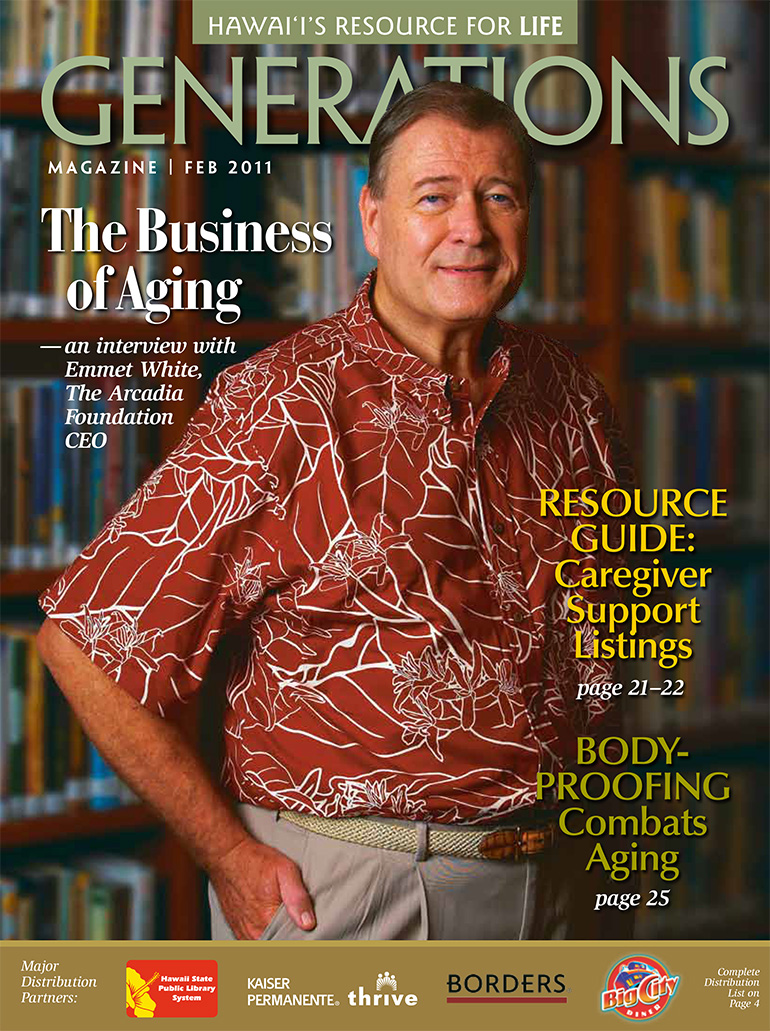
    Emmet White—local attorney turned retirement community CEO—offers us insight into the business of aging in Hawai‘i. At Arcadia Retirement Residence he sees firsthand the costs and benefits of senior care.

  • Crisis Communication

    If a parent suddenly fell unconscious or required emergency medical attention, would you know what do? Would you know what paperwork, insurance cards and medical records to bring with you to the hospital?

    Once a medical crisis occurs, it’s too late to prepare for the large amount of information that is needed by doctors, hospital staff, family and relatives. The solution? A medical organizer.

    With a medical organizer, you can log prescriptions, appointment times, treatment instructions and important contacts, plus track medical records, medical histories and vital stats.

    There are many different types of organizers on the market. Many of them feature tabbed dividers, storage pockets and useful medical charts. It is a great communication tool. And, it can help you make important medical decisions.

    Top 5 Reasons Why You Need A Medical Organizer

    1. More control: If a parent suddenly becomes unconscious or incapacitated, a medical organizer speaks on his/her behalf. It provides the hospital and emergency staff with the most recent health information.
    2. Peace of mind: One parent usually manages the finances, health records or housekeeping duties. Ask this parent to establish a medical organizer for both parents to avoid the burden of starting one from scratch when he or she is gone.
    3. Lessen the guilt: Eliminate the guilt adult children experience with end-of-life decisions because a parent did not establish the proper legal documents related to health issues. Studies found that siblings do not always agree with end-of-life decisions for a parent and this can break up the best of families or instill longstanding resentment.
    4. Minimize delays: Reduce delays with medical attention because important information was unavailable. You will also save time from having to search for information in safe deposit boxes, file cabinets or computer files.
    5. Proactive approach to care: Preparing now can save time and grief for family members who will make important decisions on behalf of a sick parent. Doctors appreciate when adult children take a proactive approach to their parent’s health, especially as geriatric progression worsens over time. Your parents will appreciate you too!

    Sandra J. Yorong is a financial advisor and author of the ‘Lifetime Medical Organizer’ and sold at retai bookstores and online at Amazon.com and www.lifemedorganizer.com

    If a parent suddenly fell unconscious or required emergency medical attention, would you know what do? Would you know what paperwork, insurance cards and medical records to bring with you to the hospital? Once a medical crisis occurs, it’s too late to prepare for the large amount of information that is needed by doctors, hospital…

  • Let the IRS Take a Bath for Change

    Nobody likes to pay taxes, but most of us like to take baths. Unless the bath is the kind where money flows out of your pocket and down the drain. If you feel like paying taxes is a lot like seeing your money go down the drain, you will be glad to know about an exciting estate planning opportunity that can help make the IRS take a bath after your death instead of your loved ones.

    When you die, the IRS will want your loved ones to pay a tax on the value of everything you owned. The estate tax reaches all of your assets, unless some exclusion or deduction applies. The law gives each of us an exclusion (I like to call it the “coupon”) from the estate tax. You can pass the coupon amount to whomever you want, tax-free. In addition to the coupon, the law gives married couples an unlimited marital deduction so estate tax can be postponed until both Mom and Pop are gone. The marital deduction doesn’t get rid of the tax—it just postpones it. The coupon does get rid of the estate tax to some extent, but it is not enough to eliminate all of the estate tax for many families.

    The law also allows an unlimited estate tax charitable deduction. So if you would rather have your money go to charity than to the IRS, you can bequeath all of the assets that would have been taxed at your death (everything over the coupon amount) to charity. But what if you want to give your descendants more than the coupon amount? Imagine sitting in a leaky bathtub. If you do nothing, eventually you and your rubber ducky will be the only things left in the tub. In order to maintain the water level, you will need to add water as fast as it is leaking out. If you add water faster than it is leaking out, the water level will rise, and eventually the tub will overflow.

    Imagine the flood that would result if you took a nice long bath (say 25 years) with hot water filling the tub faster than it is leaking out. Now imagine that instead of an overflow of water, you had an overflow of money. This is exactly how CLTs work.

    You put assets (hot water) into a CLT (bathtub). The trust agreement says that each year, 5% of the value of the assets will be paid to charity (5% of the water in the tub will leak out). Meanwhile, let’s say that the trust assets are earning income (the faucet is turned on and the tub is being filled) at the rate of 7%. The law allows us to pretend that the trust is earning only the applicable federal rate (AFR), which is set by the U. S. Treasury each month. If the AFR is 2% at the time we created the CLT, then we get to say that the trust will grow at a rate of only 2%. Net result? If payments are made to the charity monthly, the IRS will make believe that the trust will be completely exhausted in about 26 years, even though it will have far more in it at that time than when the trust was created. The best part is that all of the trust assets will go to charity and your loved ones, and not a cent will go to the IRS.


    SCOTT MAKUAKANE is a lawyer whose practice has emphasized estate planning and trust law since 1983. He hosts Est8Planning Essentials, a weekly TV talk show which airs on KWHE (Oceanic channel 11) at 8:30 p.m. on Sunday evenings. For more information about Scott and his law firm, Est8Planning Counsel LLLC, check out www.est8planning.com.

    By using a charitable lead trust (CLT), you can give assets to charity and your loved ones, without having to give anything to the IRS.

    Nobody likes to pay taxes, but most of us like to take baths. Unless the bath is the kind where money flows out of your pocket and down the drain. If you feel like paying taxes is a lot like seeing your money go down the drain, you will be glad to know about an…

  • Savvy Shoppers: Find a Charity You Can Trust

    The New Year is here and, because of the rough economy, it’s more important than ever to become a savvy shopper to both save money and prevent identity theft in 2011.

    Being a knowledgeable consumer is ultimately about using money wisely and learning how to squeeze as much value as possible out of every dollar.

    Charities seeking donations may tug at your heartstrings, but don’t succumb to pressure to give money on the spot. The Better Business Bureau (BBB) evaluates charities based on the use of funds, fundraising, governance, public accountability, solicitation and information materials.

    Look for the BBB seal and always check a business or charity out with BBB before you buy or donate. Nationwide, nearly 400,000 businesses bear the BBB seal of accreditation and meet its standards. You can also find the seal on Web sites and at business locations. Check with the BBB to make sure that the charity or company that you are considering does not have a history of dissatisfied customers or unanswered complaints.


    Check out a business or charity online at www.hawaii.bbb.org.

    The New Year is here and, because of the rough economy, it’s more important than ever to become a savvy shopper to both save money and prevent identity theft in 2011.

  • Smart Advice; How to Choose a Financial Advisor

    A financial advisor can offer valuable strategies and guidance to help you grow your savings and meet your financial goals and dreams. It’s important to select a qualified individual who is also a good match—personally and professionally.

    How to find the right advisor for your financial future:

    Ask for a preliminary meeting. Your first meeting should be complimentary and without any obligation on your part. Be wary if you are pressured to write a check or make any decisions at your initial consultation. During the meeting, listen carefully to what the advisor says. Does he or she ask questions to help clarify your financial circumstances and goals? Or are you listening to a canned speech? Be prepared to ask questions to determine how your advisor will work with you, including compensation (more on that later), frequency of meetings or calls and how your progress will be tracked. Look for someone who follows a process but is also flexible and responsive when your needs change.

    Understand the compensation model. Advisors may charge a flat fee for services while others charge a percentage of assets under management. Still others may be paid commission on the sale of financial products. It’s not unusual for all three methods to contribute to an advisor’s earnings. It’s important to understand how commissions and fees will affect the growth of your portfolio and to be aware of potential conflicts of interest.

    Compatibility matters. Your financial advisor should be someone who makes you feel at ease—enough so that you are comfortable sharing intimate financial details of your life. A successful advisory relationship can last for many years, so look for a person you can trust and with whom you enjoy spending time.

    Review experience and training. Look for someone with a depth of knowledge and valuable experience in the field. Your advisor should be able to distill complex financial topics for you in a way that you clearly understand and apply to your situation.

    Some advisors earn designations as part of their ongoing training. For example, a Certified Financial PlannerTM certification indicates completion of training in the financial planning process, with an understanding of insurance, investments, tax strategies and retirement and estate planning. Another designation, Chartered Financial Consultant (ChFC®), indicates the advisor has received training in personalized financial planning processes. Some financial planners also may be trained and experienced as Certified Public Accountants or attorneys.

    Consider specialization, as needed. Look for an advisor who has special expertise to meet your specific needs, such as estate planning or succession planning for your business.

    Check professional references. Take the time to call each reference. Ask specific questions to get an idea of the advisor’s strengths and weaknesses. If possible, talk to clients and professional associates. Credentials can also be verified by the organizations that award them.

    Be a proactive client. Ask for what you need. If you aren’t satisfied with the level of service you receive, take your business elsewhere.


    Michael W. Yee is a senior financial advisor with Michael W. Yee, a financial advisory practice of Ameriprise Financial Services, Inc. As a financial advisor, Yee provides customized financial advice that is anchored in a solid understanding of client needs and expectations, and provided in a one-on-one relationship with his clients. For more information, please contact Michael W.Yee at (808) 952-1240. Advisor is licensed/registered to do business with U.S. residents only in the states of Hawaii. Brokerage, investment and financial advisory services are made available through Ameriprise Financial Services, Inc. Member FINRA and SIPC. Some products and services may not be available in all jurisdictions or to all clients. © 2010 Ameriprise Financial, Inc. All rights reserved.

    A financial advisor can offer valuable strategies and guidance to help you grow your savings and meet your financial goals and dreams. It’s important to select a qualified individual who is also a good match—personally and professionally.