Everybody suffers from stress from time to time, given the tremendous challenges, options and responsibilities in our busy lives. Stress depresses respiration and causes shallow breathing which can lead to irritability, frustration and fatigue. Many people turn to unhealthy habits like smoking, overeating, and excessive drinking to counteract stress. Instead, you can follow this 10-minute, self-care acupressure routine to alleviate everyday tensions.
Shoulder & Neck Tension Relief
This 10-minute self-care routine is shown sitting, although you can also practice these techniques lying down.
STEP 1 — Shoulder Grasp: Curve your fingers of both hands, and place them on the tops of your shoulder muscles (GB 21), close to the base of your neck. Gradually apply firm pressure directly on to your shoulder tension. Simply let the weight of your arms relax forward, keeping your fingers curved like a hook. Sink deeply into the muscles as they soften and relax. Hold for one minute as you take slow, deep breaths. Then let your hands relax in your lap. Gently shrug your shoulders up and down to encourage them to relax.
STEP 2 — Neck Press: Interlace your fingers behind your neck, and let your head hang forward, with your elbows close together, pointing down toward your lap. Inhale deeply, raising your head as you stretch your elbows out to the sides; let your head tilt back. Exhale as your head relaxes forward and your elbows come close together in front of you. Repeat this exercise for two minutes; then let your hands float back into your lap. Keep your eyes closed and deeply relax for one minute.
STEP 3 — Press GB 20: Close your eyes, and place your thumbs on GB 20 (underneath the base of your skull in the indentations that lie about three inches apart). Apply firm pressure for one minute.
STEP 4 — Press GV 24.5: Bring the palms of your hands together. Close your eyes, placing your middle fingertips between your eyebrows on GV 24.5 (in the indentation above the bridge of your nose). To collect your thoughts and rejuvenate yourself, breathe slowly and deeply for three minutes as you focus your attention on the gentle touch of this point. Deeply relax in a chair or on your back, eyes closed, to gain the full benefits.
Everybody suffers from stress from time to time, given the tremendous challenges, options and responsibilities in our busy lives. Stress depresses respiration and causes shallow breathing which can lead to irritability, frustration and fatigue. Many people turn to unhealthy habits like smoking, overeating, and excessive drinking to counteract stress. Instead, you can follow this 10-minute,…
Family vacations are essentially quality time. It can take a lot of planning, especially if you want to visit multiple destinations on one trip. To minimize planning time and maximize quality time, choose a cruise vacation.
Cruises are all-inclusive: cooking, cleaning, serving. There’s no need to plan moving from place to place, or scheduling daily activities — where to eat or sleep — the cruise ship and crew does it all for you. It’s truly time for rest and relaxation with family and friends, like the Tan family who loves to cruise.
The only decisions you need to make are where to cruise and which shore excursions to enjoy — those are fun to decide as a family.
The Tan family on their Alaskan cruise.
For example, families love cruising the coast of Alaska — the great frontier. It offers gorgeous sceneries, spectacular mountain scapes and glaciers the size of a small state and lots of opportunities for family fun. The Inside Passage is also unforgettable, with everything from misty rainforests to craggy fjords. Many itineraries include a visit to Skagway, a town born in the excitement of the gold rush of 1898. While in port, families can visit a gold rush camp, hike on a glacier or take a wildlife-watching tour.
To explore more options for cruises, from shore excursions to discounts that will build lasting memories for your family, talk with Cruise Holidays Hawaii, your personal cruise experts. Call 808-596-7447 or visit www.chhawaii.com.
Family vacations are essentially quality time. It can take a lot of planning, especially if you want to visit multiple destinations on one trip. To minimize planning time and maximize quality time, choose a cruise vacation. Cruises are all-inclusive: cooking, cleaning, serving. There’s no need to plan moving from place to place, or scheduling daily…
Generations Magazine interviewed Mike Yee on his expertise on long-term care insurance (LTCI) and to learn more about this important policy and common questions asked.
GM: I understand you are a national leader in the LTCI industry. Could you elaborate your accomplishment?
MY: Actually, I happen to be the # 1 LTCI producer for John Hancock in the US for 2010 and 2011, which includes some 51,000 agents nationwide. That was not something I was striving for, as I would give it up any day if it meant that more professionals understood and recommended it. The results were more a reflection of my conviction, knowing what I know now about aging and long-term care.
GM: Is caregiving a huge problem in Hawai‘i and why? Where do you see these important long-term care issues in the future?
MY: The number of people needing care in Hawai‘i is staggering now and will grow in the future. There is a difference between being a companion, care manager, and caregiver. Family and friends have personal and financial lives of their own, increasing the demand for private paid homecare, assisted living, and nursing home care services. How to pay for these services is the challenge. There are already concerns about not having enough money from Medicare, Medicaid, and Social Security.
Currently, there is LTCI, life insurance with LTCI riders, and annuities with LTCI riders. Each with benefits and drawbacks; no “one size fits all.” Hawai‘i will be best served by combining public and private resources and advocating advanced financial planning for LTCI, sooner is better than later. Heading off now could be a win-win for all, better for the senior, better for the caregiver, better for the state, better for all.
GM: Do you have LTCI and why?
MY: At age of 54, my wife and I both own LTCI. We bought it at a time when we still have a mortgage, private school tuition, and college costs ahead of us. After a required physical to participate as assistant scoutmaster with the Boy Scouts, my doctor told me that I had high blood pressure and the beginning of diabetes. He gave me an ultimatum, “either lose 25 lbs. in the next 6 months or go on medication. Diabetes and high blood pressure can’t be felt. Left untreated, you can either have a stroke or heart attack.” Affordability and insurability have no correlation. I was smart enough to know it could happen to me; and if it did, I worry more about the ones I love and what would happen to them, than myself.
For more information, please contact Michael W. K. Yee at (808) 952-1240
Generations Magazine interviewed Mike Yee on his expertise on long-term care insurance (LTCI) and to learn more about this important policy and common questions asked. GM: I understand you are a national leader in the LTCI industry. Could you elaborate your accomplishment? MY: Actually, I happen to be the # 1 LTCI producer for John…
If you are concerned about how your investments are performing in today’s financial markets, you are not alone. Whether you are trying to build a retirement nest egg, or already living on one, it is important to make informed choices.
Sometimes people would like to help support the mission of an organization such as ours, but they are uncertain about what to do in the current economy. There is a way that you can help and create a more secure future for you and your family, regardless of how the economy fares. It’s called a charitable gift annuity and it is a way for you to help with the good work of a charity now and receive fixed income for the rest of your life.
What is a Charitable Gift Annuity?
A Charitable Gift Annuity is an agreement between you and a qualified charitable organization. When you transfer your cash or appreciated property to the charity, the charity agrees to pay you income for the rest of your life. Your payment will be fixed, which means that your income will never change. Your rate is based on your age at the time you make the agreement with the charity (or, if you decide to defer receipt of the income until a later time, the age at the time the income is to begin).
Hawaii law requires a charity to satisfy certain requirements in order to be able to enter into a charitable gift annuity agreement. It’s important to know that the charity of your choice meets those requirements. Not every charity does.
What are the Benefits?
There are many benefits to establishing a Charitable Gift Annuity. In addition to fixed income for life, you will receive a charitable income tax deduction to reduce your taxes in the year you make your gift. If you make a gift of appreciated property such as stock or real estate, you may also avoid paying some of the capital gain tax on the sale of your property.
What’s My First Step?
Since a Charitable Gift Annuity payment rate is based upon your age, you might want to start by requesting a charitable gift annuity illustration from a charitable organization. This will give you some information and will also enable you to make sure the charity qualifies to make charitable gift annuities in Hawaii. You will then be able to evaluate your potential benefits.
It is also a good idea to talk with your accountant or other tax advisor to determine how the tax benefits of a charitable gift annuity will fit with your overall tax situation and retirement income sources. A simple call to the planned giving office of your favorite charitable organization is a good way to get the information your accountant or other tax advisor will need to properly advise you.
National Kidney Foundation of Hawaii 1314 South King St., #304, Honolulu, Hawaii 96814
If you are concerned about how your investments are performing in today’s financial markets, you are not alone. Whether you are trying to build a retirement nest egg, or already living on one, it is important to make informed choices. Sometimes people would like to help support the mission of an organization such as ours,…
Leaving one’s legacy, in my opinion, involves much more than writing a Will to say who gets your things when you die. It involves reaching into your past and telling your life story including recalling specific memories, telling of family history, expressions of love and regret, and granting or requesting forgiveness. It also involves looking into the future to express values, hopes and wishes for loved ones. It is not only comforting for our loved ones to receive a personal written legacy, it can also be satisfying for you to know that your loved ones will receive your personal written legacy if you die suddenly.
Sadly, not many individuals make a Will. Statistics reveal that about 30% of individuals make an estate plan. Significantly fewer people take the time to write a personal legacy. Understandably this is difficult to do as we must face death and pause from our fast-paced lives long enough to reflect and write. And the world now is calling to each of us to do just that. According to the 2012 Allianz Life Insurance Company of North America American Legacies Pulse Study, 86% of baby boomers said that family stories are the most important aspect of their legacy, rather than receiving assets.
My hope for our community is that we establish this personal writing as part of a ritual in preparation of death. Long ago, our ancestors wrote their own Will. They would tap into stone admonishments such as “don’t drink, don’t smoke, marry
a Doctor or don’t marry a Doctor.” Now things have become so complicated that people hire lawyers to write their Will for them, and in the course of writing the legal documents, the lawyer bleaches out all of the heartfelt personal statements.
I ask my clients after they sign their estate planning documents to tell me what color they are. Perplexingly, they respond: “black and white.” Yet, everyone’s life is everything but black and white, it is colorful, full of depth, and is dynamic.
I urge you to go beyond the legal estate plan and write your own personal legacy to put the color back into your estate plan, add your voice into your plan and provide you with peace of mind knowing that your heart will be felt. It also provides your loved ones with a lasting personal legacy providing comfort in years to come.
I created a booklet for my clients to use to write their personal legacy, called My Heartfelt Will. I encourage each of my clients to take time out of their busy lives to sit quietly and contemplatively to write their own personal legacy. I tell them that they are doing a great job as they just completed their estate plan and are among the 30% of people to do so, and this gives them the opportunity to take the next very important step and create their own personal legacy.
Stephen B. Yim, Attorney at Law 2054 S. Beretania Street, Honolulu, HI 96826
Leaving one’s legacy, in my opinion, involves much more than writing a Will to say who gets your things when you die. It involves reaching into your past and telling your life story including recalling specific memories, telling of family history, expressions of love and regret, and granting or requesting forgiveness. It also involves looking…
A personal promise creates new, affordable homes for hundreds local seniors
In the early 1990s, local businessman Steve Metter searched for a safe and affordable place for his aging father to live. Faced with limited options, it became his mission to build a quality community for the people of Hawai‘i who faced the same situation. Steve’s determination was the foundation for The Plaza Assisted Living.
Today, The Plaza is planning to open its third property — The Plaza at Moanalua. Construction is moving quickly and plans are to open the doors to new residents by October of this year. Generations Magazine recently sat down with Steve to learn more about Hawai‘i’s senior housing challenges, and hear about how The Plaza’s newest community may help local families.
GM: What prompted the idea of starting an assisted living property in Hawai‘i?
SM: In the early 1990s, my development partner Mike Wood and I recognized the need for a new type of senior housing in Hawai‘i. We both had middle-class parents in assisted living communities on the Mainland. After my mom passed away, my wife and I wanted to bring my dad to Hawai‘i to be closer to the rest of our family. After looking around we were unable to find a senior housing rental that provided a high quality experience and affordable care. We were disappointed that the quality assisted living communities in Honolulu required high buy-in fees and long-term commitments that make them out of reach for many middle-class families. We believed that the local community deserved a rental assisted living option that could provide the same level of care expected from the most exclusive communities. We made a promise to our parents that we would develop and operate high quality, affordable assisted living in Hawai‘i.
Steve Metter’s parents.
GM: Transitioning from a caregiver for your parent to building an assisted living community is quite a leap, without experience in this area of expertise. How was the process moved forward?
SM: We knew we needed to find a good business partner. We started our search by attending assisted living conferences and visiting communities on the Mainland. Our search eventually put us in touch with Sound Health Management and Development, Inc., an assisted living management and development company out of Seattle, WA. Sound Health, led by Rick and Lisa Skelton, had been involved in the development of nearly 30 assisted living communities across the Western U.S. and is considered a leader in the assisted living industry. They, too, had noticed the lack of quality rental assisted living options in Hawai‘i and were concerned about the state’s looming senior care crisis. We had finally found a partner that had exceptional operational experience, a history of successful developments and had dedicated their lives to caring for seniors. The partnership was a natural fit as both firms were driven by the same values — integrity and commitment to quality.
GM: Was there a bigger plan for the future since multiple properties are being built?
SM: In the beginning, our focus was about fulfilling a promise to our parents to build affordable, high quality senior living rentals, which was The Plaza at Punchbowl. Once The Plaza opened, we all became motivated to expand and provide these services in multiple locations. We realized that we had the ability to help even more families. The Plaza at Punchbowl provided a rental location in town close to medical facilities, shopping, and, most importantly, the residents’ own families. Seniors want to live in their own neighborhoods or close to their families. This meant we needed to build more communities in different areas throughout the state.
GM: Where are your communities located?
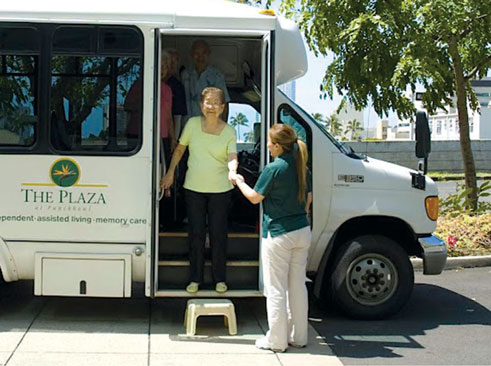
SM: Our first project, The Plaza at Punchbowl, opened in 2004 and is located in Honolulu on Lunalilo Street near Ward Avenue. Our second project, The Plaza at Mililani, is located on Ukuwai Street in Mililani Mauka and opened in 2010. The Plaza at Moanalua, our third project, is currently under construction and will be opened later this year. It’s located on Moanalualani Place directly behind Kaiser Hospital.
GM: Are there other locations that you are presently considering?
SM: Currently we are in the entitlement and permitting process for sites in Waikı¯kı¯ and Pearl City. We are also looking for sites throughout O‘ahu. Seniors want to stay in their neighborhoods and familiar areas; they should have the opportunity to do so.
Steve Metter visiting with the residences on BINGO MONDAY!
GM: How have these assisted living properties had an impact on your life, personal and professional?
SM: The Plaza communities have impacted my life in so many ways. These communities have allowed me to fulfill a promise to my parents, created diversification for MW Group, Ltd., provided a new successful platform for our limited partners, generated hundreds of new jobs and most importantly we’ve had the honor and privilege to care for many of my friends’ and our community’s loved ones.
On a personal level, my children and their classmates have had the opportunity to visit, entertain and work in our Plaza communities. Recently we had a great time teaching my son’s class about the need and responsibilities in caring for our elders. Last holiday season my wife Susan and all three kids made bracelets for some of our residents and presented them on Christmas morning. My family and I enjoyed it so much … I think it will become an annual event.
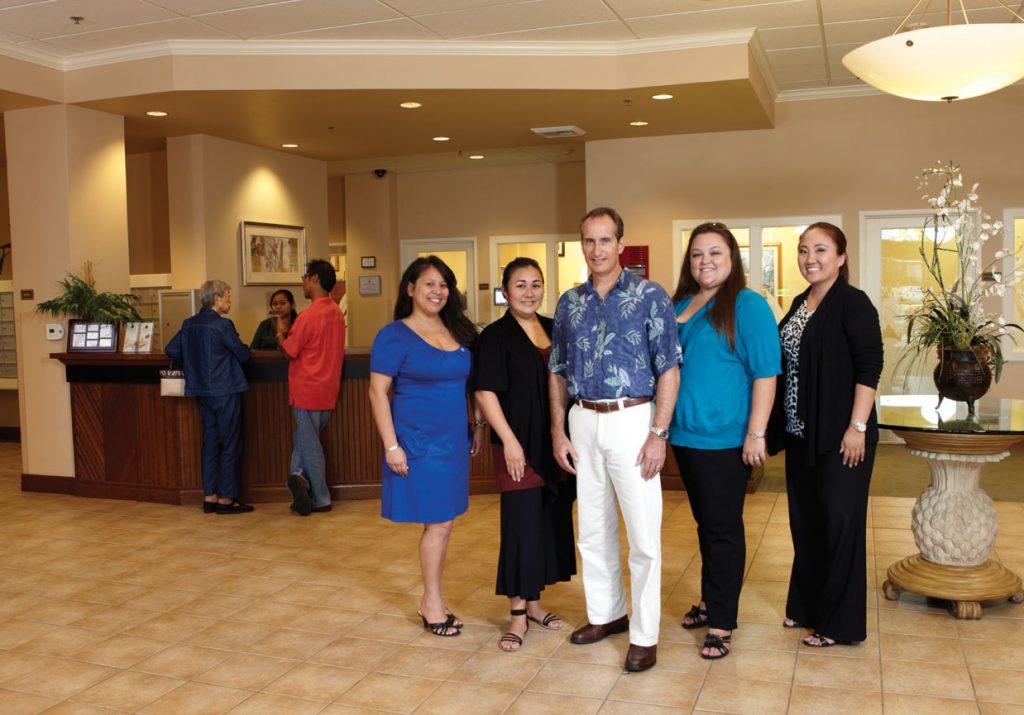
The lobby entrance of The Plaza at Punchbowl (Lt–Rt) U’ilani Kapuaakuni, Business Office Manager; Ashley Yokoyama, Administrator; Steve Metter, Developer; Tricia Medeiros, Regional Director; Shannon Miyazaki, Administrator
GM: What is the best part of caring for so many senior residents?
SM: Having lived through caring for an aging parent, I have firsthand knowledge of what people go through and the difficulties you experience. Everyone just wants to make sure that his or her parent has the best life possible, especially during the last years. I talk to friends and business associates and so many have parents who are aging and experience the similar worries that I did. I am grateful and humbled to be a part of something that has, and will, help so many families in our community.
GM: What are some of the staffs’ key traits that enable The Plaza to maintain a highly successful assisted living operation?
SM: The most important trait in our staff is passion. Our team members must be passionate about our mission. They need to care about
people of all ages because we touch the lives of not only the seniors but also their families, friends and other care givers. We can provide
technical training and education, but they must genuinely be caring and compassionate in order to be successful.
The Plaza was fortunate enough to hire Tricia Medeiros as the Administrator of The Plaza at Punchbowl. She later went on to become the
Regional Director of the company and is responsible for operations across all of our properties. Her belief is to find genuine, caring and driven people, and help them advance as we open new communities. Currently, all of our administrators at the various Plaza locations have held previous management positions within our company and were able to grow and expand their knowledge of assisted living under her direction and later become leaders of their own properties.
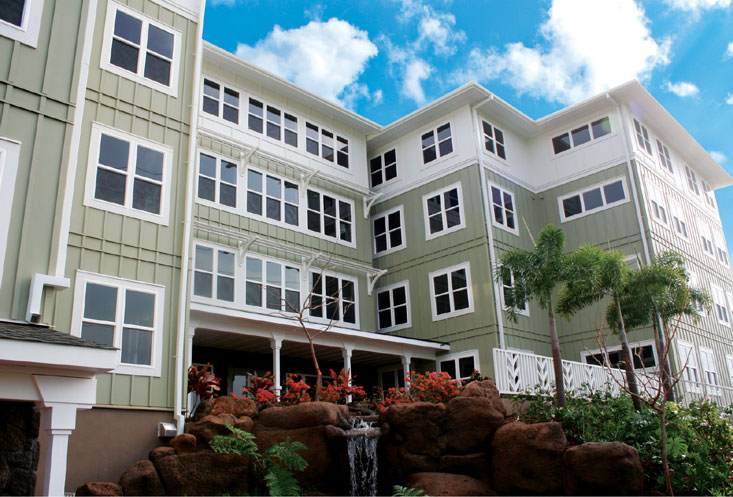
Entrance of The Plaza at Mililani
GM: What are some of the demographics of your residents? Age, level of mobility, prior occupation, financial history, where they lived prior, etc.
SM: The average age of our residents is in the mid-80s, but ages range from 60 to 100. The majority either lived in the immediate area or
has family who live near the community. Our residents are local people of all ethnicities and often will recognize former acquaintances from school or their neighborhood when they move in.
GM: What do you see in the future of long-term care in Hawai‘i?
SM: Hawai‘i’s senior population is one of the fastest growing groups in the country, and assisted living provides an option for seniors to live in an environment that fosters their independence. Services for seniors will need to continue to expand.
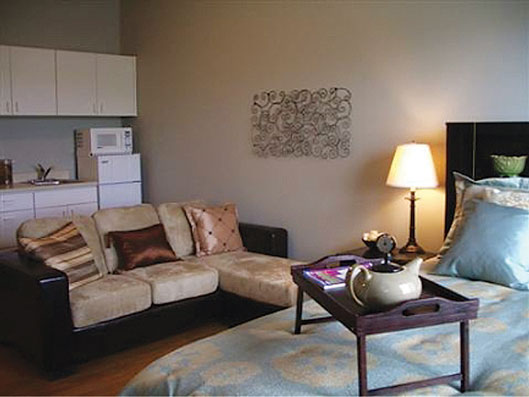
Bedroom at The Plaza at Mililani
GM: What is your best advice/tip for children of aging parents?
SM: Have the conversation with your parents early and do your research. Unfortunately, many of our residents move into our community after some kind of incident, and then it becomes a big rush to find an available apartment. In these circumstances, people often are forced to make a decision based on availability and not preference. I encourage people to go out and visit communities and learn about their differences. Families should make a well-informed decision. In addition, I think families will be surprised to see what state-of-the-art assisted living facilities offer. Prior to moving in, families should have a thorough understanding of the community’s dining experience, activities, staffing expertise, resources and overall social dynamics.
GM: In large housing facilities, how do you care for people with special needs such as dementia?
SM: Each one of our communities has a Memory Care Program. These are specially designated floors that create an environment for those residents with Alzheimer’s disease and other related dementias. The program floor is secured and allows residents to wander freely throughout the floor. In addition, the staff is trained to care for these residents’ special needs. The Plaza works very closely with the Alzheimer’s Association. The Plaza and the staff work hard to support the association because of all the services they provide our residents, staff and families. We hold support groups for the families in our communities, utilize the training they provide and continually
try to improve the residential experience.
GM: What are the benefits of living in an assisted living community?
SM: Most seniors want to reside in their homes as they age — we support that desire. But there may come a time that someone can no longer live alone in their home and need supportive services. Assisted Living provides an option for those who need services but want to live in an environment that fosters their independence. We’ve noticed that residents who were living alone in their own homes have improved health after moving into the community. This usually occurs due to improved nutrition, socialization, better exercise, health monitoring and medication management.
GM: What advice can you give if your aging parent is resistant to change?
SM: First, encourage them to visit the communities. Most find it surprisingly pleasant … like a very nice apartment complex or hotel. Next,
would be to experience it with a respite or short-term stay. When it comes to residents with dementia, reasoning with your parent may be difficult. Sometimes safety becomes a primary issue and nudging your parents may be necessary. The good news is that our staff has helped so many families through this transition with success.
I am grateful to be a part of The Plaza assisted living team. Our communities are filled with great people who have so much love, experience, memories, and wisdom to share with all of us.
The Plaza at Mililani
95-1050 Ukuwai Street, Mililani | 626-8807
• Five story building • 128 beds
Sweeping mountain views east and west.
The Plaza at Punchbowl
918 Lunalilo Street, Honolulu | 792-8800
• Six story building • 137 beds
Conveniently situated in the heart of Honolulu
with ocean views and near shopping, medical
facilities, and much more.
The Plaza at Moanalua
1280 Moanalualani Place, Honolulu | 833-8880
• Six story building• 160 beds
Unobstructed mountain and ocean views.
In the early 1990s, local businessman Steve Metter searched for a safe and affordable place for his aging father to live. Faced with limited options, it became his mission to build a quality community for the people of Hawai‘i who faced the same situation.
Exercises performed in water is truly magical. The liquid density in the pool increases the amount of workout that you would have compared with the equivalent exercise on land without the fear of falling or damaging fragile joints. It allows you to move in ways you never thought you were capable of. Many forms of land exercise are now being adapted to the pool.
Benefits of water exercise:
Increases flexibility and balance .
Increases muscular and bone strength.
Water’s buoyancy means less strain on knees, ankles and hips.
Improves cardiac fitness levels.
Burns calories by engaging the large muscle groups.
Relaxes the entire body.
Increases levels of serotonin resulting in overall feeling of wellness.
Types of water exercises:
Swimming — A complete whole-body and cardiovascular workout with interval training.
Water Aerobics — Whether in shallow or deep water, major muscle groups & full body movements are engaged.
Walking — Love to walk? Take it to the pool or ocean and double the output.
Aqua Zumba — A modified version of Zumba using water resistance to intensify the moves.
Ai Chi — Similar to Tai Chi. It combines deep breathing and slow/large movements.
Kick Boxing — Taking this sport from the gym to the pool using adapted punches and kicks.
Aquatic exercise is fun, challenging and gentle to your body. You receive in turn a healthier, stronger, younger and happier you.
Find out locations closest to you through the city parks and seniors club listings: 973-7258.
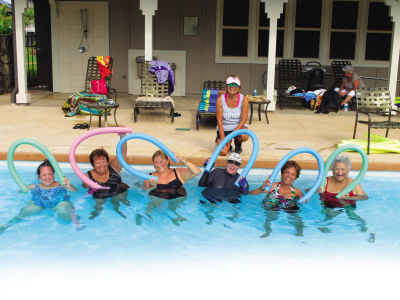
Joett and aqua participants at Franciscan Vista’s swimming pool.
Exercises performed in water is truly magical. The liquid density in the pool increases the amount of workout that you would have compared with the equivalent exercise on land without the fear of falling or damaging fragile joints. It allows you to move in ways you never thought you were capable of. Many forms of land exercise are now…
“$51? Are you sure that’s right?”
— Yes, the young lady told him.
“Does that include the tax?”
— Yes, she said again.
“Okay,” the man said and pulled a $50 and $1 out of his pocket.
“We had a nice time,” he told her.
— “We hope you join us again,” she said.
Through a stroke of good fortune, Mrs. Matthews and I had the opportunity to take a cruise to Alaska, a part of our great nation we had never visited before.
The gentleman in line ahead of me had paid a flat cruise fare — meals included. The $51 was for “incidentals” — drinks, massage, excursions — whatever. An article recently pointed out that it is almost — almost — cheaper to retire on an ocean liner than it is in a nursing home. I’m not sure that’s entirely true — but I do know they take pretty good care of you on the ship. There is a doctor on board. That can be important.
You can eat whatever you want, whenever you want. This includes ice cream. It may not be a big deal now, but believe me, at some point during your voyage, you will want ice cream. And it’s nice to know it’s always there.
If you can eat whatever you want, there are plenty of activities to work off those extra calories. I watched people playing basketball in 48 degree weather. It’s a good excuse to get more ice cream.
When you arrive at a new destination, you will feel the kind of excitement you felt as a child. It’s hard to put a price on that.
You will find yourself elbow to elbow with people from all over the world. EVERYBODY has a story and if you are the least bit interested, that person is happy to share a story with you. And you will have the chance to share your story as well. Psychologists will tell you, this is a path to good mental health — listening AND sharing.
Maybe this is the message of these notes this time around. Cruising can happen where ever you are. You don’t necessarily have to be on a ship in the middle of the North Pacific to practice cruising. You can walk around the block, head over to the library or your local senior center.
The important thing is to LISTEN AND SHARE. You will be amazed by what your fellow “passengers” have to tell you.
By the way, the fellow with the $51 charge at the end of his voyage — he got his money’s worth.
“$51? Are you sure that’s right?” — Yes, the young lady told him. “Does that include the tax?” — Yes, she said again. “Okay,” the man said and pulled a $50 and $1 out of his pocket. “We had a nice time,” he told her. — “We hope you join us again,” she said. Through a stroke of…
There are two types of Solar Energy Systems that will significantly lower your energy bill. Solar hot water systems can provide 20% to 30% of your energy needs and photovoltaic (PV) systems can provide up to 100%. There are many issues regarding a solar system for your home which you need to understand prior to purchasing a system:
1. Does the installation include roofing industry details for roof penetrations? Many installers are voiding roof warranties by using substandard roof penetration detailing causing leaks.
2. Does the system installation come with a maintenance program? Your investment needs to be maintained and your PV system needs attention to prevent module failures.
3. Do you have a copy of the warranty prior to purchasing, so you can read the limitations? Warranties are sales tools used by companies to convey the false idea that something is guaranteed when it is not.
4. Does quality matter to you? Better quality modules will cost more but last longer and produce more power over the long haul. Many contractors buy the cheapest modules and then try to convince you they are equal.
5. How long has the manufacturer been in business making modules? Solar manufacturers are losing money due to Chinese manufacturers flooding the market with low cost products. It’s been predicted that only about 10 companies will be in this business after the smoke clears, so find out how long they have made modules and are they likely to be in solar business after the dust clears.
Pacific Islands Construction believes that an informed buyer makes the best decisions. Contact them at 841-7756 or check their website at www.pacificislandsconstruction.com.
There are two types of Solar Energy Systems that will significantly lower your energy bill. Solar hot water systems can provide 20% to 30% of your energy needs and photovoltaic (PV) systems can provide up to 100%. There are many issues regarding a solar system for your home which you need to understand prior to…
In our lifetime, we have seen incredible advances in medical science. Think back 30 years. In 1982, a heart bypass operation was a really big deal. It meant weeks in the hospital and very risky surgery. Today, surgeons barely have to cut us open to reach into our bodies with instruments that enable them to do multiple bypass surgeries and have us out of the hospital in a matter of days. As a result of these kinds of advances, people in this country are living longer and longer. What we are finding, however, is that longer life does not necessarily mean improved quality of life.
For a growing number of us, the chances of needing nursing home or other kinds of long term care are increasing. The average person in 2012 stands a 66% chance of being completely incapacitated for some period of time (which may or may not include a stay in a nursing home), and 25% of us will require long-term care. Planning for this eventuality is something we should all make a high priority.
Figuring out how to finance long term care and choosing the right retirement community or nursing home involves an important set of issues that you should discuss with your financial planner, your insurance professional, and your other trusted advisors. A different, but related, set of issues arise in the legal arena.
If you have not done this already, do not wait another day before you contact your attorney or find someone who can advise you about planning for the possibility of incapacity. The concerns break down into two categories: dealing with your person (making decisions about your medical care, your living situation, and when — if ever—to stop medical intervention), and dealing with your stuff (taking care of everything you own if you lose the ability to do it yourself).
Both of these categories involve choosing and then legally empowering your hand-picked decision makers. Taking care of you and taking care of your stuff involve different issues, so think about whether to have the same people in charge of both. You may want one set of people or institutions to be your caretakers, and another set to be your trustees.
At a bare minimum, you will probably want to have an Advance Health-Care Directive (AHCD), an authorization to your medical personnel to share your health information with your Health-Care Agents, and a Durable Power of Attorney (DPA). Depending on the complexity of your estate and your family situation, you may want to have other things in your estate planning toolkit, such as a will and a revocable living trust agreement.
It is critical for you to learn your options and what kind of instructions you can give your loved ones in the event that you cannot speak for yourself. There are many good books, websites, and workshops available.
Scott Makuakane, Attorney at Law Specializing in estate planning and trust law.
In our lifetime, we have seen incredible advances in medical science. Think back 30 years. In 1982, a heart bypass operation was a really big deal. It meant weeks in the hospital and very risky surgery. Today, surgeons barely have to cut us open to reach into our bodies with instruments that enable them to…
Welcome to all of you attending this year’s Senior Fair and enjoying the great exhibitors and presentations, full of resourceful information and contacts to living well. We all should thank the producer of this—the largest event of the year dedicated to our senior community— Mike Rossell and his associate Barbara Garofano who coordinates just about
everything.
This month’s cover story features the story of The Plaza Assisted Living Properties, its commitment to the retirement community and its growing list of residences. We thank you Steve Metter and Mike Wood for their commitment to providing the much needed rental option to retirement living and providing the needed care for our growing Alzheimer’s and related dementia population.
I have recommended to hundreds of families that we all need to have the talk with our family members on “aging in place” and the options to where we want to live the rest of our lives or at least for the foreseeable future. The Plaza Assisted Properties offer one of the options that our middle class will and should seriously take a visit and check out the benefits of living in a comfortable and safe place. Developer Steve Metter made a significant comment that we must think of it as a major benefit for our loved ones that “most residents who were previously living alone in their own homes have improved health after moving into an assisted living community. This usually occurs due to improved nutrition, socialization with peers, better exercise, health monitoring and medication management.”
And we also want to thank the many who have visited us online for their own personal knowledge and research and to view the many events posted on our calendar. The numbers are growing and we continue and support that aspect of our technologically-savvy readers.
Welcome to all of you attending this year’s Senior Fair and enjoying the great exhibitors and presentations, full of resourceful information and contacts to living well. We all should thank the producer of this—the largest event of the year dedicated to our senior community— Mike Rossell and his associate Barbara Garofano who coordinates just about everything. This month’s cover…
The most important thing for our health is to get enough fruits and vegetables on a daily basis. It provides antioxidants, micronutrients, and phytochemicals to protect us from disease such as cancer and heart disease. These nutrients help us continue to function on a cellular level, keep our immune system strong and add a lot of fiber that’s needed in a healthful diet. The requirement is 5–7 servings of fruits and vegetables and 25–30 grams of fiber daily. Leafy greens like kale, collard, Swiss chard and spinach are the most nutrient-dense of all foods. Yet most people find it challenging to get this into their diets.
The easiest way I have found to get these nutrients on a daily basis is through green smoothies. Mixing the fruits and vegetables together in a Vita-Mix makes for a delicious drink, and a great way to start your day.
Ingredients
1 apple
1 banana
5 frozen strawberries
1 handful kale
1 handful spinach
1 handful mint
1 scoop ground flaxseed
1 scoop wheat germ
1 cup water or coconut water
Ice
Directions
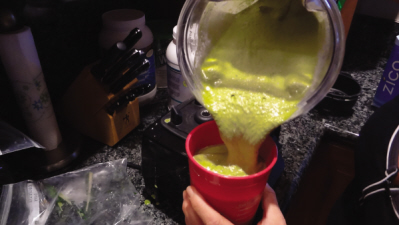
Blend all together in a blender till all the ice is crushed and vegetables and fruits are chopped to milkshake consistency. See this video for a demo . Enjoy!
The most important thing for our health is to get enough fruits and vegetables on a daily basis. It provides antioxidants, micronutrients, and phytochemicals to protect us from disease such as cancer and heart disease. These nutrients help us continue to function on a cellular level, keep our immune system strong and add a lot…

 Everybody suffers from stress from time to time, given the tremendous challenges, options and responsibilities in our busy lives. Stress depresses respiration and causes shallow breathing which can lead to irritability, frustration and fatigue. Many people turn to unhealthy habits like smoking, overeating, and excessive drinking to counteract stress. Instead, you can follow this 10-minute, self-care acupressure routine to alleviate everyday tensions.
 This 10-minute self-care routine is shown sitting, although you can also practice these techniques lying down.
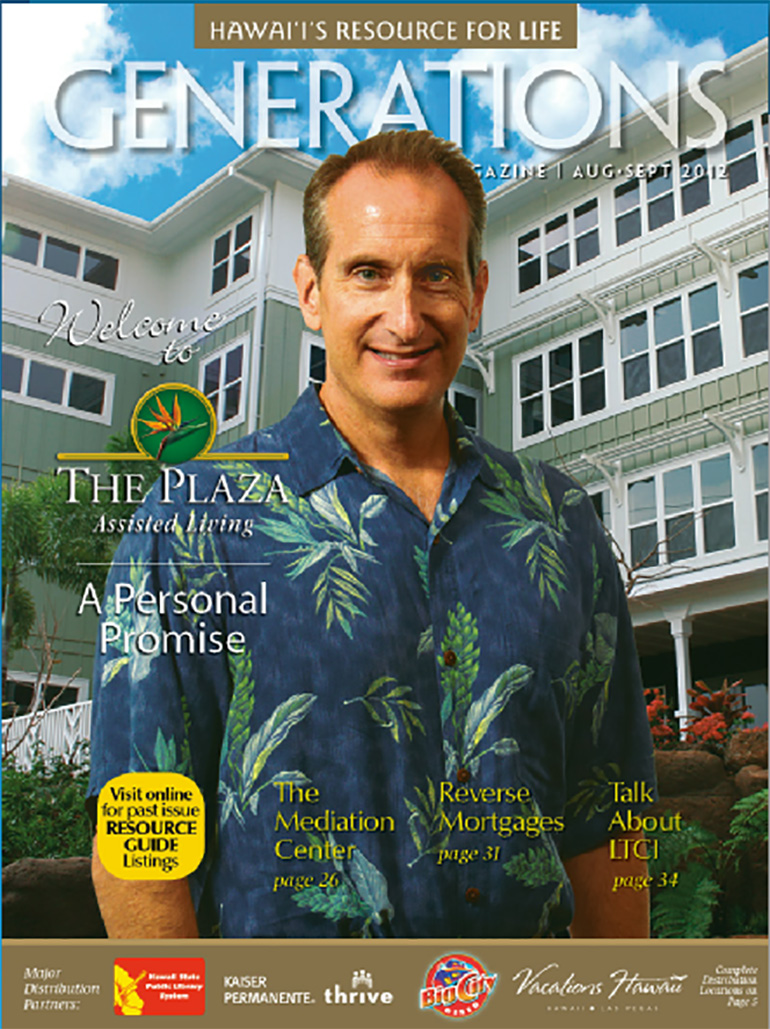
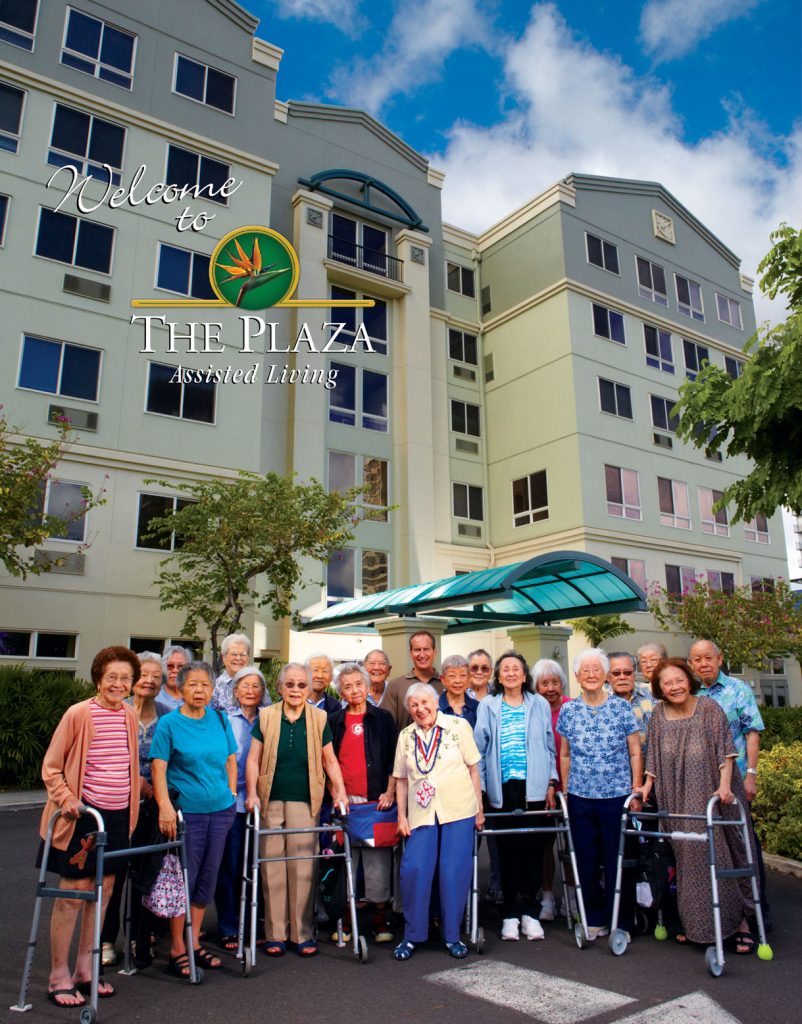 In the early 1990s, local businessman Steve Metter searched for a safe and affordable place for his aging father to live. Faced with limited options, it became his mission to build a quality community for the people of Hawai‘i who faced the same situation. Steve’s determination was the foundation for The Plaza Assisted Living.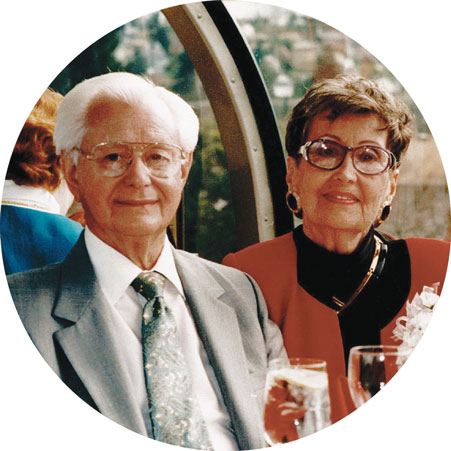
 GM: Where are your communities located?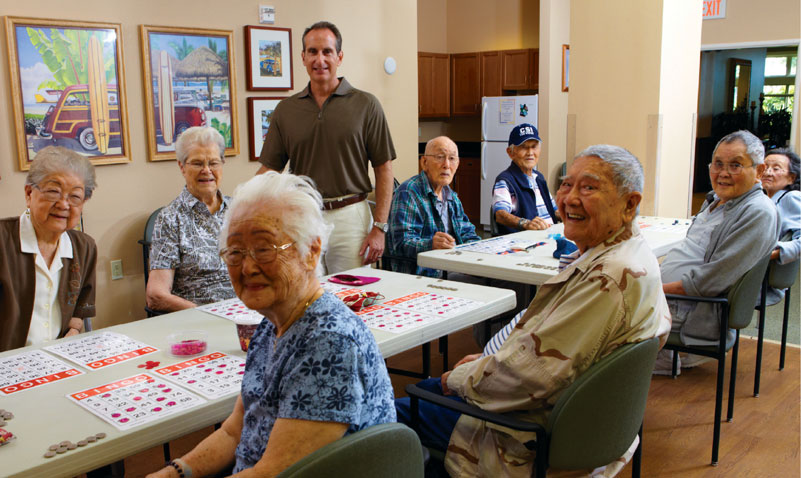
 I have recommended to hundreds of families that we all need to have the talk with our family members on “aging in place” and the options to where we want to live the rest of our lives or at least for the foreseeable future. The Plaza Assisted Properties offer one of the options that our middle class will and should seriously take a visit and check out the benefits of living in a comfortable and safe place. Developer Steve Metter made a significant comment that we must think of it as a major benefit for our loved ones that “most residents who were previously living alone in their own homes have improved health after moving into an assisted living community. This usually occurs due to improved nutrition, socialization with peers, better exercise, health monitoring and medication management.”
 The most important thing for our health is to get enough fruits and vegetables on a daily basis. It provides antioxidants, micronutrients, and phytochemicals to protect us from disease such as cancer and heart disease. These nutrients help us continue to function on a cellular level, keep our immune system strong and add a lot of fiber that’s needed in a healthful diet. The requirement is 5–7 servings of fruits and vegetables and 25–30 grams of fiber daily. Leafy greens like kale, collard, Swiss chard and spinach are the most nutrient-dense of all foods. Yet most people find it challenging to get this into their diets.
 Ingredients