Stress is a part of life. And our ability to manage stress is part of the resilience needed to live a well-balanced life. Our ability to cope with stress determines the quality of our life. How we handle stress defines who we are.
Here are nine very practical coping skills strategies to help us cope with our stressors:
The 9 Coping Skills
1. Deal with your feelings. Feelings tell us what we need to do. To deal with them, we must name them, realize it’s ok to feel them, express them in a safe way, then decide what to do to feel better.
2. Adjust your attitude. What we tell ourselves about the situation will determine how we feel about it. Looking at the good side of things (having a positive attitude) can help us feel better.
3. Discover your choices. In every situation, there are things that can and cannot change. We help ourselves when we choose something that can be changed. Your attitude can always be changed.
4. Accept imperfection. Everyone makes mistakes. We can help ourselves feel better by adjusting our attitude and assessing our choices.
5. Give yourself a break. When you become physically and/or emotionally tired, get your energy back and make yourself feel better by relaxing and taking a break from what you are doing.
6. Take things one step at a time. When you have too much to do, you can feel overwhelmed. Feel better by slowing down, prioritizing and taking things one step at a time.
7. Treat yourself kindly. The stress caused by being angry, frustrated or pushing yourself too hard can make you feel worse. Feel better by using patience and gentle affirmations.
8. Plan ahead. When we have a lot to do or think about, planning ahead can help prevent problems before they arise. Planning ahead helps us to have enough time, energy & tools to complete the task.
9. Ask for help. When no matter how hard we try or how many coping skills we use, we still can’t solve our problem, it’s time to ask for help.
Which of these nine coping skills do you frequently use? Which are hard for you? Which are easier? You will benefit by practicing all nine, with an emphasis on the harder ones.
Practicing them during routine situations will help make them a part of your daily navigation, so when things become rough, you’re more comfortable finding your way.
Stress is a part of life. And our ability to manage stress is part of the resilience needed to live a well-balanced life. Our ability to cope with stress determines the quality of our life. How we handle stress defines who we are. Here are nine very practical coping skills strategies to help us cope…
The Hawai‘i Department of Health (HDOH) is moving forward with its implementation of the state’s COVID-19 vaccination plan.
Points of dispensing (PODs) are open across the state for the initial phases of the COVID-19 vaccine distribution.
As Hawai‘i continues to receive more vaccine, dosages are being distributed to vaccination PODs throughout the islands as quickly as possible.
Eligibility & Timeline
There are two major phases in the vaccination plan. The first phase is now underway to protect the three priority groups:
◆ WINTER: Phase 1A includes healthcare personnel and long-term care facility residents, which is estimated to be 6 percent of Hawai‘i’s total population are eligible to register for vaccination.
◆ WINTER: Phase 1B initially included frontline essential workers and adults 75 and older, which is about 20 percent of Hawai‘i’s population. In early March, the DOH announced that those who are 70 or older could register for COVID-19 vaccine appointments starting on March 8.
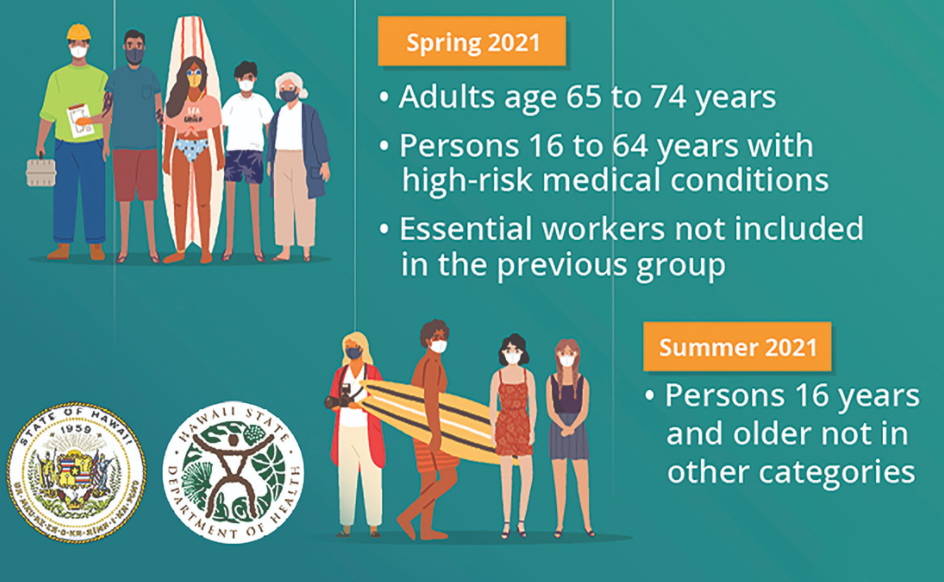
◆ SPRING: Beginning on March 15, phase 1C began, which includes adults aged 65 to 74 years, persons 16 to 64 years old with high-risk medical conditions and essential workers not included in the other categories. Phase 1C will covers 47 percent of the state’s population.
◆ SUMMER: Phase 2 will cover the rest of the population, which includes all persons 16 years and older who are not in the other categories.
It is estimated that 73 percent of Hawai‘i’s population will receive the vaccination if all those in Phase 1 receive the vaccine. Phase 2 will cover the remaining 27 percent of the state’s population.
How Will I Know When It’s My Turn?
You may hear from your healthcare provider, your employer, announcements from state and local leaders, or the media. Subscribe to daily updates at health.hawaii.gov/updates. Review the pre-vaccination checklist and register for your vaccination at http://bit.ly/C19VaccReg.
The Hawai‘i Department of Health (HDOH) is moving forward with its implementation of the state’s COVID-19 vaccination plan. Points of dispensing (PODs) are open across the state for the initial phases of the COVID-19 vaccine distribution. As Hawai‘i continues to receive more vaccine, dosages are being distributed to vaccination PODs throughout the islands as quickly…
Whoever said you can’t teach an old Rotarian new tricks doesn’t know Hawai‘i Rotarians. For the first time in the 50-year history of the annual Rotary Youth Leadership Awards (RYLA) in-person camps, the Rotary Clubs of District 5000 (Hawai‘i) facilitated an all-island virtual camp with 110 participants on Feb. 26 and 27 due to the ongoing pandemic.
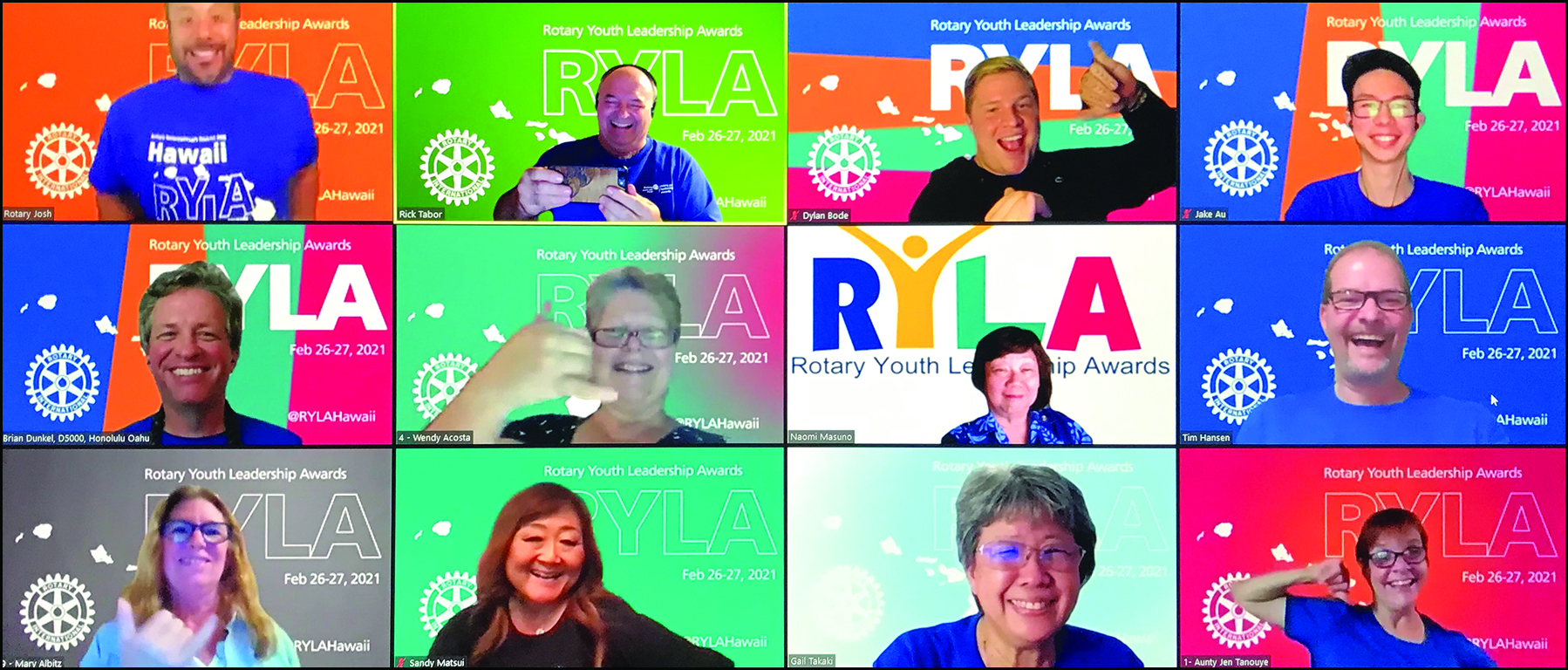
RYLA 2021 all-island committee members included (L–R, top row) Joshua Laguna, Rick Tabor, Dylan Bode, Jakob Au, (middle row) Brian Dunkel, Wendy Acosta, Naomi Masuno, Tim Hansen, (bottom row) Mary Albitz, Sandy Matsui, Gail Takaki and Jen Tanouye.
RYLA is an annual leadership program officially adopted by Rotary International in 1971 and coordinated by Rotary Clubs around the globe. Today, 160 countries offer RYLA camps. Thousands of young people are sponsored by Rotary Clubs to attend events run by the clubs’ district committee.
RYLA offers an opportunity for our next generation of leaders to define themselves while expanding their own leadership skills through lessons based on Rotary principles such as the Four-Way Test: “Is it the truth? Is it fair to all concerned? Will it build goodwill and better friendships? Will it be beneficial to all concerned?” In addition to leadership skills, RYLA lessons help youth build character, self-confidence, personal development, self-awareness and good citizenship practices.
Student camp participants are typically high school age. Of the 60 percent of Hawai‘i Rotarians who shared their birth years, 64 was the average age. Rotary’s mature members have much to offer students — and visa versa. The 2021 RYLA camp itself was a product of multigenerational problem solving. An all-island Rotary committee led RYLA into the virtual world, with the help of students.
Hawai’i RYLA Committee Member Gail Takaki, a 1975 University of Hawai‘i graduate, has been part of the core RYLA team on Hawai‘i Island since 2010. She connected RYLA and Jakob Au, a software engineering student at Drexel University, who came home to Hilo for spring break in 2020 and was still there a year later. Jakob developed and ran RYLA’s virtual platform, training senior Rotarians and tech savvy RYLA students alike on Zoom and Discord platforms.
He facilitated the event without a hitch.
“The trick to this virtual world is to be open to our youth’s virtual-world talents,” said O‘ahu RYLA Co-chair Rick Tabor (Generations Magazine community development director).
“The COVID-19 pandemic presented opportunities for problem solving, community collaboration, creativity and action,” says Gail. “Learning is an everyday activity.” It is essential to our ability to survive and thrive. My passion has always been helping people grow. My life work is about understanding what children or adults desire and their needs, and providing the opportunities for their experimentation and learning that is truly their own. Discovery of one’s courage and capacity to explore new ideas, people and things lead us all through challenges to valuable and personal rewards. RYLA 2021 was simply a joy to create.”
At the conclusion of the virtual camp, graduates presented 11 powerful community projects. RYLA’s lessons in leadership became Gen Z’s declarations, announcing their arrival as they prepare to lead the world to better places. RYLA 2021 was an amazing experience for all concerned.
Whoever said you can’t teach an old Rotarian new tricks doesn’t know Hawai‘i Rotarians. For the first time in the 50-year history of the annual Rotary Youth Leadership Awards (RYLA) in-person camps, the Rotary Clubs of District 5000 (Hawai‘i) facilitated an all-island virtual camp with 110 participants on Feb. 26 and 27 due to the…
An interview with Cynthia Arnold, Vice President of Senior Move Managers/De-Clutter Hawaii
How do decluttering and relocation services help seniors move or age in place?
These services assist older adults and their families with the emotional and physical aspects of relocation and/or aging in place. The services are used when seniors are preparing to downsize to a smaller residence, retirement community or relative’s home.
Decluttering services are also used for those aging in place, to help clear and/or organize their home so that it is safer to live in. In all those cases, these services help relieve stress on the senior and help with a smooth transition.
When should decluttering begin?
People should always be thinking about decluttering. Clutter isn’t age-related. All of us can accumulate too many possessions. However, if you start to notice that you can’t find things or you can’t get into areas in your home, then that is definitely a time to start thinking about decluttering.
Can your services be used in preparation for downsizing for a move down the road?
Yes. When you start thinking about a future move, whether it’s one or five years from now, now is the time to start downsizing. The emotional aspect of getting rid of things can be difficult, so start as early as possible to help moderate the emotions of moving from your home.
How do you help seniors and their families make decisions about their possessions?
Making decisions on what to keep and not keep can be very emotional and difficult. Most clients want to keep everything because they love all their possessions. However, if we keep the focus on what we want in our future, like a move to
a retirement community — our decisions can be based more on that destination instead of the stuff. We focus our clients on their happy future and their new goals.
We stress that the value we need to hold onto is our memories and stories, and the journey we are about to embark on.
How do you help determine what to discard?
When working with clients, we can’t tell them what to discard. The question we always pose is “What do you want to keep?”
What can seniors do with unwanted items?
Unwanted items are often discarded, but www.Opala.org includes recycling guidelines and locations. There are many organizations that take used household goods, clothing and furniture.
How do you help them determine what memorabilia to hand down through generations?
Everyone has different memories or special feelings regarding different items, so family members are the only ones who can determine what they would want. Include immediate and extended family when you are considering gifting your items. Our general rule for family items would be to keep photos and videos. We also recommend scanning photos and digitizing videos.
What should seniors gift to friends?
It is nice to give a special gift to a friend, especially if you remember them saying “Wow, what a beautiful platter!” or “I love that jacket!”
How do you help them determine what to move to the new location?
When relocating, the first thing we like to do is create a floor plan of where you are relocating to, which will help you to see what furniture will fit versus what furniture you want to take. You can only take the furniture pieces if they will fit in your new home. After you make those decisions, decide how many books, how much clothing…
How do you help seniors determine what to declutter for safety reasons?
When we declutter to age in place, the first places to focus on would be walkways that are obstructed, such as hallways, stairways and high-traffic areas. We want to remove any trip hazards that we can see, like floor mats, and extension and computer cords. Ideally, there should be three feet of clear space in all walking areas.
When is renting a storage space for extra possessions a viable solution?
We do suggest a storage unit when clients have a hard time getting rid of things or if they are short on time. If a client needs to be moved out of a place by a specific time and the sorting process is taking much longer, then a storage unit can accommodate those items for the time being.
Most times, if you are moving from a four- or five-bedroom home to a one-bedroom home, it will be difficult to let go… We also encourage clients to pack up their “maybe” items and put them into storage. If they don’t think about those items in three to six months, then that probably means they don’t mean much to them. This is a good way for them to have more time to process.
What tips can you offer to motivate everyone approaching their golden years to start decluttering on a regular basis?
We have what we call a “De-Clutter Sweep.” Take a box/bag and go into each area of your home and take things out that you quickly see you don’t want — for example, trash items. Take a trash box/bag and discard old mail, paper clippings, food wrappers, etc. You may be surprised how much trash is on the floor.
Once you get the hang of it, you can then do this with things you don’t like; things you haven’t used in a while; things you don’t need; then, things you don’t want. If you do a declutter sweep once a week, you’ll be surprised how many things you are getting rid of. Before you know it, you’ll have several boxes/bags to get rid of. Call your favorite nonprofit to schedule a monthly donation pickup.
What are some of the benefits of hiring an expert rather than attempting to do it with the help of friends and family?
When our clients moved into their homes 50-plus years ago, they were in their 30s and they called their friends with trucks to help. Moving in 2021 is very different than moving in 1971. Now that they are in their 80s, it’s not that easy to call those friends and ask them for help.
Having a hired professional will help relieve the stress and ensure that all the details of moving are completed: packing up all the items, moving the furniture, unpacking and even getting your cable, internet and phone set up. There are so many aspects to moving now and it can be extremely stressful, so it is very helpful to hire a professional who can walk you through the entire process.
When looking for decluttering or relocation help, are there any certifications to look for that help ensure quality service?
To be a member of the National Association of Senior Move Managers (NASMM), you need to be reviewed based on experience requirements, certifications and insurance coverage prior to being accepted. Read testimonies or reviews about a company, but also ask around. Many retirement communities have resources on specialists like us. Another place to call is the Elderly Affairs Division, which has many resources as well.
What advice would you give to those approaching their golden years about the importance of decluttering and downsizing?
Don’t wait. It is never too early to start the process of decluttering and downsizing. Educate yourself about all the retirement communities on the island. Decide which one you like the best now, that way, when the time comes and you want to move, you are ready to go to the place you like. It is also a good time to get all your affairs in order, like your wills, trusts, life insurance paperwork and such. Not only is it good to declutter for today, but to also prepare for the future.
When should decluttering begin? People should always be thinking about decluttering. Clutter isn’t age-related. All of us can accumulate too many possessions. However, if you start to notice that you can’t find things or you can’t get into areas in your home, then that is definitely a time to start thinking about decluttering.
Carolee and daughter Robyn are delighted to share their aloha for the Hawaiian culture.
{Play}
For 53 years and counting, Carolee Nishi has taught Hawaiian Studies as a volunteer at the Nu‘uanu YMCA. For 41 ears, she worked at United Airlines, and for a while, took a part-time job at Liberty House. For more than 20 years, she taught Hawaiian Studies at Hawai‘i public schools. And yes, in case you’re counting, the multitasking 77-year-old has worked more than one job at a time.
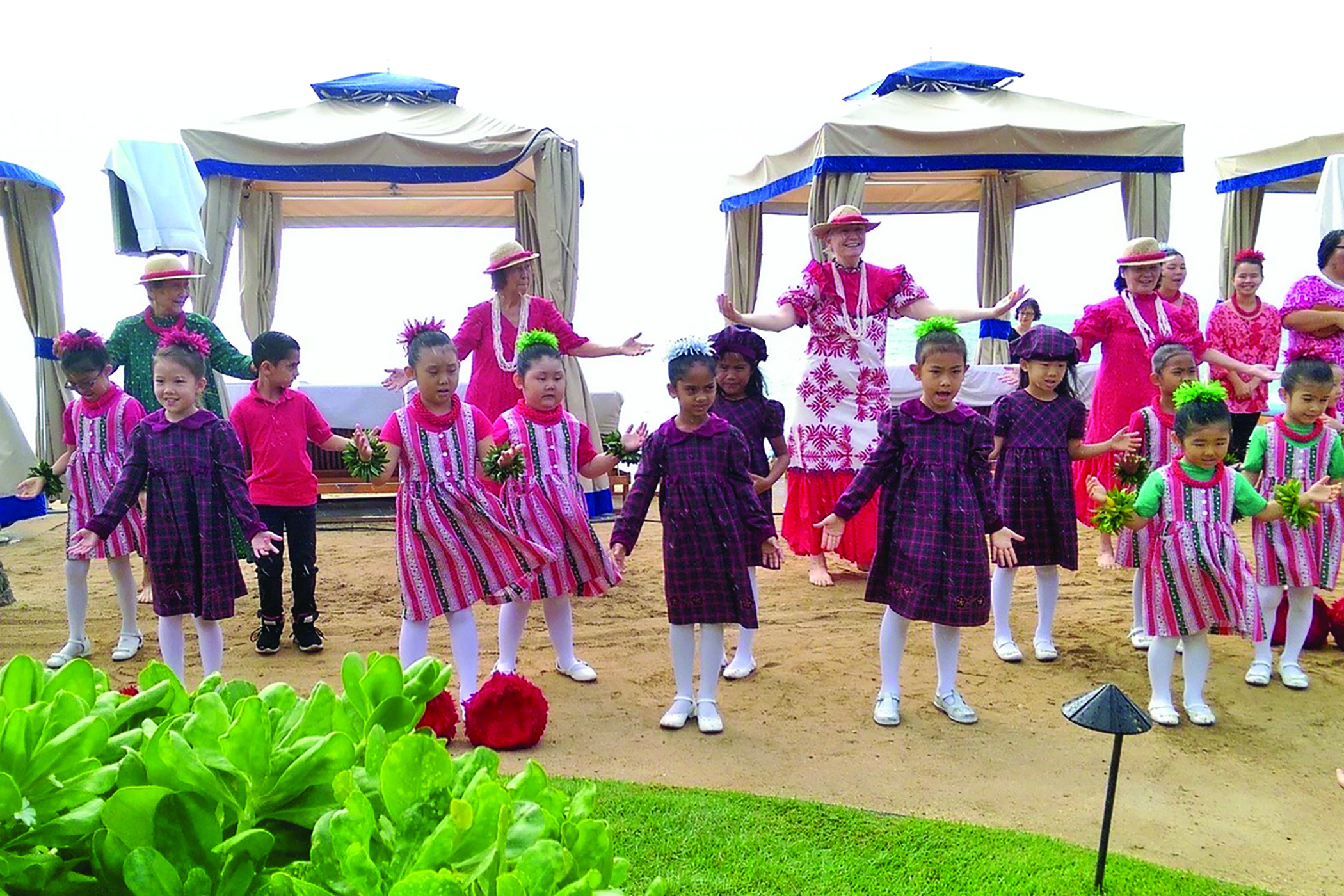
Keiki and kūpuna from Hula Hui o Kapunahala perform at dozens of events each year.
Hula Hui O Kapunahala
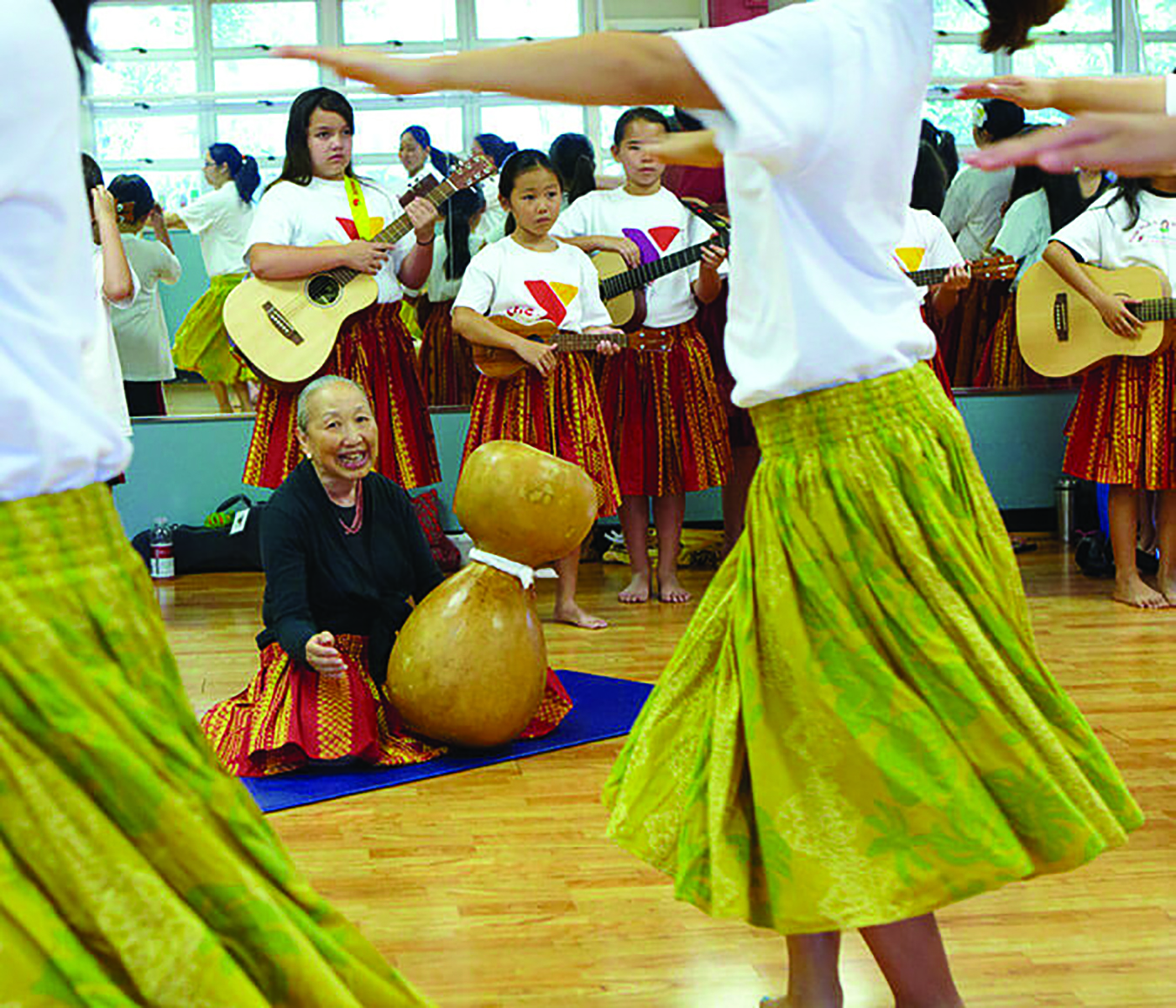
Carolee Nishi is best known as the kumu hula (hula teacher) of Hula Hui O Kapunahala (HHK) at the Nu‘uanu YMCA. For 53 years, HHK has delighted audiences on stages from Waikīkī to Waipahu, from City Hall to the Hawai‘i Theatre and from Disneyland to Expo ’70 (the World’s Fair in Osaka, Japan) with students aged 3 to 83, representing keiki to Kūpuna (children to seniors).
HHK isn’t a formal hālau hula (hula school), which is why it’s called a hui (club or group). And Carolee takes pride in saying that at HHK, every child is welcome. “We accept all ages; all nationalities; all personalities,” Carolee says with a chuckle. And when the group enters competitions, “We might not ever win,” she says. “And it’s okay. It’s okay not to win. Because life is not all about winning.”
The key lesson that Carolee imparts on all her students is to have an attitude of gratitude. “Aloha is everything. But gratitude is everything else. And gratitude is very important,” she says.
Auntie Carolee nurtures each of her students, builds up their self-confidence and finds a way to get the best out of them all. Many are leading successful lives and have returned with their own children.
At HHK, students learn life lessons, along with Hawaiian language, music, dance and cultural values. Many of Carolee’s students have become kumu hula themselves. And many more have brought their children to Carolee’s classes. While she says she couldn’t begin to count how many students she’s taught over the years, it’s clear that she’s had an impact on generations of them.
Living Treasure
Lately, the community has been showing a lot of love to Carolee, both for her service to the community and for teaching and preserving Hawaiian culture. But for someone so petite and so humble, accepting these laurels hasn’t come easy. But Carolee has stood tall and received all this respect with characteristic grace and humility.
Auntie Carolee has taught Hawaiian Studies classes to students from ages 3 to 83 at the Nu‘uanu YMCA for 53 years.
In 2020, the Honpa Hongwanji Mission of Hawaii announced its 45th set of Living Treasures of Hawaii, including musician and Kumu Hula Robert Uluwehionapuaikawekiuokalani Cazimero; Hawaiian language champion Larry L. Kimura, PhD; Japanese brush painting master Sachie Saigusa; and volunteer and Kumu Hula Carolee Mei-Jen Kapuamae‘ole Nishi — four community leaders who have demonstrated “excellence and high achievement in their particular field of endeavor, and who, through continuous growth, learning, and sharing, have made significant contributions toward enriching our society.” An official announcement stated that, “Carolee Nishi’s selfless generosity of her time, knowledge and passion with the young and old for more than a half-century truly qualifies her as a living treasure.”
When Carolee accepted this tremendous honor, she insisted that she didn’t earn the recognition on her own. But that wasn’t the only time she’s been feted recently.
In 2019, the Kalihi-Pālama Culture & Arts Society used the stage at its annual Queen Lili‘uokalani Keiki Hula Competition to present Carolee with the Miriam Likelike Kekauluohi Achievement Award that is named for Princess Likelike, the mother of Princess Ka‘iulani and sister of Queen Lili‘uokalani.
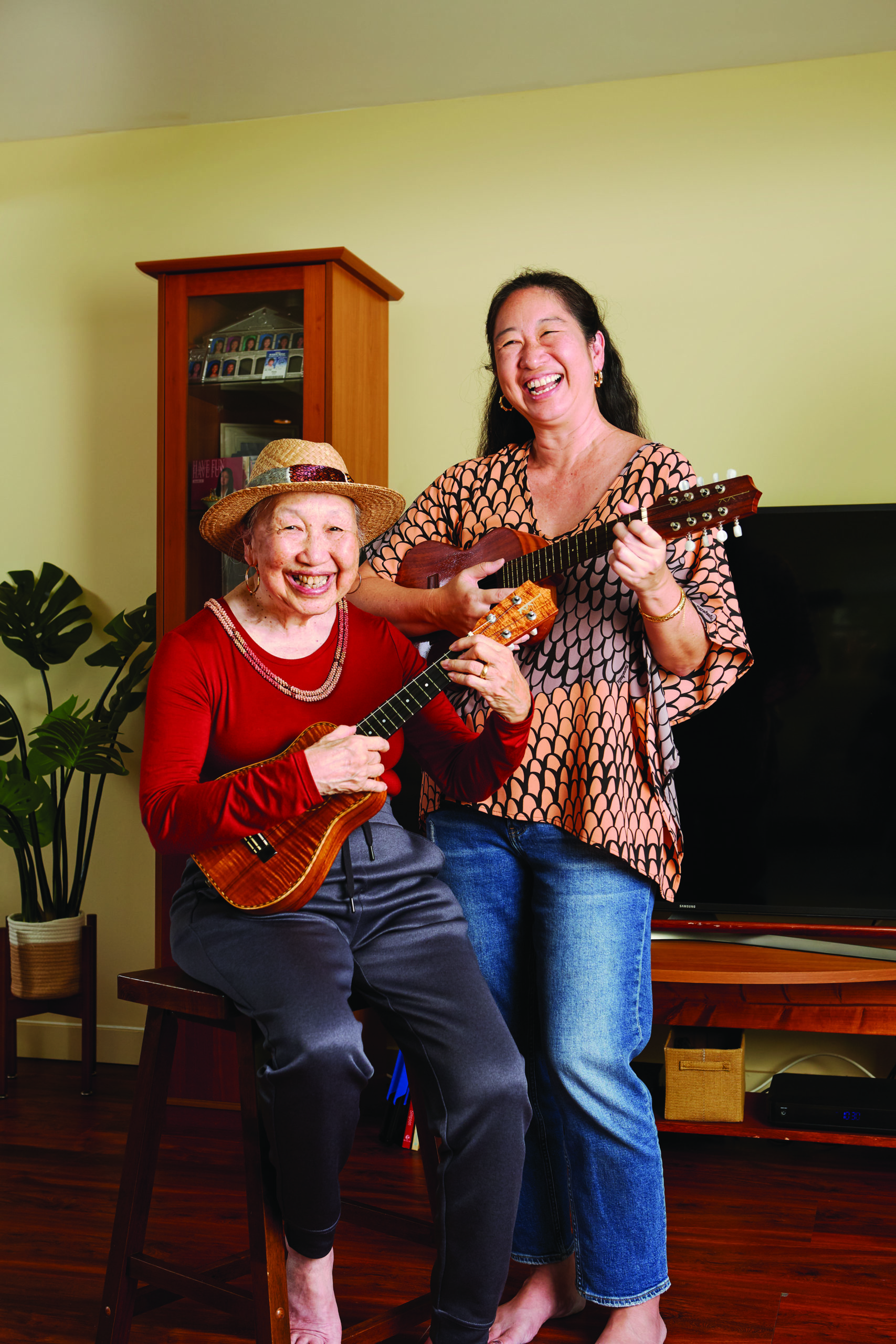
Annette Endow, 82, loves learning new things from Carolee, like using technology to join in virtual ‘ukulele classes from home.
In 2018, Carolee was recognized by the YMCA of Honolulu – Nu‘uanu Branch for 51 years of volunteerism, for her dedication to teaching Hawaiian culture and hula, and for teaching discipline and core values to youth in the community.
On Oct. 17, 2013, Ron and Carolee were joined by 1,017 of their closest friends in celebrating their 50th wedding anniversary. This was one of the biggest, but certainly not the only honor that Carolee has graciously accepted recently.
For all the accolades heaped upon her, Carolee is adamant about sharing credit with others, like the kumu kōkua youth who volunteer to help teach hula to the children at the YMCA. She’s also fond of the Kūpuna volunteers, a group of about 30 seniors who, pre-quarantine, were getting together regularly to teach and dance hula with HHK.
To Annette Endow, Carolee is an inspiration. “She’s taught me so much, and I have so much more to learn from her,” says Annette, who could be considered an inspiration herself after working for 30 years as a special education teacher and nine years as a nurse. “And she has a heart of gold,” the 82-year old adds, describing one way that Carolee supports children and youth. “She writes tons of college recommendations,” Annette says with a smile, adding, “And they all get in.”
Work + Life = Balance
Carolee Nishi hasn’t always been a volunteer. She had a long and colorful career working for United Airlines from 1964 to 2005, starting in the data processing department in San Francisco, transferring to the Red Carpet Room in Honolulu and spending seven years in passenger service at the Lihue Airport on Kaua‘i.
Something that may seem surprising about Carolee is that she’s very computer-savvy. When she was first hired at United in 1964, she was doing statistics for the airline and learning to use computer programming languages like Fortran and COBOL. “I was a computer programmer,” she says. “But we didn’t call it that. It was performance operations analysis.”
A solid education at Roosevelt High School, the English standard school in Honolulu, helped to prepare Carolee for college and career. After she graduated with the class of 1961, she went on to earn a degree in sociology from the University of Hawai‘i, and also attended college in San Jose and Los Angeles while Ron was studying aeronautical science in California.
Ron’s first job upon graduating from college was as a mechanic for United Airlines. But in 1968, the US Army drafted Ron and shipped him off to Vietnam. After a five-year tour of duty, Ron headed back to college and earned a business degree
at UH. His career after that spanned multiple industries, and he retired as director of international sales and services at Hawaiian Tel. Ron and Carolee, friends since high school, have now been married for 57 years. And their family includes daughter Robyn Nishi Kuraoka and son Trevor Nishi (they were both born on the same day, two years apart), their spouses, and granddaughters Kaila Nishi and Kiralee Kuraoka (they’re both in high school and were born a few months apart).
Robyn celebrated her 50th birthday earlier this year and is proud to say that she’s grown up with HHK. She’s now following in Carolee’s footsteps — working full-time at Hawaii Medical Service Association (HMSA) while volunteering and teaching keiki hula classes at the YMCA. During the lockdown, she’s been teaching hula classes via Zoom. “I’m very proud of Robyn,” Carolee says, eager to share examples of the ways her daughter encourages young students and keeps organized behind the scenes. Robyn has learned well from a very good teacher.
“Hula is a way of life,” says Robyn. “Hula is our way of life.”
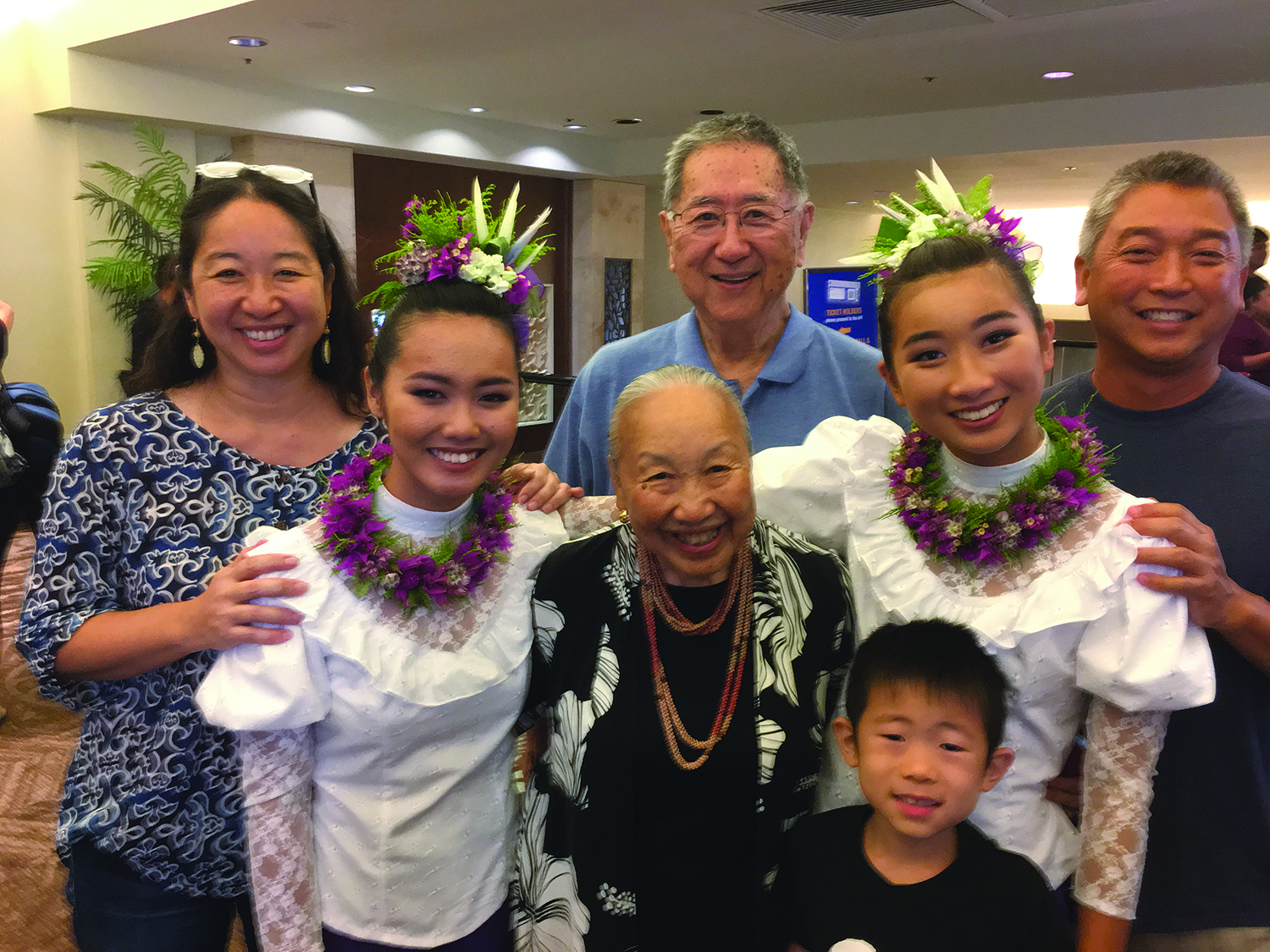
Carolee Nishi (center) with daughter Robyn Kuraoka, granddaughter Kaila Nishi (18), husband Ronald Nishi, granddaughter Kiralee Kuraoka (18), son-in-law Lance Kuraoka and grandson Kona Nishi (9).
Family Heritage
Born Carolee Mei-Jen Kapuamaeole Chung on Jan. 3, 1944, Carolee comes from a big Chinese family. “My father’s family is quite celebrated,” she says, describing how her father’s father came to Hawai‘i from China. “He was with the first wave of Chinese people that came here.” In contrast, her father’s mother was born in Ka‘ū on Hawai‘i Island and was “very local.” The pair married and had eight children. Robert Mon Gee Chung, Carolee’s father, was born in 1898, the seventh child. All five Chung brothers attended Punahou School. The eldest son graduated from Yale University and the next one from Harvard Medical School. The second brother’s daughter, Hawai‘i State Sen. Suzanne Chun Oakland, was the flower girl at Ron and Carolee’s wedding.
Many of the life lessons Carolee enjoys recounting are words of advice from her father. “He used to say: ‘If you’re gonna give, give. If someone asks you to do something, do it. Don’t ask what’s in it for me? Those are fighting words. Don’t ever think that way. If you’re going to give, you don’t tell people what to do with it. You just give it.’”
“The word ‘hā‘awi’ means ‘to give,’” says Carolee. “But there’s never a time that you give that you don’t receive.”
HAY: How Are You?
Another piece of advice from her father motivates Carolee daily. “My dad taught me that phone calls are important. When I was young, he used to tell me, ‘You better stay in touch if you want to be friends.’” And that’s the reason Carolee makes at least five phone calls to friends every day.
“I have a HAY list,” she says. It might sound like she’s saying, “Hey!” But she’s really saying, “HAY,” an acronym that Carolee made up for the phrase “How are you?” Sometimes the HAY calls are very brief. “I called Laura the other day and said, ‘How are you?’ She said, ‘I’m fine.’ And that’s it. I said, ‘Good talking to you.’ And that’s all we needed to say. Just called to touch bases.”
Making phone calls to friends is good for the soul. It’s good for both parties. And it’s a good practice for us all, especially at a time when we’re encouraged to follow social distancing guidelines.
It’s safer, for now, to use our phones to keep in touch. So it’s better then, to call and say “HAY.”
Longtime friend, 83-year old Charlie Ishii, enjoys getting calls from Carolee whom he calls an angel. When COVID-19 vaccines first became available for seniors 75 and over, Carolee helped Charlie register for his shots. “I gave her the information she asked for,” says Charlie. “Full name, date of birth, last four digits, you know,” adding quickly, “She hustles; she’s a hard worker.” Carolee even arranged for a young volunteer to take Charlie to the mass vaccination site. “I know he could drive himself,” Carolee says. “But isn’t it nice to have someone do the driving for you?”
Charlie Ishii, 83, learned to play the ‘ukulele and dance hula from Carolee. Now he’s an award-winning dancer who loves performing onstage.
Zooming Along
During the pandemic, Carolee hasn’t been quite as busy as before. But she’s still getting much done. In addition to helping friends register for vaccines, she also assembled a Zoom Crew of young volunteers to help seniors navigate technology. It’s an idea that might seem outside the box to some, but it was oh so obvious to Carolee: Mobilize people under the age of 30 to help people over the age of 70. It’s her own Genius Bar!
For the first several months of the quarantine lockdown, Carolee rarely left her house. But she really didn’t need to. She learned quickly to appreciate connecting to people and teaching classes via Zoom.
One benefit to teaching online, says Carolee, is that it forces her to be organized. She’s found that she needs to prepare lesson plans and have all her song sheets on hand before each class begins. But she isn’t complaining. Rather, she says, “It is the most wonderful way to get together. It really is.”
And the spry 77-year-old is continually innovating and reinventing herself. She started something new in 2021 — teaching virtual ‘ukulele classes to seniors. And it seems that everything about the remote ‘ukulele classes is a win-win for the teacher and her students. Classes began with the basics and have gotten progressively more advanced, which is a good challenge for their brains. Plus, it’s good for seniors to connect with others, to learn new skills, and to sing songs and play music in a group. And as an accidental bonus, the classes often become talk story sessions, which can also be a really good outlet for seniors’ mental health. “It’s really good to see them zooming along!” says Carolee.
Lifelong Learning, Learning for Life
It’s never too late to learn a new skill and you’re never too old to start. Just look at Carolee Nishi. She learned to dance hula as a child. But she didn’t learn to speak Hawaiian until she was an adult. Her first formal education in the Hawaiian language was from Dr. Larry Kimura at the University of Hawai‘i. And it wasn’t until she was about 30 that Carolee, along with her buddy Genoa Keawe, studied Hawaiian language, Hawaiian song and slack key under Auntie Alice Nāmakelua. Then, after the age of 35, Carolee began studying the Japanese language. And today, she’s using that skill when teaching another new program — virtual ‘ukulele classes for students in Japan, in Japanese.
“I don’t think I’ve, ever in my life, been bored,” says Carolee. “There is always so much to do. I mean, just tons of things.”
After state and CDC guidelines forced the YMCA to close and shut down in-person hula classes, Carolee found that she has more free time now than ever before. “I’m writing song books now and I’m getting people together, and I’m doing
a family reunion because I have all this time.”
At 77, Carolee Nishi is making good use of her free time while having the time of her life.
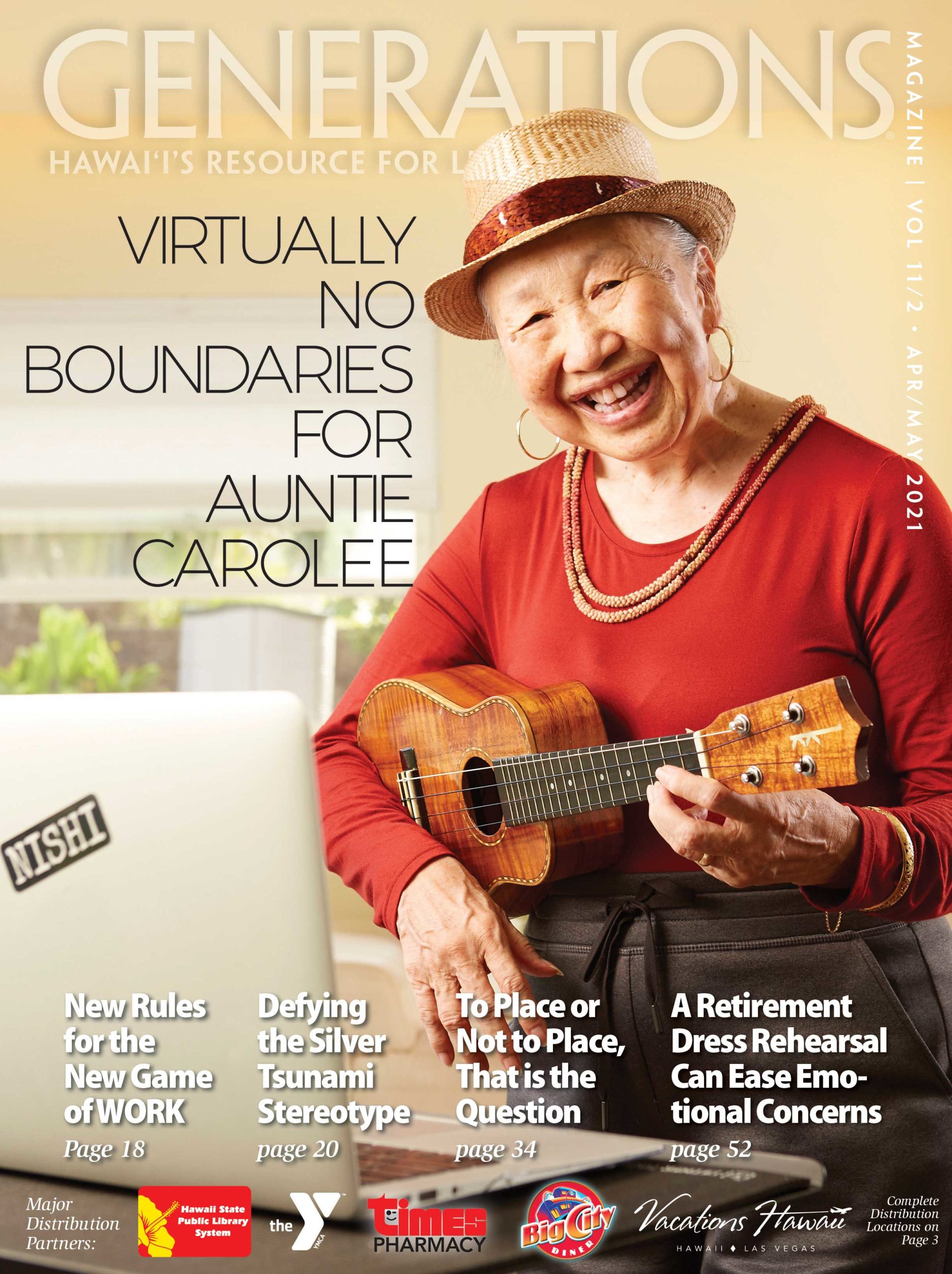
Kumu hula. Musician. Teacher. Cultural practitioner. Living treasure. True friend. These are some of the many ways that people have described Carolee Nishi. And hundreds (maybe even thousands) now her simply as Auntie Carolee. If you ask her, she’ll tell you she’s just a community volunteer. So don’t ask her, because everyone who knows Auntie…
The April – May 2021 issue of Generations Magazine features Auntie Carolee, a kumu hula, a musician, a teacher, a cultural practitioner – and – a living treasure. Youʻll also read about the new rules for work after the pandemic; defying whatʻs called the “silver tsunami” stereotype; help on deciding when itʻs time to go…

 6. Take things one step at a time. When you have too much to do, you can feel overwhelmed. Feel better by slowing down, prioritizing and taking things one step at a time.