Category: Senior News

  • Developing Disaster Resiliency

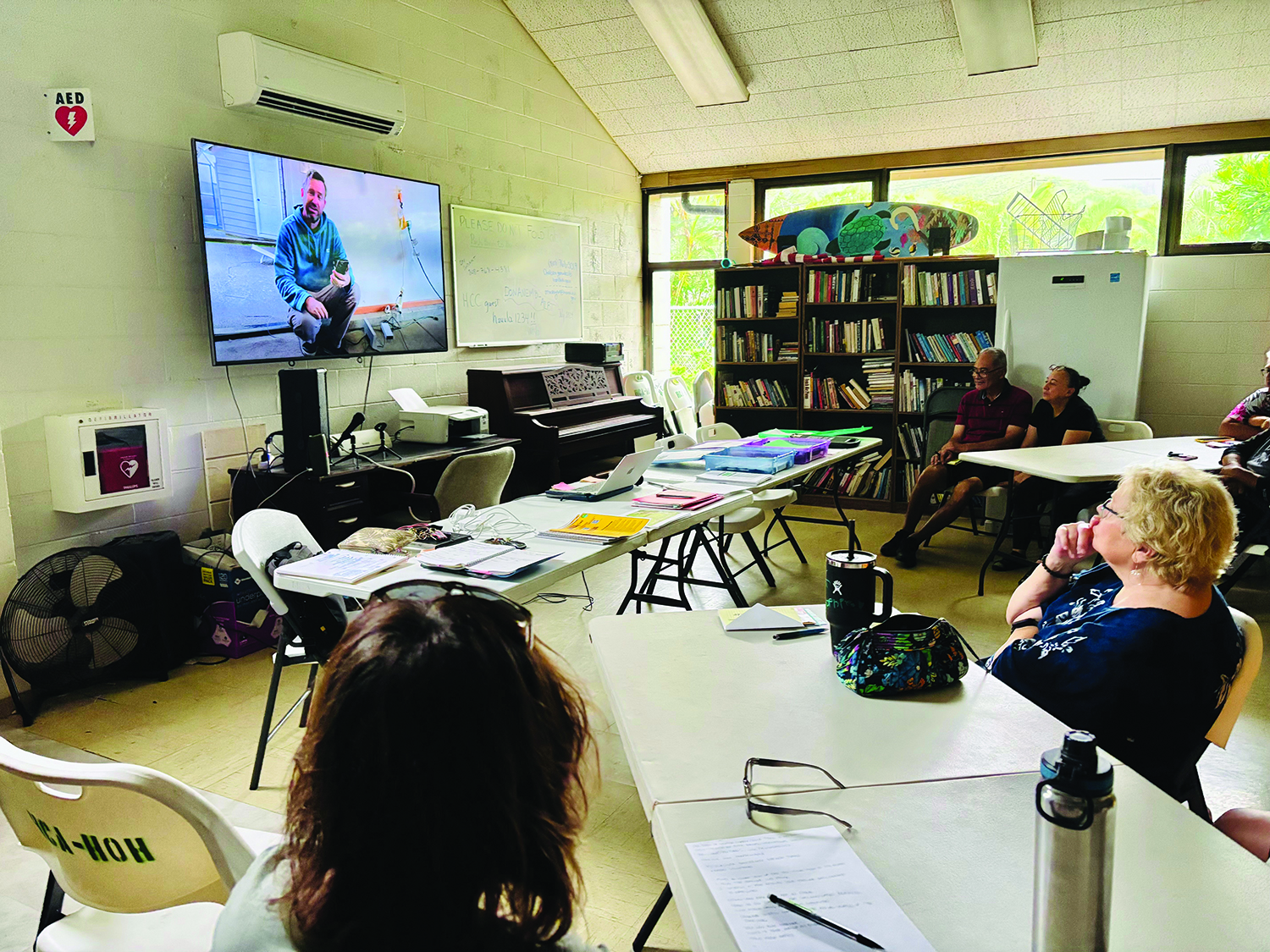
    Even before the Lahaina fire of August, 2023, Evelyn Lane, 67, was concerned about what would happen if a natural disaster struck the Kahuku Elderly Hauoli Hale senior and disabled low-income housing project that she lives in.

    Who will help them if a fire broke out in the forested area near the complex? What if there’s a tsunami? Who would help residents in wheelchairs and those who have difficulty walking?

    “All of these people could be left behind and I worried that would include me,” Evelyn said.

    The complex is developing an emergency plan with help from neighbors, local community groups and an AARP Community Challenge grant.

    The grant helped the neighboring Hui O Hau‘ula community organization purchase satellite internet system communication devices that provide internet to populations with little or no connectivity. The grant also provided training on emergency preparedness, and the use of Wi-Fi and the internet during a disaster to the Hau‘ula community and neighboring valleys in Northwest O‘ahu.

    Hui O Hau‘ula President Dotty Kelly-Paddock notes that the communities between Ka‘a‘awa and Kahuku could be cut off if Kamehameha Highway is damaged in a disaster. She used the AARP grant to buy three internet devices. She used a grant from the Castle Foundation to buy two more devices for all of the Ko‘olauloa communities in Northeast O‘ahu, and helped Lane and other community activists get training so they could help organize their neighbors to become disaster resilient and prepare for emergencies.

    Lane is organizing meetings with residents, the Kahuku Community Association, churches and other neighbors.

    “You have to be really resilient to live on the North Shore of O‘ahu,” Evelyn says, adding that internet system and the disaster resilience plan “are going to be a real benefit to our community.”

    As hurricane season approaches in June, AARP Hawai‘i encourages you and your family to have a personal disaster plan in place — especially if you are a kupuna or a caregiver for one. AARP also encourages community leaders to talk to neighbors about creating a disaster resilience plan so everyone can know what to do before the next one strikes. For more information, search online: “AARP How to Prepare for Natural Disasters” and “AARP Disaster Resilience Tool Kit.”

    AARP HAWAI‘I (nonprofit)
    1001 Bishop St., Ste. 625, Honolulu, HI 96813
    866-295-7282 | hiaarp@aarp.org | aarp.org/hi
    facebook.com/aarphawaii

    Even before the Lahaina fire of August, 2023, Evelyn Lane, 67, was concerned about what would happen if a natural disaster struck the Kahuku Elderly Hauoli Hale senior and disabled low-income housing project that she lives in. Who will help them if a fire broke out in the forested area near the complex? What if…

  • Allyn Bromley On the Edge

    Artist Allyn Bromley met with Honolulu Museum of Art Curator Katherine Love at the opening of her Allyn Bromley: At the Edge of Forever exhibition in January. The exhibition is on view at HoMA through June 15, 2025.
    Artist Allyn Bromley met with Honolulu Museum of Art
    Curator Katherine Love at the opening of her Allyn
    Bromley: At the Edge of Forever exhibition in January.
    The exhibition is on view at HoMA through June 15, 2025.

    Artist Allyn Bromley is an inspiration. At 96, she continues to go to her Nu‘uanu studio to create every week. An influential figure in Hawai‘i arts, she taught generations of students at Leeward Community College and at the University of Hawai‘i at Mānoa, where she was director of the printmaking department. She retired in
    2000 as professor emeritus.

    Now on view at the Honolulu Museum of Art through June 15 is work she created over the past eight years. The exhibition, Allyn Bromley: At the Edge of Forever, features mixed-media print-based works that are intricately assembled from hundreds of hand-printed paper elements (many were torn down or cut from previous prints), as well as components such as plastic boxes, wire, wood and cord. These works explore themes such as memory, loss and the environment. The show also includes a work comprised of charred pieces of wood fencing, a grim reminder of the power of natural forces as well as the hope that resilience brings.

    Just as Bromley gives new life to used materials, she is also inspired to find fresh meaning in familiar subjects. “I like to see if I can take something as trite as a flower and turn it into a provocative, more universal or larger idea,” she says.

    She is also a great supporter of the arts community. She recently used some of her assets to create an endowment for a visiting artist program at the Honolulu Museum of Art. In the 1970s, she attended workshops at the museum with two well-known visiting printmakers. The experience was so gratifying and impactful that she wanted to make a gift that would enable future generations of Hawai‘i artists to have similar opportunities.


    HONOLULU MUSEUM OF ART
    900 S. Beretania St., Honolulu, HI 96814
    808-532-8700 | honolulumuseum.org

    Artist Allyn Bromley is an inspiration. At 96, she continues to go to her Nu‘uanu studio to create every week. An influential figure in Hawai‘i arts, she taught generations of students at Leeward Community College and at the University of Hawai‘i at Mānoa, where she was director of the printmaking department. She retired in2000 as…

  • Caregivers Need Paid Family Leave

    Lenore from Kāne‘ohe fears that one day she must choose between caring for her mother and her job and financial security. “There will come a time when Mom needs more care and supervision and it is costly to hire help,” she told us.

    Unfortunately, this is a corner that many Hawai‘i residents are backed into. That’s why AARP Hawai‘i is fighting to improve paid family leave policies in our state.

    Older voters overwhelmingly support paid family leave. An AARP Hawai‘i poll found 88% of voters 50 and older support paid family leave and more than half would vote for a candidate who supported paid family leave.

    The poll also found strong support for other programs to help family caregivers: 56% do not believe government is doing enough to help family caregivers; 84% support increased funding for home-and-community-based services to help families keep loved ones at home as they age; and 89% support a limited state income tax credit to offset the expenses of family caregivers.

    Family caregivers are the front line of defense in keeping their older loved ones living at home — where most seniors want to be — and not in costly nursing homes.

    Across Hawai‘i, unpaid family caregivers provide critical assistance to help their older parents, spouses and other loved ones live independently in their homes. Most of these caregivers also juggle full- or part-time jobs.

    Paid family leave not only benefits those who take care of kūpuna, but also benefits parents caring for keiki
    and a growing segment of the population who care for both children and parents. Those “sandwich generation” caregivers are under enough stress without the fear of losing their job or their wages.

    An estimated 154,000 family caregivers in Hawai‘i contribute more than 144 million hours of unpaid care each year, valued at approximately $2.6 billion. They help older loved ones with medications and medical care, bathing and dressing, meals, chores and much more, saving the state and taxpayers in Medicaid expenditures if loved ones were in expensive nursing homes.

    Paid family leave would also benefit employers because it increases employee loyalty and retention, and saves money by avoiding the cost of separation, recruiting, hiring and training. AARP Hawai‘i and other pro-family organizations are pushing for paid family leave and other bills to help caregivers.

    If you want to lend your voice to help, contact AARP Hawai‘i Advocacy Director Audrey Suga-Nakagawa at asuganakagawa@aarp.org.

    AARP HAWAI‘I (nonprofit)
    1001 Bishop St., #625, Honolulu, HI 96813
    808-545-6000 | hiaarp@aarp.org | aarp.org/hi
    AARP is a non-partisan organization dedicated to empowering Americans 50 and older to choose how they live as they age.

    Lenore from Kāne‘ohe fears that one day she must choose between caring for her mother and her job and financial security. “There will come a time when Mom needs more care and supervision and it is costly to hire help,” she told us. Unfortunately, this is a corner that many Hawai‘i residents are backed into.…

  • SS Benefits Increase 2.5% in 2025

    Social Security (SS) benefits and Supplemental Security Income (SSI) payments for more than 72.5 million Americans will increase 2.5% in 2025. On average, Social Security retirement benefits will increase by about $50 per month for single recipients, $75 for couples.

    Nearly 68 million SS beneficiaries will see the 2.5% Cost of Living Adjustment (COLA) increase beginning in January 2025. Increased payments to nearly 7.5 million people receiving SSI began on Dec. 31, 2024 (some receive both SS and SSI).

    Other adjustments that take effect in January of each year are based on the increase in average wages. Based on that increase, the maximum amount of earnings subject to the Social Security tax (taxable maximum) is slated to increase from $168,600 to $176,100.

    “Social Security benefits and SSI payments will increase in 2025, helping tens of millions of people keep up with expenses even as inflation has started to cool,” says Social Security Commissioner Martin O’Malley.

    Over the last decade, the COLA increase has averaged about 2.6%. The COLA was 3.2% in 2024 and at a record high at 8.7% in 2023, due to high inflation following the pandemic.

    Annual inflation rose 3.2% in October 2024 (when the Bureau of Labor Statistics calculates the Consumer Price Index (CPI) — actually, a subset CPI called the consumer price index for urban wage earners and clerical workers (CPI-W), which measures the price changes for a particular set of goods, which is used to calculate the COLA.

    Although the COLA is designed to keep payments in line with inflation, Medicare costs are not included in the CPI-W used to determine the COLA. Therefore, Medicare Part B premiums have been rising faster than COLA for years, including 2025, according to the Centers for Medicare and Medicaid Services, with premiums outpacing both the Social Security COLA and inflation. From 2005 to 2024, Part B premiums increased by an average of 5.5% per year, while COLAs averaged less than half that rate at just 2.6%.

    In 2025, the monthly Part B premium for enrollees will rise by $10.30 (a 5.9% increase), while the COLA adjustment increase is only 2.5%, eroding away a part of the $50 SS increase. This conundrum continues to affect seniors who are concerned about how they’ll survive if SS continues to fail to keep up with the cost of living.

    For more SSA information, call 7am–5pm, Mon–Fri:
    1-800-772-1213 (toll free) | socialsecurity.gov
    Your COLA Notice
    Individuals who have a personal my Social Security account can view their COLA notice online, which is
    secure and faster than receiving a letter in the mail. Users can also receive text or email alerts when there is
    a new message waiting for them, including a COLA notice. Set up a my Social Security account at ssa.gov/myaccount.

    SSA ONLINE SERVICE HOURS
    Eastern Standard Time
    Mon – Fri 4:15 am – 1 am
    Sat 5 am – 11 pm
    Sun 8 am – 11:30 pm
    SSA COLA: ssa.gov/cola
    ssa.gov/news/press/factsheets/colafacts2025.pdf
    SSA Full Retirement Age Chart:
    ssa.gov/benefits/retirement/planner/agereduction.html
    Medicare & You 2025:
    publications/10050-medicare-and-you.pdf

    Social Security (SS) benefits and Supplemental Security Income (SSI) payments for more than 72.5 million Americans will increase 2.5% in 2025. On average, Social Security retirement benefits will increase by about $50 per month for single recipients, $75 for couples. Nearly 68 million SS beneficiaries will see the 2.5% Cost of Living Adjustment (COLA) increase…

  • Social Security Changes Access to In-Person Services

    Appointment-based services at local Social Security offices are expanding, the Social Security Administration (SSA) announced on Nov. 14, 2024. In the SSA’s ongoing commitment to serve the public more efficiently, it aims to reduce wait times, streamline service delivery, and improve the overall customer experience by scheduling appointments.

    Nearly 400 field offices have already moved to appointment-based service this year. These offices have seen significant improvements in wait times due to more efficient and helpful visitor experiences and increases in the number of customers able to complete their business online.

    Implementation of appointment-based services will be developed nationwide in two phases. The first phase is a transition period now through Jan. 5, 2025. The purpose of this transition period is to educate SSA’s customers about needing to schedule an appointment for SSA services. As a reminder, many of SSA’s services can be provided via phone with an appointment and do not require a customer to walk into an office for service.

    Effective Jan. 6, 2025, SSA will require customers to schedule an appointment for service in its field offices, including requests for Social Security cards. SSA encourages customers to become accustomed to its online services (ssa.gov/onlineservices), where many transactions can be completed conveniently and securely, and automated services (ssa.gov/agency/contact/phone.html) available by calling 1-800-772-1213 (SSA’s national 800 number).

    Customers who are not able to conduct their business online or with the automated options may call their local Social Security office or its national 800 number to schedule an appointment. Find your local Social Security office at secure.ssa.gov/ICON/main.jsp. The Honolulu office is located in the Federal Building at 300 Ala Moana Boulevard.

    Those who are unable to make an appointment or do not want to make an appointment will not be turned away for service. For example, members of vulnerable populations, military  personnel, people with terminal illnesses and individuals with other situations requiring immediate or specialized attention may still walk in for service at their local field office. Some SSA offices also have minimal to no wait times, and they will still serve customers who walk in.

    Appointment-based services at local Social Security offices are expanding, the Social Security Administration (SSA) announced on Nov. 14, 2024. In the SSA’s ongoing commitment to serve the public more efficiently, it aims to reduce wait times, streamline service delivery, and improve the overall customer experience by scheduling appointments. Nearly 400 field offices have already moved…

  • It’s Time to Review Your Medicare Plan

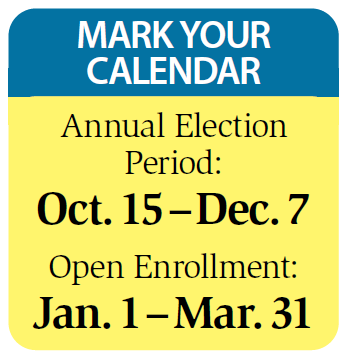
    During the Medicare Annual Election Period (AEP), Oct. 15 through Dec. 7, eligible Medicare beneficiaries can:

    • Enroll in Medicare health benefits such as a Medicare Advantage plan, with or without prescription drug coverage
    • Switch from one Medicare Advantage plan to another
    • Enroll in a stand-alone Prescription Drug Plan (PDP)

    Benefit packages change every year so review the Annual Notice of Change from your Medicare health plan to see if the benefits still suit your needs. All Medicare Advantage plans are focused on simplifying the healthcare experience. They offer a wide variety of products to meet the members where they are and empower them to take charge of their health. All Medicare Advantage plans offer a variety of benefit packages to ensure there a good fit for each beneficiary.

    If you have questions, need help understanding your benefits or want to switch health plans, call your licensed broker.

    WELLCARE BY ‘OHANA HEALTH PLAN
    Wellcare By ‘Ohana Medicare Plans:
    1-844-917-0175 (TTY 711)
    Wellcare By ‘Ohana Prescription Drug Plans:
    1-866-859-9084 (TTY 711)
    Monday–Friday, 8am–8pm
    wellcare.com/hawaii

    During the Medicare Annual Election Period (AEP), Oct. 15 through Dec. 7, eligible Medicare beneficiaries can: Benefit packages change every year so review the Annual Notice of Change from your Medicare health plan to see if the benefits still suit your needs. All Medicare Advantage plans are focused on simplifying the healthcare experience. They offer…

  • SSA Removes SSI Payment Barriers

    SSA Removes SSI Payment Barriers

    The Social Security Administration (SSA) announced two of several updates to its Supplemental Security Income (SSI) regulations that will help people receiving and applying for benefits offered through this federal program.

    SSI provides monthly payments to adults and children with a disability or blindness, and to adults aged 65 and older who have limited income and resources. SSI benefits help pay for basic needs like rent, food, clothing and medicine.

    To receive SSI benefits, applicants must meet eligibility requirements, including income and resource limits.

    Under SSA’s old rules, food and shelter were counted as unearned income, which may affect a
    person’s eligibility or reduce their payment.

    Under one of the new rulings, “Omitting Food from In-Kind Support and Maintenance (ISM)
    Calculations,” the agency will no longer include food in ISM calculations beginning on Sept. 30.

    The new policy removes a critical barrier for SSI eligibility due to an applicant’s or recipient’s
    receipt of informal food assistance from friends, family and community support networks.

    The new policy is also easier to understand and use, reduces month-to-month variability in payment amounts and will improve payment accuracy. SSA will see savings because less time
    will be spent administering food ISM.

    The SSA also announced “Expansion of the Rental Subsidy Policy for Supplemental Security Income (SSI) Applicants and Recipients.” Beginning Sept. 30, the agency will expand its SSI rental subsidy policy, which was only in place for SSI applicants and recipients residing in seven states (Conn., Ill., Ind., NY, Texas, Vt. and Wis.). In those states, rental assistance (renting at a discounted rate) is less likely to affect a person’s SSI eligibility or payment amount.

    This new rule will extend this policy to all SSI applicants and recipients nationwide. This may increase the benefit amount some people are eligible to receive and will allow more people to qualify for critical SSI payments.

    For more information on the SSI program, including who is eligible and how to apply, visit ssa.gov/ssi. To make an appointment, call between 7am and 5pm, Mon–Fri: 800-772-1213 (toll free) | socialsecurity.gov

    The Social Security Administration (SSA) announced two of several updates to its Supplemental Security Income (SSI) regulations that will help people receiving and applying for benefits offered through this federal program. SSI provides monthly payments to adults and children with a disability or blindness, and to adults aged 65 and older who have limited income…

  • Kūpuna Prevail in 2024 State Legislature

    Kūpuna Prevail in 2024 State Legislature

    It was another great year for kūpuna. Gov. Josh Green signed into law bills that both enhance healthy aging and improve care for the frail. With support from the Council of State Governments Interagency Task Force on Sustainable Long-Term Care, the Kupuna Caucus convened a long-term
    care summit of 64 organizations in February 2024, with a focus on a person-centered long-term care continuum of services. Forty-three organizations committed to champion long-term care; addressing workforce shortage; cost and sustainable financing of long-term care and models of a continuum of quality long-term care services. The bills signed by the governor that support programs and services for kūpuna are:
    ■ Long-term Care Master Plan: HB2224/Act 159 directs the Executive Office on Aging (EOA) to
    develop a comprehensive long-term care master plan and provides funding for a full-time long-term care planner.
    ■ Adult Residential Care Homes: HB2216/Act 20 increases adult residential care home payments.
    ■ Personal Needs Allowance: HB1974/Act 18 increases care home residents’ monthly personal
    needs allowance from $50 to $75. It had not been raised since 2007.
    ■ Silver Alert Program: SB2305/Act 158 directs the Department of Law Enforcement to establish
    a silver alert program to help locate missing persons 65 or older, cognitively impaired or developmentally disabled.
    ■ General Excise Tax Exemption: SB1035/Act 47 exempts medical and dental care providers treating patients on Medicaid, Medicare and Tricare from the GET, making providers more available to serve the vulnerable.
    ■ In the State Budget: HB1800 funds two programs to support community kūpuna: 1) increases fee reimbursement rates for Adult Day Care and Adult Day Health community-based programs and 2) funds $400,000 for Healthy Aging Partnership’s “Better Choices, Better Health” and “Enhance Fitness” programs on Kaua‘i, Maui, Hawai‘i and Honolulu counties.

    WHAT’S NEXT:

    During the interim (between now and next session), we can review the bills left on the table or others from previous sessions. What were the concerns raised? Can we amend the bill to address those concerns or return with more data and experience to show why the bill is needed?
    Work during the interim will also focus on long-term care. The last long-term care plan was adopted in 1988. It’s time to plan forward, and with the 43 champions and others, to come up with
    a plan and priorities to ensure our kūpuna live quality lives in the community or in institutions.

    If you want to work on these or other kūpuna issues, contact Kupuna Caucus Co-chairs: Sen.
    Sharon Moriwaki (senmoriwaki@capitol.hawaii .gov) or Rep. Cory Chun (repchun@capitol.hawaii
    .gov); or State EOA Director Caroline Cadirao (caroline.cadirao@doh.hawaii.gov).

    It was another great year for kūpuna. Gov. Josh Green signed into law bills that both enhance healthy aging and improve care for the frail. With support from the Council of State Governments Interagency Task Force on Sustainable Long-Term Care, the Kupuna Caucus convened a long-termcare summit of 64 organizations in February 2024, with a…

  • Honoring a Dementia Champion

    Honoring a Dementia Champion

    The 2024 Hawaii Pacific Gerontological Society (HPGS) honoree is Dorothy Colby. Dorothy is a highly regarded dementia care specialist with more than 25 years of professional and personal experience
    in caring for people living with dementia. She is a Certified Positive Approach to Care trainer and mentor, as well as a Hawai‘i Alzheimer’s Disease Initiative Memory Care Navigator, Dementia Friends Master Trainer and Champion, and Roslyn Carter Institute Dealing with Dementia Trainer.

    Dorothy was born in Kailua and raised in Hau‘ula on O‘ahu. After graduating from St. Andrew’s Priory School in 1981, she attended Bryn Mawr College, where she earned her master’s degree in 2023. She went back to school and graduated from the Culinary Institute of the Pacific at Kapi‘olani Community College. She joined Hale Ku‘ike in 2005 and is now its community relations director.

    An advocate for so many individuals, families and organizations, Dorothy says, “My mission is to bring care partners together to learn how to better support those living with dementia.”

    This year’s HPGS student scholarship fundraiser will be held on Friday, Nov. 8, at 5:30 pm at the Arcadia. The registration form can be found at http://hpgs.org/scholarships.html. Donations will be accepted through Nov. 30.

    HAWAII PACIFIC GERONTOLOGICAL SOCIETY (nonprofit)
    P.O. Box 3714, Honolulu, HI 96812
    Sherry Goya, HPGS Executive Director
    808-722-8487 | sgoyallc@aol.com | hpgs.org

    The 2024 Hawaii Pacific Gerontological Society (HPGS) honoree is Dorothy Colby. Dorothy is a highly regarded dementia care specialist with more than 25 years of professional and personal experiencein caring for people living with dementia. She is a Certified Positive Approach to Care trainer and mentor, as well as a Hawai‘i Alzheimer’s Disease Initiative Memory…

  • Real Property Tax Relief for Honolulu

    The City and County of Honolulu announces its 2025–26 Real Property Tax Credit program will open for applications starting July 1.

    From July 1 until Sept. 30, 2024, eligible homeowners can apply for a tax credit to help alleviate their real property tax. To qualify for this tax credit for the 2025–26 tax year, applicants must:

     Have a home exemption on their property.
     Ensure that none of the titleholders own other property anywhere.
     Confirm that the combined gross income of all titleholders does not exceed $80,000.

    The amount of credit homeowners will receive, if qualified, is based on their income and current property tax amount. The program intends to provide relief to homeowners affected by rising property taxes or on a fixed income.

    Qualified 2024–25 tax credit

    Homeowners who qualified for this credit during the 2024–25 tax year may receive an application in the mail in early July.

    Contact the Tax Relief Office for an application or download one at honolulu.gov/treasury starting July 1.

    TAX RELIEF OFFICE
    For more information, call 808-768-3205
    or visit honolulu.gov/treasury
    (Information furnished is subject to change without notice.)

    The City and County of Honolulu announces its 2025–26 Real Property Tax Credit program will open for applications starting July 1. From July 1 until Sept. 30, 2024, eligible homeowners can apply for a tax credit to help alleviate their real property tax. To qualify for this tax credit for the 2025–26 tax year, applicants…

  • 5 Primary Election Reminders

    Ahead of the 2024 Primary Election on Aug. 10, the Office of Elections offers a few key reminders for Hawai‘i voters.

    ➊ Hawai‘i is a vote-by-mail state. Your Primary Election ballot will arrive by mail. Registered Hawai‘i voters automatically receive a mail ballot for every election.
    ➋ Check that your voter registration is current. Visit elections.hawaii.gov or call 808-453-VOTE(8683) to verify that your voter registration is accurate. If you have moved or changed your mailing address, you must update your voter registration. Update online or by submitting a Voter Registration Application (link at end of article).
    ➌ You must sign your ballot return envelope for your ballot to be counted. You can expect to receive your ballot packet by July 23 for the Primary Election. Before your ballot arrives, review candidate statements at elections.hawaii.gov.
    ➍ Ballot must be received by 7pm on Aug. 10. Ballots can be returned by mail or put in a ballot drop box. Visit elections.hawaii.gov for location details. Ballots received late cannot be counted.
    ➎ Assistance is available. In need of assistance? Consider the following accessible options:

    • Visit a voter service center to vote using accessible voting equipment.
    • Request an electronic ballot and mark your ballot using your personal compatible device.

    STATE OF HAWAI‘I, OFFICE OF ELECTIONS
    802 Lehua Ave., Pearl City, HI 96782
    808-453-VOTE (8683) | elections@hawaii.gov
    elections.hawaii.gov
    Voter Registration Application:
    elections.hawaii.gov/wp-content/uploads/
    1436986-01-Hawaii-Votes_application_final.pdf

    Ahead of the 2024 Primary Election on Aug. 10, the Office of Elections offers a few key reminders for Hawai‘i voters. ➊ Hawai‘i is a vote-by-mail state. Your Primary Election ballot will arrive by mail. Registered Hawai‘i voters automatically receive a mail ballot for every election.➋ Check that your voter registration is current. Visit elections.hawaii.gov…

  • Spreading Alzheimer’s Awareness & Aloha

    Born and raised in Honolulu, Steven Tam spent many years recruiting and then training recruits at Prudential Locations Real Estate. Steven’s ability to connect with others not only made him an effective leader, but an impactful volunteer, as well.

    Alzheimer’s Awareness Begins

    When Steven’s father was diagnosed with Alzheimer’s disease in 2009, he left his full-time real estate career to assist his mother with caregiving. Steven knew nothing about Alzheimer’s, so he decided to attend a presentation by the Alzheimer’s Association — a crash course about the disease. There began a beautiful relationship. The Alzheimer’s Association provided him with resources and a network of others in same situation. Empathetic staff and volunteers taught him what to expect as the disease progressed.

    The interaction with the Alzheimer’s Association prompted Steven to look for professional opportunities to help the community. What he found there was a need to support caregivers. That led him to AARP, where he headed long-term care, caregiving and financial security campaigns. He also managed BrightStar Care of Honolulu, which provides in-home services to those with dementia and other disabilities.

    Following his father’s passing in 2013, his desire to make a difference in the lives those affected by Alzheimer’s increased. He became a volunteer at the Hawai‘i chapter of the Alzheimer’s Association, helping with programs and events. He became more involved and was eventually became the director of development. In this role, he was responsible for overseeing the fundraising programs. After three years, he retired in 2020.

    Volunteering With Aloha

    Steven has volunteered as a community educator for about 10 years. He encourages others to volunteer and urges caregivers to seek support.

    “Remember, you are not alone and be willing to ask for help — because people are willing to help more than you know,” says Steven.

    ALZHEIMER’S ASSOCIATION (nonprofit)
    677 Ala Moana Blvd., Ste. 301, Honolulu, HI 96813
    To volunteer: alz.org/volunteer, alohainfo@alz.org
    808-591-2771 | alz.org

    Born and raised in Honolulu, Steven Tam spent many years recruiting and then training recruits at Prudential Locations Real Estate. Steven’s ability to connect with others not only made him an effective leader, but an impactful volunteer, as well. Alzheimer’s Awareness Begins When Steven’s father was diagnosed with Alzheimer’s disease in 2009, he left his…