Category: Programs & Services

  • Q&A: Retirement Benefits

    Photo of a couple of seniors who are smiling about somethingQ: My cousin and I are both retired and get Social Security. We worked for the same employer for years, but he gets a higher Social Security benefit. Why is that?

    A: Your payments are based on your earnings over your lifetime. Unless you are both the same age, started and stopped work on the exact same dates and earned the very same amount every year of your careers, you wouldn’t get the same benefit as your cousin. Social Security benefits are based on many years of earnings — generally your highest 35 years. To learn more about Social Security retirement benefits, visit ssa.gov/benefits.

    Q: I went back to work after retiring, but now the company I work for is downsizing. I’ll be receiving unemployment benefits in a few weeks. Will this affect my retirement benefits?

    A: When it comes to retirement benefits, Social Security does not count unemployment as earnings, so your retirement benefits will not be affected. However, any income you receive from Social Security may reduce your unemployment benefits. Contact your state unemployment office for information on how your state applies the reduction to your unemployment compensation.

    Q: My neighbor said he applied for Social Security retirement benefits online. Can you really apply for retirement without traveling to an office?

    A: Yes, you can. What’s more exciting is it’s the easiest, fastest and most convenient way to apply for retirement benefits. Our secure website makes it simple, allowing you to apply for retirement benefits in as little as 15 minutes. You can get started now at ssa.gov/applyonline.

    Q: What is the earliest age I can begin receiving Social Security retirement benefits?

    A: The earliest age you can begin receiving Social Security retirement benefits is age 62. If you decide to receive benefits before your full retirement age, which for most people is age 66 or 67, you will receive a reduced benefit. Keep in mind you will not be able to receive Medicare coverage until age 65, even if you decide to retire at an earlier age.

    For more information, go to ssa.gov/retire.


    Social security logoFor questions, online applications or to make an appointment at a SSA office, call between 7am & 5pm, Mon–Fri:
    1-800-772-1213 (toll free) | socialsecurity.gov
     

    Q: My cousin and I are both retired and get Social Security. We worked for the same employer for years, but he gets a higher Social Security benefit. Why is that?

  • Do You Like Helping Kūpuna?

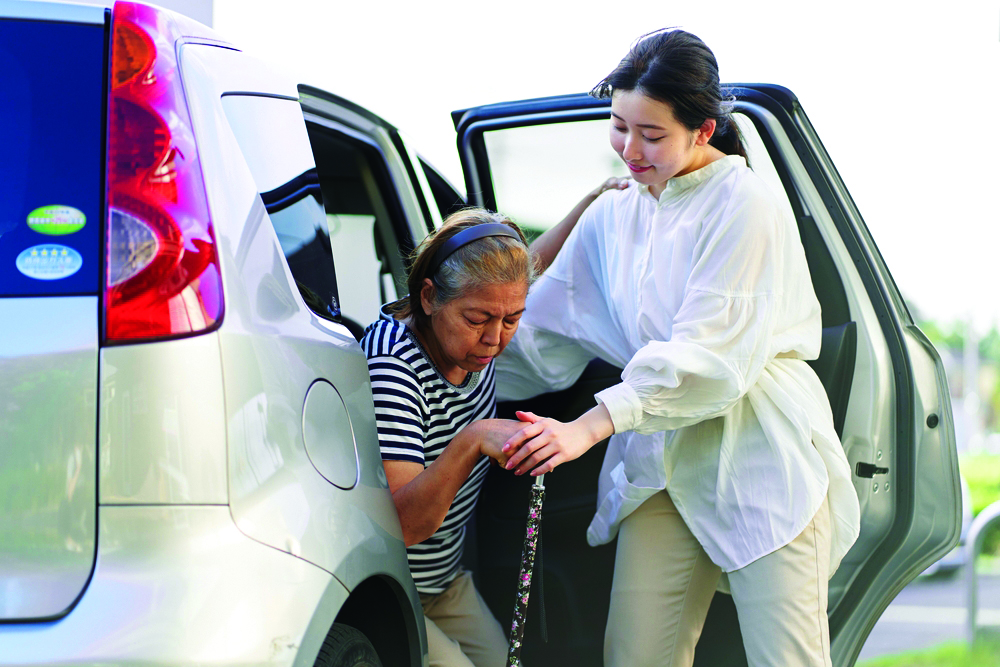
    A woman who removes an elderly person from a car

    Are you 55 years or older and looking for a fulfilling way to spend your time? Do you enjoy connecting with other seniors and making a difference in their lives? Whether you’re a recent retiree or an empty nester, Catholic Charities Hawai‘i has an opportunity for you.

    Transportation Friends for Kūpuna (TFK) is a new Catholic Charities Hawai‘i project that is seeking compassionate volunteers to provide free transportation and chaperone assistance for frail kūpuna living independently in the community. By sharing your time and companionship, you can make a significant impact on the lives of seniors in need of this resource.

    TFK welcomes volunteers of all experience levels, and will provide training and screening. Schedules are flexible. Whether you can spare a few hours on the weekends or have more availability during the week, there are a variety of opportunities to choose from to help Hawai‘i’s seniors.

    Let’s work together to bring joy to the lives of kūpuna in our community. If you’re interested in learning more about this rewarding volunteering opportunity, please contact Program Volunteer Coordinator Julie Chang using the information below.


    CATHOLIC CHARITIES HAWAI‘I (501(c) 3 nonprofit)
    1822 Keeaumoku St., Honolulu, HI 96822
    808-527-4783 | julie.chang@catholiccharitieshawaii.org
    CatholiccharitiesHawaii.org

    Are you 55 years or older and looking for a fulfilling way to spend your time? Do you enjoy connecting with other seniors and making a difference in their lives? Whether you’re a recent retiree or an empty nester, Catholic Charities Hawai‘i has an opportunity for you. Transportation Friends for Kūpuna (TFK) is a new…

  • The Legacy of the 100th Infantry Battalion

    The Legacy of the 100th Infantry Battalion

    Since it was built in 1952, the unassuming one-story building long known as Club 100 on Kamoku Street in Honolulu served as a gathering place for veterans of the legendary 100th Infantry Battalion. The battalion originated as a primarily all-Japanese-American combat unit during World II. These Hawai‘i-born soldiers were the first Japanese American combat unit to serve in WWII. They proved their loyalty to their country, the US, despite the fact that Japanese Americans were considered enemy aliens at the time. For their bravery and sacrifices, the 100th/442nd Regimental Combat Team would be recognized as the most decorated unit for its size and length of service in the history of the US military.

    Last year marked the 81st anniversary of the formation of the 100th Infantry Battalion (Separate). To date, there are 10 known soldiers who are still alive and able to tell their stories. As our veterans pass on, the stories of their valor will also begin to fade in the memories of our children and our community. Hawai‘i needs to act now to ensure their legacy lives on for generations to come.

    The 100th Infantry Battalion Veterans organization and its partners, ‘Iolani School, the University of Hawai‘i’s Center on Aging and Central Pacific Bank are committed to keeping their stories alive through the Legacy2Action challenge, now in its third year. Through project-based learning, students identify an important community issue and take action by creating and implementing an innovative project aligned with the unit’s values.

    The students’ 2023 projects were creative and uplifting, addressing wide-ranging issues. Two focused on homelessness and community-building, culminating in the production of art kits and writing activities for houseless children. Other projects focused on climate change, environmental and intergenerational programs.

    The 100th Infantry Battalion Veterans organization is calling on middle and high school students, teachers and club leaders to help keep the memory of these Hawai‘i heroes alive.


    UNIVERSITY OF HAWAI‘I CENTER ON AGING
    2430 Campus Road, Honolulu, HI 96822
    For more information, contact info@100thbattalion.org
    Written in collaboration with the 100th Infantry Battalion Veterans Organization and ‘Iolani School.

    Since it was built in 1952, the unassuming one-story building long known as Club 100 on Kamoku Street in Honolulu served as a gathering place for veterans of the legendary 100th Infantry Battalion. The battalion originated as a primarily all-Japanese-American combat unit during World II. These Hawai‘i-born soldiers were the first Japanese American combat unit…

  • AARP: Support Family Caregivers

    AARP: Support Family Caregivers

    Cheryl, a caregiver from Makawao, had to retire early to take care of her mother, who has dementia. “But now, how am I going to pay the bills?”

    Every day, Hawai‘i’s 154,000 family caregivers help their parents, spouses and other loved ones remain at home — where they want to be — instead of in an expensive nursing home.

    Family caregivers help with medications, medical care, errands, meals, bathing, dressing and much more. AARP estimates that Hawai‘i caregivers put in nearly 144 million unpaid hours each year, valued at an estimated $2.6 billion. Instead of getting paid, the average family caregiver spends more than $7,000 of their own money each year taking care of loved ones.

    Family caregivers deserve our support. That’s why AARP is advocating for commonsense solutions to help caregivers, such as a tax credit for caregivers and paid family leave to help them so they can keep working, save for their own retirement and continue to pay taxes.

    To learn more about the AARP Caregiving Campaign, visit aarp.org/politics-society/advocacy/caregiving-advocacy.

    For more about support and resources for caregivers, visit aarp.org/caregiving.


    AARP HAWAI‘I (501(c) nonprofit)
    1001 Bishop St., Ste. 625, Honolulu, HI 96813
    808-545-6000 | hiaarp@aarp.org | aarp.org/hi
    facebook.com/aarphawaii

    Cheryl, a caregiver from Makawao, had to retire early to take care of her mother, who has dementia. “But now, how am I going to pay the bills?” Every day, Hawai‘i’s 154,000 family caregivers help their parents, spouses and other loved ones remain at home — where they want to be — instead of in…

  • What to Say & Not to Say to Grievers

    Grief hurts. It hurts to witness our loved ones hurt. So a typical response to someone who is grieving is to try to comfort them and make them feel better.

    There is nothing wrong with trying to comfort the bereaved, but making them feel better is not possible. A grieving person simply wants their grief to be acknowledged and witnessed, not fixed. They have permission to be sad, angry, distracted and confused.

    There are phrases used commonly in an effort to comfort a bereaved person, but even with the best of intentions, these words can be hurtful, as they inadvertently minimize and diminish the griever’s feelings.

    WHAT NOT TO SAY

    They are in a better place.
    They lived a long life.
    At least they are no longer suffering.
    Be strong.
    Don’t cry.
    You’ll get over it.
    Shouldn’t you be over it by now?
    I know exactly how you feel.
    I understand.

    ALSO NOT HELPFUL

    You should be over this by now.
    Time heals all wounds.
    If you’re not crying, you’re not really grieving.
    Real men shouldn’t cry.

    WHAT TO SAY

    I’m sorry that you are having to navigate this.
    My condolences for your loss.
    I care.
    I love you.
    I don’t know what to say except I’m here for you.
    How do you want me to support you?

    There are many commonly held myths and misunderstandings about grief, which can present significant barriers to someone who is grieving. But when we understand the needs of those who are experiencing this painful but inescapable unbinding of the heart, we will likely be more mindful with our words.

    As much as words are important, know that your mere presence in the midst of their sorrow can be just the comfort they need.


    BEREAVEMENT NETWORK OF HAWAI‘I
    Facilitated by KOKUA MAU (501(c) 3 nonprofit)
    808-585-9977 | kokuamau.org
    kokuamau.org/grief-and-bereavement
    Learn more about grief and the healing process: Help For The Bereaved — The Healing Journey (kokuamau.org/wp-content/uploads/CtrOnAging-Booklet-5-REV_6-30-11.pdf).

    Grief hurts. It hurts to witness our loved ones hurt. So a typical response to someone who is grieving is to try to comfort them and make them feel better. There is nothing wrong with trying to comfort the bereaved, but making them feel better is not possible. A grieving person simply wants their grief…

  • Helping Dogs Help People

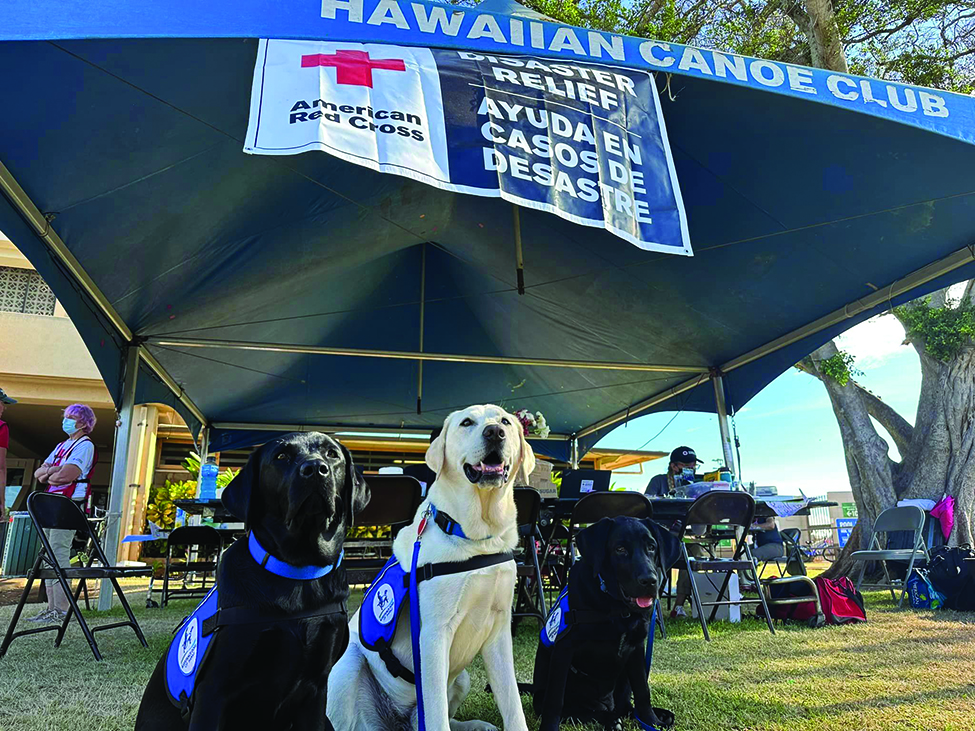
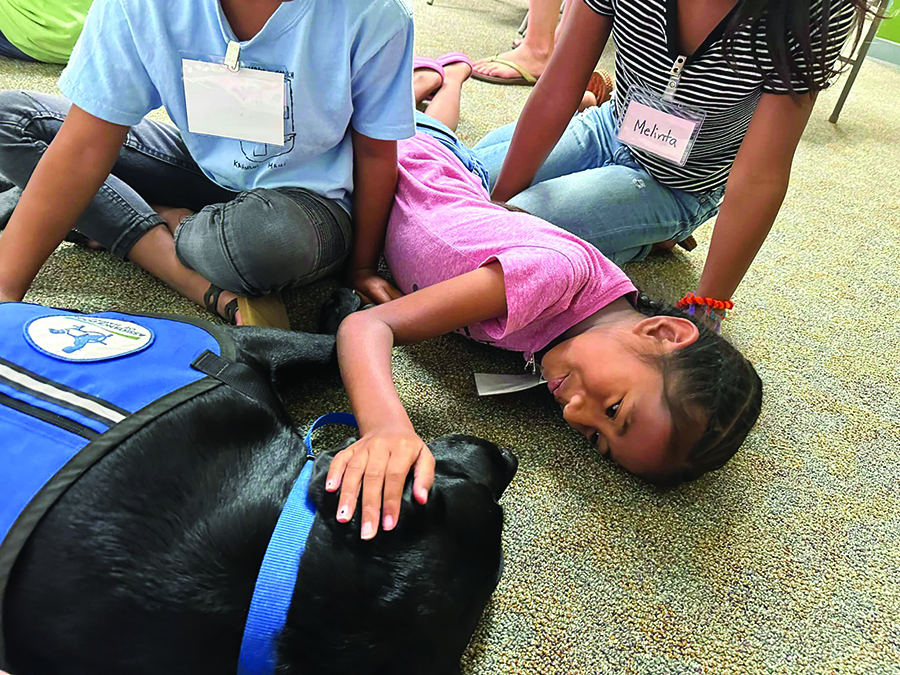
    Therapy Dog Teams startedvisiting emergency shelters, fire stations and police stations soon after the Maui fires. It’s wonderful to see people’s faces light up when they see the dogs.
    Therapy Dog Teams started visiting emergency shelters, fire stations and police stations soon after the Maui fires. It’s wonderful to see people’s faces light up when they see the dogs.

    Assistance Dogs of Hawaii (ADH) began in 2000 with a mission of training Service Dogs to assist people with limited mobility. The Maui based non-profit organization has grown over the last 23 years to provide dogs to a wide array of Hawai‘i residents with special needs.

    ADH has trained over 200 Assistance Dogs that have touched the lives of thousands of Hawai‘i residents. ADH provides Service Dogs for children and adults with disabilities and full-time Hospital Dogs that work at hospitals throughout Hawai‘i, including The Queens Medical Center, Kapiolani Medical Center, Rehab Hospital of the Pacific and Shriners Hospital for Children. ADH also provides Courthouse Dogs who help children who are victims of crime throughout the difficult legal system, and School Facility Dogs that help at local high schools. The ways that dogs can help people in need continues to grow. Assistance Dogs can help everyone from our keiki to our kūpuna.

    Assistance Dogs of Hawaii’s latest mission is providing Crisis Response for those affected by the wildfires on Maui. Therapy Dog Teams have been providing comfort to thousands of Maui residents at shelters and schools. ADH also provides support for first responders, including police and fire departments as well as FEMA and Red Cross workers. ADH adopted a puppy who was rescued from the fire in Lāhainā. She was named “Hope” and goes to school each day in West Maui, where she visits with students and comforts those who have also lost their homes.

    ADH provides all of its services free of charge and thanks to donations from individuals, businesses and foundations. To learn more about Assistance Dogs of Hawaii and how these special dogs have changed the lives of people in Hawai‘i, read Wonder Dogs: True Stories of Extraordinary Assistance Dogs.


    ASSISTANCE DOGS HAWAII (501(c) 3 nonprofit)
    P.O. Box 1803 Makawao, HI 96768
    808-298-0167 | info@assistancedogshawaii.org
    assistancedogshawaii.org
    The book is available at wonderdogsbook.com/

    Assistance Dogs of Hawaii (ADH) began in 2000 with a mission of training Service Dogs to assist people with limited mobility. The Maui based non-profit organization has grown over the last 23 years to provide dogs to a wide array of Hawai‘i residents with special needs.

  • Medicare Can Be A Slam Dunk!

    High five, fitness and senior women friends at beach with exercise, celebration and excited in nature. Sport, people and elderly females with hands in support of wellness, training or success at seaAccording to the dictionary a “slam dunk’ is a scoring shot in which a player jumps and forces a ball down through a basket for an effortless shot. Even though the player may be part of a team and has a coach — a “slam dunk” is an individual play.

    Getting set to enroll into Original Medicare is also accomplished on an individual basis. The first step is to reach out to the Social Security Administration to learn important rules that determine your eligibility and enrollment strategy.

    Coaching is available by viewing documents, blogs and videos on Medicare’s secure website at medicare.gov or by calling 1-800-MEDICARE. Many factors determine when you need to enroll and can be different from the timing for a spouse, relative or a friend. Timing is important to avoid missing your shot and incurring penalties.

    Next, you choose a strategy to secure Original Medicare. You can either register to access Social Security’s portal at ssa.gov to enroll online or contact them at 1-800-772-1213 to schedule a phone appointment. Once you submit your enrollment and follow-up to confirm acceptance, you have successfully joined the Medicare population of 63 million individuals.

    If you obey the rules, follow the basic steps and get coaching from the appropriate resources you too can hit a “slam dunk” and score Original Medicare easily and effortlessly for a winning Medicare season.


    GET2INSURANCE.COM FAMILY OFFICE
    1003 Bishop St., Ste. 2700, Honolulu, HI 96813
    800-226-3660 | martha@get2insurance.com
    Get2insurance.com

    According to the dictionary a “slam dunk’ is a scoring shot in which a player jumps and forces a ball down through a basket for an effortless shot. Even though the player may be part of a team and has a coach — a “slam dunk” is an individual play.

  • Volunteer to Protect Kūpuna

    Medicare fraud is big business for criminals. Medicare loses approximately $60 billion annually due to fraud, errors and abuse.

    When thieves steal from Medicare, there is less money for the healthcare we really need. We pay for things we may never get. We can get hurt when we receive tests, medicine or care we don’t need. Doctors, pharmacies and medical suppliers make mistakes; sometimes they straight-up steal from Medicare. Medicare is trying to crack down.

    Did You Know?

    • Hawai‘i leads the U.S. in average life expectancy at 83.1 years and kūpuna are vulnerable to scams.
    • Healthcare fraud, which includes illegal billing, is rampant and criminals are increasingly sophisticated.
    • Fraudsters want our personal identity, which threatens our safety, dignity and legacy.

    How Senior Medicare Patrol (SMP) Helps You

    Trained SMP volunteers assist beneficiaries in the first line of defense by:

    • Providing information needed to PROTECT from Medicare fraud, errors and abuse; DETECT potential fraud, errors and abuse; and they also REPORT concerns.
    • Assisting with questions, concerns or complaints and helping you understand your Medicare Summary Notice (MSN) or Explanation of Benefits (EOB).
    • Offering free group educational presentations, and one-on-one, confidential counseling.
    • Referring non-healthcare scam concerns (romance, tech support, imposter/online, gift cards, etc.) to the appropriate agency.

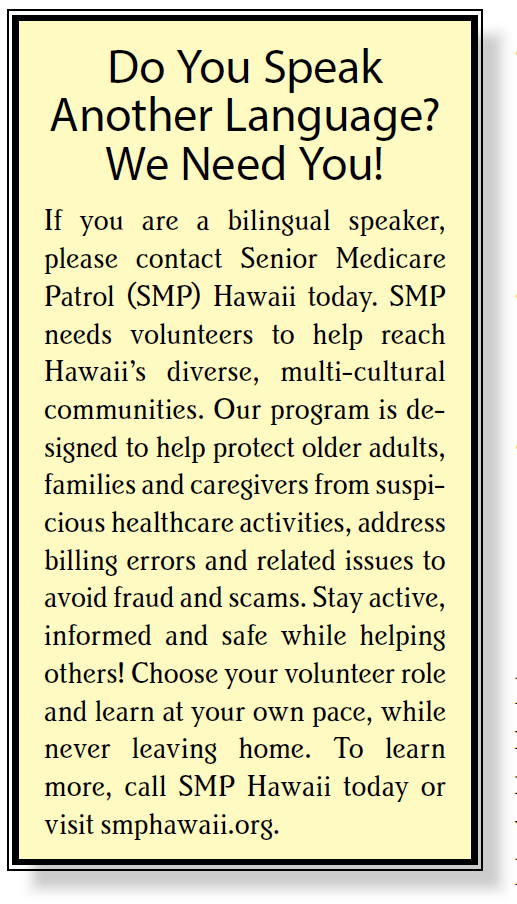
    Contact SMP Hawaii and learn how you can help our community protect itself from healthcare fraud, errors and abuse. We need volunteers who are caring, want to learn, can speak another language to reach as many people as possible, and understand that it takes our entire state to protect kūpuna.


    SENIOR MEDICARE PATROL (SMP) HAWAII
    Department of Health — Executive Office on Aging
    250 S. Hotel St., Ste. 406, Honolulu, HI 96813
    808-586-7281 | Toll Free: 1-800-296-9422
    info@smphawaii.org | smphawaii.org
    Facebook: smphawaii808

    This project was supported in part by grant number 90MPPG0053 from the US Administration for Community Living (ACL), Department of Health and Human Services, Washington, DC, 20201. Grantees undertaking projects under government sponsorship are encouraged to express freely their findings and conclusions. Points of view or opinions do not, therefore, necessarily represent official ACL policy. The Hawai‘i Department of Health – Executive Office on Aging has administered SMP Hawaii since 1997.

    Medicare fraud is big business for criminals. Medicare loses approximately $60 billion annually due to fraud, errors and abuse. When thieves steal from Medicare, there is less money for the healthcare we really need.

  • IRA Changes to Part D in 2024

    stethoscope on American tickets along with a boat of white pills

    The Inflation Reduction Act (IRA), which cut costs on some insulins and Part D vaccinations in 2023, continues to roll out more money-saving changes to prescription drugs in 2024. Medicare’s Open Enrollment Period (Oct. 15 to Dec.7) is the ideal time to consider how the following changes may affect your choice of healthcare insurance plan.

    • No coinsurance on prescription drugs for beneficiaries who fall into the catastrophic phase of Part D coverage.
    • 6% limit on average premium increases across most Part D plans.
    • Full financial help with cost-sharing and premiums may be possible for individuals who qualified for partial Extra Help in 2023 if they have limited assets and income less than 150% of the federal poverty level.

    Hawaii SHIP’s local, certified counselors provide unbiased information in one-on-one sessions and will screen income and assets for people with low incomes. SHIP specialists help clients submit Medicaid and Extra Help financial assistance forms and compare Medicare Advantage, Part D, and Medigap plans on their behalf. Contact Hawaii SHIP to learn more.


    HAWAII SHIP
    Free, local, one-on-one Medicare counseling is provided by the Hawai‘i State Health Insurance Assistance Program.
    250 South Hotel St., Ste. 406, Honolulu, HI 96813
    Oahu: 808-586-7299 | Toll free: 888-875-9229
    hawaiiship.org

    The Inflation Reduction Act (IRA), which cut costs on some insulins and Part D vaccinations in 2023, continues to roll out more money-saving changes to prescription drugs in 2024. Medicare’s Open Enrollment Period (Oct. 15 to Dec.7) is the ideal time to consider how the following changes may affect your choice of healthcare insurance plan.

  • Now That I Am Ready to Retire…

    Q: What is the average Social Security payment that a person receives each month?

    A: The average monthly Social Security benefit for a retired worker in 2023 is $1,827.00. The average monthly Social Security benefit for a worker with a disability in 2023 is $1,483.00. To get an estimate of your current and future benefits, create a my Social Security account at ssa.gov/myaccount.

    Q: How do I earn Social Security credits and how many do I need to qualify for benefits?

    A: We use your total yearly earnings to figure your Social Security credits. The amount needed for a credit in 2023 is $1,640. You must earn $6,560 to get the maximum four credits for the year. The amount needed to earn 1 credit usually increases each year when average wages increase.

    To qualify for Social Security benefits, you must earn a certain number of credits. The number of credits you need depends on your age when you apply and the type of benefit. No one needs more than 40 credits for any Social Security benefit. You can read more about credits in How You Earn Credits at ssa.gov/pubs/EN-05-10072.pdf.


    For questions, online applications or to make an appointment to visit a SSA office, call from 7am–5pm, Mon–Fri:
    1-800-772-1213 (toll free) | socialsecurity.gov

    To qualify for Social Security benefits, you must earn a certain number of credits. The number of credits you need depends on your age when you apply and the type of benefit. No one needs more than 40 credits for any Social Security benefit.

  • Medicare Season Attracts Millions

    According to the Centers for Medicare & Medicaid, more than 10,000 people are turning 65 every day and may qualify for Original Medicare insurance. Once an individual obtains the core parts of Medicare, other options may lower out-of-pocket costs. Some beneficiaries choose to get their coverage from Part C Medicare Advantage plans.

    Each year, Medicare’s Annual Enrollment Period (from Oct. 15 to Dec. 7) allows current enrollees to look at options for the following year. They can decide whether to keep their plan or select a new one. If no changes are needed, beneficiaries do not need to do anything. If a beneficiary decides to change, the new plan becomes effective the first day of the new year.

    In 2022, according to the Kaiser Family Foundation, 28 million Medicare beneficiaries were enrolled in Medicare Advantage plans. This Fall, millions of beneficiaries may be scrolling through insurance websites, watching TikTok videos and reading marketing materials. Licensed agents might also give Medicare 101 workshops at your local senior fair.

    It’s time to take a closer look at your plans! If you are happy with your existing plan, just sit back, relax and enjoy your Medicare years.


    GET2INSURANCE.COM FAMILY OFFICE
    1003 Bishop St., Ste. 2700, Honolulu, HI 96813
    800-226-3660 | martha@get2insurance.com
    Get2insurance.com

    According to the Centers for Medicare & Medicaid, more than 10,000 people are turning 65 every day and may qualify for Original Medicare insurance. Once an individual obtains the core parts of Medicare, other options may lower out-of-pocket costs. Some beneficiaries choose to get their coverage from Part C Medicare Advantage plans.