Category: Programs & Services

  • Helping to Protect Sea Turtles

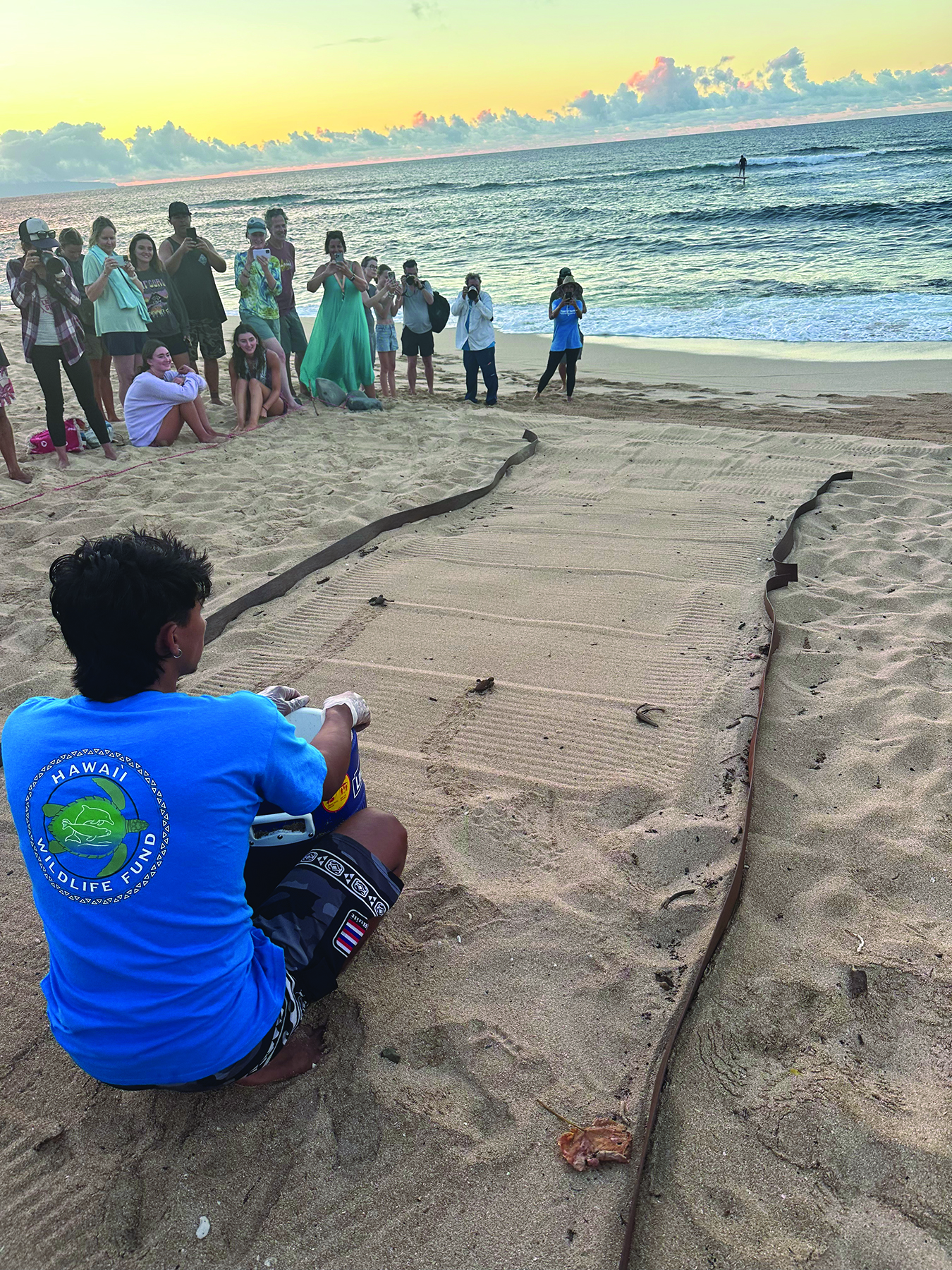
    Under the cover of a moonlit sky, a familiar hawksbill sea turtle, Orion, hauls herself up the beach with slow, powerful strokes. Now in her fifth nesting season, she begins meticulously carving into the sand, preparing a nest chamber to hold the next generation of hatchlings. One day, they too will repeat this prehistoric cycle.

    For nearly three decades, Hawai‘i Wildlife Fund (HWF) has been protecting nesting sea turtles, including the endangered hawksbill, helping to ensure the continuation of this cycle into an uncertain future. As a community-driven nonprofit organization, HWF is dedicated to the conservation of Hawai‘i’s coastal and marine species through research, education, marine debris removal and habitat restoration. On Maui, HWF leads several programs with a strong focus on safeguarding hatchlings and nesting sea turtles, including Dawn Patrol, Night Patrol and Nest Watch.

    Dawn Patrol staff and volunteers go out early looking for sea turtle tracks or an indication of a nest that has been laid. The Night Patrol looks for, guards and monitors nesting females. Nest Watch occurs day and night, watching over the nests to keep hatchlings safe from disturbance.

    However, the path to stronger sea turtle conservation on Maui has not been without its hardships. In 1993 and 1996, two hawksbill turtles searching for suitable nesting sites at Kealia Beach were tragically drawn off course by artificial lights from the nearby road. Both turtles, laden with eggs, were subsequently struck and killed by passing cars. Though heartbreaking and all too familiar, this incident marked a turning point for sea turtle conservation on Maui. In response, HWF and partnered agencies launched the Sea Turtle Recovery Project to address the many challenges sea turtles face through monitoring, researching, and the protection of nesting hawksbill and green turtles.

    Since then, with tireless support from our community, HWF has monitored 154 nests and protected 13,047 hatchlings as they made their way to the ocean. Each nesting season brings stories of resilience and survival, serving as a powerful reminder of the importance of this work. Nonetheless, every step forward is only possible through the dedication of our community. Every volunteer, from students to kūpuna, plays a vital role in our efforts. Join us in helping ensure that turtles like Orion—and even her hatchlings, who may now be finding their way back—continue to return and nest on the beaches of Maui for generations. Learn more or get involved on Maui via wildhawaii.org/get-involved/volunteer.


    HAWAI‘I WILDLIFE FUND (nonprofit)
    PO Box 790637, Paia, HI 96779
    719-332-0218 | alex@wildhawaii.org
    wildhawaii.org

    Under the cover of a moonlit sky, a familiar hawksbill sea turtle, Orion, hauls herself up the beach with slow, powerful strokes. Now in her fifth nesting season, she begins meticulously carving into the sand, preparing a nest chamber to hold the next generation of hatchlings. One day, they too will repeat this prehistoric cycle.…

  • Akamai Seniors: a Nonprofit for Seniors

    I’m honored to share the heart of Akamai Seniors, a nonprofit 501(c)(3) organization dedicated to serving Hawai‘i’s older adults. Our mission is simple: to help you find peace of mind and live healthy, productive lives, ensuring you get more out of life while spreading the aloha spirit in the communities we serve.

    We’re educators and a community outreach resource focusing on vital areas. Billions in benefits often go unclaimed because applications are complex. We step in to help. Our team provides crucial Medicare education, assisting with enrollment and ensuring you utilize the plan that best fits your needs. We also specialize in the Low-Income Subsidy (Extra Help) program. Half of all seniors qualify for this program that significantly lowers prescription drug costs and covers premiums.

    Beyond finances, we champion your overall well-being. Our Senior Wellness Program offers education on everything from fall prevention, nutrition and Alzheimer’s disease to combating social isolation. We also empower you with financial education, covering wills and trusts, Social Security and protection against scams.

    Akamai Seniors is your resource for aging and healthy living. We love our seniors and are always striving to best serve your needs. We believe every kupuna deserves to thrive!


    AKAMAI SENIORS (nonprofit)
    1311 Kapiolani Blvd., Ste. 508, Honolulu, HI 96814
    808-460-4940 | edward@akamaiseniors.org
    Akamaiseniors.org

    I’m honored to share the heart of Akamai Seniors, a nonprofit 501(c)(3) organization dedicated to serving Hawai‘i’s older adults. Our mission is simple: to help you find peace of mind and live healthy, productive lives, ensuring you get more out of life while spreading the aloha spirit in the communities we serve. We’re educators and…

  • From Keiki to Kūpuna

    Since 2019, Aloha Diaper Bank has supported Hawai‘i’s families by providing diapers and baby essentials to those in need. While our primary mission is keeping keiki healthy, we also gratefully accept donations of adult diapers, which are shared with kūpuna at our Windward Mall location and distributed to neighbor islands where the need is great.

    Kūpuna are more than recipients—they are an essential part of our organization. Many volunteer their time to wrap and inventory diapers and assist families visiting our site. Their involvement keeps them active, provides meaningful engagement, and allows them to share wisdom and experiences.

    Many kūpuna also care for their mo‘opuna (grandchildren), and we are honored to support them in that role. From keiki to kūpuna, every diaper donation impacts generations.

    We also host kūpuna-centered activities that foster connection and joy. Weekly hanafuda card games and monthly ‘ukulele classes with Joe Ahuna bring people together, encourage social interaction and celebrate lifelong learning.

    Together, we thrive when every generation is cared for with aloha.


    ALOHA DIAPER BANK (nonprofit)
    46-056 Kamehameha Hwy., Ste. 111, Kaneohe, HI 96744
    808-762-0364 | alohadiaperbank.org

    Since 2019, Aloha Diaper Bank has supported Hawai‘i’s families by providing diapers and baby essentials to those in need. While our primary mission is keeping keiki healthy, we also gratefully accept donations of adult diapers, which are shared with kūpuna at our Windward Mall location and distributed to neighbor islands where the need is great.…

  • Prepare for the Journey: As Memory Fades

    If you or a loved one has started to have memory loss, you may ask, “What will happen in the future? What can I do now to prepare?”

    SHARE may be right for you!

    Support, Health, Activities, Resources, Education (SHARE) is an evidence-based program that can help you or your loved one’s care team plan for the future by helping the team better understand the disease process, opening up communication channels, and providing resources that acknowledge individual values and preferences.

    The care team will include an individual at early stage of dementia or memory loss who is able to participate in discussion about their values, preferences and goals for the future. The other member of the care team is a care partner—often a spouse/significant other, adult child, or good friend—someone who is committed to being present with the person at an early stage as they progress on their life journey.

    A certified coach meets with the two-person care team in five sessions. The coach is a trained neutral party who will encourage communication and shares tips, skills and resources. A planning guidebook provided to the care team will serve as a tool to record plans for their future together.

    SHARE—and prepare—for the journey.


    CATHOLIC CHARITIES HAWAI‘I (nonprofit)
    1822 Keeaumoku St., Honolulu, HI 96822
    808-527-4777 | info@catholiccharitieshawaii.org
    catholiccharitieshawaii.org

    If you or a loved one has started to have memory loss, you may ask, “What will happen in the future? What can I do now to prepare?” SHARE may be right for you! Support, Health, Activities, Resources, Education (SHARE) is an evidence-based program that can help you or your loved one’s care team plan…

  • Medicare Coverage for Surgery

    Medicare covers many medically necessary services for both inpatient and outpatient surgical procedures, but the cost may vary depending on many factors.

    For outpatient surgery, the costs of ambulatory surgical center and hospital outpatient surgery may be different. Ambulatory centers usually have lower overhead costs than hospital-based outpatient surgery. For inpatient services, Medicare covers 80% of the Medicare-approved amount for doctors’ services you get while you are in a hospital and you pay the remaining 20% after meeting the deductibles. Currently, the Medicare Part A deductible is $1,676 and Part B is $257.

    Other factors that may affect cost include other insurance you may have aside from Medicare (Medicare Advantage or a Medigap plan), how much the provider charges or if the provider accepts Medicare assignment (the provider agrees to accept the Medicare-approved amount as full payment for covered services) and the type of facility.

    Outpatient costs can be found by looking up the procedure name, CPT code or Health Care Common Procedure Coding System code at medicare.gov/procedure-price-look-up. Get the code for a specific service from your healthcare provider for more accurate pricing.

    COPELAND INSURANCE GROUP
    1360 S. Beretania St., Ste. 209, Honolulu, HI 96814
    808-591-4877 | josie@copelandgroupusa.com
    planenroll.com/?purl=Josie-Banasihan

    Medicare covers many medically necessary services for both inpatient and outpatient surgical procedures, but the cost may vary depending on many factors. For outpatient surgery, the costs of ambulatory surgical center and hospital outpatient surgery may be different. Ambulatory centers usually have lower overhead costs than hospital-based outpatient surgery. For inpatient services, Medicare covers 80%…

  • Kupuna in the Classroom

    In classrooms across the State of Hawai‘i, a quiet yet powerful force is shaping the academic and emotional well-being of students: senior volunteers. Kupuna in the Classroom volunteers are stepping up to provide essential services that help bridge educational and emotional gaps many students face. They provide the kind of one-on-one attention and support that overburdened teachers often can’t consistently offer.

    Kupuna in the Classroom is also known as the
    Foster Grandparent Program.

    Kupuna in the Classroom volunteers are assigned to three to five students and focus on the specific needs of students. The one-on-one time they dedicate to students enables them to develop meaningful and productive relationships. This intergenerational model is good for the soul and helps kūpuna to stay active, use their cognitive skills and enhance their lives.

    To become a Kupuna in the Classroom (foster grandparent), an individual must be at least 55 years of age, commit to volunteering a minimum of 15 hours per week, and meet income and other program requirements.

    To volunteer as a foster grandparent, apply for services or for more information about this program, call the Foster Grandparent Program office on O‘ahu at 808-832-5169.

    FOSTER GRANDPARENT PROGRAM (nonprofit)
    1010 Richards St., Ste. 614, Honolulu, HI 96813
    shull@dhs.hawaii.gov | 808 832-5167
    humanservices.hawaii.gov/foster-grandparent-program

    In classrooms across the State of Hawai‘i, a quiet yet powerful force is shaping the academic and emotional well-being of students: senior volunteers. Kupuna in the Classroom volunteers are stepping up to provide essential services that help bridge educational and emotional gaps many students face. They provide the kind of one-on-one attention and support that…

  • Am I Doing This Right? Where Do I Turn?

    These questions are asked by every caregiver everywhere! Family caregivers frequently begin their journey with no experience and little or no training, which, understandably, leaves the caregiver feeling overwhelmed by their new responsibilities. There are 60,000 family caregivers caring for someone living with Alzheimer’s, so they bear the brunt of the disease in Hawai‘i.

    Caregivers don’t know what to expect as their loved one’s dementia progresses, so they don’t know what questions to ask in order to prepare themselves for what lies ahead. With no experience and no education, the caregiver will most likely experience stress, uncertainty, fear, frustration and a myriad of other emotions.

    The most effective ways to help ensure the highest quality of care for those with dementia are through caregiver education and making sure all the resources available to caregivers are easily accessible. Learning about the disease and knowing what to expect can help caregivers feel more in control and better able to cope and plan. Knowing where to turn to for help is crucial to help caregivers navigate their caregiving journey.

    There are many organizations that offer quality caregiver education at no cost to the caregiver, including the Alzheimer’s Association, The Caregiver Foundation, Project Dāna, AARP, the Hawaii Parkinson Association and Hale Hau‘oli Hawai‘i. Virtual workshops are advertised on websites.

    “To be forewarned is to be forearmed” makes sense for providing the public with information about Alzheimer’s disease and related dementias. Receiving education and training for caregiving, learning practical caregiving approaches and using local caregiving resources are important strategies. Armed with the resources needed to continue to provide safe, effective care for their loved one, and knowledge that there is help in the community to assist them, caregivers can be successful in their caregiving journeys, and their loved ones can remain in their communities.

    In addition, “The Dementia Public Awareness Campaign” bill passed through the legislature a few years ago and will be rolling out soon.

    HALE HAU‘OLI HAWAI‘I (nonprofit)
    98-1247 Kaahumanu St., Ste. 207, Aiea, HI 96701
    808-798-8706 | halehauolihawaii.org
    alz.org/help-support/caregiving
    thecaregiverfoundation.org/the-caregiver-foundation-services
    projectdana.org/caregiver
    states.aarp.org/hawaii/caregiver-resources
    parkinsonshawaii.org/resource-center

    These questions are asked by every caregiver everywhere! Family caregivers frequently begin their journey with no experience and little or no training, which, understandably, leaves the caregiver feeling overwhelmed by their new responsibilities. There are 60,000 family caregivers caring for someone living with Alzheimer’s, so they bear the brunt of the disease in Hawai‘i. Caregivers…

  • Long-Term Care Ombudsman Program

    This year, we celebrate the 50th anniversary of the Long-Term Care Ombudsman Program (LTCOP). Part of the Executive Office on Aging, an ombudsman is primarily an advocate for residents living in a nursing home, assisted living facility, community care foster family home, or an adult or expanded adult residential care home. Having an advocate is especially important for residents who are comatose, have dementia or cannot speak for themselves.

    The LTCOP is federally mandated to visit every facility at least once a quarter. With 1,779 facilities (12,895 beds) spread over six islands, that can only be accomplished with volunteers.

    We are not state inspectors. We don’t cite facilities for deficiencies when regulations are violated. The state Department of Health’s Office of Health Care Assurance does that. We champion quality of life and quality of care for all residents.

    The LTCOP utilizes both staff and certified volunteers to promote its mission to provide culturally sensitive advocacy and referral services to Hawai‘i’s long-term care residents.

    For more information on becoming a volunteer, use the contact information below.

    STATE LONG-TERM CARE OMBUDSMAN
    Executive Office on Aging
    Hawai‘i State Department of Health–Ka ‘Oihana Olakino
    250 South Hotel St., Ste. 406 Honolulu, HI 96813
    john.mcdermott@doh.hawaii.gov | C: 808-892-9306
    808-586-7268 | Toll Free: 1-888-229-2231
    hi-ltc-ombudsman.org | health.hawaii.gov/eoa

    This year, we celebrate the 50th anniversary of the Long-Term Care Ombudsman Program (LTCOP). Part of the Executive Office on Aging, an ombudsman is primarily an advocate for residents living in a nursing home, assisted living facility, community care foster family home, or an adult or expanded adult residential care home. Having an advocate is…

  • SSA Issues Imposter Scam Alert

    Social Security (SS) imposter scams continue to be widespread across the United States. Scammers use tactics to deceive you into providing sensitive information or money. If you receive a suspicious letter, text, email or call, do not respond.

    SSA WILL NEVER:

    • Text or email images of an employee’s official government identification
    • Suspend your SS number
    • Threaten you with arrest or other legal action unless you immediately pay a fine or fee
    • Require payment by retail gift card, wire transfer, internet currency or cash by mail
    • Promise a benefit increase or other assistance in exchange for payment
    • Mail or email “official” letters or reports containing your personal information

    WE ONLY SEND TEXT MESSAGES IN LIMITED SITUATIONS, INCLUDING:

    • When you have subscribed to receive updates and notifications by text
    • As part of our enhanced security when accessing your personal my Social Security account

    If you owe money to us, we will mail you a letter with payment options and appeal rights. SS employees do contact the public by telephone for business purposes. Ordinarily, the agency calls people who have recently applied for a SS benefit, are already receiving payments and require an update to their record or have requested a phone call from the agency. If there is a problem with a person’s SS number or record, SS will mail a letter.

    Report suspected SS imposter scams and other SS fraud by going to the Office of the Inspector General’s website: oig.ssa.gov/report. Find more information about scams at ssa.gov/scam. Please share this information with your friends, family and colleagues to help spread awareness about Social Security imposter scams.

    For more SSA information, call 7am–5pm, Mon–Fri:
    1-800-772-1213 (toll free) | socialsecurity.gov
    Your COLA Notice

    Individuals who have a personal my Social Security account can view their COLA notice online, which is secure and faster than receiving a letter in the mail. Users can also receive text or email alerts when there is a new message waiting for them, including a COLA notice. Set up a my Social Security account at ssa.gov/myaccount.

    SSA ONLINE SERVICE HOURS
    Eastern Standard Time
    Mon– Fri 4:15am–1am
    Sat 5am–11pm
    Sun 8am–11:30pm
    SSA COLA: ssa.gov/cola
    ssa.gov/news/press/factsheets/colafacts2025.pdf
    SSA Full Retirement Age Chart:
    ssa.gov/benefits/retirement/planner/agereduction.html
    Medicare & You 2025:
    publications/10050-medicare-and-you.pdf

    Social Security (SS) imposter scams continue to be widespread across the United States. Scammers use tactics to deceive you into providing sensitive information or money. If you receive a suspicious letter, text, email or call, do not respond. SSA WILL NEVER: WE ONLY SEND TEXT MESSAGES IN LIMITED SITUATIONS, INCLUDING: If you owe money to…

  • SSA Benefits Toolkits Explained

    We’ve released new resources to help you better understand Social Security benefits. We’ve designed easy-to-use toolkits to provide education about our programs for children and our benefits for families after the death of a loved one. Our School Professional and Survivor Benefits toolkits are downloadable PDFs that include ready-to-go communications, such as sample email blasts, newsletter articles, hand-outs and social media posts.

    SCHOOL PROFESSIONAL TOOLKIT

    The School Professional Toolkit at ssa.gov/marketing/assets/materials/toolkit-ss-benefits-and-ssi-payments-for-children.pdf is for teachers, school counselors and other educators. The purpose of this toolkit is to educate parents and guardians about the financial help we provide. We make payments to students with disabilities and to those who have experienced the loss of a parent or have a parent who is receiving retirement or disability benefits.

    The toolkit discusses the following:

    • Eligibility requirements
    • How to apply
    • How to respond to requests for school records and forms
    • Evidence we need from school professionals to determine whether a child with a disability may be eligible for SSI

    SURVIVORS BENEFITS TOOLKIT

    The Survivors Benefits Toolkit at ssa.gov/marketing/assets/materials/toolkit-ss-survivors-benefit.pdf is for funeral homes, care facilities and other organizations working with people who have lost a loved one. This toolkit increases awareness about survivors benefits for eligible family members. We make monthly payments to surviving spouses, minor children, adult children with disabilities and dependent parents of workers who paid Social Security taxes before they died.

    The toolkit discusses the following:

    • Eligibility requirements
    • How to apply
    • Evidence for processing applications

    For more information about our toolkits, visit the blog post titled “New Resources for School Employees and Survivors” at blog.ssa.gov/new-resources-to-educate-school-employees-and-survivors. Please help us spread the word about our tool-kits with your colleagues and others who may find them helpful.

    For more information on SSA benefits, including who is eligible and how to apply, visit ssa.gov/benefits. To make an appointment, call between 7am and 5pm, Mon–Fri: 1-800-772-1213 | socialsecurity.gov

    We’ve released new resources to help you better understand Social Security benefits. We’ve designed easy-to-use toolkits to provide education about our programs for children and our benefits for families after the death of a loved one. Our School Professional and Survivor Benefits toolkits are downloadable PDFs that include ready-to-go communications, such as sample email blasts,…

  • Recreation, Leisure & Assistive Technology

    Recreational activities provide a wide range of benefits for seniors, significantly contributing to their physical health, mental sharpness and emotional well-being.

    Engaging in leisure activities helps maintain physical fitness, stimulates cognitive function and fosters emotional resilience. Additionally, recreation offers seniors valuable opportunities to form and strengthen social connections, promoting a strong sense of community and reducing feelings of isolation.

    In recent years, assistive technology (AT) has emerged as a powerful ally in helping older adults stay engaged in recreational and leisure pursuits. AT enables seniors to maintain independence, explore new interests, and participate in social and physical activities despite age-related challenges. With the help of technology, seniors can remain active, socially connected and mentally engaged, enhancing their overall quality of life.

    What is Assistive Technology?

    Assistive technology is a broad term that includes tools, devices and systems designed to help individuals maintain or improve their functional abilities. These technologies assist with mobility, communication, cognition, vision, hearing and self-care. As people age, they often face physical or cognitive limitations. AT can help bridge those gaps to support health, participation and inclusion.

    AT for Staying Physically Active

    A wide range of assistive technology is available to help seniors engage in physical and recreational activities. Adaptive equipment makes hobbies like fishing, golf, billiards, bowling, photography, cycling and gardening more accessible. Specialized tools for card and board games and arts and crafts allow seniors to continue enjoying their favorite pastimes.

    Mobility aids such as wheelchairs, walkers, scooters and canes are vital for enabling recreation participation. Some wheelchairs are specially designed for sports such as tennis or basketball.

    Fitness trackers serve as adaptive technologies by helping seniors monitor their physical activity and health data in real-time.

    Sensory assistive devices like vibrating timers, tactile maps and audio beacons, enable individuals with hearing or vision impairments to enjoy outdoor and sports activities safely and independently.

    AT for Staying Social

    Technology also plays a significant role in helping seniors to maintain social connections. Tools such as video chat apps, adaptive phones and digital group platforms help older adults to stay in touch with family, friends and community groups, promoting their social engagement and reducing their isolation.

    AT for Mental Health and Enrichment

    Devices like speech readers, screen readers, FM systems, virtual reality, smart home assistants and communication aids provide mental stimulation and entertainment. Voice recognition software, braille displays and alternative input devices allow those with physical or cognitive impairments to access digital content and interact with the world around them.

    By integrating assistive technology into their lives, Hawai‘i’s seniors can enjoy a more active, social and enriched lifestyle. ATRC is committed to helping older adults explore how AT can support their well-being and fully empower them to participate in the activities they love.

    ASSISTIVE TECHNOLOGY RESOURCE CENTERS OF HAWAI I (nonprofit)
    200 N. Vineyard Blvd., Ste. 430, Honolulu, HI 96817
    808-532-7110 | info@atrc.org | atrc.org
    ATRC does not sell products, but recommends vendors. Device demonstration and lending programs give individuals and groups the opportunity to make an informed choice about an AT device prior to acquiring one.

    Recreational activities provide a wide range of benefits for seniors, significantly contributing to their physical health, mental sharpness and emotional well-being. Engaging in leisure activities helps maintain physical fitness, stimulates cognitive function and fosters emotional resilience. Additionally, recreation offers seniors valuable opportunities to form and strengthen social connections, promoting a strong sense of community and…

  • A Lifeline for Tenants & Landlords

    Managing rental agreements can be challenging, especially when tenants face financial difficulties. When rent isn’t paid and communication breaks down, eviction often becomes the next step. However, there’s a way to address these issues before they escalate into legal proceedings. The Early Eviction Mediation (EEM) program is a neutral, solution-based approach whereby tenants and landlords can come together with the help of an impartial mediator to find mutually agreeable solutions that allow tenants to remain in their homes while enabling landlords to receive payment — without needing to go to court.

    What to Expect from EEM

    Mediation is straightforward and accessible. Sessions are conducted through Zoom. For those with no internet, The Mediation Center of the Pacific (MCP) provides in-person access at its office.

    Both parties are required to sign a confidentiality agreement to protect the privacy of the discussions. The mediation session typically lasts about 1.5 hours, during which the mediator helps facilitate communication. Participants can also meet with the mediator separately.

    In addition to the mediator’s guidance, participants can involve case managers, social workers or US Veterans Affairs Department case managers to ensure they have support and resources.

    Mediations are scheduled quickly, typically within 48 hours, and can be resolved in three to five business days, depending on the availability of the parties involved. This quick turnaround time is especially important for senior tenants facing eviction and senior landlords who rely on rental income for their livelihood.

    Benefits of EEM

    The mediation program boasts an impressive93% agreement rate. Agreements can include payment plans, giving tenants a chance to catch up on overdue rent, or mutually agreed-upon move-out dates that allow sufficient time for tenants to secure new housing. Such solutions help foster greater housing stability, allowing tenants to stay housed longer and landlords to avoid costly, uncertain legal proceedings.

    Mediation is cost-effective and efficient. It helps prevent the emotional and financial toll of eviction, improves communication, and strengthens trust between tenants and landlords. By addressing these issues early, both parties are empowered to find solutions that keep the housing market stable and reduce the risk of future disputes. Contact us for more information.

    THE MEDIATION CENTER OF THE PACIFIC
    1301 Young St., 2nd Floor, Honolulu, HI 96814
    808-521-6767 | Roberta@mediatehawaii.org
    Mediatehawaii.org/eem

    Managing rental agreements can be challenging, especially when tenants face financial difficulties. When rent isn’t paid and communication breaks down, eviction often becomes the next step. However, there’s a way to address these issues before they escalate into legal proceedings. The Early Eviction Mediation (EEM) program is a neutral, solution-based approach whereby tenants and landlords…