The attorney’s ad tells you that you can get a “comprehensive estate plan” for $800. Does that sound too good to be true? It may be. Before you rush in, here are some questions to ask. If you get positive answers to every question, then maybe you have a real bargain on your hands.
1. Will the attorney (not a secretary or paralegal) sit down with you for as long as it takes to get a thorough understanding of your goals, and to educate you about alternative approaches? Most attorneys start to charge by the hour after the documents are signed. Find out how the attorney will charge if you have questions after your estate plan is established.
2. Once you decide on a plan, what will be included? Your plan should probably include one or more trust agreements:
• a pour-over will (for each spouse, if you are planning as a couple)
• durable power(s) of attorney
• advance health-care directive(s)
• authorization(s) for your health providers to talk with your decision-makers and family members/loved ones
• documents to transfer your assets into your trust(s): This last point is crucial. Your estate won’t work unless title to each of your assets is reviewed and transferred as appropriate.
3. Is the attorney experienced in estate planning (not every attorney is good at every area of law), and does he or she have a good reputation? Visit www.martindale.com to find out how an attorney is regarded by his or her peers.
4. Will you meet with a paralegal or an attorney when it comes time to sign your documents? You have the right to legal counsel at that time, which only a licensed attorney can give you.
5. Are all costs included in the fee? Don’t be surprised by “add ons” for such things as recording fees, notary fees and photocopies.
6. Will your estate plan include provisions to address the possibility of someone being disabled or incapacitated? And, will the attorney’s law firm be there to help when someone dies or becomes incapacitated?
7. If you need to go to hospital locally or while traveling, will you have immediate access to your advance directive?
8. Does the attorney have a program to make sure that your estate plan will be kept current? If not, it will be deficient within a year or two and it may do you and your loved ones more harm than good. One thing you can be sure of is that things will change: the law, your assets, your health, and maybe even your decision makers.
9. Will working with this attorney give you the peace of mind of knowing you have done the best you can do by yourself and your loved ones? Too many estate plans fail because of the client’s lack of understanding, implementation (such as by making sure that assets that should be transferred into a revocable trust are actually transferred) and by lack of updating. There is no point in investing in an estate plan that you are not confident will work when the inevitable or unexpected happens, such as death, incapacity, divorce, or other events that will rob your loved ones of their inheritance.
The attorney’s ad tells you that you can get a “comprehensive estate plan” for $800. Does that sound too good to be true? It may be. Before you rush in, here are some questions to ask. If you get positive answers to every question, then maybe you have a real bargain on your hands.
If you are divorced, there are several things you should know about Social Security. A divorced spouse may be eligible for benefits on more than one work record—such as one’s own record and an ex-spouse’s record. This applies to both divorced men and women. If you’ve never asked Social Security about receiving benefits based on your ex-spouse’s work, you should consider it. Some divorced people may get a higher benefit based on their ex’s work.
If your ex-spouse is living, you can receive benefits based on his or her work if:
• Your marriage lasted 10 years or longer;
• You are unmarried;
• You are age 62 or older;
• The benefit you are entitled to receive based on your own work is less than the benefits you would receive on your ex’s work; and
• Your ex is entitled to Social Security retirement or disability benefits.
If your ex-spouse is deceased, you can receive benefits:
• At age 60, or age 50 if you are disabled, if your marriage lasted at least 10 years, and you are not entitled to a higher benefit on your own record; or
• At any age if you are caring for your ex-spouse’s child who also is your natural or legally adopted child and is younger than 16 or disabled and entitled to benefits. Your benefits will continue until the child reaches age 16 or is no longer disabled. In this case, you can receive this benefit even though you were not married to your ex-spouse for 10 years.
When you apply, you will need to give your ex’s Social Security number. If you do not know his or her number, you will need to provide your ex’s date and place of birth, and parents’ names.
When you apply for benefits, Social Security can figure out if you are due a higher amount based on your ex-spouse’s record. Once again, these same rules apply for both ex-husbands and ex-wives.
If you are divorced, there are several things you should know about Social Security. A divorced spouse may be eligible for benefits on more than one work record—such as one’s own record and an ex-spouse’s record. This applies to both divorced men and women. If you’ve never asked Social Security about receiving benefits based on…
May Day is Lei Day in Hawai‘i Nei. The first Lei Day was in 1927 and celebrated in downtown Honolulu with a few people wearing lei as a symbol of friendship and goodwill. From that it grew and more and more people began to wear lei on May 1.
To continue celebrating the spirit of aloha, the Mayor of Honolulu Mayor Charles Arnold crowned the first lei queen, Nina Bowman, in 1928. After a few years, the City & County of Honolulu started a tradition of hosting an Annual Lei Queen Selection Event in March. The Lei Queen is later crowned at the City’s Annual Lei Day Celebration on May 1. Lei Day has become an important cultural event
celebrating the Hawaiian culture through various themes. The theme for the 83rd Annual Lei Queen Selection was He Lei No Ka‘ahumanu (A Lei for Ka‘ahumanu). Each year, the lei queen is selected from one of the three rotating groups:
• Nā Wahine Ōpio
(The Younger Women, 18-30 years)
• Nā Mōkuahine
(The Adult Women, 31-54 years)
• Nā Kūpunahine
(The Grandmothers, 55 and over.)
This year’s event featured the Nā Kūpunahine. On March 12th, six lovely Kūpunahine vied for top honors in this year’s Lei Queen Selection Event at the McCoy Pavilion at Ala Moana Regional Park. The entertaining event celebrated Hawaiian culture, and featured live music and an open hula period.
Each lady was scored on her lei making, hula, poise and personality, Hawaiian language skills and their ability to convey the spirit of aloha with warmth and dignity. This year’s Lei Queen is Sandrina Lei Ilima Cabato De La Cruz. Lei Queen Ilima is Hawaiian, Filipino and Chinese ancestry and grew up in Kalihi and Na¯na¯kuli. She is an administrative assistant for Parents and Children Together (PACT), and is a student at Windward Community College.
The Investiture Ceremony is on May 1st (Lei Day). Sandrina will also make public appearances throughout the year, including the Annual Kamehameha Day Parade, June 11, 2011 (tentative date) and the annual Na¯ Hula Festival, August 6 & 7, 2011 (tentative date).
May Day is Lei Day in Hawai‘i Nei. The first Lei Day was in 1927 and celebrated in downtown Honolulu with a few people wearing lei as a symbol of friendship and goodwill. From that it grew and more and more people began to wear lei on May 1.
Road Scholar is the new name for the programs developed and offered by Elderhostel, Inc., the not-for-profit world leader in lifelong learning since 1975. Its mission is to empower adults to explore the world’s places, peoples, cultures and ideas, and in so doing to discover more about themselves.
Lifelong learning should be defined by one’s outlook, not by one’s age. Road Scholar develops and offers programs specifically for people in their 50s, 60s, 70s and beyond. In a world that seems to shrink smaller by the day because of technology, Road Scholar believes that true insight and understanding are still sparked by hands-on experience and open discussions that stimulate the senses, energize the body and challenge the mind. Sharing new ideas, challenges and experiences is rewarding in every season of life and the participants come together as a group of diverse individuals who share a passion for learning.
Road Scholar is educational—participants are considered students, not tourists. Their travel programs are for the enjoyment of learning; there is no homework, no exams or grades and no special educational background is needed or required. Programs are rated by activity level so that participants can select itineraries best suited to their intellectual curiosity, physical ability and comfort.
Discover nearly 8,000 educational tours in all 50 states and more than 90 countries, including intergenerational programs designed to share your love of learning and thrill of discovery with your grandchildren. Choose from land or ship-based itineraries around the world. Through special behind-the-scenes access, you get exceptional opportunities for learning and authentic experiences while exploring the world’s most fascinating treasures at a great value.
Road Scholar may be just right for you … all that’s needed is an inquiring mind, an adventurous spirit and the belief that learning and discovery are lifelong pursuits. A fellowship of learning and the joy of discovery are the hallmarks of the Road Scholar experience.
Pacific Islands Institute has been offering Road Scholar group programs in Hawai‘i and throughout the Pacific islands of Polynesia, Melanesia and Micronesia since 1989. Through its educational programs, Pacific Islands Institute is dedicated to providing positive cultural interactions; to ensuring our programs are culturally and environmentally sensitive; to involving local people in decision making; and to protecting, sustaining and respecting indigenous cultures and environments. This local company has been recognized with awards from the Hawai‘i Tourism Authority, the Hawai‘i Visitors and Convention Bureau and the Hawai‘i Ecotourism Association.
A sampling of Road Scholar travel programs provided by Pacific Islands Institute:
Hawai‘i National Parks: Island Life in the Pacific
This 16-day, 15-night program features national parks, historic sites, wildlife refuges and state parks on five Hawaiian Islands. Follow the journey of Pele, Hawai‘i’s volcano goddess, from Kīlauea’s current eruption in Hawai‘i Volcanoes National Park, to Haleakalā on Maui for a bird’s eye view into the volcanic crater, enjoying black sand beaches, stunning waterfalls and fascinating remnants of ancient Hawai‘i along the way. Then on to Kalaupapa, on Moloka‘i’s peninsula, where Father Damien ministered to Hansen’s Disease patients; then to Kaua‘i where you will see Waimea, the “Grand Canyon of the Pacific,” and watch seabirds soar over the lighthouse and cliffs. End your stay in famous Waikīkī, including a visit to the USS Arizona, a moving memorial to the bombing of Pearl Harbor. Led by former park rangers and local cultural historians you will gain unique insider perspectives as you experience Hawai‘i’s flora, fauna and cultural history.
Intergenerational South Pacific: The Future of the Oceans
On this intergenerational adventure starting with 3 nights in Tahiti and then cruising for 7 nights to the French Polynesian islands of Bora Bora, Tahaa, Raiatea and Moorea, you and your grandchild—or even three generations if their parent(s) wish to enroll—will have a hands-on, interactive experience of French Polynesia’s marine and island ecosystems. Explore coral reefs, hike rainforest trails and much more. This voyage on the MS Paul Gauguin is specially designed to be an exciting and memorable learning experience for all ages.
Following Captain Cook
The Cook Islands & Society Islands: On this 15- night South Pacific odyssey, spend 3 nights in Tahiti and then set sail on the MS Paul Gauguin to discover the isle of Huahine, renowned for its spectacular rainforests, experience the unique majesty of the Cook Islands, then return to the Society Islands of French Polynesia for days in alluring Bora Bora, Tahaa, Moorea and Tahiti.
Documenting the Past
The Easter Island Archaeology Project: Join archaeologists and other researchers for a hands-on exploration of one of the world’s most mysterious and fascinating places. Learn archaeological research techniques and contribute to a growing body of research to bring the mysteries of Rapa Nui into view.
Road Scholar is the new name for the programs developed and offered by Elderhostel, Inc., the not-for-profit world leader in lifelong learning since 1975. Its mission is to empower adults to explore the world’s places, peoples, cultures and ideas, and in so doing to discover more about themselves. Lifelong learning should be defined by one’s…
An AARP survey of Hawai‘i residents age 50 years old and over shows a gap between the importance they place on health and financial security and their confidence in meeting those needs. More than 9 out of 10 older residents in Hawai‘i say staying healthy, mentally sharp and having adequate health insurance coverage are extremely or very important to them. Yet only 3 out of 10 say they have everything they need relative to these concerns.
“It’s not surprising that almost every Hawai‘i resident age 50-plus says staying healthy and spending time with loved ones is important,” says AARP Hawai‘i State Director Barbara Kim Stanton. “But it is alarming that most of us don’t think we have what we need to meet those goals. We all have a role to play in bridging that gap.”
Key findings from the survey, which also examined issues like aging at home, financial security and state budget concerns, include:
96 percent say staying healthy is important, but only 31 percent of these residents think they have what they need to do so.
87 percent say that spending time with family and friends is important, but only 35 percent think they have what they need to stay connected to their loved ones.
83 percent say that protecting themselves against fraud is important, but only 19 percent think they have what they need to stay safe as consumers.
The survey is the latest in AARP’s ongoing efforts to match the changing needs of its members and all older residents with resources that help them manage new opportunities and challenges. AARP offers a variety of easy-to-use online tools and information to help you and your family with your own unique needs. For example:
Strengthen your financial security and protect yourself against fraud Find out if your plans are still on track to retire when and how you want: www.aarp.org/retirementcalculator.
Stay healthier Get the facts on the prevention screenings and vaccinations you may need: www.aarp.org/healthscreenings.
To see the complete survey,Voices of 50+ Hawai‘i: Dreams and Challenges, go to http://aarp.us/gWe2Mw. Residents age 50+ represent roughly 35 percent of the state’s population. There are nearly 150,000 AARP members in Hawai‘i.
An AARP survey of Hawai‘i residents age 50 years old and over shows a gap between the importance they place on health and financial security and their confidence in meeting those needs. More than 9 out of 10 older residents in Hawai‘i say staying healthy, mentally sharp and having adequate health insurance coverage are extremely…
For generations grandparents in Hawai‘i have helped raise their grandchildren while the parents worked the farms or harvested the crops. While things changed in modern Hawai‘i, the tradition continued as busy parents headed off to work, grandparents often took the grandchildren to school or after school activities. And, by the late ’90s, many grandparents found themselves caring for their grandchildren on a full time, 24/7 basis. Yet, a myriad of Hawai‘i laws prevented them from fully caring for their grandkids. For example, grandparents couldn’t enroll the children in school or take them to the doctor. What happened to ‘‘ohana” and “hānai”? These cultural traditions of family caring for other family members, especially the keiki, were no longer recognized in our very own Hawai‘i.
In response, the Windward O‘ahu Family and Community Education Council (WOFCE) appointed a small, yet passionate, committee called Nā Tūtū. Its mission is to seek necessary legislation, which will allow grandparents and care-givers over the age of 18, to provide a safe, loving and secure home for the children in their care.
At the time Nā Tūtū was established, if parents were unavailable, the child was deemed a ward of the state and farmed out to a foster home. In order for grandparents, or other relatives, to be caretakers they had to be legal guardians.
Nā Tūtū set out to change the laws. It researched other states’ “consent” laws, some of which allowed grandparents to enroll their grandchildren in school and allowed medical services for the minors, and selected the legislation that it felt best suited Hawai‘i.
On Na¯ Tu¯tu¯’s behalf, the Human Resources Committee Chairs of both the Senate and House introduced education and medical consent laws into the legislature. To raise awareness, Nā Tūtū
made Tūtū/Keiki dolls and distributed them to all legislators; gathered more than 1,000 signatures throughout the state; followed by support letters, and after three years of testifying before committees of both Houses. The legislation for Consent for Education became law in 2003, followed by the Consent for Medical Services in 2005. By law, every school in the state must have the Consent for Education affidavit form available to all grandparents or relatives who are the primary caregivers of a minor child.
Later, the Nā Tūtū Coalition supported legislation that required the state to place a minor child with a grandparent or relative before permanent placement in a foster home. The Coalition was also instrumental in changing the policy of public housing for senior citizens facing eviction because they had suddenly found themselves caring for grandchildren in crisis. Eviction will no longer be an intimidation.
Nā Tūtū is comprised of grandparents, relatives, organizations and agencies concerned with issues facing the caregiving of minor children. Nā Tūtū is currently a state project of the Family and Community Education, University of Hawai‘i, Cooperative Extension Services. The Coalition is active in informing the general public of the concerns and activities for grandparents raising grandchildren.
For more information and to get involved, call (808) 239-8908 n
For generations grandparents in Hawai‘i have helped raise their grandchildren while the parents worked the farms or harvested the crops. While things changed in modern Hawai‘i, the tradition continued as busy parents headed off to work, grandparents often took the grandchildren to school or after school activities. And, by the late ’90s, many grandparents found…
Given the rapidly growing senior populace, Catholic Charities Hawai‘i remains dedicated to creating and providing services that keep seniors engaged and independent. Services include case management, transportation, chore and housekeeping, affordable housing, respite for caregivers, socialization and volunteer opportunities. In addition, the organization manages the popular Lanakila Multi-Purpose Senior Center, which offers individuals supportive services that help them maintain independence in the community.
The Center serves as a gathering place for seniors in the Fort Shafter to Ward area, providing more than 40 monthly programs. The schedule includes exercise classes and activities, arts and crafts, singing and musical instrument instruction, as well as dance classes in hula, tap, and ethnic Japanese, Korean and Portuguese. Special workshops include tax preparation, stress management, health maintenance and defensive driving.
Seniors also have the opportunity to participate in the Center’s many cultural clubs. For example, the Okinawa Nenchosha Club, the Center’s largest group, recently observed birthdays for more than 40 members who are 90 years or older, including two who are over 100 years young. The celebration included traditional entertainment by Toguchi-Nakasone Sensei.
“We have seen the tremendous difference our program makes in this community,” says Diane Terada, division administrator at Catholic Charities Hawai‘i. “Not only are members living to celebrate their 90- and 100-year birthdays, they are living a very active lifestyle where they are engaged and enjoying every day, meeting new people and trying different activities. At Lanakila, we know seniors thrive in a vibrant environment and we’re looking forward to continue supporting this community.”
For more information on Lanakila Multi-purpose Senior Center or other senior services provided by Catholic Charities Hawai‘i, please call (808) 847-1322 or visit online at www.catholiccharitieshawaii.org.
Given the rapidly growing senior populace, Catholic Charities Hawai‘i remains dedicated to creating and providing services that keep seniors engaged and independent. Services include case management, transportation, chore and housekeeping, affordable housing, respite for caregivers, socialization and volunteer opportunities.
Adult Day Care services are available at SECOH’s Founder Center in Kāhala and Central O‘ahu Community Center in Wahiawaˉ. Services are provided and supervised by highly competent and trusted staff with specific experience working with people who have Alzheimer’s, dementia, and multiple physical and cognitive disabilities. Service tuition includes activity supplies, community event admission fees, and nutritional snacks and meals.
Serving people with disabilities since 1965, SECOH first began serving the elderly population in 1999 with the licensure of the Founder’s Center in East Honolulu to providing Adult Day Care service for people with age-related disabilities. In 2008, the agency licensed its Wahiawaˉ facility and it plans to license three more facilities in Pearl City, Waipahu and ‘Ewa Beach by 2012 to meet the ever growing service demands of O‘ahu’s aging population.
SECOH is committed to its mission of provide people with disabilities personalized services in the spirit of enriching lives. The agency looks forward to the opportunity to serve even more of our aging population through our Adult Day Dare tuition assistance program.
Services are available:
Mon.– Sat. from 8a.m.–5p.m. in Kāhala
Mon.– Fri. from 8a.m.–4p.m. in Wahiawā
For more information about Adult Day Care services and tuition assistance, please contact Crystal at 739-2745 or ccosta@secoh.org.
To learn more about SECOH’s history, mission, and other services, please visit www.secoh.org.
SECOH, a private, not-for-profit provider of adult day care services, is offering tuition assistance to individuals 65 and older who are in need of but can’t afford out-of-home Adult Day Care services. The tuition assistance is made possible by a generous grant from the May Templeton Hopper Fund administered by the Hawai‘i Community Foundation.
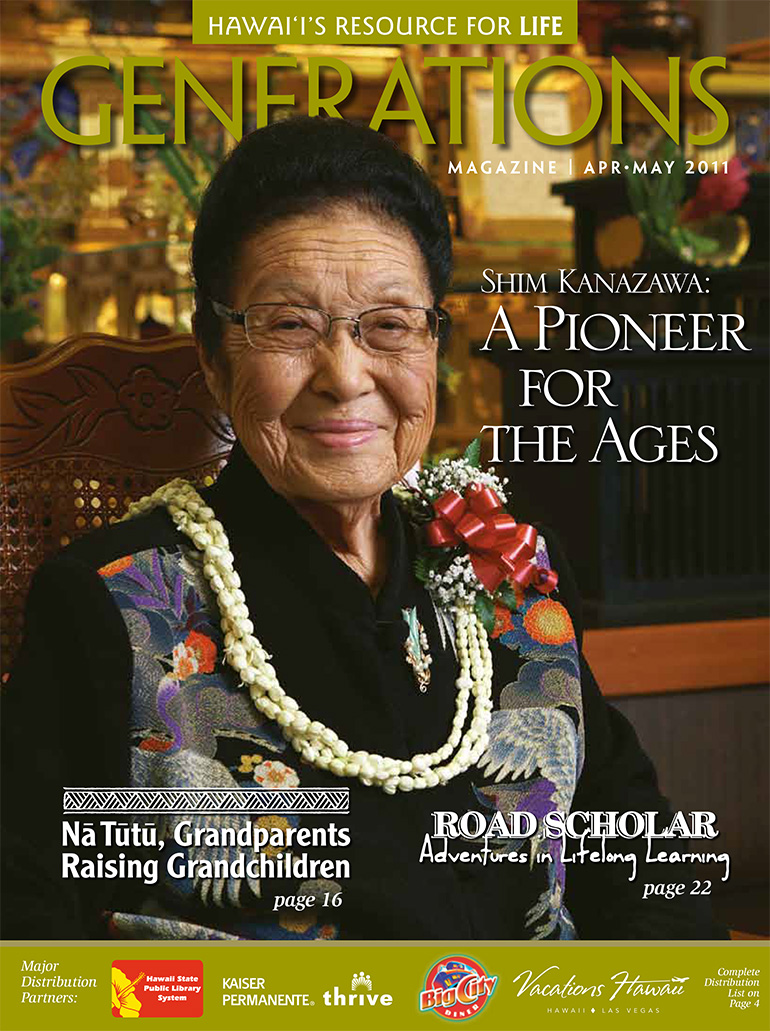
Shimeji Kanazawa, or “Shim” as most of us know her, is Hawai‘i’s original pioneer of aging issues. She has advocated for programs and services that help our senior population for five decades. In doing so, she Shim has worked with every governor, from Gov. Quinn to Gov. Abercrombie. Shim is an honorary member of the Governor’s Policy Advisory Board of Elderly Affairs and the only member since its inception in the ‘60s.\
GM: Where did you grow up? What schools?
SK: I was born in Kamuela Hawai‘i, and I was the eldest of 11 children. I attended Waimea School, Hilo Intermediate School and Hilo High School, class of 1934. In 1948, I attended Chamberlain School of Retailing in Boston Massachusetts. In 1990, I was awarded the Honorary Doctorate of Humane Letters degree from the University of Hawai‘i for my public service over six decades.
GM: What kind of influences were your mother and father?
SK: My parents immigrated from Shizuoka Prefecture (Japan) and taught us by example the value of diligent, hard work. Although there were 11 children, all of us felt loved as if we were the only child; and learned to value cultural traditions of respect, especially to elders within our family and the community at large.GM: You grew up on the Big Island and then became a vice principal at Kohala School. Tell us this story. Was this your first job?
SK: My first job after graduating high school was as the mimeograph operator for the Hilo teachers curriculum group, which was developing an instructor’s booklet. That same year I was hired at Kohala Elementary and High School in a secretarial position. On occasion, during James W. O’Neal’s absence, I was the acting vice principal for Kohala School. Mr. O’Neal authorized me to teach secretarial skills to students, which contributed toward their degree. From 1934 to August 1941, I resided at the Kohala School teacher’s cottage.
GM: Tell us the story about the Swedish ViceConsulate and your work with them.
SK: In February 1942, the Swedish Vice Consulate Department of Japanese Interest was established to protect matters concerning Japanese nationals residing in the territory. Mr. Gustaf W. Olson was the vice consul for Sweden and also the administrator for Queens Medical Center. I was the executive secretary and my responsibility, with the help of a few assistants, was to oversee Consulate operations. Our job was to assure that the POWs who were transported through Hawai‘i, and those held in internment camps such as Honouliuli, were treated in accordance with the civil, military and international laws.
GM: You are well known as the founder of Project Dana. How did this come about?
SK: In 1988, I attended a National Federation of Interfaith Volunteer Caregivers meeting in Florida, as a trustee and treasurer for Mō‘ili‘ili Hongwanji Mission. I was impressed with reports from 40 states describing their elder care programs. I enlisted the assistance of the executive director Virginia Schiaffino-Kasinki of The National Federation of Interfaith Volunteers Caregivers, Inc., now known as the Interfaith Caregivers Alliance, to establish a similar pilot program for Hawai‘i. Initially the program was focused on the Hongwanji community, however with the broad vision, diligent voluntary work and coordination of our administrator Ms. Rose Nakamura, Project Dana expanded to incorporate all denominations of churches and temples. Although I may have been given the title of “founder,” it was only through the guidance of Ms. Nakamura. She, along with her dedicated staff, developed Project Dana from a “good idea” to a valuable asset for our kūpuna. Project Dana is known for its Best Practice Program in care giving to the elderly and disabled persons so that they can continue to live in their choice of location for as long as possible. There are more than 850 interfaith volunteers servicing more than 1,000 kūpuna each year. Over the years, Ms. Nakamura has received numerous prestigious awards for her contributions, garnering national recognition for Project Dana. In 2011, Project Dana is celebrating its 22nd anniversary. For the project’s next phase, I’d like to propose a partnership between the youth and the elderly. Together, they could share their talents and resources, supporting each other in relationships that benefit both the individuals and the community.
GM: What people don’t know is that you have worked with every governor on aging issues—
from Gov. Quinn to Gov. Abercrombie. Tell us about your involvement.
SK: Gov. Quinn appointed me as chair of the Family Life and Law Committee. Along with judge Betty Vitousek who served as vice chair, we worked with the legislature to establish the Family Court System in Hawai‘i. With my 1972 appointment to the Commission on Aging established by Gov. John Burns, my focus shifted from the children and youth arena to issues challenging the elderly. I continued to serve on the Board of the Executive Office on Aging as commissioned by Gov. George Ariyoshi.
GM: The State of Hawai‘i’s Executive Office on Aging was pretty much your idea? Tell us more about those early years.
SK: With the wide impact of the state’s aging community, The City and County Parks and Recreation Department was the forerunner of the Commission on Aging. The city created an Elderly Affairs Office under the executive branch.
Through the newly formed Executive Office on Aging, we proposed and provided comprehensive health, education and social services to the older residents of the State of Hawai‘i.
GM: Every 10 years the White House Conference on Aging is held, and you have lead Hawai‘i’s
contingent for the last 50+ years. Can you tell us about these conferences?
SK: In 1961, 1971 and 1981, I led a delegation of approximately 12 community leaders to Washington, D.C. The conference convenes to discuss current issues facing the aging population. The goal was to have our concerns addressed in national legislation, which in turn would benefit the elderly throughout the nation. In 1981, I was fortunate to be selected under President Jimmy Carter’s administration to serve on the National White House Aging Committee
in Washington, D.C., which gave me an opportunity to share the plight and success of eldercare in Hawai‘i.
GM: Tell us about President Carter appointing you to advise him on aging issues.
SK: President Jimmy Carter’s administration selected approximately 15 people to serve on the Federal Council on the Aging in Washington, D.C. We met about twice a year during a two-year term, advising the president and the Senate Committee about current matters and trends of the older Americans.
GM: Tell us about your lifetime appointment as honorary board member of PABEA?
SK: Gov. Benjamin Cayetano appointed me to serve on the Policy Advisory Board of Elder Affairs, which I continue to honor today.
GM: How did you come to be the first woman President of the Board of Kuakini Medical Center?
SK: Through my involvement working with elderly affairs and legislative issues, I met Masaichi Tasaka, past CEO of Kuakini Medical Center, in 1976. He appointed me to the Board of Directors and eventually I served as the Board President in 1981. One of my proudest moments while serving on the board was enlisting the expertise of Mary Kawena Pukui to suggest an appropriate name for the newly constructed long-term care facility. “Hale Puˉlama Mau,” or House of Cherishing Care, was selected as the structures name and reminder of the facilities mission.
GM: Tell us about your involvement with Mō‘ili‘ili Community Center.
SK: My late husband, Kinji Kanazawa, was born and raised in Mō‘ili‘ili on Kaheka Lane. He was instrumental in retaining the property from government confiscation during the war years. Since 1986, I’ve been involved with MCC by serving on the Board of Directors, and participating in their various committees. For the past three years I have chaired the annual membership meeting committee. I appreciate the multi-generational and cultural component MCC provides to our community.
GM: What should people in retirement do with their lives?
SK: Keep up a healthy lifestyle, keep busy, pursue hobbies, do things for others, focus on volunteerism, and keep families together.
Shimeji Kanazawa, or “Shim” as most of us know her, is Hawai‘i’s original pioneer of aging issues. She has advocated for programs and services that help our senior population for five decades. In doing so, she Shim has worked with every governor, from Gov. Quinn to Gov. Abercrombie.
Our “can do!” island culture values resourcefulness and cooperation when faced with challenges. “We know a guy” and where to get things, and have honed skills tūtū taught us. We don’t expect anything in return for helping out. “If can, can; if no can, no can.” We put ourselves to the task.
PBS Hawai‘i (KHET or KMEB call letters in your guide) is our TV station. Our donations built it and it serves us. But don’t take it for granted. Paula Kerger, president of the Corporation of Public Broadcasting national nonprofit, recently applauded our “can do!” public television station: “This is truly, I would say, the most exceptional station in our country…
it understands what it means to be a part of the fabric of our community.”
“NOVA,” “Get Caught Reading,” “HIKI NŌ,” “PBS News Hour,” “Long Story Short with Leslie Wilcox”— we are fans! But how much do we know about our TV station?
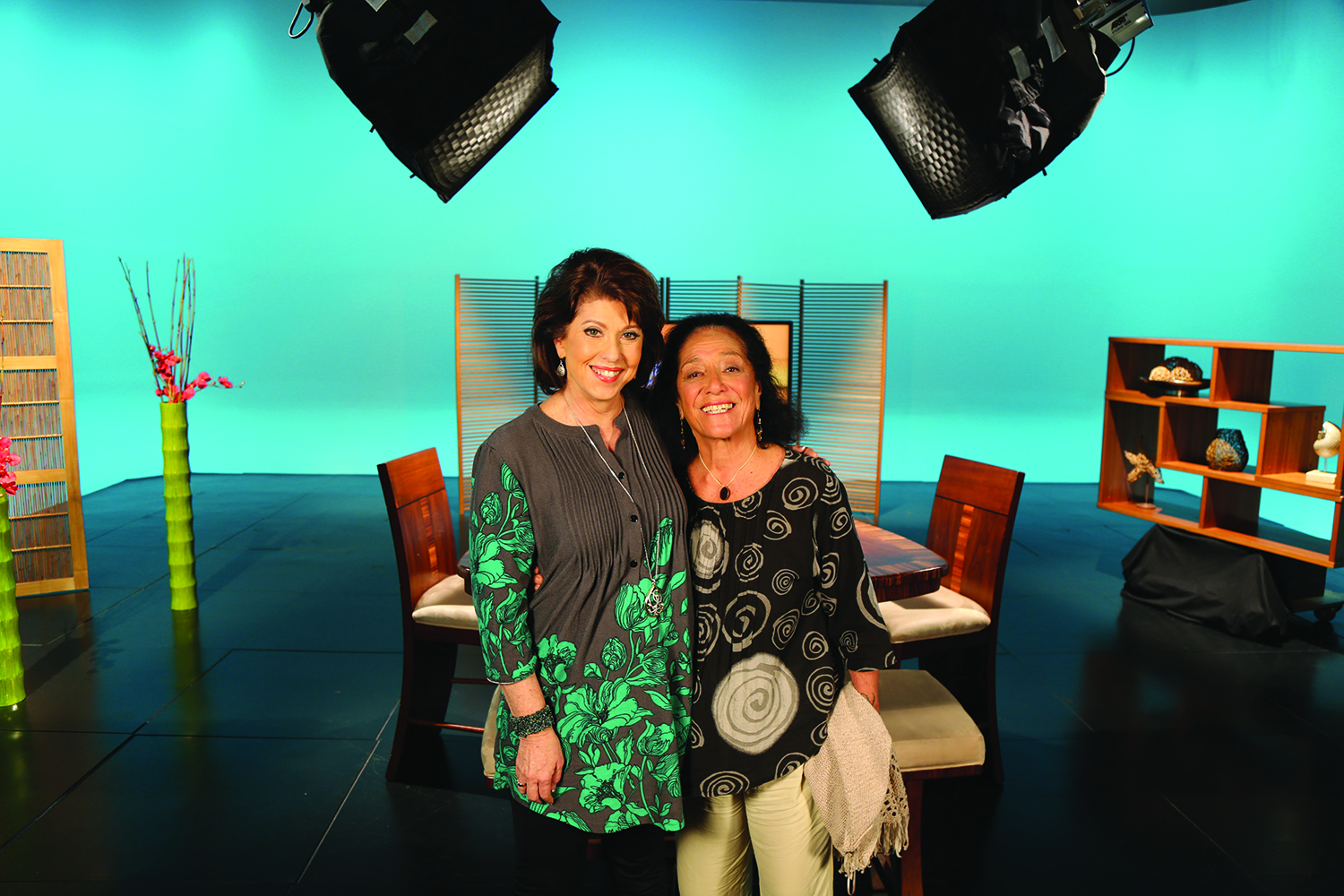
Snuggle up. We turned the tables and interviewed PBS Hawai‘i President and CEO Leslie Wilcox. Be prepared for some learning moments! And into the bargain, Leslie shares memories about growing up on O‘ahu — another reason PBS Hawai‘i expresses the heart and soul of our islands.
Generations Magazine readers watch PBS, but they may not understand how it got started.
LW: Well, Hawai‘i public television goes back to 1965, when a University of Hawai‘i professor set up closed-circuit instruction on campus. With the Public Broadcasting Act of 1967, the UH initiative became a member of the new Public Broadcasting Service [PBS]. In 1969, they introduced “Sesame Street.” It was controversial in some states, but Hawai‘i welcomed the educational program.
We were first located in a vacant lower Mānoa corner of UH near some Quonset huts. Back then, the TV station was part of the state government. Later, in 1972, the State Legislature funded a two-story building on the site. From the start, our public television station racked up a number of Hawai‘i firsts — including the first local station to provide live satellite broadcasts.
Can everyone can get PBS on an HDTV?
LW: Yes, plus via cable, satellite or online. We serve most of the Hawai‘i community free via our KHET and KMEB over-the-air broadcast signals — including financially disadvantaged communities where it’s not profitable for commercial TV stations to direct their signal. For example, we recently strengthened free service to the under-resourced, rural southern end of the Big Island. Many people do not have digital access and we care about them. That’s why we broadcast educational programming 24 hours a day on two channels — our main channel and PBS KIDS 24/7.
When state funding ended in 2000 and we became a private, nonprofit, community-supported organization, we began leasing the space we had long occupied at UH Mānoa. I joined in 2007. Years later, due to UH space needs, we lost our lease and had to move all of our operations.
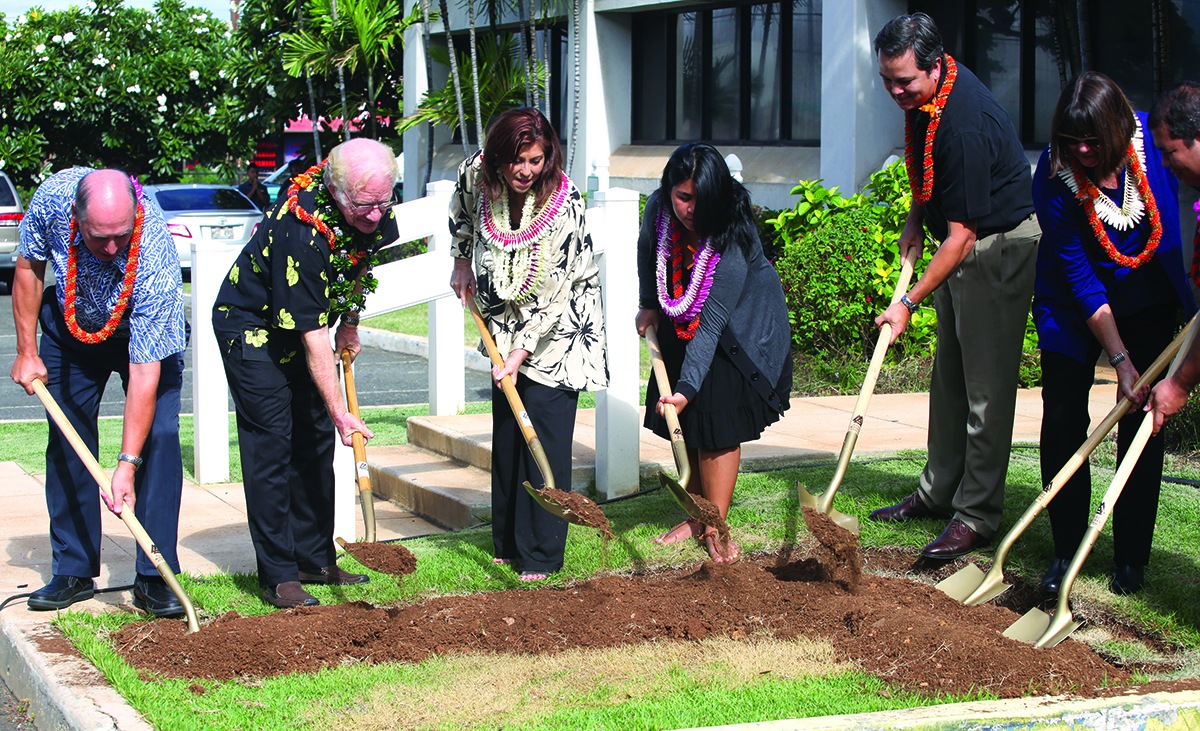
From the old to the new, groundbreaking in Nov. 2014: (LR) Neil Hannahs, former PBSH board chair; Robbie Alm, then-board chair of PBSH; Leslie Wilcox, president and CEO of PBSH; Victoria Cuba, student engineer at PBSH; Cameron Nekota, PBSH board member; Sheryl Seaman, architect, G70; and Justin Izumi, VP, Allied Builders System.
When did PBS Hawai‘i make the big move?
LW: We moved in 2016, but before that, we raised $30 million to build a big new facility across town. Relocation at first seemed like bad news and a tough blow, but like many changes, it worked out for the better. We had hopes, dreams, hard work and a “can do!” attitude. As always, “the village” of Hawai‘i nei offered support. And we had a strong staff committee headed by Karen Yamamoto managing the move.
In May 2016, we settled into our beautiful, future-facing multimedia building at the corner of Nimitz Highway and Sand Island Access Road in Kalihi Kai — the PBS Hawai‘i Clarence T.C. Ching Campus. It’s the best work environment I’ve ever had — open, cheerful, welcoming, functional to the max. Thanks to our terrific unpaid board of directors and funding by Hawai‘i individuals, businesses and charitable foundations, the facility and land are debt-free .
We’re delighted to be owners, not renters of the only locally-owned, statewide broadcasting company. All others are commercial businesses owned by large companies based elsewhere.
PBS consistently provides content and services to inform, educate and enlighten our fellow islanders. We gather feedback from stakeholders, viewers and our statewide independent community advisory board.
We want to inspire lifelong learning from childhood through active retirement and elder years. The PBS Hawai‘i mission, with its pillars of education and journalism, is a great fit with my personal philosophy. Education certainly lifted my prospects in life. And journalism increases a flow of new information. For more than three decades in journalism, I felt like I was being paid to learn.
At PBS Hawai‘i, our traditional values of integrity and fairness endure, but our methods and approaches have changed repeatedly over time with waves of new technology and with shifts in societal perspectives. Sometimes, even media professionals have difficulty dealing with change. As former Sony CEO Howard Stringer said, “We all have to remember not to hang on to the status quo long after the status has lost its quo.”
Also, PBS values adaptability and versatility. Our lean, dedicated staff has the energy, creativity and know-how to produce a significant amount of local content — weekly TV programs and frequent online offerings. We are “can do!” people.
Is it true that you are not funded by the state?
LW: Yes. We’re Hawai‘i’s sole member of the trusted private nonprofit Public Broadcasting Service. A related national entity is the private nonprofit Corporation for Public Broadcasting. It distributes federal funding to some 350 public TV and radio stations. These funds only make up 15 percent of our annual budget. We leverage PBS federal grant monies into many more private dollars, thanks to generous individual, business and foundation donors. For a number of reasons, it’s good to have different kinds of revenue streams. For example, if a funder seeks to control our editorial content, we need to stand strong — and we can, with other sources of funding.
We remember you reporting news on the air at KGMB-TV and KHON2. Did journalism bring you to Hawai‘i?
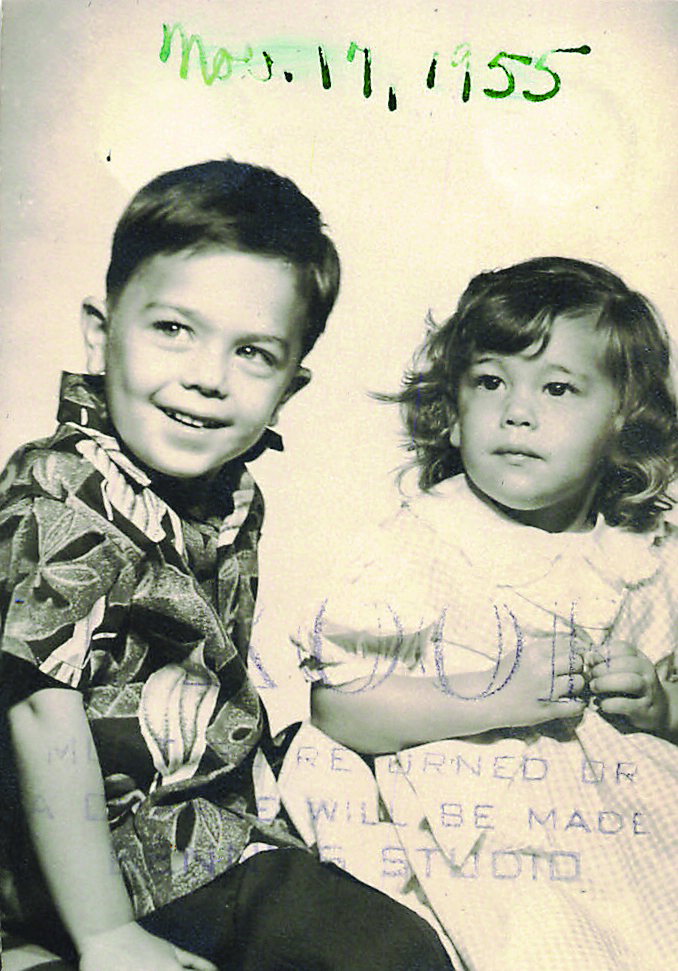
LW: Actually, I was born and raised on O‘ahu. My Portuguese forebears, Joao and Faustina Fraga Silveira, sailed here while Hawai‘i was still a monarchy. They had actually met on the ship, settled in Kalihi and had 16 children, 13 of whom survived childhood. One of the grandchildren was my mother, Blanche. During World War II, she met Paul Wilcox, a soldier stationed here. He fell in love with my mother and Hawai‘i. Dad had a great broadcast voice and became one of Hawai‘i’s early radio disc jockeys with a late-night show called the “Midnight Owl.” He later worked in radio sales. I’m in the middle of five siblings. I attended Holy Nativity School, Āina Haina Elementary, Niu Valley Intermediate and Kalani High before going to college.
Small-kid times were spent in what were once jokingly called “the boonies,” meaning Kuli‘ou‘ou Valley, with Quonset huts here and there, a farm market, and backyards where families grew veggies and flowers. Kuli‘ou‘ou was the last residential valley in East Honolulu. As a kid, I remember pink bulldozers tracking down Kalanianaole Highway to build Henry Kaiser’s huge new Hawaii Kai marina community around the ancient Hawaiian fishpond, Kuapā. Pink was Mrs. Kaiser’s favorite color. I can still remember the sparsely settled lands, dotted here and there with small farms.
My older brother Pat and I would walk across the highway, wade out to a little islet and pretend to be island castaways.
When fishermen abandoned fresh aku heads there, we’d stage aku-head swordfights. And we played with sea cucumbers, which squirted seawater. Dumb kids. I wouldn’t do this today.
In high surf, waves rolled across the road into the fishpond. The backwash left mullet stranded on the land. We kids were there to pick them up and proudly take a “fresh catch” home for dinner!
Freedom and make-believe are treasures of a post-war Hawai‘i childhood.
LW: The world was certainly a safer place; baby boom children kept themselves occupied and were allowed to roam. On Saturdays, our mothers might say, “Just make sure you come home before dark. And don’t bother anyone or get into trouble.” No cellphones or bottles of water required.
When I was still in grade school, my family moved into the new Niu Valley subdivision, then considered a middle-class community. I was older and now our keiki explorations involved crawling around in mountain lava tubes, reef diving to look for eel holes and lots of skateboarding down steep streets. I have the scars to prove it.
I learned to surf with my friend David’s old homemade board and reveled in the freedom. We also surfed Kawaikui Beach. When we got thirsty, we dove down and drank fresh water flowing through pockets in the sand. Highway work
stopped the flow of artesian water. Niu pier is long gone, too. Great memories.
What was your first job after high school?
LW: Waitressing at the old Snack Shop on the grounds of the Royal Hawaiian Hotel. My pink uniform had a big bow in the back ironed with starch from Chinatown; it was hard as a board.
I won a journalism scholarship to USC, but just before high school graduation, my parents divorced and bankruptcy followed. I stayed home to help support the family. Fortunately, I was able to pay for and attend UH Mānoa after the Honolulu Star-Bulletin, then the largest newspaper in Hawai‘i, gave me an errand-person job. Amazingly, it turned into a full-time reporting position when I was barely 19. I’m forever grateful to my former Star-Bull colleagues, who at times teased but also generously helped an awkward rookie.
Were there other mentors along the way?
LW: I’ve had too many guides and mentors to mention, and they remain in my heart. Some offered guidance, others taught by example in a critical moment. I learned from “the village” that I came to know as a journalist — at many locations across the state and under stressful, sorrowful or even dangerous circumstances.
Also I learned from reading. Books open up history, context, new ideas, other worlds, flights of fancy and knowledge of how things work. I didn’t travel outside Hawai‘i until I was 16 (for a journalism competition), but through reading, I had already crossed continents, gone back in time and seen the future. Reading continues to inform my writing and expand my understanding.
Also, my extended family members are observant and curious. “I wonder why…” was a common beginning to a sentence. It wasn’t a gossipy or nosy interest. The question connects things to history, science or community. This curiosity cultivated my sense of wonder, too. When I was 15, I researched the purchase of a big parcel of land in our neighborhood — I wondered who bought it and how it might affect life in the area. Come to think of it, that was pretty niele [nosy]!
Sounds like you were cut out to be a reporter. How was the transition to television?
LW: The first thing I learned in TV is that perception is reality. My newspaper background taught me how to gather and write news. But I was pitiful presenting news on camera. If you report with a quivering voice, your viewers are going to think something is shaky about your report, too!
KGMB-TV news director and icon Bob Sevey had recruited me, knowing I had no television experience. I told him that my own mother thought I looked and sounded goofy and unsure, and asked him for his professional advice. His candid,
old-school response: “Wilcox, you’ll get there. You’d better — this is a sink-or-swim business.”
I didn’t grow up watching women role models on television news. Men dominated the business. Fortunately, three talented women were successfully navigating the newsroom — Linda Coble, Bambi Weil (who later became Judge Eden Hifo) and Carolyn Tanaka. Finally, I got it together by deciding simply to be myself. I pictured my dear no-nonsense auntie and my favorite math teacher, Mr. Charles Hirashiki, watching at home — and I delivered the news to them. It worked.
After mastering broadcasting, what spurred you to take the helm of PBS in 2007?
LW: The magnetic pull of PBS Hawai‘i was and is still this: it is locally owned and locally managed to serve fellow islanders. We enrich others by telling authentic Pacific stories and opening windows to the world. I wanted to be a part of this mission.
One misconception about public media is that the “public” stands for government. It actually stands for you and me, and our whole community. After 13 years, still I am amazed and inspired by people who send us money to keep doing what we’re doing.
I like working for a local organization with strong national and international alliances through public broadcasting. Yet, our volunteer board members and professional staff live in the islands. We are approachable and accountable.
Some of our sponsors choose to share with others something they deeply value. Your readers may not know that Maui grandparents Jim and Susan Bendon of Sprecklesville sponsor the lessons of Daniel Tiger [“Daniel Tiger’s Neighborhood”] for all of Hawai‘i’s children. Retired UH professor Belinda Aquino still provides education for all of us by underwriting broadcasts of “Nature” and “NOVA.” Rick Nakashima of Ruby Tuesday restaurants supports the “Get Caught Reading” literacy initiative. I can’t imagine a better job.
What were the most important changes you brought to PBS when you started?
LW: I came with a deep respect for what this station had already achieved, but media technology and capabilities were changing rapidly, so I encouraged a corporate culture that welcomed new skill sets. Then you need to react and respond quickly in these fast-changing times, so I adopted a “flat” organizational structure that allows information from different sources to move quickly through the organization.
That brings us to “Long Story Short with Leslie Wilcox.” How do you get your guests to reveal so much new information?
PBS creative media executive Robert Pennybacker developed “HIKI NŌ,” and “Hawai‘i’s New Wave Storytellers.” He began reaching out to teachers in public, private and charter schools, and mentoring them in journalism and video production. The teachers ably train their students to write and produce their own stories. The skills will be used again in school, life and work — from oral and written communication, media technology and critical thinking to teamwork, collaboration and perseverance. “HIKI NŌ,” video magazine presents student perspectives, conveyed through responsible and creative storytelling. “HIKI NŌ ,” airs at 7:30 pm Thursdays. During the COVID-19 school closures. students pivoted and continued reporting from home with stories about life in the shadow of the pandemic. Every story is conceived, written, reported, taped, edited and produced by students.
LW: When people know that you earnestly want to know them and their views, it’s usually easier for them to relax and express themselves. In my gut is always the “I wonder why or how” question, but active listening is what I mainly do I’m not thinking of my next question while the guest is answering the current question.
How about the wonderful forums and discussions? That’s more than listening.
LW: We’re here to ask the questions that people at home want answered. PBS Hawai‘i takes a “can do!” approach to convening diverse voices and maintaining a respectful discussion. We offer a safe, trusted space where community members with opposing opinions may be heard. “Insights on PBS Hawai‘i,” “KĀKOU: Hawai‘i’s Town Hall” and “What’s It Going to Take?” are discussion forums. Our moderators, Daryl Huff, Yunji DeNies and Lara Yamada, are comfortable being around people with conflicting opinions, and they know that if conversations can be kept civil and even respectful, there’s a better chance of people really hearing each other and finding common ground.
Shouting over others, name-calling and public shaming run counter to island values. At PBS Hawai‘i, we want to keep things real and at the same time respectful, non-partisan and fair.
* * *
Leslie, we thank you, your dedicated board of directors and the entire PBS Hawai‘i family for sharing this inside look — and we are so very grateful for all they do. I learned a lot more about PBS Hawai‘i — and all the work that goes into creating and delivering us wonderful, high-quality programs. Going forward, I encourage our readers to join me and support PBS Hawai‘i however we can. After all, it’s our TV station! “Can do!”
To learn more about PBS Hawai‘i, visit www.PBSHawaii.org and www.wikipedia.org. We don’t have to wait to donate — online we can give a one-time gift or subscribe to make monthly donations all year long.
Photography by Brian Suda
Our “can do!” island culture values resourcefulness and cooperation when faced with challenges. “We know a guy” and where to get things, and have honed skills tūtū taught us. We don’t expect anything in return for helping out. “If can, can; if no can, no can.” We put ourselves to the task. PBS Hawai‘i (KHET…
It may be hard to believe, but during natural disasters such as hurricanes and earthquakes — and even the current COVID-19 pandemic — unscrupulous scammers set up fraudulent fundraising operations to take advantage of Good Samaritans who want to help.
Charity fraud is committed when a perpetrator creates a bogus fundraising operation, aiming to take advantage of our sympathies, goodwill and generosity. Charity fraud may also occur when a legitimate charity represents that funds will be used for one particular purpose, but the money is used for other purposes. There are many worthy causes, so don’t let the possibility of fraud dissuade you from donating. Here are tips to help ensure your donations are put to good use.
• Ask how your donation will be used. Make the caller be specific. If the answer is vague, be wary.
• Check registration. Every charity that solicits contribution in Hawai‘i must register with the Tax and Charities Division of the Department of the Attorney General. Search the AG registered charities database at www.ag.hawaii.gov/tax.
• Check the IRS website EO Select Check at www.irs.gov/charities-&-non-profits/exempt-organizations-select-check. Type in the charity name to see if its federal tax standing is valid.
• You may also check other charity watchdogs, such as Charity Watch (www.charitywatch.org), Better the Business Bureau’s Wise Giving Alliance (www.give.org), Charity Navigator (www.charitynavigator.org) or GuideStar www.guidestar.org).An internet search is also advised.
• Make sure you understand which organization is requesting your money. Some scammers use names that sound similar to legitimate charities.
• Ask what percentage of your donation goes toward admini {Play}strative costs versus the program itself. The acceptable percentage is up to you. To check the charity’s financial reports, go to www.ag.hawaii.gov/tax.
• Do not pay over the phone and scrutinize written material sent to you.
• Pay by check or credit card; never cash.
• Note that scammers can change their caller ID to make it appear as a local number.
• Call the organization to verify the caller’s name and request. Despite these safeguards, if you feel that you have been the victim of a scam:
• Call 9-1-1.
• Call the Department of the Attorney General, Tax and Charities Division, at 808-586-1480 or email ATGCharities@hawaii.gov.
• Call the Federal Bureau of Investigation at 808-566-4300.
• File a report on the Federal Trade Commission website: www.ftc.gov/complaint.
Follow these tips to help ensure your money is going to a worthwhile program.
It may be hard to believe, but during natural disasters such as hurricanes and earthquakes — and even the current COVID-19 pandemic — unscrupulous scammers set up fraudulent fundraising operations to take advantage of Good Samaritans who want to help.
It’s not uncommon to see advertisements promoting timeshares, as well as promotions for timeshare cancellation programs. The contradictory nature of these ads begs certain questions:
What is a timeshare?
Timeshares grant percentage ownership of a vacation unit for periods of time during the year. The ownership is shared with other clients who use the unit. Another way to stake an interest in a timeshare property is through the “lease” option, where the developer holds the title to the deed and the owner holds a leased interest in the property.
How does it work?
The way that a timeshare is sold in promotional campaigns makes it seem like a great investment. They have nice kiosks at Ala Moana Center and various exhibition halls. There are promises of cheaper vacations along with graphs seemingly showing a cost analysis of how it pays for itself and will only appreciate in value. Realize, however, that all the caveats, fees and associated, ongoing, allowable fee increase percentages will be in the middle of the dense, ironclad contract. By not mentioning these added costs with the same enthusiasm as they do the great views, the message to any prospective consumer is that this investment is doable and affordable.
Why is there a market for timeshare cancellation programs?
It is important to remember that there is no federal body of law or agency regulating the timeshare industry. The rule of law with regard to timeshares varies upon the location where a particular timeshare is purchased. Therefore, it cannot be stressed enough that those interested in purchasing a timeshare need to study and completely understand the sales contract before it is signed. The contract should state the withdrawal period of the purchase.
In Hawai’i, this period is seven days. Getting out of a timeshare after the rescission period has passed can be extremely difficult and payment will still be required. However, if it is suggested that you stop making payments for the timeshare, it is important to know this will limit potential timeshare exit options.
In the next issue, we will explore options for exiting your timeshare.
If you suspect elder abuse, call these numbers:
– Police: 911
– Adult Protective Services: 808-832-5115
– Elder Abuse Unit: 808-768-7536 If you have questions about elder abuse, call or email:
808-768-7536 | ElderAbuse@honolulu.gov
It’s not uncommon to see advertisements promoting timeshares, as well as promotions for timeshare cancellation programs. The contradictory nature of these ads begs certain questions:..