Category: Articles

  • Tax-Aide for Seniors

    Tax season is officially under way, and Hawai‘i residents can count on AARP Tax-Aide volunteers to help reduce tax stress. Beginning Feb. 1, AARP-trained and IRS-certified volunteers will be available at 45 locations throughout the state to help taxpayers prepare basic federal and state forms.

    AARP Tax-Aide is the nation’s largest, free, volunteer-run tax preparation and assistance service for low- and moderate-income taxpayers, with special attention to people age 60 and older. The program helps the most vulnerable people build and protect their assets through free income tax preparation. Since 1980 the program has operated under a cooperative agreement with the U.S. Internal Revenue Service. Last year in Hawai‘i more than 200 AARP Tax-Aide volunteers helped more than 10,000 taxpayers across the state. They join more than 35,000 volunteers across the country, helping millions of taxpayers each year.

    AARP Tax-Aide volunteers can also provide counseling services to people who are unable to leave their homes. In Hawai‘i last year, volunteers visited home-bound residents, including individuals in nursing homes. One-on-one, on-site tax counseling is available now through April 15. Foreign language assistance is also available at select locations.

    AARP Tax-Aide is a service of the AARP Foundation, AARP’s affiliated charity. Foundation programs provide security, protection and empowerment for older persons in need. ■


    For locations and times, please call 843-1906 or visit the Information Center on O‘ahu at 1199 Dillingham Blvd, #A106, Honolulu, HI. To find the site closest to your home, call toll-free 1-888-AARPNOW (1-888- 227-7669) or visit www.aarp.org/taxaide.

    Tax season is officially under way, and Hawai‘i residents can count on AARP Tax-Aide volunteers to help reduce tax stress. Beginning Feb. 1, AARP-trained and IRS-certified volunteers will be available at 45 locations throughout the state to help taxpayers prepare basic federal and state forms.

  • Body-Proofing II – Motion is Lotion

    Last month, we emphasized the importance of exercise to combat the natural aging process. Specifically, exercises like Pilates, Tai Chi and Yoga provide coordinated full body workouts with an emphasis on core muscle strengthening, balance and fluidness of movements. But what if you have pain in your knees or back making even simple movements like walking difficult? Thank your lucky stars because here in Hawai‘i, you are surrounded by the perfect modality—water.

    Physical therapists have been utilizing the unique properties of water to rehabilitate patients for decades. We call it Aquatic Therapy. By submerging the body partially in water, it creates weightlessness and takes the pressure off our knees, hips and spine. This is especially useful for patients with arthritis, healing fractured bones, or who are overweight. By decreasing the amount of joint stress it is easier and less painful to perform exercises.

    Once submerged, the viscosity of water provides resistance so you can build strength without using additional weights. Slow controlled movements like leg lifts and arm circles under water can be very effective for strengthening your legs, arms and back. Even simply walking in chest-height water can improve leg and back strength, balance and cardiovascular fitness.

    Another important feature of aquatic therapy is hydrostatic pressure, which is the evenly distributed pressure that is exerted on the body when it is submerged under water. This pressure provides joint positional awareness. As a result, your proprioception, the sense of where your body is in space, is improved. This is important as proprioception naturally declines with age, beginning at around 40, and is critical factor for balance reactions. Hydrostatic pressure also allows for pain free movements by decreasing swelling caused by injury or arthritic disorders.

    For rehabilitation purposes, Aquatic Therapy is often done in a heated pool, which helps to increase circulation and allow muscles to relax and stretch safely. However, if your goal is fitness and not rehabilitation from injury, any pool will do.

    Many facilities have “water aerobics” for a more structured program. Hawai‘i’s beaches are superb for aquatic fitness too. The calm waters at Magic Island are ideal. Simply walking in waist to chest-high water is an excellent workout and the gentle currents will help improve balance. As always, use good safety precautions at the beach.

    Physical therapists like to say, “Motion is lotion,” the more we move, the easier it will be to keep moving!


    Teresa Wong is a physical therapist, certified Pilates instructor and manager of the Rehab Hospital Of the Pacific Nu‘uanu Clinic. The clinic provides state-of-the-art rehabilitation programs for individuals recovering from injuries and illnesses. Visit online at www.rehabatnuuanu.org; email, twong@rehabhospital.org.

    Last month, we emphasized the importance of exercise to combat the natural aging process. Specifically, exercises like Pilates, Tai Chi and Yoga provide coordinated full body workouts with an emphasis on core muscle strengthening, balance and fluidness of movements. But what if you have pain in your knees or back making even simple movements like…

  • Your Mind and Body: The Breakdown on Bone Loss

    What is Osteoporosis?

    Osteoporosis (porous bones) is a bone disease that involves thinning of the bone tissue and loss of bone density over time. This weakens the bones and increases a person’s risk for fracture. Women are four times more likely to have osteoporosis as compared to men.

    In 2005, osteoporosis was responsible for two million fractures and $19 billion in costs. Breaking a bone is a serious matter for seniors as it can lead to disability. Active seniors who wish to maintain their independence for as long as possible need to get screened for osteoporosis. If you are diagnosed with osteoporosis, your doctor can prescribe medication and supplements.

    What are the risk factors for osteoporosis?

    Some factors increase your chances of developing osteoporosis. Some you can change, others you can’t.

    Things You Can Change

    • Increase the amount of calcium in your diet
    • Stop smoking
    • Treat eating disorders such as anorexia or bulimia
    • Exercise and lead an active lifestyle
    • Stop drinking alcohol. More than two alcoholic drinks a day prevents your body from absorbing calcium Things You Can’t Change
    • Being a woman
    • Getting older
    • Race: You’re at greatest risk if you’re of Caucasian or Asian descent
    • Family history
    • Being very thin or having a small frame size
    • Certain medical conditions, procedures and drugs

    What foods are rich in calcium and vitamin D?

    Food rich in vitamin D include dairy food such as milk, yogurt and cheese; vegetables such as broccoli, kale and collard greens; proteins such as beans, tofu and salmon; fruits such as orange, figs and rhubarb. Fish and fish liver oils are the best sources of vitamin D.

    See your doctor for a more complete, and perhaps more appetizing, list of calcium-rich foods. And, of course, sunlight is a major source of vitamin D, however, most of us in Hawai‘i get enough rays.


    Dr. Ritabelle Fernandes, MD, MPH, FACP is Clinical Associate Professor at the Geriatric Medicine Department of the John A Burns School of Medicine, University of Hawai‘i. She is board certified in Geriatric medicine, Hospice and Palliative Medicine, Internal Medicine and Home Care. She is a practicing physician at the Kokua Kalihi Valley and Kalihi-Palama Health Center

    Osteoporosis (porous bones) is a bone disease that involves thinning of the bone tissue and loss of bone density over time. This weakens the bones and increases a person’s risk for fracture. Women are four times more likely to have osteoporosis as compared to men.

  • The Art of Pressure

    Have you ever instinctively held your forehead or temples when you’ve had a headache? Everyone at one time or another has used their hands to hold tense or painful places on the body. This is the healing touch of acupressure.

    Acupressure is an ancient Chinese healing art that uses the fingers to press key pressure point to release muscular tension and promote blood circulation and the body’s natural healing abilities. Acupuncture and acupressure use the same points, but acupuncture employs needles, while acupressure uses the gentle but firm pressure of hands (and even feet).

    Foremost among the advantages of acupressure’s healing touch is that it is safe to do on yourself and others. There are no drugs involved. And the only pieces of equipment needed are your own two hands. You can practice acupressure therapy any time, anywhere.

    My acupressure clinical experiences over the past 18 years have shown me that acupressure can be effective in helping relieve headaches, eyestrain, sinus problems, neck pain, backaches, arthritis, muscle aches and stress tension. Acupressure can also be used to relieve ulcer pain, menstrual cramps, lower back aches, constipation and indigestion.

    Alice, one of my older clients, had limited mobility in her neck with severe arthritic neck pain that radiated down her shoulders into her arms as well as up into her head. After her first acupressure session, she not only felt less discomfort but also had greater flexibility in her neck. For the first time in years, she was able to move her head freely without pain.

    After several weeks, Alice realized that she could help herself by using the points underneath the base of her skull to relieve both her neck pain and stiffness. Recently she told me that whenever the pain “creeps up on her,” she practices self-acupressure.

    There are many great advantages to using acupressure as a way to balance the body and maintain good health. By relieving stress, acupressure strengthens resistance to disease and promotes wellness … using the power and sensitivity of the human hand.

    For more information, self-healing books, CDs and DVDS, visit www.Acupressure.com


    Michael Reed Gach, Ph.D., author and Acupressure Institute founder, is a foremost expert on Acupressure Therapy and self-care techniques. His seven books and instructional DVDs have sold more than a half million copies, bringing healing to thousands. Dr. Gach directs the Acupressure.com website of articles, self-healing books, CDs and DVDs available online. Gach received his PhD. from Columbia Pacific University in Health & Human Services. He authored Acupressure’s Potent Points and Acupressure for Emotional Healing.

    Have you ever instinctively held your forehead or temples when you’ve had a headache? Everyone at one time or another has used their hands to hold tense or painful places on the body. This is the healing touch of acupressure. Acupressure is an ancient Chinese healing art that uses the fingers to press key pressure…

  • Retirement FAQs

    Q: How do I show proof of my Social Security benefit amount?

    A: There are several ways to do this:

    • Use your SSA-1099 form as proof of your income
    • Use your annual notice that tells you your benefit amount for the year
    • Go online and request a Proof of Income Letter at www.socialsecurity.gov/bene
    • Call Social Security’s toll-free number: 1-800-772-1213 (TTY 1-800-325-0778) 7 a.m.–7 p.m., Monday–Friday

    Q: I understand that by 2013 I will no longer be able to receive my Social Security payments by paper check. What are the benefits of using direct deposit?

    A: The benefits of using direct deposit are:

    • It’s safe, secure and convenient;
    • There are no checks to be lost;
    • You are in control of your money; and
    • You will get your benefits on time, even if you’re out of town, sick, or unable to get to the bank.

    You choose the account where your Social Security payment is deposited. If you don’t have a bank account, you can use the Direct Express (www.godirect.gov) prepaid debit card to receive Social Security, Supplemental Security Income (SSI), and other Federal benefit payments. With this card, you can make purchases, pay bills and withdraw cash.

    Q: How does a blind or visually impaired person choose how Social Security communicates with them about important information?

    A: Blind or visually impaired beneficiaries can receive information from Social Security in different ways. To learn about notification options:

    • Visit www.socialsecurity.gov/notices and go to the page, “If You Are Blind Or Visually Impaired—Your Choices For Receiving Information from Social Security”
    • Call toll-free at 1-877-708-1776 (TTY 1-800-325-0778)
    • Contact your local Social Security office
    • Contact the U.S. Embassy or Consulate if you live outside the United States

    Q: What is a disability trial work period?

    A: The “trial work period” allows Social Security disability beneficiaries to test their ability to work for at least nine trial work months within a 60-month period. During the trial work period, you can receive full benefits no matter how much you earn, as long as you remain disabled and you report your work activity. For more information about work incentives see our publication Working While Disabled—How We Can Help at www.socialsecurity.gov/pubs/10095.html.

    Q: What are the “Parts” of Medicare?

    A: There are four (A-D) Medicare parts:

    • Hospital insurance (Part A) helps pay hospital bills and some follow-up care. The taxes you or your spouse paid while working finances this coverage, so it’s premium free. For those who are not “insured,” coverage may be purchased.
    • Medical insurance (Part B) helps pay doctors’ bills and other services. There is a monthly premium you must pay for Medicare Part B or you may refuse this coverage.
    • Medicare Advantage (Part C) plans, which generally covers the same benefits as a Medigap policy, such as extra days in the hospital after you have used the number of days Medicare covers. People with Medicare Parts A and B can choose to receive all of their health care services through one of these provider organizations under Part C. There might be additional premiums required for some plans.
    • Prescription drug coverage (Part D) helps pay for prescription drugs. Anyone who has a Medicare Part A, Part B, or Part C is eligible for prescription drug coverage (Part D). Joining a Medicare Part D plan is voluntary and you pay an additional monthly premium for the coverage. To learn more about Medicare benefits, read our publication, Medicare, at www.socialsecurity.gov/pubs/10043.html.

    Q: I can’t get health insurance because of my pre-existing condition. Is there anything I can do?

    A: You may be eligible for the new Pre-Existing Condition Insurance Plan—a program for people who have a pre-existing condition and have been without health insurance coverage for at least six months. For more information, call toll-free: 1-866-717-5826 (TTY 1-866-561-1604), 8 a.m.–11 p.m. (Eastern Time). Or visit www.pcip.gov and select “Find Your State” to learn about eligibility and how to apply.

    Q: How do I show proof of my Social Security benefit amount? A: There are several ways to do this:

  • March into Medicare

    Hawai‘i’s Sage PLUS (SHIP) counselors are often asked, “What is Medicare, and how does it affect me?”

    Medicare is the United State’s federal health insurance that is available to those 65 years and older, and to people at any age with certain disabilities.

    You can choose to use the government’s Original/Traditional Medicare, or a commercial Medicare Health Plan or a Medicare Supplement (also known as “Medigap” insurance).

    Sage PLUS is a Medicare Counseling Program, nationally known as the State Health Insurance Assistance Program (SHIP) and it is a volunteer-based program. Many of the volunteers started with the program to learn more about Medicare for their families and have been with us for more than 10 years. If you have specific questions about your circumstances, or you would like to volunteer, please call 1-888-875-9229 or visit www.hawaiiship.org.

    Have you recently enrolled in Medicare and aren’t sure what to do next? Here are a few tips to give you a jump start on a healthy future:

    Step 1: Sign up for the “Welcome to Medicare” physical exam.

    Call your doctor and schedule your “Welcome to Medicare” physical exam today. It’s an easy way for you and your doctor to get an accurate benchmark of your health.

    During the exam, you and your physician will review your medical and family history, assess current health conditions and prescriptions, and conduct health screenings to establish a baseline for care.

    You will also have an opportunity to talk about short- and long-term goals to improve your health and overall well-being. For example, your physician will provide you with a plan of action that may include referrals for other services, including preventive services such as cancer screenings, flu shots, routine vaccines and diabetes tests. Many of these services are free to most Medicare beneficiaries as a result of the Affordable Care Act.

    At the end of your appointment, be sure to schedule an annual “Wellness Exam” for the following year. Thanks to the Affordable Care Act, Medicare now covers a yearly check-up. The “Welcome to Medicare” and annual “Wellness Exam” are great ways to assess changes in your health and catch any health issues early.

    Step 2: Register at MyMedicare.gov

    Register at www.MyMedicare.gov for easy access to your health information. This free, secure online service provides access to personalized information regarding your Medicare benefits and services. If you don’t have a computer, ask someone you trust, like a family member or the administrator at your local senior center, to help you sign-up and regularly review your information.

    Step 3: Take advantage of all your Medicare resources.

    Medicare offers a number of resources to help you get the most out of your benefits. If you are a new enrollee, check out the New to Medicare? section of www.medicare.gov.


    Review your Medicare & You 2011 handbook; or call 1-800-MEDICARE (1-800-633-4227). TTY users should call 1-877-486-2048. If you need help in a language other than English or Spanish, say “Agent” at any time to talk to a customer service representative. More information is available at www.healthcare.gov, a new web portal from the U.S. Department of Health and Human Services. ■ This information prepared by the U.S. Department of Health and Human Services.

    Hawai‘i’s Sage PLUS (SHIP) counselors are often asked, “What is Medicare, and how does it affect me?” Medicare is the United State’s federal health insurance that is available to those 65 years and older, and to people at any age with certain disabilities. You can choose to use the government’s Original/Traditional Medicare, or a commercial…

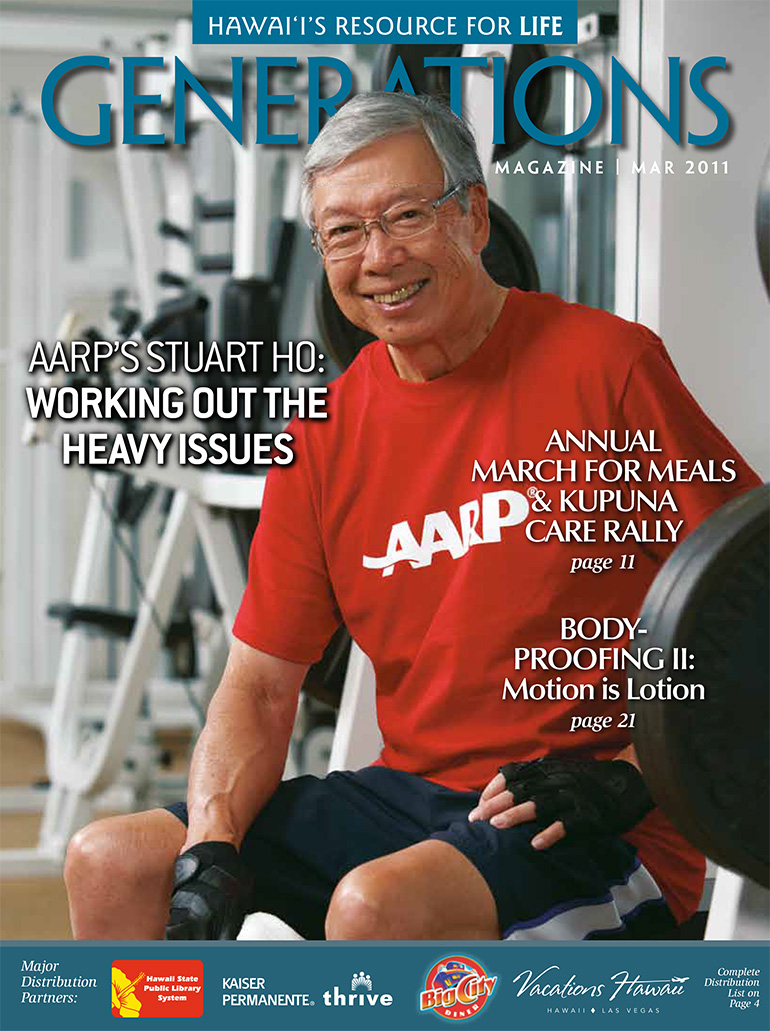
  • Heavyweight Volunteer: Stuart Ho

    Heavyweight Volunteer: Stuart Ho

    The men in Stuart Ho’s family have been heavy weights in business for three generations. His father, legendary developer Chinn Ho, turned the ‘Ilikai into the state’s first high-rise luxury resort in the 1960s. Stuart served on the boards of such notable companies as Aloha Airlines, Gannett Co., and Pacific Resources in a long and successful career as state legislator, attorney and executive. Today, son Peter Ho is continuing the family tradition of business stewardship as president and CEO of Bank of Hawai‘i.

    At 75, Stuart is busier than ever in retirement. “There was a time when retirement meant the beginning of declining health and slower pace. Nowadays, when your reach the age of 50 you’re just beginning the second half of your life and hitting your stride,” he grins. “The 50s, 60s and 70s are a chance to reinvent yourself, whether you want to keep working, change careers, spend time with family or search for a new adventure. But good health and financial security are the keys.”

    Stuart practices what he preaches. He hits the gym six times a week, plays golf regularly and remains one of Hawai‘i’s most influential community leaders. And he’s dedicated to making Hawai‘i a better place by taking up important social causes such as making health care and long-term care reform more affordable and accessible. As volunteer State President of AARP Hawai‘i, the non-profit member organization for people age 50-plus, he’s in a good position to do just that.

    GM: Your father started his business in Hawai‘i more than a half century ago. What can you tell us about that time?

    SH: The center of town was Fort and King, and the flying time to San Francisco was a long 9-1/2 hours. Doctors made house calls. We ate dinner at 5 o’clock, and didn’t lock our front door at night. No one dreamt tourism would replace sugar and pineapple. The Boeing 707 changed all that, of course. You could say the 707 and the GI Bill changed everything.

    GM: The name Chinn Ho is iconic in Hawai‘i. How did your father influence your career direction?

    SH: By providing my siblings and me the best education he could afford. We really didn’t see much of him. He worked 24/7. But I was able to absorb what was going on around him: what he was thinking; whose advice he valued; and eventually the odd realization that some of the best help and advice he got was from people on the Mainland who had scarcely heard of Hawai‘i let alone dealt with a Chinese-American who spoke fractured English.

    GM: How did growing up the son of Chinn Ho influence your view of tourism’s growth and the future of Hawai‘i?

    SH: Dad was a very early believer that Hawai‘i’s future lay with tourism. He sensed from the start what the jet plane could do for Hawai‘i. But one piece of wisdom that has stuck with me all these years actually came from the late Henry Walker. Henry was chairman of Amfac and a big sugar guy. I remember him saying, “The best asset Hawai‘i has is its good weather.” You have to travel to a lot of places to realize how true that is—and how much people are willing to pay for what we take for granted. Our good weather has made tourism the cornerstone of our economy. Despite a lot of wishful thinking to the contrary, I think tourism is the only practical means we have of growing our economy—if we have the good sense to allow that to happen.

    GM: Looking back at your career as a legislator, an attorney and a businessman, is there a single accomplishment you’re proudest of?

    SH: A lot of people will disagree with me on this, but I’m proudest of leading the floor fight in the State House on the abortion bill in 1970. The bill easily passed the Senate, but passage was really in doubt in the House. I felt very strongly that we had to have such a law. I deeply admired Gov. John A. Burns, a devout Catholic, for leaving his private views out of it, and I was grateful to Speaker Tadao Beppu for his steady support. But as the majority floor leader I had the problem of stitching the votes together, one-by-one. It was very close, but we did it.

    GM: You could do anything you want in retirement. Why did you take on the role of AARP Hawai‘i’s top volunteer?

    SH: A few years ago my aunt appointed me as her guardian, and that introduced me to the world of long-term care. Frankly, I was appalled by what she had to experience. At the time I was the CEO of Rehabilitation Hospital of the Pacific, and while Rehab was not a long-term care provider, it somewhat familiarized me with the problems in health care … my aunt’s experience brought it all home. One day AARP’s Hawai‘i Director Barbara Kim Stanton dropped by after visiting a patient upstairs. Barbara was up to her eyeballs in long-term care policy challenges. We commiserated about our problems, and she suddenly popped the question: Would I be interested in being the volunteer state president of AARP? After learning more about AARP I realized that with its 150,000 members in Hawai‘i and more than 38 million members nationally, the position could be a tremendous opportunity to promote positive social change. So I enlisted.

    GM: What kinds of changes are needed and why?

    SH: To answer that question we have to look at the challenges and opportunities related to longevity. A child born in 2000 will live about 30 years longer than one born a century ago. That’s great, but in order to live your best life you need to be both healthy and financially secure, and many Hawai‘i residents need help in both areas.

    GM: Let’s start with health. Why are health care changes needed?

    SH: Because the rising cost of health care threatens the financial security of individuals, families and businesses. That’s why AARP supported the health reform law Congress passed last year. It provides important health benefits that will improve health care for older Americans—and reduces the federal deficit by $143 billion over the next 10 years. It protects Medicare’s guaranteed benefits, and it stops insurance companies from denying coverage to people if they’re sick.

    GM: Can you cite an example of the impact of the law in Hawai‘i?

    SH: In 2009 about 16,500 Hawai‘i seniors with Medicare prescription drug coverage fell into the coverage gap known as the “doughnut hole” where out-of-pocket expenses skyrocket. This year, the new law gives these beneficiaries a 50% discount on brand-name prescription drugs. The law eventually eliminates the coverage gap entirely. That will provide financial relief to a lot of seniors.

    GM: Let’s take a closer look at financial security. How important is Social Security to Hawai‘i seniors?

    SH: Protecting Social Security is critical. There are more than 220,000 Social Security beneficiaries in Hawai‘i, about 160,000 of whom are retirees receiving an average monthly benefit of about $1,080 a month. Social Security accounts for a whopping 90% of the family income of 15% of our residents age 65 and older. It makes up more than half of the income for 30% of older residents.

    GM: Is Social Security in danger of going broke?

    SH: No. Even if no changes are made, Social Security can pay out full benefits until 2037 and nearly three-quarters of promised benefits after that. As a national leader on Social Security, AARP will continue to work in a non-partisan way to ensure reform of the program to achieve long-term solvency. Future generations can count on it being there for them.

    GM: Does AARP support raising the retirement age?

    SH: We listen carefully to our members on all issues, and AARP members have serious reservations about proposals to raise the retirement age, now or in the future. In part, that’s because they know how difficult it is for older Americans to find and keep jobs into their mid and late 60s.

    GM: In addition to your volunteer work with AARP, you’re also chairman of the Hawai‘i Long Term Care Commission. What is the Commission working on?

    SH: In 2008, the Long Term Care Commission was created to review Hawai‘i’s current system of long-term care and make recommendations for improvement to the state Legislature. It’s a complex challenge rooted in the rapid growth of our elderly population and the absence of affordable care options. Statistics show that about two-thirds of people age 65 and older will need some form of care assistance in their lifetimes. The trouble is, we pay among the highest private nursing home rates in the country and our care facilities are at full capacity. That’s putting tremendous pressure on Hawai‘i families, including family caregivers who provide unpaid care to loved ones at great physical, emotional and financial cost to themselves.

    GM: What are the possible solutions?

    SH: The Commission will make its recommendations to the state Legislature in 2012, and it would be unfair of me to speculate what they will be at this point. AARP Hawai‘i is advocating at the Legislature to support programs like Kupuna Care, which provides personal grooming, chore services, hot meals and other services to Hawai‘i seniors in their homes. Evidence suggests that it’s cheaper to care for people in their homes than in institutions. Besides, home is where most people want to be as they get older.

    GM: As you mentioned earlier, at age 50 many of us are just hitting our stride … the kids are grown, our careers are set. How would you recommend capitalizing on this time of life?

    SH: We all have a lot to offer our community— regardless of age. For example, I’m volunteering with AARP to advocate for important causes and help people live their best lives after age 50. I encourage anyone interested in staying healthy to stay engaged in our community by volunteering in some way. Such as with AARP’s upcoming Annual March for Meals and Kupuna Care Rally on March 29. We welcome the public, including your readers!

    The men in Stuart Ho’s family have been heavy weights in business for three generations. His father, legendary developer Chinn Ho, turned the ‘Ilikai into the state’s first high-rise luxury resort in the 1960s. Stuart served on the boards of such notable companies as Aloha Airlines, Gannett Co., and Pacific Resources in a long and…

  • Friends Forever: Pet Therapy

    Lower your blood pressure and make a new friend. The Hawaiian Humane Society brings the joy of pets to seniors with its Pet Therapy program.

    The Hawaiian Humane Society has been dedicated to teaching and promoting the bond between humans and animals since 1897. The Society believes that compassionate and responsible care toward animals develops compassionate and caring people. In essence, all life has an intrinsic value that contributes to the quality of life.

    With Pet Therapy, the Hawaiian Humane Society brings the joy of pet visits to the elderly at hospitals, rehabilitation centers, nursing homes, hospices and other senior and health care facilities island-wide. The pet visits help seniors with medical and emotional issues. In fact, many medical studies have shown that pet visits reduce stress, anxiety and can even lower blood pressure. Visitations can also encourage seniors to become more physically active, emotionally responsive and cooperative with caregivers and doctors, leading to a better quality of life.

    Emotionally, pet visits enhance quality of life and bring joy to the Society’s clients. Pets provide us with entertainment, companionship, love and security. Animal visitations can ease loneliness, stress, and pain—especially for older folks.

    If you, or someone you love, is interested in pet visits, please contact the Society today.

    This Pet Therapy Program not only gives back to the community, but it also provides a way to strengthen bonds between owners and their pets. If you (and your furry friend) are interested in becoming participants, please contact the Society for details on Peet Visitation Assessments.


    Hawaiian Humane Society 356-2217 www.hawaiianhumane.org

    Lower your blood pressure and make a new friend. The Hawaiian Humane Society brings the joy of pets to seniors with its Pet Therapy program. With Pet Therapy, the Hawaiian Humane Society brings the joy of pet visits to the elderly at hospitals, rehabilitation centers, nursing homes, hospices and other senior and health care facilities…

  • Elderhood Project

    In early February, seniors enjoyed the company of each other and a number of middle school students at the annual Senior Valentine Dance at Blaisdell Exhibition Hall. Oh, and by the way, there were some celebrities on hand to take a spin or two around the dance floor. I have had the pleasure in the past of taking part in this frivolity.

    The people who organize this event every year stress that it’s more than just a get-together. The seniors need the socialization that happens when they gather with their peers—and the younger people as well.

    Over the years, on the Elderhood Project, we have discovered many things. But one of the most important things we found out is that inter-generational activities benefit everybody.

    At the Valentine Dance, there were at least four generations of people laughing, dancing, talking, socializing. If you are fortunate, you have lots of family and friends who are concerned about your welfare on a daily basis. But not everybody is that lucky. That’s why it’s so important for all of us to look after one another. The more generations, the merrier.

    Whether it’s Meals on Wheels or any of a hundred other volunteer projects, think about the few minutes you could spend that would make a difference to those seniors who don’t have someone to check in on them.

    I want to take a moment to thank everyone who does volunteer, and a special thanks to Percy Ihara and the crew at Generations Magazine for their efforts on behalf of all of us … whatever generation you belong to.


    Elderhood Project airs on KHON TV2 Morning News every Thursday at 5:30 a.m. and on the afternoon segment at 5 p.m.—topics range from medical to senior life care and tips. Visit us at www.khon2.com/content/elderhood/default.aspx

    In early February, seniors enjoyed the company of each other and a number of middle school students at the annual Senior Valentine Dance at Blaisdell Exhibition Hall. Oh, and by the way, there were some celebrities on hand to take a spin or two around the dance floor. I have had the pleasure in the…

  • Healthy Heart, Happy Heart: Medicare’s Preventive Benefits

    This February share your heart with those special people by using your Medicare Preventive Benefits. As of January 1, 2011, under Original/ Traditional Medicare and Medicare Advantage plans there are no co-pays for preventive benefits. That means if your doctor feels that you could benefit from a cardiovascular screening you will pay nothing out of pocket for the screen. Taking advantage of the preventive benefits available will help keep you stay healthy (and happy).

    Everyone who has had Medicare Part B for at least 12 months is also now eligible for a “Yearly Wellness Exam.” You will pay nothing for the exam if your doctor accepts assignment. You and your doctor will make or update a “prevention plan” for you based on your current health and risk factors.

    In October of 2010 every Medicare household received a Medicare & You 2011 handbook. On page 45 is a list of Medicare Covered Preventive Services. We encourage you take the handbook to your next doctor’s appointment and ask him or her if you need any of the screenings, tests, shots or exams. If you don’t have your handbook, or you would like a paper copy of the Preventive Checklist, you can call for a copy or go to the Sage PLUS Program website and download a copy.

    If you are new to the program or have Original/ Traditional Medicare, you can also choose to receive information electronically by creating your own MyMedicare.gov account. This is Medicare’s free, secure online service for accessing personalized information regarding your Medicare benefits and services. Your personalized account includes a two-year calendar of the Medicare-covered tests and screenings, and a personalized “on the go” report that you can print and take to your next doctor’s appointment.

    Also if you would like to share a little more of your heart, the Sage PLUS Program is a volunteer based counseling program. We are always looking for volunteers to help our community. For more information about volunteering or if you have a Medicare question, we can be reached at: 586-7299/ 1-888-875-9229 or at www.hawaiiship.org.

    From all of us at the Sage PLUS Program/ the Hawaii SHIP we wish you a healthy and happy 2011.


    Pamela Cunningham is the Coordinator for Hawaii SHIP (Sage PLUS Program)

    This February share your heart with those special people by using your Medicare Preventive Benefits. As of January 1, 2011, under Original/ Traditional Medicare and Medicare Advantage plans there are no co-pays for preventive benefits. That means if your doctor feels that you could benefit from a cardiovascular screening you will pay nothing out of…

  • What’s in a Name?

    If you are a bride-to-be planning a wedding, there’s so much to do: get the dress; choose a caterer; book a venue; select the flowers. But there’s one more important thing you may need to put on your list: contact Social Security if there’s going to be a name change.

    You should tell Social Security if you legally change your name for any reason. You should also tell your employer. Skipping these important steps may:

    ■ Delay your tax refund; and

    ■ Prevent your wages from being posted correctly to your Social Security record, which may lower the amount of your future Social Security benefits.

    Changing your name with Social Security can be simple, if you prepare before visiting an office. First, go to www.socialsecurity.gov. Read the Application for a Social Security Card (Form SS-5) online at www.socialsecurity.gov/online/ss-5.pdf.  The site will further explain what two important documents you may need to take to the Social Security office.

    First, you’ll need to show Social Security a recently issued marriage document as proof of your legal name change. You will be asked to provide additional documentation if the one you provide does not give enough information to identify you in records, or if you legally changed your name more than two years ago.

    Second, you must provide an identity document that shows your old name. It also needs to have other identifying information, preferably a recent photograph. (An expired document as evidence of your old name is acceptable.)

    Finally, if you are a U.S. citizen born outside the United States and the records do not show it, you will need to provide proof of your U.S. citizenship. If you are not a U.S. citizen, Social Security will ask to see your current immigration documents.

    Keep in mind to bring original documents. A copy of an original is only accepted when it has been certified by the issuing agency. Photocopies or notarized copies of documents are not accepted.

    Your new Social Security card will have the same number as your previous card, but will show your new name. Social Security will mail your number and card as soon as the office has all of your information and has verified your documents with the issuing offices.


    Jane Yamamoto-Burigsay is the Social Security Public Affairs Specialist in Hawai‘i. For more information, visit www.socialsecurity.gov or call 1-800-772-1213 (TTY 1-800-325-0778)

    If you are a bride-to-be planning a wedding, there’s so much to do: get the dress; choose a caterer; book a venue; select the flowers. But there’s one more important thing you may need to put on your list: contact Social Security if there’s going to be a name change.

  • Glaucoma Awareness

    Glaucoma is one of the leading causes of blindness in the United States today. Sadly, more than half of people affected by glaucoma are not aware they have it. Symptoms develop slowly over time, so most people who have glaucoma don’t notice changes in their vision until it’s too late. As a result, it is vital to take a proactive approach by scheduling a full eye examination regularly.

    Vision loss in glaucoma is caused by damage to the optic nerve. This nerve is responsible for carrying images from the eye to the brain. Glaucoma is usually associated with increased eye pressure, known as intraocular pressure. It can affect anyone, but is more common as we age, if a parent or sibling has glaucoma, or in people who have diabetes or hypertension. People of African or Hispanic ethnicity are also at higher risk.

    In America, glaucoma is a leading cause of blindness, especially when it is undiscovered or untreated. There is no cure for glaucoma, but for most people, glaucoma can be effectively treated once it is diagnosed. Vision loss from glaucoma can not be reversed, so early detection is critical. Treatment usually involves ongoing use of eye drops, laser, and sometimes surgery.

    Many will not experience noticeable signs of glaucoma in the early stages, as it develops slowly. The condition can, however, be detected through a complete eye examination. Key elements of the glaucoma exam include measurement of the eye pressure (tonometry), and evaluation of the optic nerve (ophthalmoscopy). Sometimes, a test of the peripheral vision (visual field) is recommended.

    Some would say vision is our most precious sense. To keep vision going strong, we recommend having regular eye exams. Ideally, people over 40 should have an eye exam every two years and people over 60 or with diabetes, every year. Keeping the eyes healthy will help preserve quality of life and allow enjoyment of all the sights the world has to offer.


    Christopher Tortora, M.D. is a board-certified ophthalmologist and host of “The Hawaiian Eye Show,” a weekly informational radio program about healthy vision. He and his colleagues at Hawaiian Eye Center are committed to educating the public about the importance of preventative eye care. Hawaiian Eye Center has been serving Hawaii for over 35 years with locations in Hilo and Wahiawa. To learn more about a variety of eye health issues, please contact Hawaiian Eye Center at SEE-2020 (733-2020) or visit the website, http://HawaiianEye.com where “life has never looked better.”

    Glaucoma is one of the leading causes of blindness in the United States today. Sadly, more than half of people affected by glaucoma are not aware they have it. Symptoms develop slowly over time, so most people who have glaucoma don’t notice changes in their vision until it’s too late.