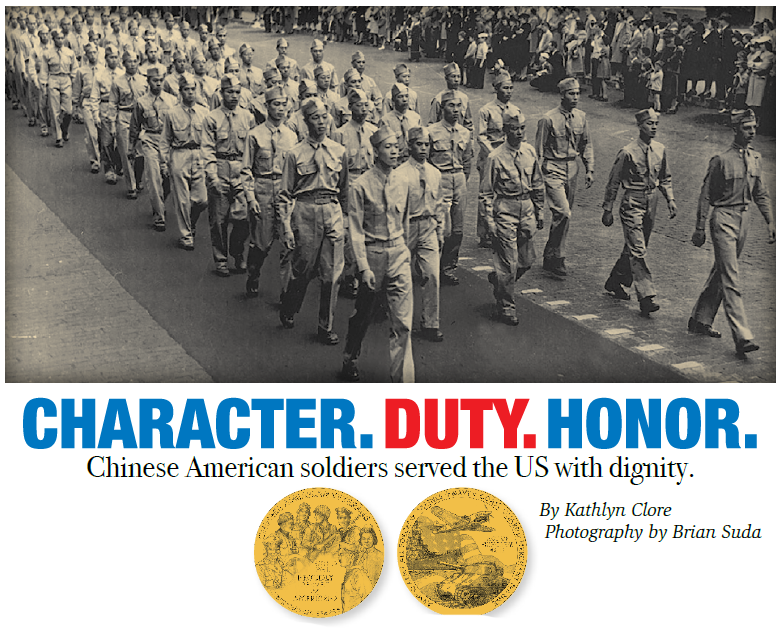
They didn’t fight for fame or recognition, but because it was the right thing to do. Now in their 90s, events beyond their control are still shaping the lives of the Chinese American veterans of World War II. A global pandemic has now extended the delay of national and local ceremonies honoring their military service. But at long last, they will soon be recognized for their patriotism.
In December 2018, Congress honored 20,000 Chinese American veterans with the Congressional Gold Medal, the highest honor the US legislature awards. The Congressional Gold Medal has been awarded to groups such as the Tuskegee Airmen, Navajo Code Talkers and the Japanese American Nisei veterans who served in the 100th Infantry Battalion or 442nd Regimental Combat Team in the Second World War.
The Congressional Gold Medal acknowledges sacrifices Chinese American veterans made despite economic and psychological struggles their families experienced under the 1882 Chinese Exclusion Act. Repealed in 1943 only because more bodies were needed for the war effort, this first legal action to limit immigration from a particular country stopped the emigration of laborers from China, limited return travel from visits to China and subjected anyone with a Chinese background to discriminatory practices.
Unlike other Congressional Gold Medal honorees, the Chinese Americans veterans have not yet received their medals. National and regional award ceremonies were due to be held in the spring and summer of 2019. Concerns about the coronavirus caused them to be postponed. The clock is still ticking, with 2,000 or so veterans still living. Approximately 50 veterans living in Hawai‘i are still waiting to be recognized as soon as House Speaker
Nancy Pelosi gives the green light.
The gold medal is awarded after two-thirds of the House of Representatives and two-thirds of the members of the Senate sign off. Signatures must be collected during a single legislative session; sessions last two years. Retired Army Maj. Gen. Robert Lee, a Hawai‘i resident, assisted the committee seeking the Congressional Gold Medal for the Chinese Americans.
Maj. Gen. Lee had worked on the campaign to see the Nisei awarded the Gold Medal and was able to draw upon that experience to assist the committee working to gain recognition for the Chinese Americans. His strategy for gaining signatures was to query the military officers or other US Department of Defense personnel serving as advisors on each congressman’s staff.
“Then the next hardest part was to design the actual medal,” Maj. Gen. Lee said. “That’s when a bunch of us met with the US Mint. We had to testify in front of the Fine Arts Commission and Citizens Coinage Advisory Committee to show why our design was worthy.”
Three of the Chinese American veterans on O‘ahu were among the guests of honor at the recent commemoration of the Sept. 2, 1945, surrender of the Japanese aboard the USS Missouri. The lives of each of these men — and those of their families — were directly impacted by their experiences of the Pearl Harbor attack, military service and post-war opportunities.
Under Attack
On the morning of Dec. 7, 1941, Joe Young and his father, Young Fong, were catching ‘opae in Kuapā Pond. The elder Young loved fishing and had leased the pond in 1937, moving his family to Hawaii Kai to run what was then the largest fishpond in Hawai‘i. Fong had previously worked as a delivery man for the Chinatown grocery he and his two brothers opened once their sugar cane cutting contract ended. The trio had emigrated together from Sun Ming Ting village near Zhongshan city in the early 1900s.
Up early that Sunday morning, 16-year-old Joe looked up from catching the ‘opae he typically sold fisherman as bait when he heard planes overhead. He saw five planes. His initial thought was that they belonged to the US Air Corps.
“My father said, ‘No, no, no, no, that’s Japanese planes,’” he remembers. He asked his father how he knew the Mitsubishi Zeros were Japanese. “‘By the rising sun and they fly in formation.’”
“What they flying for?” I asked him. “‘I think they going to Kāne‘ohe base; they gonna bomb the place,’ my father said.”
Over in Mānoa, Arthur Shak was waking in the student dormitory room he shared with his older brother. Arthur had graduated in June ’41 from Kaua‘i High School. He told his parents he would follow in his older brother’s footsteps and enroll at the University of Hawai‘i. Arthur’s father was a second-generation Chinese American and the No. 2 man at Hawaiian Canneries pineapple company on Kaua‘i. All his children worked at the factory during their youth.
Once the 18-year-old Arthur reached Honolulu after graduation, he decided to work for a year before hitting the books. More of his friends were working, anyway. So he got a job as a stock clerk in the Contractors Pacific Naval Air Bases at Pearl Harbor (CPNAB) delivering mail.
That sunny Sunday morning, the students heard the planes fly over. Like Joe Young, they assumed the planes were part of the US Air Corps. Radio broadcasts announced the bombing. Soon, Arthur and one of the stockroom supervisors drove to Pearl Harbor to see what had happened.
Walter Ching had a higher vantage point of the destruction on Dec. 7 atop the Old Pali Highway on his way home to Punalu‘u after working an overnight shift as a certified welder at Hickam Field. He’d finished work at 7am and had driven himself to Honolulu for breakfast. Then he and a friend started the drive over the Pali.
Walter had also graduated from a public high school in June ’41. Completing 12th grade wasn’t a given for Walter, whose family lived on the windward side of the island ever since his grandfather, who immigrated to Hawai‘i in the middle of the 19th century to work on a sugar plantation, took a job working for a Punalu‘u rice farmer.
Walter’s father, Yan Quong Ching, had opened the first store in Punalu‘u, a grocery and gas station, in 1935. Walter was the oldest son at home then, helping his mother in the store from 6 am to 10 pm, with breaks to walk three miles to attend Hau‘ula School until he finished eighth grade.
Not having the funds to stay in town and attend McKinley High School, Walter wasn’t expecting to continue his education. But thanks to Thomas GS Walker, a new manager at the Kahuku Sugar Plantation, Walter managed to continue his education at Kahuku High School.
After his workers took him to the field in the morning, he send the truck to Chinaman’s Hat in Kualoa to pick up students wanting to go Kahuku. “So we continued our education,” says Walter. “I didn’t want my education be over. That’s the only opportunity we had.”
After high school, Walter got a job as an electrician’s helper at Kāne‘ohe Naval Air Station, working for 60 cents an hour. Each night after work, he went home for dinner and then attended welding courses at Benjamin Parker School from 5 to 10pm. After three months, he passed the welding certification exam and took a job for 90 cents an hour building gas tanks with a private contractor at Bellows Airfield in Waimanalo. His crew was soon requested to do the same at Hickam.
“It was quite a critical job,” he said.

Aftermath
As non-English speakers, Joe Young’s parents didn’t learn about the attacks until Dec. 8, when they got their hands on a newspaper. Their children fought over radio access, so they had an inkling about what had happened.
Joe had begun his high school career at ‘Iolani, having struggled to follow his two older brothers into Saint Louis High School. He’d initially been denied admission to the Catholic school, to the great disappointment of his mother — who had no problem letting her son know she was embarrassed to go into Chinatown and face questions about the achievements of her third-eldest son. Later, his brother helped him gain admittance into Saint Louis High, but the school was converted to a hospital after the war began. He took classes at McKinley, where the Saint Louis students shared classrooms for a few months. But in his junior year, Joe left school to get a job at Pearl Harbor; he’d heard there was a dire need for workers.
“So there I was, a non-high school graduate. They tell me, ‘You’re going to be a custodian.’ I thought custodian was something big,” he remembers, chuckling softly. “But in simple language, it’s a janitor. I didn’t know. They gave me a broom and a rubbish picker.”
Joe cleared the metal still littering the airfield from the planes bombed on Dec. 7. Reclamation was hard work. He soon tested his way into an apprenticeship and got work in a machine shop.
“In those days, they had to make everything by hand… all the instruments,” he said.
Joe was earning about $100 a month. He gave $80 to his mother, lessening the sting of his earlier educational shortcomings in her eyes.
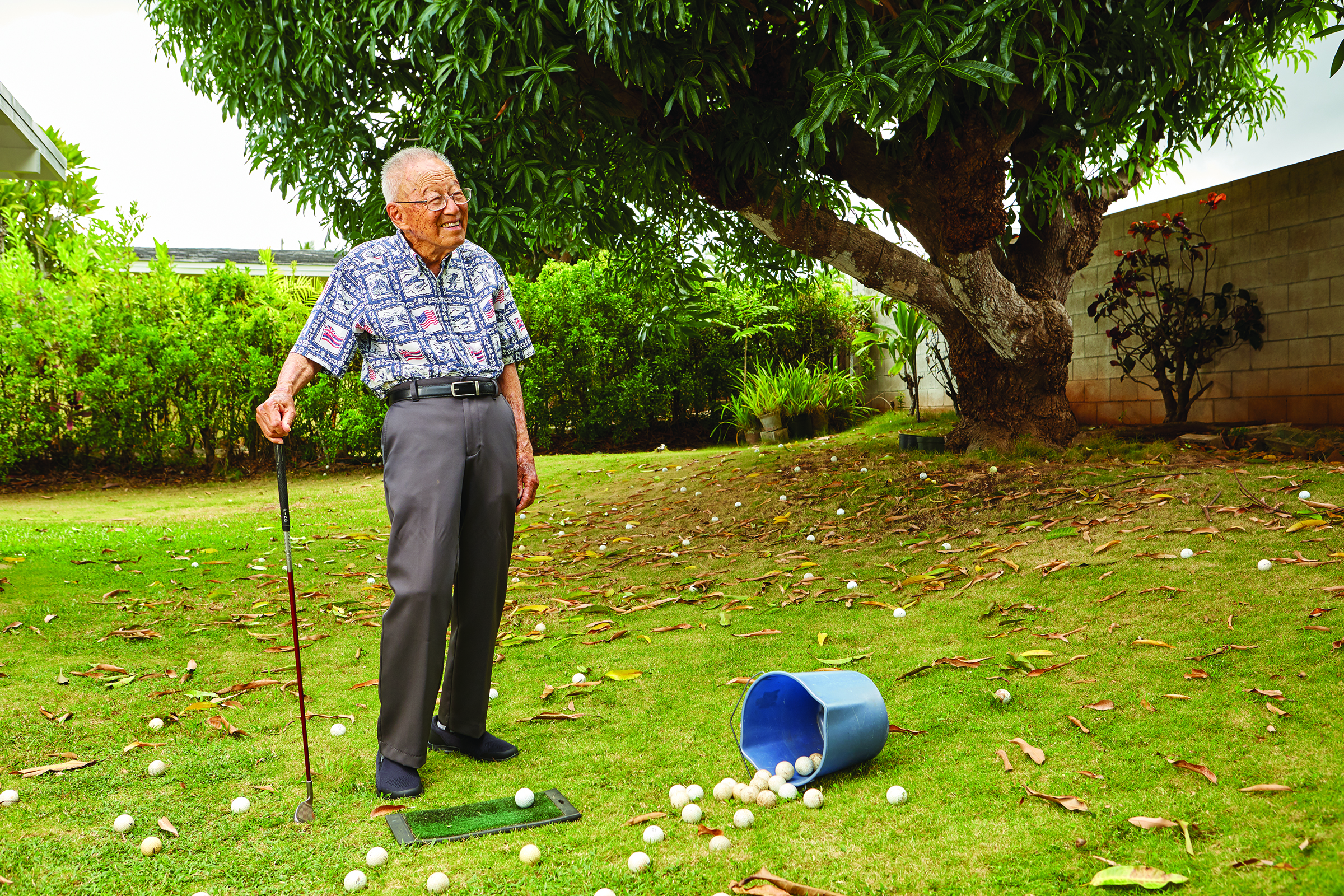
Arthur Shak clearly remembers seeing the battleships in Pearl Harbor sinking and on fire near Ford Island.
“It was really terrible,” he said. “That was the most spectacular thing I’d seen at that time and ever since.”
It wasn’t until later in his life that he realized how significant it was for him to witness the aftermath of the attack firsthand — especially as an 18-year-old civilian.
“There were a lot of guards around. You have to be careful where you go and what you do. In those days, a lot of things were classified and when they said ‘classified,’ they meant it. You don’t poke your nose in places where you’re not supposed to go.”
So Arthur carried on his work in the mailroom, sorting letters and ensuring base correspondence reached Honolulu and beyond. Soon, a Korean friend approached him and suggested he enlist.
“‘Hey Art,’” he said. “‘The US Air Corps is looking for aviation cadets to join.’” And he wanted to join up. “And he said, ‘Why don’t you sign up and join up, too.’ So I said, ‘OK, I’ll sign up.’”
That was in September 1942. Arthur was soon ferried to Santa Ana, Calif., where he began preflight training. It was his first experience of the mainland. He wasn’t at all homesick, he said, and liked the idea of becoming a pilot. Still, he didn’t argue when he was told the Air Corps assessments suggested he would make a better navigator or bombardier than a pilot. By then, he knew pilots had the highest fatality rates.
It would take him a year and four stops to complete his training, which he did in 1943. He earned bombardier wings, navigator wings and a second lieutenant’s commission.
When Walter Ching saw explosions and oil burning at Kāne‘ohe Air Base from his vantage point atop the Pali, his friend suggested that the smoke was coming from a planned training maneuver or a demonstration. Unsure, but in need of rest before another night shift, Walter went home. He mentioned the fires to his family, washed his car and went to bed.
He woke up to find the US was at war; his family heard reports of the Japanese attack over the radio. There was no work for Walter that night.
A few days after the attack, he got a call to meet at Punahou School, where the US Army Corps of Engineers was gathering able-bodied men to help with the cleanup. Walter went along, and six days after the Japanese attack, found himself cleaning up bombed out airplane hangars at Hickam Field.
During the cleanup, roofers dropped a piece of sheet metal that landed directly on Walter as he was cleaning up below. He wound up in the hospital, laid up for three weeks.
Once he recovered, though, it was right back to work. As a welder, he began repairing the gas storage tanks at Hickam and Wheeler Fields.
“Then they send me up Molokai,” Walter said. “They were building the airfield up there. We were building gasoline tanks for the airfield.”
He worked on airfields across the islands, including at Kualoa, Haleiwa, Kahuku and Dillingham. He helped build 10 oil fuel tanks at Waikakalaua Gulch that could hold a million gallons, as well as the Kunia Tunnel, a three-story underground building in a pineapple field.
In the Army Now
When Joe Young registered for the draft, he was instructed to remain in his job at the machine shop, aiding the war effort there.
Joe’s military service began after the war’s formal conclusion, in 1945. He was drafted and sent to Schofield Barracks for two weeks of basic training. Together with pals from around Pearl Harbor and Hickam, he boarded a Liberty ship for an 18-month deployment to the Philippines.
Joe was stationed at Nichols Field, near Manila. After about six weeks, a sergeant asked him if he’d like to be a flight engineer. The job came with a $40-a-month pay raise for Joe, then a corporal, so it seemed like a good idea.
On his time off, Joe and his friends wandered into Manila. The city was poor and damaged by the war. In his civilian clothes, Joe was mistaken for a Chinese citizen rather than an American. He recalls being surrounded by angry Filipinos taunting him: “Intsik baboy,” or Chinese pig.
“I put my hands up and said, ‘No, no,’” Young remembers. He learned a few words of local dialect and lied, in pidgin, to calm the situation. “They ask me what I am. I say ‘I’m half Filipino, but I speak Chinese because my mother is Chinese. My father is Filipino.’ They believed me.”
Joe didn’t venture off base out of uniform again.
A few months later, he had a another tense moment of mistaken identity in Japan, where he and his C-46 air crew traveled to ferry Japanese military officers back to Manila to stand trial for war crimes, such as the Bataan Death March. At the airport, Young was riding in a military truck with his fellow uniformed airmen when they passed a US military police officer. The MP pointed at Joe. “‘What’s that Jap doing in the truck?’” Joe recalls. “Because I’m the only oriental, understand.”
The pilot of his aircraft took the MP aside, seeming to clarify the situation.
“After that, the MP saluted and said, ‘Thank you, sir.’”
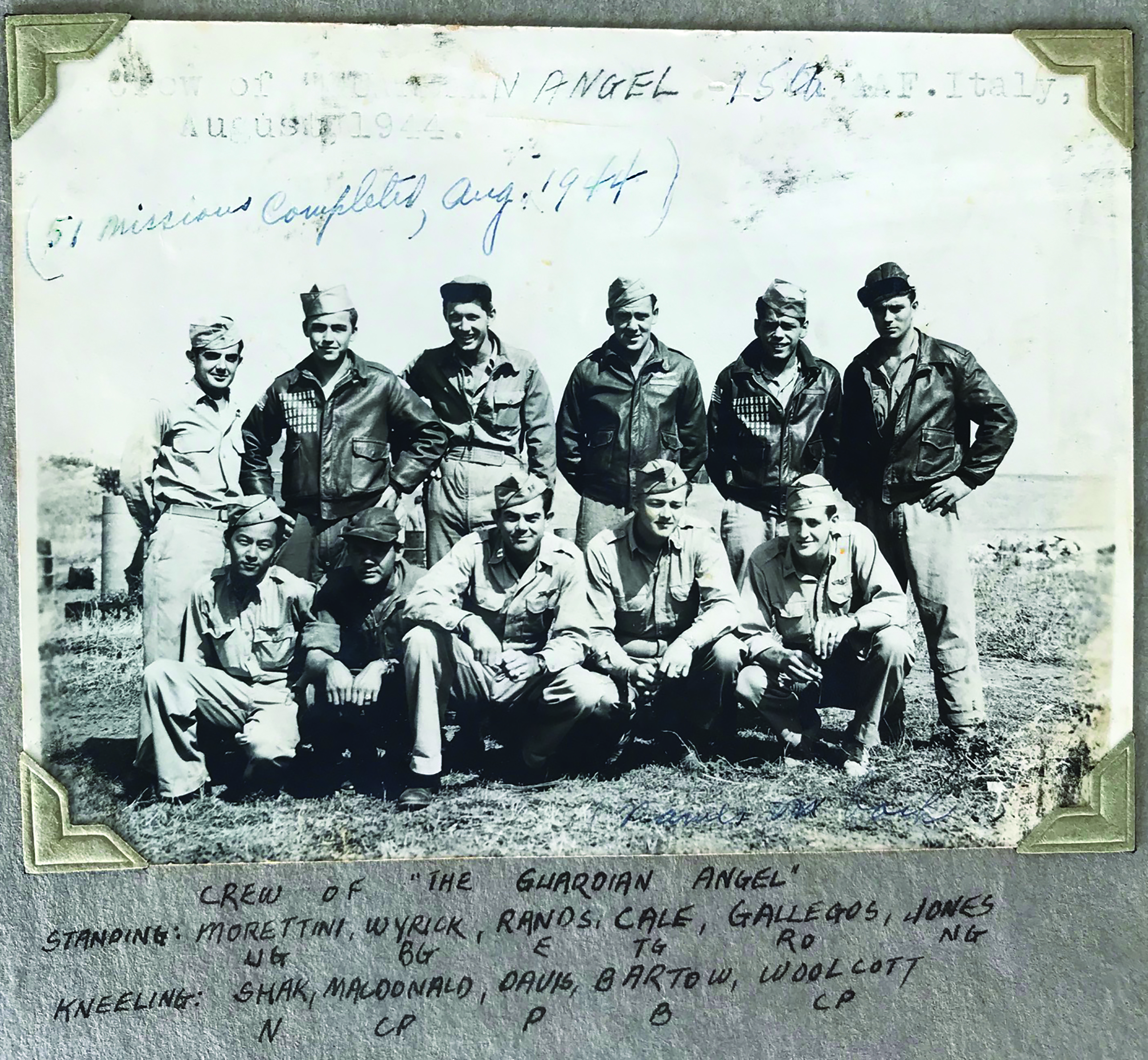
After Art Shak’s training on the mainland, he was assigned to a small base near Foggia, Italy, where he served in the 49th wing of the 15th Air Force as a navigator aboard a B-24 Liberator, a four-engine, heavy bomber aircraft. His plane, fortuitously enough, was named the “Guardian Angel.”
Arthur arrived in Italy in March 1944. He and the B-24 crew joined a major American air campaign to destroy a large oil refinery and oil storage facilities in Ploesti, Romania. Ploesti supplied more than half of the Third Reich’s crude oil.
Arthur and his 10-man crew had a day or two off between flights over the Adriatic and Yugoslavian mountains — time to write their sweethearts or exercise, he said. He shared a tent with the crew’s pilot, co-pilot and the bombardier. On mission days, they’d wake around 4am, gather their gear and pile into a truck to drive to group headquarters. There, the team sat in a briefing room with a large map pinned to the wall while intelligence officers described the mission of the day: which route to fly, where to expect heavy flak, how to avoid it, where to drop your load of bombs.
“The briefing was always a little different — whatever had changed since the last time, even if the target can be the same,” Art recalls. “Ploesti was the target that had the heaviest flak; antiaircraft fire.”
After the half-hour briefing, the crew was taken by Jeep to the airfield where the Guardian Angel sat waiting. They waited in the plane until the air traffic controller gave the signal for takeoff. Missions were about four hours out; four hours back.
“It’s scary. I wouldn’t say I was nervous, but I wasn’t falling asleep. If I may say — you’re holding your ass,” Art said. “You can see somebody get hit. You can hear things hitting against your plane. When it’s not that bad, it’s like somebody throwing rocks against your car. But when it’s a direct hit like that — boom — it’s a loud sound.”
After one flight, Art counted some 60 holes in the Guardian Angel. Another flight ended on an island in the Adriatic.
He wrote in a recent memoir: “Over Ploesti, the plane was hit by flak, severing gas lines and damaging two engines so that the plane continued on only two good engines. In addition, one 500-pound bomb, stuck in its shackles, had to be released manually, bomb bay doors had to be kept open to lessen fuel fumes concentrations from the severed gas lines, and more flak was encountered while flying low. Pilot Davis took evasive action, avoided the additional flak, and with very skillful piloting, managed to reach the coast of Yugoslavia and landed, on one pass with no second chance, on a British-held, short airstrip on the Island of Vis. The fuel tanks were inspected after landing and found to be dry.”
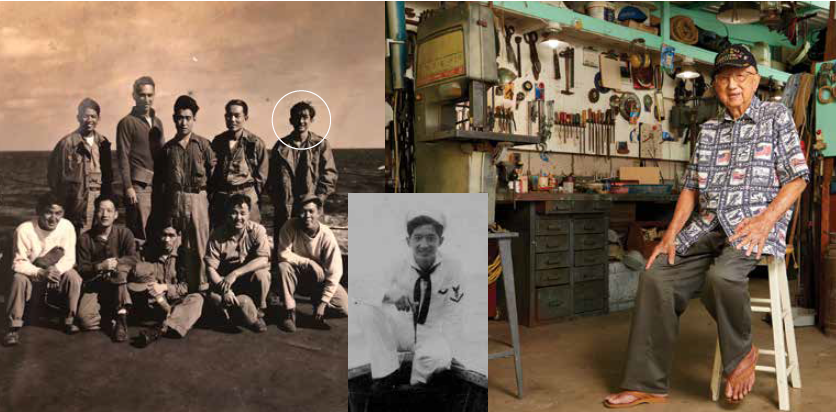
Walter Ching spent most of 1944 building key military infrastructure across the Territory of Hawai‘i. Despite lingering knee pain from the injury he sustained while cleaning up after the Pearl Harbor attack, he was drafted in status 1-A. He joined the Navy Seabees.
“My brother was drafted and sent to Guadalcanal,” he said. “I said, no way I’m gonna go in the Army and fight in the mud out there.”
He was stationed with the Seabees at Moanalua Ridge and worked at Pearl Harbor before he and about 2,000 other Seabees were sent via a troop ship to Samar Island. The trip to Samar took about 19 days. One of Walter’s first concerns aboard the ship was to secure a good sleeping place.
“So they got about 200 of us in each hold. Your bunks are all hanging up. I took the top bunk. That was the worst thing that happened in my life. The hot air came up,” Walter chuckles. “I cannot sleep. Every night I take my blanket and I go up on the cargo hold cover where we sleep.”
Saltwater showers and long lines for chow didn’t make life easier. Reaching Samar and starting construction work on an airfield and hospital there was a welcome change, even if the men did do most of their work in sweltering heat.
Bad luck struck Walter again. This time, a crane knocked him off a building, fracturing his skull. He lost some of his hearing and the use of his right wrist. He wound up in the same hospital he helped to build the previous nine weeks.
Once he recovered, he was sent to Tsingtao, China, to complete two additional months of service and earn enough points to return home to Honolulu. His job was to help escort Japanese officers to ships that would sail back to Japan. As Walter remembers, this wasn’t a particularly difficult task.
“They know they lost the war already,” he said. “They were happy to go home.”
So was Walter; he arrived back in Honolulu via Guam and mustered out (was discharged) after a physical at the Navy hospital.
Life Moves On
After his tour in the Philippines ended and his military service was complete, Joe Young found himself still missing a high school education. Local schools weren’t interested in military veterans.
“I couldn’t get into high school because at Saint Louis High School, they’re not accepting any veterans because they had a lot of trouble with them. I ask them, ‘What do you mean?’ ‘Oh, we experience behavior problems. They drink beer — not on the campus but right off the campus and we can’t do a thing about it. And they smoke cigarettes.’”
So instead, Joe passed a GED test. Then, an 80-year-old advisor at the US Department of Veteran’s Affairs office guided Joe through the process of using the GI Bill to fund his college education. After two years studying sociology and zoology at University of Hawai‘i, Young transferred to Washington University in St. Louis, Mo.
There he found his way to dentistry, completing his bachelor’s degree and dental schooling. He lived frugally. One summer he made bullets for $2 an hour at a munitions factory, helping the Korean War effort.
After graduating from dental school, Young returned home and began his own dental practice.
Art Shak was welcomed home as a hero, his father throwing him a lū‘au party when he returned on leave. He completed his military service with the 316th Troop Carrier Squadron out of Bellows Field, for which he flew as a navigator aboard the C-47. One of his last flights took off from the Tinian airfield n the Northern Mariana Islands in early August of 1945. Within 24 hours, on Aug. 6, the Enola Gay began it’s historic flight from the same field.
“Somehow I can say, ‘Hey, I was there at the start and I was there at the end in some way,’” Arthur said. “That’s my remembrance. That’s what I remember forever.”
In addition to several other decorations, Arthur received the Distinguished Flying Cross.
Once his service ended, though, he was just another vet looking for a place to use his GI Bill. Helpfully, older brother Clarence helped him decide where to attend university: Clarence had just filled out an application to Purdue University, but had been called up in the draft. So he asked his younger brother if he’d like to use the application.
“‘Yeah, OK, why not?,’” Art said. “So I put my name in instead of his and I got accepted. That’s how I got to Purdue.”
He studied civil engineering there, earning a bachelor’s and master’s degree before returning to Honolulu, where he held engineering jobs in the public and private sector.
Owing to the two injuries he sustained during the war, Walter Ching was on disability following his military service.
After a brief stint as a gas station owner back in Punalu‘u, Walter returned to his job as a welder at Pearl Harbor. But his injuries made it difficult for him to walk long distances around the dry docks. His muscles would sometimes lock up when he knelt in small spaces to weld. So he took a 50-cent-per-hour pay cut to work as a handyman on the submarine base. He worked there for six years before working as a diesel mechanic on 72-foot subs for about 17 years.
When he retired, Walter had completed 33 years of federal service.
“So when I retired, the thing I cherish the most is that they gave me the flag from the Arizona Memorial,” Walter said. “I retired on the 10th. On the ninth, the flag went up the mast. At 11 a.m., they took it down fold it up they presented me on the 10th. I have it hanging up on my wall now. I really cherish that flag.”
Perseverance
These men are their Chinese ancestor’s wildest dreams and an inspiration to grandchildren eager to listen to their stories.
Their individual lives are like others of the Greatest Generation. Like their peers, they put aside their own plans to give whatever military service the country demanded.
Then they simply returned to Hawai‘i and went back to their lives. They made a living from a trade or utilized the GI Bill to gain the college education their parents dreamed of.
Yet because of their Chinese heritage, they served while wondering, “Why am I the only oriental in my unit,” as Art Shak did.
They had grandparents who were never able to return from visits back to China, like Walter Ching. Like Joe Young, their parents were immigrants who loudly demanded their children get an education — without themselves having the local knowledge or language skills to assist in the pursuit of it.
These men persisted, overcoming the discriminatory practices and challenges woven into the fabric of their everyday lives. Each of these veterans has children who graduated not only from university, but also graduate school. In retirement, each veteran served the island in his own way, fundraising with benevolent societies and advising planning commissions.
Now in their 90s, they persist still, leading their families forward with humility and honor.
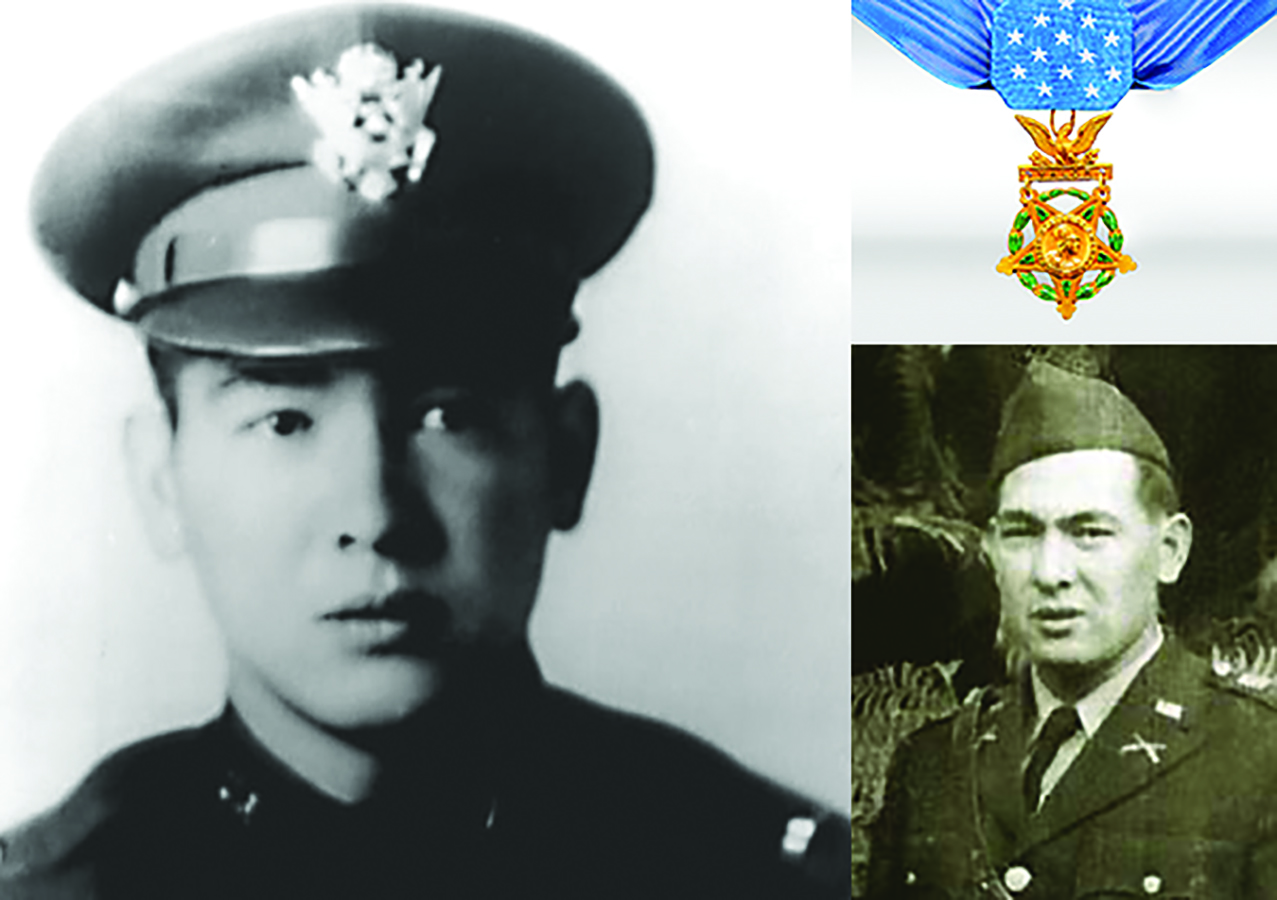
CAPT. FRANCIS BROWN WAI: THE FIRST CHINESE AMERICAN AWARDED THE MEDAL OF HONOR
The first Chinese American awarded the Medal of Honor was dead for 56 years before his family received his medal.
Capt. Francis Brown Wai was born in Honolulu, growing up playing any and all sports, from surfing to basketball and football. A graduate of Punahou School, he was a four-sport athlete at UCLA. After graduation, Wai enlisted in the Territorial Guard and was sent to Officer Candidate School in Georgia. He was commissioned as an Army officer 1941.
After the attack on Pearl Harbor, Wai focused on getting himself into the fight against the Japanese in the Pacific Theater. On Oct. 20, 1944, he and his division were part of Gen. Douglas MacArthur’s attack on the island of Leyte in the Philippines. The assault on Red Beach, where Wai came ashore, was carried out under heavy fire with enemies shooting from palm groves behind rice paddies.
Wai was part of the fifth wave of the attack. Wading onto the beach, he found all American leaders from earlier waves already killed. So he immediately took command and began issuing orders. He charged forward, moving inland through the rice paddies just as he’d once juked his way downfield at UCLA. To locate the enemy’s position, he exposed himself to draw fire; thus, the Americans could aim their return fire as they established dominance on the beachhead. Inspired by Wai’s brave example, the US troops rallied and advanced. Tragically, Wai was shot by the Japanese in the final remaining pillbox in the area.
Wai was posthumously awarded the Distinguished Service Cross. But in 2000, then President Bill Clinton upgraded Wai’s medal to the Medal of Honor — 56 years after his death — finding that racism had stood in the way of earlier consideration of Wai’s bold, selfless actions for the country’s highest decoration for military valor.
To read more about the outstanding Chinese American veterans of WWII, visit www.caww2.org/profiles.
For information about Hawai‘i veterans, visit www.caww2hawaii.org/profile1.
Families of Chinese American World War II wartime veterans from Hawai‘i are urged to register to receive the Congressional Gold Medal at www.CAWW2hawaii.org.