As we turn the page from 2012 to 2013, it is not a bad time to focus on your Rule Book (the set of documents in which you lay out your estate plan) and make sure that the rules you have in place are still consistent with your wishes and your needs. How often you review your Rule Book is up to you, but it is important to appreciate that things change. As they do, your Rule Book can gradually become obsolete, and if you fail to update it, it may do more harm than good.
WHAT KINDS OF CHANGES IMPACT YOUR ESTATE PLAN?
Changes in your health. Like it or not, your health will change over time, and the general trend will not be for the better. Your doctors can do a lot to keep you going, but they have not discovered the Fountain of Youth yet. If you ever lose the capacity to update your estate plan, your family may be stuck with a Rule Book that does not meet your needs, and there may be little that can be done about it, short of taking an expensive foray through the court system.
Changes in your assets. Values go up, values go down. Those fluctuations can affect how your estate plan works. More importantly, it is important to take periodic stock of your assets and make sure they are all properly titled. If you have a revocable living trust, you probably should have all or most of your assets in the name of your trust. If you sell an asset that belongs to your trust, make sure the proceeds go into an account owned by your trust, and when the proceeds are reinvested, make sure the new assets are properly titled.
Changes in your family situation. Any time your family experiences a marriage, a divorce, a birth, or a death, you should have a look at your Rule Book. Other changes might impact what you want to say in your Rule Book as well. Those changes might be good, such as a child heading off to college, or not so good, such as the discovery that a family member has a drug problem or a debt problem.
Changes in the law. There have been some dramatic changes in the Federal and Hawai‘i estate tax laws over the past several years, and you can expect those kinds of changes to continue for the foreseeable future. Though the changes have caused uncertainty, they have also given rise to opportunities. Over the past two years, Hawai‘i laws relating to trusts and tenancy by the entirety have changed in some very positive ways that open the door to enhanced asset protection. Don’t miss out on what those new laws have to offer.
If you review your Rule Book at least once per year, you will probably be able to stay on top of all of these changes and be able to make appropriate updates to your estate plan. You should also sign a new durable power of attorney and advance health-care directive each year, even if there are no changes. The reason to update your power of attorney is that once it is more than a year old, many financial institutions will not honor it, and once it is five years old, nobody will honor it. The reason to update your advance directive is to force you to focus on it and make sure that it accurately reflects your wishes. It will not be called upon until you are unable to speak for yourself, so you need to get it right while you still have the capacity to do so.
Scott Makuakane, Attorney at Law Specializing in estate planning and trust law.
As we turn the page from 2012 to 2013, it is not a bad time to focus on your Rule Book (the set of documents in which you lay out your estate plan) and make sure that the rules you have in place are still consistent with your wishes and your needs. How often you…
QUESTION: Should I write instructions for my jewelry and other personal assets in my Will?
ANSWER: Yes. The best method to use is a “Personal Property Memorandum.”
State of Hawai‘i law allows you to legally make your own list of beneficiaries of tangible personal property. It is as simple as making the list in your own handwriting, signing and dating it.
Why make a Personal Property Memorandum?
Passing on keepsakes to those we care about and who we know will keep them can be a meaningful experience for each of us. And we hope that the recipient of these items will continue to find value and meaning in the personal keepsakes long after we are gone.
What other benefits in preparing this Personal Property Memorandum provide?
Helps reduce conflict. It reduces any conflict that might occur between siblings after parents die. A parent’s death can be a very stressful time as people are asked to deal with assets while they are grieving, causing strain in relationships. A parent making the decision can greatly reduce any conflict that might arise.
Reduces legal fees. A Personal Property Memorandum does not require the assistance of an attorney, thus eliminating attorney costs.
Enriches relationships. By fostering communication now, it can bring relationships closer when the giver engages in a conversation with each beneficiary, in person, to tell the story and the value of the item intended for them.
QUESTION: Should I write instructions for my jewelry and other personal assets in my Will? ANSWER: Yes. The best method to use is a “Personal Property Memorandum.” State of Hawai‘i law allows you to legally make your own list of beneficiaries of tangible personal property. It is as simple as making the list in your…
“Our bodies —regardless of age — can be transformed.” — Diane Cadinha, Certified Personal Trainer
It’s important to recognize that exercise is not merely for sculpting young bodies. It is for everyone — especially seniors, who often have the most to gain. The benefits of senior fitness range from reaching a healthy weight and fighting off disease to better bone health and maintaining an independent lifestyle.
In 1997, certified personal trainer Diane Cadinha worked with her first senior client — Joan Packer, 77. “Watching Joan transform inspired me” Diane says. “It became clear to me how much a person’s quality of life could improve with diet and exercise — regardless of age.”
This started Diane’s passion to specialize in senior health. “Over the years I have seen how exercise, along with proper diet, slows down the aging process. The mind-body connection is big in keeping my seniors mentally sharp, strong and independent,” Diane says. “I learned working with seniors that it’s not over till it’s over.”
Diane’s fitness training also involves eating a healthy diet. She teaches her clients the importance of eating enough fruits and vegetables —5 to 7 servings a day, with 25 to 30 grams of fiber and healthy fats. “With the right fuel in the tank you have the energy to want to workout,” Diane says.
Fifteen years later, Joan continues to make fitness a priority. Now at 91, she inspires others to do the same. Below, we share Joan’s story, along with two other inspirational “strong and silver” seniors.
Big Guns — Joan Packer, 91
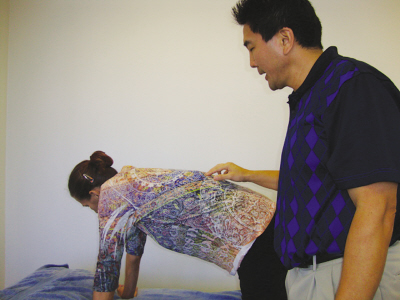
Joan: Hurdler Stretch. Helps relieve low back pain.
Joan Packer lived a fairly sedentary life in Booneville, Missouri, after retiring as a schoolteacher. When her husband passed away in 1984, she decided to move where her heart always wanted her to be — Hawai‘i. So 20 years ago Joan sold two farms back home and bought a condominium in Waikiki to begin her life anew.
Joan spent her first couple of years of retirement enjoying Hawai‘i. She noticed all the fit bodies walking and exercising at Kapiolani Park, and said to herself, I can do that. So she began a new routine of walking at the park, along with short swims in the warm Hawaiian waters.
As a former smoker Joan realized how much better she was feeling with her new found lifestyle, but she wanted to do more to get in better shape. So she decided to seek out a personal trainer. This is when she met Diane Cadinha and started working out with her twice a week. Fifteen years later, Joan says she feels better than when she was in her 50s. “I don’t really like to exercise,” she admits.“But I do it for the results. It keeps my body healthy and feeling good.”
One of her favorite exercises is something that she calls “rewards.” It’s a stretch she does at the end of her workout where she uses a foot strap connected to a cable to stretch her hamstrings.“It just feels so good,” she says, “and it also marks the end of the workout.”
“Tai Chi is my absolute favorite form of exercise … probably because it’s the least strenuous,” she smiles, “but I know that seniors need a mix of exercises… strength exercises for bone health, balance exercises to prevent falls and stretching to stay limber.”
Joan says in her previous life she used to have stiffness and various aches and pains and lacked balance and flexibility. Now, at 91, she has no physical complaints and takes no medication.
Currently, Joan walks the park just about every day, trains with Diane twice a week at her King Street studio, practices Tai Chi almost daily and swims when she can. Joan urges all retirees and seniors to keep a vigorous and healthy lifestyle by exercising every day with friends or a trainer. She does her best to avoid sitting down for more than three hours a day. She also suggests cutting out the sweets and prepared foods, and do your own cooking!
Joan’s two children who live on the Mainland are amazed (and mostly relieved) by their former couch-potato mother. They’re happy to see her as an independent, happy senior who wants stay healthy and enjoy an active retirement.
Well Balanced — Victor Hawthorne, 88
Victor: Kneeling Spinal Rotation. Great for golfers!
Victor Hawthorne retired at age 57 as an Army Colonel and, in his own words, he was “military healthy” for years while on the job. In his retirement he enjoyed playing golf and baseball and taking international cruises. Then, around the age of 75 he started to experience aches and pains and lose his ability to play his favorite sports. He dismissed it as a part of aging. However, when his balance became an issue, too, he realized he needed to do something about it.
Victor wanted to continue to play golf so he turned to personal trainer Diane Cadinha to keep him in top physical shape. Now 88 years young and just as active as he was in his 60s and 70s, Victor works out with Diane twice a week.
“I like how Diane teaches me the importance of strength and core body training — both very important for balance,” Victor says. “The weekly workouts have improved my balance and strength. I like the way I feel, and like that I can golf again.”
The benefits of working out are endless for Victor who says “don’t give up!” Exercise has improved his posture, and makes him feel strong enough to travel and visit with Mainland family. He has plans to go on a six-month world cruise in early 2013 and says he’ll continue his exercises aboard the cruise ship.
“You’re foolish to not start exercising to maintain your health,” he states energetically.“Do whatever it takes.”
Peer Inspiration — Doris Hara, 78
Doris Hara, a retired teacher was enjoying retirement and was active through her 60s. Life was good until her 70s when she began having joint problems and aches and pains. For her ailments, she was prescribed anti-inflammatory medications. She was worried that in the future she’d have to take even stronger medications as her pain worsened.
Then in April of 2012 Doris was reading Generations Magazine and stopped on a photo of a spry Caucasian lady in exercise clothes, flexing her muscles. She was amazed to learn that the lady, Joan Packer, was 91 years old. Furthermore that she had started exercising when she was 77 years old! What? Doris asked herself. I’m 77! You mean it’s not too late to start exercising? Doris was so impressed by Joan that she contacted Diane Cadinha for help.
Doris started exercising with Diane in May 2012, and has improved her health and function 100 percent. Previously, Doris had difficulty with everyday activities such as opening doors and jars, getting in and out of the car, and going up and down the stairs. Her biggest concern was getting up and down from the floor. She had completely lost that function.
“When I first came to Diane, I could only last two minutes on the elliptical machine (a stationary exercise machine that simulates walking or running). Now I’m up to 30 minutes,” Doris says. “My strength and balance keep improving. The pain in my wrists and ankles are almost nonexistent. And, yes, I’ve accomplished my biggest goal of getting up and down from the floor.”
Reverse Lunge w/ Spinal Twist. Great for balance.
Doris says that when Diane teaches an exercise she explains its health benefits and how it will help in everyday life. “That motivated me to do some of the exercises at home on the days I don’t see her. Also, connecting the movement to the mind empowers me on a daily basis.”
Diane also taught Doris how to incorporate more fruits and vegetables into her diet through “green smoothies. “I make them everyday,” Doris says. “I have so much more energy and peace of mind knowing I’m getting these important vitamins and minerals for my health and well being.”
Doris recommends finding a personal trainer like Diane who specializes in senior health. It’s life changing.
“You’re never too old to start exercising. I just turned 78! Just get started! I did!”
Exercise is one of the best ways to extend your quality of life. It helps us to maintain our health, function and immune system. Starting in our late 30s we lose about a quarter pound of muscle each year. This causes a chain reaction in our bodies. Our metabolism slows down and we start to gain weight, which can lead to other health issues such heart disease and diabetes. And, lack of exercise can lead to osteoporosis and loss of joint function. Some feel that exercise is too vigorous for seniors. This is not true! It’s more than okay for seniors to workout. Good health is needed for everyday activities such as walking up stairs, shopping and carrying packages.
To stay healthy and independent, four types of exercises are recommended:
Strength exercises build muscles and increase metabolism. They help with weight and keep blood sugar in check.
Balance exercises build leg muscles. The stability prevents falls and keeps you independent.
Stretching exercises give you more flexibi-lity and agility.
Endurance exercises are activities that increase your heart rate and breathing for 30 or more minutes. Start slowly. Maybe as little as 5 minutes of activity at a time. Gradually build up to at least 30 minutes of exercise on most or all days of the week.
*If you are over 50 years old, obese, suffer from an illness or have been inactive, see your doctor before you start a new fitness routine
It’s important to recognize that exercise is not merely for sculpting young bodies. It is for everyone — especially seniors, who often have the most to gain.
The holidays are a tough time to be in need, and unfortunately there’s way too much of that going around these days. Last year the U.S. Census Bureau said that 16% of people in the States live below the poverty line and that children in 3.9 million households across America went hungry.
These are heart breaking statistics, and many of us seek out charities to donate to during the holidays. Of course, doing so is a great idea, but donors should be wary before making that commitment. Unfortunately there is no shortage of con artists running bogus charities whose only purpose is to pad their own pockets.
How do you separate trustworthy charities from the scams? Here are a few tips to follow:
Check with Hawai‘i’s Better Business Bureau to see if a charity has met our twenty standards for accountability. Among other things BBB reviews a charities financial health and their accountability and transparency.
Check with our state attorney general’s office if a charity is registered to solicit here in Hawai‘i.
Ask for an IRS Form 990—any real charity should be happy to provide you with it. It is the IRS form that provides detailed financial information for potential givers.
Don’t click on any emails asking you to send money. Con-artists use the holidays to appeal to your philanthropic side — and they like to use email to reach out to you. Don’t fall for it. If you want to donate online, go to a charity’s homepage and follow the directions on their donations page.
When considering supporting a cause — find the answers to these questions: What portion of the donation will benefit the charity? What location will the charity use the funds in? How do they help those in need?
Giving to those less fortunate is really what the holidays are about. Make it easier for yourself to leave your mark by doing your homework and researching the charities you want to help.
The holidays are a tough time to be in need, and unfortunately there’s way too much of that going around these days. Last year the U.S. Census Bureau said that 16% of people in the States live below the poverty line and that children in 3.9 million households across America went hungry. These are heart…
This is your new year resolution: exhale. You’ve collected things through the years and you’re beginning to realize … there’s no room to breath — you see “clutter”. You know you need to declutter, but you just don’t know where to start.
You can start by exhaling.
Then begin with the least personal space, such as the least used room or closet. And ask yourself these questions. Do you really need it? When was the last time you’ve used it? When will you use it again? Is it replaceable? Does it fit comfortably in your home?
Next, use these 4 simple steps to conquering your clutter:
Create a goal: set a timeline in small steps.
S.O.R.T. your items in 4 piles: items to sell, offer, retain, and toss; then remove the items you’re not keeping off the property—literally.
Create a floor plan to maximize the space in your home.
Get organized by putting everything away in its “home” (its own place).
As you’ve asked yourself those questions while working through the 4 steps, you begin to process your emotions and feelings about those items. This will help you detach yourself from those things. As you declutter, you’ll find that once you get started and made progress, you’ll gain the confidence that you can actually finish it; and it will then become easier and faster.
Senior Move Managers and De-clutter Hawaii is Hawai‘i’s decluttering specialists. For information, free consultation or to learn more solutions to common decluttering issues, call 808-221-8345 or email at cynthia@smmhawaii.com. Also visit online to www.declutterhawaii.com or www.smmhawaii.com.
This is your new year resolution: exhale. You’ve collected things through the years and you’re beginning to realize … there’s no room to breath — you see “clutter”. You know you need to declutter, but you just don’t know where to start. You can start by exhaling. Then begin with the least personal space, such as the least used…
If you live long enough, you are likely to have an experience that is life-altering. Right now, there are two families living on the Big Island living out just such an experience; and it started out with a casual conversation between two mothers who are involved with their sons’ softball team.
Angie Toma, a scorekeeper for her son’s team, and Leanne Hirata, the coach’s wife, were in the press box one day when Angie happened to mention to Leanne that she has had three kidneys from birth. As it turned out, Leanne’s husband, Gregg, has experienced a deteriorating kidney for 20 years. Although he looks healthy, Gregg is gravely ill with kidneys that are only functioning at 11%. He is in need of a kidney transplant.
Angie thought it over and decided to donate one of her kidneys to Gregg (Leanne and Gregg’s father were ineligible to donate for a variety of reasons). Since following through on her initial decision, Angie learned that two of her kidneys had grown together, so she only has two kidneys, rather than three. Undeterred, Angie continued with the medical process and expects to donate her kidney when medical procedures are complete. For Gregg, Angie’s generosity means he will be there for his wife and three young boys, with a healthy kidney and a new lease on life.
BEHIND THE STORY
Not everyone is so fortunate. In Hawai‘i, approximately 400 people are on the waiting list for a new kidney. The supply of healthy kidneys is not sufficient to fill the need. And many patients pass away before a matching donor can be located. In the past decade, the number of patients waiting for a transplant has doubled, while the number of transplants has remained level. The need tends to increase because people are generally living longer, putting additional stress on their organs. Younger people, like Gregg, and children are also on the list. There have been approximately 1,200 transplants performed in Hawai‘i since 1988, most of them performed by the medical team currently residing at The Queens Medical Center.
Organ transplantation in Hawai‘i has been a reality since 1969, when Dr. Livingston Wong performed Hawai‘i’s first kidney transplant. He put together a team of doctors who pioneered the procedure at St. Francis Transplant Center, and later Hawai‘i Medical Center. When the latter closed its doors about a year ago, Hawai‘i was left with no facility for transplantation until The Queen’s Medical Center came forward to fill the gap. The new center is home to physicians and staff with over 20 years of experience in transplantation, including Drs. Whitney Limm and Linda Wong (daughter of Livingston Wong).
HELPING TO CREATE NEW STORIES
The National Kidney Foundation of Hawai‘i’s mission includes improving the health and well-being of individuals and families affected by kidney and urinary tract diseases, and to increase the availability of all organs and tissue for transplantation in Hawai‘i. Among their programs is a mentoring program of one-on-one help for dialysis and transplant patients. Recently, we have assisted in the creation of a new Council of NKFH known as the Hawai‘i Organ Transplant (H.O.T.) Support Group, whose mission is to improve the support for, and education of, people who’ve had or who are in the process of organ transplantation procedure through educational events and mentorship programs. The support group consist of people who are organ donors, recipients and others who are interested in transplantation.
Our hope is that organizations like NKFH and H.O.T. will help grow awareness of the need for healthy donors and encourage kidney patients who experience this life-giving process. Our hope is for even more stories like Gregg and Angie’s.
If you are interested or have questions relating to organ transplantation, you can reach NKFH at 808-593-1515, H.O.T. at 808-589-5965, or The Queen’s Transplant Center at 808-691-8897.
National Kidney Foundation of Hawaii 1314 South King St., #304, Honolulu, Hawai‘i 96814 808.589.5976info@kidneyhi.orgwww.kidneyhi.org
An Uplifting Story If you live long enough, you are likely to have an experience that is life-altering. Right now, there are two families living on the Big Island living out just such an experience; and it started out with a casual conversation between two mothers who are involved with their sons’ softball team. Angie…
‘Olelo Community Media is honored to serve the diverse people, groups and communities of O’ahu, Hawai’i. Citizens don’t often have a voice in commercial media, so Public, Education and Governmental (PEG) Access provides them with an added source of information and opinion, a forum to discuss issues, and a means of sharing first-hand stories about O’ahu’s rich community life, to island residents and the world.
So, the City and County of Honolulu Elderly Affairs Division is excited to announce an upcoming television program that will be aired on an ‘Olelo Media television channel by the New Year, 2013. This program is intended for our island kupuna, and will showcase a mix of current events, personal interviews, recreation, sports, services, demonstrations, inter-generational opportunities, tips, etc. The program will serve as a means of obtaining information, as well as, provide entertainment and potential life lessons to our entire audience no matter their age. Best of all, the program’s segments will be produced by seniors from our very own community! It will give them the chance to share their mana‘o (knowledge), give back to their community, explore and utilize new technology. Our ku¯puna has so much to offer, and we intend on tapping into that wealth of knowledge.
So, we have this amazing vision and structure to our program, but NO name! We decided on extending the opportunity to a select population of 55 and better, to give their suggestions for the title of this new show. The winner of this contest will receive a Longs Drugs $50 gift certificate and recognition on the television program.
The following are the details to be considered when naming the show:
‘Olelo Community Media is honored to serve the diverse people, groups and communities of O’ahu, Hawai’i. Citizens don’t often have a voice in commercial media, so Public, Education and Governmental (PEG) Access provides them with an added source of information and opinion, a forum to discuss issues, and a means of sharing first-hand stories about…
As baby boomers near retirement, many are discovering that they aren’t yet financially prepared to leave their careers. Moving from a full-time job to a life of travel, volunteer work and time spent with family and friends may seem like a natural next step. For those who are still determining how they’ll fund their retirement, however, cutting the strings of employment may not look so appealing.
Here are several sobering facts from the New Retirement Mindscape® 2012 City Pulse index1, an annual survey that examines retirement readiness among individuals in 30 of the largest U.S. cities: Just 63 percent of respondents say they’re saving for retirement. What’s worse, only 37 percent of respondents nationwide say they feel “on track” to retire, and just 11 percent say they were able to retire earlier than planned because they were financially able to do so.
Here are some important do’s and don’ts designed to help you move toward punching the clock for the last time and living a happy, healthy retirement.
Do strive to be debt free upon retirement.
This involves making well-planned, wise choices — and sometimes making trade-offs — during your last 10 to 15 years of your career. If possible, maximize funding into your 401(k) plan before refinancing or adjusting your 30-year mortgage to a 15-year term in order to retain the tax advantages available to you that come with saving for retirement. That might mean focusing on savings vs. paying off a mortgage or other long-term debt.
Don’t assume your retirement will be “traditional.”
In recent years, baby boomers have redefined what “retirement” really means. Some choose to work part time or start a career in which they’re really passionate about. If you aspire to have a part-time career, start laying the foundation now. Identify what you hope to do as well as the companies or organizations that might benefit most from your experience.
Don’t disregard your health.
As we age it becomes more important to carefully monitor our physical and mental well being. Obesity, high blood pressure and high cholesterol are the most common health issues in America. So get an annual physical and health screening and talk to your doctor about any health concerns you may have and what the future costs may be so you can accurately plan for them in your retirement savings.
Don’t underestimate.
When determining your retirement expenses think about the rising costs of health care, gasoline and travel (just to name a few) that you’ll continue to consume in retirement. Remember to create some contingency plans to cover unforeseen expenses. You likely won’t regret saving a little extra now for your retirement years rather than not having what you will need once you leave the workforce.
It may be a bumpy ride to retirement, but the surest way to feel confident about your future is to plan for it right now.
For info, contact Michael W.K. Yee at (808) 952-1240.
1 The Money Across Generations IISM study was commissioned by Ameriprise Financial, Inc. and conducted by telephone by GfK in December 2011 among 1,006 affluent baby boomers (those with $100,000 or more in investable assets); 300 parents of baby boomers; and 300 children of baby boomers at least 18 years old. The margin of error is +/- three percentage points for the affluent boomers segment and +/- six percentage points for the parents and children of boomers segments.
Ameriprise Financial and its representatives do not provide tax or legal advice. Consult with your tax advisor or attorney regarding specific tax issues.
Dos and Don’ts on Preparing for Retirement As baby boomers near retirement, many are discovering that they aren’t yet financially prepared to leave their careers. Moving from a full-time job to a life of travel, volunteer work and time spent with family and friends may seem like a natural next step. For those who are…
Falls are the leading cause of injuries among seniors in Hawai‘i. The risk and frequency of falling increase with age. Every 5 hours a senior in Hawai‘i suffers a fall that results in the senior being hospitalized. One in three adults 65 years or older in the US suffers a fall each year. Falls can affect seniors in many ways. Falls can result in bruises, sprains, broken bones, and/or head injuries. Falls account for 87% of all fractures among people aged 65 years or older. It can cause injury and their ability to live independently decreases. It can also limit confidence and the ability to live a comfortable life.
What are the causes of falls in seniors?
For people aged 65 years or older, 60% of fatal falls occur in the home, 30% in public places and 10% in health care institutions. Falls can be caused by many factors which are associated with health and aging conditions. Predictors of falls include a previous fall, poor posture, poor balance, prolonged bed rest, muscle weakness, mobility problems, loss of sensation in the feet, vision changes, dehydration, and drug interactions. Chronic health conditions such as arthritis, osteoporosis, stroke, Parkinson’s disease, urinary incontinence, diabetes, and heart problems may predispose to falls. Review of physician prescribed and over the counter medications, alcohol consumption, and marijuana use, may provide information that can be useful in decreasing the occurrence of falls. Environmental hazards such as slippery surfaces, poor lighting, and tripping obstacles also play a contributing role in falls.
Is there a role for therapy and exercise?
Home safety evaluations conducted by a physical therapist or an occupational therapist are invaluable in the prevention of falls. There is no charge for home safety evaluations by medical insurance, if the evaluation is prescribed by a physician. Senior participation in community fall prevention exercise programs and educational classes help prevent in-home falls. Tai Chi is excellent in decreasing the number of falls and fear of falling. Studies have shown Tai Chi to improve functional balance and physical performance in physically inactive seniors.
FALL PREVENTION
Home Modifications:
Home safety is very important in preventing falls and disabilities. Some falls can be prevented by use of the following.
Non-slip flooring.
Install stair railing and/or stair climber.
Eliminate area rugs that shift or curl.
De-clutter the living spaces and footpaths throughout the home.
Provide a roll-in or curb-less shower stall.
Install grab bars in the shower and tub areas.
Appropriate height toilet seat.
Lights in hallways as well as closets.
Replacing door knobs and faucets with lever type handles.
Increase the width of doorways to 32 inches or more to accommodate the use of a wheelchair or walker.
Installation of a smoke detector and fire extinguisher according to code.
Setting of hot water heater thermostat at 110˚F or lower.
Lifestyle Changes:
Have your vision & hearing checked regularly.
Talk to your doctor or pharmacist about the side effects of your medication.
Limit your intake of alcohol.
Use caution when getting up from eating or sleeping.
Use a cane or walker to help maintain your balance.
Wear supportive, rubber-soled shoes.
Maintain a regular exercise program to improve strength and tone
Falls are the leading cause of injuries among seniors in Hawai‘i. The risk and frequency of falling increase with age. Every 5 hours a senior in Hawai‘i suffers a fall that results in the senior being hospitalized. One in three adults 65 years or older in the US suffers a fall each year. Falls can…
The Elderly Affairs Division (EAD) was recently awarded one of 20 Benefits Enrollment Center (BEC) Grants nationwide from the National Council on Aging. The BEC grant supports the development of person-centered, community-based system to provide outreach, and to help seniors and younger adults with disabilities with limited means to enroll in public and private programs that help pay for prescription drugs, medical care, food and utilities. These programs include:
Low Income Subsidy for Medicare Part D
Medicare Savings Program
Medicaid
Supplemental Nutrition Assistance Program
Low Income Home Energy Assistance Program
EAD is an active participant in identifying and enrolling eligible persons into these programs. While most individuals are already enrolled, there are still many who do not know about these programs or may need assistance in applying.
For more information, please call the Senior Helpline at 808-768-7700.
The Elderly Affairs Division (EAD) was recently awarded one of 20 Benefits Enrollment Center (BEC) Grants nationwide from the National Council on Aging. The BEC grant supports the development of person-centered, community-based system to provide outreach, and to help seniors and younger adults with disabilities with limited means to enroll in public and private programs…
The chance of having a stroke doubles for each decade of life after age 55 and are common among the elderly. In 2009, about 650 Hawai‘i residents died of a stroke, according to the state Department of Health. But here’s the good news: a stroke is largely preventable and is the No. 1 preventable cause of disability.
Created in 1997, the American Stroke Association (ASA), a division of the American Heart Association (AHA) is to empower and educate you and loved ones of preventing strokes.
According to recent research commissioned by the ASA, about 93% of Americans do not consider stroke as a major health concern, yet it is the fourth-leading cause of death in the U.S. It is also the second leading cause of death in the world. Ages 60 – 79, 7.2% are men, 8.25% are women. For Asian or Pacific Islander, 34% are males and 32.1% are females. This was above cancer, accidents, diabetes, and pneumonia.
But here’s a hopeful statistic: 80% of strokes may be prevented. It is largely treatable. One thing to remember, to help recognize a stroke, is to think FAST.
For the first time in its 38-year history, the International Stroke Conference will be at the Hawai‘i Convention Center on Feb. 5–8, 2013. It is the world’s largest meeting for cerebrovascular healthcare professionals and will have the latest research findings and science. The conference will have over 1,300 scientific presentations.
The American Stroke Association’s mission is to reduce disability and death from stroke. Also, to help stroke survivors and their families recognize they are not alone in the recovery and to provide helpful resources for a productive life.
The chance of having a stroke doubles for each decade of life after age 55 and are common among the elderly. In 2009, about 650 Hawai‘i residents died of a stroke, according to the state Department of Health. But here’s the good news: a stroke is largely preventable and is the No. 1 preventable cause…
In a state with a high cost of living — where one in five residents will be 65 or older by 2032 — island residents are worried about paying for long-term care. In Hawai‘i, costs range from $17,500 for one year of adult day care to about $126,000 for private nursing home care — more than twice the median household income.
In a recent AARP survey, most members expressed little confidence they could afford the cost of nursing home care, and half doubted they could even afford less expensive care in their own homes. That could mean additional pressure on family caregivers in the future, the number of whom is projected to decline as the number of residents requiring some form of care increases over the next 20 years.
To address these concerns, AARP Hawai‘i is making long-term care a priority issue in the 2013 legislative session. Our goals include:
Support for Kupuna Care — AARP supports an appropriation of $9 million for Kupuna Care from the base budget. Kupuna Care is a state-funded program designed to meet the needs of frail older adults who cannot live at home without help from family or formal services.
Support for the Aging and Disability Resource Center (ADRC) — AARP supports an appropriation of $1.8 million for continued implementation and state-wide expansion of ADRCs. ADRCs are designed to help eliminate confusion by providing a “one-stop shop” for residents looking for long-term care services. A recent AARP report ranked Hawai‘i 41st in the nation in the ability to access long-term care through an ADRC.
Investigate the Cost of a Public Long-Term Care Insurance Program — AARP supports the study of the cost and feasibility of a limited mandatory public long-term care program, as recommended by the Hawai‘i Long-Term Care Commission. The study would identify eligibility requirements, benefit amounts, benefit period, and premium payments.
To find out more about the long-term care challenges facing Hawai‘i, or to get involved as a volunteer advocate, call 808-545-6005.
Pension Tax Posse II
AARP Hawai’i’s Top Legislative Priority in 2013 In a state with a high cost of living — where one in five residents will be 65 or older by 2032 — island residents are worried about paying for long-term care. In Hawai‘i, costs range from $17,500 for one year of adult day care to about $126,000 for private nursing home…