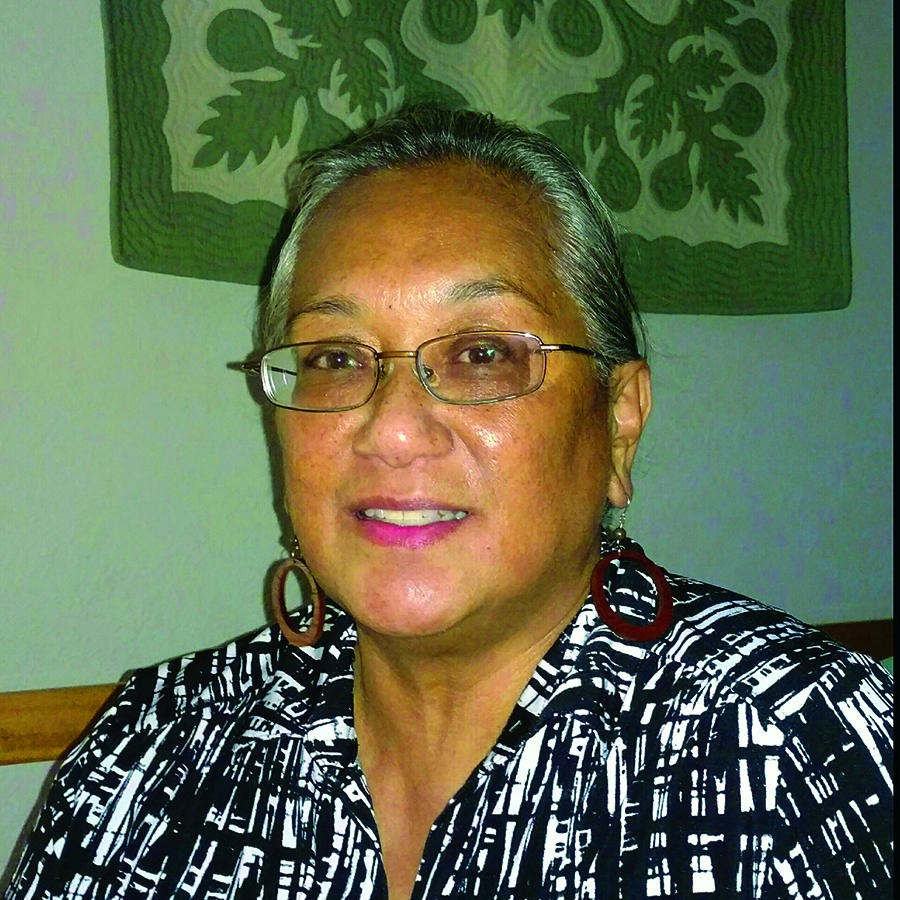
I’ve been researching my ancestors for about 20 years. On my Hawaiian side, I’ve gone back five generations, and three generations on my Filipino side. I get so excited when I connect the dots in my family tree and discover a new family member, because I now have a name and story to share with my grandchildren.
I’ve been blessed with three granddaughters and two grandsons. Analea, 13, loves to draw and has her own blog. Olena, 11, loves to cook and listen to my stories. Hoku, 4, who loves to talk and show me how to use her iPad, is the sole survivor of triplets. My grandsons (her brothers) Nahoa and Koa, lived a few hours.
I tell my grandkids stories about their ancestors, including Uncle Travis, my son who passed away at age 23 and loved to draw. They want to one day own some of his drawings. When we visit Hilo, I make an effort to take them to the gravesites of their ancestors. Before my father passed away in HPP, Kea‘au, I took the girls to visit him and took pictures of each of their hands holding their great-grandfather.
The author’s grandchildren Olena, 11, Analea, 13, and Hoku, 4.
A few years ago, I started a private family blog that only my husband and children can access. There, I share ancestors’ pictures and stories, journal entries from my youth, family traditions, photos of treasured items from my parents, and letters from my late grandparents. When my grandchildren are older, I will open this blog to them so they can learn about our family.
In February, I attended a genealogical convention in Utah, where I purchased four DNA kits for my family and am hoping to learn more about my family. I want my children and their future families to know where they came from and lessons that can help them in their lives. I want them to know they are connected to a rich heritage.
GENEALOGY RESOURCES
familysearch.org holds the world’s largest database of genealogical records.
ancestry.com provides DNA testing and tools to create a family tree.
myheritage.com helps people connect with others looking for the same ancestors, or who share the same DNA.
Family History Centers of The Church of Jesus Christ of Latter-Day Saints (Mormon chapels) are staffed with volunteers specialized in genealogy. For the nearest center, visit familysearch.org/locations/
I’ve been researching my ancestors for about 20 years. On my Hawaiian side, I’ve gone back five generations, and three generations on my Filipino side. I get so excited when I connect the dots in my family tree and discover a new family member, because I now have a name and story to share with…
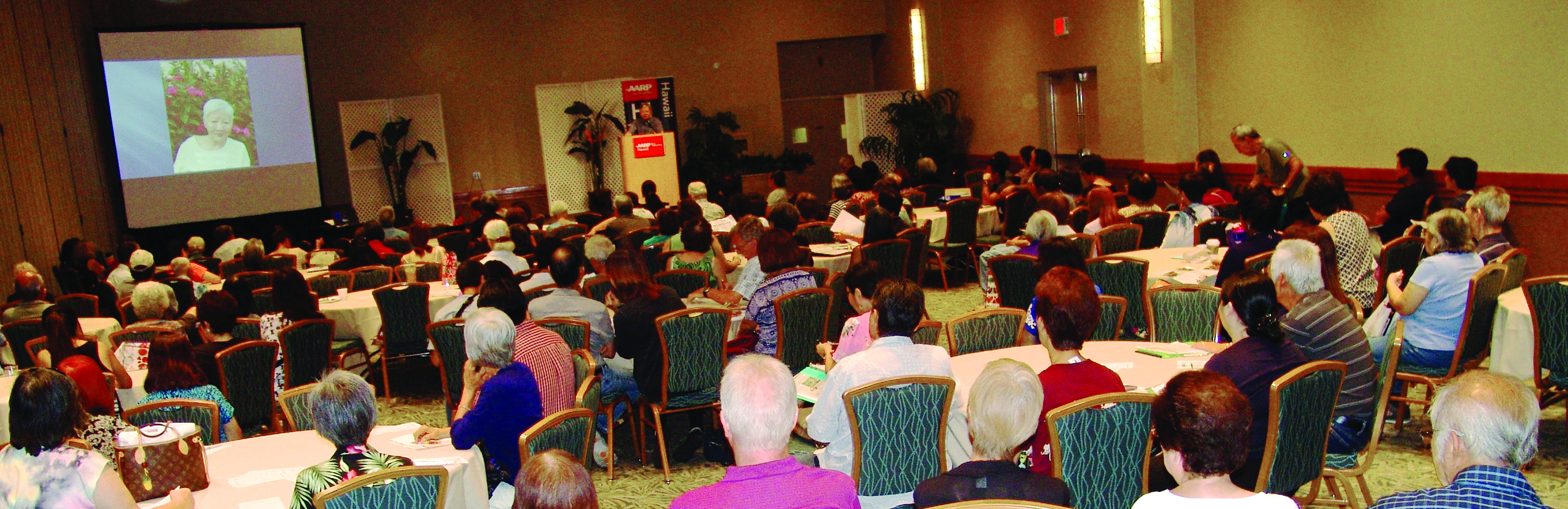
The 11th Annual Aging in Place Workshop, hosted by Generations Magazine, took place on Aug. 19, 2017, in the Ala Moana Hotel, with more than 3,000 in attendance. The free, all-day event featured speakers in estate planning, care giving, aging in place, long-term care, Medicaid and Medicare, Social Security, de-cluttering, holistic healthcare, stress-relief and much more.
Generations Magazine is grateful to its loyal partners, sponsors and readers for their support!
(Above) In between sessions, attendees filled the hallways of the Ala Moana Hotel. More than 3,000 people were at this year’s event. (Below) A well-attended session this year was, “Improving Life At Home For Caregivers & Elders” by Dr. Michael Cheang, an assistant professor at the University of Hawai‘i at Mānoa Center on Aging.
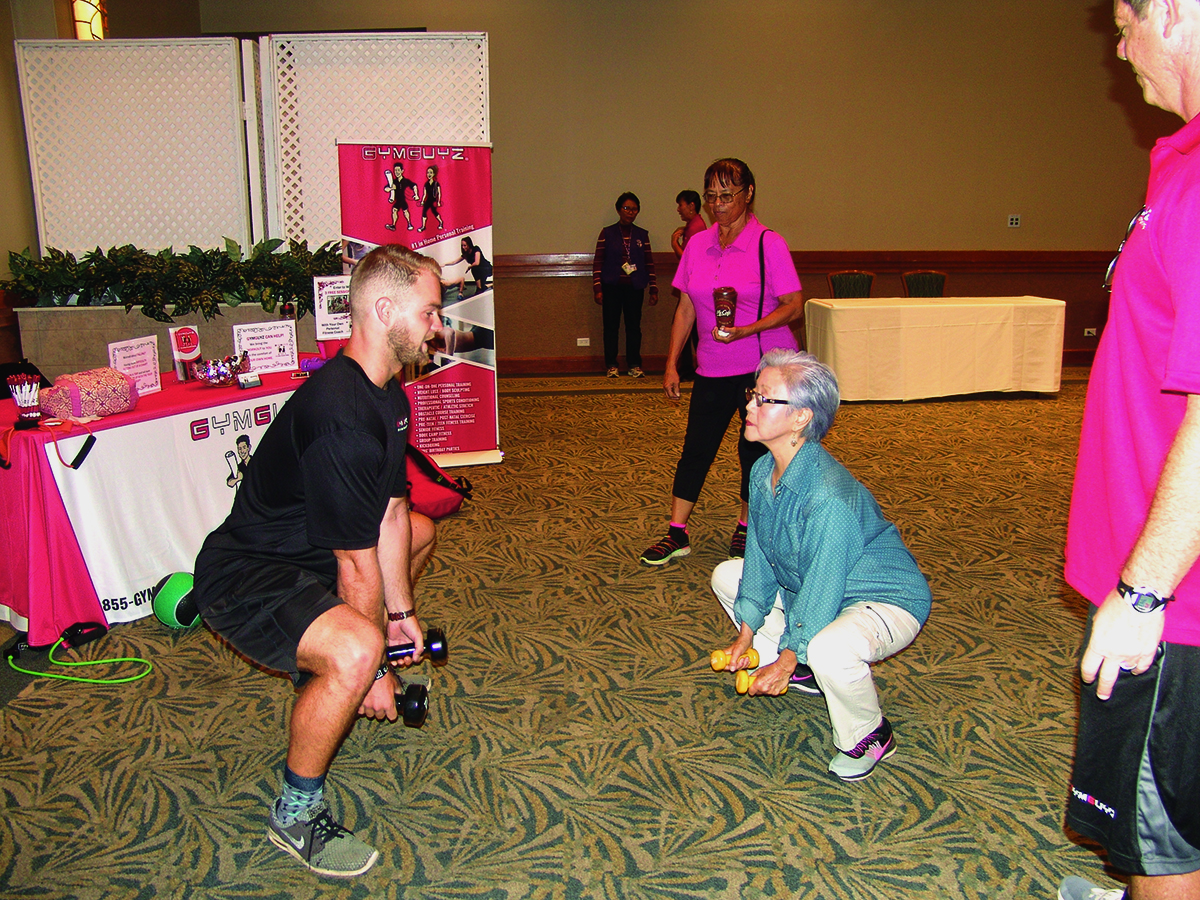
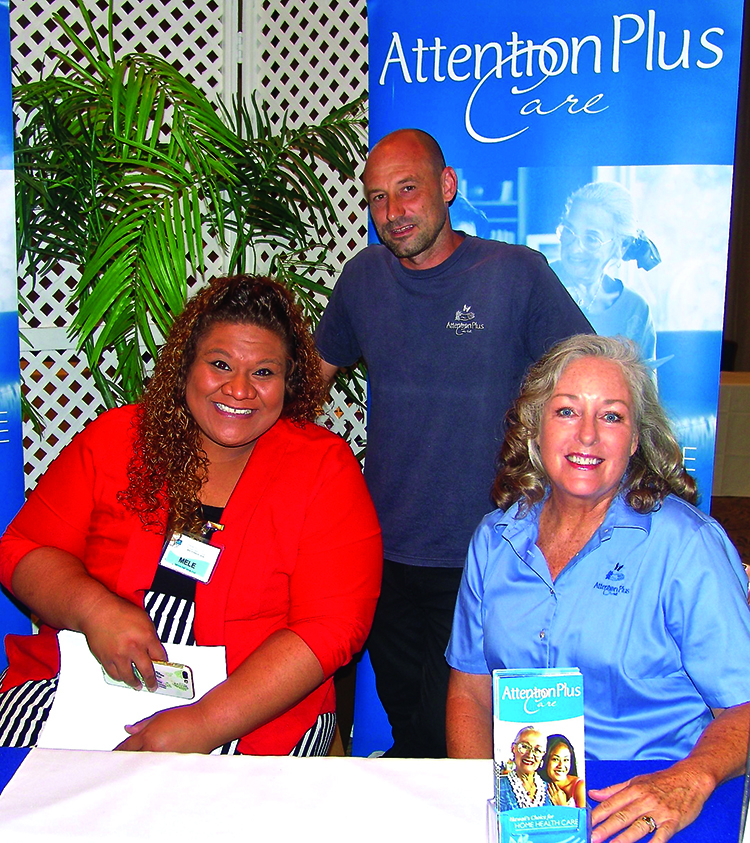
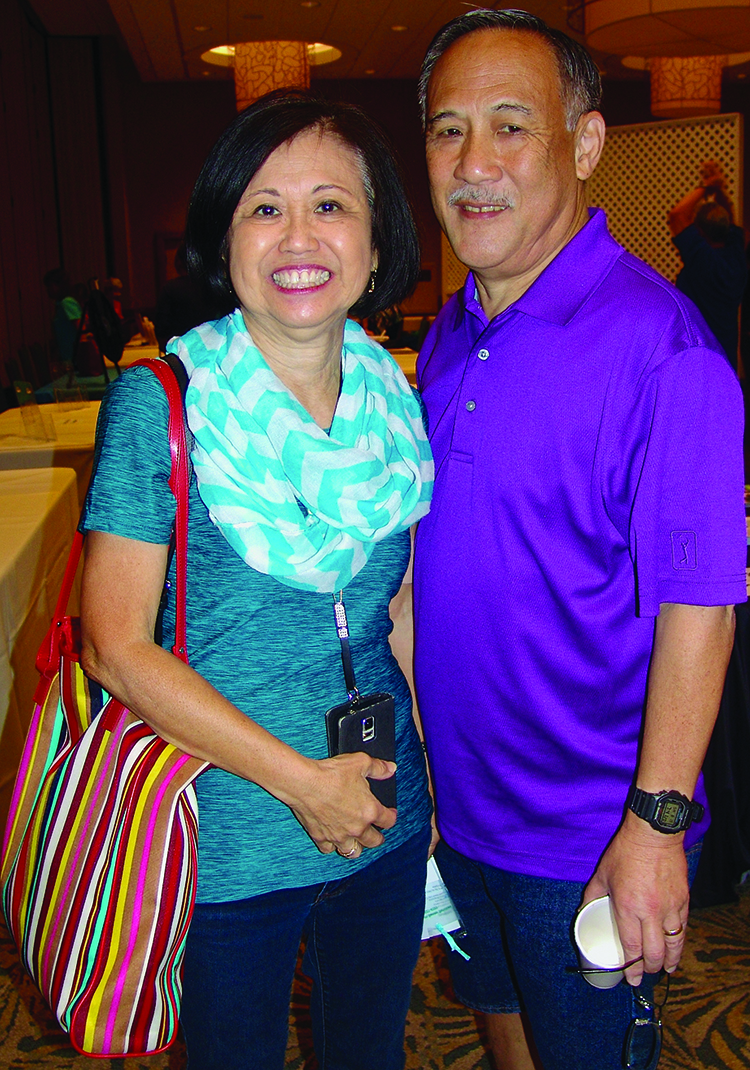
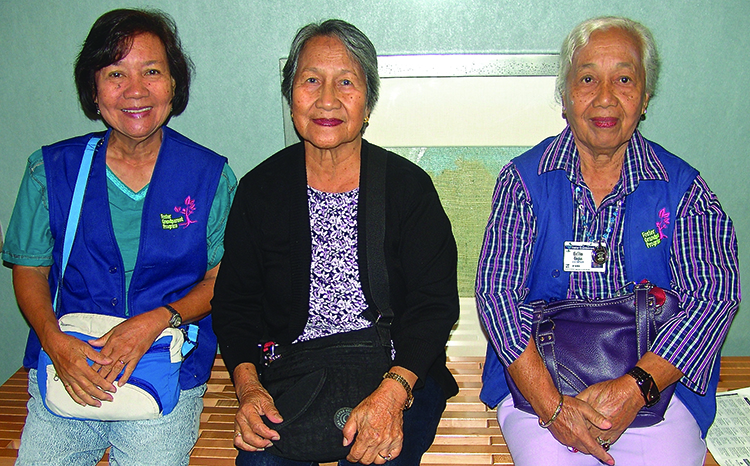
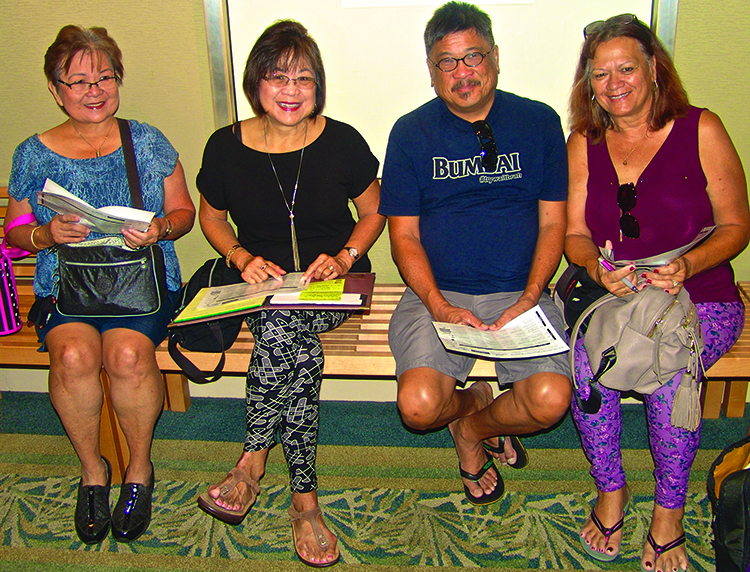
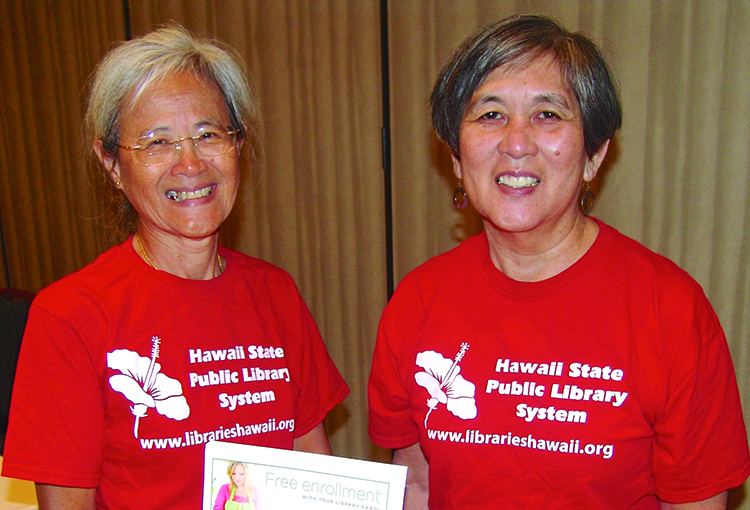
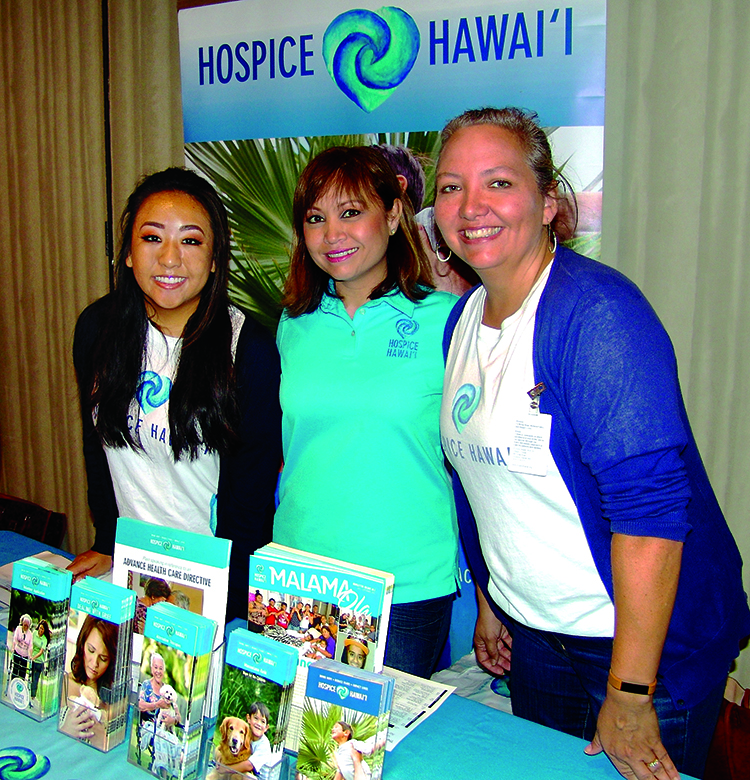
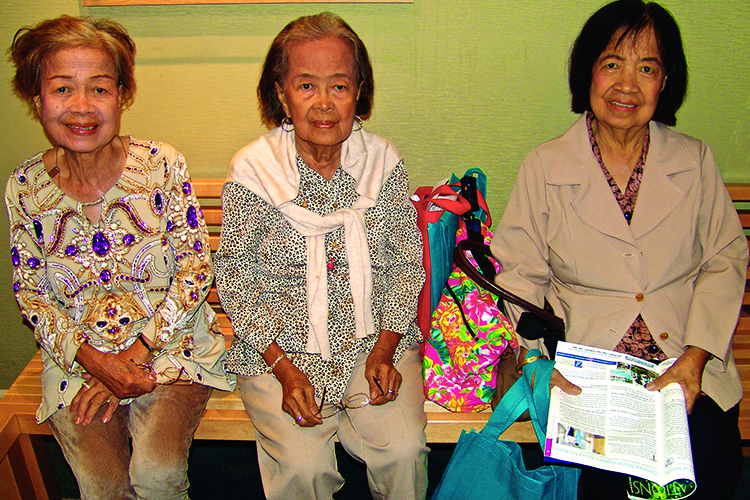
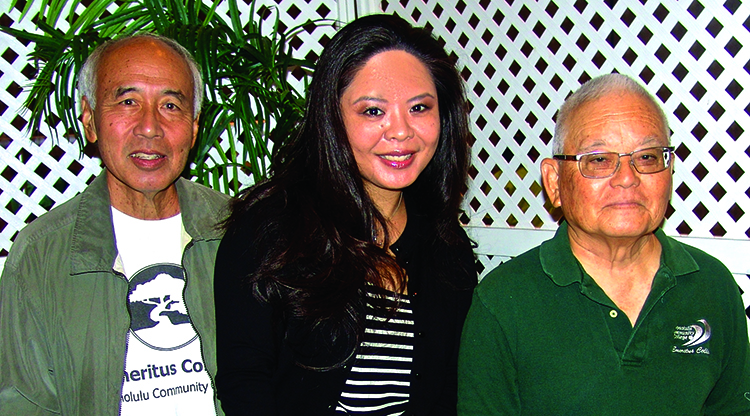
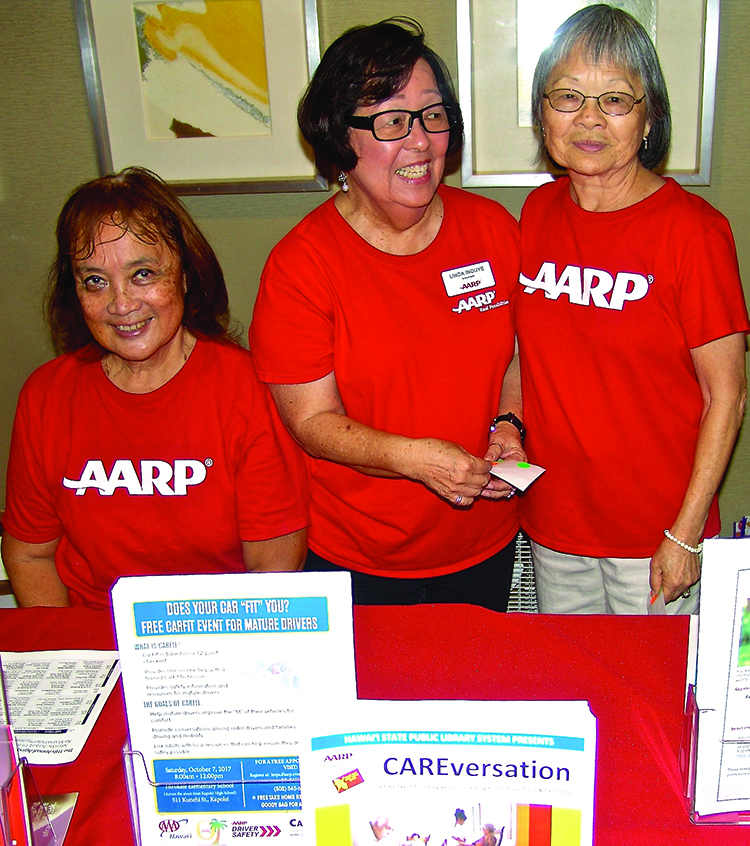
Kurtis Ackerman, a personal trainer with GYMGUYZ, did weighted squats with Joanne Pyun, while Charlotte Lyman watched. GYMGUYZ brings personal training to clients’ homes.Attention Plus Care employees provided information about home healthcare options: (L–R) Mele Toumona, Adam Funari and Eileen Phillips.In between sessions, Gail and Glenn Satsuma visited over 50 exhibitors at the Aging in Place Workshop.(L–R) Dalisay Quijano, Lolita Mendoza and Erlita Corpus volunteer 15 hours per week with the Foster Grandparents Program, assisting local children with special needs.This foursome was excited to attend all-day sessions at the Aging in Place Workshop: (L–R) Geraldine Nishihara, Donna Noguchi, Randy and Teri Chun.Employees of the Hawai‘i State Library promoted their new app and other programs for library cardholders: (L–R) Colette Young and Miriam Sato.(L–R) Cassandra Matsushige, Jean Miura and Jenny Wilkinson spread awareness about Hospice Hawai’i, a nonprofit group that assists with end-of-life care.This trio was among the first to arrive at the Aging in Place Workshop: (L–R) Felicitas Luna, Mantonia Luna and Pelagia Ramos.Honolulu Community College’s Emeritus College offers non-credit classes for seniors and folks nearing retirement: (L–R) Myron Yamashiro, Farah Doiguchi and Ed Yonemoto.The AARP table had more than a dozen volunteers throughout the day: (L–R) Pat Frank, Linda Inouye and Nancy Hironaka.
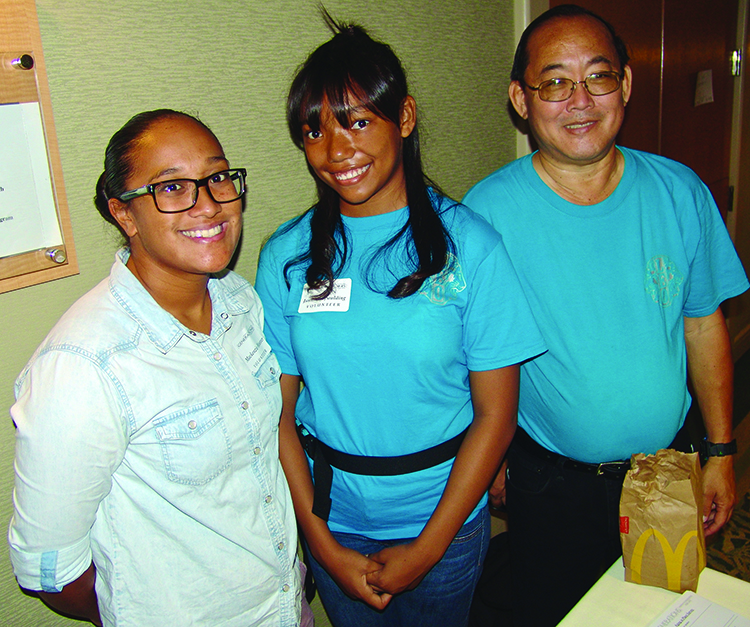
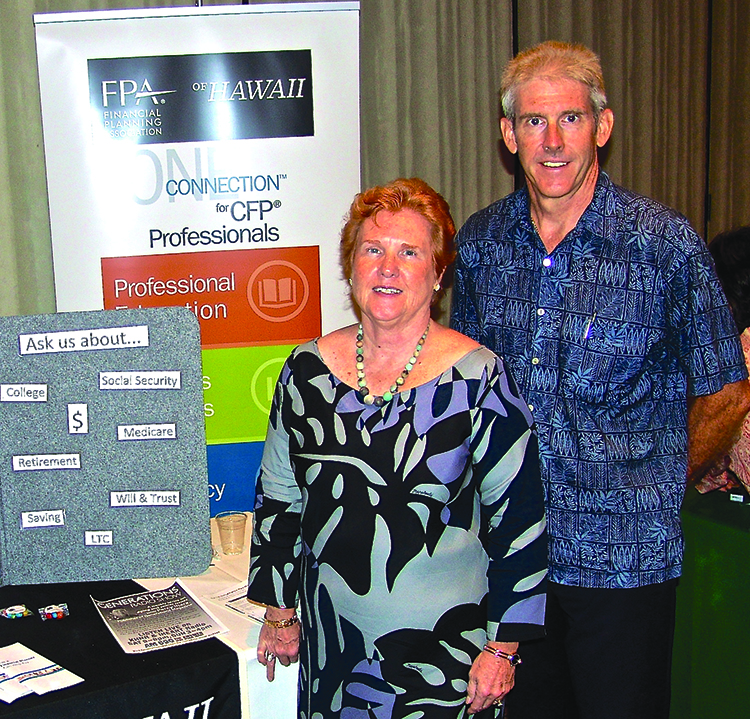
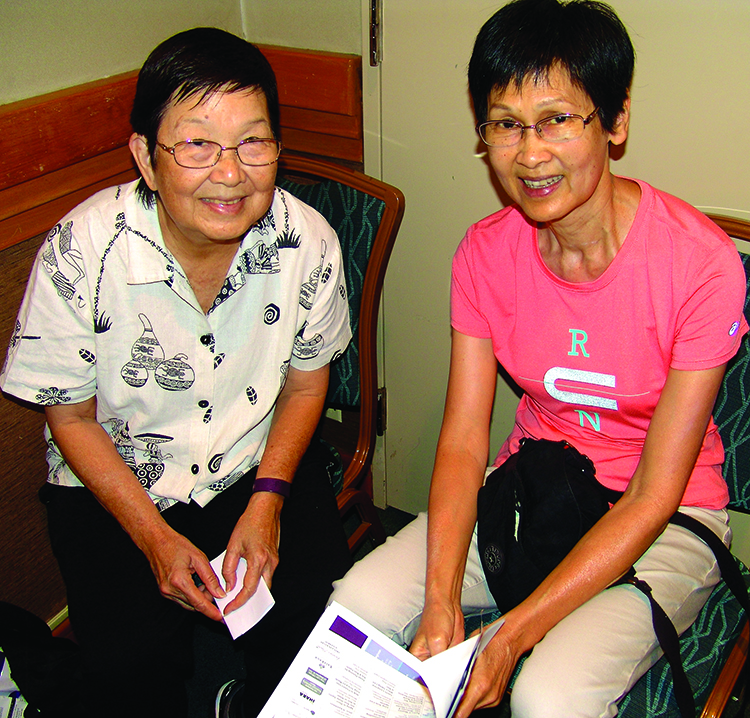
The Aging in Place Workshop relied on volunteers of all ages, like Leo Club members (L–R) Mackenzie Hoover, Jasmine Spaulding and Steven Yoshimura.Representing the nonprofit group Financial Planning Association (FPA Hawaii) were Teresa Tyler of First Command Financial Services and Douglas Brown of HomeStreet Bank.(L–R) Jan Offner and Gloria Chong took a short break in between the afternoon sessions.
The 11th Annual Aging in Place Workshop, hosted by Generations Magazine, took place on Aug. 19, 2017, in the Ala Moana Hotel, with more than 3,000 in attendance. The free, all-day event featured speakers in estate planning, care giving, aging in place, long-term care, Medicaid and Medicare, Social Security, de-cluttering, holistic healthcare, stress-relief and much…
Project Dana co-founder and Executive Director Rose Nakamura and her headquarters staff coordinate services to assist more than 1,200 elders. (L–R) Susan Kuwahara, Cyndi Osajima, Maria Morales, Lorraine Mow and Mike Hirano. (Bryson Ho not pictured)The little blue house of Project Dana
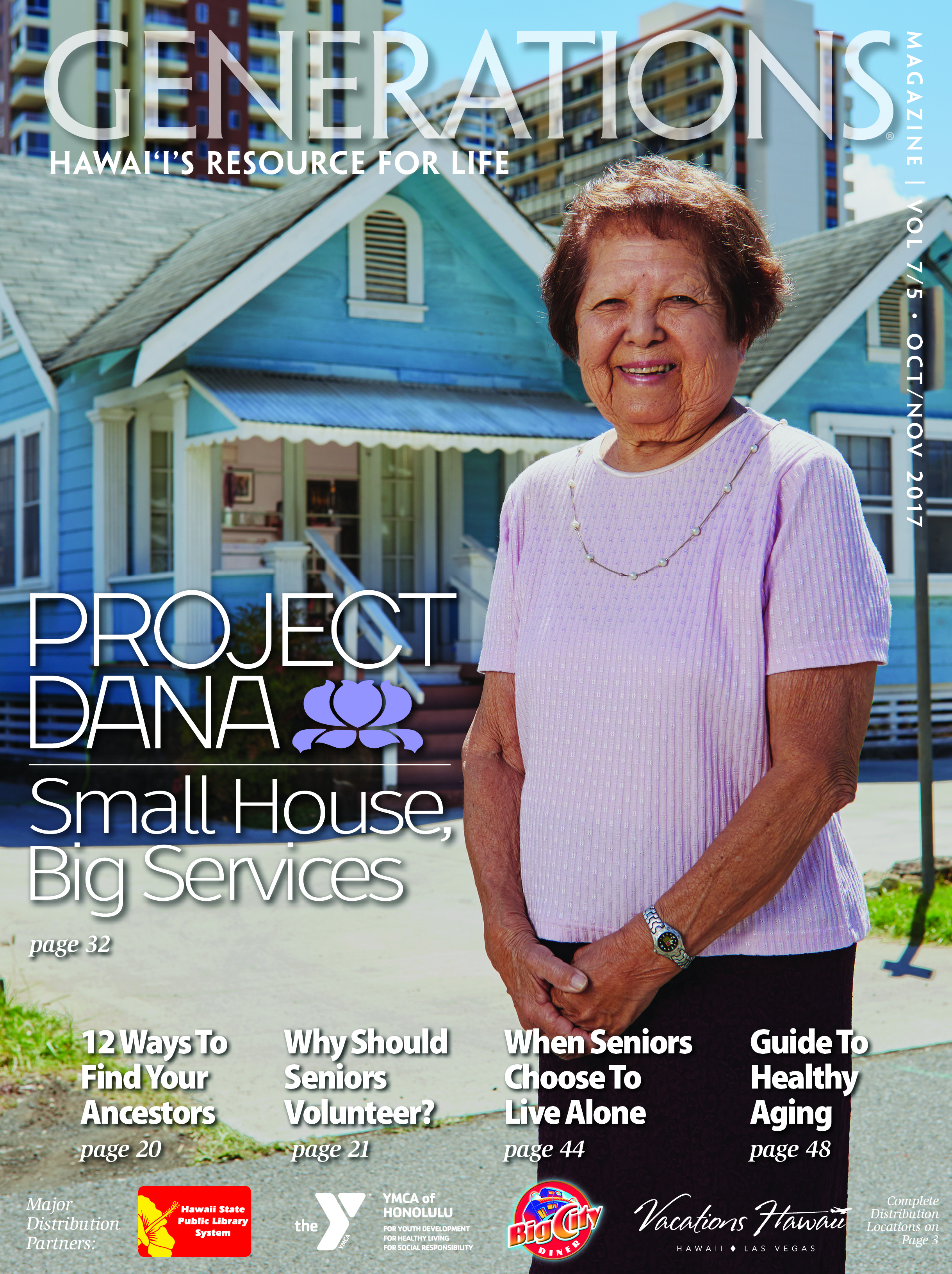
The little blue and white house in Mō‘ili‘ili, where Project Dana started an interfaith volunteer caregivers program has never closed! This headquarters was once the home of the late Kuniyo Nakamoto, who was helped by Mō‘ili‘ili Hongwanji Mission and Project Dana. She was so grateful for the compassion extended that she willed her home to Mō‘ili‘ili Hongwanji Mission. Volunteer painters, carpenters and electricians helped turn this home into offices, from which this Faith in Action project today serves over 1,200 older adults and seniors. If you have never volunteered, donated or received the services of Project Dana, it’s time you get acquainted.
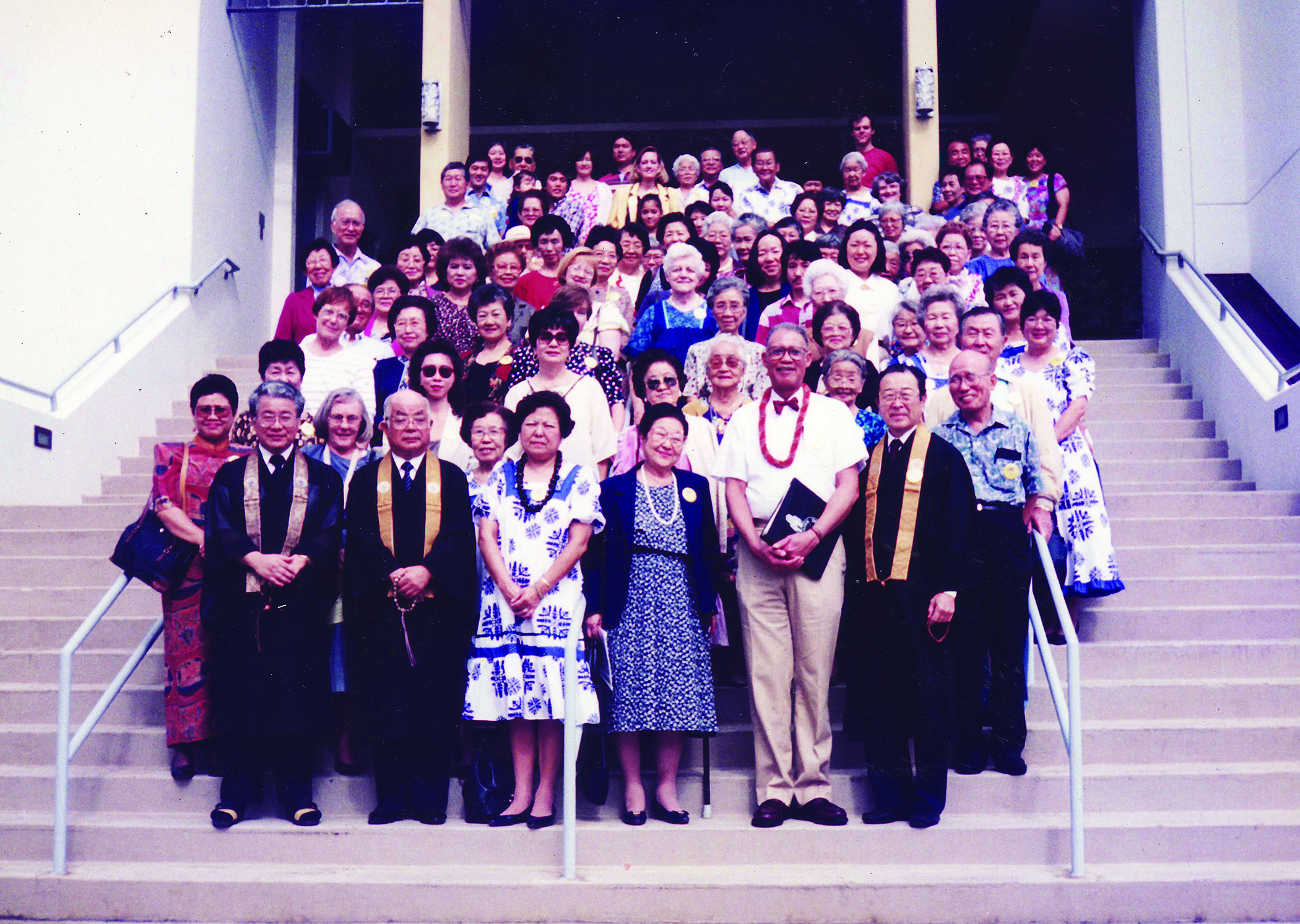
In 1989, members of Mō‘ili‘ili Hongwanji Mission began supporting Shimeji Kanazawa and Rose Nakamura in a small Faith in Action ministry to elderly people in their neighborhood. Now Project Dana partners with 32 missions and churches across Hawai‘i, selflessly giving their time to help the elderly.
Dana is not someone’s name, but a Sanskrit word that means, “selfless giving, an act of compassion.” Buddhists practice dana and teach this prized virtue to their children. Compassionate volunteers of all religions come to Project Dana with a desire to help seniors in need. Soon they discover that their small investment of time provides much more — the healing balm of social, emotional and spiritual support.
“Shim was an advocate and worked with large organizations — even on the mainland, like the National Federation of Interfaith Volunteer Caregivers,” Rose said. “I wanted to help the seniors, so I said ‘Yes.’ I was 61 at the time, but in good health and very active. My husband, Paul, was living then and helped me set up an organizational plan.”
Besides Mō‘ili‘ili Hongwanji Mission, other churches in the area joined in: Church of the Crossroads Caring Ministry and St. Mark’s Episcopal Church Aloha Ministry. A total of 32 churches and organizations partner with Project Dana and represent a wide variety of different faiths.
“We started with a handful of seniors and 15 volunteers,” Rose giggled at the memory. “The mission thought it was a big program. There are Project Dana sites on the Big Island, Maui, in California and Japan, and we coordinate with more than 150 public and private agencies. The “Persons in Need” Fund from the Hawaii Community Foundation provides assistance to homebound seniors for assistive devices, clutter clean-up, respite care and transportation needs. Personal Emergency Response System (PERS) is provided free through State of Hawai’i and Honolulu Police Community Foundation grants for one year to seniors living alone. We offer training to volunteers to assist families caring for elders with memory loss and dementia. In 2019, Project Dana will celebrate 30 years of service!”
Dana Begins with Volunteers
Kainoa Akiona studies Dietetics at UH Mānoa and takes his clients grocery shopping.
Kainoa Akiona is studying dietetics and nutrition at the University of Hawai‘i at Mānoa and one of the requirements of his scholarship is to volunteer in the community. Project Dana asks volunteers to give just one or two hours a week; it sounded easy. Kainoa had a vehicle, so Project Dana matched him with an 82-year-old senior who needed transportation to do her food shopping.
“We became friends, and it has become fun,” Kainoa said. “I just go by her house once a week, pick her up, and we go to whatever stores she needs to visit. Today, my kūpuna needed to go shopping! We went to Foodland, two banks and Safeway. I’ve been volunteering for a year, but I am continuing.”
“I also provide transportation for a young guy with a rare disability,” he added. “He’s very mindful on eating very healthy, so we shop at Down to Earth on King Street.”
Kainoa said he has grandparents, so he is used to talking with older people, and works in the food industry where he has to relate to all age groups. He said making conversation with seniors is fun and they like to tease him.
He is considering continuing his studies and becoming a clinical dietitian or a physician’s assistant. His Project Dana experience has given him a better understanding of his special gift for helping others.
Volunteer Training Opens the Door
Melanie Van der Tuin-Oka, a professor at HCC, enjoys spending time with her new friend, Virginia.
Melanie Van der Tuin-Oka teaches full-time at Leeward Community College and volunteers one hour a week.
“I have to volunteer early in the morning before my first class, but my client rises early,” she said. “I knew Rose Nakamura and Cyndi Osajima through the temple, but I never worked with the elderly, so Project Dana gave me a half-day of training and formally introduced me to my kūpuna and her daughter. The volunteer coordinator led the conversation so we could become more comfortable. I went back alone the next week, and all my concerns about getting started melted away. I could not have done it on my own, but Project Dana made it easy.”
Melanie said friendship is “organic”
because her new friend has a lot to share and she is very curious about Melanie’s life, too.
“I never really had a grandma, so now I am getting the stories, insights and wisdoms I missed — it is a very sweet relationship,” Melanie said. “As a volunteer, I can always bring cheerful, positive energy and I feel appreciated because when I am visiting, the daughter gets a break. If I discern a need, my Project Dana coordinator can help find resources to take care of it. I just have to pass on the need request. We are fortunate to have many resources for elders in Hawai‘i.
“I would recommend that readers call Project Dana and volunteer. It is an interfaith nonprofit but it’s not about religion—it’s about compassion. The volunteer work will bring them great joy.”
A Safe Home is A Happy Home
Project Dana provides social support to elderly, disabled persons and family caregivers that ensures their well-being and enables them to enjoy continued independence with dignity in the environment of their choice. Among them are home visits, telephone visits, respite care, light housekeeping, minor home repairs and transportation for medical appointments, shopping, care home visits and religious services. They also provide “Caring for the Caregiver” support group for family caregivers and home safety assessments.
Client Jane Kiuchi is 86 years old and lives independently. She is very grateful for the careful inspection, recommendations and improvements to her home — all initiated by Project Dana.
“I recommend that seniors have their homes inspected — before they fall!” Jane said. I did it after my fall, but now all the obstacles in my home are gone and I won’t fall again.
“First, Mr. Mike Hirano came and found places where I needed grab bars and pointed out a list of things I had missed like a clothes rack that was too close to my bedroom door,” Jane said. “If you have to squeeze through a door, the handle can snag your clothing and pull you over.”
“He told me to put grab bars in the bathroom so I would not hold onto the towel bars, which will not support your weight when you fall,” Jane said. “Then he helped me set up a licensed installer to put three grab bars in the bathroom and five outside my house, too. Now I can walk all the way from my door to TheHandi-Van without my walker. They also got me a PERS button that I can use to call my son and daughter-in-law or 911 if I fall and can’t get to a phone. I feel so much more secure and comfortable in my own home. Everyone who came to work on this project was so compassionate, patient and kind. Please call Project Dana for a free home safety assessment.”
Dana is for Caregivers, Too
Jackie Toma tells GM writer Katherine (left) the details of her very positive caregiver support group experience with Project Dana.
Two years after her father passed, Jackie Toma’s mom began going downhill. Jackie had lived in Seattle for 37 years and had herself suffered a stroke but was still working part-time. She returned to Hawai‘i to help her brother care for their mother. Even though they had paid home care, Jackie called on Project Dana.
“When my father was still living but no longer driving, Project Dana volunteers took my parents to their doctors’ appointments,” she said. “I remember that the volunteer would take them into the office and wait until they were finished and drive them home! It was such a big help.”
“I was fortunate to have paid home care for Mom, but I was feeling isolated,” Jackie said. “One day, the Project Dana volunteer driver told me that I could join Project Dana’s support group that meets twice a month. To tell you how thoughtful Project Dana is, they offered to send a volunteer to sit with Mom but at that time, she could manage herself at home. How nice of them to think of everything.”
“The first meeting is educational and you learn a lot!” Jackie said. “Education is provided by experts in physical therapy, assistive devices, Medicare, family mediation, legal issues, Hospice care, to name a few. The second meeting of the month is a combination ‘Rap Session’ and potluck. We all share experiences and learn from one another. It’s tough to deal with frustration and to problem-solve every time your parent’s condition deteriorates. When I was fresh out of ideas, my group came up with answers.
“I was astounded that ‘graduate’ caregivers would keep coming to our meetings after their loved ones passed. But after my mom passed, I decided to continue attending my support group. I want to mentor others in the same compassionate way I was helped.”
After 28 years of organizing, coordinating and service, co-founder Rose Nakamura passes on the office of Executive Director to Cyndi Osajima at the end of October. The dana they practice inspires all their staff and volunteers.
Rose Nakamura: The Spirit of Dana
The success of an organization is its ability to continue when the founders pass the mantle to
a new generation of volunteers. Visionary Shimeji Kanazawa died in 2014 and Rose Nakamura continued as administrator, raising up successors and mentoring new leadership with the same spirit of compassion that led her first to organize Project
Dana. In August, Rose announced her retirement and Operations Manager Cyndi Osajima is stepping up to executive director starting October 1. The organization will be in friendly capable hands, ready to serve and share compassion.
This fall is a happy time for Rose, who sees the fruits of her labor in waves of compassion flowing out from the little blue house on Nako‘oko‘o Street and the tides of gratitude returning to encourage her volunteers.
Selfless Giving Begets Selfless Giving
Generations Magazine Photographer Brian Suda and his wife, Pamela Cunningham, were caregivers for two decades. When Brian’s dad, Sakae, became frail in the ’90s, Project Dana provided support. Two years ago, when his mom, 97-year-old Tokiko, developed dementia, Project Dana again helped. The gratitude that the Sudas have for Project Dana is the best testimony to this marvelous, gracious community outreach:
After spending the last 20 years as family caregivers, we sometimes look at each other and say, “How did we survive?” It wasn’t always easy; there were plenty of good times and lots of laughter to ease the complexities of taking care of Dad and Mom. Through both of our caregiving journeys, Project Dana provided us with “scholarships” for much needed respite. A little time off meant that someone else realized how difficult caregiving could be, not just physically but emotionally as well. We used our scholarships to help provide additional days for both Dad and Mom at the day health programs that they attended. We knew that they would be safe and we didn’t need to worry about them. It’s hard to put into words the gratitude that we feel for Project Dana, Rose Nakamura and Cyndi Osajima. They and the program will always be close to our hearts and we can never repay them for helping us through the hardest and most rewarding jobs of our lives, but we will try. For now, all we can say is “Thank You, Project Dana.”
If you want to say “thank you” to Project Dana,
mail them a note and include a donation to:
It is never too early to plan for your own needs or to reach out to others in need. Project Dana volunteers are working throughout Hawai‘i, on the mainland and in Japan to help the frail elderly, persons with disability and family caregivers. Familiarize yourself with their services and share this resource with family, neighbors and friends.
Caregiver Support Group
Project Dana’s Caregiver Support Group (CGSG) program is unique in its concept because it is the only support group that provides three consecutive meetings every month during the course of one year. Attendees receive help in the form of education, rap sessions and a fun outing to help alleviate the stress that may come with continuous caregiving responsibilities for someone who is 60 or more years of age.
Meetings are held on the second, third and fourth Wednesdays of each month from 9 am–1pm unless otherwise specified at the Honpa Hongwanji Betsuin (1727 Pali Highway) in the Social Hall located downstairs of the main temple structure. Parking is available in the front and back of the main temple. All participants are requested to arrive on time.
Educating the caregiver is of prime importance. During the education session, speakers from different agencies and organizations within and outside the community present topics on health, safety, and understanding of the various issues related to the aging process. The focus is on how these factors can impact both your care recipient and also you, the caregiver. A continental breakfast and a light lunch are served
The second support component is called the Rap Session. Here, participants are given the opportunity to “talk story.” Joy and frustrations, as well as issues and concerns are often expressed in reference to the daily experiences of caring for a loved one. With this sharing, caregivers explore potential solutions among themselves and from their experience. Participants are asked to bring a dish to share in a potluck luncheon.
Finally, planned outings are offered to provide the caregivers “free time” to engage in total relaxation — breathing and nurturing the mind, spirit and body with healthy socialization. Discovering new places, and reacquainting oneself with sources outside the realms of everyday caregiving feed the soul. Some outings may require a small fee for participants. If there are any shared costs, participants will be notified in advance with the notice of date, time and theme.
Project Dana relies on a grant through the Older Americans Act of 1965, Title III E Funds, administered by the Hawaii State Executive Office on Aging through the Elderly Affairs Division, City and County of Honolulu. Monetary donations and other contributions are greatly appreciated to supplement the Caregiver Support Group and maintain the quality of the program.
In 2008, CGSG program received the Outstanding Support Group award by the Hawaii Family Caregivers Coalition and the once-aired KHON2 Elderhood Project.
Home Safety Program
Don’t become one of these statistics!
In Hawai‘i:
51 percent of deaths among elders are caused by falls occurring in the home.
61 percent of the elders who fall are women.
Most falls occur between 9 am and 1 pm
People who are 85 years or older are 10 times more likely to fall than those who are between the ages of 65–69.
Falls inside the home commonly occur in the bathroom, bedroom and kitchen areas.
Nationwide:
One out of three people 65 years and older will fall each year; most are women living alone.
90 percent of all hip fractures that occur each year are due to falls.
Only 25 percent of hip fracture patients will fully recover; 40 percent will require nursing home care; 50 percent will need a cane or walker; and 24 percent over age 50 will not survive more than 12 months after they fall.
60 percent of all falls occur at home.
The goals of the Home Safety Program are :
To increase awareness of home safety.
To create a safe home environment.
To allow participants to continue living independently at home.
To help ensure quality of life for our seniors.
To improve the well-being and enrich the lives
of our older adults and their families.
To identify all potential injury risk factors in
the home.
The Home Safety Program provides:
An initial home assessment visit
Educational information on home safety
Recommendations for possible home modifications and/or repairs
A follow-up home assessment
Possible suggestions for home modifications might include: nightlights, grab bars, non-slip mats, non-skid strips, shower seat, portable tub rail, commode, raised toilet seat, replace light bulbs, phone or power cord arrangement, etc.
Persons in Need (PIN) Funds Available
Project Dana continues to announce a special fund for seniors 65 years and older. Grants are available through the Gwenfread Elaine Allen Fund and administered by the Hawaii Community Foundation. This PIN Grant supports Hawai‘i’s frail elderly to “age in place” at home, in their community and with their family caregivers.
The PIN grant at Project Dana is in its fifth year. Assistance is provided through services already offered in three specific areas: transportation, respite and decluttering. Applications will be accepted through October.
A brief explanation of services follows:
✦ Transportation
Transportation assistance is available to frail elders for medical appointments, shopping requests and legal services such as banking, federal, state, city and county offices. Your safety and well-being are of concern regarding transportation needs. Funds for taxi fares may be offered for special medical appointments.
✦ Respite
Assistance is available to family caregivers whose elders attend adult day care/day health centers or who pay for respite care from a home health agency that goes beyond the two hours provided by a Project Dana volunteer. A one-time-only stipend, up to $600 per family caregiver, may be considered. A new component is assistance for family caregivers for overnight respite. Family members may apply for a one-time-only stipend, up to $150 per family.
✦ Decluttering
Project Dana’s volunteers provide free assessments for home safety and fall prevention. They also help seniors declutter and schedule appointments with professional organizers.
Volunteers
Project Dana would not be possible without support from a corps of trained volunteers guided by the principle of dana, a Sanskrit word that means selfless giving and compassion without desire for recognition or reward.
Project Dana recruits and trains volunteers across the state to assist the frail and elderly with their various needs. Volunteers are sensitive to diverse cultures and traditions and will receive initial and continuing training and education from the project coordinators and specialists. All Project Dana partner organizations and congregations are managed by trained volunteer coordinators.
For details on any of the program services, a free Home Safety Assessment (ask for Mike Hirano), or if you are interested in volunteering and being a part of Project Dana’s mission of service to the elderly, frail and people with disability, call 808-945-3736 or email projdana@hawaiiantel.net.
Project Dana Affiliated Locations:
O‘ahu: Aiea, Honolulu, Mililani, Kāneʻohe, Waianae, Pearl City, Kailua Hawaii Island: Keaʻau, Kailua-Kona, Hilo, Honoka‘a, Pepe‘ekeo, Captain Cook, Papa‘ikou Maui: Lāhaina, Pukalani, Kahului, Wailuku, Makawao Kauai: Līhuʻe
The little blue and white house in Mō‘ili‘ili, where Project Dana started an interfaith volunteer caregivers program has never closed! This headquarters was once the home of the late Kuniyo Nakamoto, who was helped by Mō‘ili‘ili Hongwanji Mission and Project Dana. She was so grateful for the compassion extended that she willed her home to…
by Katherine Kama‘ema‘e Smith Cover & feature photography by Brian Suda
It is said, “love conquers all.” And the riveting story of Roy Sakuma’s life and his outreach to at-risk youth proves that the lasting power of love can heal hearts and change minds.
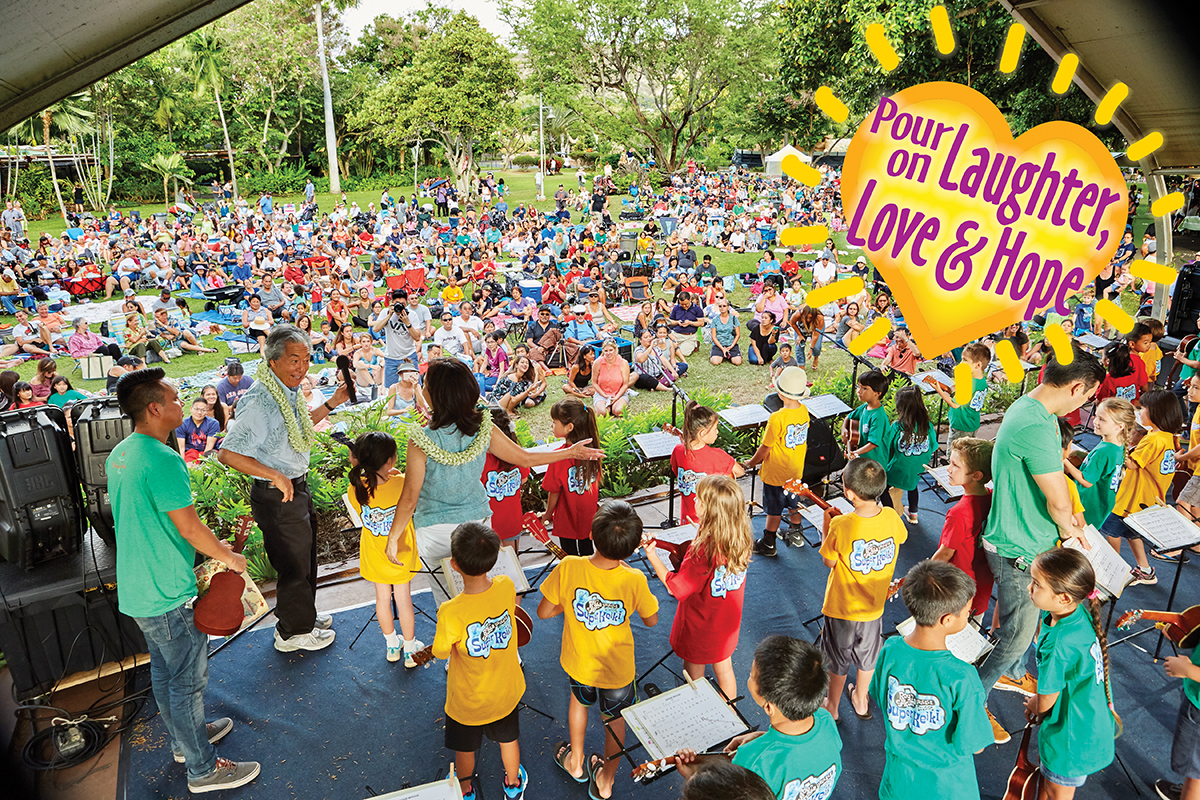
We all recognize Roy as the ‘ukulele master artist and teacher who founded the annual ‘Ukulele Festival Hawaii that recently celebrated 47 years at Kapiolani Park. Roy also hosts the popular concert series every summer surrounded by the animals at the Honolulu Zoo stage. He and his wife, Kathy, run four music studios where kids and adults learn the joy of playing ‘ukulele. Today, you will learn how Roy came to be Hawai‘i’s foremost ‘ukulele teacher and proponent of the instrument, and the powerful role love has played in his success.
I Want to Play That Song
In the 1960s, before Jake Shimabukuro or Israel Kamakawiwo‘ole, the ‘ukulele was regarded by most people as a novelty, according to Roy. Aside from virtuosos Herb “Ohta-San” Ohta and Eddie Kamae, the little Portuguese instrument was popular at the beach and backyard parties but seldom featured by Hawai‘i’s serious musicians, who preferred guitar, steel guitar, piano and even vibes. Mainland rock and roll was king, with electric guitar, bass, saxophone and lots of drums.
Roy Sakuma and Ohta-San performing together at the 39th Annual ‘Ukulele Festival in 2009. Photography by Wendal Au.
“One weekend, I was riding in an older kid’s car and heard Ohta-San playing Sushi on the radio,” said Roy. “I fell in love with the song. A couple of days later, I saw a classified ad for ‘ukulele lessons with Ohta-San and went right over.
“Playing the ‘ukulele grabbed me,” Roy said. “After 18 months, Ohta-San encouraged me to go on my own. He said that he had taught me what it took him five years to learn and the rest was up to me. ‘Go out and develop your own style,’ he said. So, I kept playing and the better I got, the more I realized how great my teacher was.”
“Ohta-San encouraged me to go on my own. ‘Go out and develop your own style,’” he said.
Roy soon began helping out at Ohta-San’s studio every weekend. When Ohta-San booked a two-week concert tour in Japan, he asked Roy to teach in his absence.
“I cannot teach,” answered Roy.
“Just do what I do,” said Ohta-San.
Roy was just 18 and he practiced all week to stand up in front of 25 adult students.
“I was very nervous until I began; then, the words just spilled out,” said Roy. “After Ohta-San returned, he asked me, ‘How did you like teaching my students?’ When I said I loved it, he told me to keep teaching them. Ohta-San continued his stellar performing career here and in Japan. And me — wow — after that, all I wanted to do was teach!”
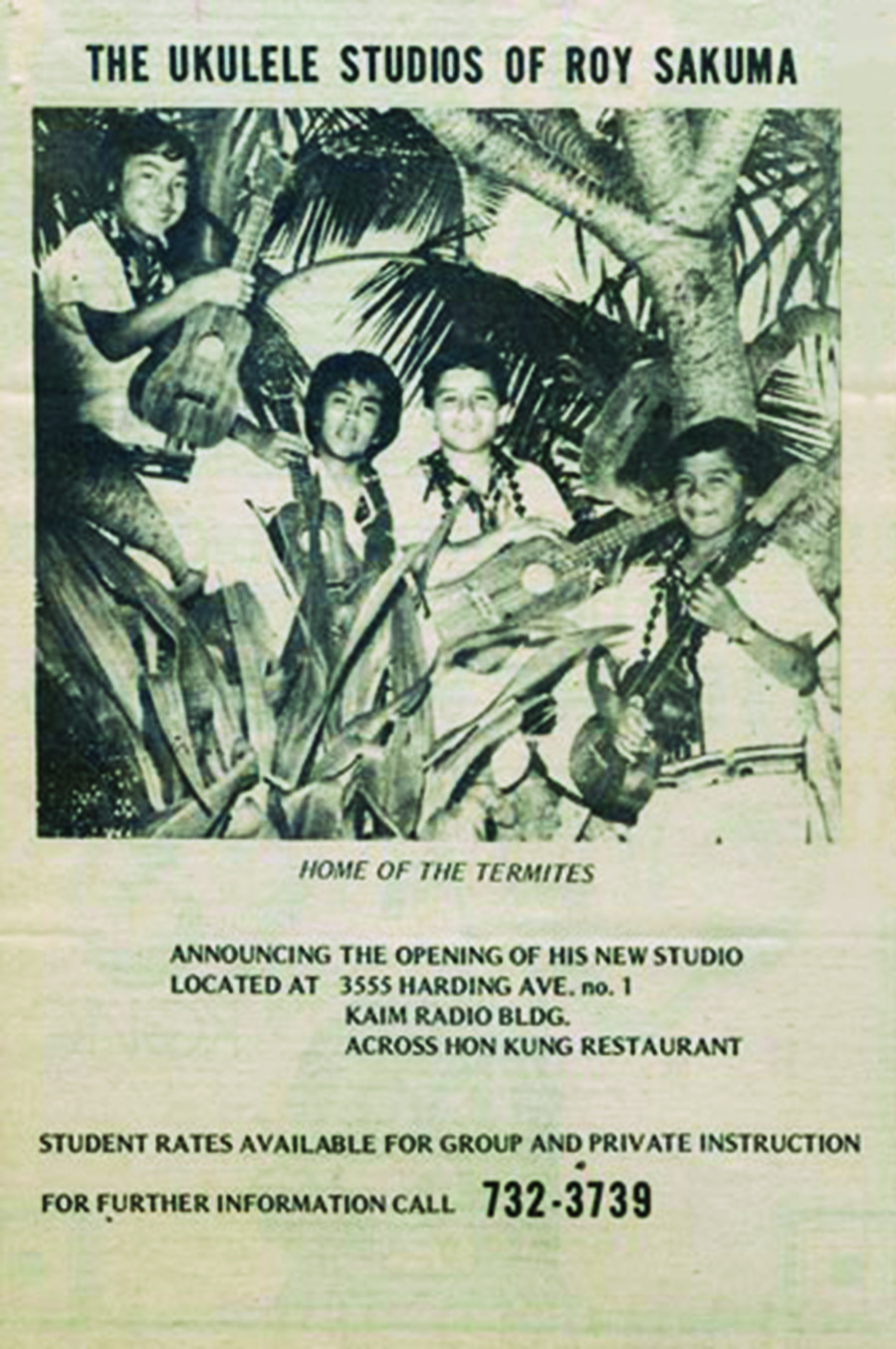
Roy opened Roy Sakuma Ukulele Studios in 1974 and ran his own classified ad. Over 40 students signed up; four were youngsters — Jason Mitsunaga, Dean Guzman, Milton Chun and Michael Ganab.
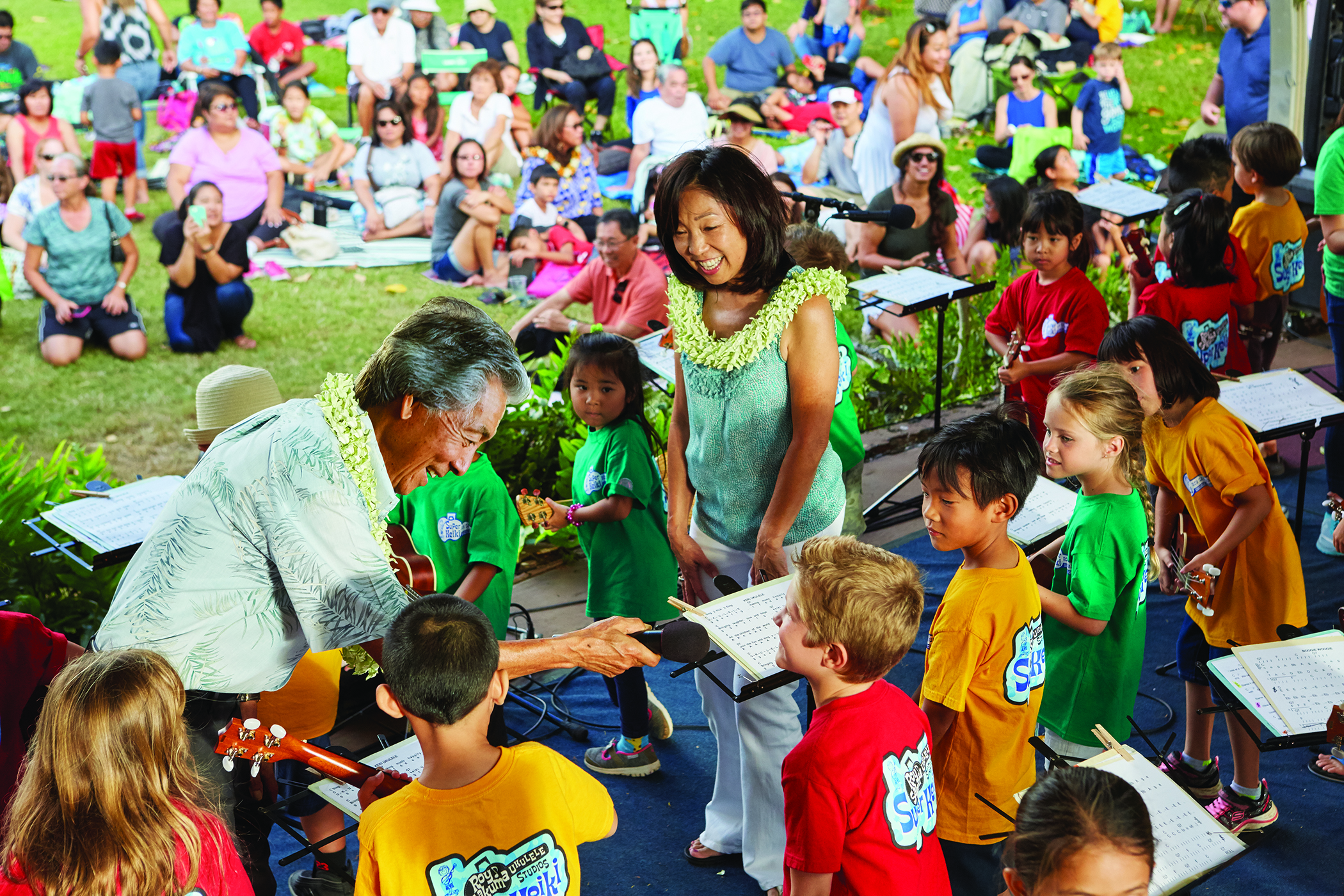
“I wanted these kids to have fun so we started a group called ‘The Termites,’” Roy said. “They were terrific young musicians, and their success and Orange Exchange TV commercial inspired children to learn the ‘ukulele. That grew into four studios and now we are teaching the kids or grandkids of our early students. At our studios, we not only teach music but we also teach love and respect. We care about our staff, and mentor them to treat the students with the same love and respect they receive from us. My philosophy is to put love on top of everything.”
Sad Hanabata Days
This joyful man with a deep abiding faith in the power of love, who mentored generations of ‘ukulele players, said he never understood love until he was in his 20s. When Roy was a child, his family struggled with mental illness and isolation. His mother suffered from schizophrenia. His father cared for her at home. A burdened but faithful provider, he overcome his sadness every evening at a local bar. Roy’s older brother also developed schizophrenia and once attacked Roy with a kitchen knife. “I remember sitting at the table watching my mother and brother talking to themselves. My daydreams gave me hope. There was little to eat, except sandwiches my father brought home from the tavern. The one bright light was my older sister, Faye, who was always there to watch over and protect me.”
Roy was born in 1947. One of his ears was half normal size. Adults would snicker at him and school children would ask, “What’s wrong with your ear?” When he asked his mom, she told him “Blame Buddha for making you like this. Look at all the people; they don’t like us.”
He became paranoid about his ear and avoided school. “When you are not in school, you find trouble. At age 6, I began smoking. At nine, I was drinking beer. Bad habits lead to mischief.”
Like most children, Roy was very honest. He told his dad that he was drinking. His father disapproved and punished him, but Roy continued smoking and drinking.
By age 10, Roy said he was holding “little balls of hurt” inside him. He learned how to tease other kids — to crush them with words and insults before they could make fun of him. “My best friend asked me, ‘Why do you always tease me? Roy, your words hurt!’ That comment hit me hard. I knew how much words hurt me, and apparently my own words also carried anger and hurt. I was amazed to find that after I had stopped teasing my friend, he stopped teasing me. Words turned out to be more horrible than I had imagined. This new knowledge also held a threat. If it is true that ‘What goes around, comes around,’ then a lot was going to come back to me.”
Still, his sister, Faye, was there for him. Roy recalls one of his fondest memories of their childhood: “When Faye was in the ninth grade, she went to her first social dance at a girlfriend’s house and gave me the number in case I needed her. Being alone at home, I started crying and called her. She came home to be with me. It’s a treasured moment that I have never forgotten.”
“From ages 10 to 15, I was convinced that it was impossible for me to fit in,” said Roy. “Full of hurt, I thought maybe I should have been born on Mars so that I could live all alone — by myself. My behavior became reckless. I didn’t like my life. Flirting with suicide touched my stone-cold emotions and offered brief relief for my pain. One day, I took a dare to swing on an old withered vine hanging off a big old monkeypod tree. The tree grew on the edge of a 200-foot cliff. I grabbed the vine and jumped off the cliff. Suddenly, I could not feel the vine in my hands anymore and I got scared. When the kids pulled me in, I was hyperventilating. I will never know what made that stunt different from all the others, but it made me stop doing things to put my life in danger… but I was still hurting inside.”
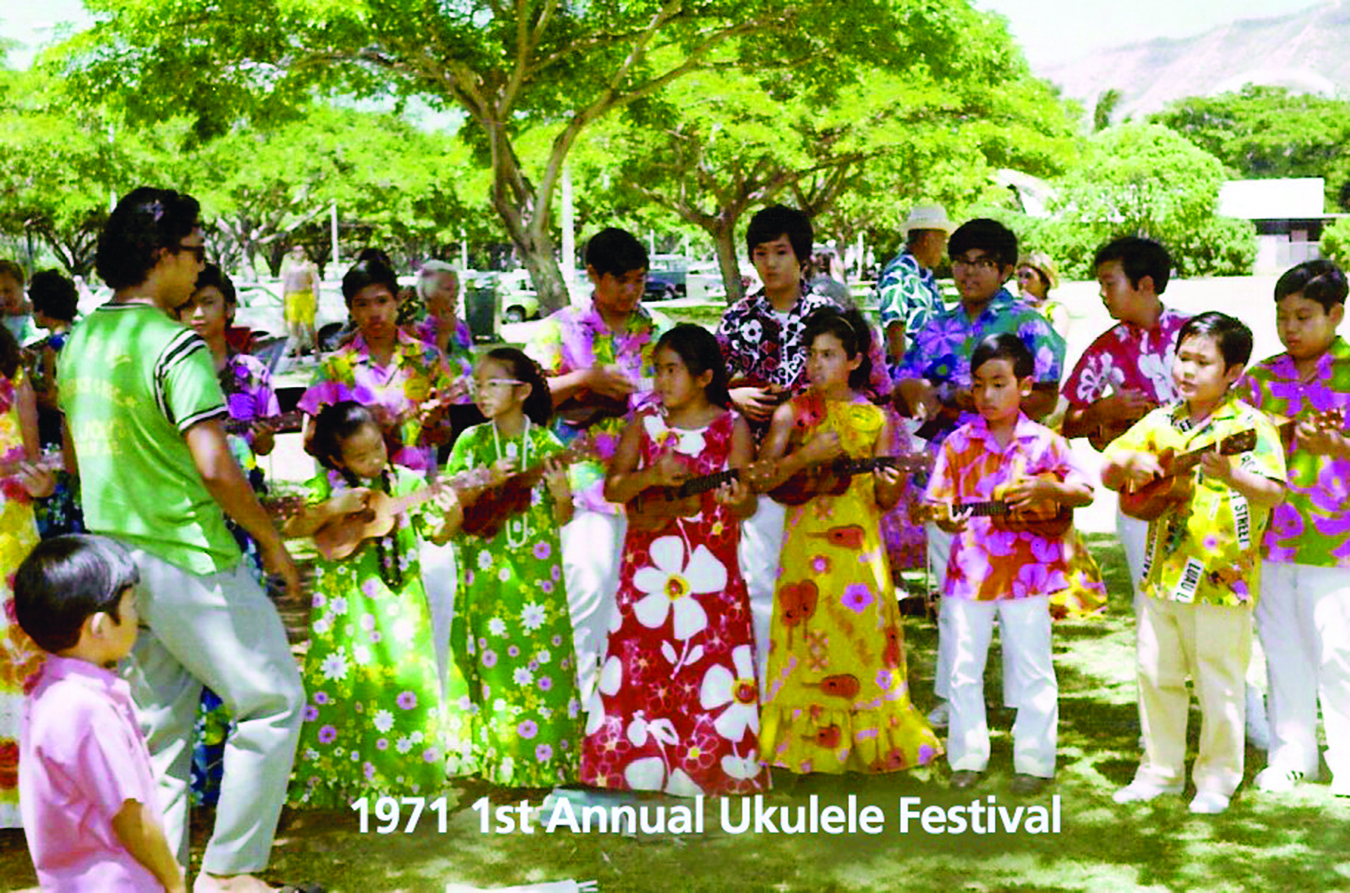
Roy and Kathy’s first annual ‘ukulele festival opened in Kapiolani Park in 1971. Since then, the ‘ukulele has been brought back into the mainstream of entertainment and the festival has reached popularity worldwide.
“I didn’t finish high school, but at age 20, I was lucky to get a job as a groundskeeper at Kapiolani Park,” said Roy. “I was so grateful for that job and did all they told me — and more. Working hard was never a problem. I liked working alone; hand-raking the whole park was my favorite job. Of course, I had learned social behavior — smiling, joking and nice teasing, but inside I was insecure and hurting. I never talked down to others because I didn’t want them to speak badly about me; instead, I bit my lip to protect myself. I never spoke of feelings or love. I did not know what the word ‘love’ meant. Even as I was still struggling with a crushed spirit. I picked up my ‘ukulele and a tune spilled out:
I am what I am; I’ll be what I be Look, can’t you see that it’s me, All of me
Copyright: Roy Sakuma Productions, 1970
“This song would become a theme for my life,” said Roy. “Once we doubt who we are and forget that we are special, bad things can happen.
Love is Patient and Kind
“In my early 20s, I met Kathy, the first girl I ever wanted to date,” said Roy. “I got up my nerve to ask her out to see the Harlem Globetrotters, who were coming to town. Thank goodness for the Globetrotters!
“From then on, Kathy and I dated once every couple of weeks, and I wanted to hold her hand, but I was afraid for her to touch me,” Roy admitted. “Hugging and other expressions of love were foreign to me and scared me. One time, we attended the Punahou Carnival, and to avoid getting separated in the crowd, I had to grab her hand. Holding hands wasn’t so scary after all.
“At our studios, we not only teach music, but we also teach love and respect.”
“A year later, I told her that I loved her and asked her to marry me,” Roy said. “She said, ‘yes!’ I went home so happy. But the next morning, I woke up crying — I knew that I must let her go. I didn’t deserve her and she would be better off without me. This love thing was beyond me.
“The next day, I asked her to meet me,” said Roy. “I asked her to please listen. I told her the truth about my fears — that my ear makes me hate looking in the mirror when I comb my hair, that I am paranoid and hate to see my body , that I am so ugly I don’t belong here; I am so ashamed that I could never make her happy.
“My philosophy is to
put love on top of everything.”
“Kathy listened. I did not want her to pity me; I wanted her to walk away and find a better man. Finally, she said, ‘I don’t see these things as your weaknesses. I see them as your strengths.’
“I was stunned. I just told her all my imperfections and failings — and she still loves me! Her love released me from the prison of my pain. It was like a gust of wind that cools the face. I had shared everything with her, and I could never go back there by myself. She loved me! Her love allowed me to reveal everything and to heal.”
Soon they married and became a team.
Love Rejoices in Truth
Since 2007, Roy Sakuma has been sharing his story with elementary and high school students — not as a music teacher — but as an inspirational speaker. His deep, intimate message touches youths who might be hurting like he was — troubled, isolated from their families, or struggling with thoughts of suicide. Roy doesn’t offer them advice; he doesn’t criticize their ideas or behavior. His story strikes a familiar chord.
“When I share my story, I ask kids who are hurting to raise their hands,” said Roy. “Hands go up and it is their way of reaching out.”
They recognize that he endured deep hurt and can understand their pain. They listen because he does not pity them. Instead he offers them the same key that unlocked his chains — love. And he points them to the richest source of love, their parents and teachers.
Listen With Love
Roy’s message of love over hurt is not only for youth but also for adults.
“Once kids fill up with hurts and shut down, responsible adults that they respect can help,” said Roy. “Adults can listen to them with love — with an open heart and mind.
“Kids really want to talk to their parents, but they are so afraid,” Roy continued. “They think that their parents are not interested, won’t listen or don’t understand them. Kids believe their parents: ‘won’t understand me, don’t love me, ignore me, don’t care, always get mad at me…’
“Parents often compliment and criticize their kids in the same breath. ‘Kimo, you did a great job, but…’ A hurting kid who can’t process their feelings will reject your encouragement as soon as they hear ‘but.’ They are bursting with so much hurt that they have difficulty seeing beyond it. Try giving compliments and then just listening.”
Love Endures All Things
“If you found a good way to deal with your feelings, share that with your kids,” said Roy. “Help them process their feelings with family and other trusted adults. Most of all, recognize that your child’s feelings are real and honest.
“Love your teens with the same unconditional love and forgiveness you gave them when they were 1-year-old toddlers. Parental love is forever. Put love on everything before you say it.
“In our music studios, we teach with love,” said Roy. “‘Ukulele music takes away stress and music crosses all emotional barriers. For some, the lesson is the highlight of their week. For us, it is an opportunity to share love, laughter and hope.”
ROY SAKUMA ‘UKULELE STUDIO
3555 Harding Ave., Honolulu HI 96816
808-732-3739 | www.roysakuma.net
It is said, “love conquers all.” And the riveting story of Roy Sakuma’s life and his outreach to at-risk youth proves that the lasting power of love can heal hearts and change minds.
By Scott Spallina, Senior Deputy Prosecuting Attorney
In the last two issues of the magazine, I shared the lessons about elder abuse that I learned from the experiences of my mother-in-law, “Mary.”
As I have mentioned before, tragedies are the fuel for many a con and when my father-in-law had his stroke, my family nearly learned this lesson the hard way. Feeling overwhelmed by the magnitude of caring for another person 24/7 and the astounding costs of hiring care, Mary did what many people in her situation do — she tried to find ways to ease the burden and reduce care costs. For Mary, this meant hiring a caregiver from Craigslist. It is from this website — where anyone can post anything without any type of verification or assurances that the services or products advertised are legitimate — that Mary found a person claiming to be a caregiver. However, it was discovered that this person was a scam artist who would come into a home, slip and fall and sue the homeowner. Fortunately, this was discovered before any con was enacted.
At another time, my wife and I drove home to find Mary in her car patiently waiting to speak with her daughter. After a lengthy discussion, my wife came inside and revealed what was so important to Mary.
My mother-in-law was just informed that one could invest in the Iraqi currency (dinar) and make millions of dollars when their country became a world power. A “close friend” of hers gave her this information, but only if she promised to keep it a secret. Fortunately, she told my wife, who, in turn, told me. In less than 10 minutes, I found countless warnings on the internet from the FBI about the “dinar investing scam.” This was a typical scam — one that promised great wealth only if you kept it secret from those who could tell you the truth.
In recent years, Mary got involved in a scheme to get free homes from banks that were “acting unconstitutionally.” Once again, this scam began with a charismatic speaker holding information seminars about “our freedoms.” The speaker told attendees that banks don’t really own your house — therefore, you don’t have to pay your mortgage… Long story short, for two years, based on this erroneous information that cost thousands of dollars, my mother-in-law didn’t pay her mortgage. As a result, the bank started foreclosure proceedings against her. Mary was very close to losing her home.
Many victims of elder abuse are just like my mother-in-law — smart, loving and filled with a desire to care for their loved ones. They are not victims because of their greed; they are victims because they believed the promises that assured them that their loved ones would benefit and be taken care as a result of the bounty they acquired through special “opportunities.”
As is evidenced by my mother-in-law’s many experiences, if an opportunity sounds too good to be true, it is. Always seek advice from professionals and trusted loved ones about get-rich-quick money and property schemes. And never make an emotional decision that involves money.
To report suspected elder abuse, contact the Elder Abuse Unit at 808-768-7536 | ElderAbuse@honolulu.gov
By Scott Spallina, Senior Deputy Prosecuting Attorney In the last two issues of the magazine, I shared the lessons about elder abuse that I learned from the experiences of my mother-in-law, “Mary.” As I have mentioned before, tragedies are the fuel for many a con and when my father-in-law had his stroke, my family nearly…
I often stare, somewhat embarrassed, at my creation of legal documents on behalf of my clients — especially after I explain my role — to clearly speak clients’ intentions at a time when they can no longer speak. Inevitably, the black and white legal documentation looks nothing like what my clients expressed to me as their most important hopes, wishes and goals.
Lawyers often believe that the form is most important — that somehow the clarity of the written legal word will communicate clients’ heartfelt wishes. However, no matter how artfully written, the form cannot stand alone in transferring intention. The written word is a static, stable, constant form of communication. This might work in and of itself if expressing a non-changing, fixed element, such as a mathematical constant. However, we live our lives in process, change, multi-dimension, complexity and emotion.
The legal documents we prepare do serve an important functional purpose. They explain who, how, when and what to do. Alone, they don’t express the meaning and intention underlying the plan. “The Conversation” provides the meaning — the “why”— and builds empathy and a deep understanding of the maker’s intentions.
Research shows that more than 70 percent of estate plans fail; failing defined as intentions not being honored. Research also bears out that process-oriented conversation provides the “solution.” When families actively engage in conversation, this failure rate decreases considerably.
Family meetings are an integral part of the process, so engage in “The Conversation”— soon.
Stephen B. Yim, Attorney at Law
2054 S. Beretania St., Honolulu HI 96826
By Stephen B. Yim, Attorney at Law I often stare, somewhat embarrassed, at my creation of legal documents on behalf of my clients — especially after I explain my role — to clearly speak clients’ intentions at a time when they can no longer speak. Inevitably, the black and white legal documentation looks nothing like what my clients expressed…
by Scott A. Makuakane, Counselor at Law, Est8Planning Counsel LLLC
Ingredients
1 part No estate plan established
1 part No family discussion
Directions
Mix vigorously, bringing it to a boil. Add unexpected ingredients to totally complicate things…
Serves an entire family… to its end.
A recent survey conducted by Chicago-based BMO Wealth Management confirmed that most Americans do not have estate plans, and those who do, do not discuss them with their loved ones. For a variety of reasons, both of these facts generate many avoidable problems that undermine family harmony.
According to the BMO survey, 52 percent of Americans do not have a will, much less a revocable living trust-based estate plan. Thus, most families must grapple with things like court proceedings and uncertainty about what to do when a loved one dies or becomes incapacitated. The survey also found that many of the people who do have estate plans do not discuss them with their children or other family members. This can result in surprises that erupt into family battles.
One of the most significant findings of the survey was that 40 percent of the time, beneficiaries feel that their parents’ estate plans were unfair. And when children believe that their parents’ estate plans are unfair, you have the basic ingredients for a fight that will only serve to enrich a small army of lawyers.
Avoiding litigation between your children after you are gone can be as simple as having an estate plan and then discussing your plan with them. If your children understand the thinking behind your estate plan, they may not agree with it, but they will be less likely to challenge it after you are gone.
Often, having a family meeting about your estate plan facilitated by an experienced mediator can bring potential problems to light and also resolve them, thereby avoiding future conflict. There are many organizations and qualified mediators who can assist in this process. One organization is The Mediation Center of the Pacific (www.mediatehawaii.org), which provides “high-quality mediation and dispute resolution services that are affordable and accessible” (see Generations Magazine’s Apr/May 2017 issue).
So, remember that having an estate plan will be a tremendous help to your loved ones as life’s inevitable transitions occur. Making sure that your family understands and supports your plan will stem bad feelings and future legal battles.
SCOTT MAKUAKANE, Counselor at Law
Focusing exclusively on estate planning and trust law.
by Scott A. Makuakane, Counselor at Law, Est8Planning Counsel LLLC Ingredients 1 part No estate plan established 1 part No family discussion Directions Mix vigorously, bringing it to a boil. Add unexpected ingredients to totally complicate things… Serves an entire family… to its end. A recent survey conducted by Chicago-based BMO Wealth Management confirmed that…
By Michael W. K. Yee, Financial Advisor and Certified Financial Planner
Saving for — and even thinking about retirement can be overwhelming. While it’s natural to worry about your financial future, be careful not to let preconceived notions prevent you from actively saving for tomorrow. If you find yourself having one of the following doubts, consider reframing your thinking. A perspective shift may be what you need to get on the right track.
◆ “Retirement is a long way off.” It’s easy to get wrapped up in your current financial obligations, telling yourself that you’ll prioritize your retirement next year. However, like many worthy aspirations, a sound retirement plan takes time and discipline to achieve. If your golden years seem far away, remind yourself of the power of saving early. Time allows you to tackle your retirement goals in smaller increments with the potential for compounded growth. Retirement will likely come faster than you think and your future self will thank you for planning ahead.
◆ “I’ll prioritize retirement after paying for my child’s education.” With the rising costs of college, it’s understandable and even necessary for you to help your child obtain a quality education. However, your nest egg should be the top priority. Once you reach retirement, you have limited options if your savings come up short. Alternatively, your child can secure financial aid to pay for college, including scholarships, grants, work-study programs and loans. You simply don’t have options like these to help fund your retirement. While retirement deserves the most attention, you can devise a strategy to simultaneously save for both important goals.
◆ “My retirement dreams are too expensive.” If your dreams of traveling through Europe or starting a new hobby seem expensive, give yourself a reality check. Start by comparing your dreams to your current nest egg. Calculate the amount you need to maintain your lifestyle, cover potential unexpected expenses (such as healthcare) and achieve your retirement bucket list. If your savings come up short, create a plan to fill the gap. Lofty dreams will force yourself to ask the tough question: “Do I want to adjust my current lifestyle to achieve this retirement dream?”
◆ “I won’t be able to retire when I want.” It’s true that more Americans are working longer and delaying retirement. Some simply prefer to remain active contributors in the workforce, but many others are forced to postpone retirement until they accumulate sufficient resources to retire comfortably. If you dream of retiring early, carefully assess whether your nest egg is sustainable over several decades. You’ll want to make sure the money you withdraw early in retirement doesn’t put you at risk of outliving your assets.
◆ “I can’t afford to save.” If this phrase comes to mind, give your self-talk a flip. Instead, think “I can’t afford not to save.” Setting aside even a small amount of money each month can make a big difference, as your assets can grow with the benefit of compounding. Consider increasing your monthly contribution to bulk up your nest egg.
◆ “My family will help me.” Perhaps you’re expecting a generous inheritance or hoping that your adult kids will provide a financial cushion if you experience an unexpected expense. Regardless of who you believe may come to your aid, it’s best to take your financial security into your own hands. Life is full of uncertainties that could impact bank accounts for both you and your family members. Knowing your future is under financial control may give your family peace of mind.
It’s not too late to correct misconceptions about the importance of saving for retirement. Consider working with a financial advisor to create a plan for your future. Together you can determine your savings targets and explore a wide range of strategies to meet your financial goals. It’s time to talk yourself back in to retirement.
MICHAEL W. K. YEE, CFP
1585 Kapiolani Blvd., Ste. 1100, Honolulu HI 96814
808-952-1222, ext. 1240 | michael.w.yee@ampf.com
By Michael W. K. Yee, Financial Advisor and Certified Financial Planner Saving for — and even thinking about retirement can be overwhelming. While it’s natural to worry about your financial future, be careful not to let preconceived notions prevent you from actively saving for tomorrow. If you find yourself having one of the following doubts, consider reframing…
By Daniel Bonilla, MedData Community Medicaid Long-Term Care Coordinator
The decision to move into a long-term care facility can be a difficult one, especially when it comes to finances. In Hawai‘i, a long-term care facility can cost anywhere from $8,000 to $12,000 a month, which is unaffordable for many families.
Medicaid’s long-term care coverage — an option that can help — is often overlooked because of common misconceptions about who qualifies and what is covered.
Here are five misconceptions:
“I will not be approved because I am not a citizen of the U.S.”
Generally, people who have been permanent residents of the United States for more than five years or those who are from a nation under the Compacts of Free Association who are 65 or older ARE eligible for Medicaid as long as they are Hawai‘i residents.
“I make too much money to qualify for Medicaid long-term care.”
Traditional Medicaid coverage does have an in-come eligibility limit, but there is generally no income limit to qualify for Medicaid long-term care. In fact, the more money you make, the less the state incurs in expenses to pay for your coverage.
“I can’t have any money in the bank to qualify for Medicaid long-term care.”
You may have checking, savings and other assets. If you are single, you can qualify with up to $2,000 in assets. If you are married, that amount increases significantly to $119,220 in joint assets.
“I’m over the asset limit; I own my home.”
Owning a home does not disqualify you from receiving Medicaid long-term care. There are many factors that contribute to whether or not the value of your property will be included in your eligible asset limit, such as its total value or if you still have an outstanding mortgage on your home.
“I will lose my home if I obtain Medicaid long-term care.”
If you are approved for Medicaid long-term care, the state may put a lien on your home but this does not mean that you will lose it. The circumstances that determine whether the state can or cannot place a lien on your property will vary. For example, if your spouse is currently living in the home, a lien cannot be placed on your property.
MEDDATA
For free screening: 808-566-6666 | 855-690-8977 www.meddata.com
By Daniel Bonilla, MedData Community Medicaid Long-Term Care Coordinator The decision to move into a long-term care facility can be a difficult one, especially when it comes to finances. In Hawai‘i, a long-term care facility can cost anywhere from $8,000 to $12,000 a month, which is unaffordable for many families. Medicaid’s long-term care coverage — an option…
by Jane Yamamoto-Burigsay, Social Security Public Affairs Specialist in Hawai‘i
Enjoying a comfortable retirement is every-one’s dream. For over 80 years, Social Security (SS) has been helping people realize those dreams, assisting them through life’s journey with a variety of benefits. It’s up to you as to when you can start retirement benefits. You could start them a little earlier or wait until your “full retirement age.” There are perks to both…
Full retirement age refers to the age when a person can receive their SS benefits without any reduction, even if they are still working part- or full-time. You don’t actually need to stop working to get your full benefits.
For people who reach age 62 in 2017 (i.e., those born between Jan. 2, 1955, and Jan. 1, 1956), full retirement age is 66 and two months. Full retirement age was age 65 for many years. However, due to a law passed by Congress in 1983, it has been gradually increasing, beginning with people born in 1938 or later, until it reaches 67 for people born after 1959.
You can start receiving SS benefits as early as age 62… or any time after that. The longer you wait, the higher your monthly benefit will be, although it stops increasing at age 70. Your monthly benefits will be reduced permanently if you start them any time before your full retirement age. For example, if you start receiving benefits in 2017 at age 62, your monthly benefit amount will be reduced permanently by about 26 percent.
But, if you wait to start receiving your benefits until after your full retirement age, your monthly benefit will be higher. The amount of this increase is two-thirds of one percent for each month — or 8 percent for each year — that you delay receiving them until you reach age 70. The choices you make may affect any benefit your spouse or children can receive on your record, too. If you receive benefits early, it may reduce their potential benefit, as well as yours.
Be as informed as possible when making any decision about receiving SS benefits. Read “When to Start Receiving Retirement Benefits” at www.socialsecurity.gov/pubs/EN-05-10147.pdf.
If you decide to receive benefits before you reach full retirement age, you should also understand how continuing to work can affect your benefits. SS may withhold or reduce your benefits if your annual earnings exceed a certain amount. However, for every month benefits are withheld, your future benefits increase. At your full retirement age, SS will recalculate your benefit amount to give you credit for the months they were reduced or withheld. Learn more at www.socialsecurity.gov/planners/retire/whileworking.html.
For questions, online applications or to make an appointment to visit a SSA office, call from 7am–7pm, Mon–Fri:
1-800-772-1213 (toll free) | 1-800-325-0778 (TTY) www.socialsecurity.gov
by Jane Yamamoto-Burigsay, Social Security Public Affairs Specialist in Hawai‘i Enjoying a comfortable retirement is every-one’s dream. For over 80 years, Social Security (SS) has been helping people realize those dreams, assisting them through life’s journey with a variety of benefits. It’s up to you as to when you can start retirement benefits. You could…
By Dan Ihara, RA, CAPS, CLHMS, Senior Real Estate Specialist, RS-65892
As we all age and watch those around us get older, concerns about the safety of our loved ones may increase. Whether it is memory loss, falls, a decrease in appetite and hygiene, or the absence of family or friends, everyone will need some kind of help sooner or later.
Some of the questions families may have are:
Should my mom be living alone since she’s fallen recently? What kind of services are available to help her in her home and how much do they cost?
For in-home care, there are home care and home healthcare options. The costs will vary based on the type and level of service needed.
Be aware that most of them will have a minimum charge per visit.
My parents are becoming more forgetful. Should they stay by themselves?
There are various options for your parents. Adult day care may be an option for companionship during the day and may accommodate even the busiest schedule. Bringing care into your home is also an option; however, its more costly than adult day care. Moving into a retirement community is also a viable option to provide a sense of community and companionship 24/7.
My uncle lives alone. Would it be safer for him to live in a retirement community? If so, what are the options?
A retirement community could be a great solution for your uncle. Retirement communities offer many services and have safety protocols in place so it is safer than living alone. There are different types of communities with various options, so it’s good to research or attend a seminar to find the one that best suits your uncle’s needs.
My neighbor has so much stuff that she could trip over! How can I get her help?
There are several declutter services that can be brought into your neighbor’s home to help remove unnecessary items. They can help sell, donate or dispose of them.
You may have other questions like those above concerning friends and family members, but rest assured that there are many resources that can provide answers and solutions to help them safely navigate this phase of life.
By Dan Ihara, RA, CAPS, CLHMS, Senior Real Estate Specialist, RS-65892 As we all age and watch those around us get older, concerns about the safety of our loved ones may increase. Whether it is memory loss, falls, a decrease in appetite and hygiene, or the absence of family or friends, everyone will need some…
Life is full of choices as a consumer. We try to make informed choices but sometimes getting there takes a bit of experience and know-how. Online product or service reviews are helpful at times but can mean different things to different people based on experience. The same can hold true when searching for home care for yourself or a loved one.
A study done by Northwestern University reveals that home care buyers should beware. Researchers who posed as consumers surveyed 108 home care agencies from around the country. Results showed they hired unqualified and possibly dangerous caregivers to work in the homes of vulnerable seniors. Not only did agencies exhibit poor hiring procedures but researchers also found that many agencies did not train, supervise, screen or test for skills competency of their caregivers. Families may not realize how unqualified a caregiver is, especially if the care is for an aging parent who has multiple chronic conditions. In the state of Hawai‘i, home care agencies are not required to obtain a license, certificate or accreditation. What’s frightening is that agencies can continue to operate without any regulating
or monitoring.
“People have a false sense of security when they hire a caregiver from an agency,” said Lee Lindquist, MD, geriatrician and author of the study. “There are good agencies out there but there are plenty of bad ones and consumers need to be aware that they may not be getting the safe, qualified caregiver they expect. It’s dangerous for the elderly patient who may be cognitively impaired. Some of the paid caregivers are so unqualified it’s scary and really puts the senior at risk. We found agencies sending caregivers out into the seniors’ home without checking,” she said. “Identifying the good agencies from the bad is difficult because many agencies have slick websites and marketing campaigns.”
The study was published in the Journal of American Geriatrics Society. From the agencies surveyed, slightly half (55 percent) conducted federal background checks. Even worse, only one-third did drug testing or checked for caregiver skills competency. More surprising, many agencies allowed caregivers to assess their own skills in a self-report and lacked consistent supervision of their caregivers. “The home care study is concerning, and families will want to seek more qualified caregivers from a reputable agency that is both accredited by The Joint Commission and licensed as a home health agency,” said Attention Plus Care Chief Administrative Officer Wesley Chang. “Home health agencies in Hawai‘i that provide skilled nursing services and other therapeutic services under a physician’s direction to home-bound patients must be licensed and monitored by the Hawai‘i State Department of Health.”
To maintain accreditation by The Joint Commission, agencies undergo a rigorous comprehensive evaluation to verify if the agency is following state and federal guidelines, as well as national health standards set by The Joint Commission. The commission’s goal is to address safety and quality care, leading to continually better patient care standards and outcomes.
Now that’s a good choice.
ATTENTION PLUS CARE
Accredited by The Joint Commission
1580 Makaloa St., Ste. 1060, Honolulu HI 96814
808-739-2811 | www.attentionplus.com
Available monthly: AGING IN HAWAII EDUCATIONAL OUTREACH PROGRAM by Attention Plus Care — A program to provide resources for seniors and their families, instructed by a registered nurse, who covers a different aging topic each month. For more information on upcoming topics, contact 808-440-9356.
By Eileen Phillips, RN, Attention Plus Care Life is full of choices as a consumer. We try to make informed choices but sometimes getting there takes a bit of experience and know-how. Online product or service reviews are helpful at times but can mean different things to different people based on experience. The same can…

 I’ve been researching my ancestors for about 20 years. On my Hawaiian side, I’ve gone back five generations, and three generations on my Filipino side. I get so excited when I connect the dots in my family tree and discover a new family member, because I now have a name and story to share with my grandchildren.