Category: Articles

  • Age Bias in the Workplace

    Bias is everywhere, including the presumption that you might be too old to work even when lengthening lifetimes allow you to do more for much longer. Nobody says it is easy for those of us in our 50s, 60s, or beyond, to overcome what others may think.

    Age bias is not just a myth but a fact to deal with in this new time of longer life spans. It is our task to learn to deal with common biases and meet the harsh realities of change. Here are some ways:

    BIAS 1: Older workers are too expensive. Forget what you once earned. Your contribution is worth what the market pays. Study marketplace pay scales before interviewing. Demonstrate your skills’ return on investment, based on their priorities and your ability to help their bottom line.

    BIAS 2: Older workers can’t learn as well as younger workers. (This is the “old dogs can’t learn new tricks” bias.) Don’t get caught with your learning down! Demonstrate what you have learned, particularly skills that will help a prospective employer or client.

    BIAS 3: Older workers are inflexible and set in their ways. (Boomers themselves set this myth in stone, and many have reaped what was sown.) Demonstrate how you have adapted to new challenges in work environments. Keep your change examples focused on describing relatively recent workplace efforts and results. Stick with 10 years or less. Nobody cares what you did before then.

    BIAS 4: Older workers are “age discrimination lawsuits” waiting to happen. Although it is more likely that people over the age of 50 will win age discrimination lawsuits than people over the age of 40 (legally protected class by the Feds), proving disparate treatment is not an easy task and a painful outcome for all involved. This is the hidden fear no employer discusses. On the contrary, demonstrate your flexibility to manage challenges the employer (or client) faces.

    BIAS 5: Once people reach their 60s, they really are too old to work. One in four people in Hawai‘i is 60 today. Chronological age bias is a hangover from the past. Don’t volunteer your age. Period. Take a self-marketing class from a qualified, mid-late career coaching expert who will ensure that you have skills to prove your energetic contribution based on relevant knowledge.

    BIAS 6: Older workers cannot adapt to new technologies. What is new in technology today is old tomorrow. Choose to continue to learn throughout your working lifetime. The single  biggest challenge in using technology is your own self-confidence. Take classes at a community college or through a senior center. Dive into the tech pool. The water is fine! And highlight your “technological currency” in your tools and during interviews.  N


    NEW WORKFORCE HAWAI’I

    Carleen MacKay, Co-Founder
    913-316-0143  |  carleenmackayhi@gmail.com
    www.newworkforcehawaii.com

    Bias is everywhere, including the presumption that you might be too old to work even when lengthening lifetimes allow you to do more for much longer. Nobody says it is easy for those of us in our 50s, 60s, or beyond, to overcome what others may think.

  • Love Through the Ages

    As we grow and mature through the years, we learn about different kinds of love.  As children, we received love from our parents and learned about the love we felt for our friends and peers.

    Our 20s was an important time. We learned to love ourselves. Loving who we are prepared us to love others. It was an exciting time, followed by intimate relationships, having children or pets and, later in life, connecting with the community and the world by traveling or volunteering.

    Dr. John Gray, author of Men Are From Mars Women Are From Venus, has written that full, adult maturity happens around age 56. As humans,
    we have so many stages of life to experience that it takes us a long time to master the many varieties of love. By the time we are in our 50s, we have developed a greater capacity. Often, the quality of our relationships improves when we have developed the understanding, acceptance and compassion for the people we share our lives with. We realize how precious love is.

    Let me share an example of how we can live a love-filled life. Sheila came to see me because her husband had died from cancer right after her second daughter got married. Sheila had planned to travel and retire with her husband, but now she was left alone. She had friends, but she didn’t want to bother them with her sadness. Her daughters were busy with their careers and husbands. She wanted to date, but she wasn’t attracted to the men that she met. She thought they all seemed “too old” for her even though they were around her age.

    Everything in her life was a problem. She continually focused on what she didn’t have. As we worked on her “Circle of Life” (from my book), she realized that her life was really good. She had her health. She could still play tennis and loved mahjong, so she called up some friends to play. Her daughters both had babies. She would babysit for them and feel the closeness of their families. She didn’t sleep well, so she’d listen to podcasts so she wouldn’t be so lonely at night.

    Slowly over time, she began to feel more hopeful. Friends invited her for dinner, and she had things to talk about. She began to feel like she could go on in her life. She has been able to build her life in a direction that feels hopeful for her. Her life is an example of how maturity allowed her to shift her love from the loss of her husband to the other people that were in her life.

    Love changes throughout our life span. If we  allow ourselves to love and be loved, we will have love through all the stages of our lives.


    MARS & VENUS COUNSELING CENTER

    www.mitzigold.com 808-737-6277 (737-MARS)

    Our 20s was an important time. We learned to love ourselves. Loving who we are prepared us to love others. It was an exciting time, followed by intimate relationships, having children or pets and, later in life, connecting with the community and the world by traveling or volunteering.

  • Making Sense of Widowhood

    Recently, I was having dinner with a number of close girlfriends and their daughters. Afterwards and on the road home, my daughter commented that I was the only woman at the event who was not widowed. My friends are all in the early to mid-60s. Of course, I knew this about each friend. As a gerontologist, I also know the statistics about widowhood.

    Still, my daughter’s comment shook me. I know that in 2015, roughly one in four, or 25 percent of people 65 and older, was widowed. Of the nearly 14 million widows and widowers in the U.S., 11 million of the widowed are women. The percentage of those widowed dramatically rises with age, for both sexes, but more so for women.

    These numbers sadden me. The thought of losing my husband is something I dread. But widowhood is a statistically ‘‘normal’’ experience for older persons, especially older women. While widowhood is considered one of the most distressing transitions experienced by older adults, we are reminded of other older women — and men — who never have been married or are divorced. Meeting one’s needs for love and intimacy varies substantially by many individual preferences and factors, such as one’s orientation, financial status, disability and even feelings of disapproval by younger family members and society.

    But, for most people, and regardless of age’s life transitions and challenges, we crave intimacy, friendships and love from our partners, our families, our friends and others in our lives. Here are some thoughts to consider.

    First, we acknowledge that there are many ways to meet emotional and intimacy needs. For an interesting book to read, I recommend
    Aging Thoughtfully: Conversations about Retirement, Romance, Wrinkles, and Regret by Martha C. Nussbaum and Saul Levmore, Oxford University Press.

    Second, it is time to debunk all of those denigrating myths about older adults, especially those around older women, that announce that aging women must graciously renounce sexual love, leaving it to the young. Recent research tells us mature love is both sexual and personal and that sexuality in older adults is highly personal, based upon memory, humor and shared history. For that reason, it can have a depth that youthful love can’t have. So, we need more knowledge and healthy attitudes about meeting emotional and sexual needs and feelings of older adults living in the community or in long-term care settings.

    Finally, let’s remember that we are talking about grown-ups here. How you handle this issue should be completely up to you. Don’t let others tell you what you want or don’t want, or what you can do or not do. Between consenting adults, there is no right or wrong way to do this.

    Love doesn’t always endure. We need more women, and men, to move away from stereotypes and to explore their own truths. But that is another story.


    MYRON B. THOMPSON SCHOOL OF SOCIAL WORK
    UNIVERSITY OF HAWAI‘I
    2430 Campus Rd., Gartley Hall, Honolulu, HI 96822

    808-956-6126
    cbrowne@hawaii.edu

    Recently, I was having dinner with a number of close girlfriends and their daughters. Afterwards and on the road home, my daughter commented that I was the only woman at the event who was not widowed. My friends are all in the early to mid-60s. Of course, I knew this about each friend. As a gerontologist,…

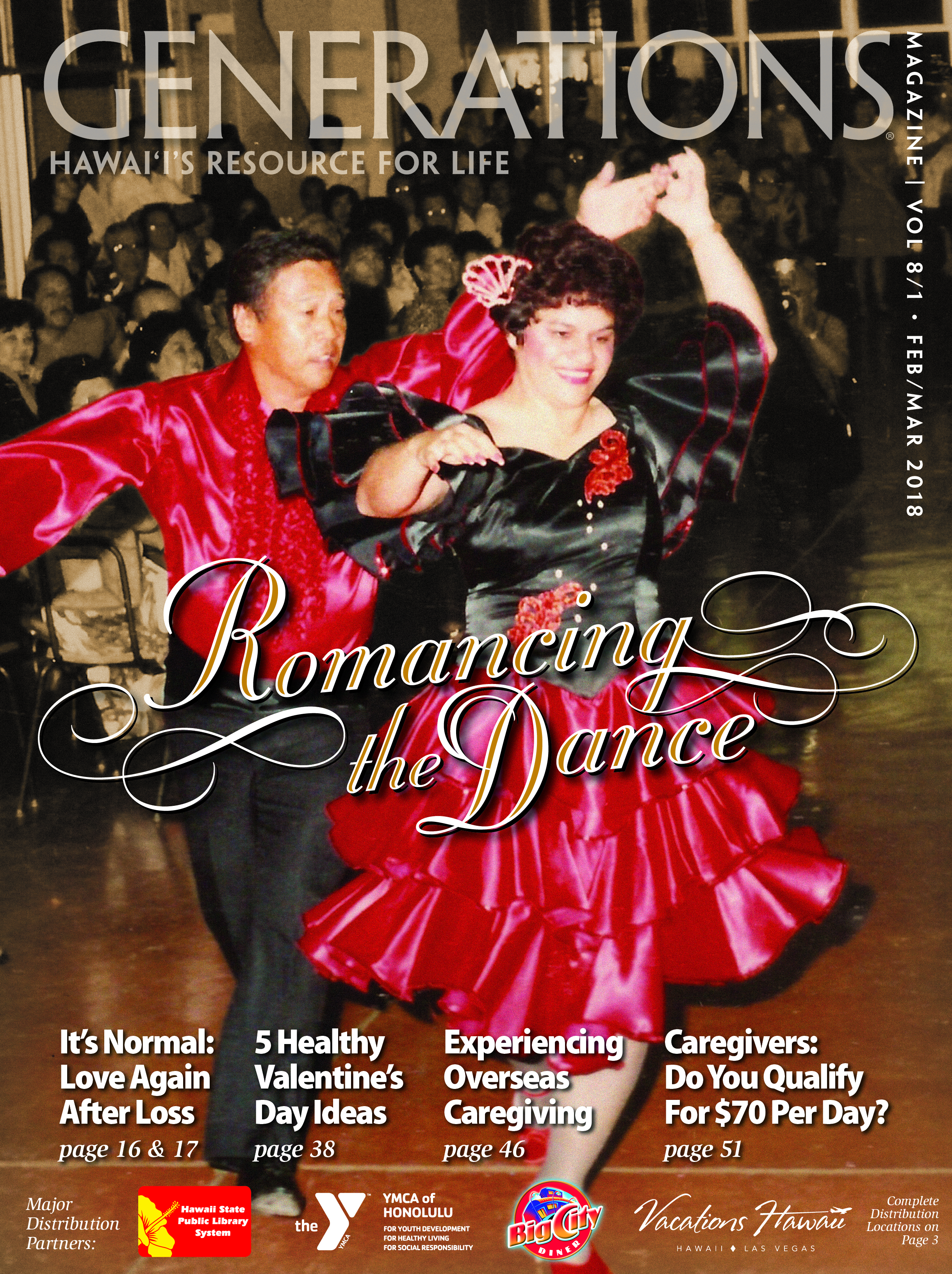
  • Romancing the Dance

    Romancing the Dance

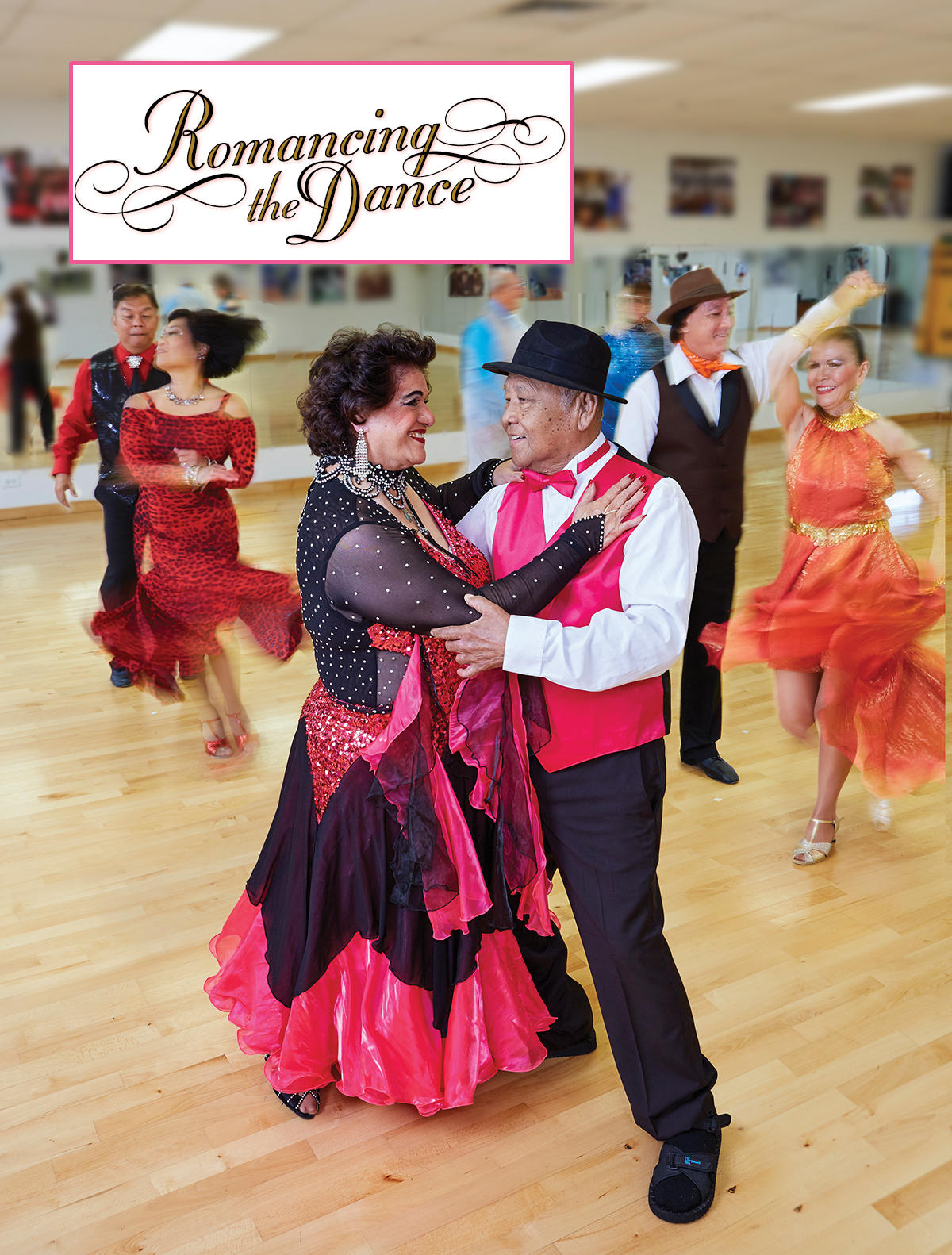
    Romancing the DanceFaith and Benny Agbayani celebrated their 49th wedding anniversary this year, and both agree that the success of their partnership is doing things together. Maintaining a close relationship is more than saying, “I love you;” it’s taking on challenges as a team, mastering new skills and learning together. Overcoming obstacles in life requires commitment, sacrifice and a willingness to cooperate. The Agbayanis do all these things well, but simply call it “sticking together.”

    The Agbayanis serve as Dance Director and Associate Dance Director of the Hawaii Ballroom Dance Association (HBDA), which has chapters throughout Hawai‘i where people may learn ballroom dances and participate at social dances at their Dance Studio or Balls at the Ala Wai Golf Course Palladium in Honolulu. Faith and Benny began at the HBDA Pearlridge Chapter. Then they became dance instructors with Arthur Murray Dance Studio in ‘Aiea, and competed in ballroom dancing competitions in Las Vegas. Later, they returned to HBDA as Rotating Instructors — demonstrating new dances to all the HBDA chapters. Now, they direct 53 volunteer Telemark instructors, who encourage ballroom dancing students throughout Hawai‘i to reach for the stars.

    “Telemark” is the name of a fundamental turn used in Waltz double-reverse turns and Foxtrot reverse turns. Mastery of the telemark is so essential to ballroom dancing that HBDA uses “telemark” to brand its Telemark Corps of Instructors, annual Telemark Ball and Telemark Queen.

    HBDA students normally start with the Foxtrot and Waltz, but before long, they step up to a full repertoire — Merengue, Rumba, Paso Doble, Argentine Tango, Mambo and West Coast Swing — to name a few.

    The Agbayanis successfully waltzed through many projects and challenges before they knew anything about ballroom dancing. Says Faith, “I think it’s the power of love and partnership that makes our marriage strong and helped us raise our family.”

    Benny agrees. “When you make sticking together a priority, you are going to stay together and enjoy a nice life,” he says.

    Ballroom dancing is partnership — an activity that can only be done perfectly when both partners work together, focus on every step and synchronize to the beat of the music. One leads, and the other follows. Both roles must be performed expertly. Mastery means learning the steps, working out the kinks, and lots of practice.

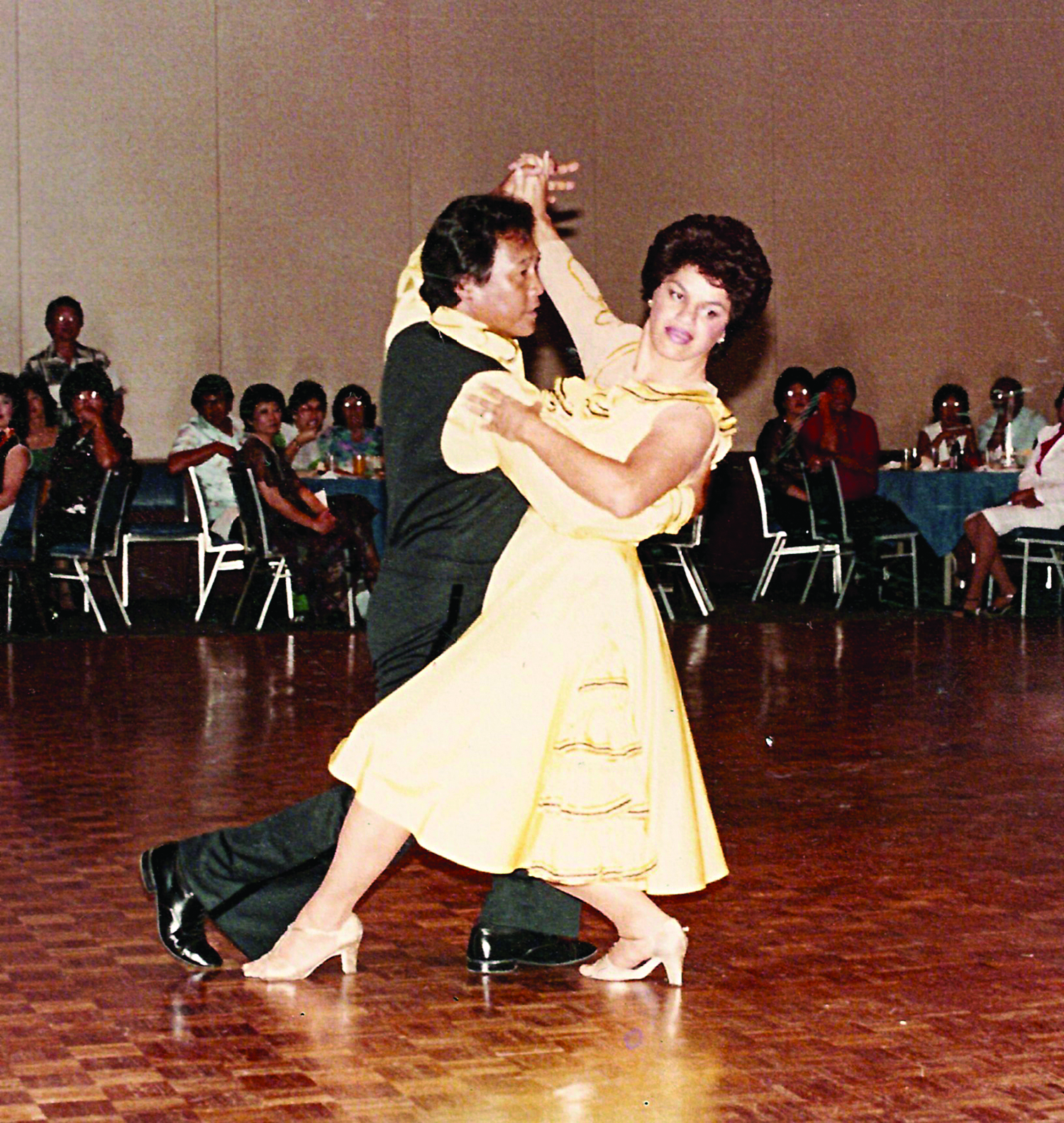
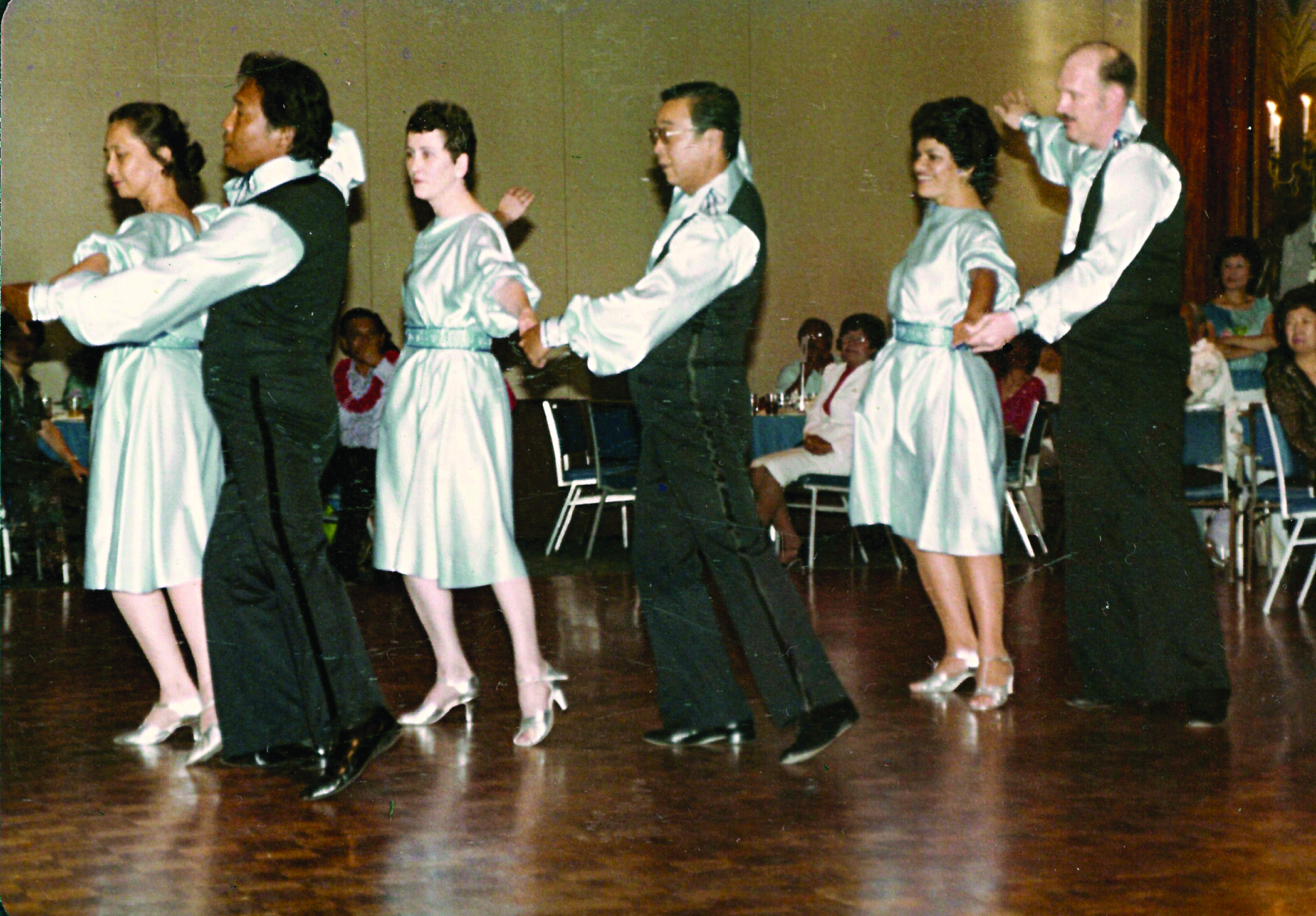
    Benny and Faith at the Arthur Murray Showcase 1983, at Princess Kaiulani Hotel
    Benny and Faith at the Arthur Murray Showcase 1983, at Princess Kaiulani Hotel

    How did Faith and Benny first get involved in dancing? We might imagine them coming from society families who danced at grand parties and taught their children to dance. Not so.

    They both came from big working families. Faith is part Portuguese, German, Samoan, Chinese and part what Benny calls “poi.” Benny’s family is Filipino and Spanish. They learned the necessity for hard work, teamwork, cooperation, and helping with family chores.

    Benny grew up on an animal farm in Wahiawā and never even attended his high school prom. Farm work prevented him from participating in sports after school. At 17, he joined the U.S. Marine Corp Reserves and tried his hand at non-farm jobs — gas station attendant, fry cook. In 1967, he became the manager of Heights Drive Inn and Coffee Shop (now The Alley at Aiea Bowl). One of his first hires was a counter girl named Faith. She was a good worker. Benny took up bowling and softball in his off hours and found out that he was pretty good at athletics.

    Faith and Benny had a good work relationship based on mutual respect. One day, Benny asked, “Eh, can you count money?” Soon Faith was doing the daily accounting as well as serving food in the coffee shop and drive-in.

    Benny left the coffee shop for a maintenance mechanic job with the U.S. Coast Guard but kept coming back to visit Faith. On their first date in 1968, a drive-in movie and dinner, Faith asked Benny to swing by her home to meet her father.

    “I was a little nervous; then her dad showed up at the door with a pipe wrench in his hand! It kind of spooked me,” says Benny.

    Faith’s dad had been trying to unclog the kitchen sink, and Benny offered his assistance. “Faith’s mom liked me right away, and I was OK with her. I hoped he would like me too,” says Benny.

    Before long, he and Faith were making plans for the future. “I remember telling Faith that with my Coast Guard job we would be ‘all set.’” They were engaged in 1968 and married at Kawaihao Church on April 3, 1971.

    In the ’70s, Benny organized a bowling league at Aiea Bowling Center with guys from the U.S. Coast Guard. Faith was secretary for the Monday night “Tired Weekenders” league, which grew from 10 to 24 teams. Organizing groups became the first step for this couple’s dance through life.

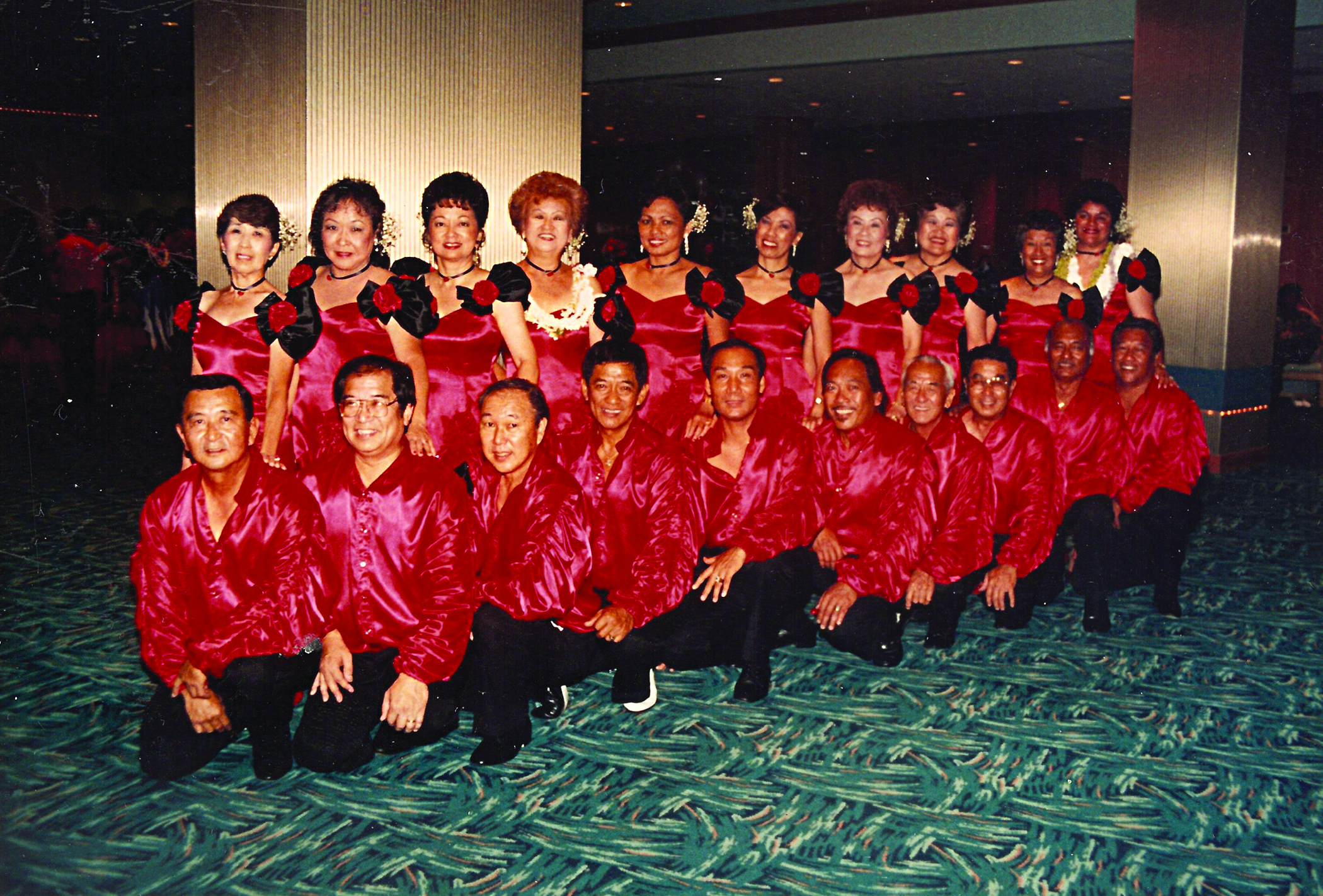
    Faith and Benny choreographed the HBDA Pearlridge Chapter Rumba Group Formation Dancers, Anniversary Ball, Sheraton Waikiki.

    One day in 1979, Faith told Benny that she knew of a fun activity that they could do together. Sticking together was their way of doing things, so Benny asked, “Yes, Honey. What is it?”

    Faith said, “Ballroom dancing.”

    “Whoa!” said Benny, “Dancing is not for me!” He was fine with any athletic sport or game, but not dancing. Despite his protest, he attended the first class.

    “I still didn’t think much of it until I saw a Telemark Instructor demonstrate professional dancing and all I wanted to do was learn how to do that. So I kept going to class and began to figure it out. We joined the Hawaii Ballroom Dance Association (HBDA) classes, directed by Eugene Ichinose. He and his wife Harriet founded the association in 1959. Ichinose was a serious man, a shogun, an able director and a perfectionist. I could relate to that. Sports take precision and mastery. You have to practice to learn how to cook, pitch, bowl, even how to run fast. Dancing took a lot of energy too, and I got into it.”

    Arthur Murray Showcase 1984, Waltz/Tango Formation, Princess Kaiulani Hotel.
    Arthur Murray Showcase 1984, Waltz/Tango Formation, Princess Kaiulani Hotel.

    Faith and Benny had been a team for a decade: working out plans, negotiating roles and responsibilities, and reaching their goals with perfect synchronization. Benny was leading, Faith was following, and outcomes required both of them to perform. But this time, Faith chose the game.

    When the boys came along, Benny and Faith encouraged them to play the team sports that Dad was never able to play when he was young.
    Faith was all in. “My boys were active rascals; they loved releasing energy on the ball field.”

    Aiea National Little League games became social events for all the parents. Benny says, “It was a pleasant family atmosphere in those days, and we bonded over potlucks at the field after the games. The men enjoyed a couple of beers at the park before going home. Can’t do that anymore.”

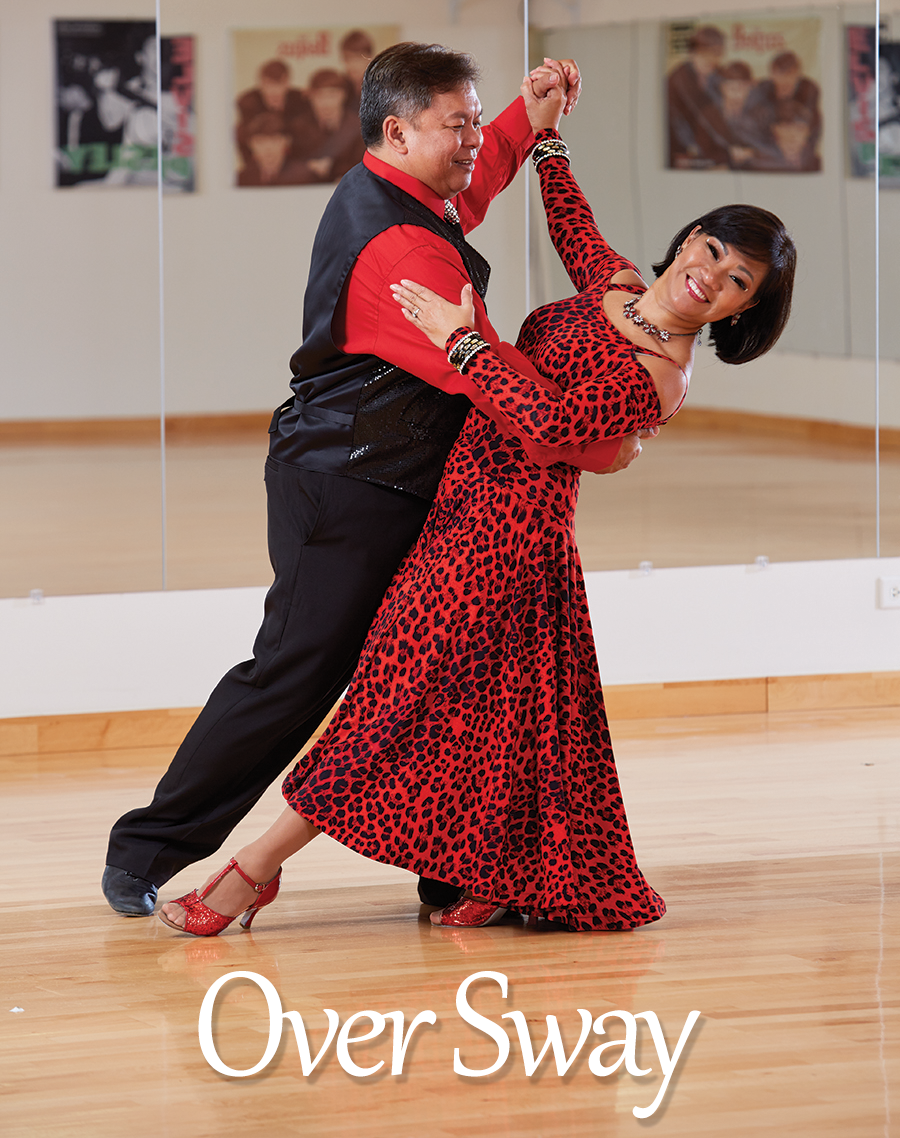
    Support and Assistance In every relationship some circumstances of life cause one partner to pause. It may be a setback, a change in responsibilities, or a time of preparation for a promotion, move or retirement. At these times, the other partner lends support and assistance to keep the relationship healthy. Circumstances are neutral, but how we react to them can make them negative or positive. Support from our partner can allow us to find comfort, joy and assurance in the pauses and low spots of life. Here we see a pause step in the waltz called an “Over Sway.” HBDA Assistant Dance Director Mark DelaCruz supports his wife Patty, Rotating Instructor, for a dramatic pause in the dance. With Mark’s assistance, Patty can relax into the dip and enjoy the freedom of movement.
    Support and Assistance – In every relationship some circumstances of life cause one partner to pause. It may be a setback, a change in responsibilities, or a time of preparation for a promotion, move or retirement. At these times, the other partner lends support and assistance to keep the relationship healthy. Circumstances are neutral, but how we react to them can make them negative or positive. Support from our partner can allow us to find comfort, joy and assurance in the pauses and low spots of life. Here we see a pause step in the waltz called an “Over Sway.” HBDA Assistant Dance Director Mark DelaCruz supports his wife Patty, Rotating Instructor, for a dramatic pause in the dance. With Mark’s assistance, Patty can relax into the dip and enjoy the freedom of movement.

    The Agbayanis’ organizational skills came into play again when the boys got interested in baseball and soccer, where Benny coached in the Aiea National Little League, AYSO and HYSA; Faith was the Business Manager and team mother. When Benny Jr. and Brendyn were at Saint Louis School, Benny coached intermediate baseball and Faith became the Saint Louis Division Mother for the Class of 1993. This is a family sticking together.

    During the years when son Benny played major league baseball for the New York Mets was a valuable clutch hitter in the 2000 National League Division Series and World Series, Faith and Benny and the family became proud cheerleaders.

    Ballroom dancing only looks easy because the couples practice hard to make it look that way. Every graceful movement represents focused learning and endless rehearsal with the music. Togetherness and respect have to be strong enough to survive the hard work of learning and executing each step perfectly. On the dance floor, your partner’s moves are your moves.

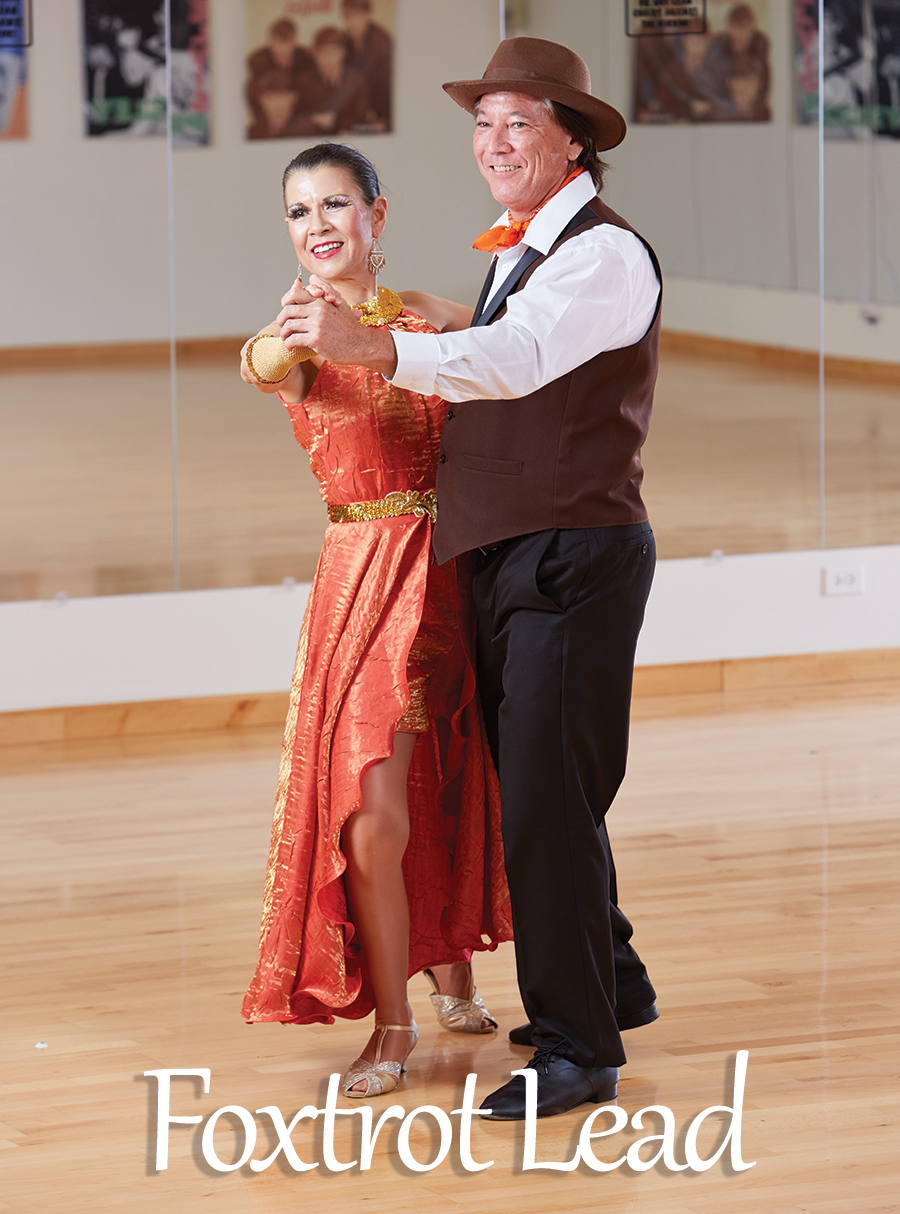
    Leadership - Good partnerships rely on leadership. The role of leader may alternate from partner to partner, based on the challenges ahead or the skill sets of each partner. In ballroom dancing, the partners spend time rehearsing their steps together and ironing out cues and clues they will use to communicate their intended actions. We can take a lesson from ballroom dancing, particularly when issues require us to change direction. As HBDA Senior Instructors Martin and Leona Powell dance the Foxtrot, they move to an open promenade position. Martin expertly communicates to Leona through body movements; Leona follows his physical lead and other visual cues to maintain perfect rhythm.
    Leadership – Good partnerships rely on leadership. The role of leader may alternate from partner to partner, based on the challenges ahead or the skill sets of each partner. In ballroom dancing, the partners spend time rehearsing their steps together and ironing out cues and clues they will use to communicate their intended actions. We can take a lesson from ballroom dancing, particularly when issues require us to change direction. As HBDA Senior Instructors Martin and Leona Powell dance the Foxtrot, they move to an open promenade position. Martin expertly communicates to Leona through body movements; Leona follows his physical lead and other visual cues to maintain perfect rhythm.

    Soon after joining the Hawaii Ballroom Dance Association, the Agbayanis were instructing other students. “Eugene Ichinose asked us to be Rotating Instructors, teaching at all the O‘ahu chapters. We declined because Faith and I both felt that we should first learn more dance skills, traditional dance terminology and steps. So we joined an Arthur Murray dance class and paid for lessons for the next eight years.”

    Their Arthur Murray instructors encouraged them to compete in a national ballroom dancing competition at Las Vegas, Nevada. “In 1980, we won several medals, gold, silver and bronze! In 1982, we came back with gold, silver, bronze again!” says Benny.

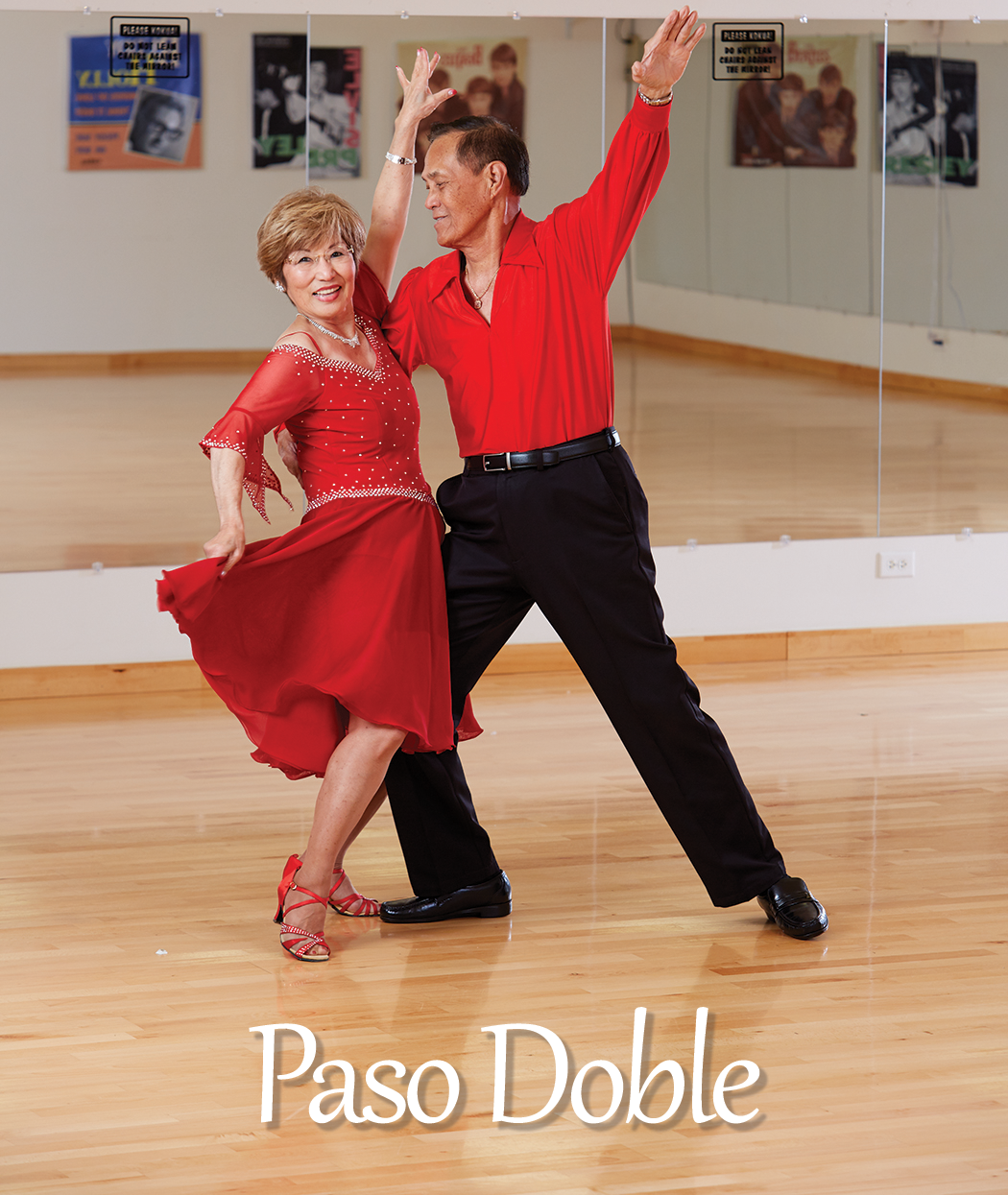
    Independence – Opposites attract, so partners have to find ways to work together for mutual benefit. Often, playing different roles helps us accomplish more. The “double time” music played at Portuguese and Spanish bullfights is the inspiration for a ballroom dance called the Paso Doble, where the man plays the matador and the woman, his cape. While the partners each have completely different roles, they must execute their steps and positions flawlessly and quickly to keep up with the lively beat. Here HBDA Assistant Dance Director Melvin Camut “unfurls his cape,” Rotating Instructor Susan Masumoto, who “drapes” on his arm with a flutter of her skirt. The matador and cape play independent roles, but they flow together with precision.

    In the ’90s, “Mr. Ben and Miss Faith” were Arthur Murray instructors in ‘Aiea, and when the studio moved to Florida, they returned to HBDA, with full credentials. Eugene Ichinose was happy to have the Agbayanis back, now with the confidence to share their knowledge with others. His only advice to Benny was to be a “little less agreeable.” He said, “Benny, as director, you have to have a thick skin and cannot say yes all the time.”

    There isn’t much Benny could do about his amiable temperament, but with help from Faith he found a way to be more firm. “When disputes arise, Faith talks to the people and finds out what the problem is. She understands Hawai‘i cultures, personalities and how things work. After she and I discuss the issue quietly, I can kindly say no if I have to. Working together is what we do best,” says Benny.

    HBDA has eight chapters throughout the State. Its mission is to provide dance experience for the people of Hawai‘i that is fun, affordable and promotes healthy minds and bodies. The association’s performance venue is the Palladium, an 11,000 square-foot polished eucalyptus dance floor upstairs at the Ala Wai Golf Course clubhouse. Each month, on the 1st Saturday, HBDA has a dinner dance event at the Palladium. Monday through Thursday, from 7 pm to 9 pm, Basic Bronze I/II, Bronze II/Silver intermediate and advanced students gather at the Dance Studio to practice an extensive repertoire of dances including Tango, Swing, Samba, Rumba and Merengue. Classes for Novice Beginner students are held at The Dance Studio in ‘Aiea Saturday mornings, from 8 am to 10 am. Line Dance/fitness/Hot Hula takes place at The Dance Studio Saturday, from 10 am to Noon.

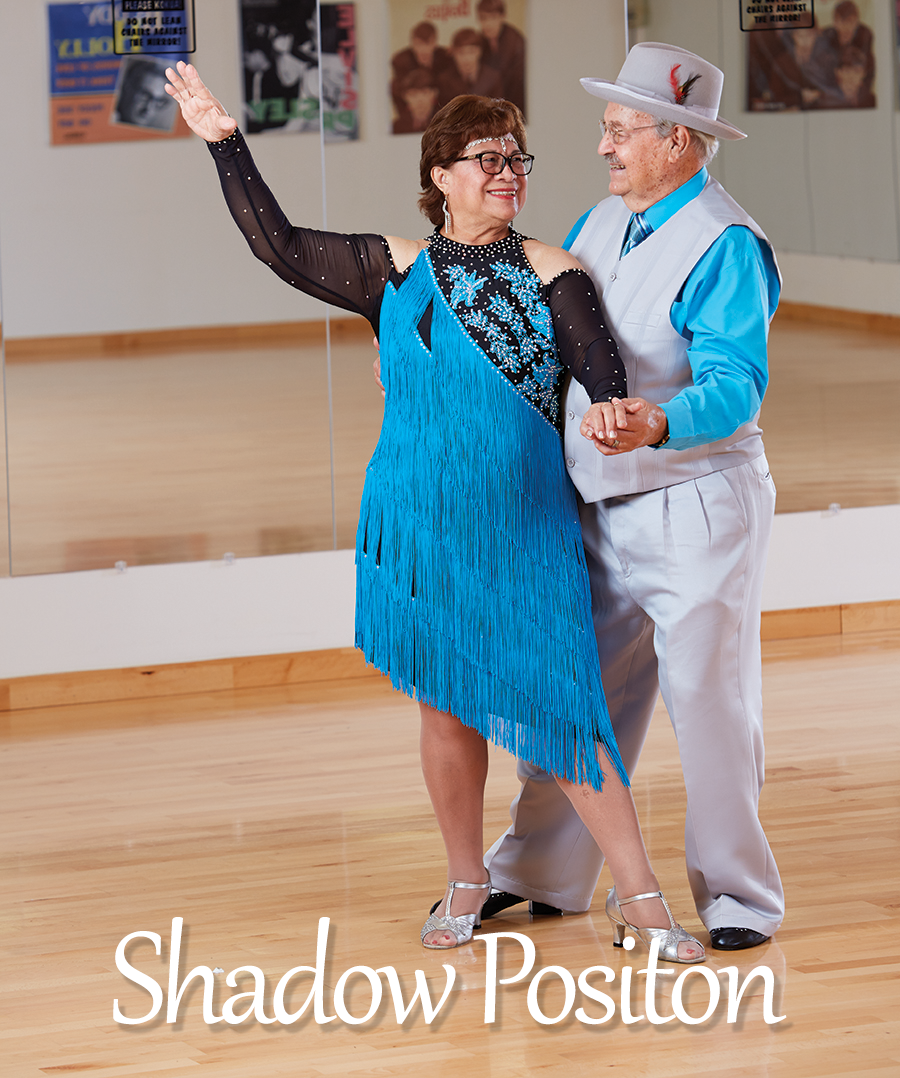
    Showmanship and Promotion - Love often urges us to put the spotlight on our partner; a common goal may require us to promote our partner’s skills. Togetherness takes a different shape when we must lead from behind, or face the public on behalf of our partner in the wings. The “Shadow Position” seen in many ballroom dances and in couples figure skating, represents this kind of relationship. The man dances behind the woman for several measures of music. The couple holds hands as a way of keeping balance and communicating. Senior Instructors David and Lea Twigg demonstrate the “Shadow Position” as David shows off Lea and they both express a deep enjoyment of the dance and each other.
    Showmanship and Promotion – Love often urges us to put the spotlight on our partner; a common goal may require us to promote our partner’s skills. Togetherness takes a different shape when we must lead from behind, or face the public on behalf of our partner in the wings. The “Shadow Position” seen in many ballroom dances and in couples figure skating, represents this kind of relationship. The man dances behind the woman for several measures of music. The couple holds hands as a way of keeping balance and communicating. Senior Instructors David and Lea Twigg demonstrate the “Shadow Position” as David shows off Lea and they both express a deep enjoyment of the dance and each other.

    For seniors, ballroom dancing has many benefits: aerobic exercise, mental exercise and socialization all improve and sustain good health. Learning new dances and keeping to the rhythm of the music are proven to support thinking and mood. And dancing is fun — laughter is a powerful medicine!

    Every November, HBDA holds the Telemark Ball, a fundraiser that supports the HBDA’s Telemark corps of non-salaried volunteer instructors. Proceeds from event ticket sales will fund annual membership dues for the instructors. This gala event qualifies as a “three-shirt” event for the men, counts as low-impact aerobic exercise. The reigning Telemark Queen of 2017–18 is Rotating Telemark Instructor Elsa Navares. She and her escort, Romeo Navares, thrilled the guests by dancing the Viennese Waltz.

    If you are thinking, “I want to dance like that,” the Telemark instructors
    at HBDA will act as mentors, instruct you, and give you an opportunity
    to practice so that you and your dance partner may develop confidence and experience the joy of dancing.

    Benny recently celebrated his 75th birthday, and looks forward to seeing the grandchildren graduate. At HBDA, Benny and Faith are proud of the students and grateful for the instructors, who are his backbone, and the legacy of Eugene and Harriet Ichinose. Sticking together leads to success and happiness. The Agbayani secret is out!

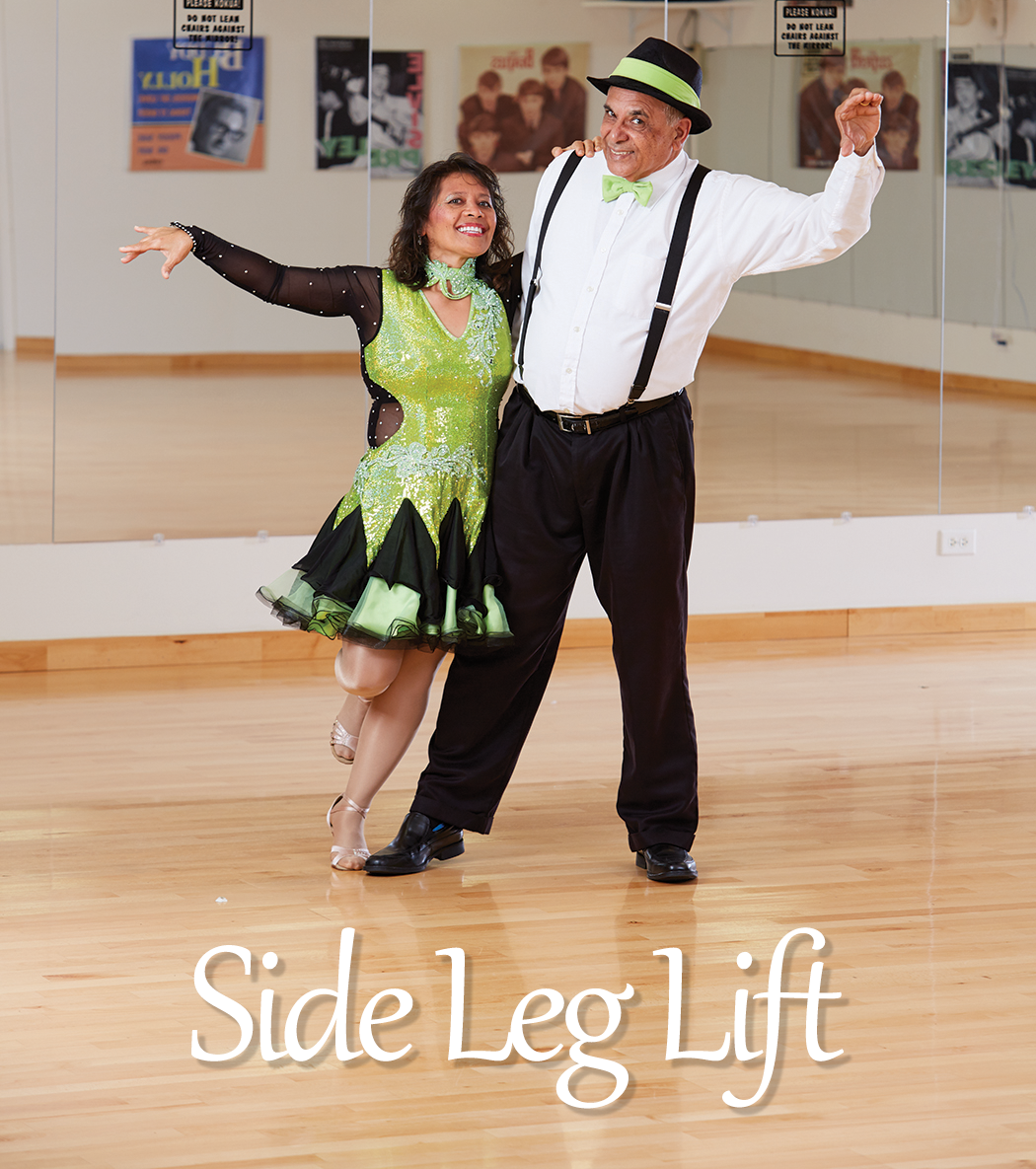
    Trust and Confidence - Knowing each other over a long period of time and under challenging circumstances develops trust. As couples take on small challenges they learn more about one another’s temperaments, strengths and weaknesses. As they learn to communicate, they are able to tackle bigger goals, build confidence and reliance. HBDA members Chris and Becky Prendergast know each others’ skills well. Here they demonstrate a Side Leg Lift where Becky shifts her weight to one foot and bends her outside knee as Chris pulls her into his hip in a modified lift. Becky leans in full confidence that Chris will gracefully maintain her balance and lead her to the next step. Lifts and successful landings are common in Jazz Dancing, and in successful partnerships.
    Trust and Confidence – Knowing each other over a long period of time and under challenging circumstances develops trust. As couples take on small challenges they learn more about one another’s temperaments, strengths and weaknesses. As they learn to communicate, they are able to tackle bigger goals, build confidence and reliance. HBDA members Chris and Becky Prendergast know each others’ skills well. Here they demonstrate a Side Leg Lift where Becky shifts her weight to one foot and bends her outside knee as Chris pulls her into his hip in a modified lift. Becky leans in full confidence that Chris will gracefully maintain her balance and lead her to the next step. Lifts and successful landings are common in Jazz Dancing, and in successful partnerships.

    Faith and Benny Agbayani celebrated their 49th wedding anniversary this year, and both agree that the success of their partnership is doing things together. Maintaining a close relationship is more than saying, “I love you;” it’s taking on challenges as a team, mastering new skills and learning together. Overcoming obstacles in life requires commitment, sacrifice…

  • Hospice Hawai’i Taps New Leader

    In 1979, 11 visionary pioneers founded a non-profit organization dedicated to helping people die with dignity in Hawai‘i. Since then, Hospice Hawai‘i’s remarkable team has been committed to enhancing the quality of life of patients and their families through an interdisciplinary approach to care. The care provided allows individuals to remain at home or in their chosen setting in order to live life to the fullest.

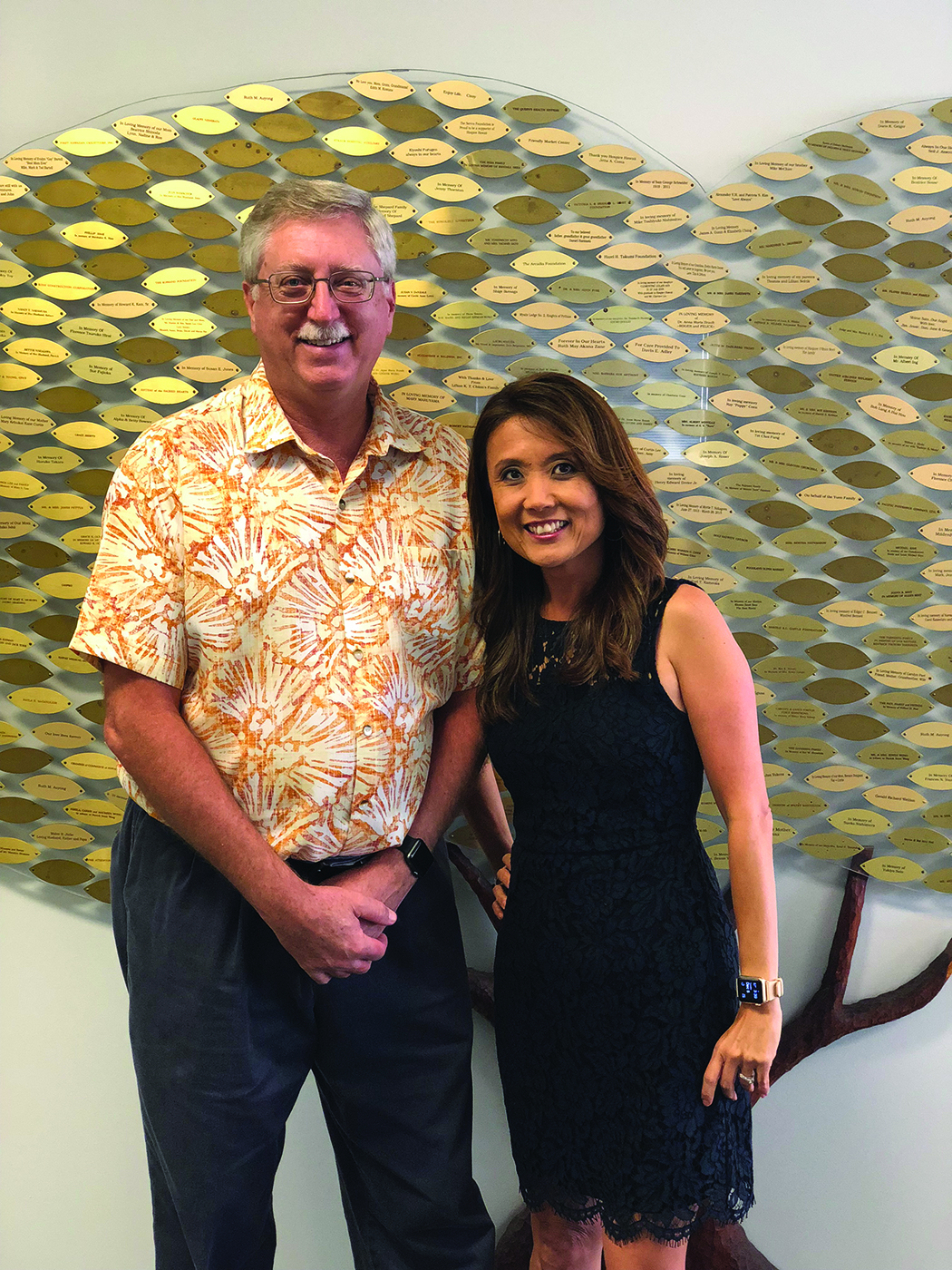
    Photo of Ken Zeri and Tori Abe Carapehlo
    Ken Zeri and Tori Abe Carapehlo

    Hospice Hawai‘i recently welcomed a new president/CEO, Tori Abe Carapelho. She replaces Ken Zeri, who retired after 31 years of service in hospice care. Carapelho looks forward to building upon Zeri’s legacy of shaping community values toward hospice and palliative care, collaborating with other healthcare professions and expanding Hospice Hawai‘i’s services to continue providing high-quality care to patients and their families.

    Carapelho joined Hospice Hawai‘i in 2008 and served as chief strategy officer, overseeing marketing and fundraising, admissions, leadership, special projects and strategy development. Carapelho aims to perpetuate Hospice Hawai‘i’s mission “to bring hope, reduce fears and impact lives,” and dispel certain myths about hospice care.

    “I’ve got big shoes to fill, and it’s important to me to be strategic and thoughtful as we look at future opportunities,” Carapelho says. “It is my hope that people will eventually be comfortable enough to discuss hospice freely.”


    HOSPICE HAWAI‘I
    808-924-9255  |  www.hospicehawaii.org

    In 1979, 11 visionary pioneers founded a non-profit organization dedicated to helping people die with dignity in Hawai‘i. Since then, Hospice Hawai‘i’s remarkable team has been committed to enhancing the quality of life of patients and their families through an interdisciplinary approach to care. The care provided allows individuals to remain at home or in…

  • Where Do Our Seniors Live?

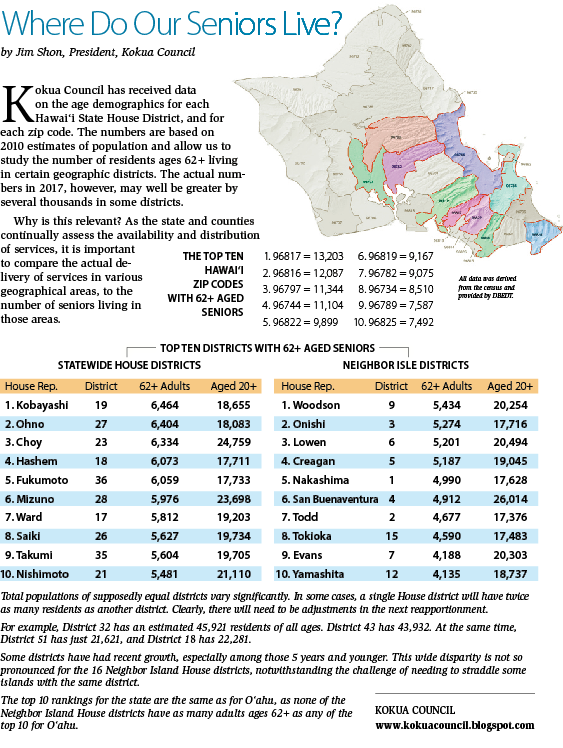
    Kokua Council has received data on the age demographics for each Hawai‘i State House District, and for each zip code. The numbers are based on 2010 estimates of population and allow us to study the number of residents ages 62+ living in certain geographic districts. The actual numbers in 2017, however, may well be greater by several thousands in some districts.

    Why is this relevant? As the state and counties continually assess the availability and distribution of services, it is important to compare the actual delivery of services in various geographical areas, to the number of seniors living in those areas.

    Where do our seniors live?


    KOKUA COUNCIL
    kokuacouncil.blogspot.com

    Kokua Council has received data on the age demographics for each Hawai‘i State House District, and for each zip code. The numbers are based on 2010 estimates of population and allow us to study the number of residents ages 62+ living in certain geographic districts.

  • Always a Fun Day at the County Fair

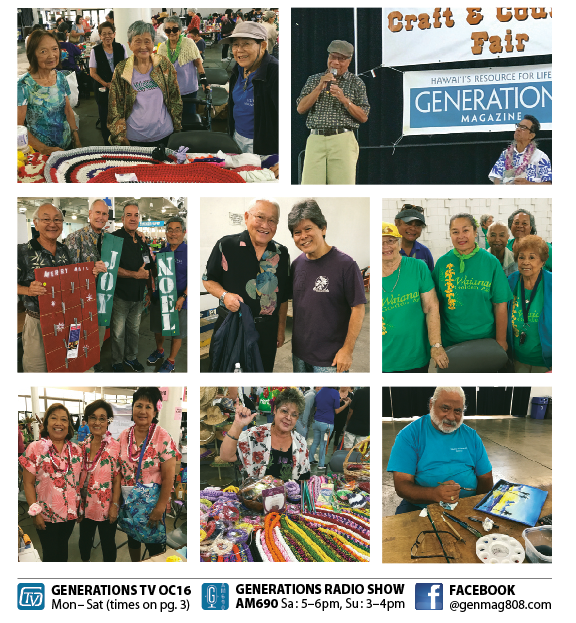
    Who says there’s hardly any fun at a county fair? Seniors attended the Mayor’s Annual Craft & County Fair, held Nov. 18 at the Neal S. Blaisdell Center Exhibition Hall. Craftspeople sold beautiful handmade items and Uncle sold his paintings. Singing? Can’t go without that.

    Mr. Ed Angel participated in a karaoke contest singing it his way, MC’d by Jeff Apaka. Generations Magazine partnered in the City and County’s Honolulu Department of Parks and Recreation event.

    Lots of smiles and laughter at these events, so be sure not to miss this year’s fair in November.

    Mayor's Annual Crafts and County Fair

    Who says there’s hardly any fun at a county fair? Seniors attended the Mayor’s Annual Craft & County Fair, held Nov. 18 at the Neal S. Blaisdell Center Exhibition Hall. Craftspeople sold beautiful handmade items and Uncle sold his paintings. Singing? Can’t go without that. Mr. Ed Angel participated in a karaoke contest singing it…

  • Caregiver Challenges & Solutions – Week 3


    According to the Hawaii’s Executive Office on Aging –  statistics show many of us will need long-term care at some point in our lives, especially as we get older. The costs associated with long-term care are staggering and will only go up. Generations Magazine is beginning our Blog section with one of the hottest topics on most older adults and that is of caregiving. The first line of defense of long term care is family caregiving.

    Have you had a discussion with your family of your long term care needs?

    Let us know by leaving a comment, question or opinion!

    Have you had a discussion with your family of your long term care needs? Join the conversation by leaving a comment, question or personal opinion!

  • Caregiver Challenges & Solutions – Week 2


    According to the Hawaii’s Executive Office on Aging –  statistics show many of us will need long-term care at some point in our lives, especially as we get older. The costs associated with long-term care are staggering and will only go up. Generations Magazine is beginning our Blog section with one of the hottest topics on most older adults and that is of caregiving. The first line of defense of long term care is family caregiving.

    How will you pay for your long term care needs?

    Let us know by leaving a comment, question or opinion!

    How will you pay for your long term care needs? Join the conversation by leaving a comment, question or personal opinion!

  • A New Style of Caregiving

    The term “millennial” typically evokes certain images in our minds. Born between 1985 and 2004, millennials have been labeled the “Me Generation,” “Me, Me, Me Generation,” “Peter Pan Generation” and “Boomerang Generation.” These are far from complimentary.

    Aside from reflecting re-verse ageism, such stereotypes divert attention from this generation’s unique potential for kūpuna care. Millennials differ from Generation X (born 1965–1984), baby boomers (born 1946–1964) and the Silent Generation (born 1925–1945).All generations differ from one other, stamped by the particular historical, social and cultural environments that characterized their formative years. Rather than belittle the traits specific to millennials, how can we take these traits into account to customize eldercare recruitment and training efforts and capitalize on the singular strengths of this generation?

    According to the 2013 Millennial Impact Report, 73 percent of millennials engaged in volunteer work in 2012. Many millennials work in programs for older adults. Some examples:

    • They teach English to older immigrants and help them access health services as part of Project SHINE at Temple University.
    • They provide appropriate home modifications in the Home Safety for Seniors Program, operated by the ManaTEEN Club in Bradenton, Fl.
    • They do yard work and household repairs for the Our Folks Program in Groundwork Hudson Valley, New York.
    • They provide companionship for older adults and respite for family caregivers as part of the Time Out Respite program at Temple University.
    • They help elderly with low vision by shopping for and reading to them in the VISIONS Intergenerational Program in Selis Manor, New York.
    • They instruct older adults on the use of technology in The Gerontechnology Program at Pace University, New York.

    Of all age groups, millennials have been the one most studied. To effectively recruit millennial volunteers and optimize their work with older adults, what characteristics (of theirs) should agencies and organizations keep in mind? Millennials are:

    Multi-taskers. They’re able to juggle many responsibilities at once but can be easily distracted. Their jobs should entail a variety of experiences and tasks; a supervisor should also set explicit daily and weekly goals to keep them on task.

    Tech-savvy and connected to social media. Keep your website and social media, such as Facebook and Twitter, up-to-date and easily accessible. Avoid appearing archaic, which is a real turn-off for this generation. Use their technological skills to keep your organization in-the-know, and allow millennial volunteers freedom and opportunities to identify new, unanticipated technological contributions to the group.

    Interested in work balance and flex schedules. It may be necessary to rethink traditional volunteer roles to accommodate such preferences, perhaps offering “short stints” or micro-ways of initial involvement that are time-limited, then offering a continuum of levels of involvement as they become more invested in their work.

    Support causes, rather than organizations. The work should inspire them to continue. Frequent reinforcement of the relevance and impact of their contributions is essential. Research indicates that support for a given cause is the main reason millennials volunteer, followed by desire to connect with like-minded peers and develop skills and knowledge relevant to future career development.

    The term “millennial” typically evokes certain images in our minds. Born between 1985 and 2004, millennials have been labeled the “Me Generation,” “Me, Me, Me Generation,” “Peter Pan Generation” and “Boomerang Generation.” These are far from complimentary. Aside from reflecting re-verse ageism, such stereotypes divert attention from this generation’s unique potential for kūpuna care. Millennials…

  • Go with Your Gut

    The World Health Organization (WHO) has identified mental wellness issues — stress, depression and anxiety — as the leading causes of a “global health burden.” Could it be that, for the past century, we’ve had the mistaken notion that these problems are all in our head, when in reality they are largely in our gut?

    Did you know that we have two brains? You undoubtedly know about the brain in your head. And while you might not know much about the “second brain” in your gut, you’ve probably “felt” it before. We feel “butterflies” in our stomach when we fall in love or when we’re nervous. We have a “gut feeling” about decisions that we’re wrestling with. Our stomach “growls” when we’re hungry, and we feel “sick to our stomach” when we’re stressed out. Many of us also know that when our gut feels off we simply don’t feel our best.

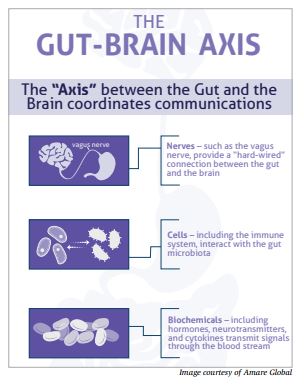
    Our two brains also “talk” to each other through a complex network of nerves, cells and biochemicals. Only within the last few years have scientists and health experts begun learning the importance of microbiome balance in regulating not just our gastrointestinal functions, but also our mood, mental focus and emotional well-being.

    The discovery of the gut-brain axis and the explosion of research around the microbiome — the 100 trillion bacteria that live in our gastrointestinal tract — is causing a fundamental shift in how we think about (and improve) both mental wellness and physical health. For example, some recent scientific research demonstrates that gut bacteria influence everything from neurotransmitters (depression/anxiety), gut integrity (regularity), immune function (colds/flu/allergies), inflammation (pain, heart health, dementia), and even gene expression (related to a variety of degenerative diseases, including Alzheimer’s and even cancer).

    Unfortunately, so much of today’s modern lifestyle can disrupt the microbiome and lead to imbalances across the gut-brain axis, causing us to feel fatigued, depressed and stressed. Research has shown that the microbiome can become disrupted by the aging process, but it may also show that we can use nutrients (specific combinations of probiotics, prebiotics and phytobiotics) to rebalance the microbiome and optimize gut-brain axis function for improved mood, reduced depression, lessened anxiety, and enhanced stress resilience.

    Many people have long known that gut health is important for overall wellness, and now modern science and innovative companies are backing up why feeding the gut with the right foods can help each of us feel happier and healthier.


    AMARE GLOBALl
    Lori Makiya, Wellness Partner
    808-285-9620  |  amaretogether@gmail.com
    www.lovingyourgut.com

    Visit online to learn more about how to optimize the mind-gut connection and for information on Amare Global’s FREE information sessions with Dr. Shawn Talbott in Honolulu on Saturday, February 9, 2019. Contact Lori Makiya (above) for registration and location details.

    Editor’s note: Before trying any dietary supplements, we encourage you to
    do research and consult your doctor before taking them.

    The World Health Organization (WHO) has identified mental wellness issues — stress, depression and anxiety — as the leading causes of a “global health burden.” Could it be that, for the past century, we’ve had the mistaken notion that these problems are all in our head, when in reality they are largely in our gut?

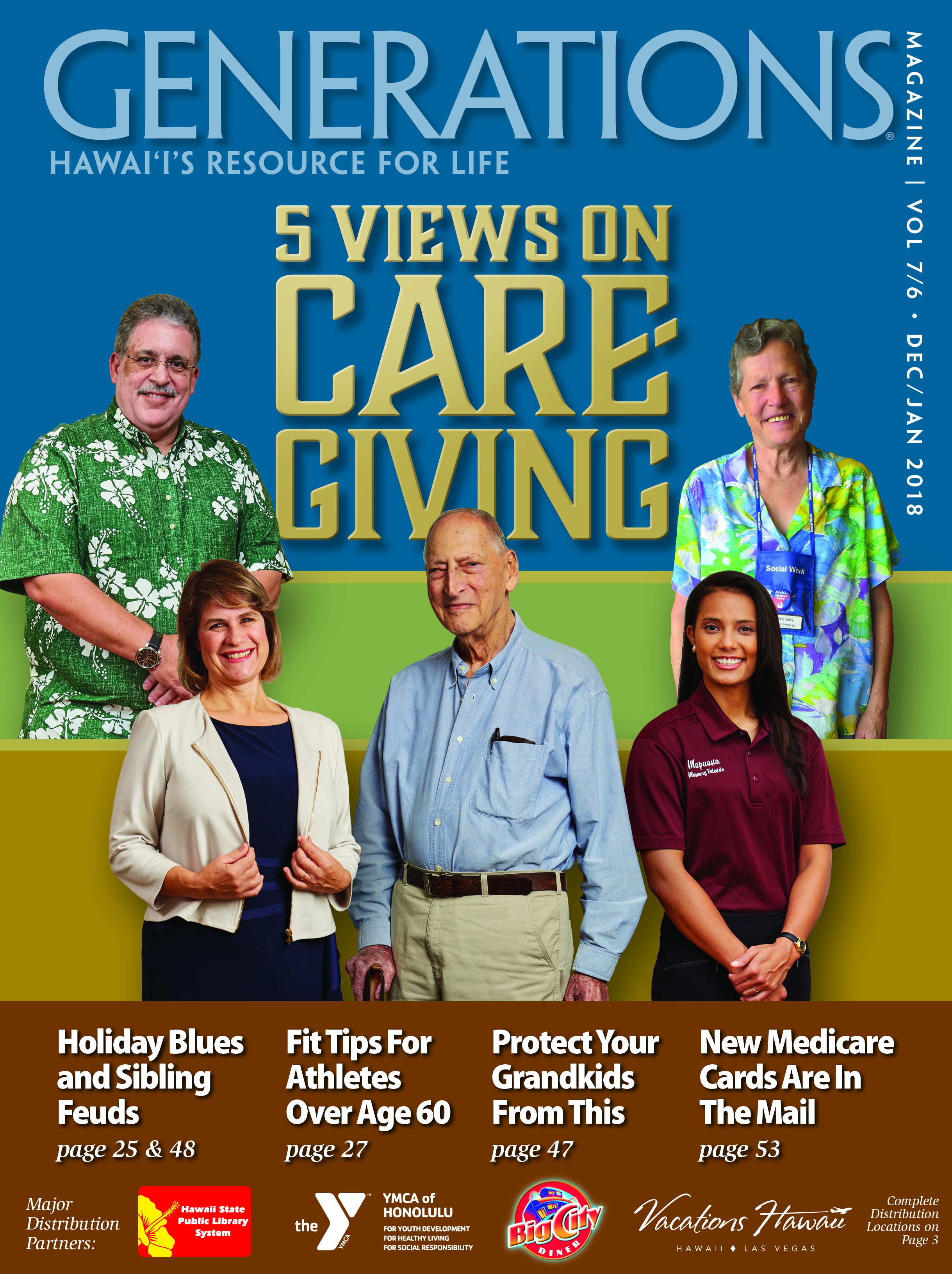
  • Five Views on Caregiving

    Five Views on Caregiving

    Aging with dignity is a major public health issue for the state of Hawai‘i. People of all ages work with and advocate for the elderly by providing educational resources for families and brainstorming private and public health solutions for the growing needs of kūpuna. All generations offer experience and expertise.

    By 2029, over 70 million baby boomers in the United States will be over 65. The fastest-growing demographic is seniors over 85, numbering over 40,000 in Hawai‘i.

    The blessing of longevity has two downsides: Declining health and mobility, and eventual dependence on caregivers.

    Greatest Generation members, born before the great crash of 1929, lived through the Great Depression and World War II and are now in their late 80s to mid-90s. They had to be frugal, and they treasured work. They fought and volunteered for freedom, cared for elders with respect, attended school, learned a trade and respected authority. They also saw the arrival of Model T autos, jazz and aircraft.

    Members of the Silent Generation were born between 1925 and 1945. Some fought in WWII and the Korean Conflict. They adopted the traditions and work ethic of their parents and kept their feelings to themselves. They enjoyed a robust post-WWII economy and a high school education. Many attended college on the GI Bill. They watched the rise of communism and shaped 20th-century pop culture, rock ‘n’ roll, TV and mainstream media.

    After WWII, over 76 million baby boomers were born between 1946 and 1964. They are the wealthiest, healthiest and best-educated generation yet. As “hippie” teens, they protested against the traditional values of their parents. Their midlife “yuppie” lifestyle was adopted globally. They became experts in their fields. Cold War nuclear “detente” and recessions led them to distrust big government. They are deep thinkers, optimistic and respond to civic calls for action.

    Children of baby boomers are Generation X and millennials. Generation X, born between 1965 to 1984. learned early independence as latchkey kids of working parents. Rocked by divorce and economic downturns, Gen X-ers are pragmatic, problem-solvers who adapt well to change. Technologically adept, they learn by discussion and case study. They value experience over wealth and tend to be skeptical. Generation X is less motivated than boomers to make a difference or to leave a legacy.

    Millennials, born from 1985 to 2004, outnumber boomers in the U.S. workforce. They have more college degrees than any other generation; they smoke less and tend to count on friends and public welfare in tough times. They learn by trial, error and collaboration. They carry college and lifestyle debts, frequently change jobs, save less and own fewer assets than previous generations. They marry late and anticipate six decades in the workforce.

    We bring you the wisdom and advice of five notable persons who have laid the foundation for eldercare and public policy for aging issues in Hawai‘i. Collectively, their ages span almost eight decades, but each has a different perspective and approach to meeting the needs of the elderly; their approaches are related to the generation into which they were born. All are “paying it forward” so that we all may age well, with dignity.
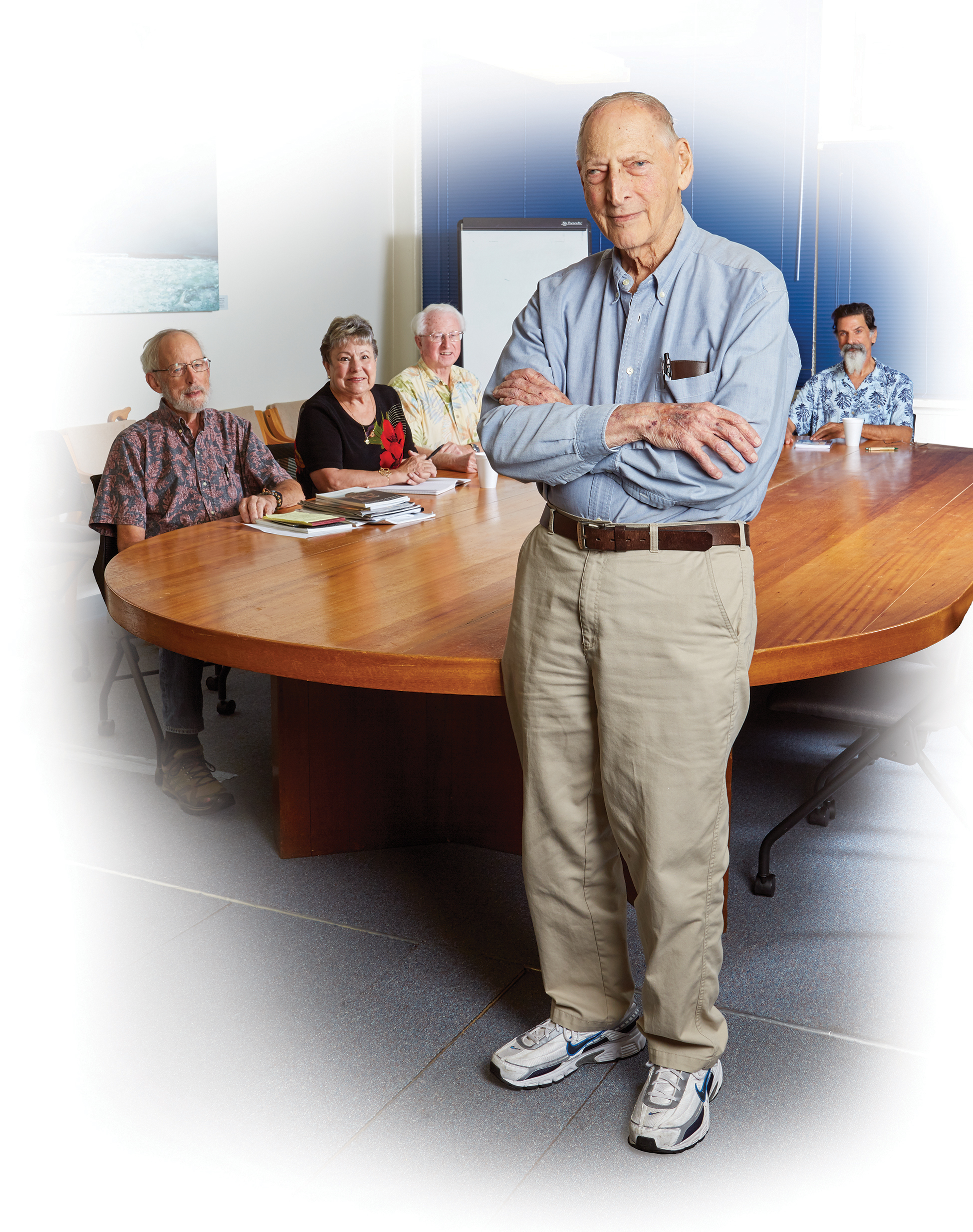
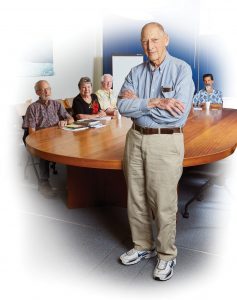
    Anthony “Tony” Lenzer is a member of the Greatest Generation and a paragon of hard work. Besides HPGS, he serves on the boards of several aging advocacy groups. Tony taught gerontology (the study of old age) at The University of Michigan School of Public Health before joining the faculty at the University of Hawai‘i in 1969. He helped develop a gerontology program at the UH School of Public Health. In 1988, he served as a volunteer training coordinator for AARP Hawaii and spent several legislative sessions as aging adviser to Sen. Les Ihara Jr.

    As a member of the Greatest Generation, he grew up learning how to do a lot with little and focused his energy on productive projects that would help the entire community.
    “I am very proud of the work we did to expand the number of professionals focused on aging,”

    Tony says. With other dedicated faculty, he created two gerontology certificate programs. Many of the 150-plus students who are certified in aging now lead nonprofits and government agencies that provide services for seniors.

    Tony recently taught a five-session weekly workshop, “Aging and Dying With Dignity,” at UH’s Osher Lifelong Learning Institute, but his current focus is to increase the population of caregivers.
    “There is a need to educate and support family caregivers within their cultural context,” Tony says. “Parallel to education is a need to develop agencies and services on all islands to deliver care in homes and facilities.” He advocates immigration policies that favor experienced caregivers from abroad and supports the initiation of caregiver training programs in colleges.

    “I believe caregiving is a profession, and the state should proactively create tiered certifications to facilitate a career ladder. When caregiving blossoms as a career, it will stimulate other services —
    equipment, nutrition, treatments, etc.”

    He urges banks to target young wage earners for savings plans that will encourage them to build financial assets for their elder years. He also has advice for boomers:

    “Many baby boomers have not accumulated or protected enough assets to pay for the rest of their retired life. They continue to work because they must. If older people are going to stay in the workforce, they need work opportunities. Other seniors who are inspired to community service will need training in skill building, leadership, consulting and advocacy.”

    Tony invites his guests to pour their own coffee, joking that he is not a mover and a shaker, but “moving shakily” these days. When asked to predict the future, this member of the Greatest Generation quips, “I just want to see my 88th birthday!” If tackling difficult problems, finding solutions and cultivating a quick humor are good for the brain, Professor Lenzer will be advocating for years to come.
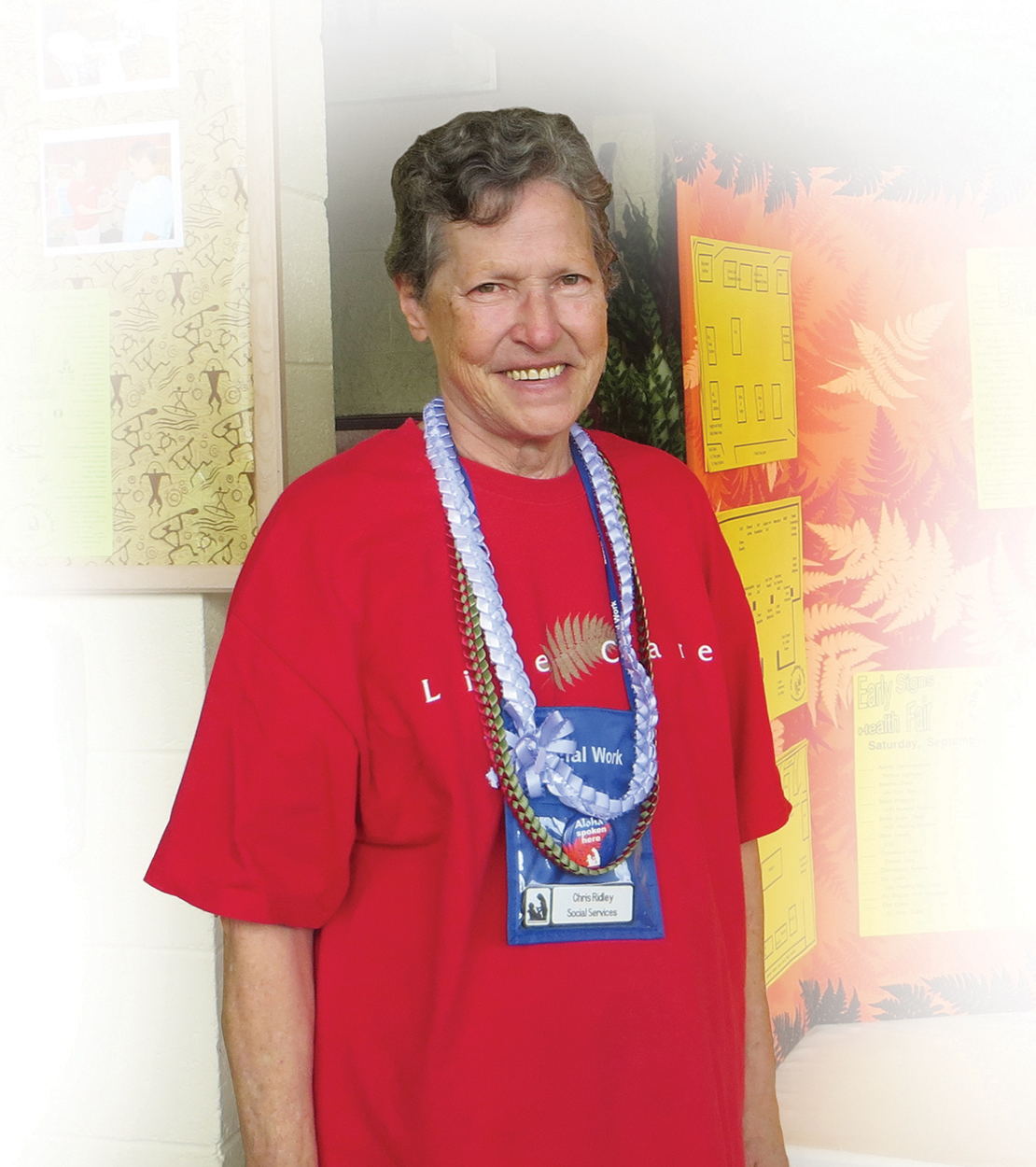
    Chris Ridley is a luminary in the Alzheimer care community. Like others in her generation, she sees community needs and enlists others to join in the cause to address them. In college, she chose mental health social work as a profession and honed her skills. But in 1984, she moved to Hilo to care for her father to undergo the life-changing, on-the-job training we call caregiving.
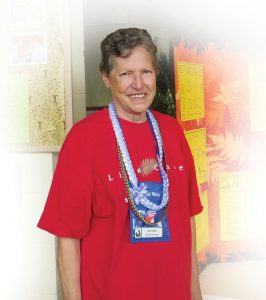
    “The most critical thing I learned was to be a care partner instead of a care “giver.” My dad was not comfortable with all my care choices and displayed his frustration. I thought I knew what was best for him. When he became unable to walk, I was upset that he rejected the “Mercedes” wheelchair I selected and chose to scoot around on the floor. It was difficult, but I discovered that he slept well on
    a mattress on the floor. He eagerly ate his meals from a Japanese chabudai table, and I washed the floor every day for him so his environment was clean. I learned that caregiving is not making our loved ones “normal” or “happy” but keeping them comfortable, building their self-esteem and protecting their dignity — on their selected path. This is respectful caregiving.”

    Chris’ answer to needs of seniors and the elderly — especially home care for people with dementia — is community education and activation. She travels through Hawai‘i County helping families form care teams for their loved ones who want to age in their own homes.

    In 1999, she founded the Early Signs Health Fair, where everyone can come for free health screening—blood pressure, sugar, kidney function, bone density, dental consults, chiropractic exams and adjustments, exercise and activity classes and presentations by physicians. Her proudest achievements are her work with Life Care, Early Signs Health Fair and increasing public awareness for Advanced Care Directives.

    Chris would like to see Hawai‘i become a dementia-friendly community where we witness and honor our elders’ choices and provide help to keep them on their chosen paths.

    “I was called to evaluate an elderly woman whose neighbors could not convince her to go see a doctor. The neighbors knew one another and were friends with the lady. One neighbor was taking her to the bank and grocery store. The man next door was mowing her lawn. A third was bringing in her newspaper and mail every day. The whole neighborhood was respecting her wish to stay in her home! I signed her up for services like Meals on Wheels and doctor transport. And then I offered a talk-story for all the neighbors, who had become a care team without even knowing it. I showed them which agencies can help and told them who to call in an emergency.

    “This neighborhood is a blueprint for helping Hawai‘i kūpuna stay in their homes as long as possible — not taking advantage but respecting the elder’s wishes — each neighbor helping a little.”
    Chris is a baby boomer who is a change agent for her community. Her legacy will be to educate Hawai‘i’s residents about home caregiving for elders with dementia and to help foster new attitudes toward elders within the community.

    “My dream is that agencies and nonprofits who provide in-home caregiving services to our kūpuna will adopt a seven-day schedule to improve the consistency of care for clients who are aging in place,” she says. Consistency is a hallmark of her ability to change lives and significantly help others in need.
    Jerry Correa is at the tail end of the baby boomer generation, planning for eventual retirement and breathing a sigh of relief that the children of boomers are striking out on their own. Around the corner looms the responsibility of caring for their elderly parents.

    Jerry became president and chief executive officer of St. Francis Healthcare System of Hawaii in 2012. With the blessings of the Sisters of St. Francis and the St. Francis Healthcare System’s board of directors, coupled with support from his leadership team, he is moving full speed ahead to meet the needs of seniors and family caregivers.

    As the first lay leader of St. Francis Healthcare System, he received valuable advice from the sisters: “Give the ku¯puna and caregivers what they tell you they need.”
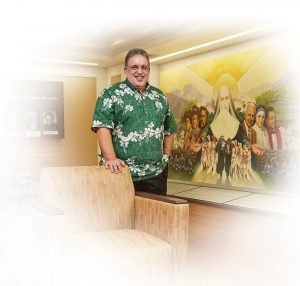
    Jerry says, “We faced some hard decisions in order to reinvent ourselves. We needed a strategic plan to carry forward the values, mission and success of the sisters of St. Francis, so I studied how they organized and administered their ministries.” His information technology background compelled him to take a systemic, logical approach to the planning process.

    Giving kūpuna what they want meant replacing the traditional medical care model with a broad range of home- and community-based services for Hawai‘i’s growing population of seniors who want to stay healthy and age in place.

    While St. Francis’ kūpuna services in the community continue, Jerry and his team are transforming the Lilihā campus into the St. Francis Kūpuna Village, a one-stop center for health and wellness services, adult day care, caregiver services, and assisted living and skilled-nursing facilities. “This model gives kūpuna and their families easy access to all services at one location and maintains their ties to friends, family and community,” he says.

    In April 2015, the Lilihā campus welcomed the addition of a skilled-nursing facility. In 2018, active kūpuna and caregivers will be able to enjoy a full array of health and wellness services on the Lilihā campus. A team of social workers who understands cultural traditions, family dynamics and critical needs for emotional and spiritual support will coordinate all healthcare services.

    While the St. Francis kūpuna Village is under development, St. Francis is giving seniors and caregivers a taste of what is to come with caregiving classes, fitness classes for seniors and other services. And, as the needs of the community change, St. Francis Healthcare System will continue to offer new services and programs.

    The best is yet to come!

    As the Lilihā campus and programs gradually become available, Jerry keeps kūpuna posted with inspiring weekly messages on the St. Francis website’s news page (www.stfrancishawaii.org/news).
    He keeps listening to what seniors say and need.
    Jackie Boland, a familiar friend of kūpuna, directs AARP’s community events and educational resources for Hawaii residents over age 50. She relies on an army of volunteers, who are AARP members themselves, to help plan and implement programs that appeal to everyone across the board — from those in the workforce to frail seniors nearing end of life. “In Hawai‘i, we have a rapidly aging population that can look forward to greater longevity and health than on the mainland. Therefore, we approach our work from two directions: Helping those who are healthier to access tools and resources that can help them experience their possibilities, and helping frail ones in need of assistance and advocacy. For those in good health, my challenge is to develop ‘Fun with Purpose’ activities that engage people in stimulating activities, disrupt aging and redesign our communities. People over 50 have so much to contribute to the community and to themselves,” she says.
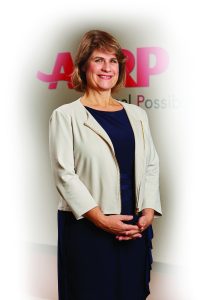
    Older adults who are not in the workforce are a great resource for our community.Jackie says that society has to catch up and change the way we think about retirement. Many retirees want to contribute and maximize their skills to maintain their healthy productive years. They are a talented volunteer force for community activities because of their lifetime of experience and self-knowledge.
    Boland points out that the elderly population (over 85) is growing fast. Nearly all of them want to age at home, and this is only possible when they receive help from family and friends. One in four of Hawai‘i’s adults is a caregiver of parents or spouses, and AARP is working hard to support them with educational resources and workshops.

    “We feel passionate about helping family caregivers. Without them, our kūpuna would be reliant on government programs, and neither we as a community or they as individuals can afford that. We work hard to link caregivers to resources, teach them how to care for themselves while caring for family members and advocate for them in the Legislature.

    “I have a passion for helping women because they live longer and often take on the work of caring for family, putting their own needs aside. Many women stop working or work less, with the result that they earned less and accrued less savings and Social Security. Therefore, their financial resources and benefits are lower in old age. They often outlive their family caregivers and their resources, adding to their mental and physical stress in old age. Our women’s scholarship program has helped so many up-grade their skills and get training and education otherwise not available to them.

    “I want to reach everyone over 50 and let them know about the many AARP programs and educational resources here to help them live their best lives. That’s why we collaborate with many partners like Generations Magazine, to provide educational resources for seniors. If everyone can learn to make good choices to plan for their later years, then growing older can be FUN,” Jackie says.

    Let’s take her advice and start by learning and planning now. We can talk with our families to make sure we have sufficient resources to live with dignity and be productive community members for life. All the answers to our questions, and needs, are there if we only reach out.
    Mapuana Taamu is a busy and productive millennial. Her passion and drive are focused on helping our aging population. She balances multiple jobs: Nursing care in a facility that specializes in memory care, and home care training and services through her own company, Memory Friends, which uses Positive Approach® to Care (PAC) curriculum to teach family caregivers empathetic techniques for giving care. Taamu attends Kapi‘olani Community College (KCC), pursuing an associates of arts degree in accounting and business. She also works part-time for Generations Magazine, managing social media and writing resource articles for you.

    Her passion for healthcare and dementia care, in particular, stems from seven years as a volunteer with Hospice Hawai‘i, Project Dana, Kokua Mau and Hale Kū‘ike in Kāne‘ohe. She attends Kupuna Caucus, is an advanced care planning speaker for Kokua Mau and is an active member of the Kahalu‘u Lions Club. In a short time, she has accumulated a lot of experience in aging.
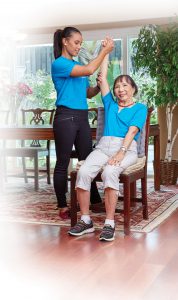
    “I look like a person you would label a millennial — with tattoos, who enjoys attending meetings in skinny jeans and a white tee,” says Mapuana. She is quick to promote her accomplishments and independent, pragmatic approach to life. Like many millennials, she places a high value on experience and is comfortable collaborating with teams where she can apply her honed skills and the skills of others toward results.

    She counts on her “amazing EQ,” or emotional quotient when working with patients and their families. Like IQ tests, EQ tests measure your capacity for knowing and expressing your emotions and reading emotional expressions of others. “Dementia primarily affects the left half of the brain, the center of language, comprehension and vocabulary. Therefore, non-verbal behaviors say more than words. Reading facial expressions and body language becomes a necessary care skill.

    “Memory Friends is my homecare service for forgetful seniors and their families. We teach Caregiver Action Network (www.caregiveraction.org) programs that train caregivers how to interpret the challenging behaviors and body language of their loved ones with dementia. We help clients adapt a routine of simple exercises that improve health, clarity and attitude,” she says.

    She is majoring in caregiving through first-hand experience and minoring in business on the typical route — college.

    “If only other health professionals could see past my young age and place as much value on my experience as they do on higher educational degrees, then I, and many others, could begin working on these issues and finding the answers.”

    Mapuana has a message for her generation: “Everyone can make a difference. Healthcare is a great career path with many rewards. I invite other millennials to attend meetings, get involved and let your ideas be heard. Let’s collaborate and lead our generation.”

    AGING IS WALKING IN A CIRCLE
    We live in a world with more aging persons than previous generations. Although each generation has its own “personality” and ways of facing challenges, we walk the circle of life together — from dependent childhood and productive midlife, to retirement and dependent old age. As we try to meet the growing challenges of aging in the 21st century, all generations have much to offer. The Greatest Generation laid the foundation for all the services and public programs we now have for the elderly. Baby boomers are working to support and multiply these services for their parents and themselves.

    They have accumulated wealth and assets and developed public awareness about aging. The technologically skilled, independent thinkers of Gen X and the compassionate, problem-solver millennials are applying their skills and logic to improve community support for their parents. They’re planning for their own elder years, which will be longer and more productive yet. Where are you in the circle of aging? Are you actively planning for your elder years? What can you do to make the future even better?


    ARTICLE RESOURCES

    AARP Hawaii
    1132 Bishop St., #1920, Honolulu, 96813
    808-545-6024https://www.aarp.org/states/hi.
    AARP is a national, nonprofit group for adults over age 50. The Hawai’i chapter advocates for financial resilience, safe housing, healthy lifestyles, long-term care, livable communities and more.

    Hawaii Pacific Gerontological Society
    P.O. Box 3714, Honolulu, 96812
    www.hpgs.org | 808-722-8487
    The nonprofit HPGS strives for the well-being of seniors in the Pacific Islands. Annual events include job fairs, conferences and fundraising.

    University of Hawai’i – Mānoa, Center On Aging
    Gartley Hall, 2430 Campus Rd., Honolulu, 96822
    808-956-5001 | www.hawaii.edu/aging/
    COA is the “catalyst of academic excellence in gerontology” for aging groups in the Pacific Islands. It comprises experts in medicine, law, sociology, disability and family resources, nursing and more.

    Life Care Center of Hilo
    944 W. Kawailani St., Hilo, 96720
    808-959-9151 | www.lifecarecenterofhilo.com
    The second-largest nursing home in Hawai’i, this facility has an Alzheimer’s and dementia unit, patient rehabilitation and 24-hour nursing care.

    Alzheimer’s Association
    1130 N. Nimitz Hwy., Ste. A-265, Honolulu, 96817
    808-591-2771 | www.alz.org/hawaii/
    One of 70 branches nationwide, the AA Aloha chapter advocates for Alzheimer’s care, support and research, and hosts caregiver meetings on Hawai’i Island, Kaua‘i, O‘ahu and Maui.

    St. Francis Healthcare System of Hawaii
    2226 Liliha St., Honolulu, 96817
    808-547-6500 | www.stfrancishawaii.org
    St. Francis offers hospice, adult day care, personal care, senior education and a retirement community in Ewa. Phases 2 and 3 of Ku¯puna Village are scheduled to be completed in 2018 and 2019.

    Hospice Hawai‘i
    860 Iwilei Road, Honolulu, 96817
    808-924-9255 | www.hospicehawaii.org
    Hospice Hawai’i offers end-of-life care in the patient’s home or chosen setting. Interpreters in 15 languages are ready to help.

    Project Dana
    2720 Nakookoo St., Honoulu, 96826
    808-945-3736 | www.projectdana.org
    Project Dana is a volunteer-based program for
    elderly people and their caregivers. Services include visits, home-safety evaluations, respite,
    light housekeeping, home repairs and errands.

    Kokua Mau
    P.O. Box 62155, Honolulu, 96839
    808-585-9977 | www.kokuamau.org
    Kokua Mau is a professional group for hospice, advanced-care planning and palliative care. Meetings, workshops and webinars are available.

    Hale Kū‘ike
    95 Kawananakoa Pl. | 595-6770 (Kalihi)
    45-212 Kāne‘ohe Bay Dr. | 808-235-6770 (Kāne‘ohe)
    www.halekuike.com
    Hale Kū‘ike, a residential-home group specialized in Alzheimer’s disease and dementia, employs staff trained in the Positive Approach to Care® model.

    Aging with dignity is a major public health issue for the state of Hawai‘i. People of all ages work with and advocate for the elderly by providing educational resources for families and brainstorming private and public health solutions for the growing needs of kūpuna. All generations offer experience and expertise. By 2029, over 70 million…