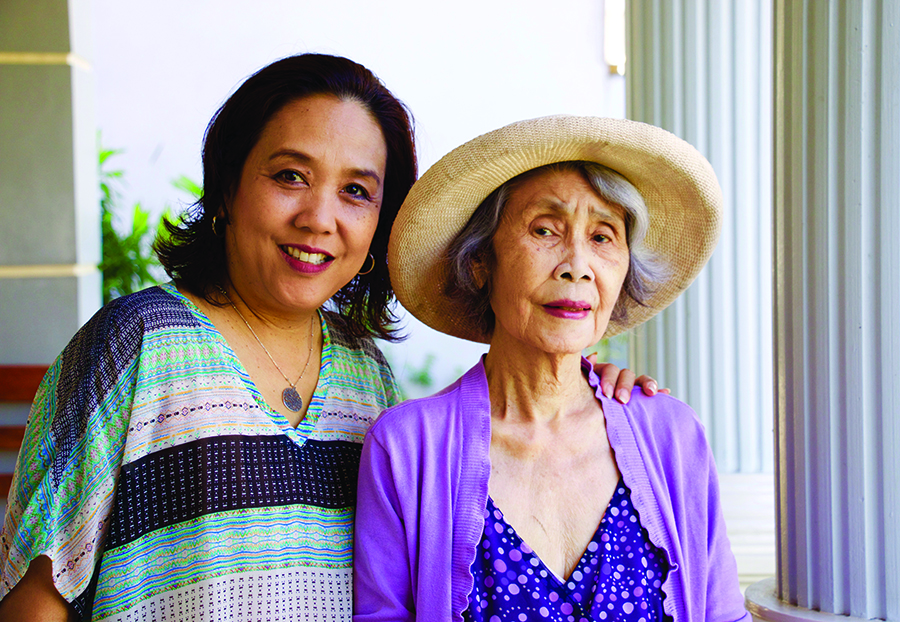
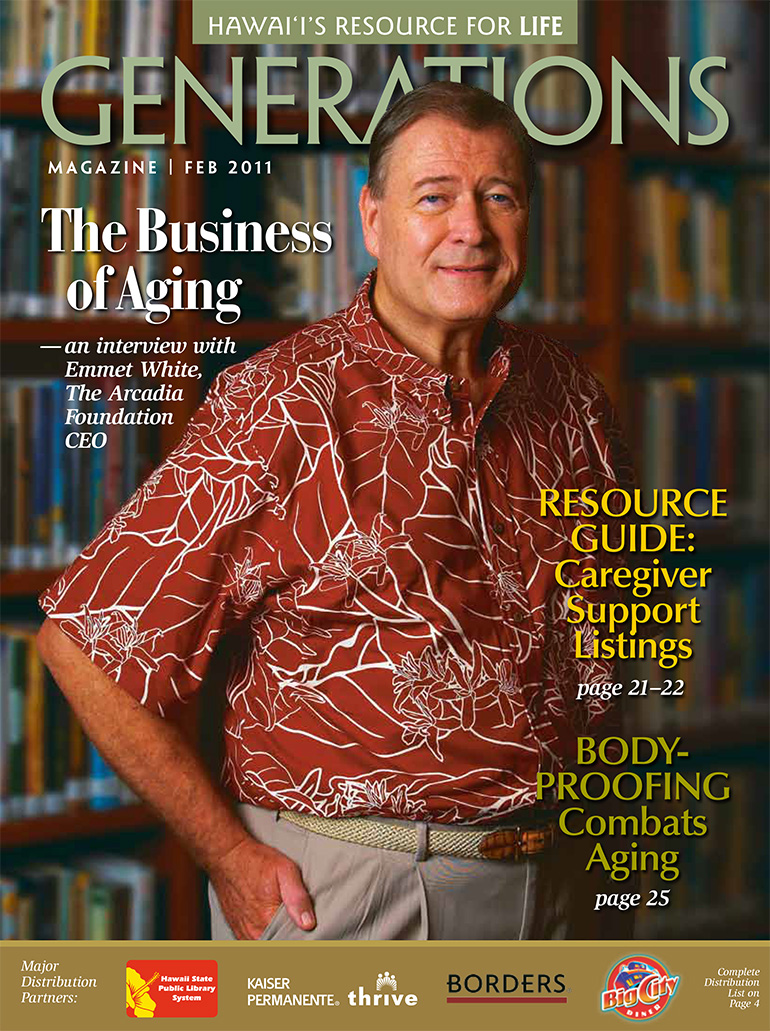
Emmet White—local attorney turned retirement community CEO—offers us insight into the business of aging in Hawai‘i. At Arcadia Retirement Residence he sees firsthand the costs and benefits of senior care.
You may know Emmet White from his previous life as a local attorney, board member of Central Union Church or Colonel in the Hawai‘i Army Reserves; however, most know him for his work as President and CEO of Arcadia Community Services, the holding company for Arcadia Retirement Residence, Craigside Retirement Residence, The Arcadia Foundation, Arcadia Edler Services and Arcadia Home Health Services.
Emmet explains The Arcadia Family of Companies’ approach to senior care, including its future plans for “life care without walls”—or homebased care—a concept that combines services so that residents can age in place at home.
In addition to what retirement communities such as Arcadia are doing to serve seniors, Emmet says that ‘seniorhood’ as a whole needs to be reshaped. Times are changing. The demand for senior care is exceeding supply, and the effects of Health Care Reform are yet to be known. He says that smart use of technology, medical care and education are critical for successful health care in Hawai‘i. However, he cautions, on a personal level, each of us needs a shift in attitude about saving for our senior years. It’s up to all of us to bear the cost of our own senior care, as best we are able, to ensure quality of life in our later years.
GM: With your family on the East coast, why did you decide to move out to Hawai‘i? Having been here for 40 years, are you here to stay?
EW: I had roomed for a year in college with a fellow from Hawai‘i, and gorgeous warm weather all year round was very appealing to me. In 1971, I talked with my wife of 1½ years, Betty, about going to Hawai‘i and seeking jobs. With some hesitation and misgivings she said, Okay. When we arrived in Hawai‘i in late 1971, my former college roommate’s family was very welcoming and supportive to Betty and me. As fate would have it, I passed the Hawai‘i bar exam and was hired by a small law firm. Betty was initially hired as a parttime history teacher at Sacred Hearts Academy (she is now the Head of School). We haven’t had anytime to look back since!
GM: What do you love most about Hawai‘i?
EW: I love the beauty of Hawai‘i’s weather and the people who live here, as well as the opportunity to raise a family and work all these years with Betty at my side.
GM: What is something people don’t know about you?
EW: For 10 years, in my youth, I was a drummer in a summer community band on the New Jersey shore, which gave weekly concerts on the boardwalk. I enjoyed this “gig” very much!
GM: What is your favorite restaurant? EW: Betty and I have three favorites: Paesano’s in Ma¯noa when we have a yearn for Italian; Ruth’s Chris at Restaurant Row when I have a yearn for a good steak; and, Panya at Ala Moana Center when we’re alone, hungry and worried about eating too much!
GM: You and your wife Betty White of Sacred Hearts Academy must have very busy lives. What do you guys do for fun?
EW: Betty and I like to be quiet together when we’re not on the go—we both enjoy reading, or a special trip with just the two of us! I also enjoy an occasional round of golf. We enjoy entertaining—I do the food shopping and Betty does the cooking. Much of our free time is spent with three grandsons, all under the age of 3 years old.
GM: What is a good day for just you?
EW: Our Arcadia companies are devoted to providing quality care and services for our seniors. During the day I see a cheerful outlook and many little acts of love and kindness by, between and among our staff, residents and our families and friends. As I reflect on the day, usually during my drive home, I say a short prayer of thanks, and believe that life is good!
GM: Any hobbies other than work?
EW: For years I enjoyed playing softball in the lawyer’s league on Saturdays (I’m long retired), and, for now, keeping an eye on our young grandboys when their parents are busy is the hobby of choice!
GM: What motivated you to go from the legal field to working with seniors, and how was the transition?
EW: In 1995, Arcadia, on which I had served as a board member from 1983, was at a crossroads needing new leadership and direction. Based on discussions with the Directors, and after conversations with my family, I decided to give this leadership role a try. The small law firm of which I was a member, was disappointed, but was supportive of my move from the active practice of law to my working at Arcadia. The transition from law practice to a leadership role in senior living and health care services was quick and with no regrets or second-guessing. Over the last 15 years we have honed our senior care skills and developed six related companies to provide vital services for our kuˉpuna.
GM: What have you learned from your residents that inspires you?
EW: I have found that when you sit quietly, listen and ask good questions, you will find in each senior resident, participant or client a unique past with wonderful experiences, insights and a special brand of wisdom that produces volumes of valuable and enjoyable knowledge for you and your fellow workers. I am also inspired daily by the great devotion to each other I witness in the couples that reside at Arcadia.
GM: Any favorite stories or residents that you can share?
EW: Indeed, there are volumes of stories, but one that is emblazoned in my memory is that of a beautiful, very petite, 95-year-old resident, whom I had known for years. She had finally agreed to be with us in our Health Care Center. Cancer was taking its toll. When I came to visit with her a few days after her move, she informed me that she had only $50,000 left. Taken back by her direct comment, I remember asking, “What, Marge, do you want to take it with you?” We both had a hardy laugh, and I told her that we would not speak of money again. Then, with her piercing wide and deep blue eyes, looking up at me with a look that at once combined wonderment and joy, she asked, “Emmet, what do you think Heaven will be like?” A host of thoughts cascaded through my mind, as I knew Marge, a wonderful person and friend, would soon be embarking on her journey beyond. I remember saying to her, “All I know, Marge, is that if St. Peter gives you any trouble, I’m doomed to purgatory forever.” A couple of months later Marge passed. But, her query always flashes before me when death is addressed, and her expression, as the start of her journey neared, has always been an inspiration to me for what awaits us beyond our life on Earth.
GM: What do your residents love most about Arcadia?
EW: There are many reasons that seniors reside at Arcadia. I believe one of the initial reasons people chose to reside at Arcadia is the promise of lifetime care, including long-term assistance, should the need ever arise. But, I think that what most residents come to love about Arcadia is being a part of a caring community where dignity, companionship and the environment bring joy and good quality to life everyday
GM: Are you planning to, or could you see yourself, living in Arcadia later on in life?
EW: With the average age of entry for Arcadia at 80 years of age, in a nutshell, if I live that long and Betty sees the value at the time, Arcadia (and 15 Craigside)—if affordable for us—are very attractive options for Emmet’s and Betty’s “very” senior years!
GM: Do you see more retirement communities like Arcadia coming in the future?
EW: No doubt. On the Mainland, there will be more retirement communities similar to Arcadia in the future. And, while the metrics suggest that Hawai‘i needs more senior living facilities, the cost, as well as the government permit and development processes in Hawai‘i, may be too prohibitive for the design, planning, construction and operation of a new Continuing Care Retirement Community (CCRC), especially for that amorphous middle class of Hawai‘i seniors who are too poor to be rich, and too rich to be poor.
GM: What is your opinion on the new Medicare reforms?
EW: The 2010 Medicare reforms come with a substantial price tag:
■ higher/new taxes on the well-to-do
■ taxes on annual health insurance plan premiums that are more than $10,200 per individual (e.g. 40% of that cost)
■ new fees on the health care industry (supposedly because they’re getting new customers)
■ cuts in Medicare spending
While these reforms promise better coverage, the “redistribution” of benefits may not produce overall satisfactory results.
Of course, change and adjustments in senior health care and services are inevitable. I do think that people need to adjust ambivalent attitudes about devoting personal wealth and assets to one’s care in their senior years. We also need to embrace the smart use of technology, medications and clinical care. Adjusting attitudes will have a lot to do with the future success of our huge and expensive health care system.
GM: What is your vision for health care in Hawai‘i?
EW: The smart use of technology, medications, and medical and clinical care are critical to future successful health care in Hawai‘i, as is consistent and continued education on health care programs and services for seniors and their families. There needs to be a major change in consumer attitudes regarding the responsibility for personally bearing much greater costs for our own senior care and long-term care. Senior long-term care and services are not and cannot be a government entitlement program.
GM: Obviously not everyone will be able to live in Arcadia even if they wanted to as there are not enough beds. In your opinion what is our future look like for long-term care?
EW: Statistically, long-term care is a possible factor in every senior’s future. But, no one knows, and the data is unable to tell us specifically, who will need it and for how long it will be required. Private enterprise and government must work in close collaboration with each other to maintain a strong safety net for those less fortunate. Nursing facilities are, and will be, needed to deal with the more intense sub-acute care required for indigent nursing home residents, as well as private pay nursing home residents, which home- and community-based programs cannot reasonably and responsibly handle.
GM: Home-based care is where most families have the challenge to care for their loved ones, is there any easy fix?
EW: There is no “easy fix” for home-based senior care. The Arcadia Family of Companies’ approach to senior care and senior services in the greater community has been evolving. We are pursuing the concept of “life care without walls.” This business concept involves the need to develop the right combination of the following elements for residents who are aging in place in their homes and apartments:
(1) a reasonable financial posture
(2) a reasonable and comprehensive cost schedule
(3) a care coordinator
(4) home/apartment inspections with appropriate maintenance for a senior’s safety and convenience
(5) at least, personal annual geriatric assessments and acceptable health planning and focus
(6) an emergency response system
(7) appropriate in-home assistance with one’s activities of daily living
(8) transportation, as needed
(9) meals, as needed
(10) access to a location with social and wellness programs, including programs and therapies at Arcadia and 15 Craigside
(11) companions, as needed and as planned
(12) referral to sub-acute facilities, as may be required.
Another part of the “fix” is the recognition that one has to assume personal responsibility for the cost of a better quality of life in one’s senior years. The government may provide some help, but, generally, the lion’s share for senior care and services should, and must be borne by the senior.
GM: Do you plan or want to live to 100?
EW: It isn’t my call on reaching 100! If I am given the privilege of a longer life (at 64, I think I’ve just embarked on “those senior years”), I hope my quality of life will be good, so I prepare for the future by trying to adhere to the sound and popular core values we share at the Arcadia companies, as well as saving some money for the “senior costs” Betty and I might face!
GM: Thank you for this wonderful interview. How would you like to sign off to this?
EW: Thank you, Percy, and Generations Magazine for the opportunity to talk about thinking, learning, and planning with our families and loved ones for our anticipated walk into an exciting and rewarding “senior” future.

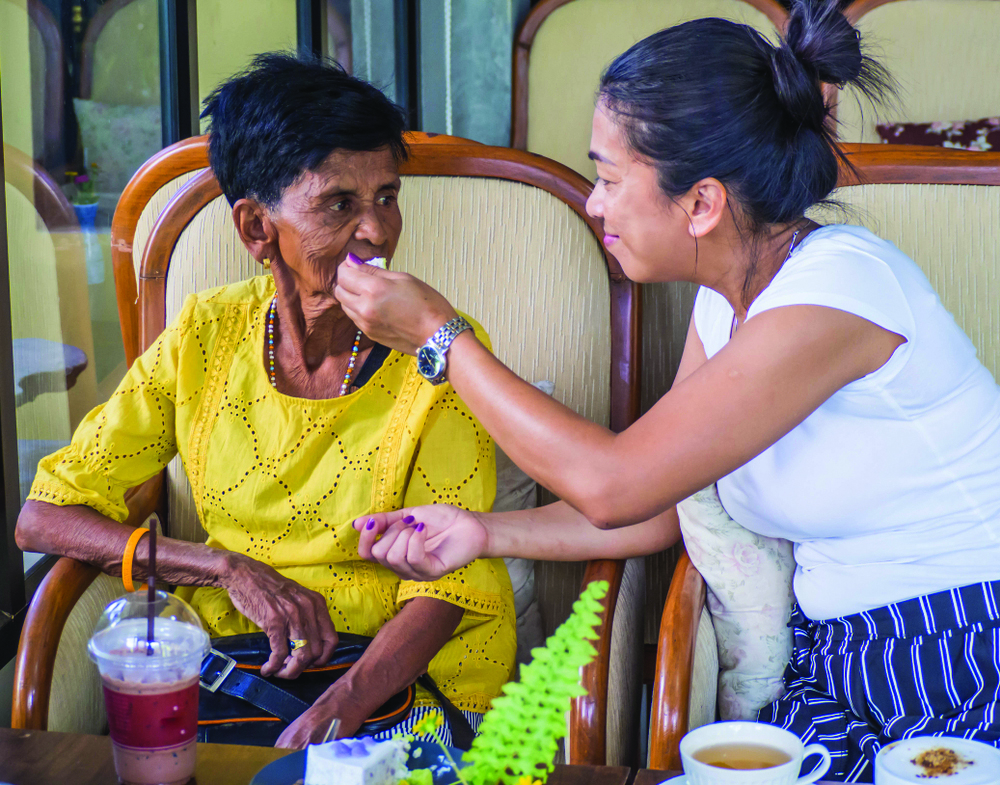 There are two main categories for long-term care solutions for seniors: senior communities and residential care homes. In senior communities, kūpuna live together in an apartment-like setting and interact with one another through daily, scheduled activities. They dine with other residents. In residential care homes, three to five seniors are cared for in a home-like setting. Residents get more individualized attention and all of their needs are taken care of.