by Katherine Kama‘ema‘e Smith cover & feature photography by Brian Suda
The traditions and language of the original Japanese immigrants to Hawai‘i in the late 1800s survived because they taught their children to venerate and value the culture of the homeland. In over six subsequent generations of American Japanese, no single organization has nurtured language and culture more than Mo‘ili‘ili Community Center on O‘ahu. In addition to supporting a thriving Japanese Language School for children, the center opens its doors five days a week to 300 to 500 senior members who come to participate in a wide array of arts, activities, educational programs and adult day care. This private nonprofit organization is the traditional bedrock of Mo‘ili‘ili families.
Executive Director Nadine Nishioka told Generations Magazine about the 115-year history of the center. In the 1890s, children of plantation worker families in Mo‘ili‘ili attended Japanese language school in the private home of Kihachi Kashi-wabara. Mo‘ili‘ili was a large marshland area at the bottom of Manoa Valley, behind Ala Wai (then a river) and Waikiki Beach flats. Lands adjacent to the many ponds and Kapaakea Springs were cultivated with rice, lotus and various vegetables. Along the dirt trails of this farming community were small shops and businesses, and wood-framed houses. Beside the homesteads, small plumes of smoke rose from wood stoves used for ofuros and cookhouses. Customs, foods, religious beliefs and common interests knit the residents of Mo‘ili‘ili into a harmonious community.
The Center’s Heritage
In the late 1800’s, when the sugar barons of Hawai‘i wanted to expand their plantations, they recruited farm workers and engineers from Japan. The men came first and soon brought in their wives. Freedom and work opportunities in Hawai‘i offered hope to young Japanese from a homeland ravaged by decades of war with China. Chinese invaders outlawed the practice of Japanese cultural traditions and Japanese language, so schools and temples were important features of a new life in Hawai‘i. For Japanese immigrants, plantation camps promised a second chance for success. In Mo‘ili‘ili, the community drew together and in 1928, purchased the language house and land that became the community center.
During WWII, the Mo‘ili‘ili community founded a formal council association. At that time, mainland Issei and Nisei were being interned in war camps, but in Hawai‘i, the Nisei first joined the civilian volunteer brigade and later entered the U.S. Army. The council was a hub for the community to gather and support one another. After the war, in 1945, they were awarded an official charter, and 20 years later, in 1965, this private nonprofit organization was formally named “Mo‘ili‘ili Community Center.”
ADULT DAY CARE AND SENIOR ACTIVITY CLASSES AT MO’ILI’ILI COMMUNITY CENTER; COVER PHOTO OF BOARD MEMBERS, SENIOR AND CHILDREN ATTENDEES OF MO’ILI’ILI COMMUNITY CENTER; PHOTOS FOR GENERATION MAGAZINE
The Center Today
The business model for today’s center is simple and very successful. “Our members pay an annual membership fee that covers our overhead, salaries and operating expense,” said Nadine. “Next year, the fee will go up to $40 from $35 per person,” said Nadine. “Some seniors add a cash gift with their membership because they can afford it and they appreciate the benefits they are receiving here. For some seniors, the fee seems high but it all works out. We never turn away any seniors who may have difficulty paying the fee.” Professional planners say that successful community programs are designed and resourced at the grassroots level. Nadine agrees. She places the success of the center squarely on its members. “Our seniors know the programs they want and we just listen to them,” said Nadine. “They want mahjong, and they want it early in the day when they are alert and have a better chance of winning. They organize the games and find the prizes. Senior center staff members make sure the room is ready and oversee their plans. Mahjong starts at 7:30 am, and is so popular that our seniors are lined up and waiting in front of the door at 7 am.”
“Whenever MCC members have an idea for an activity or event, they make a plan and find the resources to put on the program,” said Nadine.
“We provide the space and scheduling and our members ensure the program or event’s success.”
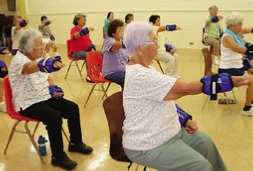
One of the most popular weekly sessions is Rhythm & Life held every morning. This award-winning Japanese exercise and stretching program is designed for elders and choreographed to Japanese music. Rhythm & Life invites both actively mobile seniors (standing) and less mobile seniors (seated) to better fitness and improved blood circulation. The packed room is filled with intently engaged and happy faces as the participants work out to the beats of various rhythms and tunes. Other active options include outcome-based exercise, Zumba, classic tai chi and a special tai chi class for seniors with im-paired balance who want to rehabilitate themselves. This one is important for preventing falls. “I think one beauty of our center is that seniors who have lost a spouse or no longer live in their old neighborhoods may come here and socialize while they participate in healthy activities for body, mind and soul,” said Nadine. “We offer physical exercise, mental stimulation and ways to learn and participate, but socializing combats isolation and loneliness. Members have the opportunity to spend happy times with people who share memories of earlier times and traditional values.”
This benefit was certainly obvious to Generations staffers, who saw members chatting before and after yoga class and senior Zumba.
A display of the impressive artwork and handicrafts produced by MCC members proudly hangs in the center. It demonstrates the wonderful skills seniors can learn here. Traditional kumihimo is the art of braiding cords and ribbons. In ancient times, the samurai braided decorative laces for their armor; today, ties on haori jackets or obi kimono sashes are often crafted with kumihimo. When combined with beading, kumihimo art produces intricate and elegant bracelets. and festive dancing to enka music. Each year, Japanese teachers bring different traditional arts and crafts.
Art classes abound, with origami, shodo calligraphy and festive dancing to enka music. Each year, Japanese teachers bring different traditional arts and crafts.
Japanese Language at the Center
Language is the foundation of culture, and today, children are still learning Japanese at Mo‘ili‘ili. The intensely interactive program includes plays and performances that delight the whole family. The original mission of passing on the Japanese language to the next generation was a budding flower of the old Mo‘ili‘ili community. Today, the branches of that flowering plant produce a bouquet of family-based activities, arts and expressions. A few of the directors on the center’s board actually attended Japanese language classes at MCC when they were in grade school!
Today, K-5 children attend Japanese after-school classes every weekday and practice speaking Japanese with their parents, who learned it in the same facility. The whole family is able to speak Japanese with the grandparents. While many MCC programs are geared to elders, the center itself is oriented to fulfill the needs of the entire family, interacting across age groups as they do at home.
The Teens in Action program gives young volunteers in seventh grade or higher an opportunity to work as aids in the many children’s programs at MCC: After-school A+, Early Morning Care, and programs for school intercession, holidays and summer break.
Senior Programs at the Center
Cultural and community outreach events of MCC are all organized, planned and resourced by staff and member volunteers. Everyone pulls together to make the center a vibrant place where members can be proud of all they accomplish. Their volunteer work results in fun, satisfaction and benefits the community.
“Our members love singing karaoke, and performing both ‘auana hula and Japanese dance; when they learn a dance well, they like to perform it at homes for the elderly,” said Nadine.
“They recently organized performances at various senior daycare centers and nursing homes. We provide the transportation, they make their own costumes, and delight in bringing beauty and enjoyment to the other elders.” Another community service for which MCC recently became a partner is a version of Meals on Wheels. Instead of delivering meals to seniors’ homes, MCC drivers go out and bring elderly to the MCC dining hall for a hot meal. Coming to the center gives them the opportunity for socialization and conversation in a safe, happy environment. The new program is working very well. Nadine regrets that MCC does not have more space and staff for their very popular Kupuna Support Program. This adult daycare program is for frail as well as not-so-frail seniors who can use the restroom with very little assistance. They participate in a number of fun, healthy activities geared to stimulate their minds, bodies and souls. Palolo Chinese Home Catering provides a healthy lunch, which is included in the Kupuna Support Program fee — $55 a day.
“We always have a waiting list,” said Nadine. “The need for good adult care is so great that families are willing to be ‘on call’ for an opening of just one or two days when one of our regular clients is sick or traveling.”
By the end of Generation Magazine’s tour of MCC, it was clear that we could fill two issues with program details and still not cover every offering at this wonderful community center—transportation and escort services, excursions, counseling, special events and more.
Become a Center Member
If you are over 60 and live in Honolulu between Ward Avenue and Hawai‘i Kai, you are within the city area serviced by Mo‘ili‘ili Community Center. However, MCC also welcomes participants from all areas of O‘ahu. To learn more about the organization and its many programs, please visit www.moiliilicc.org.
This year, Mo‘ili‘ili Community Center is celebrating 115 years as a place of learning, health and enrichment. For many generations, the center has served families and created family ties throughout a broad community. MCC’s important work continues due to the generosity of many donors, grants and the Aloha United Way. If you wish to help them with a cash donation, remember that all donations to MCC support the programs, not the administration. Donations are tax deductible and every dollar helps the beneficiaries of the center.
MO‘ILI‘ILI COMMUNITY CENTER 2535 S King St., Honolulu HI 96826 Hours: M–F 8 am to 5 pm
808-955-1555 | Fax: 808-945-7033 | office@moiliilicc.org | www.moiliilicc.org
The traditions and language of the original Japanese immigrants to Hawai‘i in the late 1800s survived because they taught their children to venerate and value the culture of the homeland. In over six subsequent generations of American Japanese, no single organization has nurtured language and culture more than Mo‘ili‘ili Community Center on O‘ahu.
The National Kidney Foundation of Hawaii (NKFH) is aiming high with a new clinical community resource center. It broke ground in July and Sen. Daniel Kahikina Akaka wants all of us to support the last bit of fundraising. The new center in Kapolei will house many clinical community programs to help people at risk of chronic kidney disease get early screening and teach them how to stay healthy.
At 92, Sen. Akaka is still working to help the people of Hawai‘i. His warm, sunny smile continues to encourages us to celebrate goodness with gratitude for all we have. He retired several years ago, but while in Washington, he learned how many persons in Hawai‘i suffer from chronic kidney disease (CKD). Since he came home, he has been helping NKFH tackle this disease.
“I was astounded that kidney disease was such a big problem for us,” Sen. Akaka said. “Hawai‘i has 30 percent more kidney disease than other states; Native Hawaiian, Pacific Islanders, Filipino and Japanese communities are most affected — a major segment of our community. When I retired from public service, I made the Kidney Foundation of Hawaii the focus of my continuing community work. The need is so great and NKFH has many successful programs that help people stay healthy. If we can help get the word out, they can help more people at risk for kidney disease.” One person can’t solve such a big problem alone, so Sen. Akaka is asking all of us to learn more about CKD. We can help involve our families and mo‘opuna in healthy habits that protect our kidneys. We can encourage them to get screened for early signs of diabetes and high blood pressure — the two disorders that often lead to CKD. Currently, NKFH offers free educational materials, health programs and community screening events at various locations throughout the state every year.
Above: An artist’s rendering of the Sen. Daniel K. Akaka Community Center in Kapolei. Left: Sen. Akaka with NKFH Senior Director Diana Benningfield at U.S. Renal Care West Oahu Dialysis.
Chronic Kidney Disease
The chronic or long-term decline of kidney function may start after a urinary tract infection or occur as a result of other disorders. Because kidney disease often starts “silently,” persons losing kidney function will not notice any symptoms until it is too late to save their kidneys.
The best way to know if your kidneys are healthy is to undergo simple urine and blood tests. Patients who already have mild chronic kidney disease may be able to slow the progress by testing their “numbers” regularly and adopting lifestyle habits that are healthy for their kidneys.
We met up with Sen. Akaka and NKFH Senior Director Diana Benningfield at the U.S. Renal Dialysis facility in Kapolei, which provides dialysis services for people whose kidneys no longer function. Here’s what we learned: Most dialysis patients have had diabetes or high blood pressure for some time. Eventually, these disorders damage the tiny filters inside the kidney called glomerular units that transfer waste products and toxins from the bloodstream to the urine. Eventually, the kidneys stop funtioning, causing toxins and am monia buildup in the blood and patients develop the symptoms of end-stage kidney disease.
Early detection with simple screening tests can help slow down the advance of chronic kidney disease.
Without treatment, persons in kidney failure will die. Dialysis machines can keep patients alive, but the treatments may be very challenging for patients and their families. Dialysis machines pump a patient’s blood over membrane filters to remove waste products and ammonia, and return clean, filtered blood back into the patient. Each treatment may take several hours and may have to be repeated up to three times a week. A dialysis treatment schedule requires a lot of energy, and between treatments patients have to watch what they eat and how much fluid they drink.
Another option for patients with kidney failure is organ transplant. However, not all patients are candidates for a kidney transplant, and those who do qualify must join a waiting list until a healthy kidney donor with a good immunological “match” may be located. in Hawai‘i, patients may not have dialysis units nearby their homes and may have to face a long waiting list to receive dialysis treatment.
Sen. Akaka Community Center Promotes CKD Prevention
“Finding a cure for diabetes or high blood pressure goes on,” said Sen. Akaka, “but until then, we need to prevent diseases, not just find cures.”
To this end, the senator is raising funds to build the Daniel K. Akaka Community and Kidney Clinical Resource Center that will also house a new array of NKFH programs and services at Kapolei. The center will invite the community to a place where they can participate in health and wellness programs that support the prevention of chronic kidney disease.
Creating awareness for regular screening has been a major outreach project for NKFH for many years. The goal of the foundation’s publicity and innovative clinical programs is to screen as many adults and keiki as possible in order to detect kidney disease before dialysis is required. With early detection and health skills management, patients can work with their doctors and NKFH to control and slow the progression of CKD. Screening and education allow many people with kidney disease to maintain a robust quality of life and avoid going on dialysis.
The new clinical community resource center will also offer the public and patients with CKD a hub where all may learn and master new habits that will keep their kidneys healthy—such as cooking classes. Families can come to the center for screening tests, attend health classes, participate in healthy exercise and learn how to manage life with CKD. Nonprofits will be invited to the center to use its meeting rooms for gatherings and special activities.
“Aside from the teaching kitchen, where people learn how to cook healthy meals, we also plan to have a commercial kitchen for creating new healthy food products,” said Glen Hayashida, president and CEO of NKFH. “When people ask us, ‘What can I eat now?’ we want to provide useful resources. Our cookbooks are popular and great for homemakers, but many new patients don’t know how to cook. We want the center to be a vital health resource.”
Everyone should seek education about kidney disease, regardless of gender or age.
Health Maintenance Skills Are a Necessity
Sen. Akaka supports the NKFH’s programs because he knows that a healthy lifestyle has positive benefits for ku¯ puna.
“The body needs exercise,” he said. These days, he goes to the gym every day, usually using the weight machines. Although he uses a cane to assist in walking, gym equipment allows him to exercise his upper body, lower body and core muscles.
With the help of his family, he began choosing healthier foods about 15 years ago, when he was 77. His wife, Millie, and daughter, Millanne Akaka Matson, started buying foods without preservatives. They said it used to be difficult to eat out because they could not be sure menu items were appropriate or healthy. Most of their food had to be homemade. But now, more restaurants offer healthy choices.
Earlier this year, the senator started a no-salt diet to reduce water retention.
Other health maintenance programs slated for the new center will be diabetes training classes, high blood pressure classes and fun, outcomebased physical fitness programs.
Right Kind of Learning for Hawai‘i’s People
“We need a facility with people who will work with patients and look at the culture of the people of Hawai‘i,” says Sen. Akaka. “There are many ways to deliver information and care. People receive guidance in different ways based on their upbringing and beliefs.”
Pukui, Haurtig and Lee researched the powerful connection between cultural traditions in Hawai‘i and how patients relate to healthcare in Na¯na¯ I ke Kumu: Look to the Source. The book is the basis for Sen. Akaka’s comment. He understands that resource center professionals must provide services to the community with cultural sensitivity and in a way that is acceptible to patients and their families. Getting individuals to accept their disease, comply with treatment and modify their lifestyles to achieve better health requires a comfortable “conversation.” Talk story takes time. We live in a land where the sitting down for a chat requires getting to know each other sharing a snack and telling stories of our past. The community center can draw people in and create an environment that encourages the way we learn in Hawai‘i.
A Little More Fundraising for the Clinical Community Resource Center
In July 2016, community leaders ceremonially broke ground for the new NKFH headquarters, a prime location to serve more than 40,000 West O‘ahu residents suffering from kidney disease. The ground floor of the $12 million, three-story building will house the Senator Daniel K. Akaka Community and Kidney Clinical Resource Center, including a library of his papers and books. The upper floors will have room for NKFH’s clinical and educational programs and services. Any additional space will be available for lease.
“I look forward to this kidney wellness center minimizing the impact of CKD for people who now suffer from the disease. It will be the source that eliminates the disease for future genertions,” said Sen. Akaka. “We have raised three-quarters of the funds already. Our grand opening is slated for January 2018.” Humble as ever, he said that he’s just playing a small role: It’s coming together because so many hardworking people are attached to it. “I’m just here to help,” he said.
L–R: Ray Soon, Ernie Soon, Steve Kelly, Danny Kaleikini, Ty Cullen, Glen Hayashida, Sharon Har, Kim Marcos Pine, Mike Gabbard and Lois Mitsunaga at the NKFH groundbreaking in Kapolei.
“You can help, too, in a number of ways,” he said. “Just visit our website at www.kidneyhi. org to see how you can get involved — we always appreciate your kind support and kokua.”
Human and Financial Costs of CKD
The statistics for CKD in Hawai‘i are a big concern for our state. More than 168,000 people are already diagnosed with CKD and another 100,000 are at risk for kidney disease because they have diabetes or high blood pressure.
Of the 450 patients on the organ transplant waiting list, over 90 percent are waiting for kidneys. Most will die before they have the opportunity to get into a dialysis treatment program or to receive a kidney transplant operation. End-stage kidney failure is heartbreaking and reinforces the need for prevention and health maintenance.
For Sen. Akaka, funding the very high healthcare costs of dialysis and kidney transplants is a big concern for our state. NKFH programs are the best option for reducing the costs of CKD in Hawai‘i.
Sen. Akaka remembers his third-grade teacher at Pauoa Elementary engaging her students in mathematics with a piggy bank. She used it for several lessons, “teaching us math by counting the money,” he said. Then the teacher asked them to write down what they would buy with the money. “That was our composition lesson,” he said. For young Daniel, the practical application of mathematics to accounting would serve him well in life.
Many years later, he applied the piggy bank lessons to his work in Congress. While serving on the Senate Committee on Banking, he developed the consumer advocacy portion of the Dodd-Frank Wall Street Reform and Consumer Protection Act. The legislation was created in response to the financial crisis of 2008 and ensuing Great Recession. It brought new regulations and consumer protection initiatives to the financial industry.
A Matter of Hawaiian Values
Sen. Akaka frames his work with NKFH in terms of Hawaiian cultural values, which some call “plantation values.” He grew up farming taro on kuleana land in Pauoa Valley, the youngest of eight children. Working the land in a side valley up Nu‘uanu and managing the chores of a large family encouraged cooperation, shared responsibility, reciprocity and peacekeeping. “I was the niele (questioning) one,” he said, “I always wanted to know things.” Akaka, a Chinese name, came from his father, Kahikina Akaka, who was hapa Hawaiian and Chinese. His mother, Annie, was fullblooded Hawaiian.
Volunteers are an essential part of CKD awareness programs.
“Spirituality and faith carried our family,” he said. The Akaka family way of life was daily prayer, with daily morning and evening devotions and Sunday services at Kawaiaha‘o Church. Righteousness was expected. Doing things “pono”— justly, with integrity and for the common good — was Daniel’s way of honoring the deeply held values that his parents taught him.
After attending Kamehameha Schools, he joined the Army Corps of Engineers during World War II from 1943 to 1947, first training at Schofield Barracks and then serving in the Central Pacific at Eniwetok in the Marshall Islands, and Guam and Saipan in the Marianas. After the war, he graduated from UH Ma¯noa to become a high school social studies and music teacher. He went into school administration and became the chief program planner for the state.
After winning his first congressional election in 1976, Daniel K. Akaka served 13 years as a U.S. Representative and then another 19 as a U.S. Senator. He always lived by the rule of “pono” righteousness, saying, “the just things [you accomplish] will remain constant through the times.” He is most famous for the Akaka Bill, which would have established a process for federal recognition of Native Hawaiians. Although the bill never passed, his vision is still part of every discussion and action that furthers self-governance for Native Hawaiians.
Another cultural principle that guides all his work is aloha. “I think the mission for Hawai‘i is to help the world know aloha,” he said. “If the world could live and have relationships like the people of Hawai‘i, the world would be a much better place.”
The Future Looks Bright
This community center approach to prevention has strong support. There is a good probability that community access to lifestyle training and support will help a large number of patients and their families at risk for CKD. Hawai‘i’s people will have a better opportunity to maintain their health and slow the onset and progression of the disease.
Every day is a new day of progress, education and hope for families struggling with CKD. Let’s help Sen. Akaka and NKFH find a cure, and also support our families and neighbors until the time when a cure is found.
The National Kidney Foundation of Hawaii (NKFH) is aiming high with a new clinical community resource center. It broke ground in July and Sen. Daniel Kahikina Akaka wants all of us to support the last bit of fundraising. The new center in Kapolei will house many clinical community programs to help people at risk of…
“ I didn’t really choose Waikīkī — my feet were already permanently planted here in the sands of my ancestors. Waikīkī is my kuleana and it makes me whole.” — Jeff Apaka
Hawai‘i greets the rest of the world at Waikīkī. Each year, millions of tourists compare their Hawai‘i brochures to the first impressions they get from the world’s most famous beach community. Jeff Apaka grew up there, entertains there, works as community relations director for Waikīkī Community Center and sits on the Waikīkī Neighborhood Board No. 9. He is a serious advocate for his community.
Hawai‘i operates on a delightful mix of pragmatism and altruism. We are very practical people who can make something from nothing, solve problems and find a way to do whatever is needed. We don’t think about rewards as much as we care about helping others. The highest praise is when a kūpuna says we are “nice.” That one word means we manage our kuleana (responsibilities) well, respect our community and try to make decisions that help people around us feel more comforted, happy and secure.
Jeff Apaka is nice. He is part Hawaiian, part Chinese and a few more parts; he embodies the finest Hawaiian traits. In his roles as a professional “showman” and a compassionate community leader, he taps into his gift of kindheartedness and uses his innate talents to make life in Hawai‘i a little better for everyone.
Alfred Apaka, 1919 –1960
It wasn’t easy getting to where he is. Jeff’s father, renowned romantic baritone Alfred ‘Aholo Apaka, died at age 40 when Jeff was just 13. Besides a career as an entertainer and producer, Jeff had a family kuleana to care for two of his elders. Blending his gift of compassion into his entertainment talents led him to a long career with Waikīkī Community Center as a community relations director. Now in his own kūpuna years, Jeff is a protector of his beloved Waikīkī community, and the elders who live there.
His early life was split between Hawai‘i and Beverly Hills. When he was 6, the movies and TV drew the Apaka family to Beverly Hills with the help of Bob Hope. Billboards, neon lights and Hollywood glitz fascinated little Jeff, with bigger-than- life director, actor and studio executive “neighbors” like Caesar “Butch” Romeo and The Andrews Sisters. Beverly Hills High School schoolmates included Rob Reiner, Rick Dreyfus and Albert Brooks.
Alfred Apaka’s crossover career was hot. From his start at Don the Beachcomber (now The International Marketplace), his records began selling on the mainland. Postwar thirst for Hawaiian music was driven by a hundred thousand veterans who had fallen in love with the romantic, soothing airs of steel guitars, ‘ukulele and island tunes sung by luscious Hawaiian voices like Apaka’s. In the ’50s, aloha shirts were the rage and the “Hawaii Calls” radio show broadcast around the world. Sellout crowds at The Lexington Hotel’s Hawaiian Room in New York City clamored for the tunes of Alfred Apaka, “the darling of Manhattan;” Mahi Beamer; John Kameaaloha Almeida; Haunani Kahalewai; Nina Keali’iwahamana; Clara Inter (Hilo Hattie); and the Ray Kinney band.
Jeff’s dad appeared on “The Ed Sullivan Show” and “The Dinah Shore Show.” Bob Hope helped him get a contract to help Henry J. Kaiser popularize his new Hawaiian Village Hotel in Waikīkī. The sky was the limit.
Fame often takes its toll on families. When Jeff was in the fourth grade, his parents divorced and he returned to Honolulu with Mom. He began exploring his own performing talents. During eighth grade at San Rafael Military Academy, tragedy struck — Alfred’s heart suddenly failed during a game of handball — and Dad was gone.
Alfred Apaka teaching his son, Jeff, the ‘ukelele as Mom watches. Above, auntie shows Jeff some hula.
Jeff took it hard. He spent two years at a Jesuit seminary in Canada before returning to Beverly Hills High School, where he graduated in 1964. He went alone to his audition for the American Academy of Dramatic Arts in New York City, and joined a class with Danny Devito and Melanie Safka. He also took acting classes at Fordham University and in 1968, he was singing the mainland nightclub circuit when he had an offer to debut in Honolulu with his own show at the Monarch Room of the Royal Hawaiian Hotel. Things started to happen; he was signed to Capitol Records. Among all the Waikīkī entertainers, Jeff was always the baby; the youngest.
In performing arts, Jeff is his own man. “My voice is like my dad’s but not as romantic — my strength is as a song and dance showman. I had piano and violin lessons when I was young and I love music, but Dad wanted to be a physician, not a singer. He encouraged me to do well in in my studies, but creating live productions is my passion; I can do almost anything onstage.” Jeff also writes skits, directs and produces. His creativity, eye for detail and organization skills make him a talented event producer and manager.
From 1979 to 1983, Jeff starred with Audrey Meyers in the popular “Here is Hawai‘i” stage show written by Keola Beamer and produced by the late Tom Moffatt at the Maui Surf Hotel (now The Westin Maui Resort & Spa).
“That was my favorite gig. We had live rain, snow, an erupting volcano and falling stars onstage. For the “Honolulu City Lights” number, a big moon glowed over a silhouette of the Honolulu skyline as the lights came on in the buildings. A great show transports the audience to their deepest emotions: love, longing, joy and laughter. That’s why we had so much fun doing it and audiences loved it,” said Jeff. “Smiling and laughter is so important to health and longevity, and nothing brings more joy to people than live shows.”
After the Maui show, Jeff returned to Waikīkī to become a caregiver for his maternal grandmother and paternal grandfather. Nobody ever gets training for family caregiving. When the time came, he had the right stuff to honor his kūpuna and keep himself going — compassion and lots of energy.
After his kūpuna passed, Jeff built a career, first entertaining passengers as a cruise director on The Independence and The Constitution. Later, he produced the shows.
“During this time, I was also the chief barker for Variety Club: A Children’s Charity. On Christmas Eve, 1928, a club for entertainers in Pittsburgh found a baby abandoned in their theater and took her to raise. Today, Variety Clubs in many states aid children,” said Jeff. The chief barker (club board president) organizes fundraising events. Jeff’s success with Variety Club of Hawai‘i impressed the late Gerri Lee, who then recruited him to run fundraising events for the Waikīkī Community Center.
Compassion and Business
On the flip side, Jeff Apaka is a community leader. In the tradition of Hawaiian performers, his “day job” is critical for residents of Waikīkī. Last month, he celebrated 25 years as community relations director for the WCC on Paoakalani Avenue. In his spare time, he has been serving on the Waikīkī Neighborhood Board No. 9 for the last 18 years. Waiki¯ki¯ residents often see Jeff strolling with Ponoli‘i (the righteous one), his 13-year-old Chihuahua—a kūpuna “puppy.”
“When I grew up on Launiu Street, homes had gardens, hedges, coconut trees — no highrises. The Waikīkī neighborhood was full of Hawaiian families. Local kine beach boys ruled the beach and tourism was just beginning to boom. Later, mainland surfers moved in and brought drugs with them. The stretch from Liliuokalani Avenue to Kapahulu Avenue came to be called ‘The Jungle,’ a pejorative description that portrayed our home as tenement housing for kānaka maoli.”
“That was not the truth. Hawaiian seniors residing in this moderate- living community wanted nothing to do with addicts, who not only ran the streets but also renamed old shore breaks so that the Hawaiian names eventually became lost.
In 1977, Sen. Hiram Fong Jr. and Gov. George Ariyoshi founded the WCC by putting Gerri Lee’s Waikīkī Senior Program in the old St. Augustine parochial school buildings and Dr. Chong’s Waikīkī Health in the vacant convent. Today, WCC also includes the Early Learning Center for preschoolers and an active thrift store.
The board members, staff and donors of WCC developed a very successful nonprofit, offering Waikīkī residents senior health, wellness and prevention programs, and individual case coordination services for frail seniors at risk for homelessness. Caroline Hayashi, president of the nonprofit, said, “Our workshops, activities and educational programs meet the physical, cognitive, social, emotional and well-being needs of our kūpuna. We have over 70 different activities for seniors every month, from exercise to leisure interests — and free parking for all our
activities.”
May 8, 2017, is the 25th anniversary of the WCC fundraiser, The Duke Kahanamoku Beach Challenge (formerly, the Ala Wai Challenge). Jeff built this paddling race around some of Hawai‘i’s most celebrated watermen — Tommy Holmes, Blue Makua, Michael Tongg, Nappy Napoleon and the late Myron (Pinky) Thompson. Now, this huge public event is held at Hilton Hawaiian Village on Duke Kahanamoku Beach, where the lawn comes alive with crafters and live entertainment. Canoes bring in dignitaries to the mauka end of the lagoon for a traditional Hawaiian welcoming protocol to bless the spirited competition and fun!
“When I was new at WCC, I wondered how I could pull off something like this, but the strength and inspiration of my kūpuna and my friends in the community led the way to success,” said Jeff. “It’s a great cause because we help so many kūpuna and keiki.
“Helping is fun. I like escorting seniors on travel tours to outer islands twice a year. At Thanksgiving, I plan a buffet dinner for kūpuna who have no family here or on the mainland. The Waikīkī Beach Marriott Resort & Spa and my musician friends help with food, beverage and entertainment.”
Jeff’s roots in Waikīkī are deep. “We all crave identity. I knew my middle name, ‘Aholo,’ was connected to Dad’s Hawaiian lineage, but our ties to Queen Lili‘uokalani explain my deep affection for Waikīkī and Maui’s red carnations. Actually, I did not really choose Waikīkī — my feet were already permanently planted here in the sands of my ancestors. Waikīkī is my kuleana and it makes me whole.”
Princess Lili‘uokalani adopted Jeff’s grand-aunt, Lydia Ka‘onohiponiponiokalani ‘Aholo, when she was 7 days old, after her mother died in Lahaina, Maui. Lydia played in the princess’s gardens on Wainani Way, Waikīkī, when Lili‘u’s land, Hamohamo, was an open meadow stretching across Paoakalani Street and the Ala Wai Canal to Kapahulu and out to the beach. Lydia attended Kawaiaha‘o Seminary School for Girls. She was the first graduate of Kamehameha School in Kalihi and its first Hawaiian language instructor. Lydia’s father, Luther ‘Aholo, taught at Lahainaluna Seminary. “Aunty Lydia ‘Aholo told Alfred Apaka to honor Queen Lili‘uokalani by wearing a double lei of sweet, tiny red carnations that grew in Luther and Keahi’s yard on ‘Aholo Road in Lahaina. Today, whenever Jeff performs, he wears white to set off the traditional ‘Aholo double red carnation lei — and his father’s jade ring.
Lydia Ka‘onohiponiponiokalani ‘Aholo
Jeff talks about the future with the same energy and compassion that he puts into all his work. “I wish all kids could experience the mainland living. It would help them relate better to visitors, and allow them to better appreciate Hawai’i Nei. The ‘āina connects everything and we must do what we can to protect it. Waikīkī ahupua‘a extends up Mānoa Valley. A lot of the kingdom is underneath the concrete of Waikīkī.”
Jeff recently finished five years starring in and producing a Hawaiian show at the Hilton Hawaiian Village. “Visitors still come to Hawai‘i to hear live Hawaiian music,” he said. He is looking for a permanent theater home in Waikīkī for an updated live show.
Jeff worries about Waikīkī kūpuna on fixed incomes, and especially those who are being displaced by high-rise condominiums. “Just a small increase in the cost of living forces seniors to make choices about what they can afford to buy. Sometimes the choice is between rent and food.
Every little thing we can do for them that saves them money helps them keep going and stay in their homes. I hope everyone who reads this article will support the Waikīkī Community Center. I hope Waikīkī families will seek WCC services, participate in our programs, volunteer or donate.”
Feeling pity doesn’t help others; action does, but requires a lot of courage. Jeff does not shrink from his desire to help others. He finds a way to get things done, like the Hawaiians of old.
“Mahalo to all the community leaders and people who have worked with me through the years; I know your love for this place.”
Jeff makes me think of one Alfred Apaka lyric, “Keep a smile on your lips, brush the tears from your eyes…” Jeff energizes his deep compassion to help kūpuna, keiki and their families — and dry up their tears. It’s a powerful talent. Perhaps Jeff’s recipe for success is worth a try.
Lend Your Support for a USPS Alfred Apaka Stamp
Jeff is leading a campaign for a commemorative stamp in 2019, Alfred Apaka’s 100th birthday. The U.S. Postal Service counts on the Stamp Advisory Committee to decide who gets honored. We need thousands of letters from the entire Hawai’i community to win their attention. Write a short note today and send it to:
Citizen’s Stamp Advisory Committee
475b L’endant Plaza SW, Rm. 3300
Washington, DC 20260-3501
Sample Letter:
Aloha to All Committee Members,
Please consider commemorating Alfred Apaka (1919–1960) on a U.S. Postal Service stamp in 2019.
Before jet travel, the romantic voice of Alfred Apaka broadcast throughout the world live on “Hawaii Calls,” “The Ed Sullivan Show” and “The Dinah Shore Show,” making fans everywhere dream of visiting the Hawaiian Islands. In the dynamic years leading to statehood, Apaka’s popularity drew audiences to all Hawai‘i entertainers and a new genre of American music.
Mahalo for your kind consideration!
Hawai‘i greets the rest of the world at Waikīkī. Each year, millions of tourists compare their Hawai‘i brochures to the first impressions they get from the world’s most famous beach community. Jeff Apaka grew up there, entertains there, works as community relations director for Waikīkī Community Center and sits on the Waikīkī Neighborhood Board…
Family is a very important source of virtues and values. Our ancestors collected generational wisdom from their ancestors — surviving and thriving through famines, wars, migrations, dynasties and empires. Closely knit families can be a source of nurturing, support and protection for their members; family and cultural traditions support us through important life passages, and provide the framework for how we respond to challenges and opportunities.
Les Ihara is ninth of 11 children and appears second from the left with his parents.
Like many Hawai‘i residents, husband and wife Les and Shirley Ihara of Kāne‘ohe came from Japanese immigrant families. Their families were able to manage through the Great Depression and provide them an education. After World War II, they began their own family, and Les’ Army career took them all over the United States and abroad. Now in their late 80s, they find themselves the patriarch and matriarch of a four-generation clan that practices togetherness. There are lessons for all of us in the Iharas’ simple recipe for a happy life: be patient, be tolerant, do what brings happiness and have fun wherever you are.
They graciously agreed to share their stories, and the values they learned from their parents that they felt were important to pass on. There are some lessons here for all of us.
Mitsue “Shirley” Sonoda is the youngest (far left) with her parents and five siblings.
The Roots of Family Culture
Shirley Sonoda was born in Kahului, Maui, the youngest of six children. She grew up in an Hawaiian Commercial & Sugar Company (HC&S) plantation home in McGerrow Camp, Pu‘unēnē. Hard work was honorable and led families to success. Shirley’s father worked in husbandry at Waihe‘e,Pu‘unēnē and Haleakala Dairies, taking care of birthing cows and calves. Her mom worked in the dairy’s plant, washing the pint-sized glass milk bottles that were used at the time. Shirley describes a “wonderful,” childhood in an agricultural community surrounded by fresh fruits and vegetables and lots to do. “As the youngest, I was spoiled,” she said.
Family Support and Encouragement
Shirley favors her pretty mother. Shirley giggles. “My name is really Mitsue, but one day a lady said, ‘that child looks just like Shirley Temple,’ and from then on, I was always called Shirley. My oldest sister, Hilda, doted on me, and my brother, Kiyoshi, who was one up from me, was my protector and best friend,” said Shirley. She had a lot of boyfriends, but was encouraged to focus on her studies and go to college. During the summers before her junior and senior years at Baldwin High School, Shirley worked on the line at the Maui Pineapple Company cannery in Kahului.
Shirley’s parents both came from Kumamoto on the island of Kyushu in the southern part of Japan. Her father immigrated to Maui first. Wars with China were very hard on the Japanese people and Shirley’s maternal grandparents wanted her mom to have a better life, so they allowed her to become a “picture bride.”
Les is also Nisei (a first-generation American of Japanese descent) and ninth of 11 children. “I had a lot of attention and supervision from the older siblings, but we were all very supportive of one another,” said Les. “I think it is important to allow the kids to pursue what they really want to do and give them the encouragement they need.”
“I wanted the kids to be scouts like me, but they much preferred sports and didn’t continue in scouting,” said Les. “So, I supported them in sports and they all became good athletes — and our grandchildren are, too. Percy was bigger than the other boys and excelled in baseball. My daughter, Sherry, and her daughters, Cynthia and Cathlene, coach tennis for St Andrew’s Priory and Sacred Hearts Academy. All our kids are good swimmers and the grandchildren are into many different team sports. In Japanese, we encourage one another with this expression: gaman. It means to stick with it or hang in there. So I tell our grandchildren to pick what feels comfortable for you — what you like to do — and then do your best to stick with it.”
“Scouts’ honor and honesty have always ruled my life and I tried to pass on these virtues…”~Les
Family History of Enterprise
About 10 years ago, Les discovered some interesting background about his father’s family. In 1898, his father and paternal uncle came to Hilo from Yamaguchi-ken on the main island of Honshu. His dad came to build railroad bridges and tunnels for the cane trains between Hilo and Honoka‘a. His uncle was a labor negotiator, procuring contracted workers from Japan. The brothers’ last name was Tomishima.
It was the turn of the century and the end of the first Sino-Japanese War when China signed the treaty of Simonoseki, and ceded both Taiwan and Penghu to Japan. In the occupation, Japan sent educators to teach the Japanese language and culture to the people on these islands. On Jan. 1, 1900, the Taiwanese resistance killed eight Japanese educators; one of whom was the only son of the Ihara family. “Without an heir, the family decided to adopt my father,” said Les.
Les’ maternal grandmother was a merchant who came to Hawai‘i in the 1930s and ran the Shigeta Store in Hilo, which later became the Ihara Store. This general merchandise store was famous for penny “ice cakes,” a type of Popsicle. Strawberry was the most popular flavor, but Les loved the azuki bean ice cake. When Les got his driver’s license at age 15, he became the store’s delivery person, hauling groceries and charcoal to customers’ homes. Right across the store on Kīlauea Avenue was the Hilo Hongwanji Mission.
Formative Training
“Church and language school at the hongwanji were very important to my parents and to me,” said Les. “I learned Japanese language, martial arts and discipline. I also became very interested in scouting and achieved Eagle Scout before my last year of high school.” Les even considered a career in scouting administration, but social workers were in demand after the end of WWII, so he studied psychology and social work at University of Hawai‘i at Mānoa. “Scouts’ honor and honesty have always ruled my life and I tried to pass on these virtues,” he said.
Les also loved tennis. “In high school, I would collect stray tennis balls from around the court and when I found old racquets in the rubbish bins, I would repair them — that’s how I started playing tennis.” He taught himself by reading tennis books and putting conceptual techniques into practice. Discipline learned at Hongwanji paid off and Les won the Hawai‘i Island championship in 1945.
Later, he would join the All Army Tennis Team in the ’60s and win the Armed Forces Senior Singles and Doubles Championship in 1980, in addition to numerous others trophies. He still plays three days a week and says tennis keeps him healthy, mentally and physically. He aims to play as long as he can.
Once married, they were destined for an adventure. Both Les and Shirley’s lives were about to get interesting: Les, in taking on a large command and Shirley, always looking on the bright side of being a military wife.
Respect for Education
All Japanese-Americans share a deep respect for education. The Issei (Japanese immigrants) assimilated American culture but insisted that their children attend both public school and also Japanese school. Les and Shirley were also encouraged by their families to pursue higher degrees — older siblings paid tuition for the younger ones. They sent their boys to Mid-Pacific Institute for high school and paid college tuition for all six kids. This high value placed on education has been extended to the grandchildren, too. The tradition created four independent business owners, one professional educator and one state Senator.
Love and Marriage
At the same time Les was at UH, Shirley was attending business college in Honolulu and living in a beach hut where the Hilton Hawaiian Village now stands. She was studying hard, babysitting part-time at Queen’s Surf Hotel and doing bookkeeping for the Niumalu Hotel Restaurant. Handsome Les Ihara happened to be bussing tables at Niumalu and fell for beautiful, upbeat Shirley.
“She agreed to go to a dance with me — that was great,” reminisced Les. “Shirley is all the things I am not. She is outgoing, thrifty and laughs a lot. I am very appreciative and still love to be around her. My goal is to spoil her and make her happy.”
They could hardly wait to be married, but Les’ family would not allow it until he graduated and had a job. He received his degree on June 14, 1950, and landed a job in Hilo as a social worker a few months later. On Shirley’s birthday, they were married in the Niumalu Hotel garden on the afternoon of Sept. 4, 1950. That night, Les and Shirley flew to Hilo and the next day, Les began his first job.
The Korean War started a week after Les graduated from college. Les got a few months deferment, but in early 1951, he was drafted and took basic training at Schofield Barracks on O‘ahu and later at Fort Ord, California. After basic training, he had a choice to finish advanced basic training and go to Korea as an infantryman, or to enroll in Officer Candidate School (OCS). Of course, he chose OCS at Fort Bliss in El Paso, Texas. Shirley, who was carrying their first child, stayed with her oldest sister on O‘ahu and joined him later.
Shirley served as a volunteer with the American Red Cross. Her Family has followed in her footsteps with extensive involvement in many community services.
Be Patient; Be Tolerant
Les was commissioned a second lieutenant in May 1952 and was assigned to Camp Roberts near San Miguel, California, where an all-Caucasian National Guard outfit from Alabama was in active duty training for the Korean War. He was the only non-white officer in the entire battalion but he said he didn’t feel any discrimination. In late 1953, the Army was ordered to integrate. Les was then a platoon leader and when black soldiers joined the unit, he experienced, firsthand, the effects of discrimination. At that time, soldiers carried half a field tent in their backpacks. At night, two men piched their tents together. “I could not believe that all those guys were trying to bed down in half-tents. I ordered them to put the tents together, but the order was never carried out and I knew my superiors would never back me up.” Nevertheless, Les stood by his values of tolerance and kindness. “One time in college, a gang of tough guys sucker punched me. I got away, ran to the Coke machine and broke an empty bottle to make a weapon to defend myself. They decided not to beat me up, and I will never forget that feeling of being outnumbered. I teach my kids to be tolerant and kind to everyone.”
Look at Change as Adventure
Career Army families get bounced around among duty assignments. The term “Army brat” comes from Army children who were traumatized by moving around from place to place. Psychologists found that the parents’ attitude about change determined if the children were hurt by the moves or grew up well-adjusted. This is where Shirley’s “Pollyanna” view of life, seeing the good in people, places and events, was a distinct advantage. Instead of saying, “Oh no!— not another move,” Shirley would respond, “Korea? Great! I want to see the world!” Her children learned to love adventure and look for fun in new undertakings.
Cross-country trips were always an adventure and a democratic process.
In following years, the growing Ihara family moved wherever the Army needed Les: Hawai‘i, Germany, Kansas, Virginia, California and Korea. Shirley recalled, “I was one of the wives who moved and followed my husband to most of his duty stations. The only place I did not go was Vietnam. For me, it was exciting to see new places and meet new people. When the kids were small, it was no problem moving them from one school to another. Every new place was an adventure. In Germany, Percy was born and he stayed with a nanny while we took the older children on trips to the Benelux countries and Switzerland. Sometimes we would leave all the children at home and get away for a weekend by ourselves. It was a great life.”
Percy recalls long cross-country trips to Virginia in the family’s Country Squire Station Wagon. The children passed the long hours playing cards — Paiute (Hawaiian Knock Poker) was a favorite. “After my dad clocked 500 miles, we began looking for a motel with vacancies, a pool and a kitchenette. After checking out a few, we would all vote on where to stay. In those days, if a motel had a color TV, it might win our vote.” Family democracy is a way of teaching children the power of the vote, how to debate your point of view, and how to accept the group’s authority, if you don’t win. This is a powerful form of mutual support.
Shirley’s zest for life resonates in younger generations of Iharas. They all love to travel. Annual family vacations bring 30 to 40 members of the Ihara clan together, and Les and Shirley pay for everything. “We would not be able to afford the vacations for our family if they didn’t take us to Canada, Washington and almost every Hawaiian Island over the past 20 years,” said oldest daughter Sherry. This love for the unknown and ability to find fun in new situations plays out in many ways. One is managing risk and return, the hallmark of entrepreneurs. Converting adversity into blessing has become an Ihara family “trait.”
“It’s very important to laugh every single day and enjoy life.”~Shirley
Social Responsibility
Being the spouse of a commissioned officer living on an Army base challenged Shirley with new family and social responsibilities. She learned to be an extraordinary hostess. On the spur of the moment, she needed to be prepared to graciously accompany Les to formal functions at the officers’ club. She said with a smile that a nice set of pearls “will turn any dress into proper dinner attire — I learned that from other Army wives.” She also fondly remembers a major’s wife who taught her to play bridge. “That was nearly 60 years ago. She invited me to join other ladies for lunch and bridge.” She added, “They said I was a fun person and I certainly enjoyed the game. Les and I still play once a week.”
Helping one another translates to community, too. Before Les retired as a colonel, he helped a lot of younger soldiers learn the ropes of military command. Shirley volunteered extensively with the American Red Cross. These expressions of altruism were not lost on their children — they and their families are civil servants, volunteers, educators and community business people. All Ihara family members devote themselves to community service by volunteering for nonprofits, churches and community athletics. Now their grandchildren volunteer, too.
Enjoy Life With Your Family — Stay Connected
“It’s very important to laugh every single day and enjoy life.”~Shirley
Shirley is definitely fun to be around. “Les has learned to be a good laugher,” she said. “It is so easy to become grumpy; it’s very important to laugh every single day and enjoy life.”
I think the Iharas mastered something that some families might take for granted. It is mutual respect and support. Family members stay connected even though they are busy, because you can’t really be supportive if you don’t know what challenges your family is facing. Once a month, Shirley and Les and all the four generations get together for a meal. There’s opportunity for real connection when they go on an extended vacation together.
Les and Shirley have a life of their own, too — Las Vegas every other month and a cruise once a year. Shirley is thankful that she could focus on her family because she never had to take a job. She also quips that she is not ready to “retire” from her family responsibilities: cooking fabulous meals and keeping track of all 14 grandchildren.
In the close and supportive Ihara family, these are the values that Shirley and Les learned from their parents and grandparents: be honest, work hard, go after what you want and stick with it. They maintain family togetherness by committing themselves to enjoying life by keeping a tolerant and upbeat attitude, by supporting other family members in what they want to do and by spending time helping others in their community.
In November, Les and Shirley were doting on a new Ihara great-grandchild in Washington State. Their six children are passing down Ihara family traditions to 14 grandchildren and a fourth generation of nine great-grandchildren. These are wonderful lessons for all families, and to Les and Shirley we say, “Thank you.” To us they say, “Gaman!”
Family is a very important source of virtues and values. Our ancestors collected generational wisdom from their ancestors — surviving and thriving through famines, wars, migrations, dynasties and empires. Closely knit families can be a source of nurturing, support and protection for their members; family and cultural traditions support us through important life passages, and…
Our brothers, and sister, in arms (L–R): Bo (Cummins) Mahoe – Vietnam War, Ronald Gella – Korean War, Ted Tsukiyama – World War II, Rona F. Adams – Vietnam War
The story of every veteran describes his or her contribution to the defense of American ideals — life, liberty and the pursuit of happiness. Their stories always represent their brothers in arms who did not return, reminding us of the terrible price of war in lost lives, destruction of civilian communities, and terrors that infest both mind and soul. We cannot know the profound trauma that military and civilian survivors of war carry in their hearts, but if we listen to what they share, we can be supportive friends, laughing with them when they laugh; crying when they cry.
Over 50,000 senior veterans of World War II, Korea and Vietnam live in Hawai‘i. Add to that another 70,000 younger veterans who either served in peacetime or completed tours in recent wars in the Middle East. Coming soon are Veterans Day on Nov. 11, the 75th anniversary of the attack on Pearl Harbor on Dec. 7 and the 50th anniversary of the commemoration of the Vietnam War in May 2017. If you don’t know much about the wars our senior veterans fought, learning a little bit about them will be an eye-opener. Hawai‘i veterans have done so much for our country.
The job of every veteran is a small tactical piece of a massive strategic war operation. Herein lies the dilemma of combat survivors: They don’t call themselves heroes. They call their fallen brothers in arms “real heroes.” In military operations, everyone who follows orders — supply personnel, radio operators, air controllers, pilots, cooks, nurses, mechanics, interpreters, drivers, tankers, military brass and combat soldiers — earns respect.
Civilians assess wars by outcomes — leading to a very different definition of a hero. Just like a naïve child, we ask, “What did you do in the war?”— hoping to hear a battle story. Turn the page and learn what three American brothers and one sister in arms share about their service in three different wars. Their message to us is consistent: All veterans deserve our gratitude and respect.
Ronald, third from the right, with his platoon friends. A time he remembers, but does not speak of often.
Ron Gella grew up in Waipahu, where his dad worked for O‘ahu Sugar Company. “I attended the sugar company elementary school, and right after graduating from Waipahu High School, joined the U.S. Marine Corps. First, I was sent to Camp Pendleton in San Diego , California, then to a reserve unit at Pearl Harbor. I was then sent to the main headquarters for 30 days of combat training, and finally, to the attack transport ship, USS Thomas Jefferson for 14 days more training at Yokosuka Naval Base in Japan.”
The Chinese Communist Forces (CCF) had issued an ultimatum to United Nations Supreme Cmdr. Douglas MacArthur that any movement north of the 38th parallel would be met with force. He did not take the threat seriously and on Sept. 15, 1950, the 1st Division Marines were part of a surprise amphibious landing of U.N. forces at the western port of Incheon, just 25 miles west of Seoul. Gen. MacArthur planned the invasion because U.N. allied troops were locked in by communist forces in the eastern Pusan Perimeter. A ruse made the communists believe an attack would come 105 miles south at Kunsan, so only a few enemy units showed up to defend the muddy flats of Incheon. U.N. forces immediately crossed the 38th parallel and headed north to take back the western half of Korea from the communists. Gella’s company landed last, on Sept. 16, and began a bloody fight inland to take Seoul. Gen. Edward Almond declared the city liberated on Sept. 25.
Like many combat veterans, Ron does not talk about the details of his combat service. “I prefer to keep it to myself,” he said. “It ended up all right; for that I am grateful.”
“Our mission was to take back the capital of Seoul,” said Ron. “We secured the city, but there was more work to do. After that, we fought at Pusan, and in late November, ships took us up to Wonsan on the east coast, to support the final offensive to take all of Korea from the communists.”
The U.N. campaign up the western part of Korea was successful and troops were approaching the Yalu River on the Manchurian border. Newspapers at home reported that all that remained was to “clean up and get home by Christmas.” All that was left was the northeast corner of Korea, a mountainous region that included Chosin Reservoir. From the port of Hungnam on the east coast of Korea, a force of about 15,000 1st Division Marines, two battalions of the 7th Army and a unit of British Royal Marine Commandos began a 78-mile march on a dirt road through a pass in the Taebaek Mountains to the reservoir. There they would meet U.N. forces coming from the reservoir’s west end. This operation would complete the U.N. mission to liberate the Republic of Korea.
Fighting through roadblocks on the narrow trail through the mountains was successful, and camps were established at Koto-ri, the halfway point, and Yudan-ri, near the reservoir. On the night of of Nov. 27 at Yudan-ri, 120,000 CCF who had secretly taken up positions in the mountains, ambushed the Marines in the valley. Losses were great. On the west end of the reservoir, Commu-nist forces also routed the 8th Army and U.N. troops, who were subsequently ordered to retreat below the 38th parallel.
Ron and the other surviving Marines were ordered to withdraw back down the narrow trail to Hungnam. Besides their disadvantaged position in the tight valley, Marines struggled in clothing and gear that was not sufficient for 30-degree-below-zero temperatures. Casualties were so great that there was no room in hospital tents; blood plasma froze and medications in syringes had to be warmed in the medic’s mouth in order to stay liquid. Many soldiers suffered severe frostbite injuries. At one point on the trail, U.S. Army Engineers built a temporary bridge between two peaks, and after the entire force crossed, blew it up — a bold move that provided a jump on the pursuing CCF. Under the most adverse weather conditions, U.S. fliers helped by suppying some air cover.
Click by click, the battered U.S. troops pulled together every ounce of reserve and miraculously fought their way back to Hungnam harbor. They sustained more casualties than any other Marine battle but Iwo Jima, and transported out all their dead and wounded with them.
“We brought out over 100,000 Korean civilians, too,” said Ron.
With 3,000 killed in action and 12,000 casualties, including 6,000 wounded in action, the survivors of the Battle of Chosin Reservoir are called “The Chosin Few.” The CCF reported 45,000 casualties. The fighting in Korea continued until the 1953 armistice.
“We boarded ships in Hungnam with thousands of civilian refugees and bugged out to Japan,” said Ron. “From there, I came home to Waipahu.”
Coming home for veterans of the Korean War was difficult. After enduring so much, there was no heroes’ welcome. The military operation is often referred to as “The Forgotten War.”
“When we came home, except for my parents, there was nobody at the airport to meet us — no flag waving, no band, no honor guard — that hollow surprise is something that always stuck with me,” said Ron. “I went home to Waipahu for a while, and then, because I was still in the reserves, they sent me to San Diego. You know what duty they gave me? Gate guard! I will never understand that.”
If you know a veteran who served in Korea, make a special effort to let him or her know they are not forgotten. We may never know how much suffering they endured. Ron and many combat heroes like him don’t seek attention and may never talk about their war stories, except perhaps with other combat veterans who understand how it was there.
We civilians cannot begin to understand what our veterans went through. All we can do is show our gratitude and perhaps make up for the heroes’ welcome they never got. Most of all, personally honor them and their willingness to serve.
Ted remembers enlisting as soon as he was allowed. It was a proud move he made without hesitation — he was an American.
Not all of the 14,000 Nisei of the 100th Infantry Battalion and 442nd Regimental Combat Team (RCT) served in Italy and France during WWII. Over 6,000 were in Military Intelligence Service in many theaters.
At 95, Ted Tsukiyama clearly remembers the Pearl Harbor attack in 1941. An ROTC student at University of Hawai‘i, he was told to report for military duty in the Hawaii Territorial Guard (HTG) to protect bridges, reservoirs, pumping stations, schools. Soon after that, Washington ordered Japanese-Americans dismissed from HTG, classifying Ted as a “4C Enemy Alien.” Japanese-American active military at Schofield Barracks were also reassigned to nonmilitary posts.
“Living in Hawai‘i, our Japanese ancestry never mattered,” said Ted. “But after Pearl Harbor, Japan was our enemy and our enemy had faces just like ours. One time, a Hawaiian guy asked a Japanese American HTG member, ‘Who you gonna shoot?’ The distrust hurt; I was an American.”
In California, first-generation Japanese immigrants were uprooted and moved to internment camps in the interior of the mainland, but for the moment, American-born Nisei, who the military called “Americans of Japanese Ancestry” (AJA), were neither friend nor foe.
In 1942, Japanese-American ROTC students at University of Hawai‘i boldly declared their loyalty to the “Stars and Stripes” and petitioned UH to form the Varsity Victory Volunteers (VVV). Once assembled, this labor battalion assisted the 34th Army Engineers to construct military installations and fences. They also installed barbed wire defenses and worked in quarries.
“I was a VVV, and as soon as the War Department formed a special Nisei combat unit in 1943, I signed up,” said Ted. The Nisei excelled in military training, and soon, the 100th Infantry Battalion, 442nd RCT, 552nd Field Artillery Battalion and 1399th Engineering Construction Battalion were sent to fight in Italy and France. This band of brothers with the “Go for Broke” motto became World War II’s, most decorated combat unit, earning nearly 16,000 decorations, including 21 Congressional Medals of Honor and eight Presidential Unit Commendations.
“In 1944, after completing Army boot camp at Camp Pendleton instead of combat training in Mississippi, I was assigned to Military Intelligence Service Language School (MISLS),” said Ted. “The War Department had concluded that Americans of Japanese ancestry who had attended Japanese language schools in Hawai‘i or Japan would be very useful in intelligence.”
The first MISLS was at the Presidio, but in 1941, anti-Japanese sentiment was so rife in California that the War Department moved the school to Fort Snelling, near St. Paul and Minneapolis, Minnesota, where the students would be safer. From 1942 to 1945, over 6,000 students — mostly Nisei — trained as translators, interpreters and code crackers to assist allied troops in the Pacific theater. “I spoke Japanese but had to learn heigo military language for my job, intercepting and translating into English all the Japanese Air Force pilots’ radio communications in the China-Burma-India air space.”
Ted’s parents had come to O‘ahu from Tokyo in 1911 and worked in a relative’s retail store — the Japanese Bazaar. He grew up American in a large Nisei community. “We knew about the Japanese wars with China but never thought about an attack on Hawai‘i,” said Ted.
“I was assigned to the 6th Army Air Force Radio Squadron Mobile Unit in the China-Burma-India Theater,” said Ted. “We were a ‘Special Interception Unit,’ supporting the 10th Air Force and the British forces who were taking back Burma [now Myanmar]. We were eavesdroppers. The Japanese occupied nearly all of Southeast Asia and there was a lot of chatter on the airwaves. They had no idea we were listening. My job was to transcribe, translate and report all communications, and report them to U.S. Intelligence HQ. We had 150 Nisei from the 442nd intercepting, translating, interrogating prisoners and even broadcasting messages into enemy territories. We had to be careful not to be mistaken for the enemy; buddying up with a haole soldier was a wise move.”
The Imperial Army’s plan was to starve out the Chinese by closing down the supply route from India. While the 13th Air Force was helping the Chinese allies, the strategic mission of the 10th Air Force in Burma, which Ted’s unit supported, was to protect truck convoys and chase off the Imperial Army. “We worked in four teams around the clock and moved around wherever we were needed, keeping track of what the Japanese pilots were up to — sometimes in Ledo, India, near the Burma border, or on the China end of the road at Bhamo and Myitkyina. We took our radio equipment wherever we were needed — our intelligence helped the British recover Burma and kept the Chinese allies alive.
“After the war, I finished college on the G.I. Bill at Indiana University. In 1950, I graduated from Yale Law School, returned home to Honolulu and began a long career in general law and labor-management arbitration. My wife, Fuku, and I raised one daughter and two sons.”
Hongwanji Mission in Honolulu has named Ted a “Living Legacy of Hawai‘i.
Ted served decades as a historian for the 442nd RCT Veterans Club and MIS Veterans Club in Honolulu. His detailed and thoroughly indexed research, titled, “The Ted Tsukiyama Papers,” is a compilation of public records, correspondence and veteran interviews. It is available to the public at University of Hawai‘i Hamilton Library and Evols open-access digital library. To read the papers and learn more about the Nisei in WWII, visit www.evols.library.manoa.hawaii.edu/.
Rona Adams with her commanding officer. She proudly served for two years.
O.K. Now I’m sure you wonder how a nice, young Jewish girl from Los Angeles, who hung out in Beverly Hills, ever got to Vietnam. Before I start my story, I want to thank all of the medics, corpsmen and dust-off crews that were over there; without them, we couldn’t have done it.
Well, as a little kid (never ask a lady her age, right?) after WWII, I saw a war movie called, So Proudly We Hail with Jeannie Crane, Veronica Lake (the sexy blond with hair hanging over one eye) and Claudette Colbert. Three Army nurses in Bataan heard the enemy coming toward their hospital tents, but they couldn’t leave their patients (it was considered desertion) — so Veronica put a grenade in her bosom, went outside and blew up the enemy. I decided then and there I wanted to be an Army nurse in combat.
I always remembered that movie. After high school and college, I went off to nursing school in San Francisco. I was a nurse, but there wasn’t a war then, so I returned to LA and became an operating room nurse — they need those in a war.
When the U.S. got involved in Vietnam, I was still very impressionable and saw the movie In Harm’s Way. I thought, OK. Here’s my chance. I had a long talk with my mother because I was an only child; my father passed away when I was a kid. She could have prevented me from putting myself in harm’s way.
I also researched the military branches. I didn’t want the Navy, since I got queasy even on the moored Queen Mary in Long Beach — so I walked into the recruiting office in LA and told the recruiter that I was a nurse, and I wanted to join the Army and go to Vietnam. Needless to say, he thought I was crazy.
Right before I was sworn in with a bunch of other people, I got cold feet and almost backed out, but the recruiter had a good hold on me. By that afternoon, I was Capt. Rona Adams, U.S. Army Nurse Corps. I had signed my life away for two years.
A few months down the road, I reported for about seven-and-a-half weeks of basic training at Ft. Sam Houston in San Antonio, Texas. If you ever saw Private Benjamin, that was me.
Shipping out, I sat in a bar at the San Francisco Airport overlooking the UC Berkley campus wondering what the heck did I do? I may never come back, for heaven’s sake. I may never be in the Polo Lounge at the Beverly Hills Hotel again! I’m going to be taking a bath out of a helmet…
Packed in my footlocker were all the wrong uniforms for Vietnam, a jungle combat zone with two types of weather — hot and wet or hot and dry. They gave us standard fatigues and boots, men’s long johns and headgear with warm earmuffs — leftovers from Korea. It also contained 200 pounds of Kotex! They didn’t have that stuff over there. Things have really changed for women in the military.
Over the Pacific, I downed a few toddies, stopped in Guam and then arrived in Vietnam. Those puffs of smoke in the sky sure as heck didn’t look like clouds… and camouflaged stuff with sandbags all over the place. Then it struck me. Oh my God, I am in a war!
At Saigon’s airport, I sat on my footlocker and waited. An older Navy officer came by, looked at my nametag and asked, “Is anyone coming to pick you up, Capt. Adams?” “I don’t think so, sir,” I replied. “Do you know where you are headed?”
“I don’t think so, sir,” I said, handing him my orders, (which I did not know how to read). He told me to sit tight and got a couple of guys to pick me up and take me to see the chief nurse. I guess my orders were for Tay Ninh, but the chief nurse reassigned this operating room nurse (who also ran a cardiac catheter lab) to the 3rd Field Hospital in Saigon. Then the guys took me to BOQ #2 for the night.
Rona receiving her Bronze Star medal, recognizing heroism and achievements in a combat zone.
That next day, the chief nurse showed me around the hospital. I had seen people die, but I was not prepared for the horrific injuries I saw that day. I met a soldier with a suction chest wound, who could hardly get enough air to speak. When I asked him how he was, he sputtered, “Fine.” That got me, and I will say that I cried my way through Vietnam. American soldiers press through unbelievable injuries and never complain. They use humor to cope with the most devastating situations. Their valor impresses me so much.
Our hospital was right in the city of Saigon. Military Police were our first line of defense, and fortunately, we never came under attack. During the Tet Offensive, we had 200 casualties arrive in the first 10 to 12 hours. I was the head nurse of the emergency room, and I don’t know how we got through it.
After Tet, I extended. Being a beach bum from California, I chose the 8th Field Hospital in NHA Trang as my duty station, because it was near the ocean. Actually, this was a more dangerous location because we were right next to an airfield connected to the 5th Special Forces camp — both juicy targets. Special Forces posted a list of their KIAs. After Tet Offensive, it got very long. It was hard to lose those guys.
I left the Army after two tours and returned home, but nobody asked me about my war experience. Posttraumatic stress disorder (PTSD) was not even a recognized diagnosis then. Even if it was, doctors or nurses with a mental disorder could never find work. I didn’t know any other veterans, so I never talked about Vietnam.
I gravitated away from operating room work, became a director of nursing and then took a corporate job managing surgical services for seven hospitals. Later, I moved to Hawai‘i and managed a surgicenter in Honolulu.
After two years, I retired and got involved in service to other veterans. I call it “paying back.” Veteran volunteers find it a very healthy way to connect with our memories and help others do the same. A lot of our brothers in arms are hurting like we are.
I belong to Jewish War Veterans out of respect for my father, the Veterans of Foreign Wars, and I am also the president of O‘ahu Chapter 858 of the Vietnam Veterans of America (VVA), the only chapter in Hawai‘i.
When I take my two certified therapy dogs, Bindi and Mele, to Tripler Army Medical Center to visit the patients, I wear my special VVA polo shirt that says, “I’m a Vietnam Vet, and “I am Bindi and Mele’s Mom.” The nurses thank me for my service and say that we oldtimers paved the way for them. That feels good. Friends who understand your burdens are the best kind of support. Together, we can do anything!
“We were determined to return to Lahaina when our duty was over.”
Bo (Cummins) Mahoe calls himself a reluctant soldier. Draftees were given 30 days to take an aptitude test and talk with recruiters about duty options, but Bo and his cousin didn’t bother. They went straight into the infantry. “I fit the Army’s requirements for pointman, the person who walks through the jungle 30 to 40 feet ahead of the squad, watching out for booby traps and signs of enemy combatants. It’s the ‘point of the spear’ concept,” he said. At 20, he was in front of the front line.
“Philip Chun, my cousin from Honokohau, Maui, and I got drafted together, and we spent our military service side by side. We were determined to return to Lahaina when our duty was over.” Their will to live and return is the core of American grit and a shining ideal. But for those who make it, survivor’s guilt is a dark reality.
“Our training in California was almost six months long; we landed in Vietnam Feb. 1,” said Bo. “For us island soldiers, it was pretty cold.” In Vietnam, Bo and his brothers in arms faced a war very different war from WWII. The former French-Indonesian Republic of Vietnam had been fighting against the Viet Cong communists in the north for two decades. Civilians in North and South Vietnam survived by complying with both sides, creating a complicated web of stealth, intrigue and deception that often seemed impenetrable. Taking ground was a measure of victory in previous wars, but not in Vietnam. Sometimes the troops wondered why they fought for ground only to give it up the next day.
Bo, a descendant of High Chief Pi‘ilani, grew up in a Lahaina home fronting Mālā Wharf. Like all American kids, he was hooked on Hopalong Cassidy, Rowdy Yates, John Wayne, Randolph Scott and The Lone Ranger. He and a large pack of neighborhood kids enjoyed playing outdoors and slinging cap gun six-shooters.
“Growing up in the diversity of Hawai‘i made adjusting to the military much easier to handle,” said Bo. “The Vietnam jungle, although more humid than home, offered the same terrain, vegetation and a familiar botanical garden most island kids grew up in. We were the only ones who recognized the edible plants.”
Bo credits his Army training, too. “The Army helped us stay alive,” Bo said. “They teach that everyone — and especially those involved in combat arms (point of the spear) — should always be prepared. Preparation, like school homework, offers the best outcome for any obstacle. Another military mantra is ‘adapt and overcome.’ If a fellow soldier is wounded or killed, you have to be able to continue the mission, even without the support of that individual.”
When American troops first deployed to Vietnam, pointmen drew first fire. As the war went on, the Viet Cong learned that they could save ammunition and kill more Americans by letting the pointman go by and waiting to ambush the full platoon. “Why kill these guys — let them go and shoot the bunch behind. By the time I got there, the longevity of a pointman was pretty good,” said Bo. “I stayed alive 10 months.”
“Another problem for us island guys was when our squad was being picked up by choppers in the jungle,” said Bo. “As pointmen, Philip and I would run out to be extracted first. Sometimes the helicopter gunners would fire at us because Chinese-Hawaiian guys look like Viet Congs. That was hazardous duty! “
Like many veterans, Bo Mahoe does not talk about the terrors and brutality he faced. But he is deeply involved with service to other veterans, for whom he serves as an advocate.
“The army offered us a very abrupt transition from combat duty to civilian life,” Bo said. “In 48 hours, cousin Phillip and I went from sergeants to misters. Today, soldiers coming back from Iraq have six months of service in the U.S. with transition programs to help them re-enter civilian culture. When I came home to Maui, there was nobody to talk to. A veteran on O‘ahu can interact with active military and their families because the Army, Navy, Marine, Air Force and Coast Guard all have strong representation on O‘ahu. I have only one high school classmate who experienced combat, Peter Nararino. We came home different. Besides this social isolation at home, Veterans Affairs was sluggish in its efforts to help the Vietnam veteran. They did not recognize PTSD until 1981. Since the ’90s, the VA has made major strides toward providing benefits and services to veterans from all wars.”
Veterans can relate to other veterans in service organizations. Bo is member of Koa Kahiko — Molokai Veterans Caring for Veterans. “Two days before Larry Helm, commander and one of the founders, died, he said to me, ‘Take care of the veterans!’ So I work with many veterans groups and events on Maui. I am a member of the Maui Nō Ka ‘Oi Chapter 282, Korean War Veterans, and it reaffirms that although the theaters are different and the weaponry is different, the human experience of combat is identical.
Even our Global War on Terrorism soldiers work in different climates, with more sophisticated weaponry, but the common denominator is the combat experience.
“Only half of 1 percent of Americans wears the uniform,” Bo said. “Female veterans have shared unique perspectives of what was formerly a male-dominant culture. Again, I was a reluctant soldier; reluctant in that I was drafted into the military. Since the draft ended in the mid-1970s, individuals serving in today’s military do not have the reluctance I had. I salute their patriotism.”
Bo proudly displays his veteran’s chapter and regiment emblems (left).
When asked what wisdom he has for friends and family of veterans, Bo shared this advice: “Although our nation honors our veterans on Veterans Day, Nov. 11, all citizens should extend that honor to them every day. Veterans have ensured that American citizens enjoy freedoms and liberties, daily, so, gratitude one day a year is insufficient. Remember that the young veteran man or woman left home a civilian and returned home a changed individual. Honor that change.”
These four heroes teach us this: It is the duty of civilians to welcome home veterans. When they reach out, we may be able to help them reconnect, find medical and social assistance, find meaningful work and create a living space that is safe and comfortable. We can never understand what they endured, how haunted they are by memories or how difficult it is to re-enter civilian life. However, we can give them the respect and honor due a warrior and protector of freedom.
Brothers in Arms by Katherine Kama‘ema‘e Smith from the Oct-Nov 2016 issue of Generations Magazine, Hawai‘i’s Resource for Life
What’s new at The California Hotel and Casino — downtown Las Vegas’ largest iconic hotel? Its multi-million-dollar refurb designed to preserve “Aloha Spoken Here” bumps up the comfort experience to a new level for family members of all ages. Frequent visitors from Hawai‘i will experience hundreds of fresh and different updates, but at the heart, “The Cal” remains the friendly, safe and relaxing “home away from home” that Hawai‘i travelers desire. Take a look at some of the new digs and see what’s coming next!
The Cal is Open for Fun!
We decided to feature The Cal now, so that all our readers will know what to expect on their next visit to Las Vegas. After all, in Hawai‘i, we are used to hearing about hotels refreshing their décor and amenities. It’s commonplace in the hospitality industry for hotels to close down for renovations. But at The Cal, asking guests to reschedule their vacations and temporarily laying off staff are not in the playbook. Instead, they are upgrading the hard way, redoing one or two things at a time while they offer their treasured guests seamless service and uninterrupted “aloha.”
One look at the hotel lobby tells you that these renovations are not small or insignificant. The area is opened up with cool, bright travertine tile, glamorous artwork and upscale lighting. It is so stunning that I was relieved to see familiar faces at the desk — folks who know my name and welcome me with aloha. Our Generations Magazine staff was on the job with photo shoots, interviews and getting the June-July issue to the printer, but we sacrificed a little sleep to enjoy ourselves in the casino. Many of us need to work while we are on vacation and The Cal staff was eager to accommodate our specific needs.
The laughing Buddha in the lobby gets lots of attention. Some rub his tummy with one hand; others insist that two hands brings luck. The hotel collects all the coin “offerings” on the statue and donates the money to United Way Hawai’i — it’s another way The Cal extends true aloha.
First on my list was my mission find the famous Buddha — yes, he’s still here! Rubbing his tummy doesn’t guarantee that I will be a winner, but the tradition warms good memories of many happy days at my Las Vegas home.
Glory Connolley, Sanya Fujiwara and Lorraine Teixeira were sitting in the lobby, waiting to go back home to O‘ahu. That’s a curious thing about this place. Folks are smiling on their way in and on their way out. They were having a wonderful time and loved the clean, bright new décor.
The front desk is a very small part of the whole hotel and casino, but it leads to other renovations — some complete — others starting later this year and next spring. Already, new carpeting with red hibiscus flows throughout the whole casino floor. New ceiling lights open up the room and enhance the gaming experience (particularly noticeable at the craps tables). A powerful ventilation system keeps the air fresh, and new machines and games mix in with old favorites. The Redwood Bar & Grill is undergoing a makeover, and under design are a brand-new sports bar and a casino sports lounge with sports book. When these major casino up-grades are finished, a West Tower hotel room remodel will begin in the fall.
Asian Fusion Comfort Food
I understand Sam Boyd, who started The California over 45 years ago, lived in Hawai‘i and loved local-style food. Through the years, The Cal tradition for Asian-inspired dining options has grown up to the tastes of 21st century Hawaiian travelers. Now chic Honolulu-style has come to The Noodle House — light wood flooring, dark Oriental-style tables and chairs, an open kitchen and high, open ceilings. Minimal accents of Asian pottery and framed rice bags are set off by crisp red linens to finish the look of this fine family eatery. Last year, it opened with a superb cosmopolitan array of Asian stews and noodle tapas — seafood, pork, beef or vegetables. Since then, the menu has evolved to full entrée portions that lend well to sharing, but the prices are still very reasonable. Our eyes were bigger than stomachs. Four of us shared five dishes that compare to Honolulu’s Asian fusion restaurant fare. Without drinks, the bill (with tip) was under $140, and we took plenty of leftovers back to our rooms to snack on later. Yum!
In mid-August, authentic lū‘au foods, local stews and bento treats will again be served on the mezzanine at a renovated Aloha Specialties. Lappert’s Ice Cream, which offers hot coffee and doughnuts in the morning, will be renovated this winter. On the main floor, The Market Street Café serves a full menu: breakfast through dinner and on to midnight snacks, and their famous oxtail stew. Even though there is often a line, service is speedy and a full meal only grabs a half-hour out of your gaming schedule. Meat lovers will not be denied one meal while The Redwood Bar & Grill undergoes a facelift this summer. The chefs will be serving their Las Vegas steakhouse menu we love — at the Main Street Station Pullman Room — a hop, skip and a jump away. Hospitality with aloha continues at The Cal.
We ran into a group of friends who travel together to The Cal a few times a year. Elaine Terai started visiting in the late ’90s, but Hank and Jane Takara, and Ron and Marjie Malilay say they have been coming since the casino opened in the ’70s. “It became a second home,” said Jane. “It wasn’t so big then — the entrance was right by the Market Street Café.”
(L–R) 1994 Golden Arm Ron Malilay and Candace Kawakami from Honolulu; poker players Elaine Terai and Marjie Malilay; reunioneers and blackjack fans Hank and Jane Takata
Aloha Still Spoken Here
Ron is a Golden Arm winner (1994) who held the dice for one hour and 24 minutes. “I was at the same table with Stanley Fujitake the night he threw the dice for over three hours,” said Ron. That was the start of The Golden Arm Club that later led to The Annual Golden Arm Tournament played every April at The Cal.
On the wall next to the craps pit is a case with brass plaques engraved with the names of players who rolled the dice continuously for one hour or more at The Cal. The Golden Arm Club began in 1958, when Stanley Fujitake rolled for three hours and 12 minutes — a feat that has never been repeated. The odds of rolling for hour are the same as hitting a hole-in-one. Even so, there are 300 Golden Arm Club members and a “Platinum Wall” of repeat members on the mezzanine. Craps players love The Cal.
Ron grinned. “You know what? I left and went to bed right before Fujitake took the dice. In the morning, I heard everyone who bet on Stanley won big — the cage ran out of chips and had to issue script for players!” He explained that as hard as it is to escape rolling a seven for over an hour, on average, two lucky people do it every month. All their names (including Ron’s) are on the Golden Arm Wall of Fame.
Craps players love The Cal.
At home in Honolulu, Elaine and Marjie play regular poker with friends once a month, but here, they become video poker players. After hours of intense play, they relax at the blackjack tables. “The dealers are so friendly here,” said Marjie. “A serious blackjack or craps table is no fun — betting seems like work. Playing at The Cal is enjoyable. Everyone is so happy and helpful.”
Jane appreciates personal service. “Hank and I travel a lot and do a lot of community work. I think what impresses us most about The Cal is that they listen to us — and treat us like family, not strangers.” Her Waipahu High School reunion and Ron and Marjie’s Kahuku reunion were both held at The Cal this year.
A peek at The Cal’s updated casino floor.
Hank, a serious blackjack player, told me that when he stops to rub the belly of the laughing Buddha every evening, he puts all his pocket change on the statue. “Did you know that the hotel collects the coins off the Buddha and sends the money to United Way in Hawai‘i? That shows you the heart of the management here. They don’t just speak aloha, they live aloha.”
Comfort of Home in Friendly Surroundings
Lisa from Honolulu gives The Cal a thumbs up. “We love the new look! It’s clean and fresh — a very comfortable vibe. Food and staff are just awesome and make your stay heavenly.”
“There’s a lot going on in the background,” says Susan from Maui. She sees changes since her trip in January. “I saw a new logo sign outside with a big pink hibiscus, and the new carpeting in the casino has hibiscus, too. I love the ‘Game of Thrones’ and Brittany Spears games, and new 3D games are different and fun.” Susan is looking forward to a renovation of the West Tower, too. She said, “I hope they make the rooms as comfortable and luxurious as the new lobby restrooms. They are a ‘10’ in my book.”
Get used to the fresh clean look of home! Above is the comfortable lobby seating, and below, an elegantly appointed ADA-compliant lobby restroom.
When you put all the renovations together as we have done for this article, you get a vision of how comfortable and inviting The Cal will be when the whole property plan rolls out — during the rest of this year and into 2017.
Right now, when you drive into the valet area, your wheels squeal on the new surface. Your friendly valets still greet you by name, but now in a well-lit, sparkling entrance that leads to a bright, clean bell desk and upscale lobby. New directional signs point the way to all your favorite spots. And when you pick up your car, there are benches all the way to the street, so nobody has to stand. A big green neon “Mahalo” sign adds beauty and light to the back wall.
What to Expect in Your Next Trip
Holo Holo, “The Happy Bar,” replaces the San Francisco Bar. It caters to beer drinkers, with microbrewery specialties on draft and in bottles to savor while you enjoy bar-top play. Soon, sports enthusiasts can play in a casino sports lounge with sports book and stay in the game at a brand-new sports bar. The Redwood Bar & Grill returns to the main floor this fall with fresh interior décor that takes the tradition forward, and the whole casino floor will pop with color when all the chairbacks are upholstered in red, orange and purple.
West Tower hotel rooms and Aloha hospitality suites will be refurbished later this fall, 2016 — in the same quiet way, without disturbing the stay, play and dining of The Cal’s honored guests.
One word resounds with everyone we talked to at The Cal —“comfortable.” It refers to more than the soft, luxurious bedding, comfortable chairs in the casino, good food and friendly hospitality. It’s even bigger than an expert, friendly staff, where guests know all the bosses on the property. The Cal has achieved the status of “home” by delivering an affordable comfortable vacation to Hawai‘i travelers for over 40 years. Sheltered from the hustle and bustle of work, responsibilities or even the buzz of Fremont Street, once you set foot inside The Cal, you can sigh in relief, stop holding your pocketbook so tight and relax. Home is so friendly, familiar, safe and comfortable, that playing is easy and fun!
Aloha Remains at the ‘The Cal’ by Katherine Kama‘ema‘e Smith from the August-September 2016 issue of Generations Magazine, Hawai‘i’s Resource for Life
Whether singing, producing CDs, acting, developing Kamehameha School alumni or leading community organizations, Marlene Sai does everything from the heart. Judy Garland onced asked, “When do the words come true?” Marlene turns her love songs into reality by the sheer will of her aloha and proven business savvy. We joined Marlene on the site of her latest project, renovating a 114-year-old building to house a senior center.
The Ka‘akako “pump house” looks so out of place in a forest of towering modern high-rises. For decades, rumors spread that it would be turned into a museum, a restaurant, fine shops or even a car dealership. Now, for the first time in 66 years, Pacific Gateway Center will put this historic industrial building back into use as a community center. This $2.5 million renovation project is supported by an HCDA grant-in-aid and additional funding by the legislature. Remediation of the interior is in progress under the direction of Project Coordinator Marlene Sai, a woman with a reputation for energy, grace, aloha and a remarkable ability to get things done.
PBS documentary “Betrayal”
Marlene Sai, an actress, vocalist and music executive, is popularly known as a grand dame of Hawaiian music, whose signature songs “Kainoa” and “Waikīkī,” and portrayal of Lili‘uokalani in the PBS documentary “Betrayal” won her fame and many awards. What many may not know is that Marlene also worked in administration at Kamehameha Schools and built its alumni department, while continuing to perform select “gigs.”
Before balancing work and family was ever mentioned, she was raising her two daughters and in the mainstream of two careers. “I have always been in entertainment and always worked every day in an office — even when I was performing nightly in Waikīkī,” said Marlene. Today, she is driving the Pacific Gateway Center project, Nā Kūpuna Makamae Center, and also leading important community projects, such as Kūpuna Power and the Prince Kuhio Hawaiian Civic Club. She created the Kūpuna Power event with Sen. Brickwood Galuteria in 2012 to educate elders about aging issues and to enrich their lives.
Renovate
Now officially called “Nā Kūpuna Makamae Senior Center,” the pump house was designed in 1900 by Oliver G. Traphagen (the architect for the main building of the Moana Surf Westin Resort & Spa). The pump station was part of a larger sanitation system engineered for Honolulu by Rudolph Hering from New York City. The tall stack exhausted a huge steam-driven pump housed here. Traphagen balanced the Romanesque exterior of this 1,500-square-foot fortress with large arched windows and a green tile roof that survived well in our climate. This government facility ceased operations in 1949, when all pumping was taken over by the Ala Moana station. In 1978, the old pump station was registered as a historic building; the current construction will not change any of the building’s exterior design features.
One might say that the pump station has been waiting for Nā Kūpuna Makama — The Beloved Seniors. It is a place all seniors recognize and can find their way to on TheBus. Because it is a historic building, it will always be an oasis of open sky and green lawn in Kaka‘ako — a legacy of the past. Later this year, Pacific Gateway Center will open its doors as a community haven for activities that initiate fun: hula, music lessons and performance, yoga, tai chi and movie matinée day, to name a few. Marlene and Marketing Coordinator Valery O’Brien are creating meaningful cultural and educational events that will tell the stories of Hawai‘i, and all her people groups and programs that support and grow our community values.
Follow Your Star
People in Kamehameha Schools at the same time as Marlene said that her music career came up fast. She is from the musical ‘Ikuwā family. In her early teens, her uncle, Andy Cummings, a Hawaiian musician and composer, taught Marlene some of his songs. One was “Kainoa,” a melody he was scoring for his dear friend, Jimmy Lono Tako, a slack key artist on Hawai‘i Island. Her perfect pronunciation of Hawaiian came from her parents and grandparents. If singing with “Uncle” conjurs visions of fancy music studios with monitors, headsets and hanging mics, Marlene will be quick to describe sitting on the front porch after school, with Uncle Andy teaching her his songs, maybe an hour or two every day. He never told her why he was mentoring her; it was just fun — and Marlene loved to sing.
“Our family always had gatherings at our home in Kaimukī, where we would come together to enjoy music — playing instruments, singing and dancing. While I attended Kamehameha Schools, the music influence and structuring with a variety of music was plentiful.”
The key to Marlene is practical grounding. When she graduated from Kamehameha, she got a job working in travel during the summer — earning a living was her priority. “I was on the bottom rung at the agency and pulled Saturday and Sunday shifts. It was OK because I was single. In fact, there were several of us who worked in town on the weekends. Pau hana, we would meet at Joe’s at Waikīkī, near the old Biltmore Hotel, for a snack. We were all just starting out.”
Don Ho at Honeyʻs.
Marlene was a good paddler and knew many of the Waikīkī beach boys. One day, a surfer asked if she and her girlfriends would like to take a ride out to a Kāne‘ohe to a place with good music — Honey’s, a restaurant-bar. “My friend plays good music and manages the place for his mom,” he said. So the next Sunday, they drove over the pali, playing ‘ukulele, singing and laughing the whole way. The 27-year-old entertainer was a fellow named Don Ho. “He was terrific! During the introductions, one of the fellows told Don he should call me up to do a number because ‘this wahine can sing.’ In his kolohe way, Ho said, ‘Yeh — she can sing.’” He did call her to the stage. Marlene sang “Kainoa,” the song her uncle taught her. Ho immediately offered Marlene a part-time job singing at Honey’s — never guessing that she was only 17. She gave him her family’s phone number.
Marlene said Ho never called her, but a few weeks later, he flagged her over as she drove down Kalākaua Avenue. “I lost the number and been looking for you,” he called from his Thunderbird convertible. He asked her to Honey’s the next night — which turned into the start of her recording career. She remembers casually rehearsing with the band — Sonny Chillingworth, Gary ‘Aiko, Tony Bee and Mike Garcia. She did not know that dignitaries of Hawai‘i ’s entertainment industry were in the audience — Bill Murata, George Chun, Herb Ono and Jack deMello — to hear Chillingworth play.
Above is a rare shot of Marlene recording “Kainoa” in 1960. Above is Don Ho in the early days. Her family and Ho opened Marlene to Hawaiian songs and Kamehameha Schools taught her an appreciation for all kinds of music.
“After I started at Honey’s, my career took off and I decided not to go on to the University of Hawai‘i. When my “Kainoa” album took off, comedian Lucky Luck, disc jockey J. Akuhead Pupule and Jimmy Walker asked me to be on their radio and TV shows… soon I was playing at Duke Kahanamoku’s Supper Club in Waikīkī.”
Put Your Talent to Work
The hit album “Kainoa” wasn’t recorded track by track in a studio. “Sounds of Hawai‘i label was just building a new studio, so we recorded in the Honolulu Rapid Transit bus barn on King Street, where the police department is now. The acoustics were good late at night, when all the traffic died down and the planes stopped flying overhead,” she said. A live performance “air mix” is a desirable sound, but exceedingly difficult to achieve — the whole number must be performed perfectly. Amid all the parked buses, with the help of some of Hawai‘i’s finest musicians — Chillingworth on straight guitar and slack key, Ho on the organ and Alex Among on vibes — Marlene was able to pull it off.
Always the quintessential professional, Marlene said, “It‘s a great story, but I still want to digitize the “Kainoa” project to improve the sound.”
“Kainoa” and “Waikīkī” became her signature songs, later joined by “I Love You,” composed for her by her friend, Teddy Randazzo, an international recording star. In addition to cutting more than 20 albums, she entranced audiences at the biggest Waikīkī hotels — Hilton Hawaiian Village, The Royal Hawaiian Monarch Room, Moana Surf Rider — and supper clubs, such as Don the Beach Comber and Duke Kahanamoku’s.
Marlene said she still misses Ho. They often reminisced about their little-kid days — when everything was fun and exciting. She affectionately called him “Quack,” (relating to Donald Duck) and Marlene’s nickname was “Goofy” because she sometimes likes to joke and act crazy. “We were young and the industry was so big. I had no plan; I was young and fearless and wanted to explore as far as I could go. I was a baby performer working among greats like Genoa Keawe, Haunani Kahalewai, Alfred Apaka, Maddie Lam, Vicky I‘i Rodrigues and Johnny Almeida, to name a few. I was so blessed.”
Marlene Sai has a big following in Japan. Since 1962, she has been performing for Japanese audiences. Here she performs in 2010 with Japanese musicians who specialize in Hawaiian music.
In contrast to the glamor and glitz of stardom, Marlene was wise and eager to learn the gritty entertainment business. She learned as she went, always tackling projects and getting them done. “Donald helped me negotiate a contract at Duke Kahanamoku’s Supper Club with Kimo McVay. After I had recorded with Sounds of Hawaii, I started Makaha Records with friends George Chun and Tom Moffatt. Later on, I got involved with Hawai‘i Academy of Recording Arts as an active board member — I’ve been president three times, treasurer, chair of Nā Hōkū Hanohano Awards a few times — and eventually we took it to the Hawai‘i Convention Center.”
“Respect your gift,” Marlene tells the young entertainers. “The fun comes, but first, you have to treat your business seriously.”
A sober reality of a singing career is meeting your audience where they are. In 1962, Marlene took her first road trip to Japan, where she is still a star. Every spring, she travels west to perform for her fans, backed up by Japanese musicians and hula dancers who specialize in popular Hawaiian music.
Some Recognition and awards
• 1986 The Hawai’i Academy of Recording Arts (HARA) Nā Hōkū Hanohano Award for “Best Female Vocalist” • 1987 Hawai‘i State Theatre Council Po‘okela Award for her portrayal of Queen Lili‘uokalani in “Hear Me, O My People” • 1999 Kamehameha Schools Alumni Gallery Award • 2004, HARA Nā Hōkū Hanohano Lifetime Achievement Award in music and recording, 2007 Hawaiian Music Foundation Hawaiian Music Hall of Fame Inductee • Her first LP release, “Kainoa,” was voted “The 50 Greatest Hawai‘i Albums”
Use Your Talent in New Ways
Besides a buttery contralto voice, Marlene has the heart of an actor — an ability to express deep emotions. After her fabulous singing and recording success in the ’60s, acting became one of her most rewarding endeavors. In music, she always asked her composers what inspired their songs and then interpreted that emotion. Her nightly showroom productions always engaged a meaningful storyline. As an actress, she studies her character carefully and “lives” the emotions as they would.
In 1986, she appeared with Tom Selleck as Wahine Luka on “Magnum PI,” and in the next year at Castle Theater, she starred in the Don Berrigan production of “Hear Me O My People,” a one-character play about Queen Lili‘uokalani. So compelling was her portrayal of the queen that Marlene was invited to perform before members of Congress at Folger Shakespeare Theatre in Washington, D.C.
PBS documentary “Betrayal”
“I was fascinated by the history of the overthrow. In late 1990 or early 1991, Ellen Pelissero, Ted Jung, Edwin Ebisui and I partnered to form Kukui Foundation, a 501(c)(3). Ellen, a professional writer, began researching the historical documents and wrote the original script for a feature documentary. She and I were co-executive producers. Tremaine Tamyose did some script rewrites. He and Joy Chong were co-directors for the production. Shooting was at KHET Manoa Studios. I portrayed Queen Lili‘uokalani. The PBS-Hawaii docudrama “Betrayal” premiered in Hawai‘i on Jan. 17, 1993, on the 100th anniversary of the overthrow of the monarchy.”
Marlene‘s interpretation of the warm-hearted monarch with ali‘i dignity and the humility of a servant of Ke Akua won her a PBS award. According to Television Histories: Shaping Collective Memory in the Media Age, “Betrayal” brought the historical record to the attention of the general public and forever changed popular opinion about Hawaiian sovereignty. Marlene was forever changed, too. “I learned so much I never knew about our Hawaiian history and Lili‘uokalani; for the Kukui Foundation team, the experience was a humbling honor.”
Marlene had fun bringing Bloody Mary, the sassy, comical and oh-so-lovable matchmaker, to life in “South Pacific.”
Readers will also remember the 2007 Hawaii Opera Theatre production of “South Pacific,” in which Marlene played the heady Bloody Mary, counseling young lovers to talk “Happy Talk.” She surprised audiences by bringing her keen sense of comedy to the stage, a trait familiar only to family and close friends. The following year, she was back onstage at the Hale Koa Hotel with a review called “This is Hawai‘i.”
Share What You Love
When asked by Leslie Wilcox on KHET’s “Long Story Short” how she views her legacy, Marlene joked, “Legacy? Well, it looks like I’ve been around a long time.” Joking is her way of deflecting praise, but no one can look at her life and fail to recognize the lasting contributions she has made to her extended community. At age 74, she still loves adventure. Whether discovering the business of entertainment and recording, reinventing herself as an actress, developing the alumni department at her alma mater or building a senior center — Marlene has always honored the gifts she was given by using them and exploring ways to put them to good use.
Marlene raised her family with the same discipline that her parents exercised — focusing on the importance of being grounded, earning a living, being fearless and learning all you can. Marlene lives by this rule, researching everything she does and considering all her commitments before she signs a contract. Finding a project worthy of her effort, she forges ahead fearlessly. It is a foundational lesson for her grandchildren. “When my granddaughter was very young, I told her not to be afraid when she performs her hula. Just get up there and share what you love. Speak to the audience through your kuhi and your body.”
Marlene succeeded in raising her family and creating a legacy by building on what she knows, and inventing a future based on her strengths. In a musical family, her talent wasn’t that unusual. When she took it outside, she soon realized she was different. She never gave up her office work, but developed it to the highest level. Today, she is a seasoned administrator in charge of multimillion-dollar project budgets. Her children grew up in the music industry and Marlene recalls her daughter once asking, “Mom, we’re not like other people, are we?” For a seven-year-old, the answer “We are different” might have been dis-appointing, but her mother knew that training in independence and embracing “different” frees the spirit to be creative.
A Walk Down Memory Lane From Marlene Sai’s simple sing-along with her uncle, Andy Cummings, and first vocalist job at Honey’s, came exciting gigs at the old Biltmore Hotel and hit LPs. Later, she began acting but continued to sing, record and serve in trade and community organizations. She still misses Don Ho, cherishes her many friends and associates, and mentors young talented performers.
Invent Your Future
In 2014, Pacific Gateway Center broke ground on the renovation of Nā Kūpuna Makamae Center, at the corner of Keawe Street and Ala Moana Boulevard. The senior center that serves the Kaka‘ako area, will provide innovative services and programs to empower, educate, enlighten and entertain our cherished seniors and their families.
Building a legacy is inventing your future. Marlene loves what she does, and when she finds a project that speaks to her, she commits her time and energy with gusto. And so it is with Nā Kāpuna Makamae. On prime real estate, in an area where elders are underserved, Marlene is helping this nonprofit renovate a historic blue rock building that would cost a fortune to design and build out today. The sewage pump house will be reinvented into an education and creative center where the people of Kaka‘ako can congregate, learn and be inspired to shape their own futures, and follow new dreams.
And even though she loves her challenging “day job” as project and program coordinator, this year, Marlene will also be following the muse she adores — acting in a new Brian Kohne film project called “Kuleana.” This high-concept, feature-length historical drama takes place on Maui in 1971. The film explores a consciousness that preceded the Hawaiian cultural renaissance of the mid-seventies.
Let’s all take a lesson from Marlene Sai and put some thought and energy into inventing the future of our dreams.
Mahalo Nui Loa e Marlene! We love you too!
“It is by looking into the window of your heart that you will find the details of your life.” — Marlene Sai
Aloha iā ‘oe: A Marlene Sai Legacy by Katherine Kama‘ema‘e Smith, Cover & Feature Story Photography by Brian Suda from the June-July 2016 issue of Generations Magazine, Hawai‘iʻs Resource For Life
Weekday mornings, as the sun rises in Kalihi, seniors congregate at Lanakila Multi Purpose Senior Center to play, learn and serve their community. Dispel the idea of loneliness or aimless activities to pass the time away. Members of Lanakila Center engage in meaningful pursuits, through which they create strong friendships and develop new skills. It is no wonder that this senior center welcomes up to 200 members every day. Follow the schedule of three members:
We Play
8:00 am
Richard Tada parks his car at Catholic Charities Hawaii’s Lanakila Center in Kalihi. He is a volunteer “audio engineer/disc jockey” for the center’s special events. Today, he comes to help coordinate the Japanese Cultural Club’s New Year Celebration. He and his friends move the equipment to the stage area: mixer, speakers, CD and cassette players and microphones… Richard has fun putting them together. The performers arrive early, eager to dance. They hand Richard the tapes and CDs. Here they go, “Testing, one, two, three… testing …”
Richard retired from United Airlines and first visited the center as a caregiver, bring- ing his father-in-law who was a longtime member. Richard provided transportation and a watchful eye for his father-in-law, who was becoming more frail, but still wanted to be with his friends at Lanakila Center. After his father-in-law had passed, Richard kept coming to the center. He was able to focus on his interests.
Seven ethnic clubs gather regularly at Lanakila. All members of the center are welcome to join any or all clubs. The clubs help to perpetuate the culture and traditions of their respective ethnic group and create opportunities to celebrate birthdays, provide entertain- ment, and go out on excursions, etc. and started sitting in, but not participating in, the Enka (Japanese folk ballads) class.
Finally, Enka class sensei Marian Arakaki told him that he “might as well join” the class since he was there every week. Richard gets pleasure from singing for an audience; in the process, he learned to hold a microphone. Later, he learned to set up and operate an audio system. Now he also volunteers as an assistant treasurer for the Okinawan Nenchosha Club, chairs the center’s Program Committee and was recently recognized as one of 47 veterans in the center’s first Veterans Day Celebration. }}
First order of the day is always about being nimble. The clubs often start their meetings with exercise or dance. For other ways to stay strong and fit, the center offers a wide variety of activities, including Fusion exercise, Karate, Sahm Bo Dahn, and Stretch and Tone. Dance lovers can join hula, line dance, tap dance, Korean dance, or Okinawan dance. By doing enjoyable activities, members maintain their independence as they age.
9:00 am
The New Year Celebration starts right on time. Richard pays full attention to the program, cues from the master of ceremonies and signals from the performers. The club members enjoy the music, songs and performances. The grand finale of the New Year Celebration is when all the members demonstrate their traditional Japanese dance to Richard’s joyful and festive music — everyone gets into the fun.
11:00 am
After his morning gig, Richard can’t wait to see his mahjong friends. Every week he learns more, even after eight years playing at the center. Mahjong challenges memory, attention, calculation, strategy and decision-making. Richard loves the stakes, but most important of all is joyful fellowship with his peers. With his friends, he plays, jokes, laughs and shares yummy treats. Tracking the tiles keeps the mahjong players’ minds sharp. Friendly competition generates lots of laughter. The time passes so quickly, and nobody loses because the game continues next week! }}
We Learn
8:30 am
Helen Castillon walks from her apart- ment right across the street from Lanakila Center. She goes to the Activity Room and prepares to start the Filipino Cultural Club meeting. Helen never thought she’d ever be in this type of position—leading meetings or planning events for over 100 attendees! Now in her third term as president of the club, she has participated in the Lanakila Center’s annual Leadership Training to learn the roles of officers, communication skills, and how to run meetings and handle conflict. She also knows the importance of succession and encourages the club vice president to shadow her and learn the knowledge and management skills Helen has learned.
Helen initially came to the center as a senior worker via the Honolulu Community Action Program’s Senior Community Service Employment Program. In 2007, when she be-
came age 60, she was able to join Lanakila Center as an official member. In addition to providing clerical support as a SCSEP worker, Helen also received help from Lanakila’s social worker/case manager to apply for senior housing across the street. After a six-year wait, she was finally able to move into Kapuna I, which has become her “home away from home.”
Keep the mind active by learning new skills. Sensei Takeuchi (right) teaches taisho koto (a miniature form of koto) twice a week. Seniors learn to translate music notes to sounds, keep their fingers nimble, and practice their memory through a cultural form of music.
9:30 am
Catholic Charities Hawai‘i provides presentations on health and wellness for seniors, and Helen greets today’s scheduled speaker before the Filipino club. She has learned about lots of community resources as she is always looking for the best information and resources that can benefit her club members. Today, she has invited a health care provider to discuss diabetes and healthy diets with club members. After the presentation, she gets to enjoy some music, dance with the club members, and sample some ‘ono ethnic potluck dishes, like pancit and lumpia.
10:30 am
After saying goodbye to the speakers and club members, Helen goes to the library annex to join Tai Chi for Health, an evidence-based class for fall prevention. Since 2014, she has practiced the gentle, graceful moves, and learned the purpose of each move. The regular tai chi exercises keep her body balanced to prevent falls that can cause potentially serious injuries. At the end of the 10-week class session, she helps the instruc- tor conduct the outcome evaluation. Through this process, she gathers the data to show how much the Tai Chi for Health has benefited her and her classmates. The class reports fewer trips and falls!
Health and wellness is a priority. Randy Lau (right) is a certified instructor who leads an evidence-based Tai Chi for Health/Fall Prevention class twice a week. By learning Tai Chi, Lanakila’s seniors, including Helen, gain significant benefits: relax mind and body, strengthen movement control, improve coordination, and reduce the risk of falling. Easing the fear of falling builds their confidence to stay active.
11:30 am
Helen waits at the front of the Lanakila Center for the Catholic Charities Hawai‘i shuttle van. Whenever she has a doctor appointment, she calls the Catholic Charities transportation dispatcher two weeks in advance to request a ride to and from her destination. During the trip, she gets to talk with the other küpuna passengers about what she learned and she listens to the highlights of their day too. Helen continues to look forward to learning, helping others and growing at the senior center. }}
It is the mind and body that will support the spirit. Yoga is popular with seniors, too! Instructor Hasegawa’s yoga classes fills up quickly during registration. Through yoga, seniors are able to protect their joints, build strength, and improve balance, etc. Rain or shine, as long as the center is open, you will see them practicing twice a week!
We Serve
8:00 am
“Good Morning!” says Diane Kawakami as she greets each küpuna entering the center where she has volunteered as a receptionist for the last five years. She helps her fellow seniors sign up for various activities: Tai Chi, Line Dance, Basic English, ‘Ukulele and more. She listens carefully to their questions and patiently gives them the information they need. She also receives items from donors for Lanakila Center’s “thrift shop” and acts as the salesperson for “shoppers.” At the same time, she answers inquiries on the phone. She is truly a multitasker!
Diane, like Richard, first had contact with Lanakila because her mother and two aunties were longtime members. She would occasionally drop off her mother at the center and had an opportunity to meet some of her mother’s senior friends. After her mother had died, Diane reached retirement and needed to figure out a plan for the rest of her life. One activity she loved was Lanakila Center’s Line Dancing class. From there, a friend at the center recruited her to help out at the reception desk, putting her former telephone operator skills to good use. Now Diane also serves in leadership positions with the Okinawan club, as well as taking minutes for the Program Committee. When asked why she continues her membership at the center, Diane says, “because of the people—the seniors,” whose motivation and enthusiasm for life inspire her.
Volunteering benefits the volunteer AND the center. Every week, 97-year-old Mrs. Kakazu, a retired nurse, rides on the Catholic Charities Hawai`i van to the center. She has volunteered since 1980, doing blood pressure screening for the members. High blood pressure usually has no symptoms, and can’t be detected without being measured. Mrs. Kakazu makes it convenient for the members to find out their blood pressure readings. The volunteer work helps keep her mind active and her contribution helps keep her fellow seniors healthy, too. This is a true win-win situation.
9:00 am
It’s time for Diane to join her Enka singing class. They gather their songbooks and dance outfits for today’s rehearsal. About six times a year, this group performs songs and dances for frail seniors in nursing homes and care homes. They sing in English, Hawaiian and Japanese. They perform traditional Okinawan dance and hula. They are very talented, and their picture ap- peared in Generations Magazine.
10:00 am
Diane and the other Enka students leave for a nursing home down the road. They have performed here many times, and the patients love to have them return. After greeting the patients, they take turns singing as a group and doing solos. Some patients remember the melodies and get passed the microphone so they can do a solo, too. They all sing along as Diane interprets the lyrics with beautiful hula moves. Seated patients join in by following Diane’s hula moves with their hands.
12:00 pm
Back at the center, the Enka class eats lunch together and talks about their experience. Diane shares, “It makes me feel so good when the nursing home residents respond to us, smile back, and try to follow the motions. I can see happiness in their faces. It feels good to serve the community.”
Being part of a larger purpose is what contribution is all about. While most of the members were enjoying the entertainment at the lanai, five other members help prepare the bentos for lunch. They don’t mind missing out the fun outside because they were having fun serving the others. In the center, you can see sharing, contributing, and giving—everywhere, all the time.
It certainly feels good to know that Catholic Charities Hawai‘i has created a blueprint for successful senior clubs in urban settings. With a small staff and trained volunteers, they provide hope, community and meaningful growth for persons over 60. The members develop lasting friendships with like-minded people who like to have fun, enjoy learning and want to spend their time serving their community. Perhaps it is an extension of “living aloha,” the heritage of plantation camps or school days when we cherished the chums with whom we passed every grade. In Hawai‘i, we are a community that likes to get together, have fun and tackle projects. At Lanakila Center, seniors of all ages are having fun and doing a lot of good work!
Serve to inspire life. Every year, members step up and advocate for Lanakila Multi Purpose Senior Center and other vital senior services. Here they are on the Legislature’s Opening Day, after meeting and talking with the senators and representatives to promote seniors’ rights and advocate on behalf of those in need.
Our motto at Lanakila Multi Purpose Senior Center, “We Play, We Learn, We Serve,” accurately reflects the intention of the center’s work—encouraging fun with a purpose. This helps seniors remain independent and active in the community and avoids costly and unwant- ed institutionalization for as long as possible.
A study published in the American Journal of Public Health found that interventions for loneli- ness may result in reduced doctor visits, which may also reduce health care cost.
Indicated in Hawai‘i’s 2013 Profile of Success- ful Aging, “Supportive relationships, interactions with the environment, engagement in social activities … all have positive correlations on the well-being of older adults.”
The Centers for Disease Control and Prevention also advises older adults that “regular physical activity is one of the most important things you can do for your health. It can prevent many of the health problems that seem to come with age.”
A study published in the Journal of the American Academy of Neurology indicates that engagement in leisure type activities may reduce the risk of dementia.
In 1969, the state of Hawai‘i established a model senior center in Kalihi. Originally called the Hawaii State Senior Center, the program changed its name to Lanakila Multi Purpose Senior Center in 1975, under the management of Catholic Charities Hawai‘i, a private, nonprofit 501(c)(3) organization.
Today, the center at 1640 Lanakila Avenue serves nearly 1,500 seniors age 60 and older. It offers seven ethnic clubs, provides over 30 classes and hosts many special events. Healthy activities for seniors involve exercise classes and health screen- ing. Scheduled seminars to keep our küpuna safe include topics ranging from pedestrian safety to securing personal finances.
Visit Lanakila Multi Purpose Senior Center any weekday. Check out our center’s newsletter at www.catholiccharitieshawaii.org. For more information, call 847-1322. Learn how you can live out the motto, “We Play, We Learn, We Serve.”
Weekday mornings, as the sun rises in Kalihi, seniors congregate at Lanakila Multi Purpose Senior Center to play, learn and serve their community. Dispel the idea of loneliness or aimless activities to pass the time away. Members of Lanakila Center engage in meaningful pursuits, through which they create strong friendships and develop new skills. It is…
The Alzheimer’s Association of Hawaii estimates that by 2025, there will be 35,000 Alzheimer’s disease patients over the age of 65 in the state. Almost as many elderly patients will suffer from other related dementias associated with hardening of the arteries or Parkinson’s disease. As our population ages, planning and delivering care to dementia patients is sure to touch your life.
It is time to lift the veil and reveal the face of this disorder that lurks in the shadows. Let’s shine a bright light on the habits that can help us protect our brains, accurate resource information, clinics that specialize in early diagnosis and treatment, and new therapies on the horizon. If you learned about Alzheimer’s five years ago, you might be surprised at what our experts have to say.
“Alzheimer’s disease is most challenging because it is the only ‘top’ 10 disease in our country without a cure.”
Kore K. Liow, MD, Director & Clinical Professor of Neurology, Hawaii Pacific Neuroscience; Chair, Work Group on Prevention & Treatment of Alzheimer’s Disease, Hawaii 2025 State Plan on Alzheimer’s Disease & Related Dementias. kliow@hawaii.edu
Dr. Liow, why is early diagnosis of Alzheimer’s disease so important?
Every 69 seconds, another person in the U.S. is diagnosed with Alzheimer’s-type dementia, progressively decreasing brain function that is not necessarily associated with aging. On the mainland, most dementia patients have Alzheimer’s disease. However, in Japan vascular dementia with decreased circulation in the brain is more common. Our blended ethnic community has increased incidence of vascular-related dementia compared to the mainland. Because we treat vascular dementia differently from Alzheimer’s, early treatment and prevention with supported lifestyle changes can reduce the risk of stroke. Sometimes blood flow to the brain can be improved, restoring normal brain function. Particularly in Hawai‘i, it is crucial that persons with early memory loss be evaluated and diagnosed quickly to rule out treatable vascular disease, and other reversible and treatable disorders that mimic dementia.
While we do not yet have a cure for Alzheimer’s disease, current medications can temporarily slow the progression of the disease and keep the patient functioning normally longer. More can be done to preserve the remaining brain cells when treatment begins early. We would like the patient to help plan their treatment and plan ahead for the time when they will need full-time care. Early on, when they are still functioning, they can make their wishes known, participate in clinical trials and research, and help prepare advanced care directives.
What other conditions mimic Alzheimer’s?
We had a patient who was erroneously diagnosed with Alzheimer’s seven years ago and told there was nothing that could be done. She was left to deteriorate and was in a wheelchair be
cause she could no longer navigate. Her brain MRI showed a treatable condition of normal pressure hydrocephalus, meaning excessive fluid in brain. When we treated her by draining the fluid surrounding her brain, she could walk normally again. Other conditions like vitamin B-12 deficiency, hypothyroidism, and clinical depression affect cognitive function so that people may think they have dementia. But these disorders are treatable. Therefore, it is important that all memory loss be evaluated early for reversible causes.
How do you diagnose Alzheimer’s or other dementia at Hawaii Pacific Neuroscience clinic?
A multidisciplanary team of doctors reviews current cases.
Well, it is not an easy diagnosis. First, we obtain an accurate patient history, comparing past and present behaviors, moods and cognitive function. We need to test brain function with electrical activities using EEG (electroencephalogram) and look for structural abnormalities with brain MRI. Because of the complexity of the brain, many of the tests and interpretation of results requires consultation with a specialist skilled in this field. At Hawaii Pacific Neurosciences, we bring the specialists to the patient in our “one-stop shop” neuroscience center where patients consult with a multidisciplinary team of neurologists, geriatricians, neuropsychologists, psychologists, wellness coaches and nutrition specialists all in one location, so caretakers do not have to travel to different locations for these specialized tests and treatments. All the testing is performed in one facility, and interpreted by our specialists trained in the field of memory and dementia. This way, we can provide an accurate diagnosis quickly and recommend an individualized treatment plan or if appropriate, a research or clinical trial.
How do you treat Alzheimer’s disease?
Currently, we have some medications that alter transmission of signals between cells in the brain to temporarily slow the progression of Alzheimer’s. Our goal is to see patients before they become forgetful, because treatments are most effective early on. Our goal is to begin nutritional regimens and brain exercises to stimulate different parts of the brain and increase blood flow to the brain before the patient loses the capability to retain or re-train memory using brain mapping and brain stimulation exercise. Reminiscent and music therapy help keep patients functioning at normal levels longer. We want patients working on-site with our psychologist, neuropsychologist and cognitive specialists, and wellness nutrition coach.
We have also been successful in bringing clinical trials of new research medications and therapies for dementia to Hawai‘i, joining the worldwide community in advancing the science and understanding of Alzheimer’s and the quest for better treatments and a cure. Much research has been directed toward blocking the aggregation of amyloid protein precursors. These proteins lock together to form “plaques” between brain cells and can block the normal connections we make when thinking. Researchers are also looking at ways to dissolve tau proteins that form in the brain and pinpointing how brain cells die.
Hawaii Pacific Neuroscience is one of 46 sites in U.S. selected to conduct clinical trials with drugs that work on novel drug receptors. In addition to slowing memory loss, we also hope these drugs will help modify the behaviors that are so troubling to patients, families and caregivers.
Why does dementia patients’ behavior change?Is it a personality change?
We normally have “filters” we use to hold back inappropriate words and behavior and choose responses that match the situation we face. Choosing, deciding and planning our actions and words are cognitive functions of the brain. As dementia progresses, the patient loses the cognitive ability to exercise their natural filters — they cannot control their thoughts and actions — so their behavior and conversation become inappropriate. Patients may become agitated without cause, react in unexpected ways or believe their delusions. As a result of agitation, they may ask questions over and over. It is helpful for families to remember that inappropriate behaviors are the result of the cellular breakdown of the brain — not the intentions of the patient.
We believe that the demanding physical and psychological needs of dementia patients require a team approach to diagnosis and therapy. Our care delivery model is to have a geriatrician (board-certified physician who specializes in elderly patients) examine the patient physically and also assess for any advance-care planning that may be needed. This exam is followed by an evaluation by a neurologist specializing in neurodegenerative disease who develops an accurate diagnosis and looks for reversible causes of dementia. Patients then undergo memory tests administered by a neuropsychologist. Based on the results of the testing, our psychologist or cognitive specialist designs “brain games,” brain stimulation and mapping exercises that maintain brain the patient’s brain health. The family is is involved in treatment, nutrition and wellness coaching, as they often cook for the patients and can support lifestyle modifications.
At Hawaii Pacific Neuroscience, we now follow over 2,000 memory loss and dementia patients from all the Hawaiian Islands and Pacific Rim. Families know that they can come to one place for all their specialists’ appointments, specialized tests, latest treatments and compassionate memory care. Our groundbreaking research and clinical trials bring hope to those who have failed all other therapies and allow Hawai‘i to join the worldwide scientific community in the search for new treatments for these disorders.
“ It takes a team to provide care to each Alzheimer’s patient, whether at home, in a care home, foster home or nursing home. I call the members ‘care partners.’ They can’t make the patients happy, but they can make them comfortable and support their wishes, no matter how tough it gets.”
Chris Ridley, Director of Social Services, Life Care Center in Hilo and Program Specialist for Alzheimer’s Association on the Island of Hawai‘i. 808-443-7360
As a social worker, how soon do you become involved with Alzheimer’s patients?
This is a disease that impacts everyone. I consult with patients, and their families and friends at every stage of their path — from diagnosis to end-of-life. In fact, even before diagnosis, I teach public seminars all over Hawai‘i, encouraging friends and families to help forgetful people get diagnosed and seek treatment.
Early on, patients can participate in their care plan, envision how they want to live out their days and communicate that to their care partners. Some forgetfulness is caused by chemical imbalances or other disorders that can only be tested and treated by a physician. Maybe your fuzzy thinking is due to deficiencies of vitamin B12 or vitamin D. Perhaps a tumor or a slow thyroid is causing your confusion. Memory loss is also a symptom of depression. All these problems can be treated and possibly reversed, so it is very important for persons with memory loss or behavior changes see their primary care physician and get a full check up. I recommend that they go with a care partner — someone who will go the distance and help them look at all the possibilities.
Some patients believe that because there is no treatment for Alzheimer’s disease, there is no point to going to the doctor. At the moment, there is no cure, but there are treatments and medications that help patients perform normal functions longer. I say, “Don’t wait; don’t worry.” Take a proactive stance. All treatments work better when patients get started at the very first signs of memory loss. Creating new diet and exercise habits can improve blood circulation to the brain. Creating more opportunities for social engagement and mental/emotional/spiritual stimulation will exercise every part of the brain and improve overall thinking. Learning new things stimulates new pathways in the brain. Some foods protect brain cells from damage.
The FDA has approved some medications to treat the early and moderate stages of Alzheimer’s disease and age-related dementia. These medications may help maintain cognitive function temporarily. Again, treatment needs to start early.
If diet, exercise and social engagement improve memory loss, do they prevent dementia?
It looks that way. I give a talk called “Healthier Habits for a Healthier You” that shows the great benefits of the Mediterranean and Dash diets for heart and brain health.
It’s very easy to fall into the habit of eating a high-fat diet. Seniors sometimes lose their sense of smell and taste and wind up eating salty and sugary foods that play havoc with high blood pressure and diabetes. Changing your eating habits can improve your current health, increase longevity and keep your brain healthy. These same diets are good for your bones, too.
Are most dementia patients living at home?
Yes. The Alzheimer’s Association and Life Care Center believe that people with memory loss do best when mainstreamed in the community. Patients thrive in familiar surroundings, among their loved ones. Whether patients are at home or in a facility, it it still takes a large team of care partners to help them. Patients in good physical health may need care for many years, driving the cost of custodial care beyond the family’s financial capabilities. For these reasons, we support home care and adult day care for dementia patients.
Part of my work is meeting with the family of every newly diagnosed memory loss patient and helping them plan to keep their loved one functioning at the highest level. It is critical to get the patient to make decisions about how they want to live out their life. I ask the family to get as much information from the patient as possible, and make sure all care partners know that their role is to honor the path their loved one selects. You would be surprised what patients say is most important to them. Some families need to share their feelings face to face — to clear the air and find comfort. I always tell families that their only job is to keep the patient comfortable. The road will be difficult, and they can’t be feeling guilty because the patient is not happy. When the job gets too much for them, it’s OK to get help. Care partners cannot protect the patient from the disease, but they can support the loved one’s wishes.
What advice do you give to care partners dealing with strange and upsetting behaviors?
Social workers and case managers help patients and families navigate care options.
Care partners have feelings, too. We want our loved ones to have good days, remember us and respond appropriately. Sometimes we get caught off guard by harsh or cunning words or behaviors — and it hurts. We get frustrated listening to the same comments or questions over and over. We teach care partners to “interpret” the need that might be generating the behavior and to analyze why the behavior makes us angry. For example, one family member was exasperated because her dad would shower so long that he used up all the hot water every day. When she analyzed his behavior, she found dad soaping himself again and again, forgetting that he had already washed. When all the shower gel was all gone, he would get out of the shower. She solved the problem by putting the soap in a very small container. Dad could only soap up once, rinse and get out of the shower.
Another care partner came to dread the late afternoon when his brother would continually ask, “When are we going to eat?” until dark. The support group suggested that the question stemmed from a need for comfort. Dinnertime is often associated with relaxation, family interaction, a full belly and the end of work. So instead of trying to answer the question, he found little ways to comfort his brother in the late afternoon: additional small snacks, a walk or looking at photos. With added comfort, the questions stopped. Like a mother interprets the cries of her baby, care partners must look behind the words and behaviors to find out what “need” their loved one is trying to express. Respond to the need, not the behavior.
Everyone caring for an Alzheimer’s patient should be in a support group. On Hawai‘i Island, going to a meeting 20 miles away is a hardship. The Alz.org website has virtual support groups online. You don’t even have to leave your home to get new information and solutions to your problems. You may call the Alzheimer’s Association hotline at 800-272-3900, or check out the ALZConnected and Message Boards on Alz.org. You can always call the Program Specialist for the Alzheimer’s Association on your island.
Remember, one person cannot do all it takes to care for a dementia patient. A care team of family, friends, neighbors and church members may still not be sufficient to meet all the needs. County, state and nonprofit agencies may have services in your area. At some point, you may need paid home care or home nursing services. Plan ahead and don’t wear yourself out before you ask for more help. Don’t skip meals and go without sleep because your loved one is active all night. Be sure you have all the resources you need to keep yourself healthy. Learn how to receive help and practice being a receiver as well as a giver.
Tell us about your organization.
“ We must redefine caregiving and create a community that is aware.”
Christine Payne, Executive Director of Alzheimer’s Association, Honolulu. 1-800-272-3900
In Hawai‘i, the Alzheimer’s Association delivers most of the education on Alzheimer’s disease and related dementia. Our education and support groups are for patients and care teams who are helping dementia patients: families, neighbors, friends and care providers. In addition to support groups, educational seminars and a robust website with many resources, we provide a 24-hour, seven-day-a-week helpline for all questions and concerns about dementia and dementia care.
Awareness begins with the need for early diagnosis. We are struggling with several barriers to getting patients to visit doctors who can help them with memory loss. What we hear people saying is that because there is no cure for dementia, why should they bother going to the doctor.
Awareness and early diagnosis is important for caregiving and understanding Alzheimer’s.
Some people are probably afraid, too — so how does early diagnosis help?
There are at least two very good reasons to get a diagnosis and to do it right away. The first; there are other medical problems that mimic Alzheimer’s, and some of them are reversible if caught in time. The second; there are a lot of big decisions you need to make so that your family will not have to make them for you. Making your wishes known now will prevent a lot of family turmoil later on, and family members will feel good if they know what you want. It is important to understand that if you wait, you may not be legally competent to make these decisions.
Let’s talk about how your organization helps family caregivers.
2015 Walk to End Alzheimer’s supporters gathered at Ala Moana Beach Park.
The family is usually intimately involved with caring for dementia patients. Our organization aims to help the family, too. Awareness is really needed for all who wish to help care for loved ones with Alzheimer’s disease.
We run into a lot of “guilty” caregivers who think that they should be able to care for mom all by themselves. More than any other disease or disability, Alzheimer’s seems to cause this extreme guilt in caregivers. However, it is not only inappropriate, but unhealthy. It is absolutely necessary for caregivers to take time for themselves. I cannot stress this enough. The level of care required for dementia patients is beyond what one person can provide. Caregivers are not superhuman and everyone has to change their concept of what caregiving is supposed to be.
We recommend that families work as a team with neighbors, friends, church, civic clubs, county and state support services, and paid service providers. Care for an Alzheimer’s patient takes twists and turns. Every patient is different and nobody can predict what symptoms each patient will encounter. With a team approach, the responsible daughter, son or spouse can stay healthy themselves, and have the time to manage care schedules and plan for the next phase of care.
When I was caregiving, I found it hard to ask for help. Is this a common problem?
Yes, this is a very common problem in Hawai‘i, where we have a cultural bias against asking for things. Our way of life centers on giving, but we don’t take; we offer, but we don’t ask. The cultural ideal is to not burden others. It may be very difficult for the caregiver to ask for help. That is why we have the helpline (800-272-3900). Families may start here with us by making one phone call. We will refer them to other services and get the ball rolling. Alzheimer’s Association can make it easier to ask for help and put you in touch with other care partners who have answers.
Today there are 26,000 Alzheimer’s patients in Hawai‘i. We estimate that there are 69,000 people who identify themselves as caregivers. You probably know someone who is helping care for a person with dementia.
The last thing I want to tell readers is that care comes in small packages. I have people tell me, “I’m not a caregiver; I just buy the groceries every week,” or “I only sit with Dad on Sunday so Mom can go to church.” These little gifts of running an errand or giving the main caregiver a few hours of respite are very important ways to give care. And they are very culturally acceptable in all our island communities.
So don’t be shy about the good you are doing. You are helping more than you know.
What should our readers do to connect with Alzheimer’s Association?
Visit our website — it’s a library of helpful information. If you know a family who is struggling to get dad or mom diagnosed, or needs help developing a care team, give them our helpline number or send them to our website. If you want to help the family of a friend with Alzheimer’s, we can suggest how best to offer your assistance.
Facing Alzheimer’s disease or related dementia takes courage and the energy of a large care team — family, friends, neighbors, pastors, coworkers, volunteer care partners, paid care professionals and public service employees. It all begins with awareness. Share this article with everyone who needs to know what our Hawai’i experts have to say.
Information & Services at www.alz.org
24/7 Helpline: 1-800-272-3900
Care Partner Support Groups (O‘ahu and Neighbor Islands)
Practical Classes for Caregivers, e.g., “How to address challenging behaviors”
Wandering Solutions: MedicAlert™, Safe Return™ and Comfort Zone™ Program
Community Resource Finder
How to Plan for the Future
Online Forums and Message Boards
These are just a small example of what you’d find online
The Alzheimer’s Association of Hawaii estimates that by 2025, there will be 35,000 Alzheimer’s disease patients over the age of 65 in the state. Almost as many elderly patients will suffer from other related dementias associated with hardening of the arteries or Parkinson’s disease. As our population ages, planning and delivering care to dementia patients…
Father William F. Petrie, sscc, looking over Kalaupapa Settlement from the cross atop the Kauhako crater.
Bill Petrie is a priest with the Congregation of the Sacred Hearts of Jesus and Mary — the same order as St. Damien. With Mother Marianne Cope, the Sisters of St. Francis of Syracuse and volunteer Joseph Dutton, Damien brought the love of God and dignity to Hansen’s disease patients exiled at Kalaupapa.
Inspired by the life of St. Damien, Father Bill worked 25 years in India with Mother Teresa of Calcutta, helping the poorest of the poor and many who were afflicted with Hansen’s disease. Now he serves as Pastor of St. Damien Church on Moloka‘i and supports Catholic ministry to the last Hansen’s disease patients in Hawai‘i.
Many seniors and baby boomers returning to the church and looking for the God of their youth, are inspired by the story of Damien’s love for God and the patients of Kalaupapa. Faith, hope and love help us face uncertainties at the end of life. Father Bill’s joy and enthusiasm are infectious and people want to be around him — like St. Damien won the hearts of patients in Kalaupapa.
So we asked Father Bill to share his wisdom on new beginnings — the transitions of life. His counsel is simple: change will come, so embrace closure and take time to prepare for the next step on your path. His kind, humble words offer a quiet oasis amid the chaos of our boisterous world.
Take a few moments to hear what father Bill learned from the joy, peace and love of Mother Teresa and Saint Damien.
My Beginning as a Priest
Without realizing it, we face many new beginnings in our lives, some small and others life changing events. One such new beginning was my being inspired to become a Catholic priest after reading the life of Father Damien of Moloka‘i, a vision so profound that it was to lead me to work with Mother Teresa of Calcutta helping Hansen’s disease patients in India. I started by writing a letter. Mother Teresa didn’t answer, so I sent a second note with a $250 donation, for her work with the poorest of the poor. Again, no response. Then my superiors gave me permission to visit India, so I wrote her again, saying I wanted to help with the work and giving her the flight, time and day of my Calcutta arrival.
Father Bill Petrie’s life path began with being inspired by St. Damien. It led to priesthood, and 25 years working with the poor and Hanson’s disease patients in India with Mother Teresa.
Wow, no one was at the airport to meet me! I thought, am I just doing my own thing or is this truly an inspiration from God? After spending the night in a city lodge, I found a telephone book and the number of the Missionaries of Charity, the religious society that Mother Teresa founded in 1950. Anxiously making the phone call, I heard a voice answer and then stated who I was — I wished to speak to Mother Teresa, and my purpose was to volunteer and help with her Hansen’s disease work. The delicate but firm voice said: “This is Mother Teresa; come right over.”
We became friends the first moment we met. The chemistry between us created a bond and new beginning that would last 25 years, from 1975 to 2000. Mother Teresa explained that she never received my letters or the donation, but it didn’t make any difference. I made this journey to the unknown in faith, and there was a place for me in the Hansen’s disease work.
Another phase of my life was beginning. I was to realize that closure must be followed by a neutral time of reflection and preparation for a new beginning. I had worked in a loved-filled parish setting for several years, and leaving it was difficult for both the people in my life and me. That was closure. The old expression, “love is being able to let go,” won out. Then a neutral time followed when I spent almost a year preparing, obtaining more medical knowledge and learning rehabilitation skills. Then I remember it well — June 29, 1975, at 33 years old — my new beginning started. I can compare the experience to the date of a graduation or marriage.
Learning to cherish the dates of new beginnings starts with your remembering your birthday. And remembering the first day of a new adventure develops a sense of gratitude. Being grateful is the very foundation of obtaining happiness. Seeing both the good and the bad learning opportunities, accepting what life brings, and letting go of negative aspects allows us to be ready to move on. Taking things as they come or as they are “given” brings ongoing satisfaction with yourself and all your daily activities.
Beginning to Grow in Wisdom
Reading books about St. Damien eventually allowed me to see Damien as a role model for my life. I learned about the people who supported his work, Franciscan sister Saint Marianne Cope, who spent over thirty years at Kalaupapa and Joseph Dutton, a layman who worked in Kalaupapa for forty-two years. That these people freely and willingly embraced serving people rejected by the world, gave me a sense of awe. What made them do it, in those days, when there was little understanding of Hansen’s disease or its transmission.
My association with Blessed Mother Teresa gave me insights into their Moloka‘i beginnings. I had experienced some of the hope and tender joy that sustained them, brought them happiness, complete fulfillment and daily work satisfaction. Mother Teresa told me that the most important part of helping the suffering is to “be there.” Saint Damien, Saint Marianne, and Joseph Dutton were experts at “being there.” This lesson could be applied by any faith-filled person and especially by caregivers who might be reading this article.
After three years working at one of Blessed Mother Teresa’s Hansen’s disease Rehabilitation Centers, I was assigned to assist her missionary sisters in another location to help construct another rehab facility. The Catholic Church in that area had an “Archdiocesan Leprosy Office.” At my request, the Bishop changed the name to a “Human Life Center” for promoting personal, interpersonal and community growth, based on the prayer of Jesus, who asked God that we “would have life abundantly.” The life that Blessed Mother Teresa was living and imparting was exactly that — abundant life, full of productive faith, hope and dignity. I think abundant life is also what Damien, Marianne and Joseph Dutton were able to help the patients of Kalaupapa achieve. The Moloka‘i trio was successful despite the isolation of Kalaupapa and Kalawao. With limited resources and support, they offered the patients many new beginnings. With modern communications and the jet age, Blessed Mother Teresa exercised her faith and shared the abundant spiritual life in over 120 countries around the world.
Everyone has Charisma
Mother Teresa
Do we have that which Blessed Mother Teresa had — that drive that made her love for God and neighbor so powerful? We may call it charisma, one of those divine gifts that we receive at birth. Each person has to discover what his or her gifts are. It is not a specific characteristic but a variety of different aspects of our personality. Our individual charisms have an impact when we create energy — when we do or say things. Becoming charismatic is going out and getting involved in life, putting your skills to use, experiencing excitement, creating joy and even accepting the pains and sorrows of life. Blessed Mother Teresa saw Saint Damien as one of her role models. His work inspired, strengthened and nourished her Hansen’s disease medical and rehabilitation work. Saint Damien was a Catholic priest of the Congregation of the Sacred Hears of Jesus and Mary, the same order to which I belong. Mother Teresa brought me to New Delhi to meet Prime Minister Rajiv Gandhi and said: “India needs Fr. Damien’s Congregation.” This encounter created another new beginning, a religious formation program in India for men and women who felt called to join the same religious family as Saint Damien. The charism of our religious congregation is “to contemplate, witness and proclaim the mystery of God’s love.”
Significant Others in Our Lives
Saint Damien, photo credited to Sacred Hearts Archives, Rome
Spiritually charismatic individuals empower people around them. Through Blessed Mother Teresa’s sponsorship for 25 years in India, it was possible for me to experience many new beginnings, starting medical clinics, creating informal education programs, and acquisition of land for the construction of hundreds of houses for homeless Hansen’s disease patients. Especially important was helping the children of patients — to protect their health, encourage education and provide skill training for employment. The lives of
Saint Marianne
Damien, Marianne and Dutton inspired me, but it was my association with Blessed Mother Teresa that empowered me to share Damien’s vision with others and continue his work. “Significant others,” has nothing to do with having a special partner. Rather it is recognition of what has happened in my life because of their inspiration. Blessed Mother Teresa and Saint Damien were significant others for me and countless people. Anyone who accepts them as role models, gets energized.
Sacred Presence
There is a quality that all people have in varying degrees. I call it “sacred presence.” I experienced it when working in India. Blessed Mother’s mobile clinic distributed medicine once a week. One week there were no medical supplies, so the clinic didn’t take place. The following week when the medicines arrived, one of the patients asked Mother Teresa where she was last week. She responded that they didn’t come because there were no medicines. The patient replied that it didn’t make any difference if there were no medicine — she should have come anyway. Wow! What a powerful lesson that was for me. Distribution of medicine, food or clothing was not as important as the presence of Mother Teresa herself. That’s when the concept of sacred presence became a reality for me. In some ways, we are all practicing it when we attend a wake of a deceased person. We don’t need to be concerned about what we will say to the bereaved family because just being present affirms and uplifts those in mourning. Sacred presence is the best gift we can bring to a wedding, a graduation, or a reunion. When individuals are filled with God’s love, they have a spiritual empowerment, which radiates to others. My understanding of Saint Damien is conveyed to me by some insights Mother Teresa taught her volunteers. She would tell them that it’s not how much you give, but the love you put into the giving. When gathering with other people, make sure everyone leaves a happier and better person. Smiling at someone is an action of love, a gift to that person. Small gestures exercise and strengthen the sacred presence that surrounds us when we love God and our neighbor.
Despite all that Damien had to endure, we marvel at his sacred presence when he wrote that he was the happiest missionary in the world! His spiritual joy enriched everyone who was around him. He confessed that he received his strength kneeling at the altar, in prayer. Don’t we all need a daily silent and prayerful time? A rich celebrity once admitted to Mother Teresa that he felt guilty in her presence because of the great work she did for the poor. He was comparing his life to hers and felt that he fell a little short. Her simple answer was stunning — she didn’t tell him to change his ways. she encouraged him to be holy in his life, just as she was called to be holy in her life. Her response consoled and energized him. Mother Teresa was inspiring him with her presence and encouraging him to live abundantly.
Discovering Sacred Places at Kalaupapa
The word “sacred” is derived from the Latin word sacre, which means restricted or set apart. An extraordinary person, place or object can be designated as sacred, and may seem to have a different reality from natural or normal things. The sacred is always connected with divinity and religion. One of the oldest sacred places on earth is the Holy Land, visited for millennia by pilgrims and tourists. In Asia, people visit the sacred Taoist and Buddhist mountains. The tourist travels on a vacation; the pilgrim journeys as a purposeful spiritual act. There are many sacred places in the world connected to the sacred presence of an individual. A pilgrimage to Kalaupapa/Kalawao on the island of Moloka‘i can be a very memorable vacation, a peaceful retreat for making life decisions, or even a new beginning. Over eight thousand Hansen’s disease patients lived and died on this sacred land. Hundreds of dedicated workers and medical personnel lived at Kalaupapa/ Kalawao, often at great sacrifice. For Catholics, the lives of Saint Damien and Saint Marianne are a source of inspiration. The Latter Day Saints, Protestant churches and Buddhists all have a history of committed individuals in ministry here. By making a pilgrimage to Kalaupapa, you learn the historical context for the canonized saints and countless other holy people who died here.
A view to Kalaupapa pier from the courtyard of St. Francis Catholic Church. Photo courtesy of Father Pat.
Papaloa Cemetary, resting place of some of the 8000+Kalaupapa residents
HANSEN’S DISEASE
An ancient disease described in Bible was called “leprosy” in English, after the Latin, lepra, meaning “scaly.” Today we call it Hansen’s disease, named for Dr. Gerhard Henrik Armauer Hansen, a Norwegian physician who identified the bacterium that causes the disease, Mycobacterium leprae. Hansen’s disease is transmitted among humans the same way we pass on colds. In the past 20 years, modern antibiotics have cured over 200 million cases of Hansen’s disease worldwide.
Beginning to Learn About Kalaupapa
Unless a patient or worker personally invites you to visit Kalaupapa, the only way to tour the settlement is on an approved four-hour Damien Tours and arranged access via Makani Kai airlines or Kalaupapa Mule Tour. The mule train descends a path down a majestic 1800-foot cliff that separates Kalaupapa from the rest of Moloka‘i Island.
The success of a spiritual journey to a sacred destination always depends on the individual. When you visit Kalaupapa, I recommend taking time for silent reflections at each special site Damien Tours visits. Breathtaking views of huge cliffs we call the “Pali” and the rock-bound coast that isolate Kalaupapa from the rest of the world end with the arrival of your nine-passenger plane at Kalaupapa landing strip, one of the few USA airports without TSA equipment and security personnel. The open-air pavilion, a picnic area for residents, echoes bygone days of trust and goodness. Your tour guide, the driver of an old school bus, awaits at the Kalaupapa welcome sign.
Photo provided by Wikipedia
On the road to the settlement, Papaloa Cemetery is the first reminder of the eight thousand plus patients who died here. So many graves on a little spit of land make us reflect upon our own death and funeral. Saint Damien and Mother Marianne saw funerals as celebrations and liberation from the burdens of life to a new heavenly life — another new beginning.
Next, the bus passes the Mormon Church, a reminder that Hansen’s disease was without boundaries. The driver points out the Kalaupapa pier, and we try to imagine steamers mooring offshore and small rowboats bringing patients ashore. Damien always came to welcome the saddened newcomers. Many were overcome with grief, knowing they could never return home to their loved ones. Exile was permanent.
The bus stops briefly at St. Francis Catholic Church, where a Congregation of the Sacred Hearts priest celebrates Mass every morning. Nearby stands the Congregational church. These three churches are a reminder that faith in God gave generations of patients strength, hope and meaning to their lives. Only the convent and St. Elizabeth Chapel remain on the spacious land that once housed and ministered to hundreds of girls and women, giving them love, care, protection and dignity. The Bishop family supported a home for girls where St. Marianne and the Franciscan Sisters ministered to single females and young girls, some of whom were orphans. On ruins of a former hospital destroyed by fire is a new clinic where a medical staff attends to several patients and workers still living in the settlement.
Another vacant parcel of land marks the site of the Baldwin Home for boys and men. Volunteer Joseph Dutton and the Sacred Hearts Brothers were the caretakers for the men.
The tour stops at the memorial grave of Saint Marianne, who also started Kapiolani Home for Girls on O‘ahu and Mauilani Hospital on Maui. This joyful nun used to say she worked “not for reward, but for God.”
A view of St. Philomena Catholic Church from the south, across open fields of unmarked and marked gravesites.
Next, the bus drives by former patient homes and the visitors’ reception center. The patients’ cafeteria is still used every day, and a former movie hall is used for holiday celebrations during the year. The bus turns left on Damien Road, which leads to Kalawao where the original settlement was established. The first structure seen is the Siloama Church, constructed by the patients one year after arriving in 1866. A boundary wall separates the compound where St. Damien lived and constructed the Saint Philomena Catholic Church. Beside the church are the original graves of St. Damien and Joseph Dutton. The sacred land surrounding the church holds over one thousand unmarked graves. A memorial will be constructed to remember the names of all the 8,000 or more patients who died in Kalaupapa and Kalawao.This is very sacred ground; peace and quiet envelop you. Take time to quietly sit, meditate or pray. Across the road are the remains of the original home for boys and girls, before the settlement moved to Kalaupapa. Old photographs are helping the National Park Service renovate the landscape as Kalawao looked over a century ago.
Deep silence, broken only by wind and surf, draws every tourist or pilgrim inward. They have personal thoughts about the sorrow and pain endured by the Hansen’s disease patients who lived here. Kalaupapa calls us to reflect — it is a memorial to closure, extended quiet, neutral time of preparation, and accepting new beginnings.
The road continues. Today, National Park Service workers are preparing Kalaupapa and Kalawao for the time when there are no more Hansen’s patients living here. The settlement will be preserved and managed as a national historic park. I am privileged to be the Pastor of St. Damien in Kaunakakai, and to be able to assist residents and workers in Kalaupapa as they transition. I minister to my congregation in the tradition of St. Damien and St. Marianne, with the training of Mother Teresa. I, too, am a happy missionary. Like my special “others,” I look forward, with joy and gratitude, to more new beginnings.
For the adventurous, a Damien Tour begins with a mule ride on a switchback trail descending 1800 feet.
FATHER DAMIEN TOURS
The only way to visit Kalaupapa is through Father Damien Tours. They operate a four-hour tour of Kalaupapa Settlement and Kalawao daily (except Sunday). There are three ways of getting to Kalaupapa:
If you have heard of the centuries-old myth of the mystical Fountain of Youth, you know it was rumored to be a spring that healed and restored the youth of anyone young or old, lame or sick, who would drink from it or bathe in its waters. Explorers spent their lives searching for such a spring, but… was it only a dream?
A short peek into the lives of three Hawai‘i residents, recently crowned Ms. Medicare™ 2015, reveals the curious nature of youthfulness — it flows from within…
The inaugural Ms. Medicare,™ “Age of Elegance” pageant, held last year in Hawai‘i, was the very first of it’s kind. The idea, which became the mission for the competition and celebration, was my notion that qualifying for Medicare at age 65, or at any age due to disability, does not diminish an individual’s vitality or relevance in life. In fact, it seemed to me that Medicare supports healthy aging. Ms. Medicare titleholders promote this mission, acting as role models for those newly eligible for Medicare or existing Medicare beneficiaries who remain healthy and continue to enjoy an active life, long after Medicare age. Crown holders want other Medicare beneficiaries to learn more about the value of government health programs like Medicare and Medicaid. By appearing at health fairs and events focused on aging and healthy living, the pageant winners share their own personal experiences as Medicare beneficiaries. The titleholders focus on Medicare program affordability, beneficiary rights and protections, quality of care, preventive screenings, and freedom to choose plan type and options. They also share how Medicare coverage allows them to continue to live life to its fullest without concern about increasing healthcare needs, which may arise as they age. Each Ms. Medicare is eager to share how Medicare works for them, regardless of the health plan they have chosen to provide their coverage. This year’s sponsors include KNDI radio, Ohana Health Plan, Get2insurance.com, and Southern Insurance Group.
“ Our bodies are our temples and God made us all wonderful. I nourish myself, my family,and friends with natural whole foods and nutrients, which allows energy and vitality to flow within us. This is how we enjoy and sustain healthy, productive lives.”
Lorraine Bachran making smoothies
Laurie Bachran, at age 86 years young, holds the title of Ms. Original Medicare. Original Medicare provides coverage for a portion of the costs for core benefits like in-patient hospital care under Part A and Part B doctor visits, lab work etc. Original Medicare beneficiaries can pair their coverage with a stand-alone Part D prescription drug plan, and/or a Medicare supplemental plan, to cover some or all of the costs not covered by Original Medicare.
Laurie is truly an “original.” In the 1970s, decades before the current trends of juicing, raw diets or “fasting” periodically to cleanse the system, Laurie owned and operated Living Foods health-food store in Kane‘ohe, the place to go for delicious freshly made smoothies, organic food and herbal supplements. If you catch up with Laurie at home, she will blend you a nutritious smoothie. You will certainly find restoration in her personal warmth and energy, in the brief minutes it takes her to whip up your drink. A cornucopia of healthy fruits and vegetables is a constant staple in her kitchen.
Laurie, was born in the late 1920s, and returned to Hawai‘i after college in 1949 with her husband, Bill Bachran, whom she met during a production of The Mikado. Bill worked as a media and public relations consultant for over 40 years. He managed the Hawaiian Open and Sony Open in Hawai‘i media room for decades and was fluent in Japanese. Bill’s work allowed Laurie and Bill to meet and enjoy the company of Frank Sinatra, Norman Rockwell, Gary Cooper, Arnold Palmer, Tiger Woods — all originals in their fields. Their marriage of 60-plus years produced three sons, three daughters, 10 grandchildren and 13 greatgrandchildren. Bill credited Laurie with keeping him vibrant and healthy as he continued to work long after he became an octogenarian.
Now in her eighties, in addition to appearances as Ms. Original Medicare 2015, Laurie continues to work as a beauty consultant for Better Health Unlimited and as a member of the Xyngular Corporation. Elite American Health trade association recently recognized her dedication, leadership and achievements in nutritional counseling. Laurie educates individuals interested in learning habits that produce healthy lifestyles and enhanced quality of life. In addition, she is a highly sought after public speaker and author of two cookbooks: Mrs. Hawai‘i’s Cookbook and Mrs. Hawai‘i’s New Cookbook. She also holds a master’s degree in theology, and volunteers at River of Life shelter. She used to teach Bible studies throughout the islands and served as a co-pastor for New Hope Christian Fellowship. She believes a joyful spirit and spiritual strength are the keys to a rich, satisfying life.
Tutu Laurie and her grandchildren are all “in the pink”— her favorite color — enjoying an outing at Kane‘ohe Bay.
The nature of Laurie’s youthfulness begins with healthy nutrition, regular exercise, and drinking healthy amounts of water. Once tapped, a mystical “Fountain of Youth” seems to spring from her in all directions. Just meeting her leaves you feeling refreshed and optimistic.
If wife, mother grandmother, great-grandmother, entrepreneur, pastor and author is not enough to convince you of her vitality, Ms. Original Medicare is not Laurie Bachran’s first pageant title — and even at the age of 86 — it’s not necessarily her last. Laurie competed in a national contest sponsored by AARP and was selected as one of AARP’s Fresh Faces of 2008. In 1963, two years before The Medicare Act was signed into law, Laurie was crowned Mrs. Hawai‘i.
Four generations of the Bachran clan now pursue active healthy lives in Hawai‘i. Laurie maintains a healthy lifetyle, mindful of her diet, exercise and water intake. She also models and teaches her family the tenets of her Christian faith, which offers strength and joy for a rich and satisfying life.
Original Medicare celebrated it’s 50th birthday in July — how fitting that Laurie be crowned Ms. Original Medicare 2015. She is a true original. Laurie will likely continue to be active and vibrant until age 100. Stay tuned — you may see her in a 2030 Ms. Original Centenarian Pageant!
“There is great strength coming from connection with family and friends. Watching families develop common goals, encourage each other and grow spiritually fuels my life energy. It is important to show love and be surrounded by people you love. My family is my Center.”
Fay Rawles Schoch was crowned Ms. Medicare Advantage™ 2015, representing those beneficiaries who choose to get their Medicare coverage from a private insurance company. These plans are known as Medicare Advantage plans under the category of Medicare Part C programs. A government publication, Medicare & You 2015, lists AlohaCare, Kaiser, HMSA, Humana, Ohana Health Plan and UnitedHealth as health organizations that offer Medicare Advantage plans to Hawai‘i Medicare beneficiaries.
Fay has had long and diverse careers as an insurance executive, bank trust officer, offshore cruise-line human resources director, and certified Adlerian parent educator and writer. All her pursuits demonstrate a deep connection with the world around her, but her deepest passion is her work as a parenting educator and writer.
Fay continues to conduct parenting workshops and develops written materials for them. Now in her early 70s, she and Robert Schoch are married for more than 40 years. They met at an insurance conference and on their first date Fay learned that Robert was a single dad raising two girls and a boy. After a short courtship, they married.
At the young age of 25, Fay became the parent of three toddlers under the age of five. As a new wife and stepmom, Fay discovered the work of German psychologist Alfred W. Adler. It resonated with her as the perfect prescription for managing her instant family. Fay began absorbing Adler’s work and applying his concepts at home. She credits her ability to smile through tough times and challenges of rearing a family to her Adlerian training. It teaches that we cannot control events, but we can control how we respond to them. Adlerian theory of parenting takes a holistic approach to mutual respect and accepting responsibility for behaviors . Counselors teach, guide and encourage children with the ultimate goal to promote each individual’s sense of belonging, and to increase their social interests and societal contributions. Adlerian techniques focus on all family members valuing each other, staying connected and participating in “family meetings,” where everyone is encouraged to share their concerns, successes and challenges.
As the children reached their teenage years, Fay found she was expecting; soon she had a blended family, with the oldest in her 20s and the youngest in diapers. Adlerian parenting techniques again proved most valuable.
Each sibling accepted and doted over their little sister; they remained close even as college and relationships drew them away from home. Fay’s youngest became a great athlete, comfortable playing soccer and football. With her parent’s support, she successfully petitioned to compete on a Pop Warner football team. After graduating from Punahou School, she received a congressional appointment to attend the United States Merchant Marine Academy in New York, served on the high seas for six years and is now a Coast Guard reservist, USCG Third Assistant Engineer. Fay’s daughter also earned her masters degree at the Massachusetts Institute of Technology. She is currently an executive with Intel Corporation and lives in Silicon Valley with her husband and two children. As she raises her own toddlers, She uses Adlerian parenting concepts and frequently consults with mom for new tips.
Fay has been teaching Adlerian theory parenting classes for more than 25 years and is a founding director of the Family Education Training Center of Hawai‘i (FETCH). Many of her former students are grandparents now, who return to her classes to share their successes using techniques Fay taught them — and to keep learning Adlerian techniques that help them care for their grandchildren.
For Fay Rawles Schoch, the important connections to her husband and children radiate out to grandchildren, community and the world beyond. In her travels to the Vatican and Spain, she experiences the novelty, beauty and value of all people.
Fay maintains a busy schedule, traveling to Europe to see family and friends, visiting her adult children and grandchildren on the West coast, and teaching parenting classes. She loves attending a water aerobics class offered by the Windward YMCA. Fay smiles easily and has a sense of humor that brings a smile to everyone she meets. At age 72 years young, her skin is smooth and flawless and her shoulder length hair perfectly frames her lovely smile. Fay radiates a light and joy that are consistent with the benefits of the legendary “Fountain of Youth.” Her lifelong practice of Adlerian concepts has allowed all who partake of her wisdom to enjoy a sense of belonging, well-being and a connectedness to family, friends, community and society as a whole. A simple hug or “aloha” from Fay triggers a sense of well being — that all is okay in the world and your presence in it makes life better.
“As a child, my mother stressed the importance of correct posture… That coaching opened many opportunities and fortune; and led to the physical lifestyle I have today. I am forever grateful for her investing in me. Her care and wisdom continue to burn brightly within me.”
Terri Rainey represents our Ms. Medicare/Medicaid Dual Eligible pageant title. Medicare beneficiaries who qualify for both federally administered Medicare and full Medicaid benefits from their State health program are known as “duals.” If a Medicare beneficiary is dual eligible, they can join a Medicare Special Needs Plan or SNP. Health plans that offer Medicare SNP’s, provide a valuable service for duals by coordinating benefits between the Federal Medicare program and State Medicaid plan to ensure the beneficiary has a seamless experience accessing benefits from both programs.
Nubian Pageant winners.
Our youngest crownholder at the young age of 68, Terri Rainey is elegant and charming. As a personal trainer and life coach, Terri has the physique of a ballerina and the grace of a European princess. It will come as no surprise that as a young child, Terri was a music prodigy and child model. She also competed and was crowned Miss Fashionetta 1965 and Mrs. Ebony World Hawai‘I 1992. Terri is the co-owner of Nubian Pageant Systems® and has been a judge or consultant for many local pageants, including Miss Hawai‘i USA, Miss Cherry Blossom, Miss Filipino Hawai‘i and the National Miss United Way.
Pageant owner Terri Rainey and her husband George mentor African-American men and women through NubianPageant Systems.
Terri has been married to George Rainey for more than 35 years. In 2010, they co-founded and launched Nubian Pageant Systems on the island of Maui where they reside. Based out of Hawai‘i, the Rainey’s organization has an overarching mission to role model personal development in African American men, women and children as young as 4 years of age, “instilling a rich African cultural pride and teaching our ancestors’ contributions and achievements to the world.” They wish to create a stronger community of individuals who exercise strong character, wholesomeness and compassion.
Terri’s experience, as well as her personal commitment and dedication to the causes she believes in, enabled her to begin her reign as Ms. Medicare Dual Medicare-Medicaid immediately after the December 2014 crowning ceremony. She has been a sought-after educational speaker at senior clubs and events throughout Maui, and has dazzled audiences with both her oral presentations and also her appearance. Terri graces any stage with the eloquence of royalty. She is compassionate, with a heart of gold — but she may not let you eat cake. Trim and muscular, Rainey follows the workout regimen of an Olympic athlete, paying strict attention to what she eats and the dietary habits of those around her. She is a walking, talking “Wikipedia” of nutritional facts, but does not attempt to be heavy-handed or aggressive — or insist you adopt her dietary regimen. Her energy, strength, balance, flexibility and obvious low body fat tell her story — people look and ask her how to get there. The benefits of her healthy lifestyle are reflected from head to toe, challenging others to learn more from her and adopt her habits.
Terri with her mom, Gladys Lee, attending a fundraiser dinner dance in Honolulu.
There is no question that Terri has unlocked the secrets of the “Fountain of Youth,” and bathes daily in it’s restorative waters. Terri and her husband travel extensively, and have been around the world at least once — halfway around many times. Terri is so photogenic, that snapshots of her and George, touring, exercising, relaxing on the beach or shopping in foreign ports around the world look more like professional photo shoots, destined for commercial use. Terri definitely emits the image of someone decades younger than her 68 years. A fountain of youth within her continues to feed her passion to help others discover their own special vitality and personal strengths.
The three reigning titleholders of the 2015 Ms. Medicare Pageant all teach us an important lesson about the true nature of youth. They have found ways to nurture an uncommon youthfulness inside them and draw on it every day. Explorer Ponce de Leon, failed to locate a physical fountain. Perhaps that elusive fountain actually lies within all of us, just waiting to be drawn to the surface by proper nutrition, a sense of well-being, connectedness to the people and world around us, and robust, active movement throughout our day. This is the nature of youth.
As the reigning Ms. Medicare titleholders’ year of service concludes, their greatest contribution just might be guiding us to the notion that our “Fountain of Youth” lays dormant inside all of us. Its restorative powers may be unleashed at any age, if we emulate the lives of people who successfully bathe in its waters and drink from its springs. Let’s seek out health, strength and joy! The rest of our lives on Medicare begins today — let’s find that “Fountain of Youth!”
Volunteer honoree delegates throughout the state were celebrated on Friday, June 5th, at Cafe Julia, Honolulu, with the directors of each Hawai‘i county for the Executive Office on Aging (they are also known as the AAAs).Volunteer honoree delegates (L–R top) Roger Caires (Kaua‘i), Robert Ferolano (Hawai‘i Island), Donald Jensen (Maui), Alan Kumalae (O‘ahu), (middle): Pat Simpson (Kaua‘i), Janet Murakami (Hawai‘i Island), Katsuko Enoki (Maui), Yolanda Morreira (O‘ahu); (bottom) AAA directors Nalani Aki, (O‘ahu County), Deborah Stone-Walls (Maui County), Kealoha Takahashi (Kaua‘i County), Kimo Alameda (Hawai‘i County).
An Introduction by Terri Byers, Director of Executive Office on Aging
Mahalo to Generations Magazine for the opportunity to introduce myself to you. When I was appointed director of the state Executive Office on Aging (EOA) by Gov. David Ige earlier this year, I joined a fantastic team of professionals and volunteers dedicated to honoring our kupuna. The office is funded primarily by grants under the Older Americans Act, state appropriations and other federal grants. EOA has a staff of 25, assisted by volunteers from the Long Term Care Ombudsman program, the Senior Medicare Patrol and the Hawai‘i State Health Insurance Program.
We work with all four county Area Agencies on Aging (AAAs) via local Aging and Disability Resource Centers (ADRC) to enable older adults to live in their own homes for as long as possible. Connecting them to direly needed support and services can be a complex process.
Alternatives to institutional care are called home and community based services. In Hawai‘i, these supports are made available through DHS, Quest Integration (QI), EOA’s Kupuna Care and Older Americans Act services provided through your county’s AAA. EOA provides training and technical assistance to the AAAs so they can meet federal guidelines for a fully functioning ADRC.
A Driving Need for Change
Section 2402(a) of the Affordable Care Act requires the U.S. Department of Health (DOH) and the Hawai‘i Human Services (HHS) create regulations that:
Respond to beneficiary needs and choices;
Provide strategies to maximize independence, including client-employed providers; and
Provide support and coordination necessary for “individualized, self-directed, community-supported life.”
We use ADRC as a mechanism to comply with these federal requirements, and we are actively seeking new private and nonprofit partnerships to help us serve the needs of older adults and family caregivers. Read on and find out what’s going on in your county. You will see why I am excited about the future of aging in Hawai‘i. To become involved with EOA planning activities, please call our office at 808-586-0100.
COUNTY OF HAWAI’I
by C. Kimo Alameda, HI County Executive Director, Office on Aging
Kupuna Care (KC) program provides funds to “… help frail and vulnerable older persons lead independent, meaningful and dignified lives in their own homes and communities.” Services for Seniors and the Hawai‘i County Office of Aging (HCOA) has increased the number of seniors receiving Kupuna Care funding in Hawai‘i County by creating a unique case management and transition approach, that doubles the impact of the state’s fiscal investment while ensuring seniors are safe, happy and living in their homes with their families for as long as they choose.
Services for Seniors Office Team, (L–R) Kim Takehiro-Jack, Michelle Yamasaki and Tessie Hernando
Of 273 KC-funded seniors receiving case management from Services for Seniors in 2014, 77 percent were able to stay in their homes at an average cost of $1,200 per month. This is an astonishingly low figure when average monthly costs at Hilo’s Life Care Center run $12,405, Okutsu VA at $11,200 and Foster Home Care or a Care Home between $3,000 and $5,000. Services for Seniors reduced out-of-pocket costs through its “least restrictive placement” approach to transition planning that involves the development of lasting informal partnerships for seniors at every level.
After a Kupuna Care consumer receives three to six months of case management and wrap services, Services for Seniors staff works diligently to replace formal services with community and volunteer supports. These supports are provided by caregivers in the family, friends, faith-based members and/or community volunteers willing to be a part of the consumer’s caregiving team. Transition to informal supports reduces the use of Kupuna Care funds, which then enables other eligible seniors to participate in the program. This system also reduces the number of consumers on a wait list, allowing Services for Seniors to help a larger number deserving elders age in place with dignity.
For every Kupuna Care dollar HCOA and Services for Seniors spends, the State of Hawai‘i and its taxpayers save either $2 to $3 in foster care home costs, or $10 to $12 in long-term residential costs. By listening to our kupuna and connecting them to their circle of support, Services for Seniors creates successful relationships that benefit the whole community.
Active Seniors Give Back Through RSVP
Hawai‘i County’s Elderly Activities Division is one of the most active senior entities in the state, serving over 12,000 older adults. One of its prized programs is the Retired & Senior Volunteer Program (RSVP) that places close to 1,700 Hawai‘i Island seniors in over 150 volunteer stations. This year, RSVP celebrates 42 years and will accumulate 130,000 hours of service — a value of $1.3 million given back to the community. RSVP also gives our active seniors meaningful volunteer work that enables them to engage with their community as well as live independently in their own homes.
You never know whom you might run into as you walk the halls of Hawai‘i County’s Aging and Disabilities Resource Center. How would you like to chat with a guy who was inducted into the Volleyball Hall of Fame?
Pete Velasco, RSVP Volunteer
Hall of famer and Olympic volleyball legend Pedro “Pete” Velasco is an RSVP volunteer who spends several hours a week answering the phone and welcoming walk-in clients at Hawai‘i County’s Nutrition (HCN) program — one of many duty stations available to RSVP volunteers aged 55 and older. Pete’s wife, Adelle, oversees the Keaau HCN program. “She introduced me to RSVP,” says Pete. “I answer phones, and I help make connections between people.”
Pete Velasco and Tom Haine, 1966 USVBA National Champioships
Connections between people and leadership is what led Pete to the pinnacle of volleyball — first as part of the Outrigger Team that won tournaments across the nation in the ‘50s. He played on the United States National teams at the 1963 and 1967 Pan American Games. In 1964, he was elected captain of the USA Olympic volleyball team for the Tokyo games, where volleyball was first recognized as an Olympic sport. He returned to the Olympics in Mexico City in 1968.
Pete has a great recipe for life: “I live by seven words — commitment, dedication, and sacrifice. If you do these three things, God is bound to give you success. But to maintain success you need the next two words — creativity and innovation. And to perpetuate the success you need the final two words — humility and compatibility.” Pete is truly a humble man. “At my point in life, I give from the heart. You don’t owe me anything, because I already received when I gave to you.”
Pete is still winning points, answering telephone requestsat the ADRC office, and finding out the answers.
Giving is what RSVP is all about. Pete says, “I love what I do. The RSVP program helps me to share my aloha with those I can help.”
Join RSVP and share your aloha with those you can help. RSVP volunteers come from all walks of life: homemakers, landscapers, postal workers, salespersons and coffee growers all bring their successes and wisdom to their volunteer work. If you are over 55 and can commit to several hours a week, please call 808-961-8730 or visit our office at Kamana Senior Center, 127 Kamana St. in Hilo. And contact our ADRC office for information on our various programs and services.
by Deborah Stone-Walls, Maui County Executive on Aging
Maui County Office on Aging (MCOA) is an office filled with activity. Since implementing standardized tools and procedures of the Aging and Disability Resource Center (ADRC), new referrals to MCOA have increased as much as 400 percent a month. While the numbers of seniors and individuals with disabilities requesting assistance has increased, the available funding to serve the seniors of Maui, Moloka‘i, and Lana‘i has remained mostly static. Therefore, MCOA finds it necessary to look for opportunities to creatively solve the issue of how to meet the increasing need without the luxury of an increase in funding.
A major way that MCOA is working to find solutions is to greatly increase emphasis on helping seniors, family caregivers and individuals with disabilities improve their overall health. Two “evidence-based” (proven to create expected outcomes) healthy-aging programs now available on Maui are Better Choices, Better Health (BCBH) and Enhance®Fitness (EF).
Lana and Jose Queding of Keokea, Maui, attended a six-week Better Choices Better Health training class that “Gave us back our life,” according to Lana. Many seniors can benefit by learning how to manage their chronic disease and enjoy a better quality of life.
BCBH includes a Chronic Disease Self-Management Program (for those with a long-term health conditions, such as diabetes, arthritis, heart disease, obesity, high blood pressure and many others). The six-week workshop covers how to deal with pain, fatigue and frustration, and teaches action planning, in addition to ways to improve fitness and manage medications.
Another BCBH workshop is the Diabetes Self- Management Program (for those who are prediabetic or suffer from diabetes). Both workshops provide the necessary self-management tools that reduce symptoms and promote better health and overall enjoyment of life. The once-a-week class for people with diabetes meets for six weeks, building awareness for healthy choices, and creating good habits that allow participants to bring themselves into better control and increased overall health. Family members may attend to reinforce and support healthy choices. Jose and Lana Quedding from Keokea in Upcounty Maui are enjoying their retirement with the improved quality of life that came from attending our program.
These dynamic, interactive and fun workshops are offerred to seniors on Maui, Moloka‘i and Lana‘i. Evidence shows that program participants experience positive outcomes, such as improved health behaviors, positive changes in health, increased confidence, better communication with health providers, fewer visits to physicians, expanded support networks, more energy and less fatigue. Participants experience a better quality of life when they are no longer totally controlled by their chronic disease.
MCOA is also excited to continue work with community partners by offering Enhance®Fitness, a nationwide, evidence-based physical activity program for seniors. The program has been nationally recognized by the Centers for Disease Control and Prevention, U.S. Department of Health and Human Services, U.S. Administration on Aging and the National Council on Aging. More importantly, folks on Maui who have participated in Enhance®Fitness report that they are noticeably stronger and more physically fit! Many have been astounded that physically, they now can do more than they have in years. Even small increases in strength, flexibility and balance can make household chores and errands much easier.
Leona Medeiros and Rodger Mellema have fun in Kihei’s Enhance®Fitness class. The “stepping-over-object” exercise improves balance as students lift one foot off the ground while balancing on the other leg for a short time
Enhance®Fitness is a fun, one-hour, interactive class offered three times a week at various locations on Maui and Lana‘i. MCOA is in the initial stages of planning for Enhance®Fitness implementation on Moloka‘i.
The program challenges active, older adults, as well as individuals who are unfit or near-frail, with exercises and activities geared to every level of fitness. Participants “work out” standing, seated or in their wheelchairs — each as they are able. Every class is like four classes in one: aerobics, balance, strength training and stretching. No special or expensive equipment is needed, and soft wrist and ankle weights are provided.
Enhance®Fitness instructors are specially trained. Individual participant progress is followed with fitness checks at enrollment and every four months thereafter. Exercises are safe and may be modified according to participant ability. The class also affords social interaction and reinforcement among persons who have a common desire to get healthier. Enhance®Fitness classes are a great way to get stronger, have more energy and maintain independence.
For further information on all Maui County Office of Aging programs and services, please call Monday through Friday 7:45 am to 4:30 pm:
by Nalani Aki, County Executive on Aging, City & County of Honolulu, Elderly Affairs Division
For O‘ahu elders over 60 and people with disabilities of any age, obtaining information and referral assistance starts with the Elderly Affairs Division, ADRC “one-stop” Senior Helpline: 808-768-7700. Trained community service aids assess needs and refer callers to service providers in Honolulu County, and conduct assessments for frail elders 60 and older who may qualify for publicly funded services. For example, a homebound elder in need of meals would be assessed and connected to local agencies that provide meal service.
My job is to oversee Honolulu’s Aging and Disabled Resource Center (ADRC), a component of the Elderly Affairs Division. Each month, our helpline connects answers hundreds of calls regarding long term service and supports on O‘ahu.
We understand that transportation is a challenge for many people, so ADRC is a helpline to we connect older adults and people with disabilities to the agencies that can help them. Aids answer questions Monday through Friday from 7:45 am to 4:30 pm except holidays. Many call to ask what programs are available and how to qualify; those interested in specific services may be in directly referred to a service provider. In addition to connecting O‘ahu elderly and people with disabilities to specific government and community agencies, a community service aid will also arrange to visit potential clients to verify assessment information and help them create a support plan. Many seniors wish to continue to live in their own homes, but need assistance with meals, transportation or other services. A support plan may include state or federally funded services, identifies members of support, such as family members, friends and neighbors, volunteers or paid professionals. It is a plan that covers all options for assistance — formal and informal.
A warm “aloha” from our O‘ahu EAD Staff: front row (L–R): Sandy Esaki, Kaimanaonalani Makekau, Andrea Golden, Remy Rueda, Carol Makainai, (middle row) Ryan Gallardo, Pablo Venenciano, Melanie Hite, Kelly Yoshimoto, Sharra Feliciano, Matu Marrero, Lenny Fabro, Jade Kauwe-Lopez, (back row) Robyn Meyer, Joel Nakamura, Alex Blackwell, Daleena Castaneda, Roger Clemente, Carolyn Tellio, Craig Yamaguchi. Not pictured: Carlton Sagara.
Some seniors say the hardest step is admitting that they need help and picking up the phone to ask for help. Our aids will guide you to community services that make sense and connect you to publically funded services you qualify for. ADRC also supports a website packed with information. Family members and caregivers use it most. During the next year, we plan to enhance the site for easier navigation. We are still evolving. It has taken a lot of time and effort to roll out our “onestop” helpline and ADRC services to such a large audience of seniors and people with disabilities. Agencies and community programs are changing and improving their services, too. We ask for your understanding as we continue to meet the challenge of guiding everyone to the best options to meet their specific needs.
O‘ahu’s Retired and Senior Volunteer Program (RSVP) is the volunteer end of help and assistance. RSVP engages people age 55 and over in a diverse range of volunteer activities offered by more than 25 “volunteer stations” (nonprofit or government agencies who deliver services to the elderly, as well as providing other community needs). Project Director Lenny Fabro heads this very successful island-wide program.
RSVP is federally funded under the Corporation for National and Community Services (CNCS). In 1972, it was initiated on O‘ahu by Helping Hands Hawaii. Since 2010, the City/County of Honolulu, under the Elderly Affairs Division (EAD), sponsors RSVP O‘ahu. Currently, over 200 RSVP O‘ahu volunteers contribute over 14,000 hours. “Two hundred more volunteers are needed,” says Fabro.
Carl Nakamura preparing to load his truck with meals. Carl’s duty station is “shuttling” and distributing meals outside the Honolulu area. Other volunteers will meet Carl in Wahiawa and deliver the meals to seniors.
“We make it easy for citizens to volunteer,” Fabro continues. “Persons over 55 who can commit time each week may enroll by calling 808-768-7700, or by filling out the online form at www.elderlyaffairs.com/site/460/rsvp.aspx or on Facebook at www.facebook.com/RSVPOahu. We also reach out with presentations at fairs, community gatherings and organization meetings. We invite volunteers to an orientation that explains all the many types of volunteer opportunities available. The beauty of RSVP is flexibility. Volunteers pick what they want to do based on their skills and tastes. If they want to help on Mondays delivering a meal to a senior, and on another day help with blood donors, they can do it. If an activity does not suit them, they may switch to another more compatible assignment.”
Some of the volunteer stations now available are: Hawai’i Literacy, The Next Step Shelter, Office for Social Ministry, Blood Bank of Hawai‘i, Lanakila Meals on Wheels, State Executive Office on Aging, HCAP Head Start and several elementary schools providing tutoring and mentoring. One important volunteer opportunity is with the EAD. Volunteers assist with important independent living services, such as transportation, companionship and telephone reassurance, to homebound elders. Another station that assists with independent living services is the Waikiki Friendly Neighbors program.
Fabro encourages people 55 and over, to apply their knowledge, skills, and experiences to volunteer and help meet community needs. If you have some time to commit, sign up and check out the many ways you can help our O‘ahu community.
by Kealoha Takahashi, Executive on Aging, County of Kaua‘i Agency on Elderly Affairs, Office of Community Assistance
Elders on Kaua‘i are just a phone call away from our Agency on Elderly Affairs. Our receptionist will answer requests for information, and process requests for assistance by taking the caller’s name and address and making an appointment for visit and needs assessment from a Community Service Assistant. Our goal is to be sure elders know what federal, state, county and community services are available to them, and to refer them to agencies and care providers who can deliver those services. Funding is limited and helping those who live alone is top priority.
In April, at the 2015 Mayors’ Day of Recognition for National Service, Kaua‘i Foster Grandparents Program and RSVP volunteers presented William Arakai, Kaua‘i District superintendent, with a cartful of school supplies for Kapa‘a Elementary School.
While most people call us, we also assist elders who email us, visit our office or submit questions on our website. Last year, we processed over 4,000 requests for information and referrals.
Friendly Agency on Elderly Affairs staff help Kaua‘I seniors “Live well and age well.”
Kaua‘i County is part of a nationwide Area Agency on Aging program, which was created by the Older Americans Act. It mandates that we provide elders access to health, transportation, information and referral services in our community. To be sure that all elders have access to us, we reach out to the community with presentations and workshops, too. We follow our elder clients as they age, and send caseworkers to do annual assessments.
It is important for seniors on Kaua‘I to know that services are available to them and to their families. Never believe that you have nowhere to turn.
That goes for caregivers, too. Plan ahead for the time when your loved one will need more help than you can give. Find out what services are available to you now and in the future. Don’t wait until you are exhausted and stressed out before you call for assistance with your loved one. We have information about daycare for elders and respite services for worn out caregivers that can help them manage better and maintain their own mental and physical health. Call us — we can help.
Kaua‘i RSVP Volunteer Opportunities
The Corporation for National Community Services (CNCS) grants funds to Kaua‘i County that help pay for Community Service staff salaries. Actually coordinating and delivering services takes the work of a full community. On Kaua‘i, over 350 volunteers donate their time to assist 24 different organizations that deliver services to the elderly. All skills can be used to help others. If you want to learn new skill, we will teach you. All you need is to be active, age 55 or older, and able to commit to several hours a week to help the elderly. To volunteer, call 808-241-4479.
Foster Grandparents Program
Another statewide program that CNCS funds is Foster Grandparents. This program teams elders with school children who don’t have grandparents. Educational research shows that kids who spend time with grandparents perform better in school. Undivided attention, unconditional friendship and mentoring from elders can create a positive framework for the child at school and play.
Healthy Aging Program on Kaua‘i
It’s never too late to get healthy! We encourage seniors to participate in our newest programs for healthy aging. Doctors have proven that exercise and careful management of chronic disease can keep body, heart and mind healthy as we age, and improve quality of life.
Enhance®Fitness classes are very popular with seniors, because exercises are modified to each senior’s ability. Here, participants do upper body strength training while seated.
Enhance®Fitness
We currently run nine Enhance®Fitness classes at seven different sites on Kaua‘i. Instructors monitor students’ progress and record increased flexibility, balance, overall strength and endurance. Fitness also improves attitude. Just the social interaction of attending class is a happy benefit for elders who spend most of their time at home.
Diabetes Self-Management Workshop
This important program meets once a week for six weeks. It helps diabetic seniors make better choices. We currently have a two-hour-a-week Diabetes Self-Management workshop that helps diabetics keep their “numbers” under control, become more active and generally feel better.
For more information on Healthy Aging workshops on Kaua‘i, please call or visit us oline.
AAA – Area Agencies on Aging ADRC – Aging & Disability Resource Center AEA – Agency on Elderly Affairs (County of Kaua‘i) BCBH – Better Choices, Better Health CNCS – Corporation for National & Comm. Services DHS – Department of Human Services DOH – Department of Health EAD – Elderly Affairs Division (County of O‘ahu) EF – Enhance®Fitness EOA – Executive Office on Aging HCEAD – Hawai‘i County’s Elderly Activities Division HCN – Hawai‘i County’s Nutrition HCOA – Hawai‘i County Office of Aging HHS – Hawai‘i Department of Human Services KC – Ku¯puna Care MCOA – Maui County Office of Aging QI – Quest Integration RSVP – Retired & Senior Volunteer Program

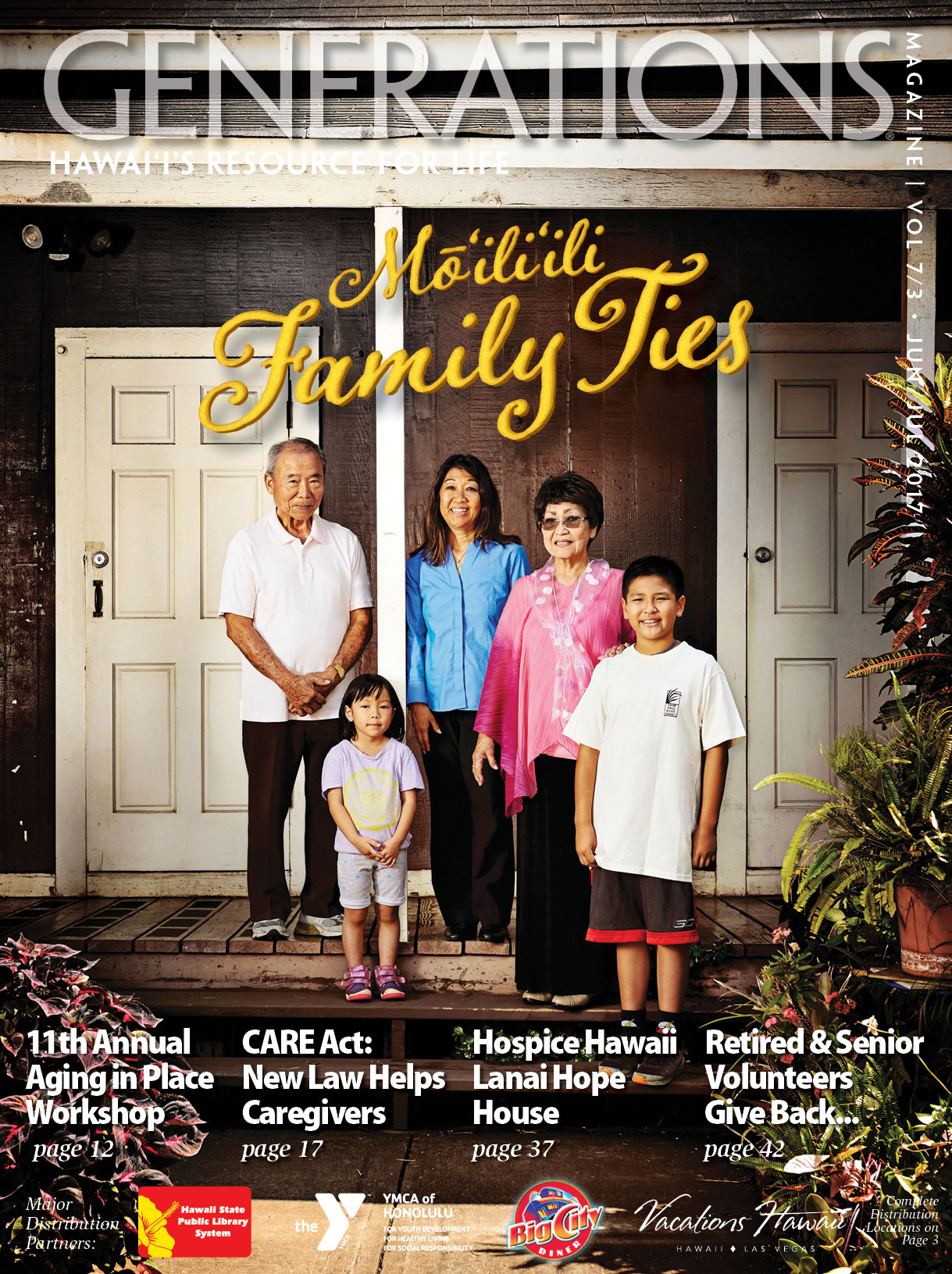
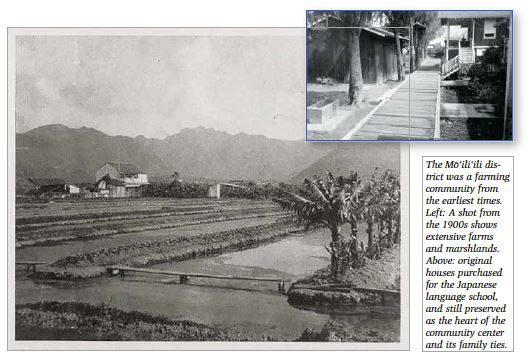 The traditions and language of the original Japanese immigrants to Hawai‘i in the late 1800s survived because they taught their children to venerate and value the culture of the homeland. In over six subsequent generations of American Japanese, no single organization has nurtured language and culture more than Mo‘ili‘ili Community Center on O‘ahu. In addition to supporting a thriving Japanese Language School for children, the center opens its doors five days a week to 300 to 500 senior members who come to participate in a wide array of arts, activities, educational programs and adult day care. This private nonprofit organization is the traditional bedrock of Mo‘ili‘ili families.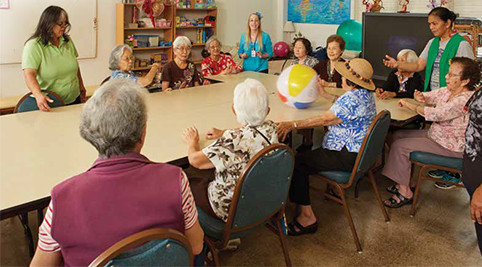
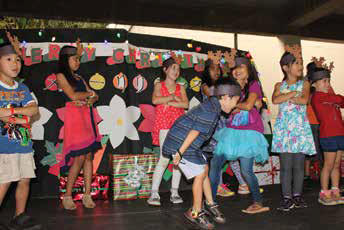 One of the most popular weekly sessions is Rhythm & Life held every morning. This award-winning Japanese exercise and stretching program is designed for elders and choreographed to Japanese music. Rhythm & Life invites both actively mobile seniors (standing) and less mobile seniors (seated) to better fitness and improved blood circulation. The packed room is filled with intently engaged and happy faces as the participants work out to the beats of various rhythms and tunes. Other active options include outcome-based exercise, Zumba, classic tai chi and a special tai chi class for seniors with im-paired balance who want to rehabilitate themselves. This one is important for preventing falls. “I think one beauty of our center is that seniors who have lost a spouse or no longer live in their old neighborhoods may come here and socialize while they participate in healthy activities for body, mind and soul,” said Nadine. “We offer physical exercise, mental stimulation and ways to learn and participate, but socializing combats isolation and loneliness. Members have the opportunity to spend happy times with people who share memories of earlier times and traditional values.”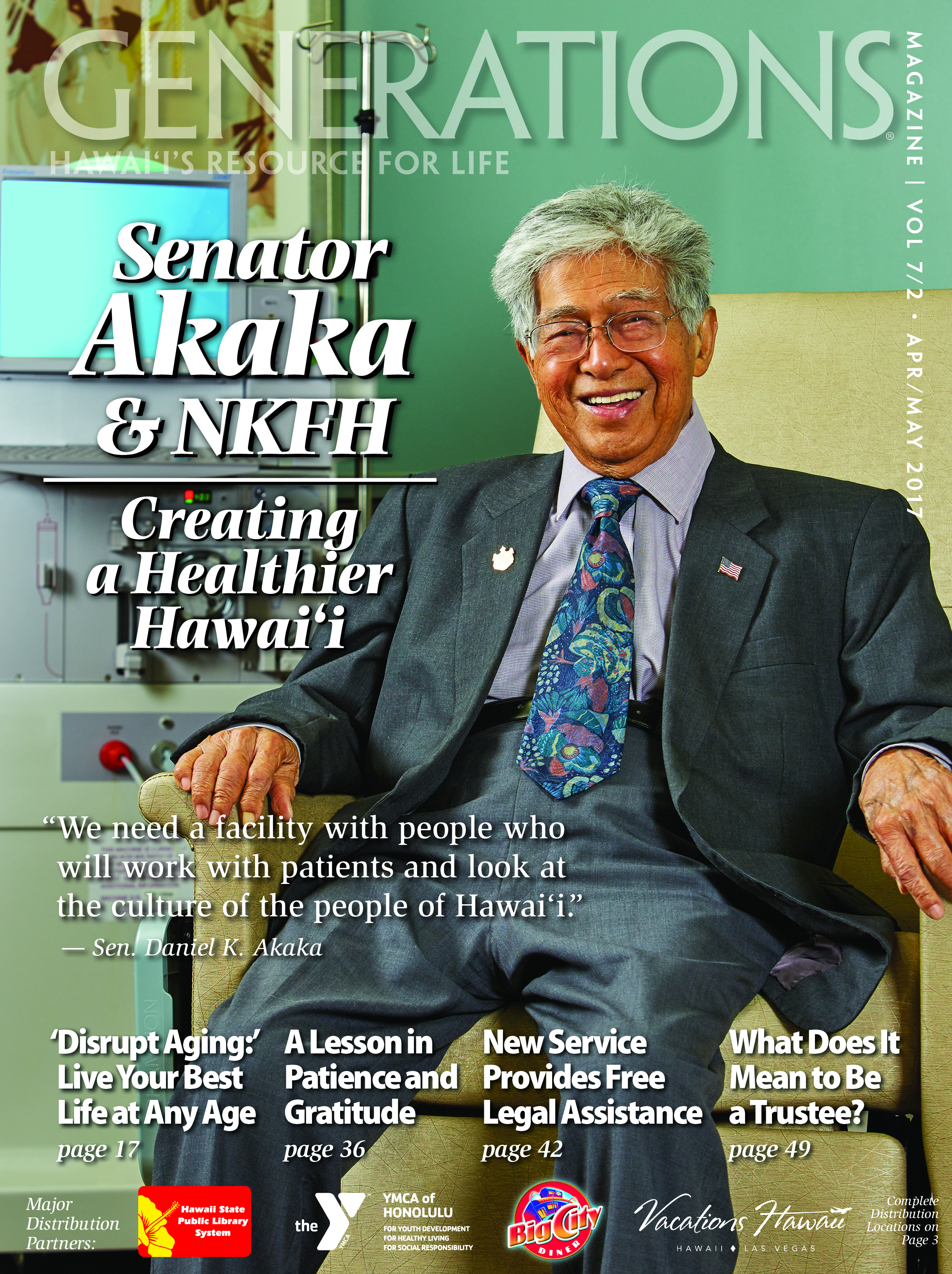
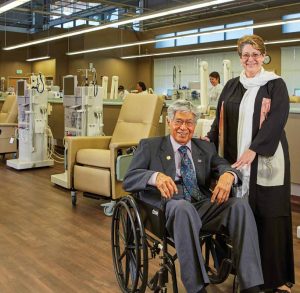
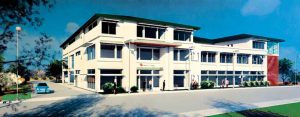
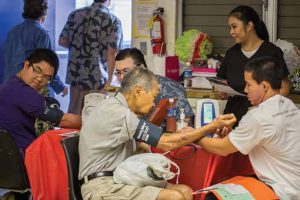
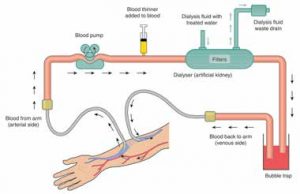

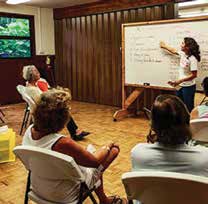 Everyone should seek education about kidney disease, regardless of gender or age.
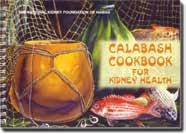
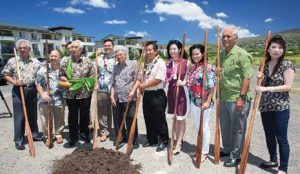
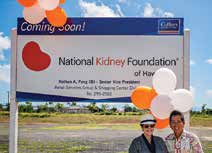
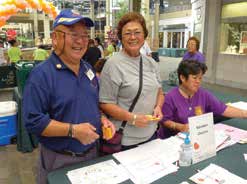
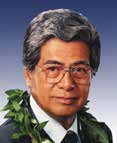
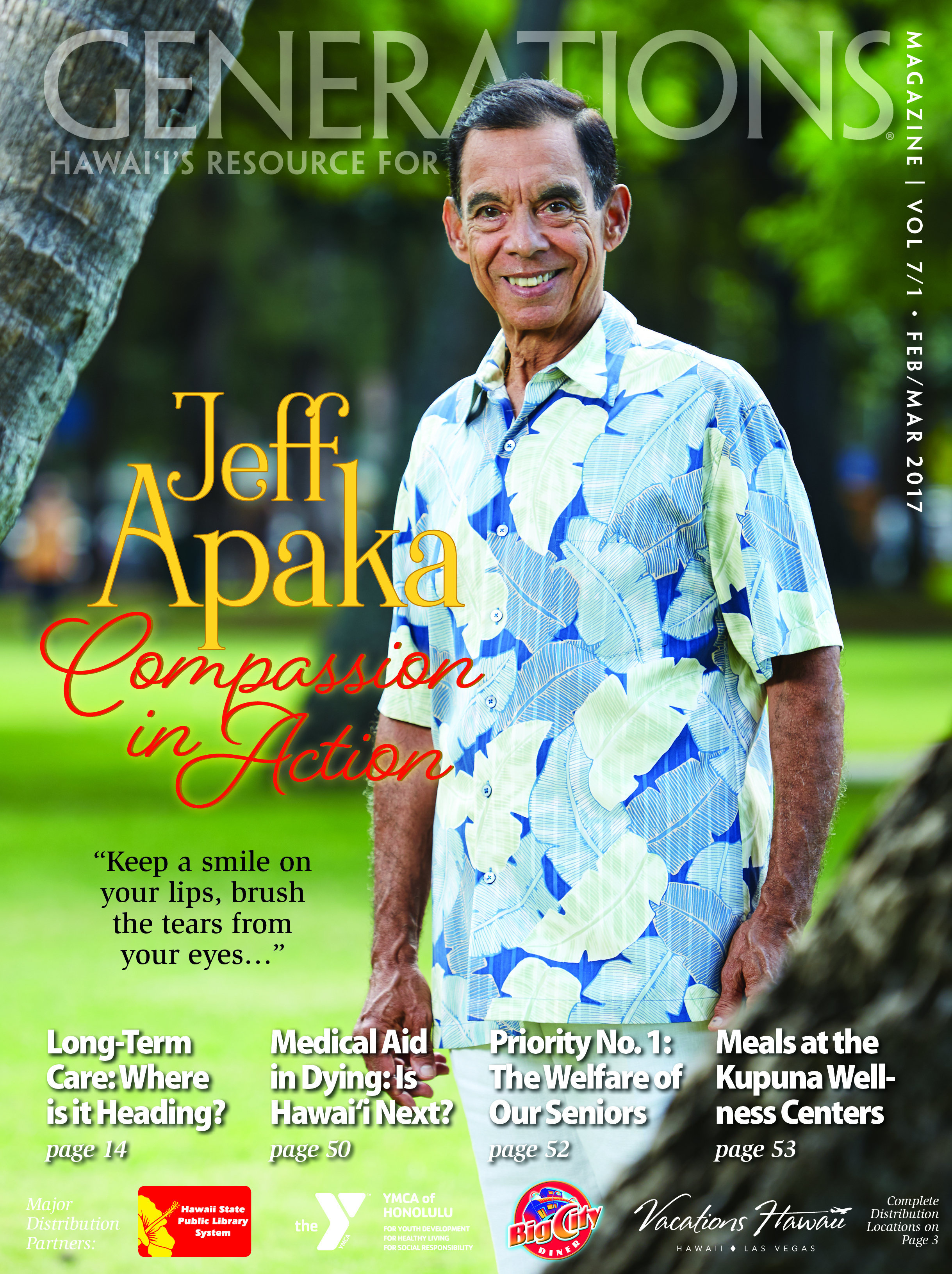
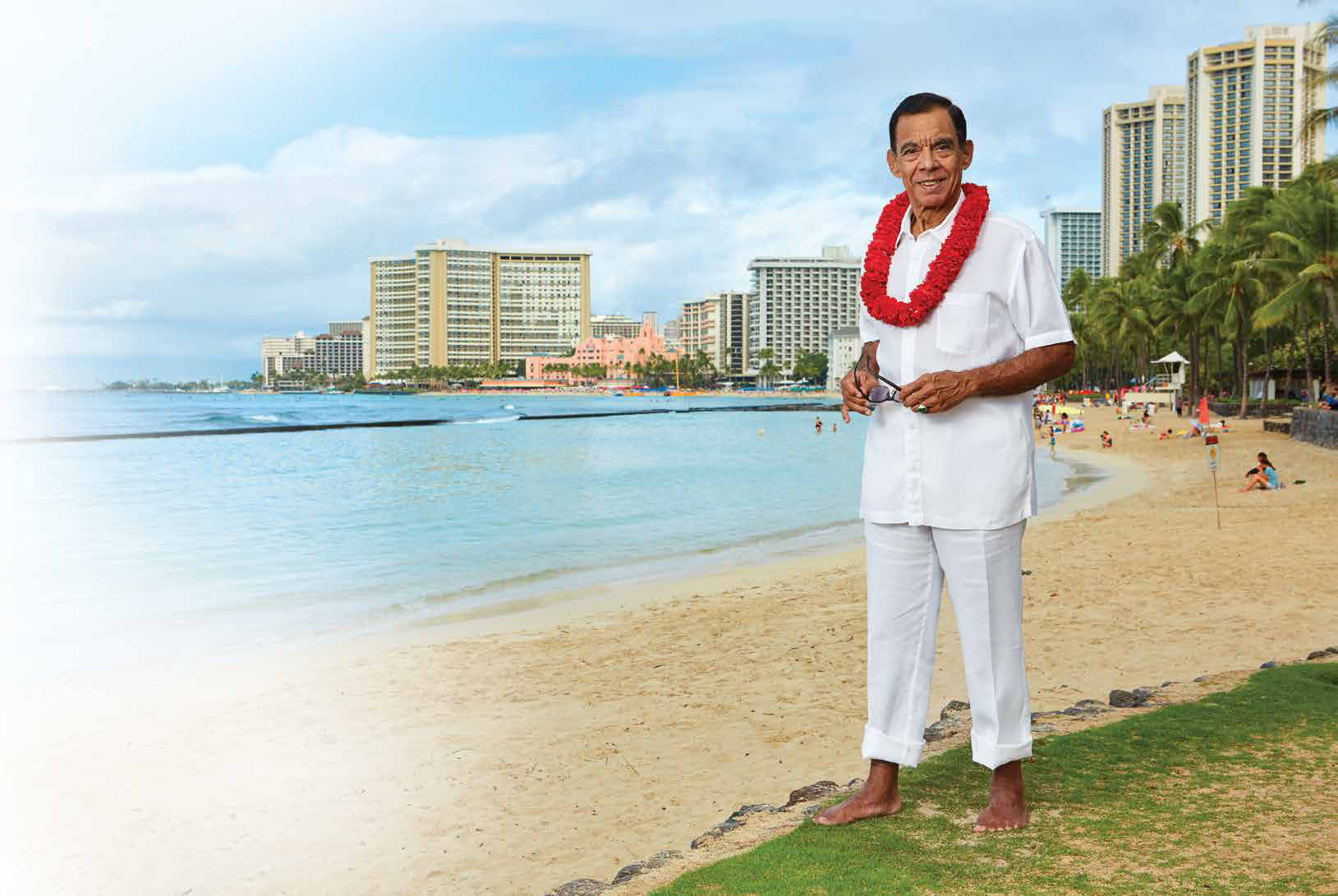
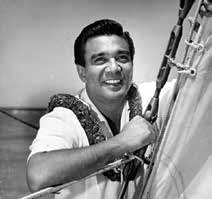
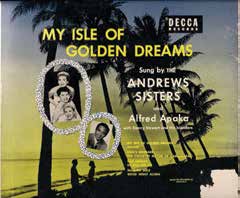
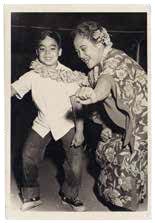
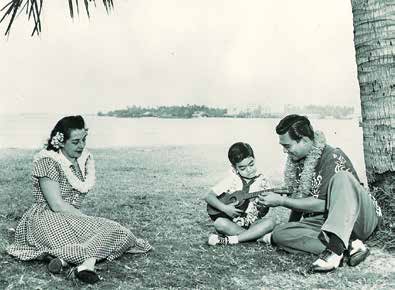
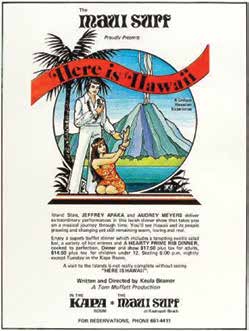
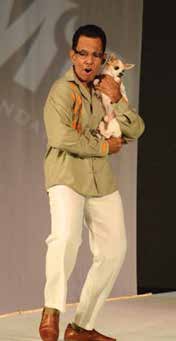
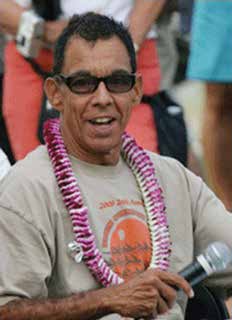
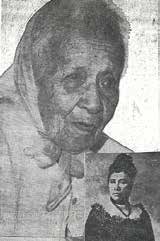
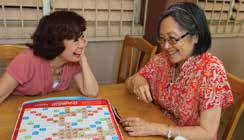
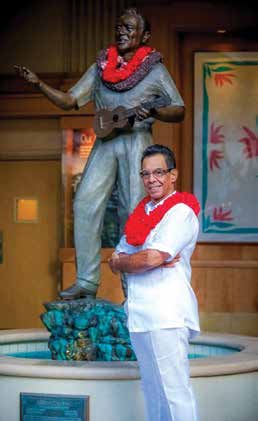
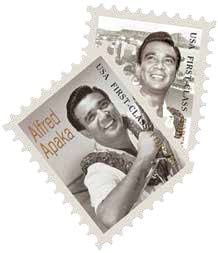
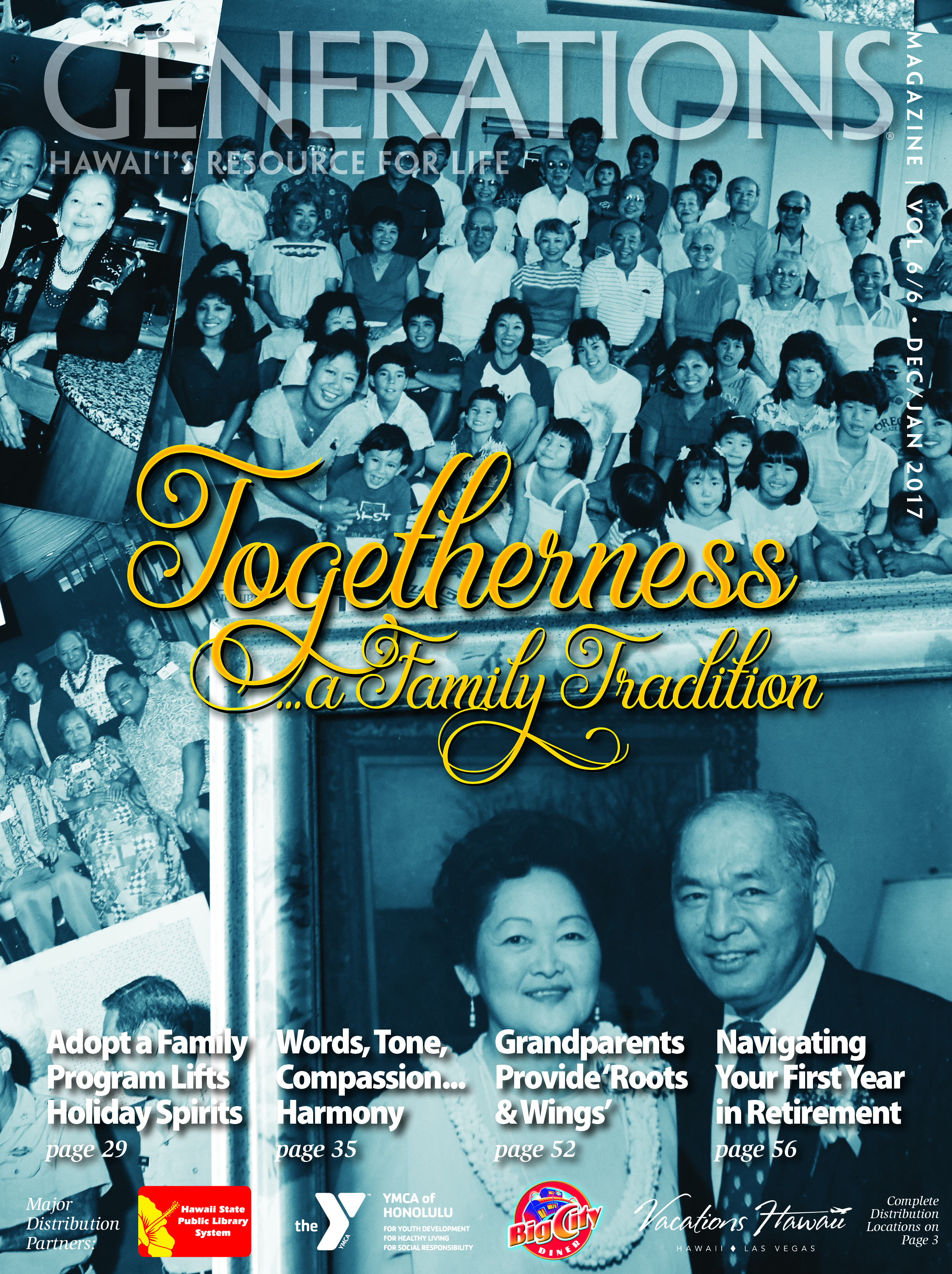
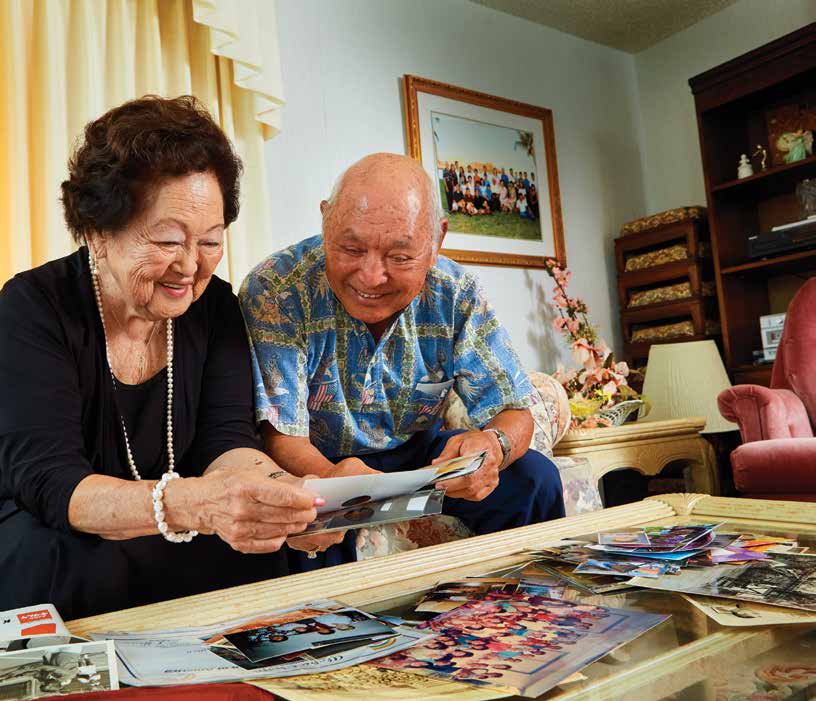
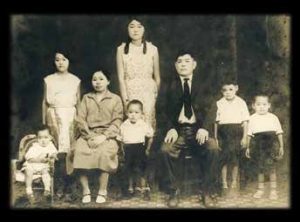
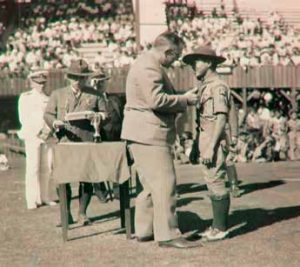
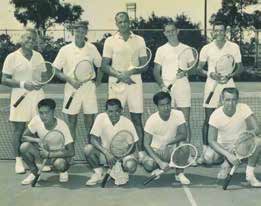 Les also loved tennis. “In high school, I would collect stray tennis balls from around the court and when I found old racquets in the rubbish bins, I would repair them — that’s how I started playing tennis.” He taught himself by reading tennis books and putting conceptual techniques into practice. Discipline learned at Hongwanji paid off and Les won the Hawai‘i Island championship in 1945.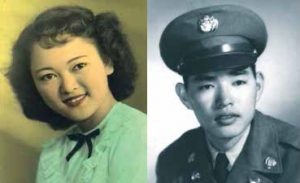
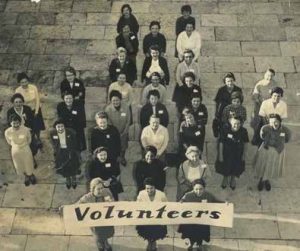
 in half-tents. I ordered them to put the tents together, but the order was never carried out and I knew my superiors would never back me up.” Nevertheless, Les stood by his values of tolerance and kindness. “One time in college, a gang of tough guys sucker punched me. I got away, ran to the Coke machine and broke an empty bottle to make a weapon to defend myself. They decided not to beat me up, and I will never forget that feeling of being outnumbered. I teach my kids to be tolerant and kind to everyone.”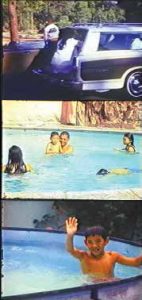
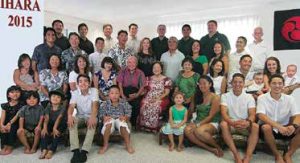
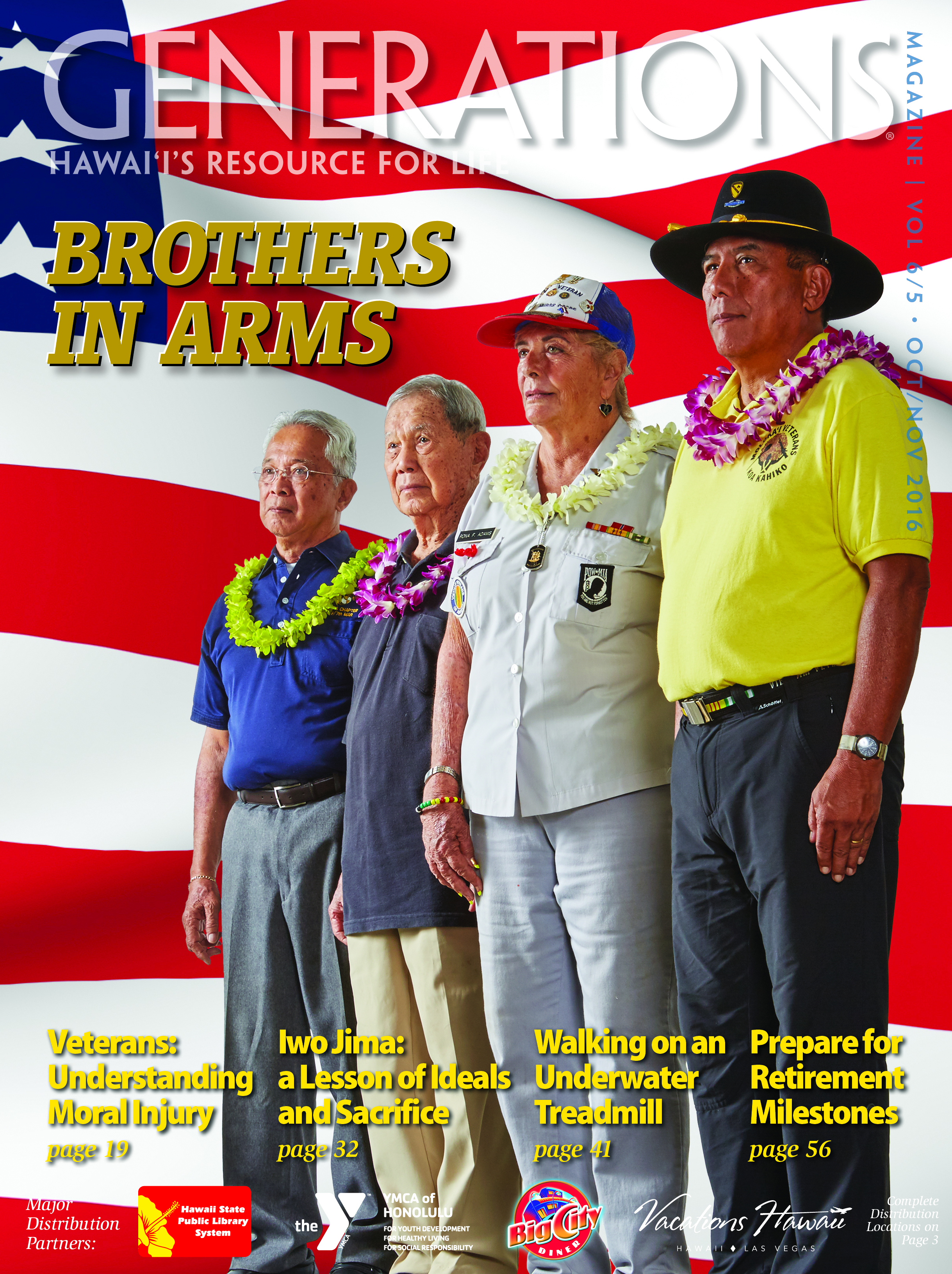
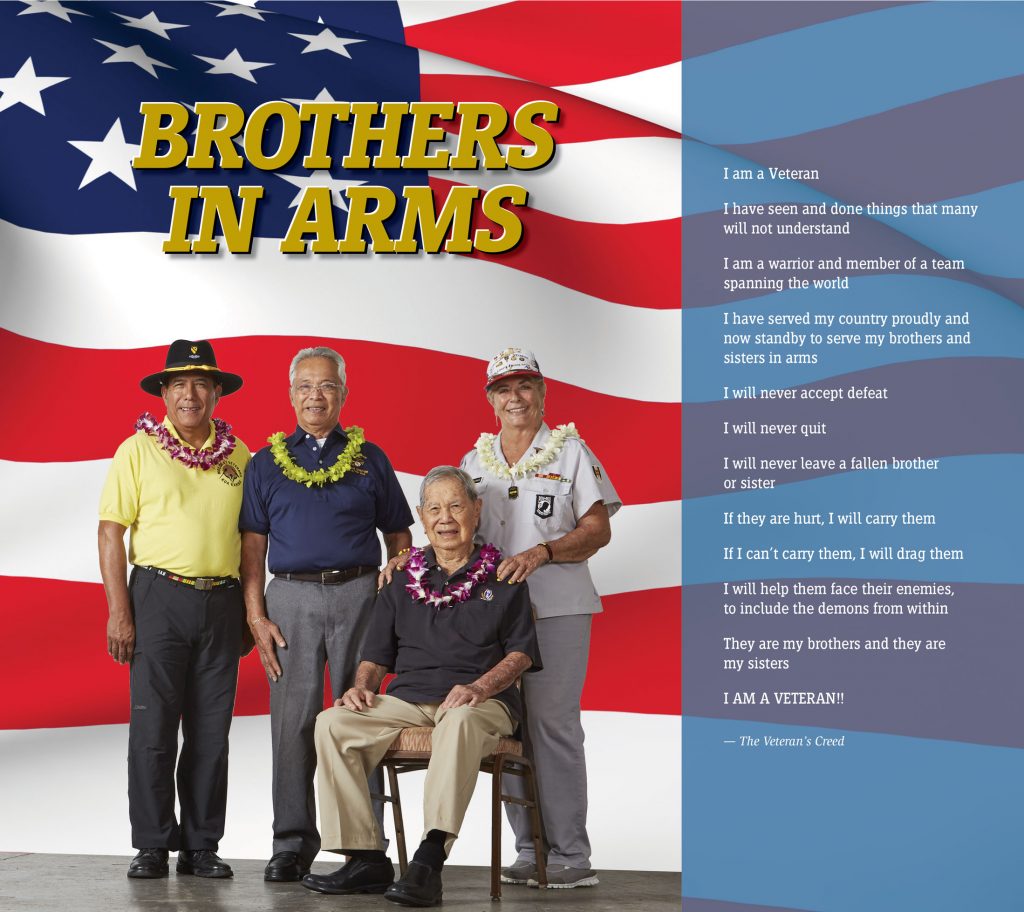
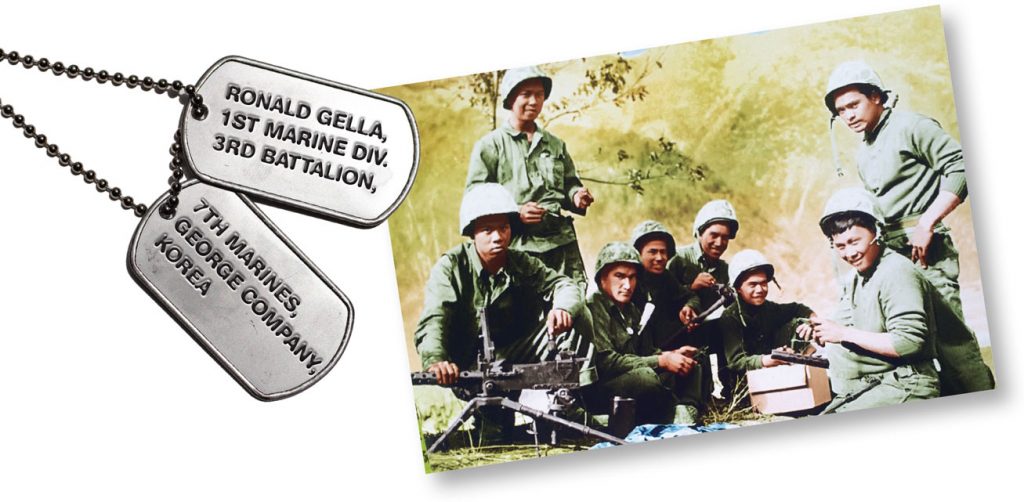
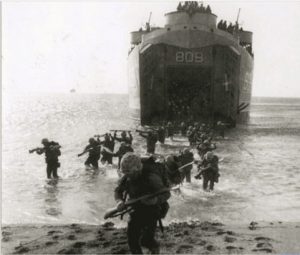 The Chinese Communist Forces (CCF) had issued an ultimatum to United Nations Supreme Cmdr. Douglas MacArthur that any movement north of the 38th parallel would be met with force. He did not take the threat seriously and on Sept. 15, 1950, the 1st Division Marines were part of a surprise amphibious landing of U.N. forces at the western port of Incheon, just 25 miles west of Seoul. Gen. MacArthur planned the invasion because U.N. allied troops were locked in by communist forces in the eastern Pusan Perimeter. A ruse made the communists believe an attack would come 105 miles south at Kunsan, so only a few enemy units showed up to defend the muddy flats of Incheon. U.N. forces immediately crossed the 38th parallel and headed north to take back the western half of Korea from the communists. Gella’s company landed last, on Sept. 16, and began a bloody fight inland to take Seoul. Gen. Edward Almond declared the city liberated on Sept. 25.
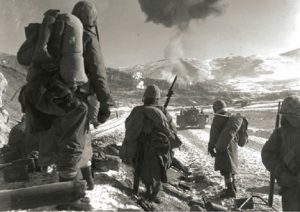 Like many combat veterans, Ron does not talk about the details of his combat service. “I prefer to keep it to myself,” he said. “It ended up all right; for that I am grateful.”
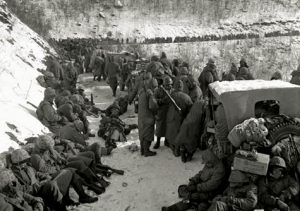 Ron and the other surviving Marines were ordered to withdraw back down the narrow trail to Hungnam. Besides their disadvantaged position in the tight valley, Marines struggled in clothing and gear that was not sufficient for 30-degree-below-zero temperatures. Casualties were so great that there was no room in hospital tents; blood plasma froze and medications in syringes had to be warmed in the medic’s mouth in order to stay liquid. Many soldiers suffered severe frostbite injuries. At one point on the trail, U.S. Army Engineers built a temporary bridge between two peaks, and after the entire force crossed, blew it up — a bold move that provided a jump on the pursuing CCF. Under the most adverse weather conditions, U.S. fliers helped by suppying some air cover.
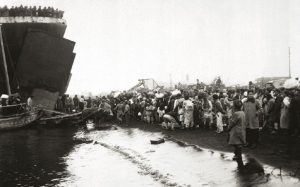 Click by click, the battered U.S. troops pulled together every ounce of reserve and miraculously fought their way back to Hungnam harbor. They sustained more casualties than any other Marine battle but Iwo Jima, and transported out all their dead and wounded with them.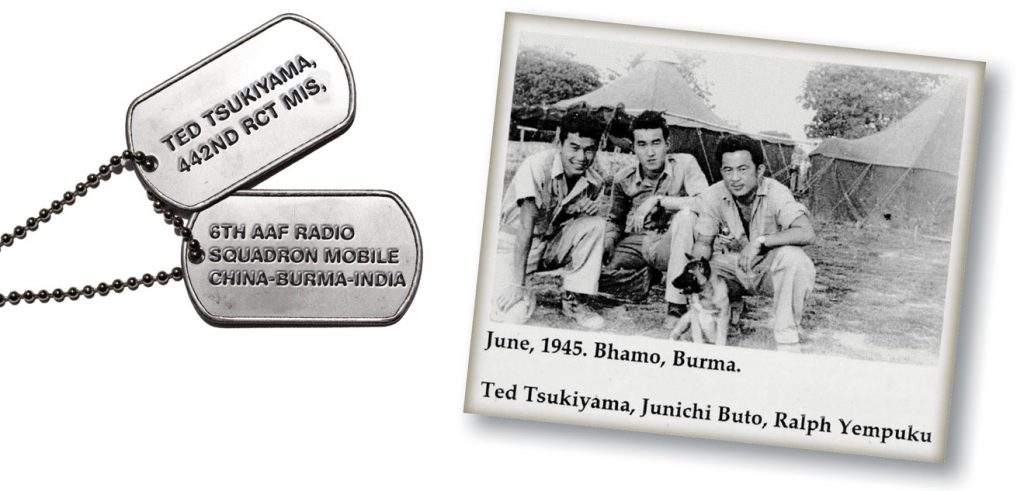
 Not all of the 14,000 Nisei of the 100th Infantry Battalion and 442nd Regimental Combat Team (RCT) served in Italy and France during WWII. Over 6,000 were in Military Intelligence Service in many theaters.
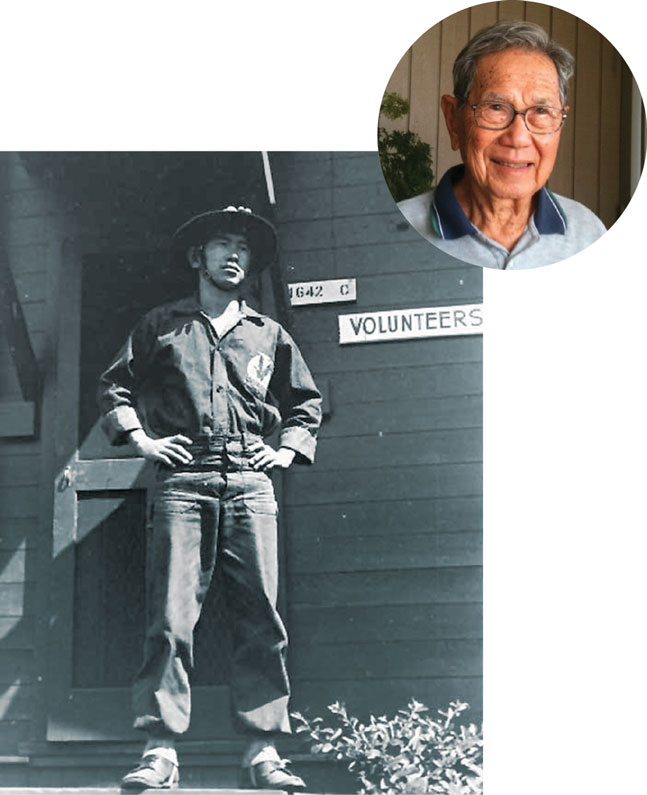 In 1942, Japanese-American ROTC students at University of Hawai‘i boldly declared their loyalty to the “Stars and Stripes” and petitioned UH to form the Varsity Victory Volunteers (VVV). Once assembled, this labor battalion assisted the 34th Army Engineers to construct military installations and fences. They also installed barbed wire defenses and worked in quarries.
 The first MISLS was at the Presidio, but in 1941, anti-Japanese sentiment was so rife
in California that the War Department moved the school to Fort Snelling, near St. Paul and Minneapolis, Minnesota, where the students would be safer. From 1942 to 1945, over 6,000 students — mostly Nisei — trained as translators, interpreters and code crackers to assist allied troops in the Pacific theater. “I spoke Japanese but had to learn heigo military language for my job, intercepting and translating into English all the Japanese Air Force pilots’ radio communications in the China-Burma-India air space.”
The first MISLS was at the Presidio, but in 1941, anti-Japanese sentiment was so rife
in California that the War Department moved the school to Fort Snelling, near St. Paul and Minneapolis, Minnesota, where the students would be safer. From 1942 to 1945, over 6,000 students — mostly Nisei — trained as translators, interpreters and code crackers to assist allied troops in the Pacific theater. “I spoke Japanese but had to learn heigo military language for my job, intercepting and translating into English all the Japanese Air Force pilots’ radio communications in the China-Burma-India air space.” Force Radio Squadron Mobile Unit in the China-Burma-India Theater,” said Ted. “We were a ‘Special Interception Unit,’ supporting the 10th Air Force and the British forces who were taking back Burma [now Myanmar]. We were eavesdroppers. The Japanese occupied nearly all of Southeast Asia and there was a lot of chatter on the airwaves. They had no idea we were listening. My job was to transcribe, translate and report all communications, and report them to U.S. Intelligence HQ. We had 150 Nisei from the 442nd intercepting, translating, interrogating prisoners and even broadcasting messages into enemy territories. We had to be careful not to be mistaken for the enemy; buddying up with a haole soldier was a wise move.”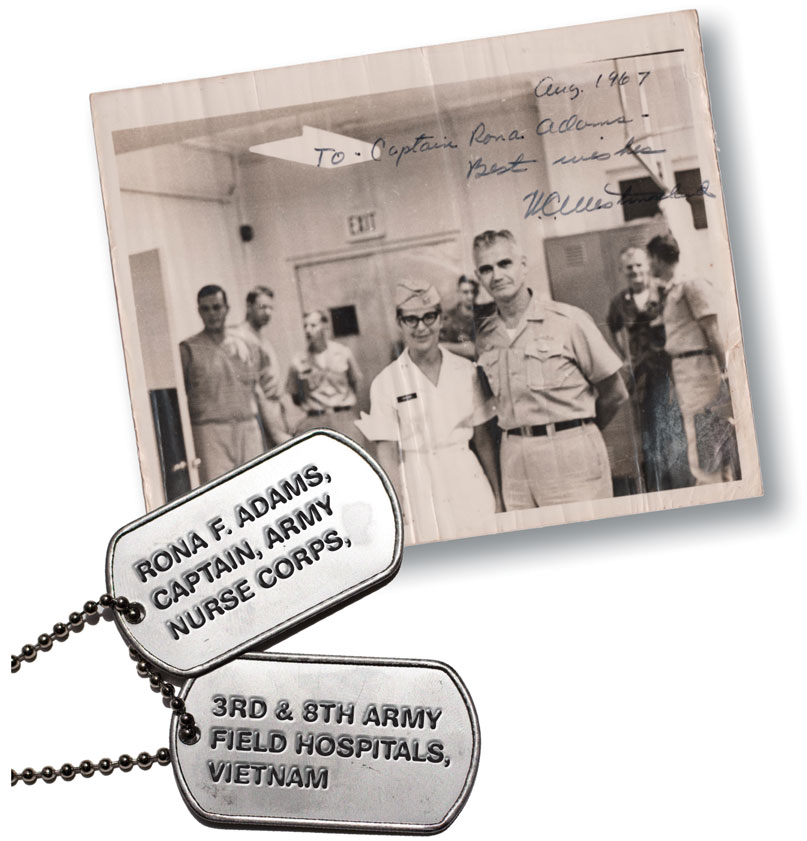
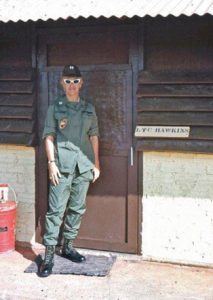 At Saigon’s airport, I sat on my footlocker and waited. An older Navy officer came by, looked at my nametag and asked, “Is anyone coming to pick you up, Capt. Adams?” “I don’t think so, sir,” I replied. “Do you know where you are headed?”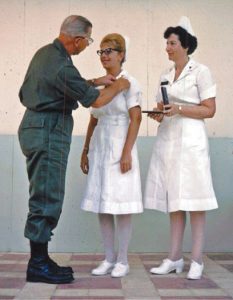
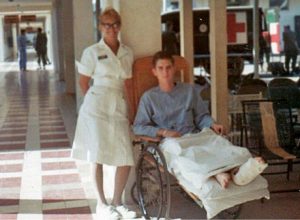 Our hospital was right in the city of Saigon. Military Police were our first line of defense, and fortunately, we never came under attack. During the Tet Offensive, we had 200 casualties arrive in the first 10 to 12 hours. I was the head nurse of the emergency room, and I don’t know how we got through it.
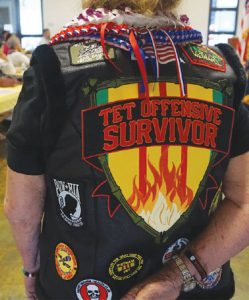 I left the Army after two tours and returned home, but nobody asked me about my war experience. Posttraumatic stress disorder (PTSD) was not even a recognized diagnosis then. Even if it was, doctors or nurses with a mental disorder could never find work. I didn’t know any other veterans, so I never talked about Vietnam.
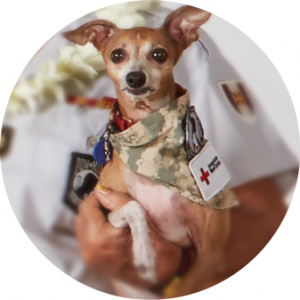 I belong to Jewish War Veterans out of respect for my father, the Veterans of Foreign Wars, and I am also the president of O‘ahu Chapter 858 of the Vietnam Veterans of America (VVA), the only chapter in Hawai‘i.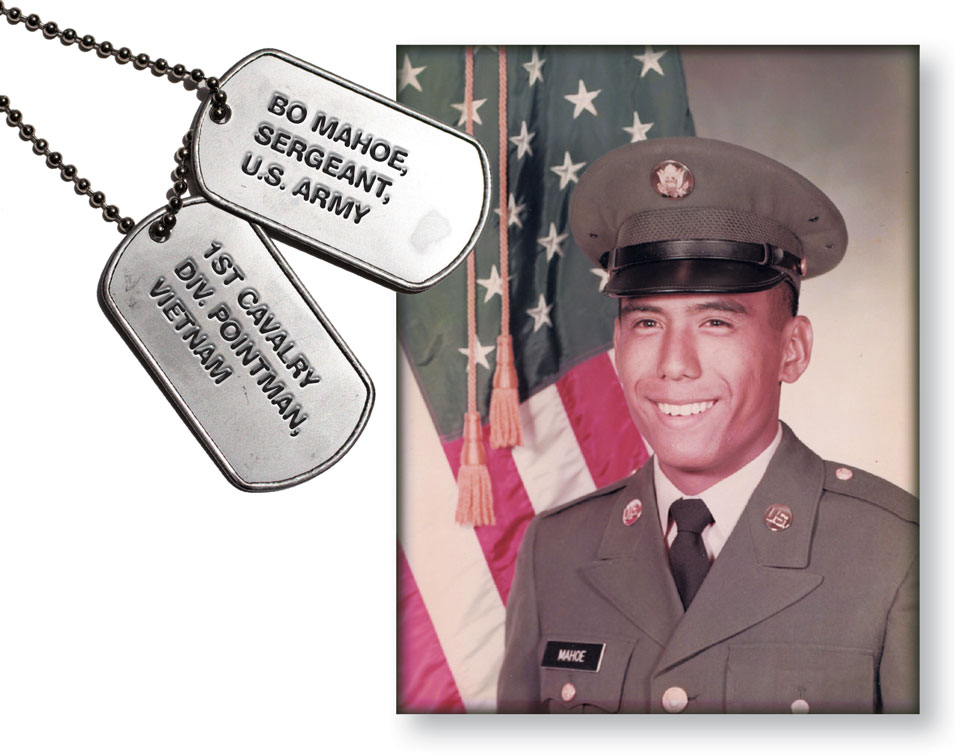
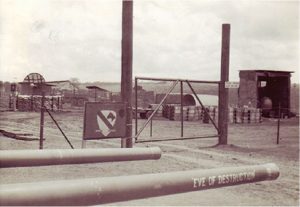 “Our training in California was almost six months long; we landed in Vietnam Feb. 1,” said Bo. “For us island soldiers, it was pretty cold.” In Vietnam, Bo and his brothers in arms faced a war very different war from WWII. The former French-Indonesian Republic of Vietnam had been fighting against the Viet Cong communists in the north for two decades. Civilians in North and South Vietnam survived by complying with both sides, creating a complicated web of stealth, intrigue and deception that often seemed impenetrable. Taking ground was a measure of victory in previous wars, but not in Vietnam. Sometimes the troops wondered why they fought for ground only to give it up the next day.
 “Growing up in the diversity of Hawai‘i made adjusting to the military much easier to handle,” said Bo. “The Vietnam jungle, although more humid than home, offered the same terrain, vegetation and a familiar botanical garden most island kids grew up in. We were the only ones who recognized the edible plants.”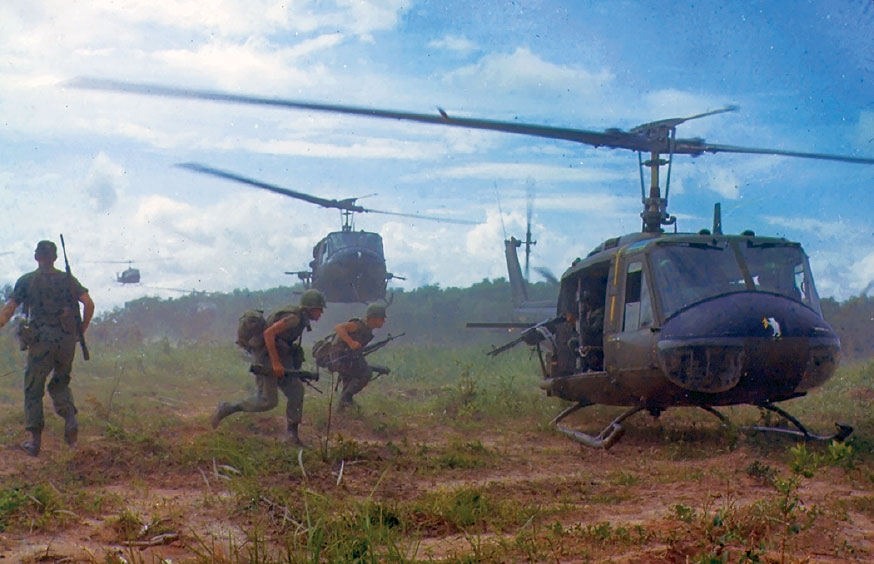
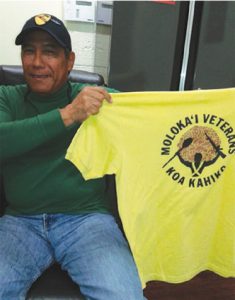


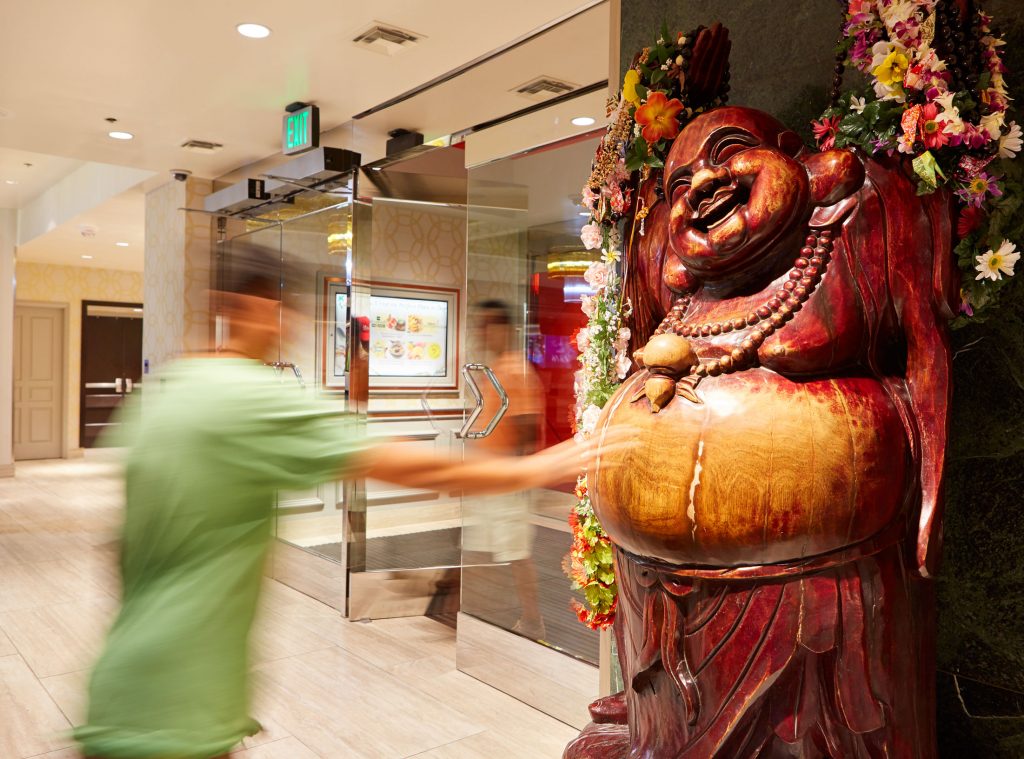
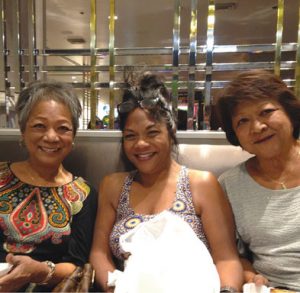 Glory Connolley, Sanya Fujiwara and Lorraine Teixeira were sitting in the lobby, waiting to go back home to O‘ahu. That’s a curious thing about this place. Folks are smiling
on their way in and on their way out. They were having a wonderful time and loved the clean, bright new décor.
Glory Connolley, Sanya Fujiwara and Lorraine Teixeira were sitting in the lobby, waiting to go back home to O‘ahu. That’s a curious thing about this place. Folks are smiling
on their way in and on their way out. They were having a wonderful time and loved the clean, bright new décor.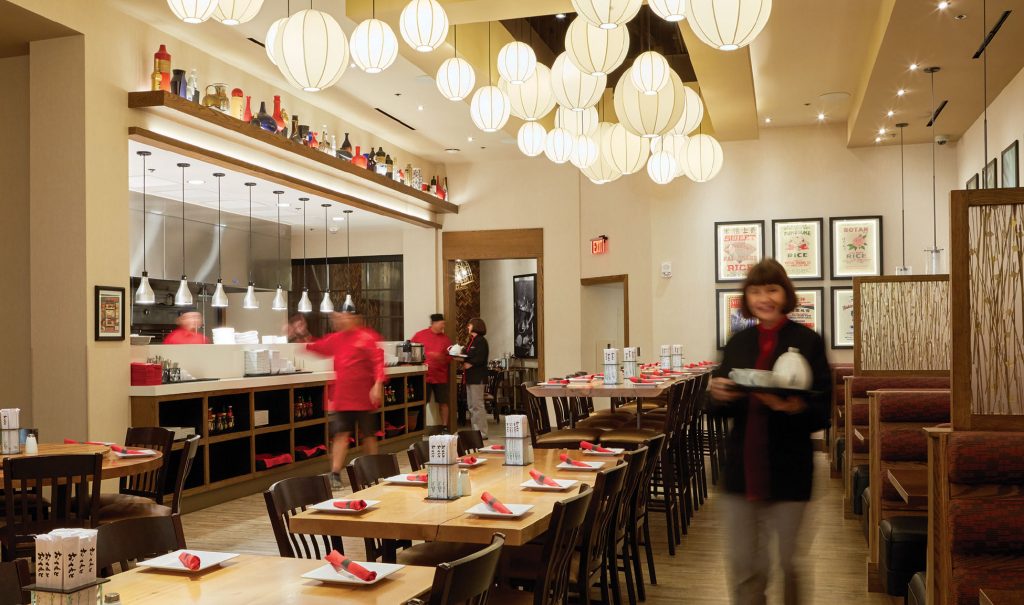
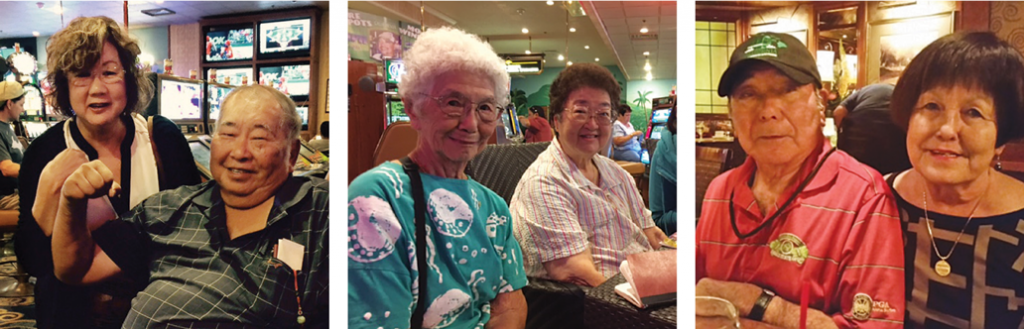
 Lisa from Honolulu gives The Cal a thumbs up. “We love the new look! It’s clean and fresh — a very comfortable vibe. Food and staff are just awesome and make your stay heavenly.”

 West Tower hotel rooms and Aloha hospitality suites will be refurbished later this fall, 2016 — in the same quiet way, without disturbing the stay, play and dining of The Cal’s honored guests.
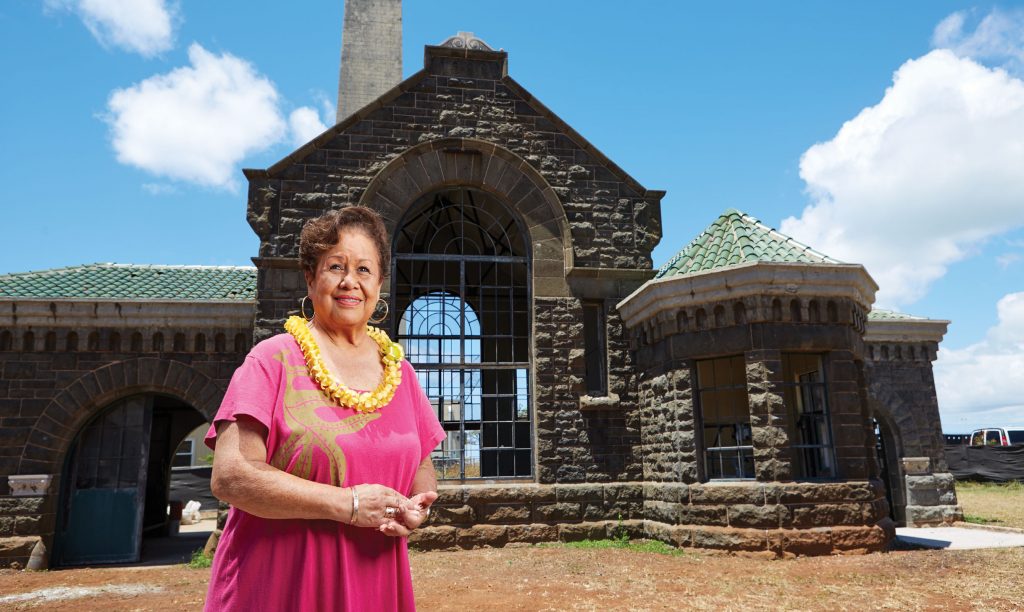
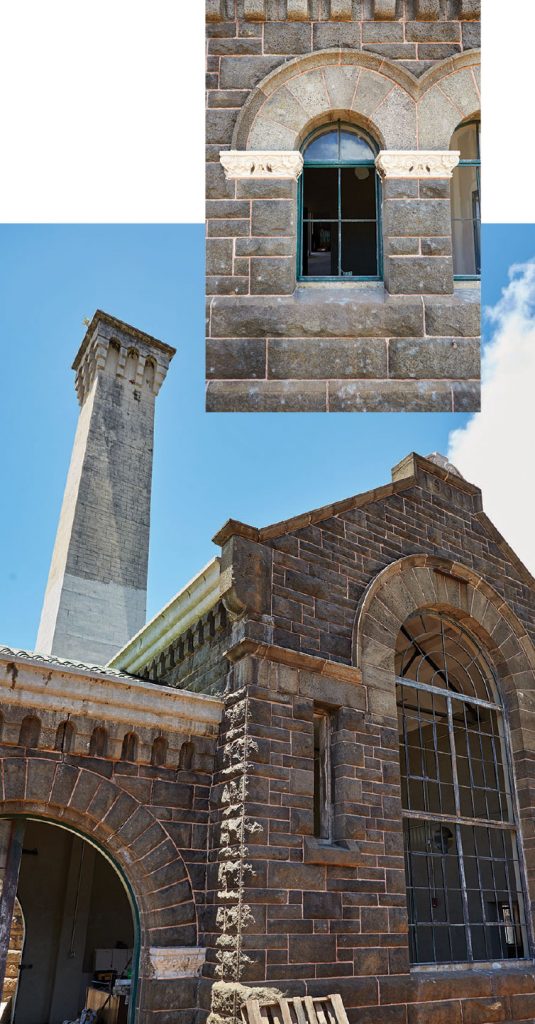
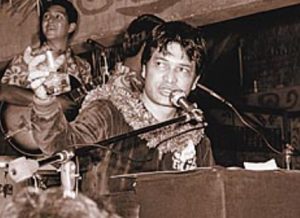
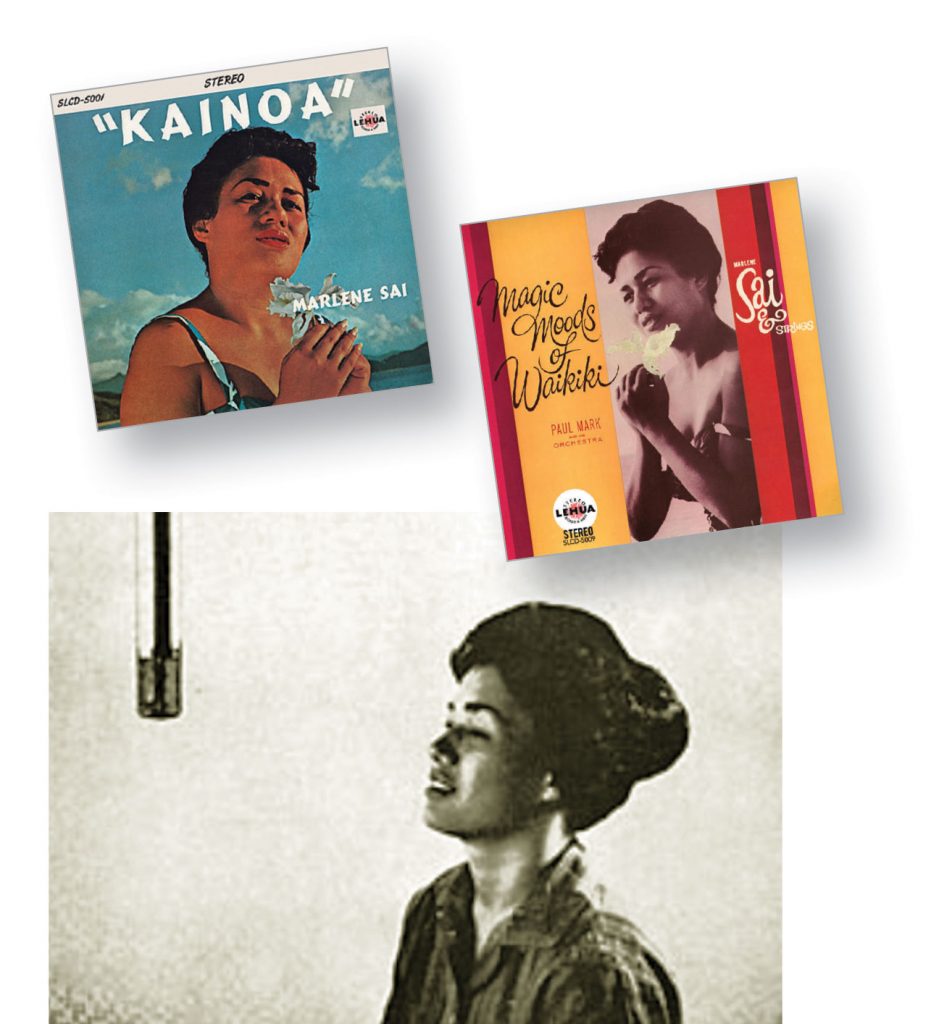
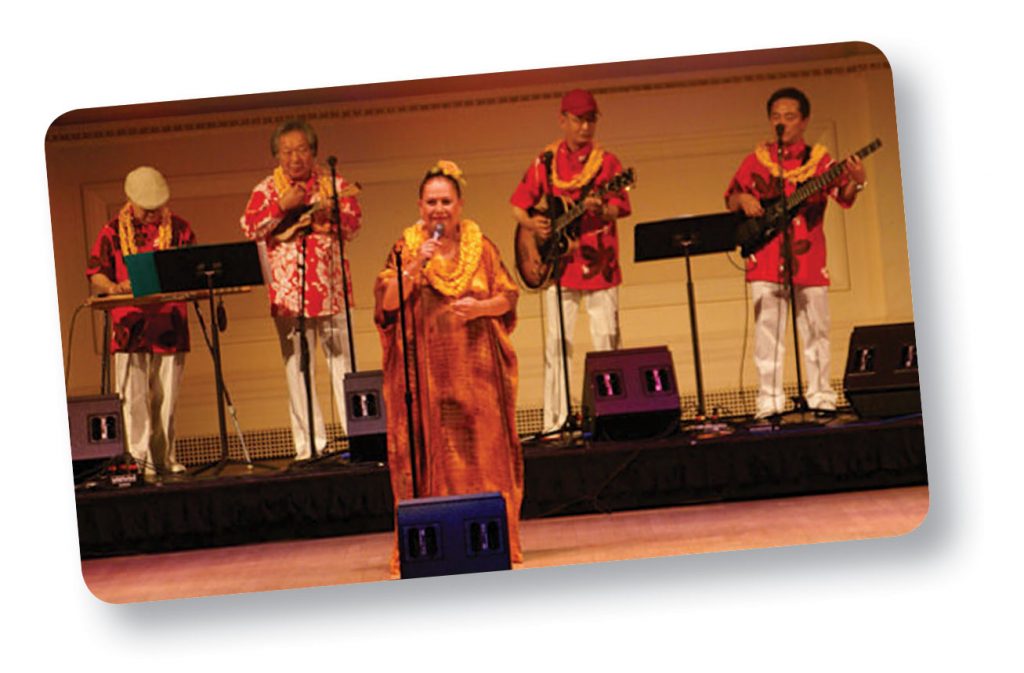
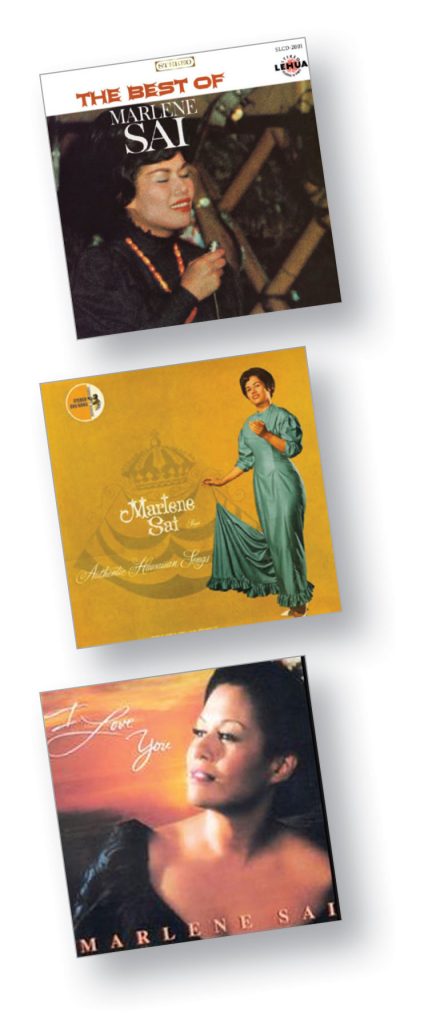
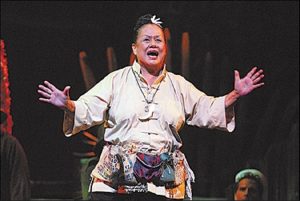
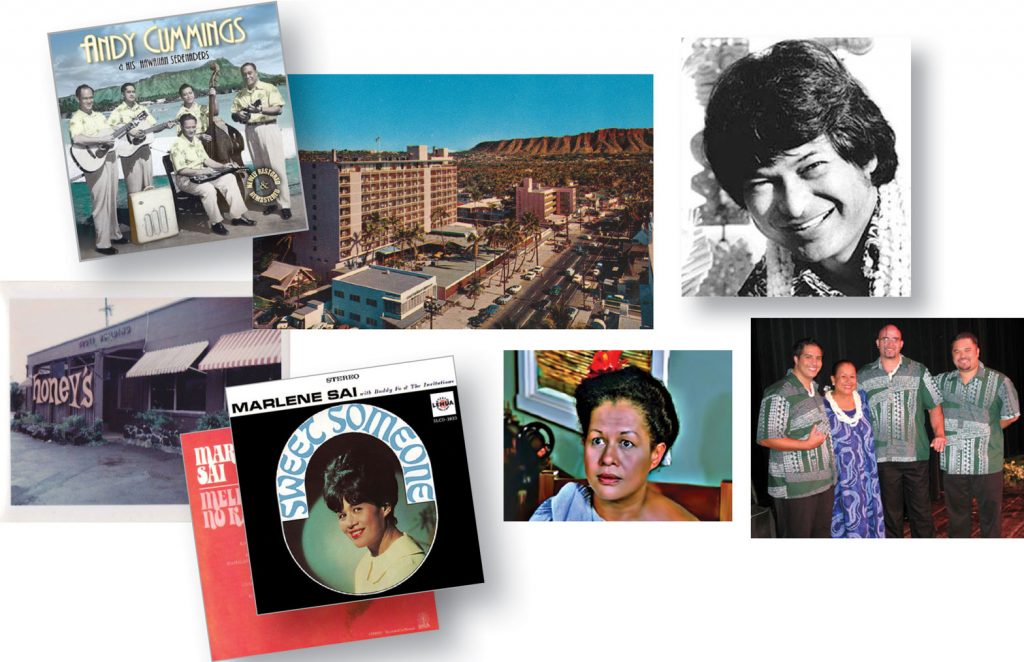
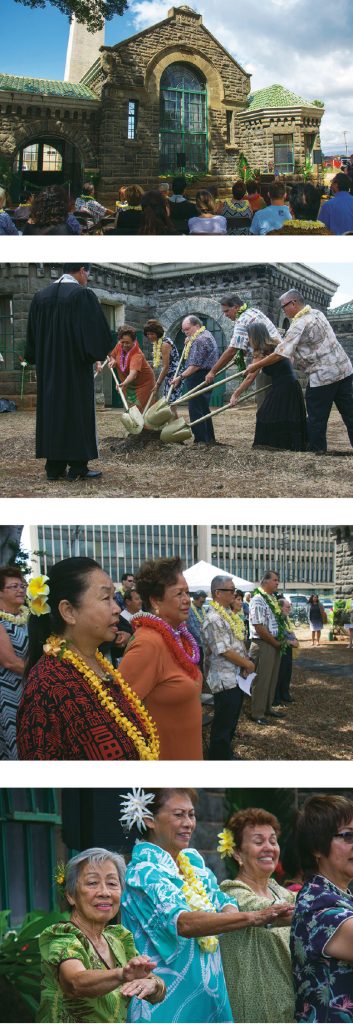

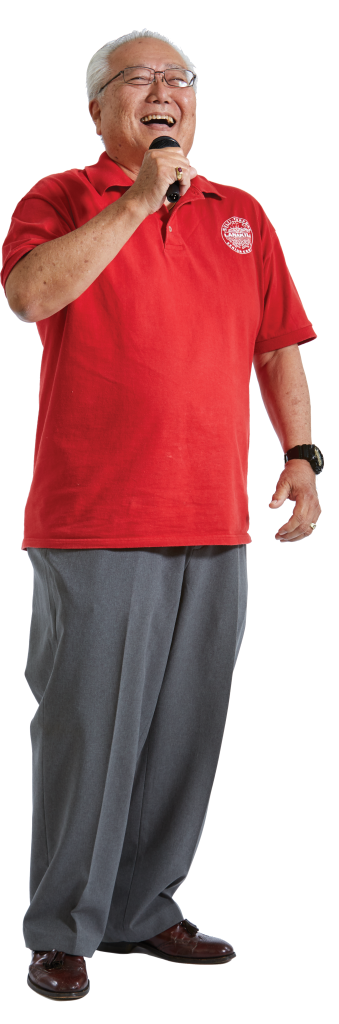 We Play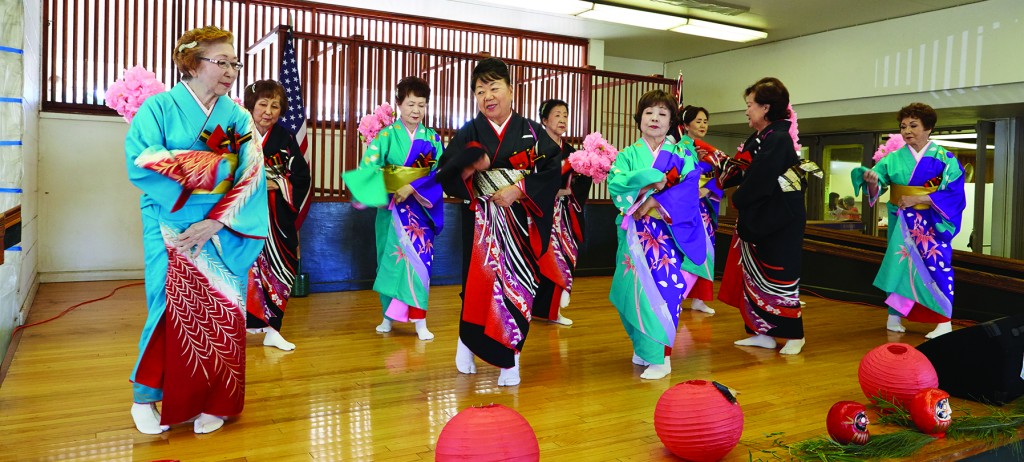
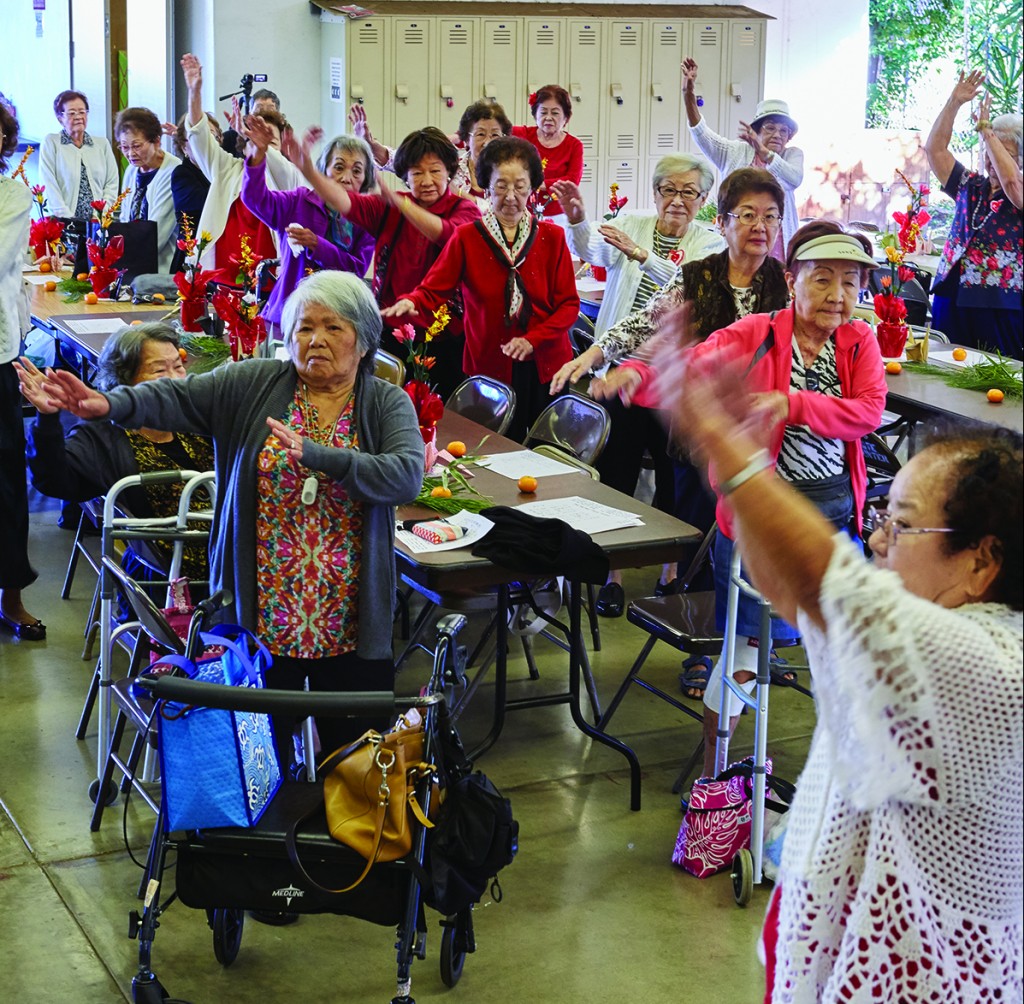
 We Learn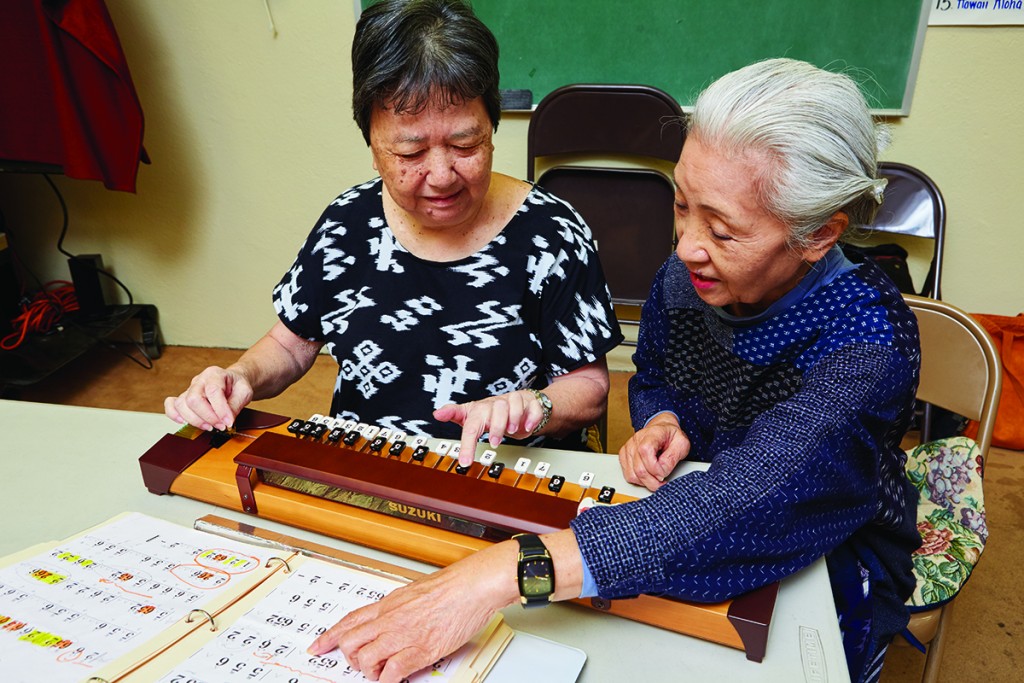
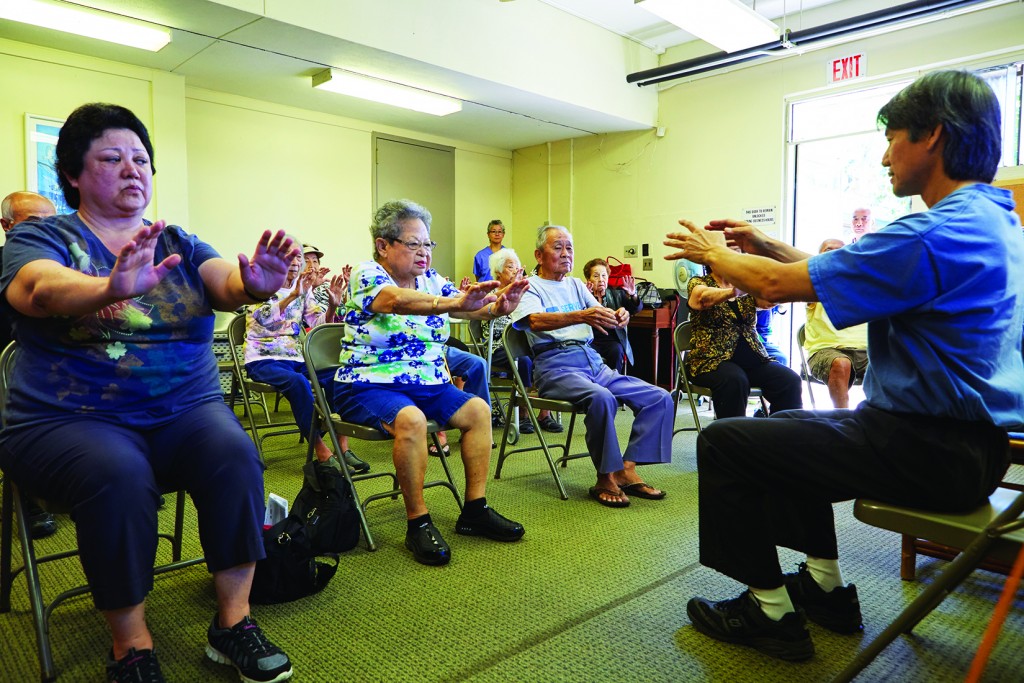
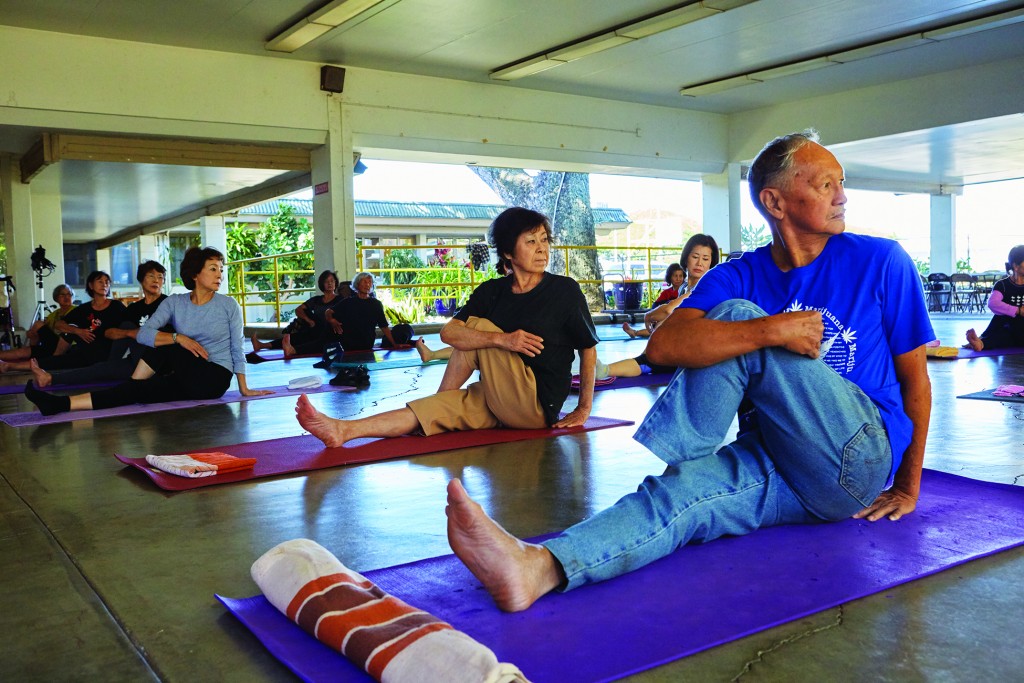
 We Serve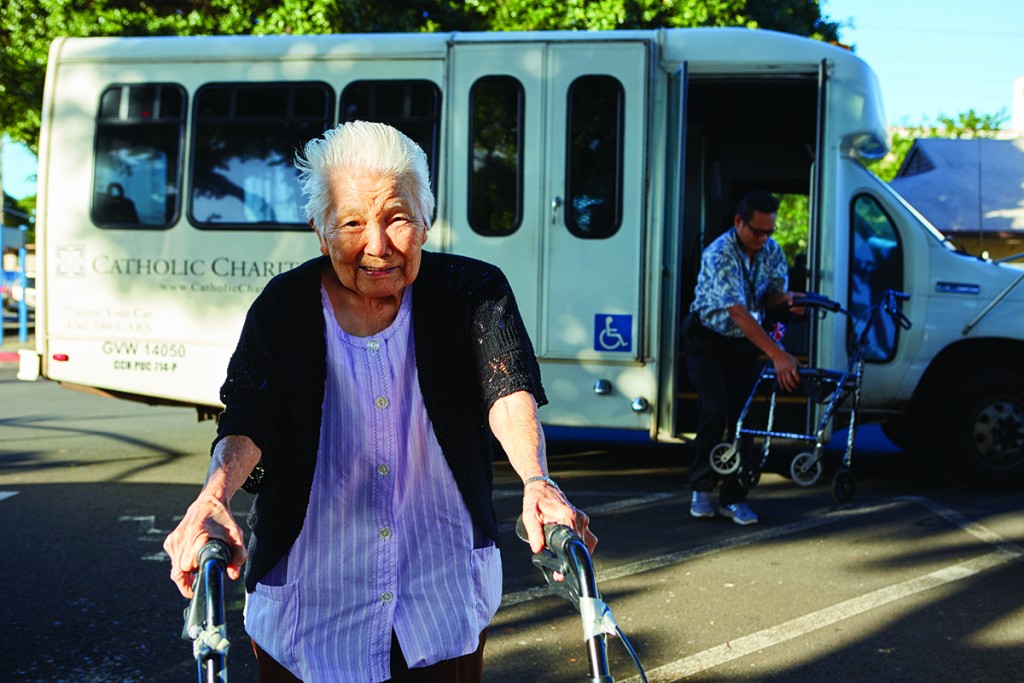
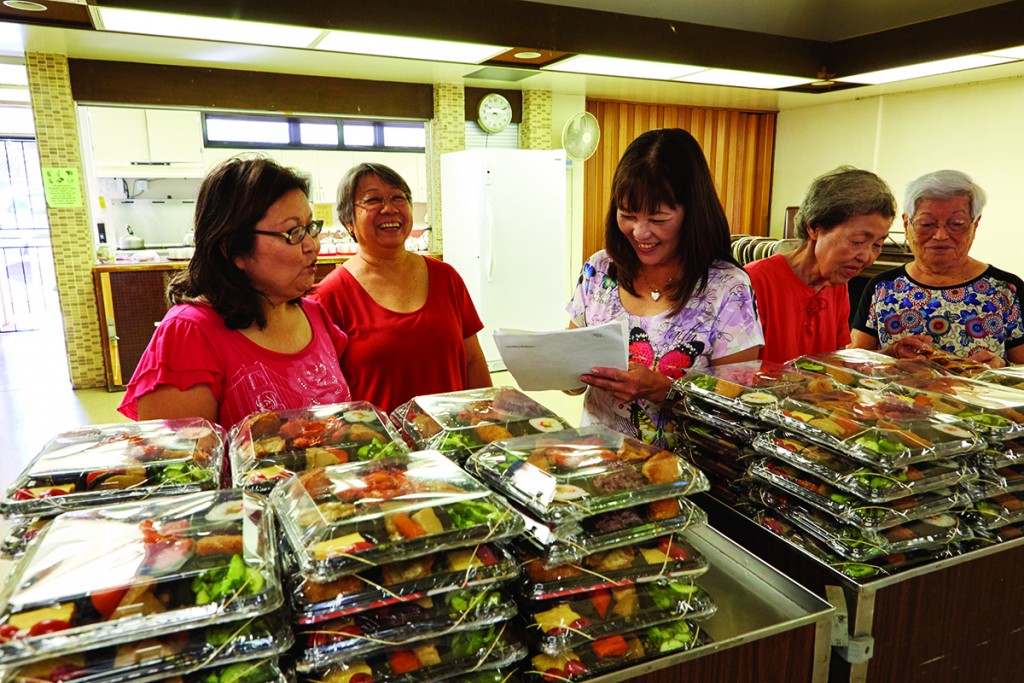
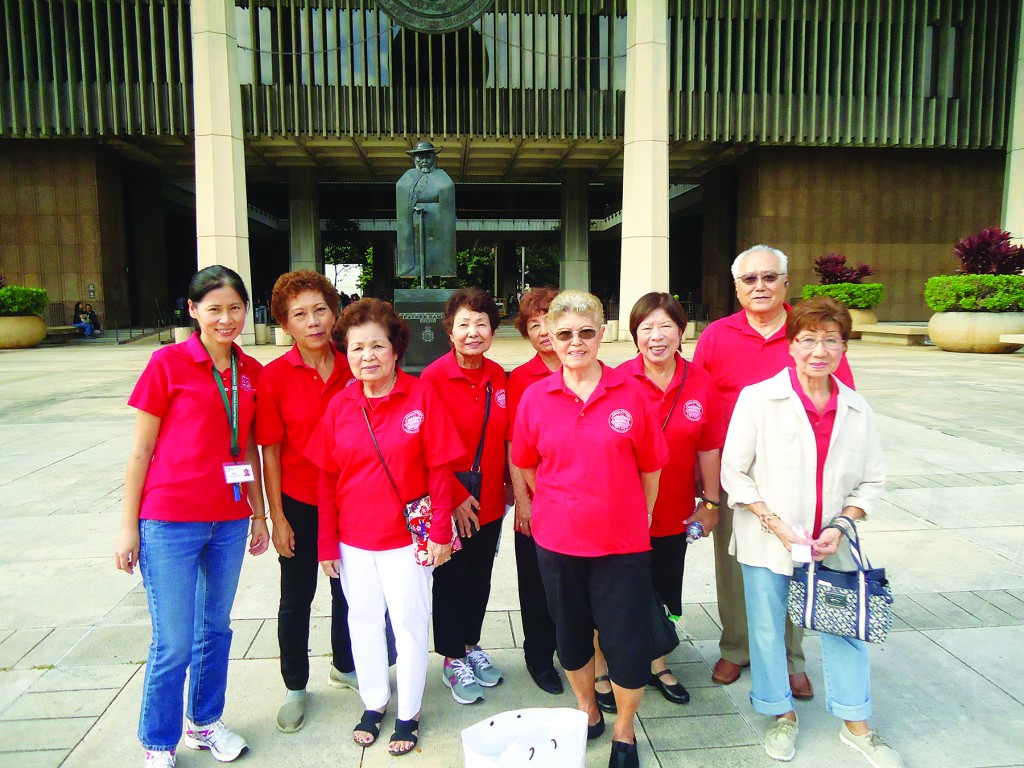

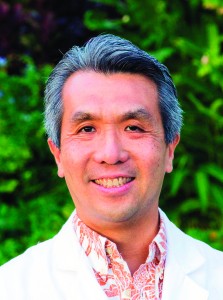
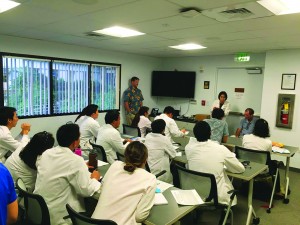
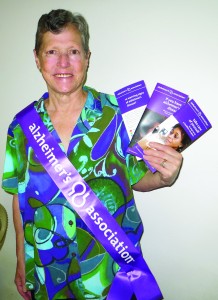
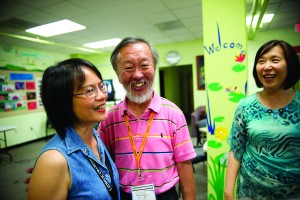
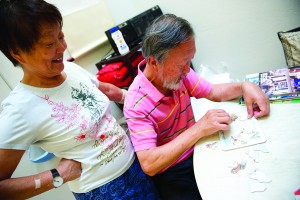
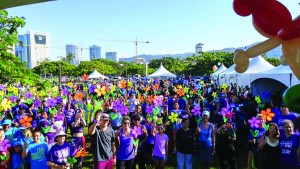

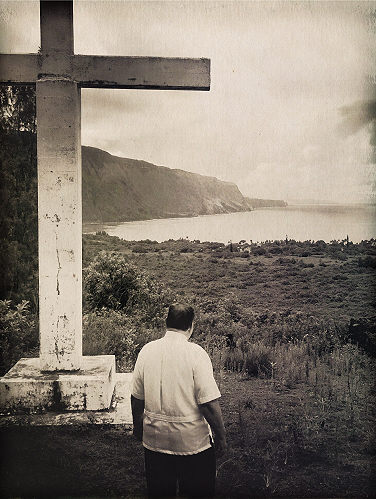

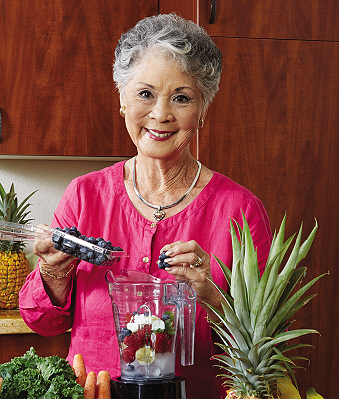
 Now in her eighties, in addition to appearances as Ms. Original Medicare 2015, Laurie continues to work as a beauty consultant for Better Health Unlimited and as a member of the Xyngular Corporation. Elite American Health trade association recently recognized her dedication, leadership and achievements in nutritional counseling. Laurie educates individuals interested in learning habits that produce healthy lifestyles and enhanced quality of life. In addition, she is a highly sought after public speaker and author of two cookbooks: Mrs. Hawai‘i’s Cookbook and Mrs. Hawai‘i’s New Cookbook. She also holds a master’s degree in theology, and volunteers at River of Life shelter. She used to teach Bible studies throughout the islands and served as a co-pastor for New Hope Christian Fellowship. She believes a joyful spirit and spiritual strength are the keys to a rich, satisfying life.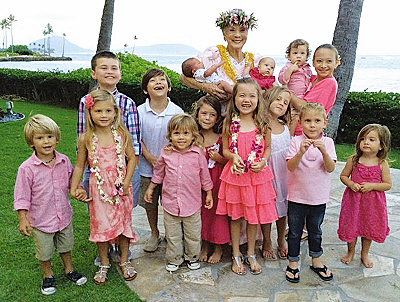
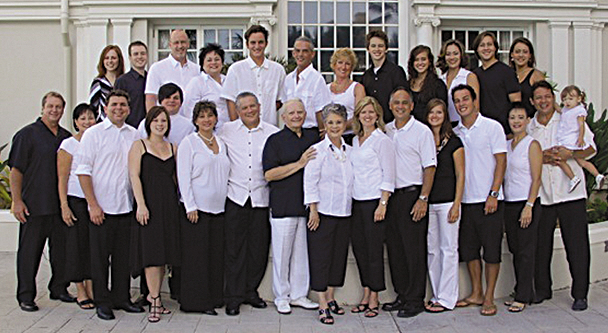
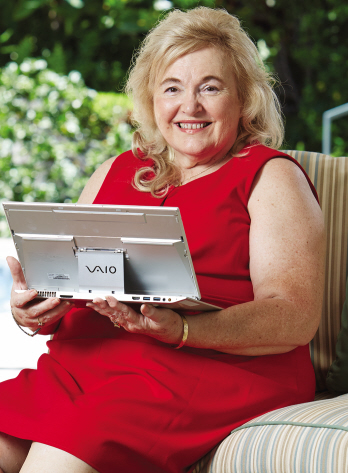 Fay Rawles Schoch was crowned Ms. Medicare Advantage™ 2015, representing those beneficiaries who choose to get their Medicare coverage from a private insurance company. These plans are known as Medicare Advantage plans under the category of Medicare Part C programs. A government publication, Medicare & You 2015, lists AlohaCare, Kaiser, HMSA, Humana, Ohana Health Plan and UnitedHealth as health organizations that offer Medicare Advantage plans to Hawai‘i Medicare beneficiaries.
 At the young age of 25, Fay became the parent of three toddlers under the age of five. As a new wife and stepmom, Fay discovered the work of German psychologist Alfred W. Adler. It resonated with her as the perfect prescription for managing her instant family. Fay began absorbing Adler’s work and applying his concepts at home. She credits her ability to smile through tough times and challenges of rearing a family to her Adlerian training. It teaches that we cannot control events, but we can control how we respond to them. Adlerian theory of parenting takes a holistic approach to mutual respect and accepting responsibility for behaviors . Counselors teach, guide and encourage children with the ultimate goal to promote each individual’s sense of belonging, and to increase their social interests and societal contributions. Adlerian techniques focus on all family members valuing each other, staying connected and participating in “family meetings,” where everyone is encouraged to share their concerns, successes and challenges.
 Each sibling accepted and doted over their little sister; they remained close even as college and relationships drew them away from home. Fay’s youngest became a great athlete, comfortable playing soccer and football. With her parent’s support, she successfully petitioned to compete on a Pop Warner football team. After graduating from Punahou School, she received a congressional appointment to attend the United States Merchant Marine Academy in New York, served on the high seas for six years and is now a Coast Guard reservist, USCG Third Assistant Engineer. Fay’s daughter also earned her masters degree at the Massachusetts Institute of Technology. She is currently an executive with Intel Corporation and lives in Silicon Valley with her husband and two children. As she raises her own toddlers, She uses Adlerian parenting concepts and frequently consults with mom for new tips.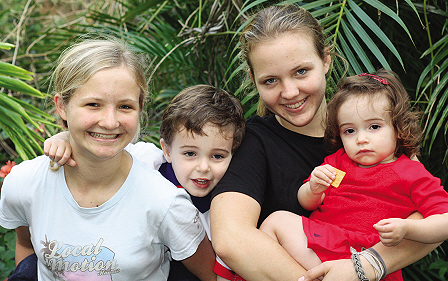
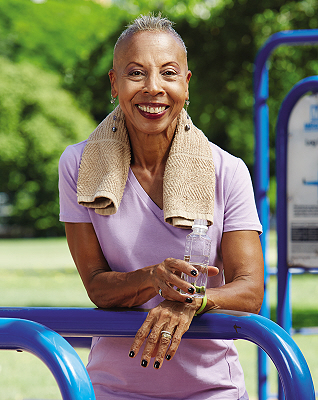 Terri Rainey represents our Ms. Medicare/Medicaid Dual Eligible pageant title. Medicare beneficiaries who qualify for both federally administered Medicare and full Medicaid benefits from their State health program are known as “duals.” If a Medicare beneficiary is dual eligible, they can join a Medicare Special Needs Plan or SNP. Health plans that offer Medicare SNP’s, provide a valuable service for duals by coordinating benefits between the Federal Medicare program and State Medicaid plan to ensure the beneficiary has a seamless experience accessing benefits from both programs.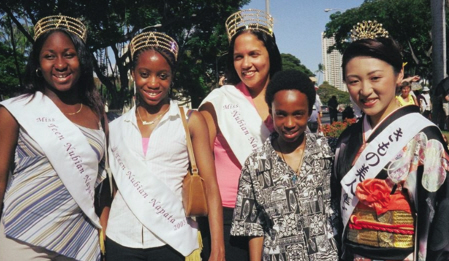
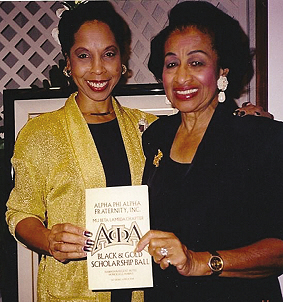
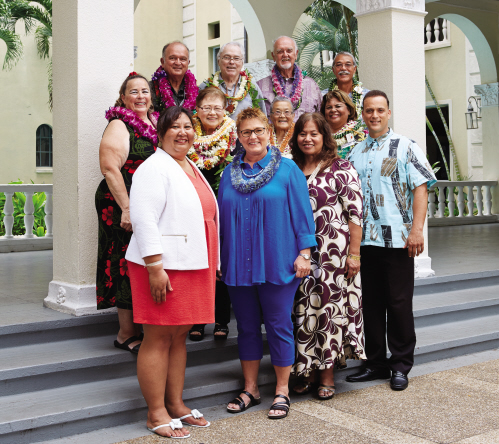
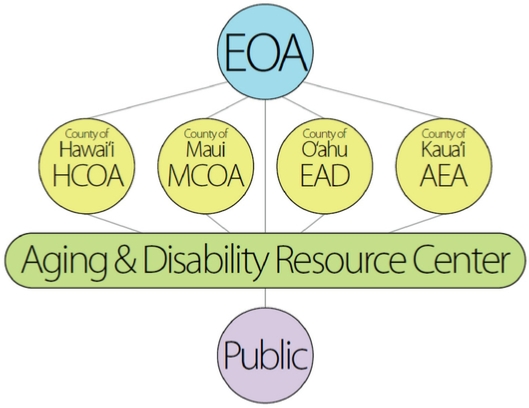
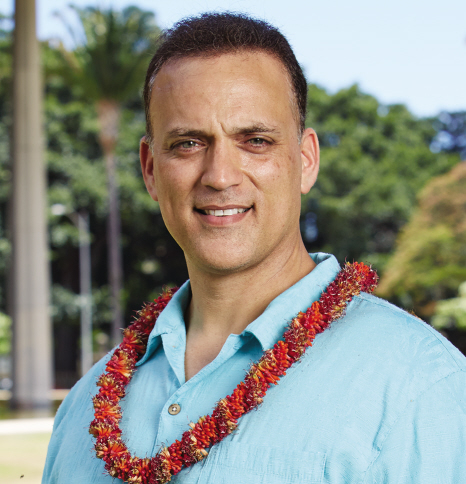 Kupuna Care (KC) program provides funds to “… help frail and vulnerable older persons lead independent, meaningful and dignified lives in their own homes and communities.” Services for Seniors and the Hawai‘i County Office of Aging (HCOA) has increased the number of seniors receiving Kupuna Care funding in Hawai‘i County by creating a unique case management and transition approach, that doubles the impact of the state’s fiscal investment while ensuring seniors are safe, happy and living in their homes with their families for as long as they choose.
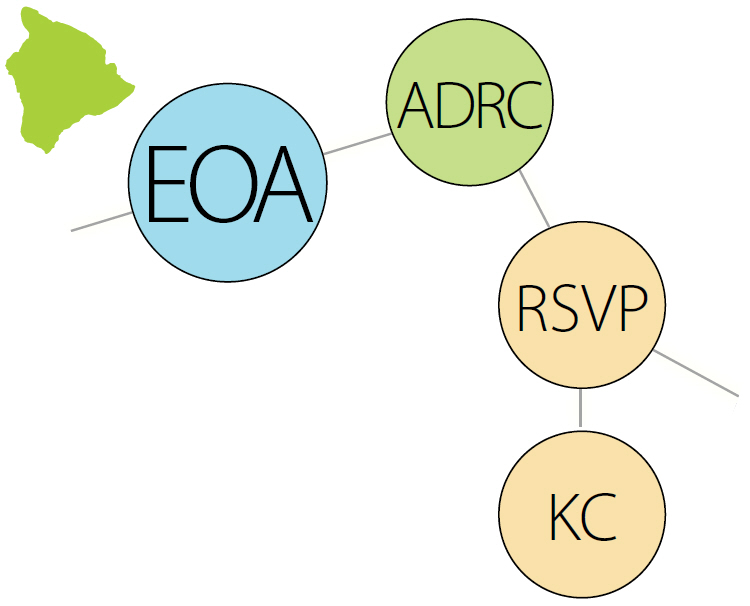 After a Kupuna Care consumer receives three to six months of case management and wrap services, Services for Seniors staff works diligently to replace formal services with community and volunteer supports. These supports are provided by caregivers in the family, friends, faith-based members and/or community volunteers willing to be a part of the consumer’s caregiving team. Transition to informal supports reduces the use of Kupuna Care funds, which then enables other eligible seniors to participate in the program. This system also reduces the number of consumers on a wait list, allowing Services for Seniors to help a larger number deserving elders age in place with dignity.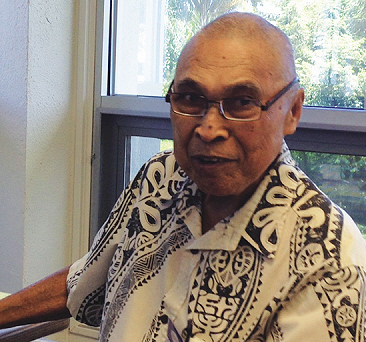
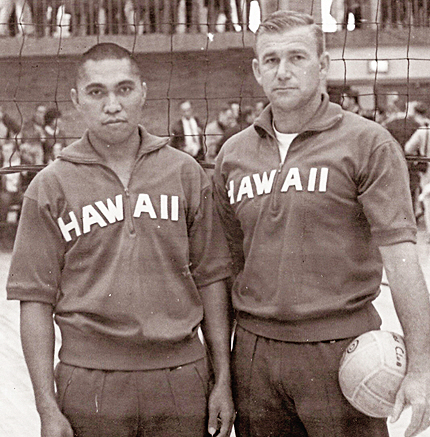
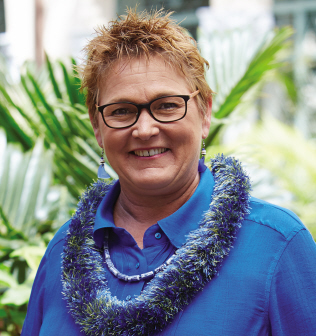 Maui County Office on Aging (MCOA) is an office filled with activity. Since implementing standardized tools and procedures of the Aging and Disability Resource Center (ADRC), new referrals to MCOA have increased as much as 400 percent a month. While the numbers of seniors and individuals with disabilities requesting assistance has increased, the available funding to serve the seniors of Maui, Moloka‘i, and Lana‘i has remained mostly static. Therefore, MCOA finds it necessary to look for opportunities to creatively solve the issue of how to meet the increasing need without the luxury of an increase in funding.
 A major way that MCOA is working to find solutions is to greatly increase emphasis on helping seniors, family caregivers and individuals with disabilities improve their overall health. Two “evidence-based” (proven to create expected outcomes) healthy-aging programs now available on Maui are Better Choices, Better Health (BCBH) and Enhance®Fitness (EF).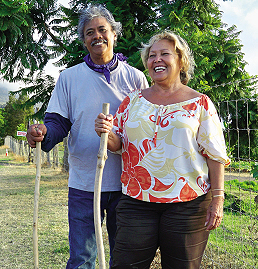
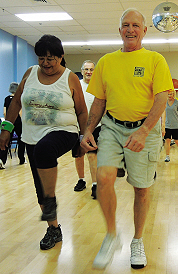
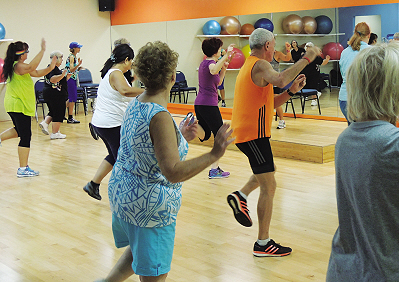 Enhance®Fitness instructors are specially trained. Individual participant progress is followed with fitness checks at enrollment and every four months thereafter. Exercises are safe and may be modified according to participant ability. The class also affords social interaction and reinforcement among persons who have a common desire to get healthier. Enhance®Fitness classes are a great way to get stronger, have more energy and maintain independence.
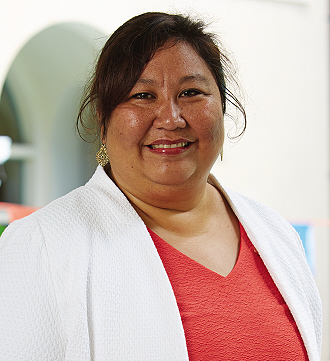 For O‘ahu elders over 60 and people with disabilities of any age, obtaining information and referral assistance starts with the Elderly Affairs Division, ADRC “one-stop” Senior Helpline: 808-768-7700. Trained community service aids assess needs and refer callers to service providers in Honolulu County, and conduct assessments for frail elders 60 and older who may qualify for publicly funded services. For example, a homebound elder in need of meals would be assessed and connected to local agencies that provide meal service.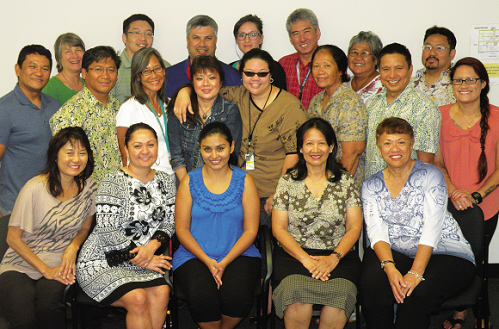
 O‘ahu’s Retired and Senior Volunteer Program (RSVP) is the volunteer end of help and assistance. RSVP engages people age 55 and over in a diverse range of volunteer activities offered by more than 25 “volunteer stations” (nonprofit or government agencies who deliver services to the elderly, as well as providing other community needs). Project Director Lenny Fabro heads this very successful island-wide program.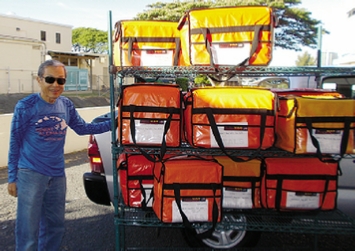
 Some of the volunteer stations now available are: Hawai’i Literacy, The Next Step Shelter, Office for Social Ministry, Blood Bank of Hawai‘i, Lanakila Meals on Wheels, State Executive Office on Aging, HCAP Head Start and several elementary schools providing tutoring and mentoring. One important volunteer opportunity is with the EAD. Volunteers assist with important independent living services, such as transportation, companionship and telephone reassurance, to homebound elders. Another station that assists with independent living services is the Waikiki Friendly Neighbors program.
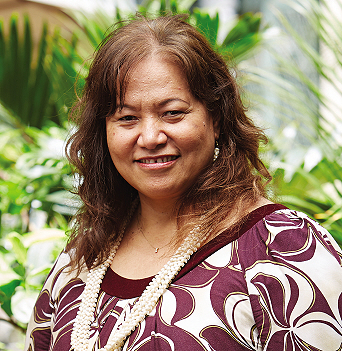 Elders on Kaua‘i are just a phone call away from our Agency on Elderly Affairs. Our receptionist will answer requests for information, and process requests for assistance by taking the caller’s name and address and making an appointment for visit and needs assessment from a Community Service Assistant. Our goal is to be sure elders know what federal, state, county and community services are available to them, and to refer them to agencies and care providers who can deliver those services. Funding is limited and helping those who live alone is top priority.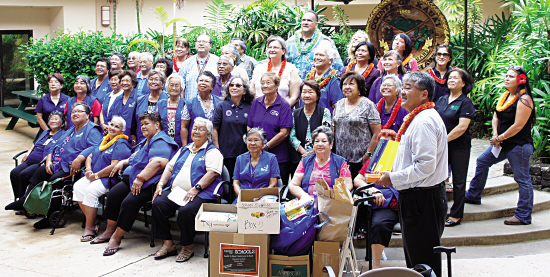
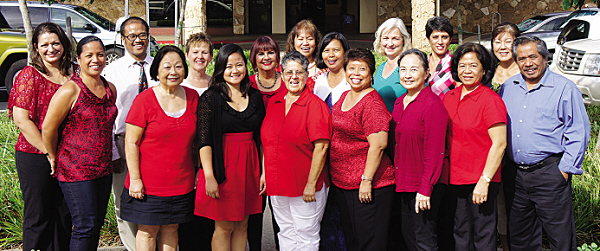
 That goes for caregivers, too. Plan ahead for the time when your loved one will need more help than you can give. Find out what services are available to you now and in the future. Don’t wait until you are exhausted and stressed out before you call for assistance with your loved one. We have information about daycare for elders and respite services for worn out caregivers that can help them manage better and maintain their own mental and physical health. Call us — we can help.