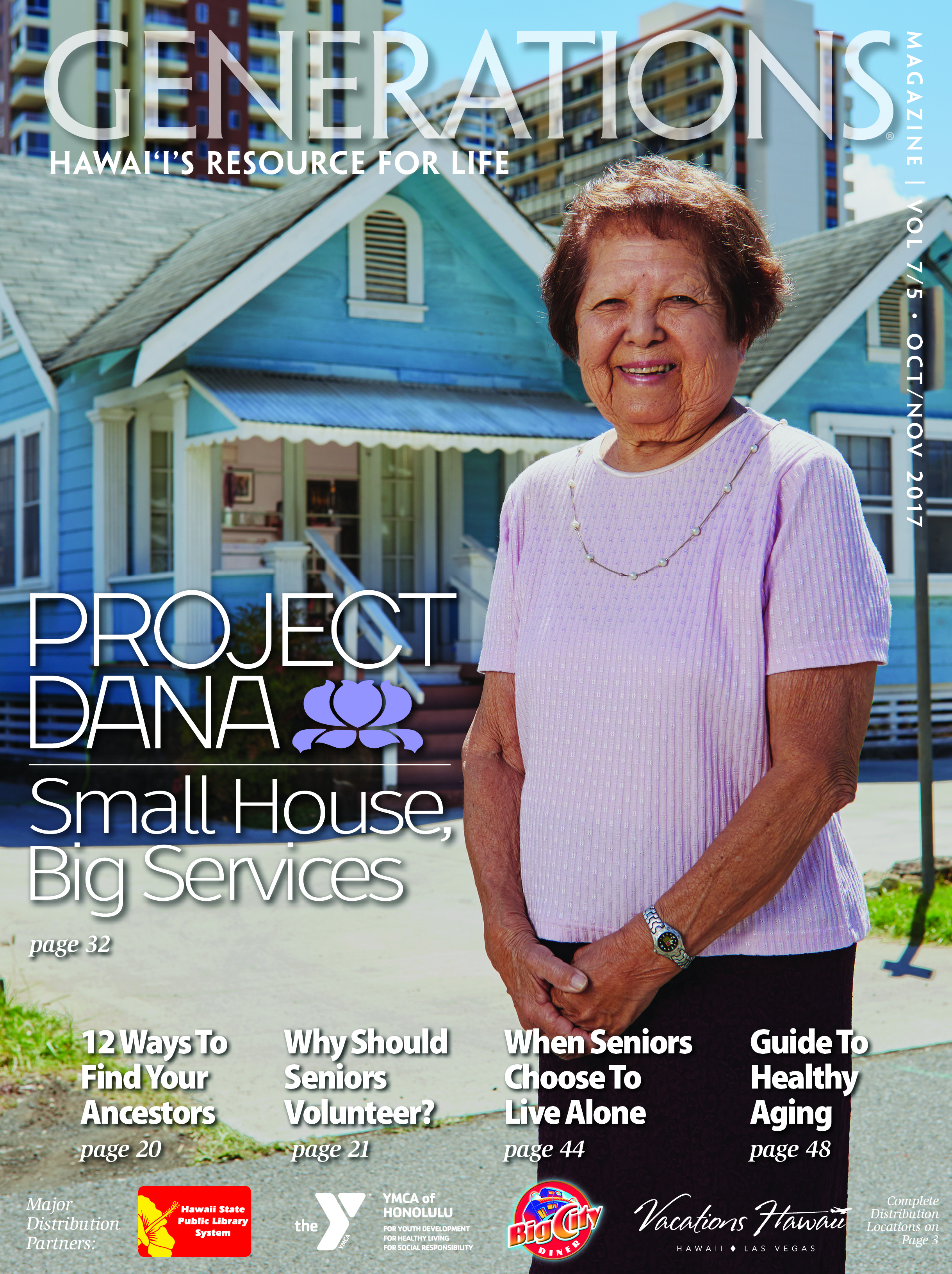
Category: Cover Story

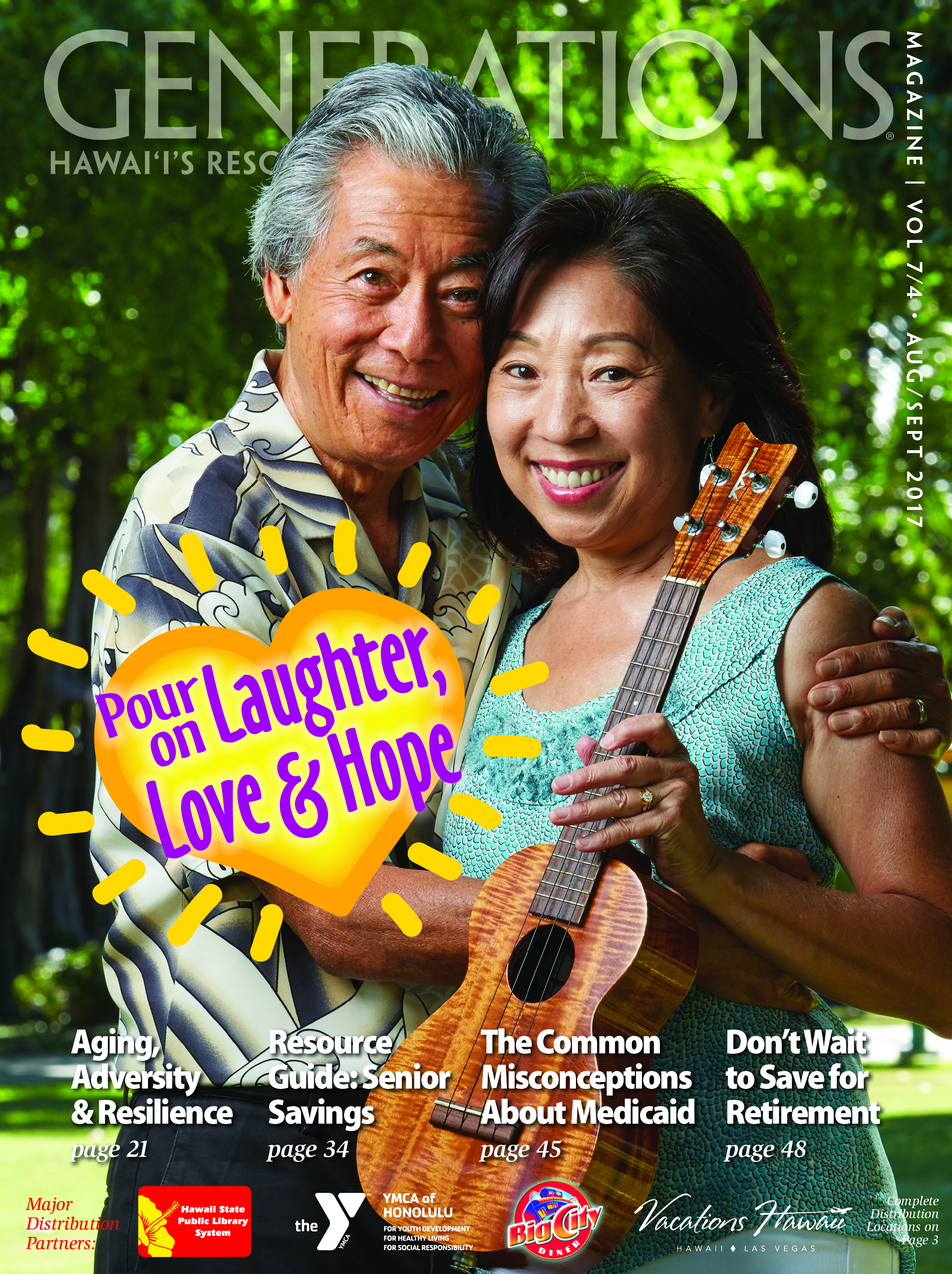
  • Runninʻ On Aloha with Carole Kai

    Runninʻ On Aloha with Carole Kai

    From a very young age, Carole Kai showed a flair for the dramatic — sometimes pulling a bedsheet off the clothesline and holding it tightly across her shoulders while flying around the backyard like a superhero. Other times, she showed a more businesslike approach — like the time she hosted a boxing match in her backyard and sold tickets to neighborhood kids for 5 cents apiece.

    Carole enjoys sharing stories like these when asked where her entrepreneurial spirit came from. She credits that to her mother. Throughout her life, Carole says, her constant motivation was to live the life her mother couldn’t. “I just wanted to make her happy,” she explains.

    “My mother was a wonderful person. She really had dreams. But in those days…” Carole pauses to compose herself, and then begins describing Ethel Shimizu — a pretty teenager who became a single parent who worked at a barber shop for 50 years. “I remember she was always hanging up towels. So when I earned my first paycheck, the first thing I did was buy her a washing machine and dryer,” Carole says with a smile. “And then I didn’t have to hang up towels either.”

    Growing up in Kaka‘ako, Carole was sometimes teased for being “different.” In those days (the late ’40s and early ’50s), most of the kids in the neighborhood had a dad who went to work and a mom who stayed at home. But Carole’s father had left the family when she was young. She says her mother seemed to work all the time. And her brother and sister were a lot older than she was. So Carole was often left home alone — which was another thing that made her different from most other kids.

    Making a difference

    More than being different from others, though, Carole has made a difference for others, awarding the Carole Kai Scholarship to deserving students at McKinley High School, and humbly accepting many honors herself, like these, for her role in promoting health and fitness, music and entertainment, and community service:

    • “Carole Kai Day,” proclaimed by Gov. David Ige
    • “Aloha Is” Award for Community Service, at the
      Nā Hōkū Hanohano Awards
    • Distinguished Alumni Award, presented by the
      University of Hawai‘i
    • Franklin Delano Roosevelt Award for Distinguished Community Service, awarded by the March of Dimes
    • Communication and Leadership Award, from
      Hawaii’s Toastmasters District 49
    • 2018 American Patriot Award, from the Honolulu Council of the Navy League
    • The Ihe Award, from the Hawaii Army Museum Society
    • Mana O Ke Koa “Spirit of the Warrior” Community Service Award, from the U.S. Army, Pacific (USARPAC)

    And Carole is especially proud of the achievements that have made a lasting difference in the lives of people in the community:

    • the Great Aloha Run, which has given more than $14 million to charitable causes, will celebrate its 35th year in 2019
    • “Hawaii Stars” is celebrating its 25th anniversary in 2018
    • the Carole Kai International Bed Race gave away more than $2 million to charities in its 20 years

    But while it might seem that Carole Kai has led a charmed life, the little girl from Kaka‘ako with big eyes and even bigger dreams who grew up to be one of Hawai‘i’s biggest stars, has faced her share of adversity. When Carole’s father left the family, he left them with the stigma of abandonment. Her grandparents shunned Carole and her siblings. And her mother had to give up her own dreams in order to raise her three children.

    Carole has few memories of her father. “One story I remember about my father was when I asked him why my name has an E in it,” Carole says. “Other girls I knew that had my same name spelled it C-A-R-O-L. But my name ends with an E. And my dad told me, “Don’t you know? The E is for energy!” Fluttering her eyelashes, Carole adds, “I guess I was an energetic little girl.”

    E is for energy

    Carole is one of those people who is filled with energy — constantly setting and achieving new goals. And she’s also one of those people who can fill up a room with energy — inspiring others to achieve their own personal goals by entering the Great Aloha Run and “Hawaii Stars.”

    As co-founder and president of the Great Aloha Run, Carole leads a team of thousands of volunteers and dozens of businesses that give back to the community and support tens of thousands of participants in the annual charity run.

    As co-star and executive producer of “Hawaii Stars,” Carole leads the sales efforts for the local TV show that is “making stars shine” and joins co-star Kimo Kahoano in welcoming people to showcase their talents onstage and on TV.

    And the common element in all of this is the energetic Carole Kai Onouye.

    Today, at the age of 74, Carole continues to keep busy, working daily in the Great Aloha Run office in Iwilei and traveling (most recently to Peru) with husband Eddie Onouye, who’s a successful businessman and entrepreneur, and Carole’s high school sweetheart.
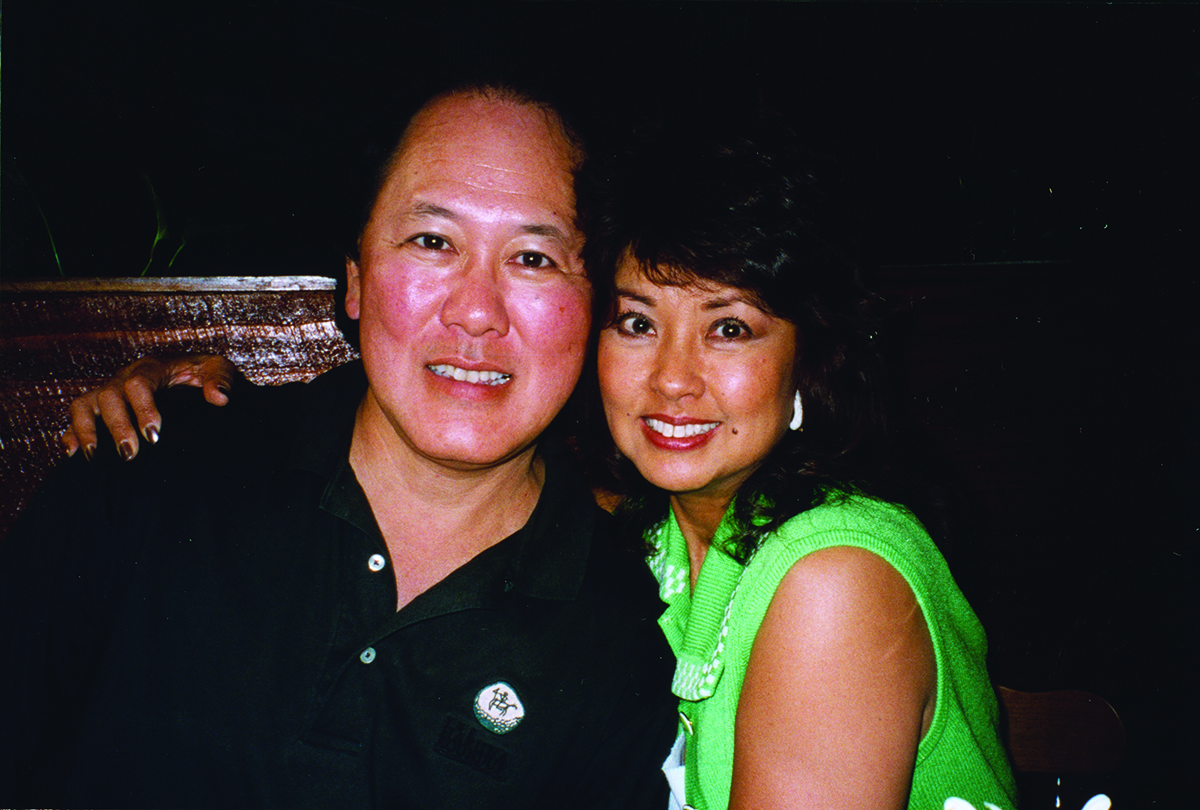
    Carole and high school sweetheart Eddie celebrating an anniversary at Lake Como, Italy.
    Carole and high school sweetheart Eddie celebrating an anniversary at Lake Como, Italy.

    “Eddie was my first love,” Carole says, slowly, as she shares another one of her favorite stories. “He was my first boyfriend. And I was so in love.” Eddie was the same age as Carole and was making plans to go away to college after graduating from Farrington High School. “On his graduation night, he took me to a special place. I honestly thought he was going to propose to me,” Carole says softly, dipping her head to one side. Then she adds quickly, “But he dumped me.”

    Twenty-five years later, in 1987, Carole Kai and Eddie Onouye were married.

    Throughout those 25 years, between 1962 and 1987, their separate journeys took Carole and Eddie away from the islands and apart from one another, and ultimately gave them experiences and life lessons that made them who they are today.

    Eddie studied engineering in college, volunteered for the draft and served in the Army, and became a successful, self-made businessman.

    Life lessons

    After Eddie left Hawai‘i, Carole focused her energies on music, which she had always loved. Her first job, at The House of Music near Ala Moana Centerstage, didn’t last long. Carole enjoys telling the story of telling a customer, “I’m sorry, the store is really underhanded,” when she really meant to say it was understaffed. “I got fired,” Carole says quickly. Decades later, that young teenager would find herself hosting a TV show and singing competition on that nearby Centerstage.
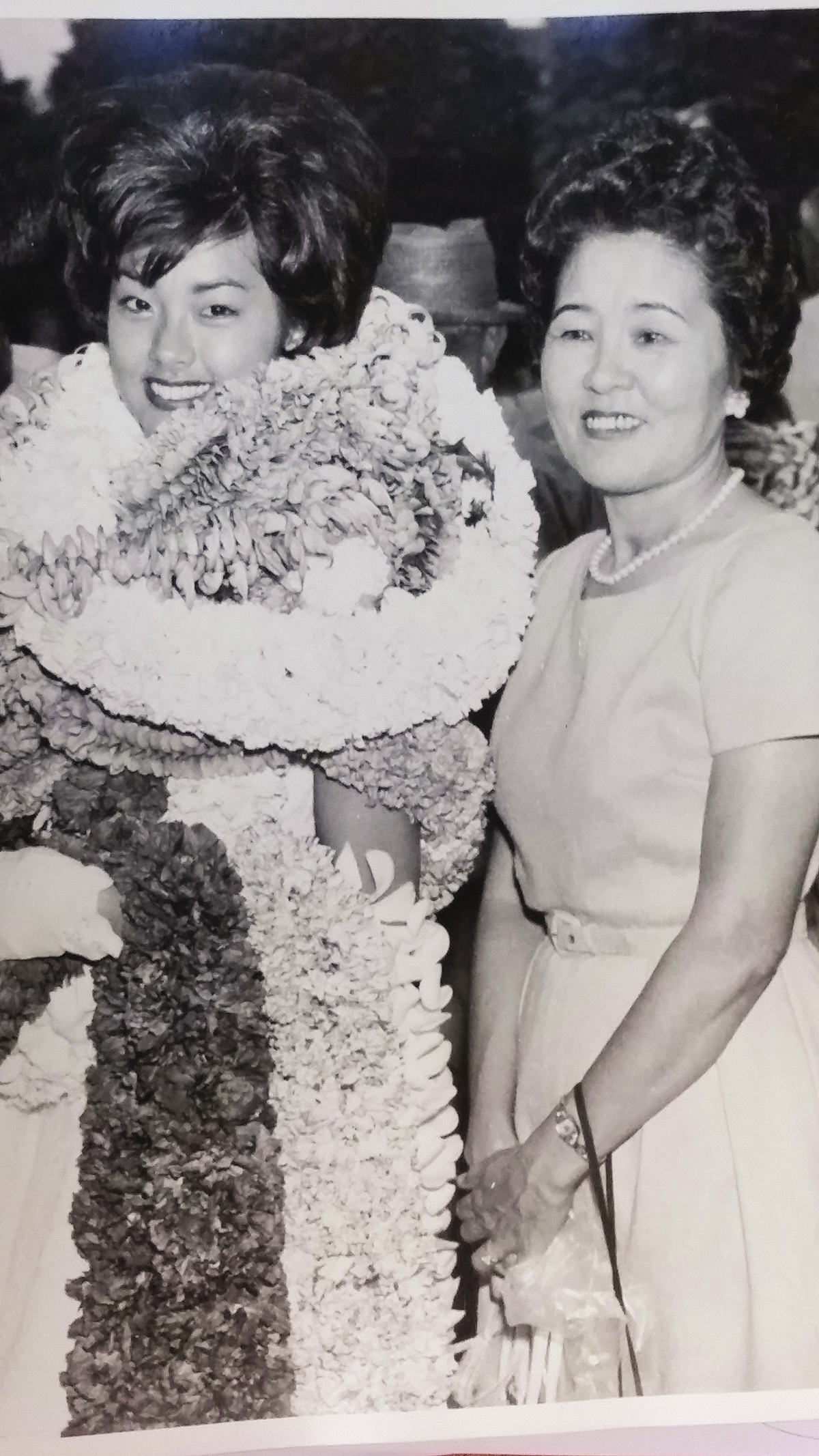
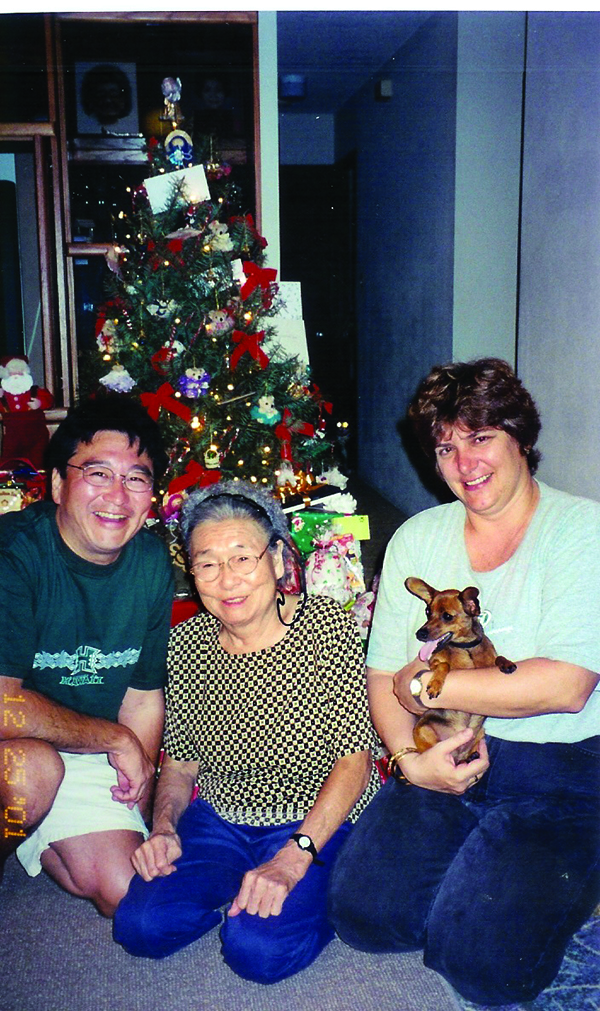
    Carole with her mom, Ethel, on graduation day, McKinley High School, Class of 1962.
    Carole with her mom, Ethel, on graduation day, McKinley High School, Class of 1962.

    Carole’s mother Ethel encouraged her daughter’s talent, paying for piano lessons and dance classes. “She always told me, ‘Whatever you want to do, you can do it. And I’m there for you,’” says Carole, adding, “I had no fear of failure.” So, from a very early age, Carole believed that she could be and do anything she put her mind to. And for her, that was a career in music.

    After graduating from McKinley High School, Carole earned a degree in music from the University of Hawai‘i at Mānoa. But she didn’t become a concert pianist as her mother had wished. “I wasn’t into practicing eight hours a day, all day, like some of the students in the music department,” Carole adds. “I’d rather be around people.”

    Carole is truly a “people person” and enjoyed surrounding herself with crowds of people — entertaining audiences in Waikīkī and Japan and Las Vegas/Reno/Tahoe throughout the ’60s and ’70s. And she was happy to have her mother stay with her during her stints in Vegas. “I was doing things that she would have liked to do herself,” Carole says. “My mom also had dreams of being an entertainer.”

    Carole Kai’s first professional gig was singing and playing the piano at the Tropicana Hotel as the opening act for Guy Lombardo. She later opened for Jerry Lewis, Roger Williams, Shecky Greene, George Carlin, and Don Rickles, and spent time with another girl from Hawai‘i, Elaine Okamura and her husband Wayne Newton.
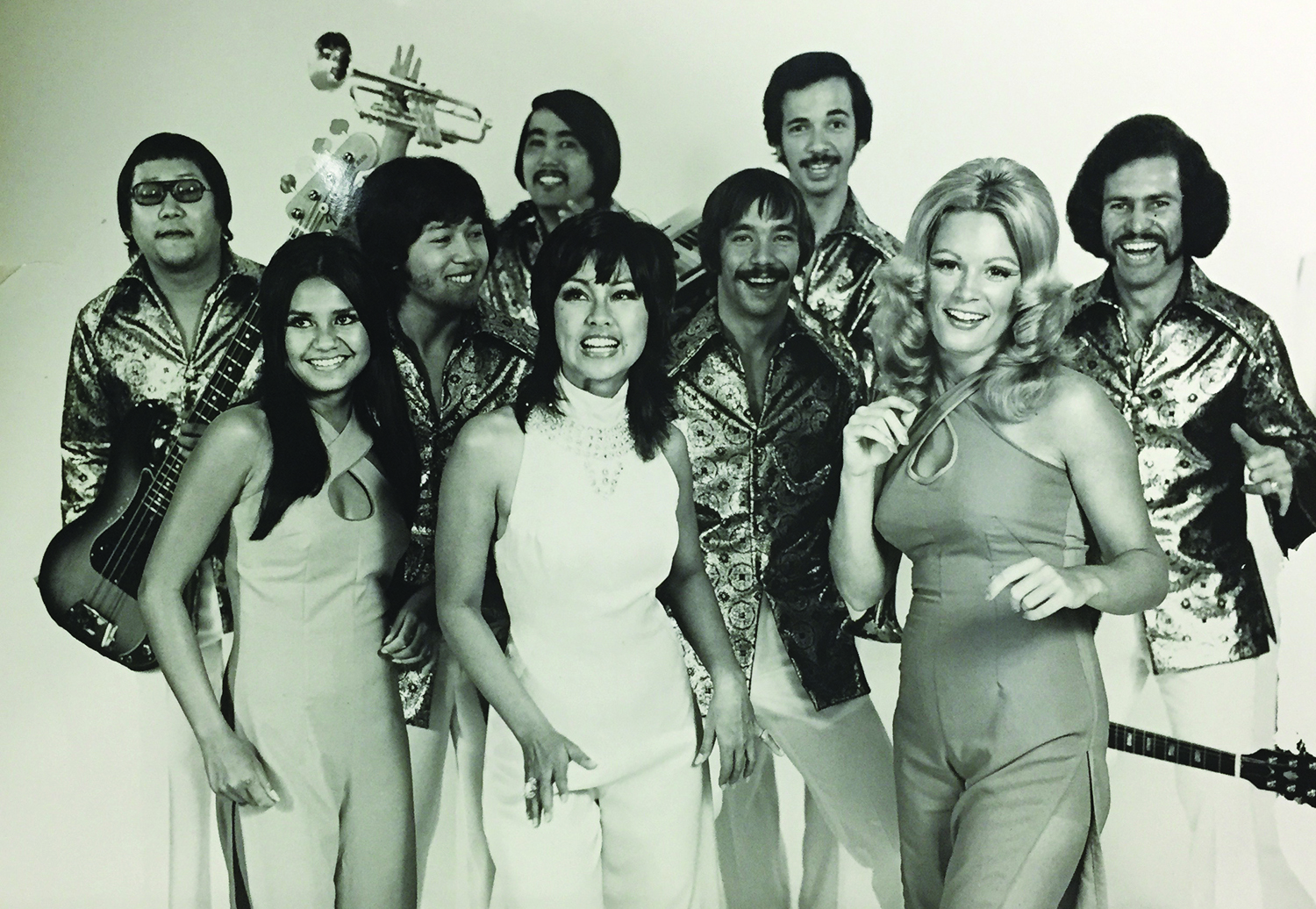
    Carole performed at the Hilton Hawaiian Village’s Garden Bar (1968 to mid ‘70s) with the Fabulous Krush and singers Sonya Mendez and Debbie Simpson
    Carole performed at the Hilton Hawaiian Village’s Garden Bar (1968 to mid ‘70s) with the Fabulous Krush and singers Sonya Mendez and Debbie Simpson

    Voted the “Most Talented” student at Washington Intermediate and McKinley High School, Carole was also named the “Most Promising Newcomer of the Year” in Las Vegas. And when she returned to Hawai‘i, she opened for Don Ho and later staged her own Vegas-style show.

    In the late ’90s, Carole joined forces with powerhouse singers Loyal Garner, Melveen Leed, and Nohelani Cypriano to perform and record as The Local Divas. That musical match-up was quite a way for Carole to end her professional musical career. But she has continued to shine onstage, on television, and in the community.

    Throughout it all, the exuberant Carole Kai never let celebrity go to her head. Instead, she used that platform to “do good” for other people. “My mother was always working,” she says. “So she never had time to give back to the community. And that’s what drives me to do it now.”

    “My mother always told me, ‘You cannot keep taking out of the well, because the well will become dry. So you have to always give back,’” Carole adds. And she’s lived by those words to this day.

    Giving back, with aloha
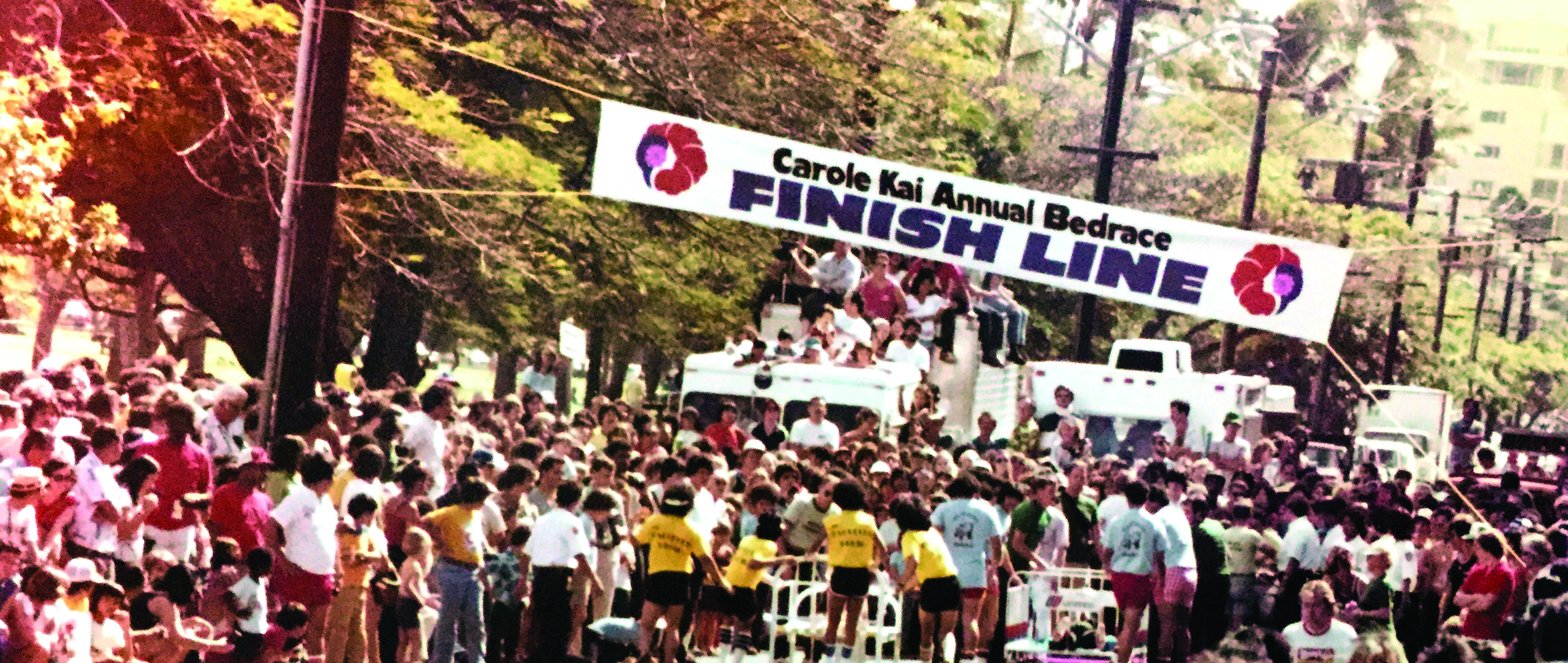
    The Carole Kai International Bed Race was a popular event that raised over $2.5 million for charity from 1974–1994.
    The Carole Kai International Bed Race was a popular event that raised over $2.5 million for charity from 1974–1994.

    Through the Carole Kai International Bed Race, Carole invited the community to share in a fun event that raised millions of dollars for dozens of charities between 1974 and 1994. That included $2 million raised for the Variety School, a school for children, teens, and young adults with learning differences. The Bed Race was a huge success, but Carole would make an even greater impact with her next venture.

    In 1985, Carole launched a great new idea. The Great Aloha Run brought together nearly 12,000 participants who made their way along an 8.15-mile path from Aloha Tower to Aloha Stadium, making it the largest first-time running event in the world.

    The event’s instant success was a credit to its co-founders: Carole Kai Onouye and Dr. Jack Scaff, a renowned cardiologist known as the Father of the Honolulu Marathon.

    To date, the Great Aloha Run and Carole Kai Charities have:

    • generated over $14 million in charitable giving
    • benefited over 150 nonprofit health and human service organizations, the military, and community groups, and
    • distributed 95 percent of its charitable donations within the State of Hawai‘i.

    In 2019, the Great Aloha Run will celebrate its 35th year. That’s a major milestone for Hawai‘i’s largest participatory race — with more than 20,000 runners, joggers and walkers; over 4,000 volunteers; dozens of sponsors and donors; and only two full-time staff members.

    “And we could not do the race without the input and guidance of our board members; Larry Okinaga, Randy Hiraki, Jean Hagi, Robin Campaniano, Ali Nikkhoo, Emi Anamizu, Stanford Carr and Mike McCartney,” says Carole.

    Walking the walk, running the run

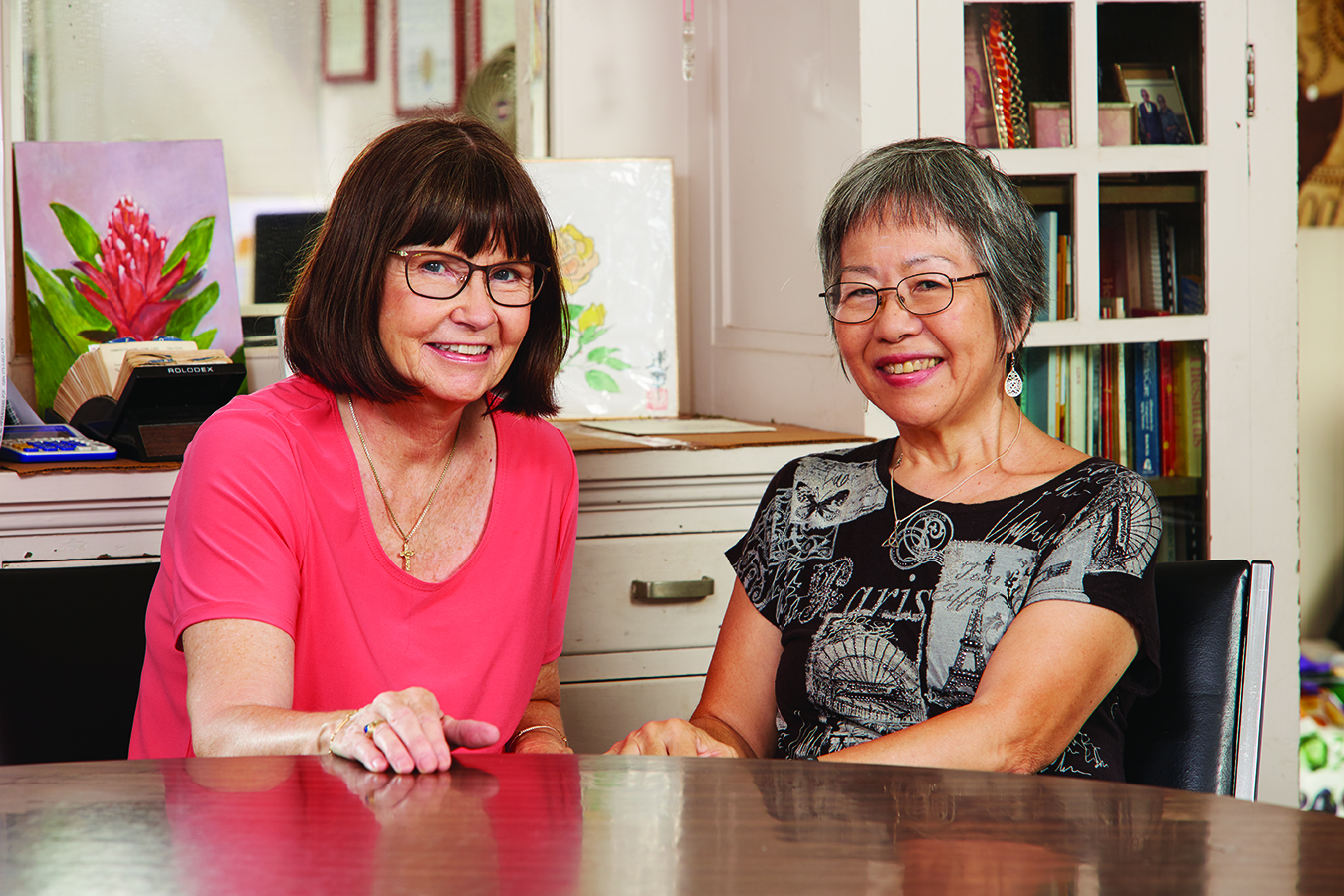
    Carole Kai Charities, which “runs” the Great Aloha Run is a nonprofit organization whose sole mission is to raise funds for charities in the State of Hawai‘i. And the two people who “run” the office, Claire Nakamura Rochon and Brent Imonen, are a perfect complement to each other in skill set, mindset, and personality.

    Claire works to maximize charitable giving by minimizing expenses, while Brent manages event operations and marketing, bringing new ideas to enhance the experience for participants.

    “We solely exist to give money to charities,” says Claire, listing a few of the expenses vital to operating a safe and profitable event: from T-shirts and buses to barricades and port-a-potties, and from renting the Blaisdell Center and Aloha Stadium to lining the roadways with special duty officers. But Claire is always happy to say, “Our biggest expense is the charities. Once we pay all our bills, the rest goes to charities.”

    The dynamic duo
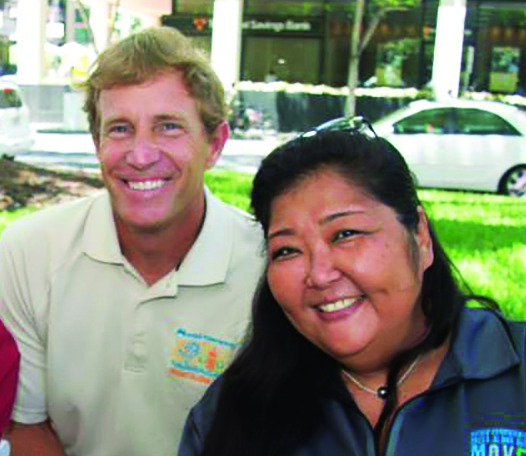
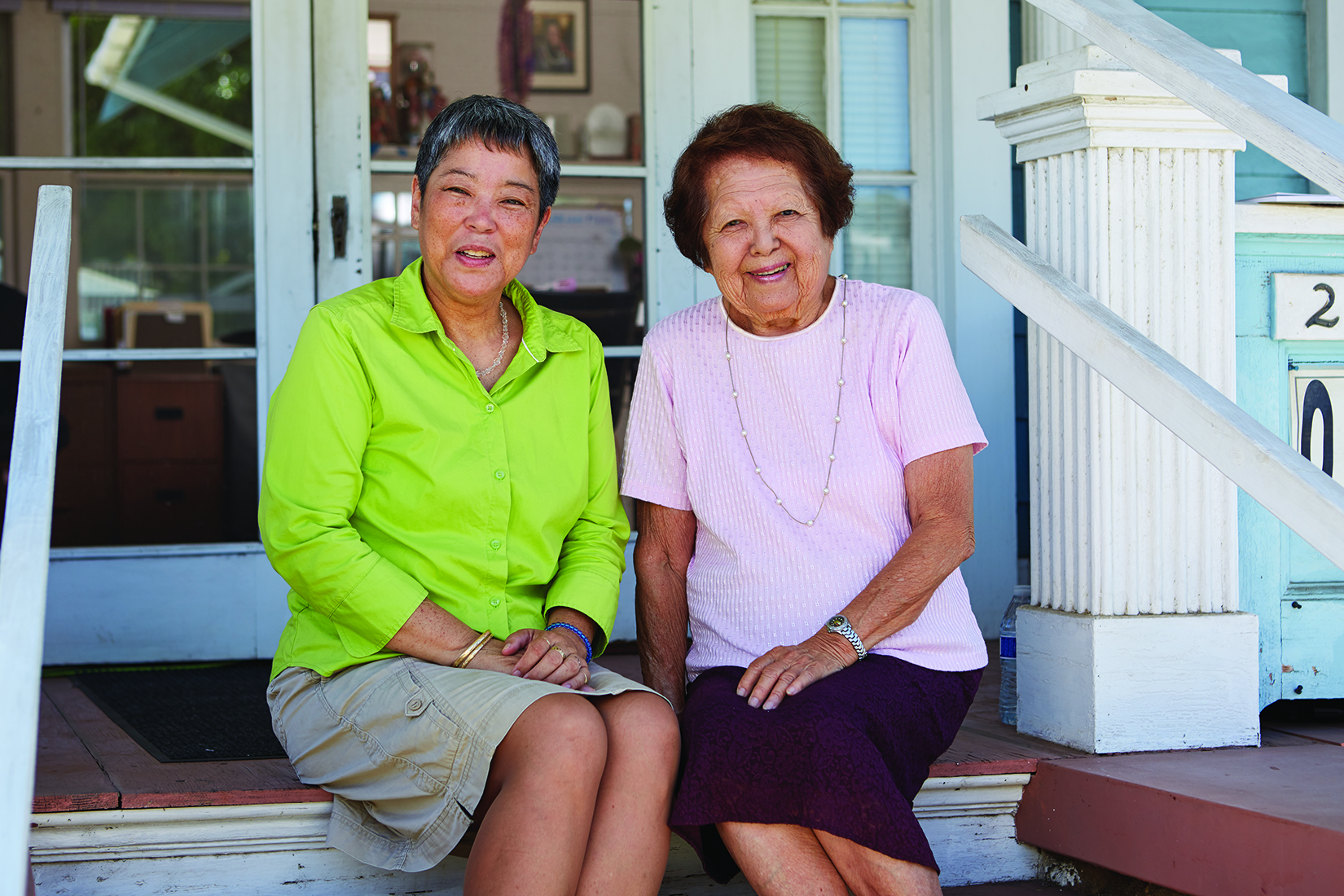
    Claire Rochon and Brent Imonen.
    Claire Rochon and Brent Imonen.

    Claire Nakamura Rochon is a perfect fit as the Administrative Event Coordinator for GAR (the Great Aloha Run). She participated in the event herself (as a walker in high school). She worked at the Variety School (a beneficiary of both the Bed Race and GAR) and served as an administrative liaison for the events. And she volunteered for GAR before being hired to run its day-to-day operations. That’s the ideal resume, built over 30 years. And that makes for a perfect fit.

    Today, Claire’s personal goals align with her professional ones — to ensure that both the Great Aloha Run and the giving can continue.

    As Race Director for the Great Aloha Run, Brent Imonen is a perfect fit for his role, too. The former professional triathlete and competitive swimmer also volunteered for the event and participated in GAR as an elite runner, completing the 8.15-mile run in under 41 minutes. And before Brent worked as the GAR race director, he managed field marketing programs for sports drinks and other products at events that included the Great Aloha Run and Expo. He continues to work with community events like the Duke’s Oceanfest and Honolulu Ekiden & Music Festival. Along with his experience, Brent brings a for-profit mindset and creative ideas in event marketing.

    When he’s asked about his vision for the future of the charity run, Brent points to the past. “In the early ’80s, when GAR first started, there was no internet, no social media, and there were fewer community events for people to choose from,” he says. So, for the Great Aloha Run to continue its success well into the future, Brent adds, “We need to be able to provide ‘that experience’ that people want to have and want to share. We all believe in the mission. But my perspective is a little out of the box. I think part of what I’m here to do, is to help transform GAR for the next 35 years. That’s the piece I add.”

    Brent, Claire, and Carole enjoy working with community partners, sponsors, and volunteers year-round. And during the few months that the office quiets down and the office computers would otherwise sit idle, they invite seniors to attend free computer classes (taught by volunteers, of course) to learn to use technology and continue to enrich their lives.
    Personal goals

    This time of year — the end of one year and the beginning of another — is the perfect time to take the time to contemplate the accomplishments we each have made, while setting new goals that we can achieve, big or small.
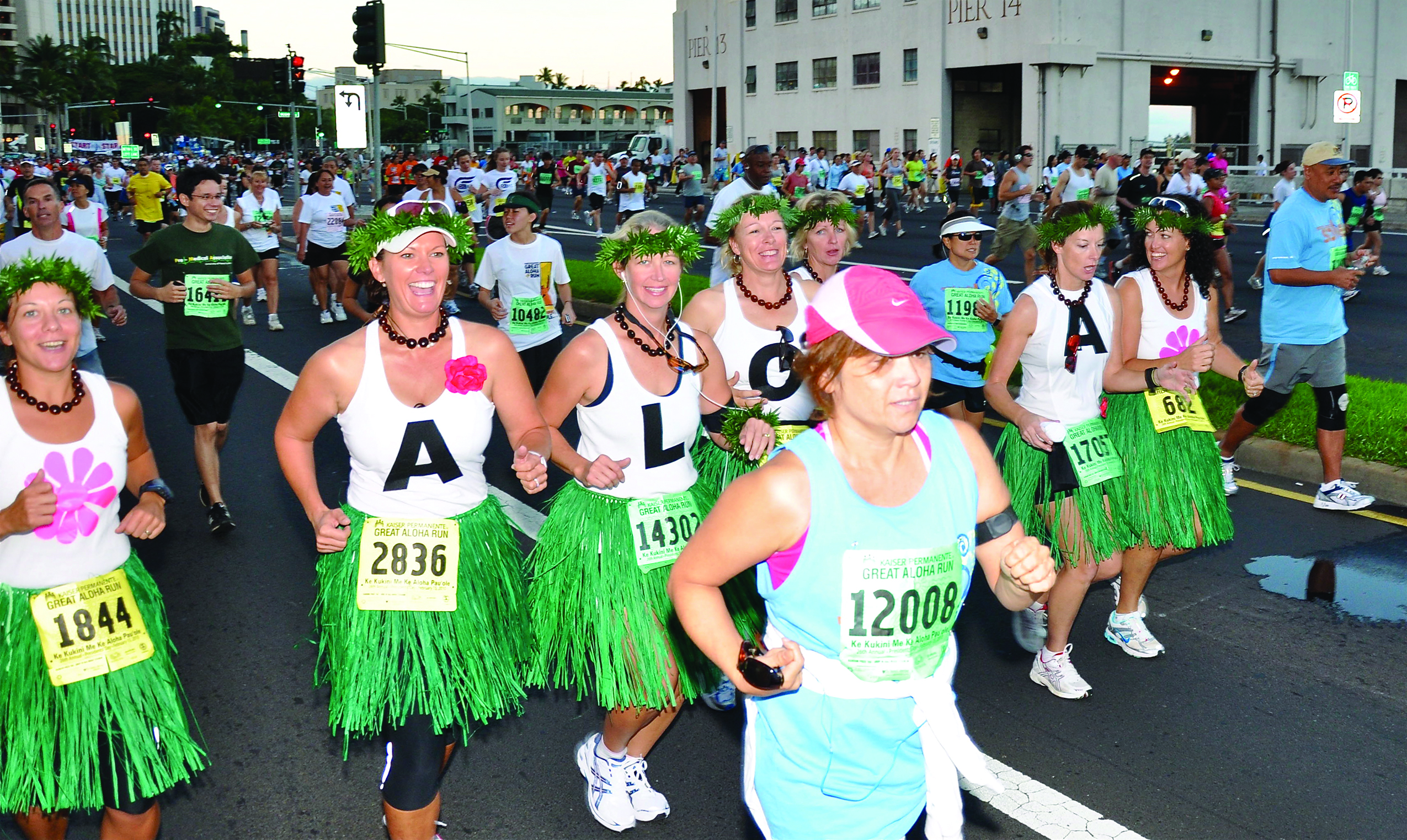
    If you’re like many people, participating in the Great Aloha Run is a major personal goal and may be one of the healthiest things you’ll do this year. And for some, it’s actually one of the healthiest things they’ll do all year.

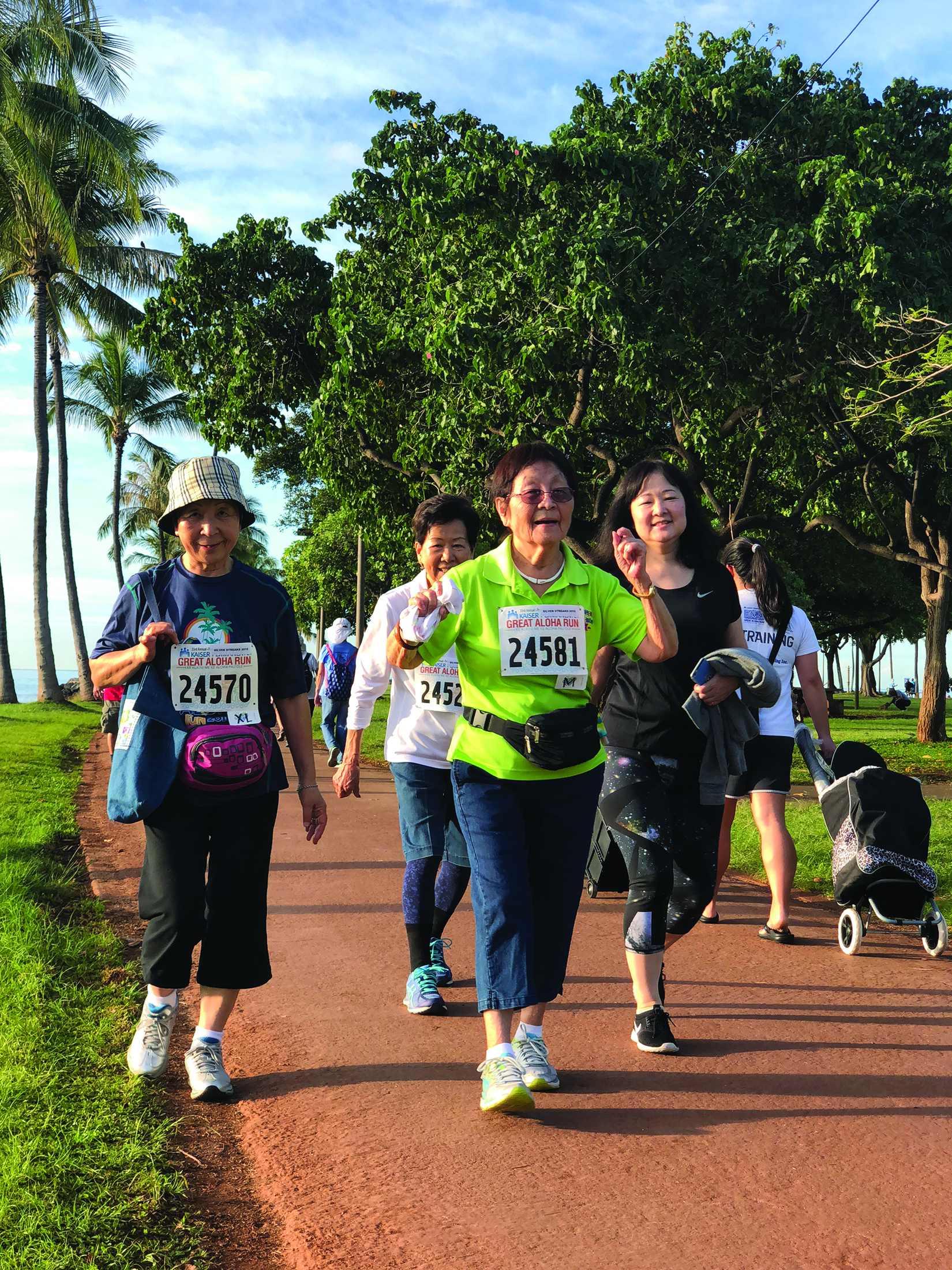
    A good way to start working toward that goal is to participate in this year’s Silver Streaks Sunrise Walk for Seniors. Preparing for that event can lead to health benefits for you, and a good, fun time for all.

    If you set the goal of participating in the upcoming Great Aloha Run or Silver Streaks Sunrise Walk, consider training with a friend, and work to keep one another motivated. Visualize your goal becoming a reality. Imagine the feeling of being encouraged and sharing the aloha spirit with others around you as you cross the finish line.

    And for those who may not wish to run or walk, you can also volunteer to help at the events and share your aloha with others throughout the community.

    It’s never too late to set new personal goals, or work toward ones you may have set for yourself many years ago — like Carole Kai Onouye, who’s living up to the personal goal she set as a little girl: just to make her mother happy.

    By sharing her aloha with other people in the community, Carole is like a backyard superhero with a bedsheet cape.

    Silver Streaks Sunrise Walk

    The Silver Streaks Sunrise Walk for Seniors is a fun, healthy walking event planned especially for seniors age 55+ on a 2-plus mile course around Ala Moana Park. (The flat, traffic-free route will begin near McCoy Pavilion.)

    The Hawaii Recreation & Parks Society, which produces the event in conjunction with the Great Aloha Run, offers participants lots of encouragement along the course, refreshments, entertainment, door prizes, and an official Silver Streaks T-shirt when they reach the finish line. Participants will also receive FREE entry into the Great Aloha Run Sports Health & Fitness Expo on Saturday, Feb. 16, 2019. (That’s one week after the Silver Streaks Sunrise Walk.)

    Great Aloha Run
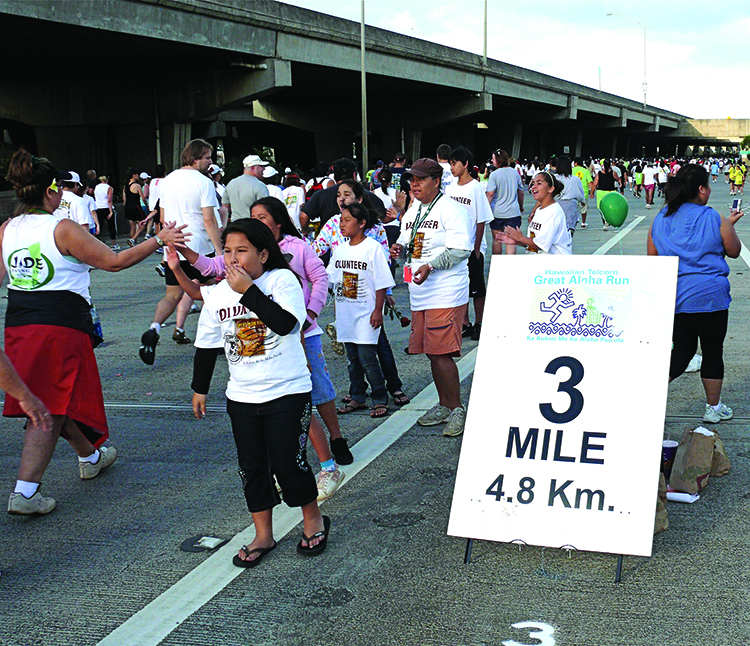
    The Hawai‘i Pacific Health Great Aloha Run (GAR) is held each year on Presidents Day and is viewed differently by different people. It’s a competitive race for elite runners, a fun run for fitness fans, a healthy walk for groups and individual weekend warriors, and an annual event for local military groups. It’s promoted as having a place for everyone who wants to participate, with a warmly inclusive philosophy reflected in the Hawaiian phrase, “Ke kukini me ke aloha pau‘ole” — the race with compassionate love.
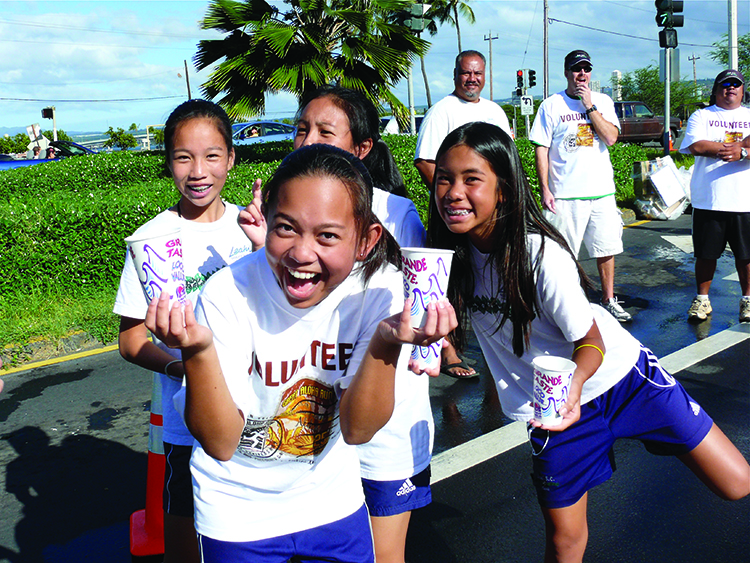
    Many people benefit from participating in regularly scheduled In Training Workshops throughout the year. And thousands of people of all ages attend the annual Great Aloha Run Sports Health & Fitness Expo where they gain new information and helpful tips to improve their health and fitness. To learn more about the Great Aloha Run, the Silver Streaks Sunrise Walk for Seniors, and the Great Aloha Run Sports Health & Fitness Expo, visit the website at: www.greataloharun.com.

    2019 Silver Streaks Sunrise Walk

    For the first time ever, the 30th Silver Streaks Sunrise Walk for Seniors will be held in conjunction with the Keiki Great Aloha Run. Both events will take place on the same 2-mile course, on the same day.

    DATE:
    Saturday, February 9, 2019

    TIME:
    6:45am walk numbers distributed
    7:15am warm-up
    7:30am walk begins

    LOCATION:
    Meet at McCoy Pavilion, Ala Moana Bch. Pk.

    ENTRY DONATION:
    $15 by January 31, $20 on or after February 1 (shirt size guaranteed for entries postmarked by Jan. 23)

    DEADLINE:
    Sign up on the day of the event

    INFO: Leave a message at 808-548-1108 and someone will return your call or email: hrps@hawaiirecreationparksociety.com


    2019 Hawai‘i Pacific Health
    Great Aloha Run

    The 35th Great Aloha Run is open to all. Come out  as a participant or a volunteer!

    DATE:
    Monday, February 18, 2019
    Presidents Day, 7am–10am

    LOCATION:
    Aloha Tower, 155 Ala Moana Blvd.

    ENTRY DONATION:
    $10 Babies in Strollers
    $25 Keiki (5–12 yrs.)
    $25 Seniors (65´ yrs.)
    $30 Military
    $45 Individuals / $60 late reg (Feb. 16–17)

    DEADLINE:
    Feb. 16–17. Sign up at the GAR Sports Health & Fitness Expo

    REGISTER / VOLUNTEER / INFO:
    www.greataloharun.com, 808-528-7388,
    email: registration@greataloharun.com

    From a very young age, Carole Kai showed a flair for the dramatic — sometimes pulling a bedsheet off the clothesline and holding it tightly across her shoulders while flying around the backyard like a superhero. Other times, she showed a more businesslike approach — like the time she hosted a boxing match in her backyard and sold tickets…

  • Caregiving in the Cycle of Life

    Caregiving in the Cycle of Life

    “One of my colleagues once said, ‘There are only four kinds of people in the world: those who have been caregivers, those who currently are caregivers, those who will be caregivers, and those who will need caregivers.’”— Rosalynn Carter, 1997

    Former first lady Rosalynn was a caregiver herself and she believed that family caregiving is a cycle of life that touches everyone. Here, four people, each at a different point on the cycle, share their care stories from the heart, offering words of wisdom and points of caution. As you read, consider your journey on the Cycle of Caregiving. Where are you? Are you prepared?

    LORI & GERALD LEE – Beginning Caregivers

    Lori, Pearl and Gerald Lee

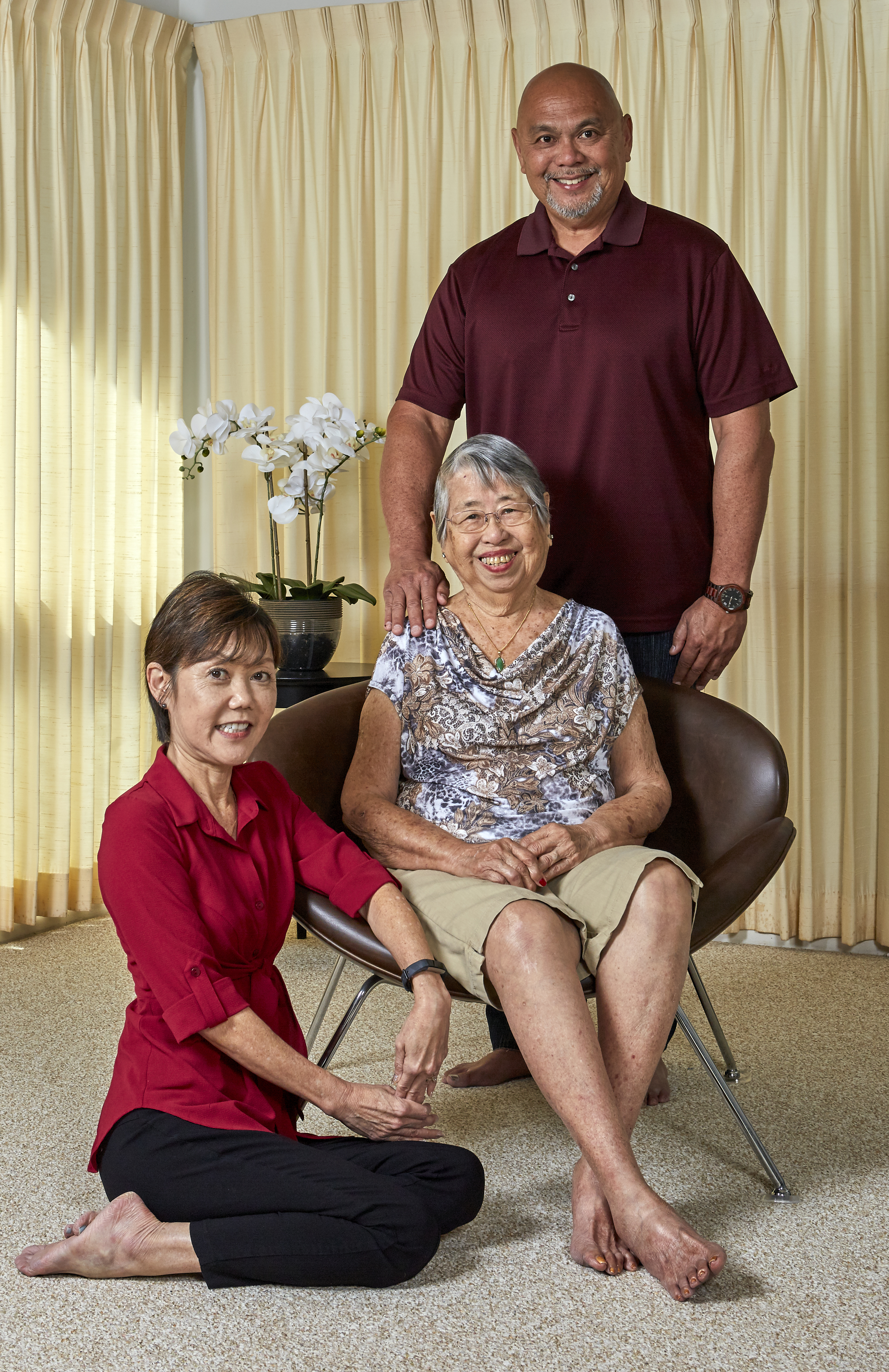
    I worked as an elementary school teacher for 33 years and recently retired from the Hawai‘i State Department of Education. My husband, Gerald, is still working at Pearl Harbor Environmental Division and plans to retire in a year or two. We have been happily married for 35 years, are empty nesters and have three successful children, Chase, Shelby and Dayne. We love to travel and enjoy new experiences. I planned to have an active retirement volunteering, traveling and, especially, enjoying my favorite hobbies — Zumba and yoga.

    A year ago, right after I retired, Dr. Edith Pang called us to report that Pearl “Popo” Lee, Gerald’s mom, was in feeble health. She notified Gerald to say, “Your mom needs someone to care for her, and your mom picked you.” It took us by surprise! Popo was a stay-at-home mother who became a widow seven years ago, and was suffering from diabetes, gout and other physical problems. She has four children: one in San Francisco, one in Japan and two on O‘ahu, Gerald and his sister. We were shocked and unprepared but felt a sense of obligation to help because I was retired, and the other siblings were not able to take her in.

    How did you manage the transition?

    Popo sold her home in Hawai‘i Kai and moved in with us a year ago. Being responsible for an elder’s health and well-being can be overwhelming. Providing meals on a diabetic and gout diet plan, monitoring her exercise, physical therapy, medications and scheduling her doctor’s appointments and social activities are one aspect; preparing our home — installing grab bars, door handles, nightlights and converting a bath to a shower — is another. Adjusting our lives and schedule so that she retains her dignity, feels contented and stays healthy is a challenge. I am happy to say that Popo’s health has improved since she came to live with us. She did not eat a healthy diet and wasn’t getting enough exercise on her own. Now she has lost weight, increased mobility and her stamina for exercise. Her balance has improved and her sugar levels are good. I think the structure of a daily routine makes her more confident.

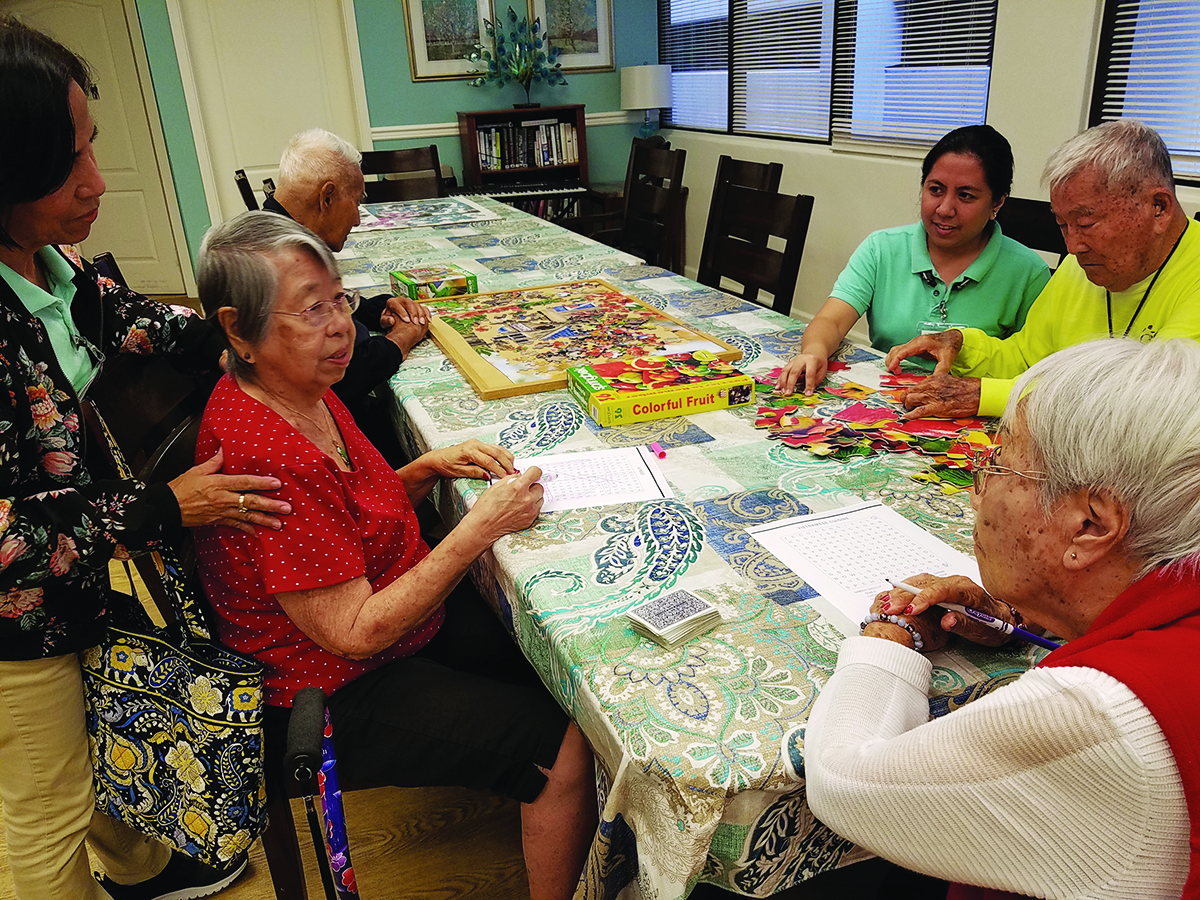
    Popo enjoys activities with her new friends at Hale Hau’oli in Aiea.

    Is Popo still able to socialize now that she lives in your home?

    Certainly. She is enrolled in senior day care at Hale Hau‘oli in ‘Aiea. Kathy Wyatt and her staff provide an inclusive “club” that Popo loves, and she has made many new friends. Our family comes to our house to visit her and are learning that Popo and we need to know when they are arriving. They didn’t realize that Popo is not capable of scheduling or attending family functions on her own. When they  take Popo out for lunch, they need to arrange it with us, so we may schedule accordingly. These little adjustments are expected when an elder has lived decades in her own home, but it takes energy to set new rules without offending people who assume she is in the same condition as years past.

    Where did you find information to train yourself for caregiving?

    Actually, my mom trained me by example when she was taking care of her aging parents. I am very fortunate to have had that experience, and I am not afraid of this vital responsibility. To find local resources for Popo, we look online and get advice from neighbors and friends who are caring for their parents. The resources and advertisers in Generations Magazine offer useful information. Every situation is unique, so we are always thinking and trying out new strategies. Caregiving is a work in progress at all times. That is what takes so much energy.

    What do you see in the future?

    We have barely discussed the future, but if her needs become more than we can handle, we will need to seek professional help such as specialized nursing care.

    Any lessons learned that you want to share?

    Tell your readers that they cannot anticipate everything. We discovered that TV Parental Controls are essential when Popo accidentally ordered “Baywatch Season 5” and “The Bachelorette Season 2” on my Amazon
    account. She knows not to give out her credit card number, but somehow she got on Amazon, where purchases are automatically charged to my card! She doesn’t even know what “Baywatch” is! You just have to laugh.

    Being mindful of each other is very important, too. It’s a marathon, not a sprint, and every bit of help counts. Establishing new habits requires conscious patience, such as reminding her to wear fresh clothes every day. Once the routine is working, focus on creating meaningful memories throughout each month. Anticipation of fun events and seeing family and friends brighten every day leading up to the activity too. Your retirement plans might not include some form of caregiving now, but that might be in your future. Don’t get blindsided.

    Caregiving is a work in progress at all times. That is what takes so much energy.”

    Pat Bemis – Current Caregiver

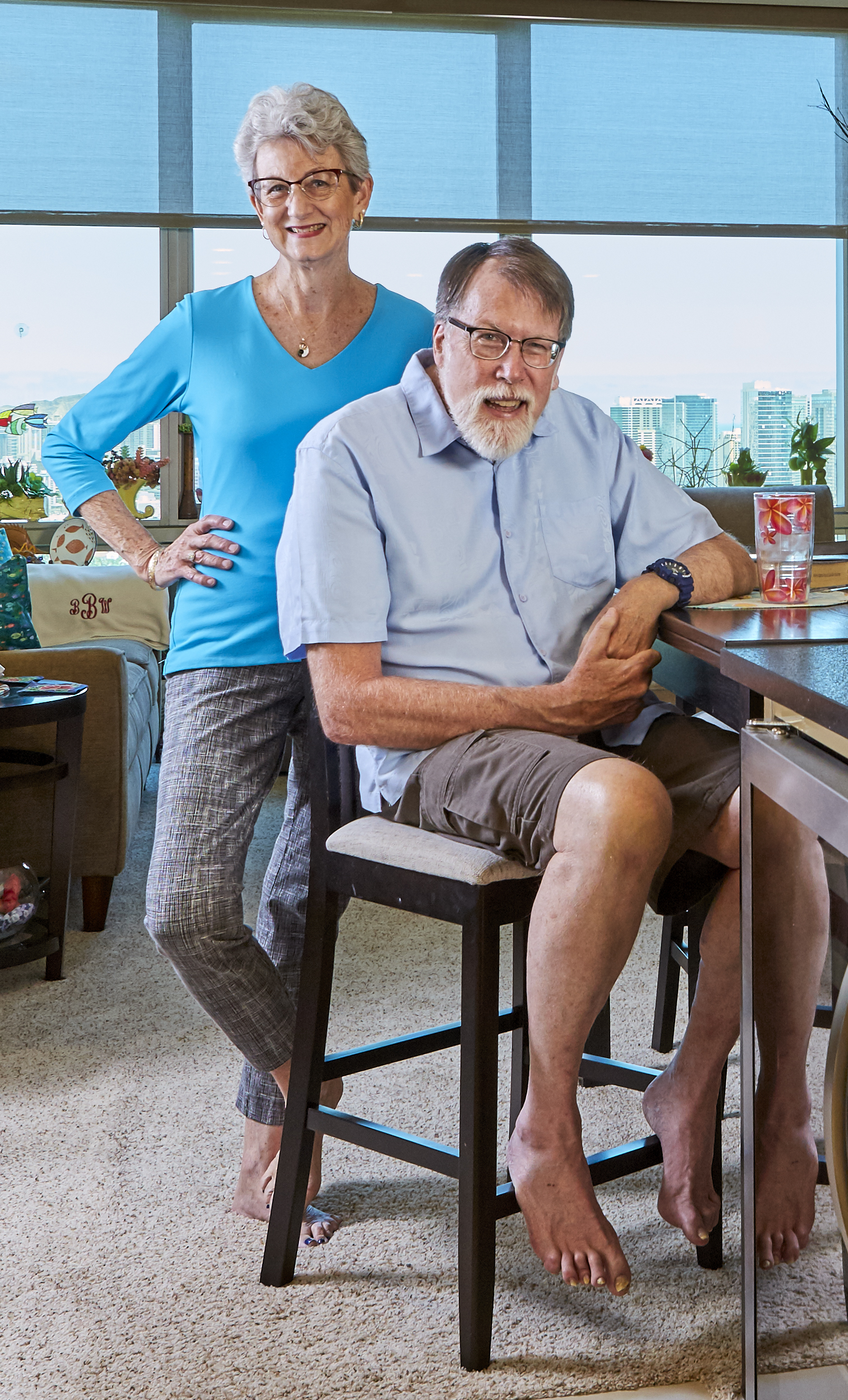
    Pat and Gardner Bemis

    I have a master’s degree in Nursing Education and I love teaching, and for 45 years I have enjoyed being a nurse. Strange, but caregiving is a bit different from nursing. It’s 24-hour duty that never ends and most of the time you are making decisions alone. Having nursing skills and medical background is a significant advantage, but managing and providing long-term care is harder.

    About eight years ago I experienced unusual fatigue. My thinking at the time was that I was “helping” my husband with chores, finances, driving, and medication management but he was doing his own personal care, so it wasn’t caregiving.

    One of my closest friends had to inform me that I was really a caregiver! I had eased into it without even knowing.

    How is your caregiving journey going?

    I care for my husband at home, and still enjoy being with my tall, handsome physician. The biggest challenge is doing all the thinking for another adult. He looks the same except for a bit slouched in posture and shuffling steps. But he has difficulty making choices and decisions and problem-solving, and it breaks my heart. His short-term memory loss is at times hard to deal with and causes me to ask God for more patience — almost on an hourly basis. However, he can still make correct diagnoses when watching medical shows on TV. The brain is a wonder that continues to baffle me.

    My husband and I worked together, so I was one of the first to know when he was diagnosed with Parkinson’s disease before age 40. He was young, handsome, brilliant, with lots of energy — a fun person to do fun things with. I was very optimistic about his prognosis, and saddened at the same time. He was an amazing doctor. We married, and he continued to work for 13 more years. We adopted a baby together to add to our blended family to make four daughters.

    Did you have any earlier caregiving experience?

    I also assist with the care of my mother on the East Coast. After my dad died in 2002, my mom fell into a funk. Previously assertive, energetic and self-assured, she became lost and didn’t know what to do with herself. My family relied on me to help with medical decisions and had I known the symptoms of dementia 15 years ago, I would have done many things differently for my mom. Her father had Alzheimer’s disease too.

    When her behavior started to change, I misread it as her being “a Pill.” Not knowing her brain was failing, I was impatient and argued with her. When what she was saying was not matching what she was doing, I began to mistrust her. It was a tough period for us both. I now realize she knew something wasn’t right but she didn’t know what it was. She was afraid to tell anyone and didn’t know what to do. It took much detective work to figure out that what she was telling her doctor and the truth were not the same. Her physician finally diagnosed her with Alzheimer’s three years ago. Had I known better, I would have gotten her care faster and been more compassionate. When I apologize to her, she says, “I have no idea what you are talking about — so there is no need to apologize.”

    Is it difficult being on a care team for a loved one who lives
    on the mainland?

    Yes. I am blessed to have two very supportive younger brothers who are helping. My family is on the East Coast and what I have experienced is that
    “everyone who cares can do something.”

    A sister-in-law and nieces picked up Mom’s wash weekly and drove her to outside appointments before she went into skilled care. Now, the great-grand kids visit Mom and share her activities, like coloring. My brothers have moved Mom’s belongings several times as she graduated to more intense levels of care. They set up her room the way she likes it. When they visit her, they “face time” with me so I can actually see how Mom looks. I have been the financial contributor as well as her health care proxy. My retirement savings ran out in 2016 and, last year, all her funds were gone and I had to apply for Medicaid for Mom. I am grateful that we have options, but it is very sobering to see your loved one outlive their financial resources.

    Pat, what would you have done differently?

    My biggest takeaway of caregiving is that I was not prepared. Yes, I had end-of-life discussions with my parents and my husband. But what about the time before the end of life? Both my parents and husband wish to be body donors. That is wonderful, but what about the years of “dependent living” required between now and your ending? I have learned that the journey can be long.

    I wish I had stayed employed longer. I miss having an income. For intellectual stimulation, I volunteer, go to yoga twice a week, belong to a sewing group and an art group. I would have gone bonkers long ago if it weren’t for my core group of girlfriends, “The YaYa’s.” They are the best support in the world, not only for me but also for my husband. My joy in life is our granddaughters, who bring unconditional love into our lives and home.

    While caring for her husband at home, Pat is also part of her mother’s care team along with her brothers. She regrets misinterpreting her mother’s early signs of dementia.

    Any words of wisdom for caregivers?

    My biggest concern is who will pay attention to me should I inherit Alzheimer’s. Who will know the difference between my rational and “not normal” behavior? Therefore, my No. 1 job is to take care of myself. If I do that well, then I can carry out my caregiving responsibilities well too. At the end of the day, I believe that I am doing the best I can for those I love and they truly do appreciate it.

    I suggest that all caregivers plan for their own future care. Get information from professionals and seek out resources. Last year, I visited almost all the assisted living facilities in Honolulu to see what they offered and if I would be comfortable there. I am proud that I tackled this eye-opening experience. I want to know what will be available for me and not wait for a crisis to figure out where I will live who will care for me. All I am learning will help me make good decisions.

    I also suggest getting involved with AARP. They opened my mind to a whole host of ideas, options and information. I am grateful to be a member.

    At the end of the day, I believe that I am doing the best I can for those I love and they truly do appreciate it.”

    Jody Mishan – Former Caregiver

    Jody Mishan

    I am the daughter of John and Maria Mishan. Without my parents, I wouldn’t be here, so I wish to honor that. Every caregiving journey is unique. Mine deepened the love my father and I shared, shaped my character.

    Tell us when that journey began and about your experience of caring for your father.

    I cared for my father after he was diagnosed with Alzheimer’s disease from 1999 until his death in late 2006. My father was not defined by dementia, but by a lifetime commitment to family and career. Dad served as a Navy aviator in World War II in the Mediterranean Circle, flying reconnaissance missions on the coast of Africa. He received the Distinguished Flying Cross for his service. Caring for my father was the best and most important thing I will ever do in my life. I witnessed the true hero that he was, remaining a gentleman and expressing love and grace until the end. Caregiving was a gift and a blessing that changed my life.

    Discovering the lack of resources available, I started to advocate for improvements in caregiver support. During this time I served as public awareness coordinator for Kōkua Mau: Hawai‘i Hospice & Palliative Care Organization. They truly understood my caregiving journey.

    Assisting a vulnerable loved one strengthens your compassion, courage, strength, commitment, loyalty and patience. Caregivers of family members with dementia ride a roller coaster of anger, depression, stress and exhaustion; I learned that compassion is stronger than negative emotions, and patience is a muscle that can be strengthened. Like characters in “The Wizard of Oz,” we don’t know our courage until tested. Our brains and hearts will rise to the occasion.

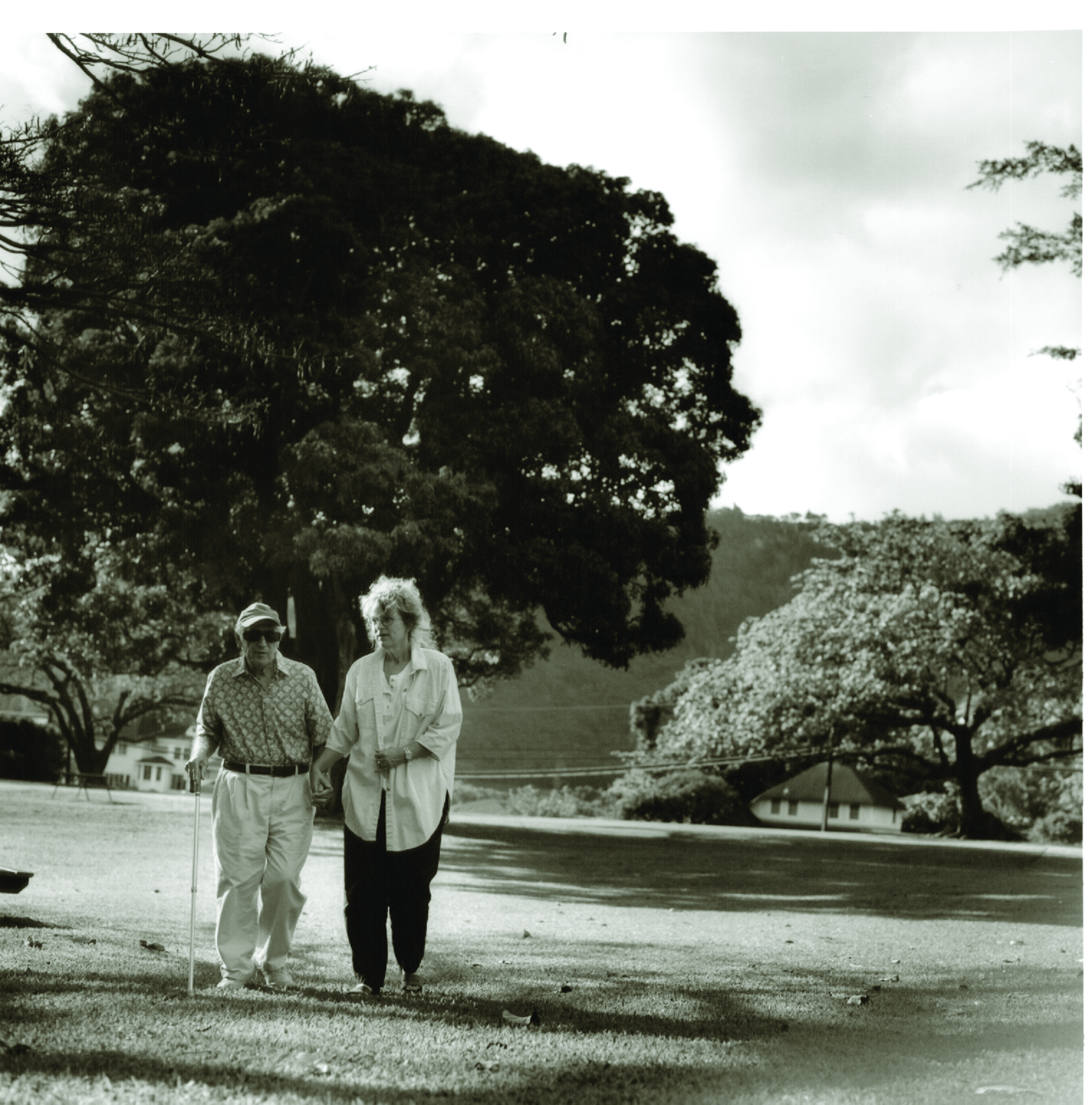
    Jody’s father, a Navy aviator in WWII, loved being out in the fresh air, so she incorporated walks in Manoa’s beautiful neighborhood parks into his care routine early on.

    Can you share some details of your caregiving?

    Early on, Dad was diagnosed with a mix of Alzheimer’s disease and Lewy body dementia, which explained the stiffness he experienced as it progressed. We made the best of the gradual loss of physical and mental ability, developed a good sense of humor, learning to “not sweat the small stuff.” We validated him, made him feel loved and treasured, giving him “moments of joy”— important pillars of dementia care.

    In those early stages, Dad enjoyed going places in the car and taking walks in Mānoa where we lived. For the last three years, he was unable to move on his own, in need of total physical care. We were able to afford professional caregivers in the daytime, but I was alone with him at night, setting my alarm to get up to turn him in bed and change him if needed. Sometimes I had day shifts too.

    Do you have any tips for new caregivers?

    I noted things that worked or did not work on my dementia caregiver’s journey.

    • Seek resources, help, support, anywhere you can get it. It takes patience and time to identify people and services that actually make a difference.
    • Be proactive: read books, search online. Join a support group and seek dementia caregiver training.
    • Practice self-care in your own personal way —
      meditation, visualization or exercise. Find anything that brings you joy, even if it’s just 15 minutes with a friend or walking.
    • If your loved one has memory loss, see a geriatrician or neurologist for an assessment. About 9 percent of conditions causing memory loss can be reversed. An early, accurate diagnosis is essential.
    • If they are able, take your loved one for walks or shopping to help them remain a part of the community as long as possible.
    Photograph by John DeMello

    How did you deal with caregiver burnout?

    Praying for strength and guidance became a regular habit. I also bonded with other dementia caregivers at an Alzheimer’s Assoc. support group for poetry and journaling led by Frances Kakugawa.

    Regularly talking about my feelings with a counselor made a huge difference! I also found compassion, support and understanding from co-workers at Kōkua Mau. The beautiful love that Dad and I shared gave me strength. It made me happy to see him content and smiling, safe and comfortable.

    Any regrets or mistakes?

    There were times I lost my temper, which is normal for dementia caregivers. I found myself cussing in traffic, getting irritated when he was not treated well in hospital or rehab. It surprised me that I could get so outspoken and not care what others think. But I was fighting for him and his rights, so it made me ornery. My lack of sleep did not help.

    Were there any residual effects?

    This is a critical question! It takes years to recover from the caregiving burnout, to grieve and process the experience. You have to train yourself not to be vigilant anymore, to sleep through the night, to put yourself first and find joy again. It’s like PTSD in many ways. There should be support groups or counseling for recovering caregivers.

    Before becoming a caregiver, I was an audiovisual writer/producer. After his passing, I wrote/produced “The Genius of Aging” public awareness campaign for KGMB TV. I was a coordinator for the first State Plan on Alzheimer’s Disease and Related Dementia for the Executive Office on Aging. Now, I am a consultant for UH Center on Aging’s Hawai‘i Alzheimer’s Disease Initiative.

    So caregiving for Dad set me on a new career path working on dementia projects with fantastic healthcare visionaries, service providers, aging advocates and educators. Dementia caregivers are now my tribe — people who really care.

    What caregiver resources do you recommend?

    Explore the Alzheimer’s Association classes and services. Attend Positive Approach® to Dementia Care workshops. Locate a Memory Care Navigator on this UH website:.

    Poetry and journaling are one of the most essential and effective healing activities I discovered on my journey. Visit Frances Kakugawa’s blog.

    You have to train yourself not to be vigilant anymore, to sleep through the night, to put yourself first and find joy again. It’s like PTSD in many ways.”

    Carleen MacKay – – Future Care Recipient

    Carleen MacKay

    I was a VP for human resources for high-tech Silicon Valley employees who were making over $100k annually and losing their jobs. In the industry, it is called “out-placement,” a process by which companies assist laid-off employees find new employment. My book, Alternative Ways to Work, helps people manage career change, re-imagine their skills, and stay relevant. Another of my 35 books that seniors love is The Hundred Year Life: juxtapose imagination and facts. I write about what I do best — embrace the future with joy and gusto. To be honest, I have never considered slowing down by choice or by need. But Percy Ihara tells me that 70 percent of people will require some long-term care at the end of life. Yikes! I need to start planning!

    You’re so active at 80; do you visualize yourself in long-term care?

    So far, I can take care of myself — always have. Long-term care doesn’t sound like too much fun. But I am going to look into local care facilities and options to see what I might be able to afford.

    Do you have children?

    Yes. I was a single parent, and all three of my children have college educations — two own their own businesses. I live in an ‘ohana unit in one son’s home, and when I told him about this interview, he said, “Oh don’t worry. We’ll take care of you.” But my kids have done less planning ahead than I have. I do not expect them to bear the whole burden of my end-of-life care — either financially, emotionally or physically. I read that injuries due to falls often end independent living and break your bones and spirit. I need to call my local Aging and Disability Resource Center and get a free fall prevention assessment of my apartment right away.

    Can you see yourself in the cycle of caregiving?

    Sure do. I cared for my mother in her home when she came to the end of her life. I was a businessperson, so I hired a maid for cleaning and later found a care facility where my mother could be treated, cared for and offered socialization with other seniors. However, I never provided hands-on care, and I don’t expect my kids to do that either. I like to work, be involved socially and do fun kinds of exercise to keep healthy. However, time — as it does for one and all — is beginning
    to overtake me.

    Carleen MacKay at home

    Time is a big issue. Healthy seniors fear they will outlive savings and retirement income.

    Yes; I am proud that I lived prudently in my early years and that I still bring in a little income. But I’ll be honest; my vision is to “die in the saddle,” writing books and giving lectures on the road. I want to keep active late in life, but I just learned that people over 70 could expect to outlive their body’s ability to perform the tasks of daily living, and the odds against dying in the saddle are very high. In case I die long, I don’t know if my savings will be adequate. I need a Plan B that addresses other options to pay for the kind of care I want. My children need to know what my wishes are, too.

    Some of our readers haven’t done much planning either. What’s your next step?

    Well, I am just getting into Generations Magazine resources, which are chock full of useful information for aging in place and end-of-life planning. I’m going to get educated and educate my family as soon as possible. I just found out that I am too old to buy long-term care insurance, so I already missed out on one financial option. I also learned that Medicare does not have long-term care benefits, so paying for care is my primary concern.

    I think your readers should share this article with all their neighbors, family and friends who plan to work till they drop. Tell them not to wait until 80 to draw up a Plan B. We seniors who work are experts at what we do — and we also have to be experts in planning for long-term care the end of our lives. Better late than never!

    I want to keep active late in life, but I just learned that people over 70 could expect to outlive their body’s ability to perform the tasks of daily living.”


    Jody, Pat, Lori and Carleen are at different points on the cycle of caregiving. Where are you? What did you learn from their experiences and tips?

    Rosalynn Carter and the original members of Last Acts started a significant movement, and they would be surprised to see professionals in geriatrics, long-term care, homecare, financial planning, reverse mortgages, hospice and adult day care and strategies for aging in place struggling to keep up with demand for their services. The number of people over 80, cost of care and waiting lists are all growing. The fact is, family caregivers still provide most eldercare.

    The common threads in our four caregiving stories are that long-term care is a team effort that requires careful planning. Generations Magazine resources offer many professional options for care. Talking with your family and other families on the cycle of caregiving will help you find the best plan for you.

    Former first lady Rosalynn was a caregiver herself and she believed that family caregiving is a cycle of life that touches everyone. Here, four people, each at a different point on the cycle, share their care stories from the heart, offering words of wisdom and points of caution. As you read, consider your journey on…

  • Go For Broke

    Go For Broke

    As morning dawned on December 5, 1941, a fisherman cast his net along O‘ahu’s north shore. A college student helped his father open a new business. A volunteer took kids to the beach in Waimānalo. Two University of Hawai‘i students, watching soldiers running drills nearby, talked about war preparations while they checked out the surf. It was pretty much like most other days, for most people.

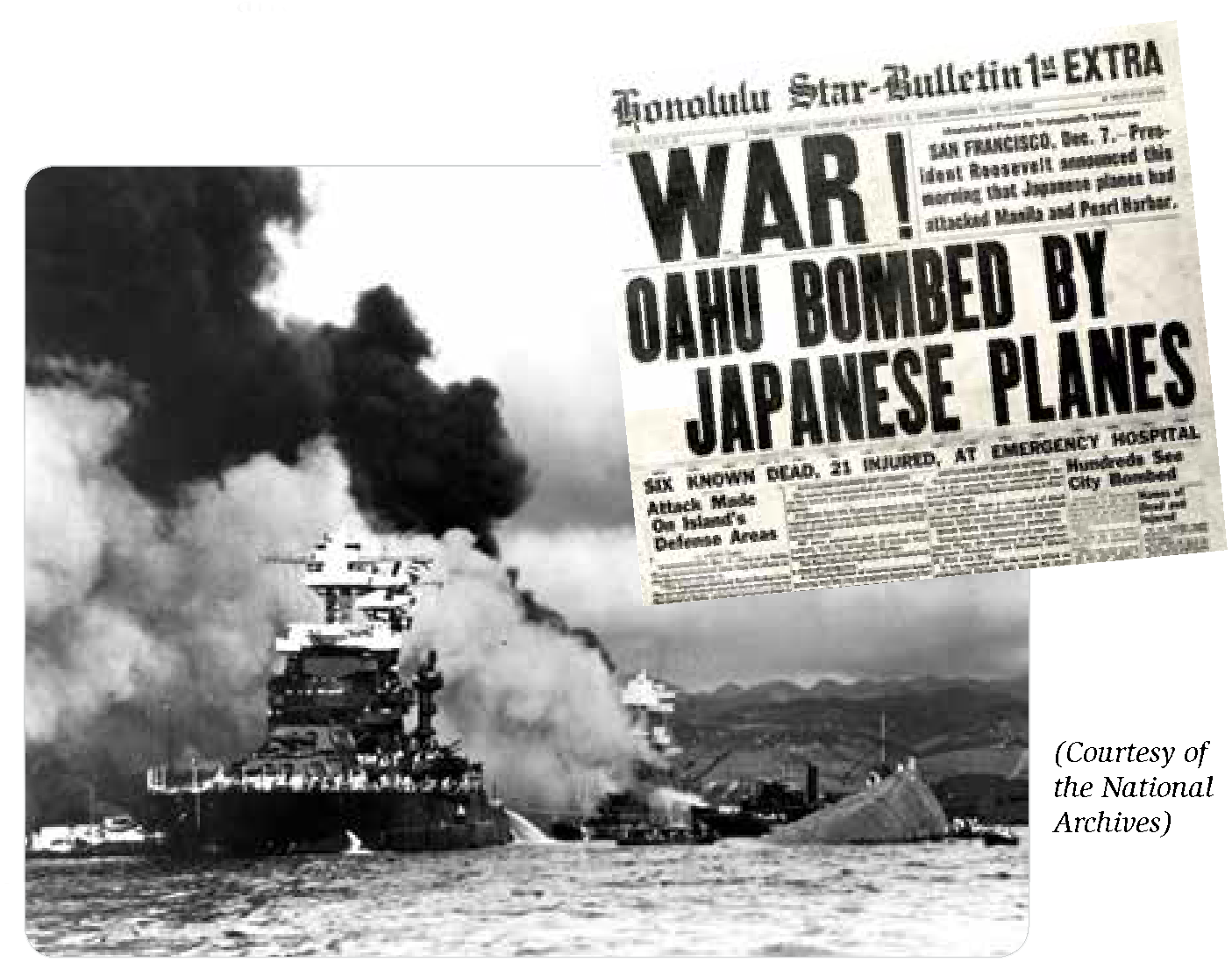
    But Sunday, December 7, 1941, would become known as “a date which will live in infamy” and President Franklin D. Roosevelt would announce to the nation the next day that, early on Sunday morning, “the United States of America was suddenly and deliberately attacked by naval and air forces of the Empire of Japan.”

    The impact of that attack led to events that would change the life of every person in the U.S.— especially those living in Hawai‘i — and especially those of Japanese descent.

    The bombs that dropped on Pearl Harbor exposed fears, suspicions, and distrust toward Japanese immigrants (issei) and their American-born children (nisei).

    The days leading up to December 7 were idyllic for many, including Japanese American youth, most of whom had never been to Japan and whose patriotism for America ran deep.

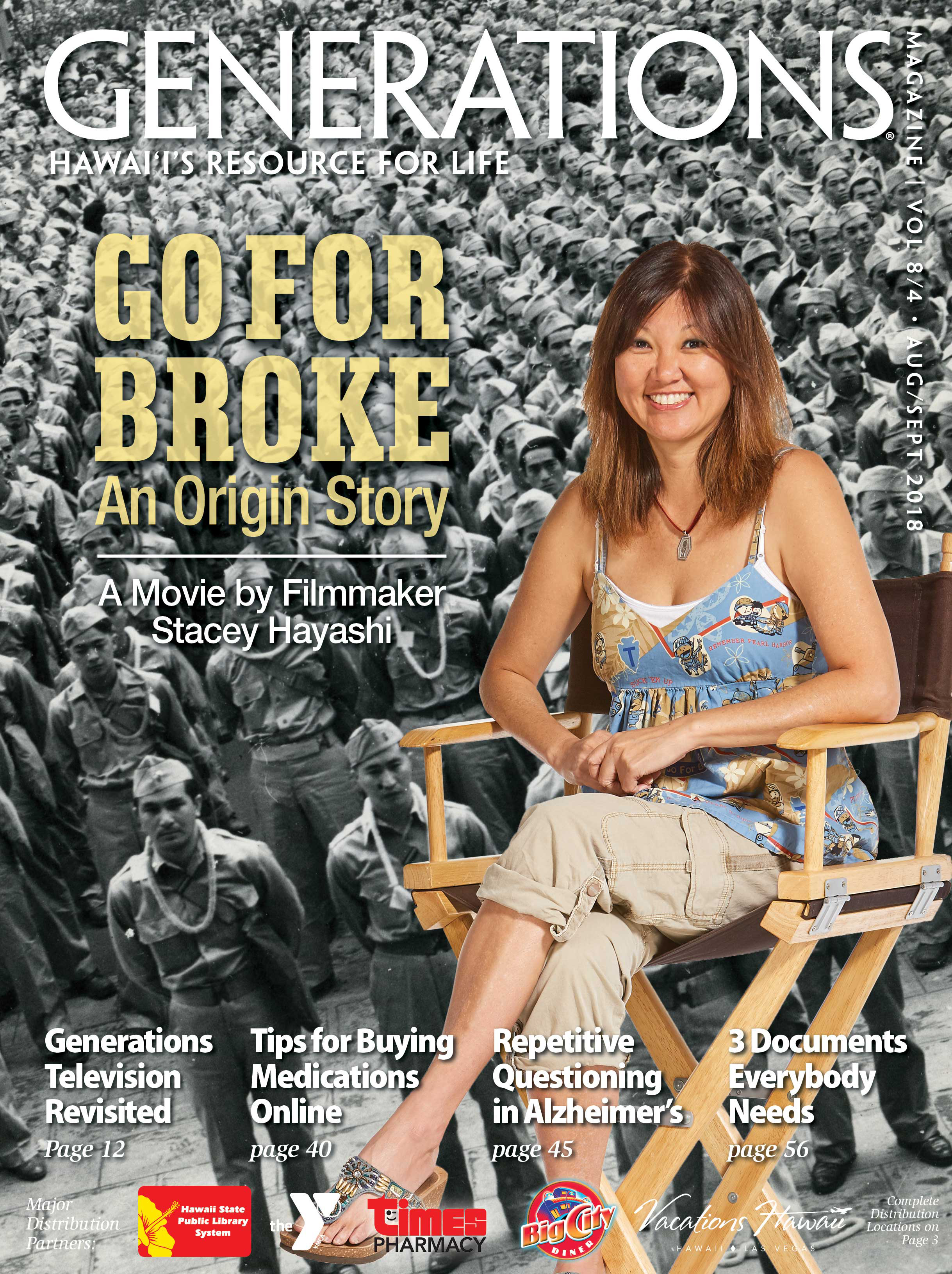
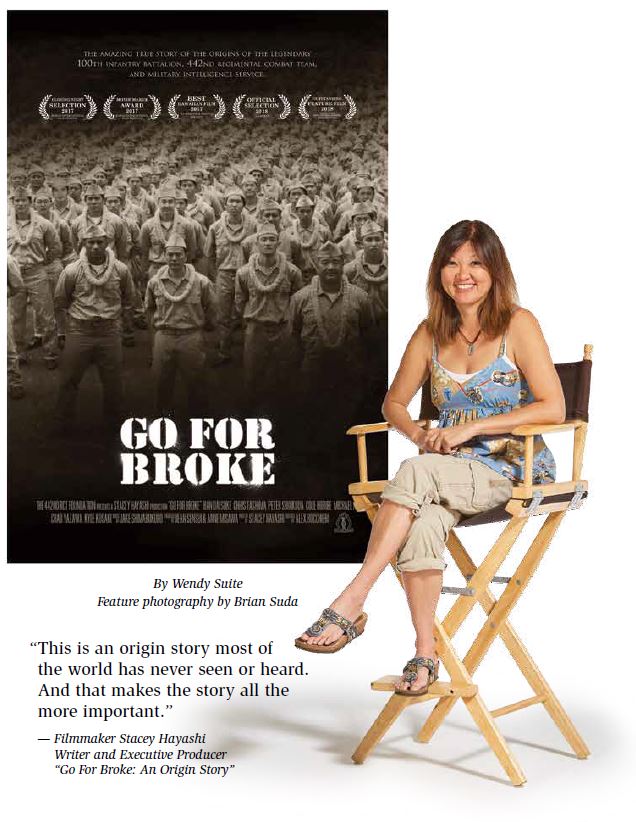
    It’s against this backdrop that a new, locally produced film, “Go For Broke: An Origin Story”—written and produced by Stacey Hayashi — tells the true story of the origins of the all-Japanese American military units: the 100th Infantry
    Battalion, 442nd Regimental Combat Team, and Military Intelligence Service (MIS) during World War II.

    A bow-on view of the lightly damaged battleship USS Maryland with the burning USS West Virginia behind her and the capsized USS Oklahoma beside her, Pearl Harbor, US Territory of Hawaii, 7 Dec 1941.
    A bow-on view of the lightly damaged battleship USS Maryland with the burning USS West Virginia behind her and the capsized USS Oklahoma beside her, Pearl Harbor, US Territory of Hawaii, 7 Dec 1941.

    True, untold stories

    Like today, most people of Japanese descent born in Hawai‘i in the early 1900s felt fully American. It was the only country they knew.

    Why, then, did Japanese Americans feel a need to prove their loyalty to their country?

    Why did the 442nd adopt the motto: “Go For Broke,” meaning ‘risk it all’ or ‘shoot the works’?

    What compelled them to show such selfless courage on the battlefield that theirs would become the most decorated combat unit for its size and length of service in American history?

    The answers to these questions can be found in the untold stories of these humble, loyal, and in many ways, ordinary Americans whose actions proved their loyalty to their country.

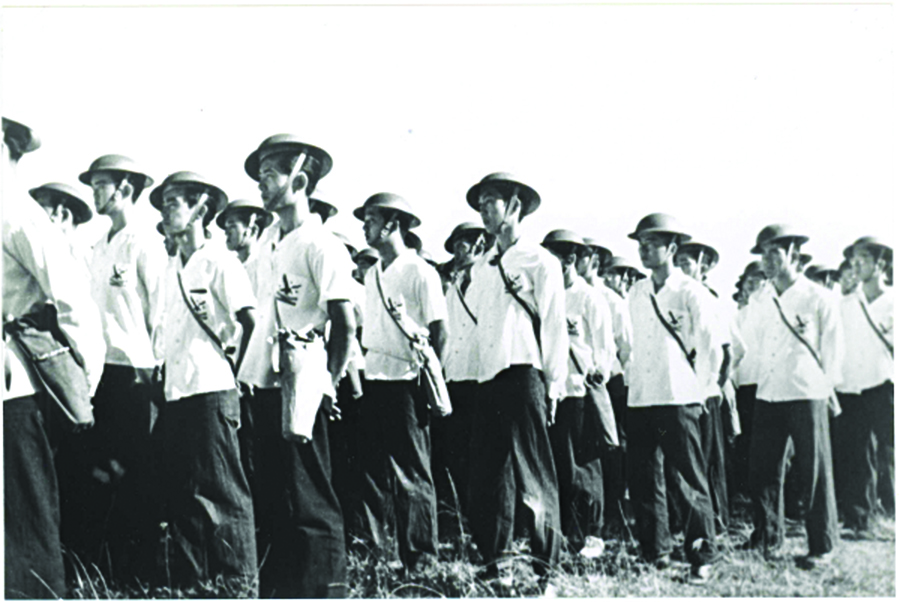
    Above: Varsity Victory Volunteers at work building field ice boxes in Hawai‘i. Below: VVV assembled in formal dress with gas masks. Identifiable men are Harry Sato, Yoshiyuki Hirano, Yasuhiro Fujita, James Okuda, David Fujita, Thomas Shintani, Masato Yoshimasu, Minoru Ikehara, and James Oka. [Courtesy of Ted Tsukiyama]
    Above: Varsity Victory Volunteers at work building field ice boxes in Hawai‘i. Below: VVV assembled in formal dress with gas masks. Identifiable men are Harry Sato, Yoshiyuki Hirano, Yasuhiro Fujita, James Okuda, David Fujita, Thomas Shintani, Masato Yoshimasu, Minoru Ikehara, and James Oka. [Courtesy of Ted Tsukiyama]

    The fight to fight

    The first of these untold stories was the fight for the right to fight for their country. Before the nisei soldiers could display extraordinary valor against the Nazis in Europe, they faced tremendous adversity on the home front.

    Few people were aware then, or even now, that 4,000 Japanese Americans were already serving in the U.S. armed forces at the time of the attack on Pearl Harbor, most of whom were in Hawai‘i, serving draft time.

    Soon after the Japanese attack, Americans of Japanese Ancestry (AJAs) were reclassified 4-C: “enemy aliens,” ineligible to serve in the U.S. military — despite being U.S. citizens. AJAs already in the military were discharged and stripped of their weapons, simply because of their race.

    Other AJAs, who wanted nothing more than to fight for the country of their birth, were denied that opportunity, simply because of their race.

    Few people are aware that the 442nd Regimental Combat Team wasn’t organized until more than a year after the start of the war—a critical period of time when Japanese in America faced racism, discrimination, arrests by the FBI, and mass incarceration on the U.S. West Coast. Even fewer people are aware of the circumstances and actions which led to its formation—stories which form the heart of the movie “Go For Broke: An Origin Story.”

    On December 7, members of the university ROTC were activated into service as the Hawai‘i Territorial Guard (HTG). They were assigned to protect ‘Iolani Palace, other government buildings, and utility and military installations — proud to serve their country and trusted to repel the impending invasion. But then the soldiers became highly discouraged when their own government called them: enemy aliens.

    That’s when a little-known hero stepped into the story. A community leader and Executive Secretary of the Atherton YMCA, Hung Wai Ching empathized with the dejected college students and listened as they said they wanted to prove their loyalty to their country by fighting for it.

    Ching encouraged them to volunteer their service as non-combat civilian laborers.

    “If they don’t trust you with a gun, maybe they’ll trust you with a pick and shovel,” he said. And so began nearly a year of service for 169 university students, assisting the war effort in a military labor battalion. The former university ROTC students called themselves the Varsity Victory Volunteers (the VVV, or Triple V), and they built roads and buildings, and broke rocks — armed, not with rifles, but with picks and shovels, hammers and saws, crowbars, and sledgehammers.

    In June 1942, the AJA soldiers of the 298th and 299th Infantry were segregated into the Hawai‘i Provisional Battalion, and sent out of Hawai‘i to basic training in secret. They became the 100th Infantry Battalion (Separate), an orphan unit which no one wanted, at first. But their record-breaking performance in basic training proved that AJAs would be outstanding American soldiers.

    Meanwhile, at home in Hawai‘i, the dedicated and loyal VVV impressed military officials, which helped change the minds of military and political leaders — paving the way for the formation of an all-Japanese-American unit: the 442nd RCT.

    The legendary 442nd RCT

    In February 1943, the War Department called for 1,500 AJA recruits for the 442nd. Because of their role in effecting the creation of the 442, members of the VVV were the first to hear the news and they voted to disband so they could join the unit.

    On the U.S. mainland, 1,208 recruits volunteered from inside concentration camps, where their families would remain incarcerated by President Roosevelt’s Executive Order 9066.

    In Hawai‘i, almost 10,000 volunteered. And on March 28, 1943, 2,686 members of the newly-formed 442nd Regimental Combat Team marched down King Street, lined up at ‘Iolani Palace, and then headed off to basic training on the U.S. mainland and onward to European battlefields.

    In just two years of combat, 14,000 men served in the 442nd, with a well-documented record of bravery that is unequaled to this day.
    Much less is known about the vital roles and great danger faced by thousands of nisei linguists who served in the Military Intelligence Service (MIS). Their work as interpreters, interrogators, and translators was strictly classified during the war and for decades beyond.

    A record of heroism and sacrifice

    The 100th/442nd RCT is the most highly decorated unit in U.S. military history for its size and time in combat. Its 18,143 individual and unit decorations include: 9,486 Purple Hearts, eight Presidential Unit Citations, 21 Medals of Honor, 33 Distinguished Service Crosses, one Distinguished Service Medal, 559 Silver Stars, 22 Legion of Merit Medals, 4,000 Bronze Stars, 15 Soldier’s Medals, 12 French Croix de Guerre, two Italian Medals for Military Valor, and a great many more.

    In 2010, the Congressional Gold Medal was awarded to members of the 100th/442nd and MIS. And surviving 442nd members have been honored with France’s highest and oldest award, created by Napoleon himself: “Chevalier dans l’Ordre National de la Légion d’Honneur” (Knight in the National Order of the French Legion of Honor) for their key participation in the liberation of France during WWII.

    On July 15, 1946, President Harry S. Truman welcomed members of the 442nd to the White House. Acknowledging the challenges they faced at home and abroad, he said: “You fought not only the enemy but you fought prejudice, and you have won.”

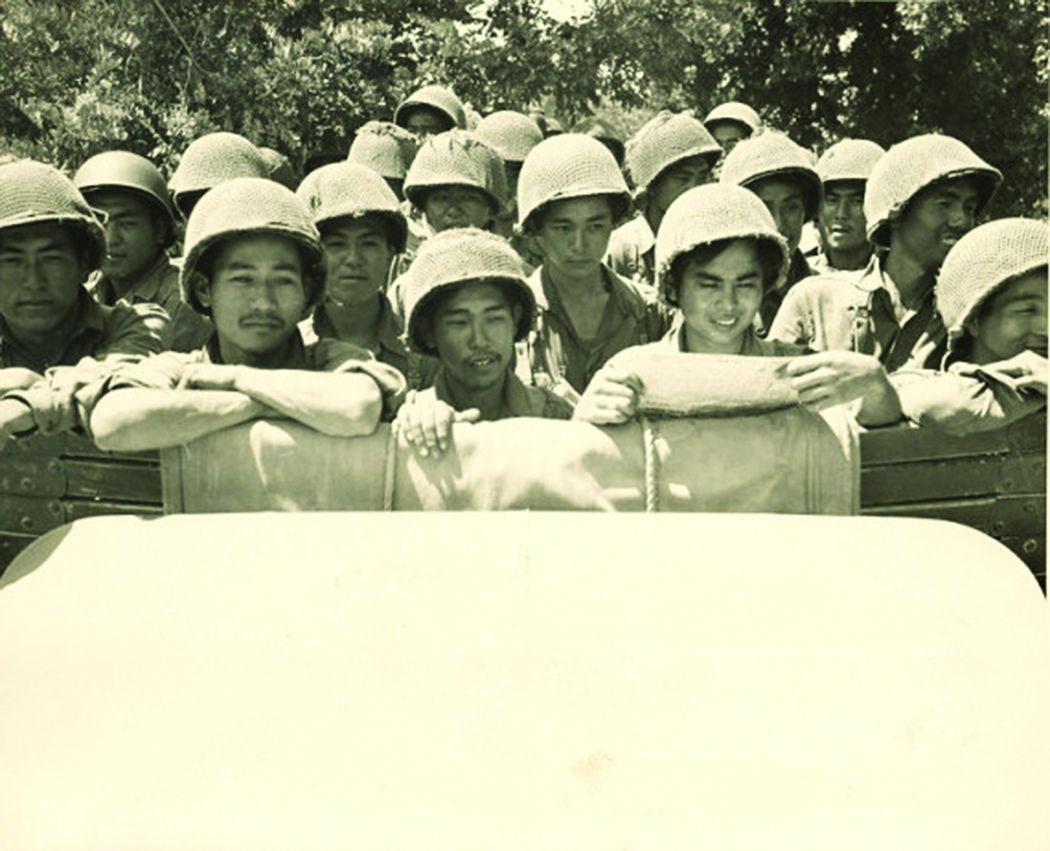
    Top: Japanese-American troops of 100th / 442nd Regimental Combat Team leaving for regimental reserve after 16 days of fighting, Castellina Sector, near Livorno, Italy, July 1944. Center: Japanese-American soldiers of the U.S. 100th Infantry Battalion marching in the Valletri area of Italy, May 1944. Above: Nisei linguists S. Phil Ishio and Arthur K. Ushiro helped interrogate a Japanese prisoner in Papua New Guinea, 1943. (Photos courtesy of the National Archives)
    Top: Japanese-American troops of 100th / 442nd Regimental Combat Team leaving for regimental reserve after 16 days of fighting, Castellina Sector, near Livorno, Italy, July 1944. Center: Japanese-American soldiers of the U.S. 100th Infantry Battalion marching in the Valletri area of Italy, May 1944. Above: Nisei linguists S. Phil Ishio and Arthur K. Ushiro helped interrogate a Japanese prisoner in Papua New Guinea, 1943. (Photos courtesy of the National Archives)

    A local girl needing to tell a local story

    “The untold story is the adversity these young men faced, the character they showed, for the 442 to be created in the first place.”
    Stacey Hayashi

    It’s taken local girl Stacey Hayashi more than 15 years to bring this story of the 100th/442nd and MIS to the big screen. Her dream — to perpetuate stories like this for today’s youth and for future generations — took perseverance and sacrifice, like that of the veterans she passionately honors with this film.

    To make her dream come true, the software engineer had to become a filmmaker. She had to become a fundraiser. She had to gather resources, conduct interviews, and write the screenplay. There was a lot to learn. But the resourceful serial entrepreneur, writer, and designer was determined that somehow, the stories of veterans who became her dear friends and family would be told.

    “People know about the 100th/442 and the bravery they showed, fighting the enemy in Europe, liberating towns in Italy and France,” she said. “But most people don’t know what had to happen for the 100th or 442nd to even be formed,” she added, referring to the racial discrimination faced by Japanese in Hawai‘i and the U.S. West Coast before and after December 7.

    Stacey believes that “films can be powerful tools in bringing stories to light and keeping them alive, as well as a source of healing.”

    “Sharing stories or seeing them told can be cathartic for survivors. Hopefully, it will also open up dialogue between survivors and their families,” she said. “Though we couldn’t tell every story, I tried to include as many as we could. I hoped to capture the spirit of who they were and are, their happy-go-lucky attitudes and kolohe natures, even in the face of such great adversity.”

    She wished all her veteran friends would see the film and know that they were remembered and appreciated. Sadly, Assoc. Producer Eddie Yamasaki of the 442nd RCT I Company, who helped champion the movie for 15 years, died a few months before its release. Also, Congressman K. Mark Takai, a steadfast advocate, succumbed to cancer in 2016. The film is dedicated to his memory.

    Akira Otani (portrayed by Chad Yazawa) watched as the FBI arrested his father at gunpoint. Yet, he was among the very first to volunteer for the 442nd RCT.
    Akira Otani (portrayed by Chad Yazawa) watched as the FBI arrested his father at gunpoint. Yet, he was among the very first to volunteer for the 442nd RCT.
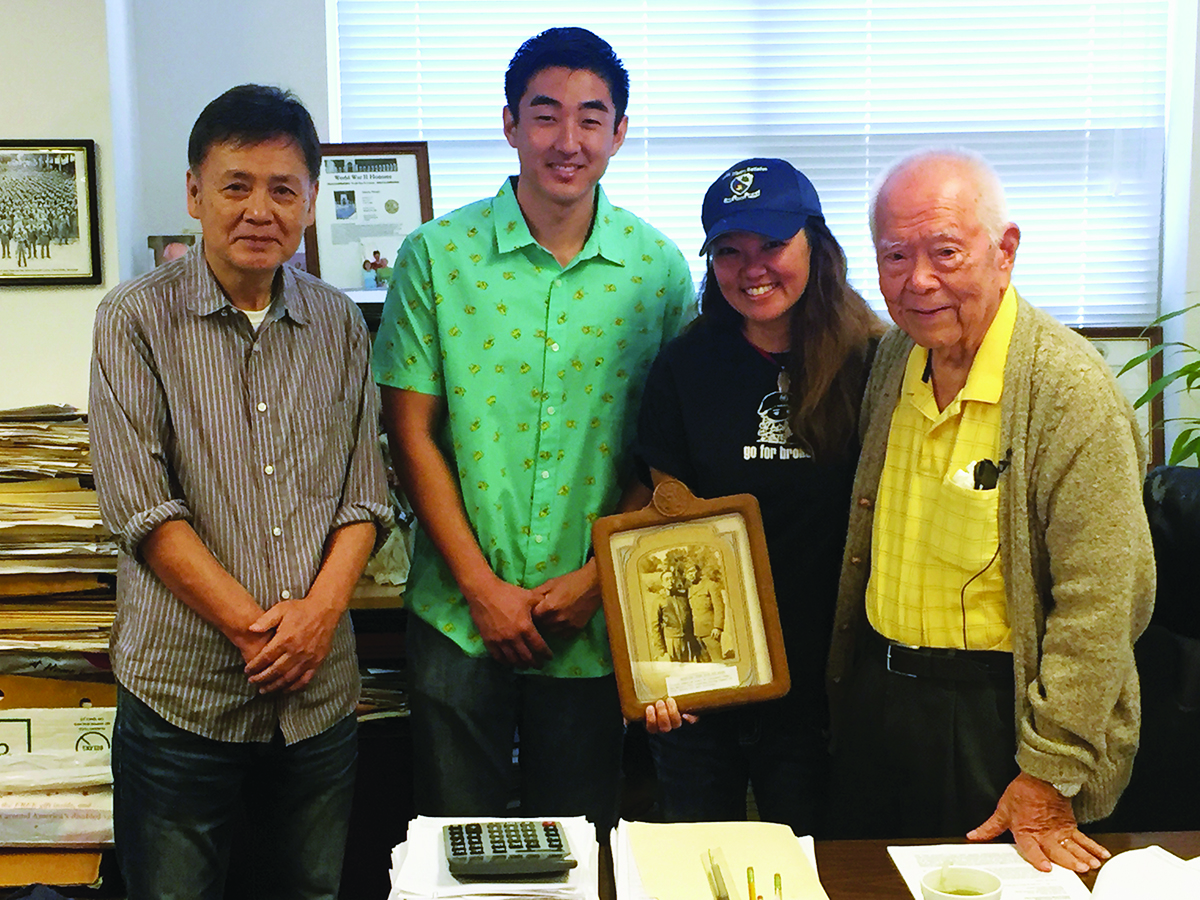
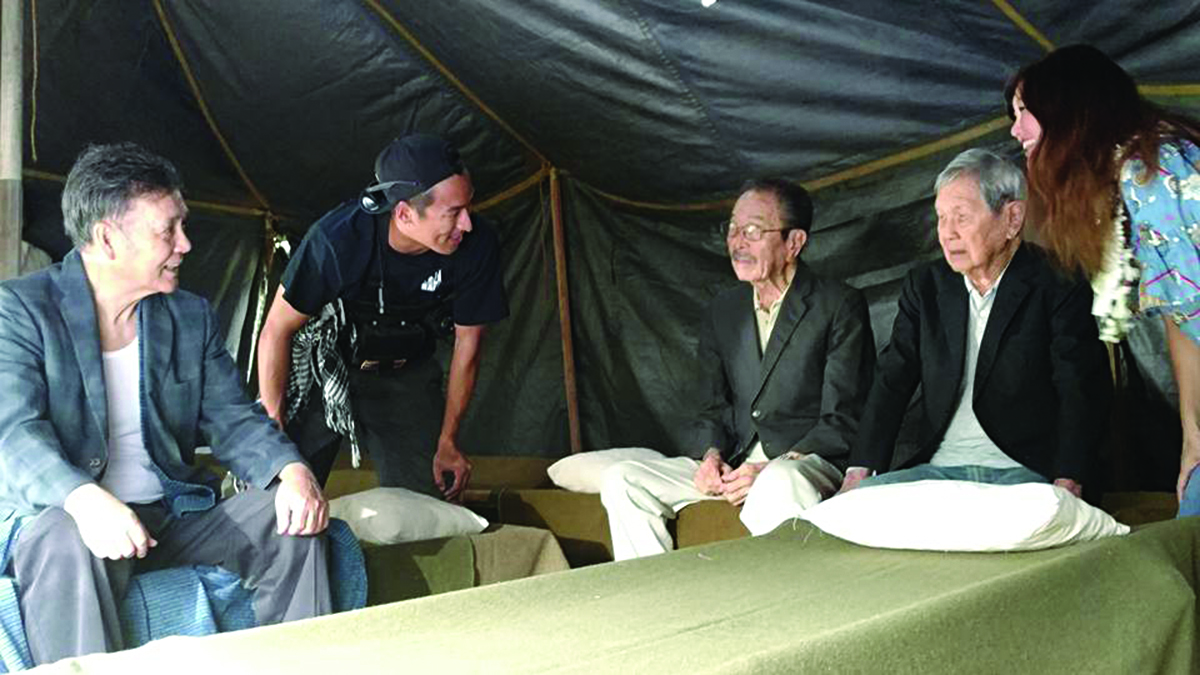
    Akira Otani, real-life 442 veteran (right) met Chad Yazawa, the actor who portrayed him (green shirt) and Ban Daisuke, who portrayed his father (left).
    Akira Otani, real-life 442 veteran (right) met Chad Yazawa, the actor who portrayed him (green shirt) and Ban Daisuke, who portrayed his father (left).
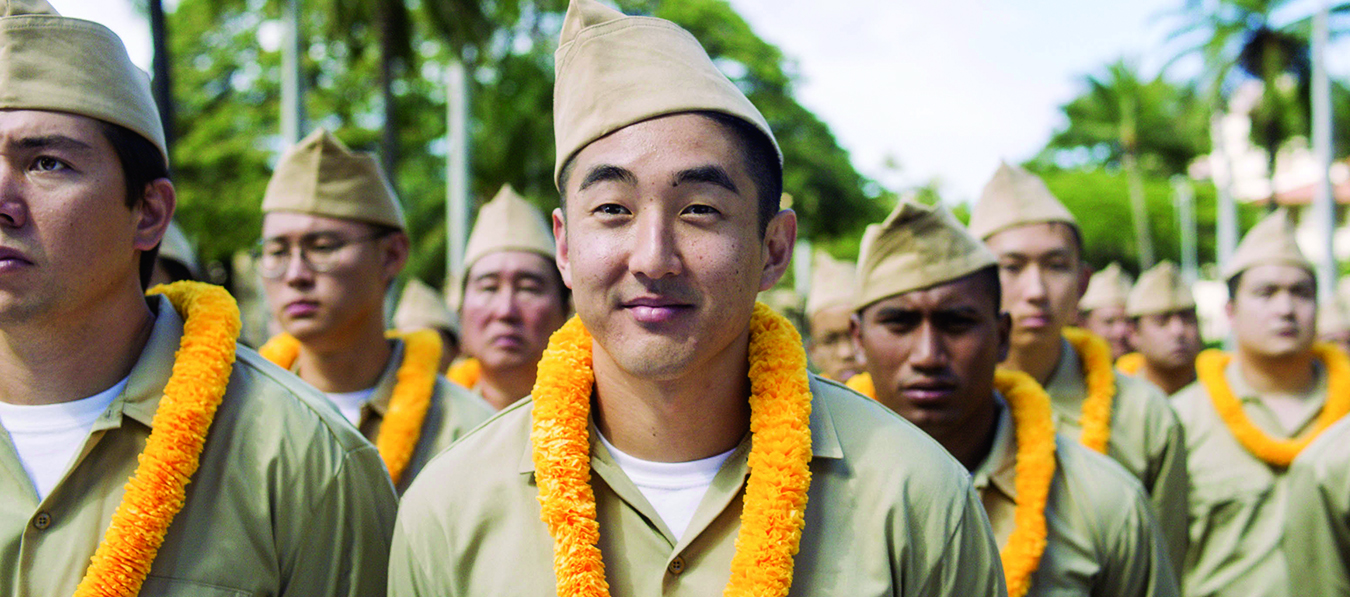
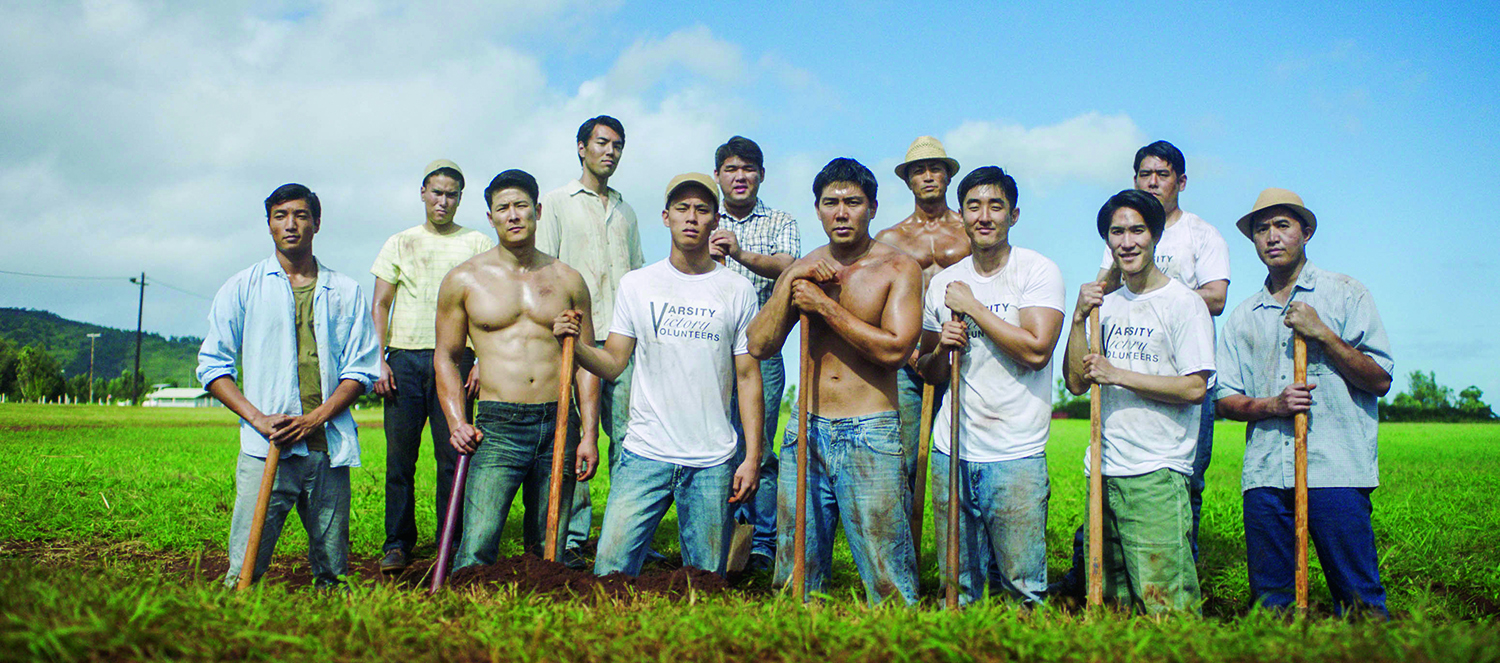
    Many scenes were filmed at the actual locations where the real events took place. Here, the Varsity Victory Volunteers (VVV) stand with picks and shovels.
    Many scenes were filmed at the actual locations where the real events took place. Here, the Varsity Victory Volunteers (VVV) stand with picks and shovels.
    The assistant director and executive producer chatted with veteran actor Ban Daisuke and real-life veterans, Yoshiaki “Sharkey” Fujitani and Ted Tsukiyama.
    The assistant director and executive producer chatted with veteran actor Ban Daisuke and real-life veterans, Yoshiaki “Sharkey” Fujitani and Ted Tsukiyama.

    Journey of Heroes

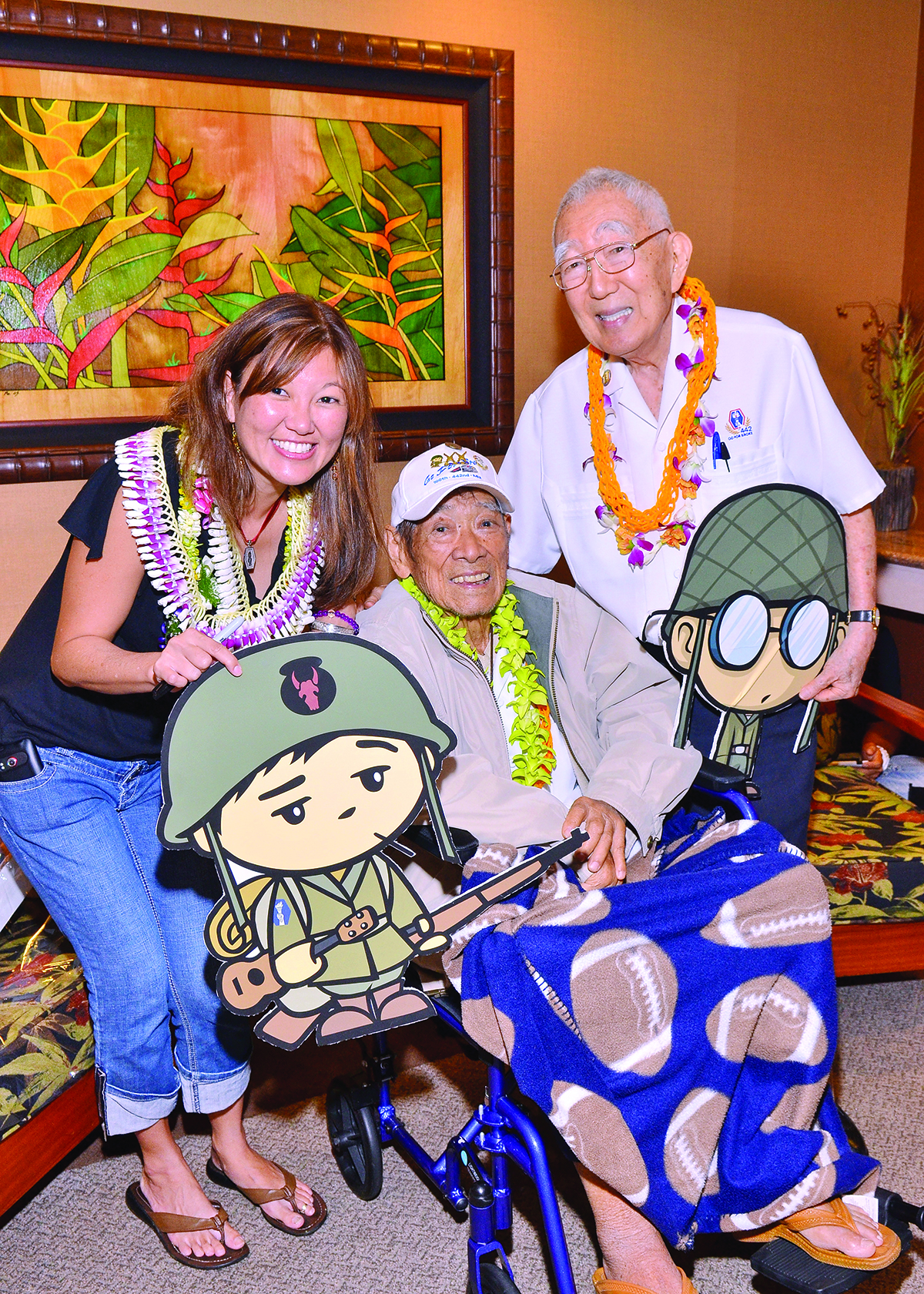
    Stacey didn’t just become a filmmaker in her quest to share what she calls “the inspiring true story you’ve never heard, about heroes you didn’t know existed.” She also became a rising star in the world of comic books and Japanese anime and manga, writing and self-publishing a comic book, “Journey of Heroes: The Story of the 100th Infantry Battalion and 442nd Regimental Combat Team.” The historically accurate graphic novel, illustrated by Damon Wong, features cute characters that look a lot like the veterans they represent.

    Thousands of the comic books have been donated to schools across Hawai‘i and the United States, introducing real-life heroes and perpetuating their stories for today’s youth and generations to come.

    The great legacy of the greatest generation

    Almost all of our WWII veterans are gone now, including Stacey’s great-uncles who served in the original 100th Battalion and the 442.
    And through this film, Stacey is doing her part to keep alive the great legacy of the nisei veterans — a small part of the greatest generation.

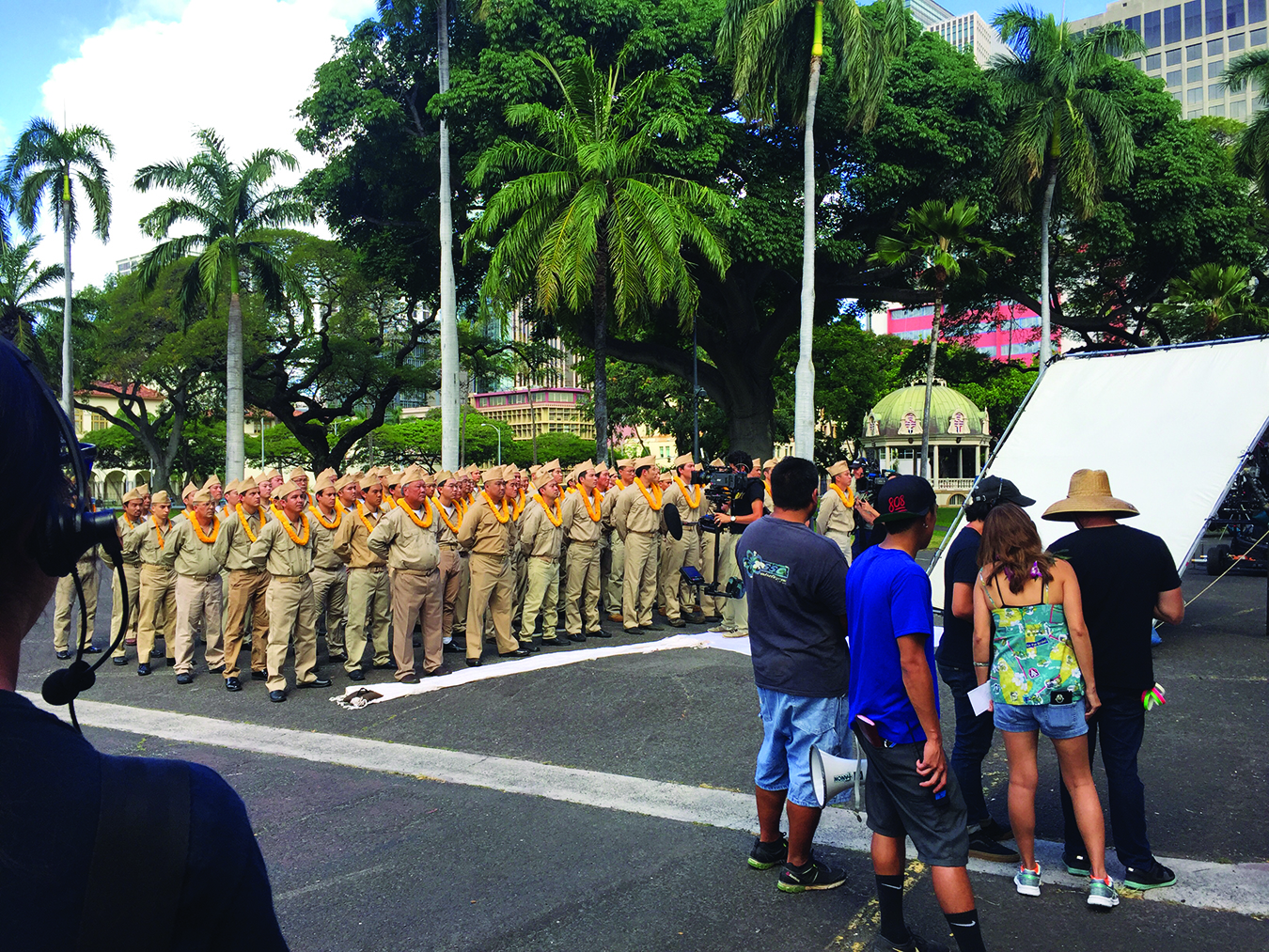
    Director Alexander Bocchieri and producer Dean Sensui combined meticulous planning and creative shotmaking to portray King Street, circa 1943.
    Director Alexander Bocchieri and producer Dean Sensui combined meticulous planning and creative shotmaking to portray King Street, circa 1943.
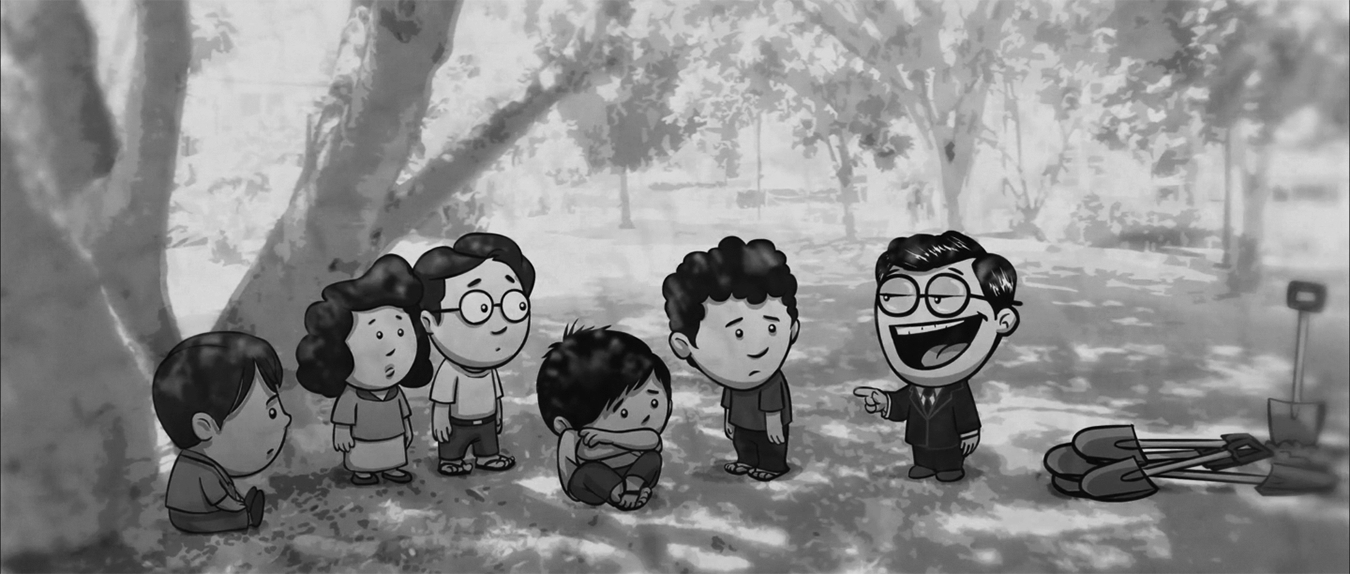
    More than just a comic book —“Journey of Heroes” combines historically accurate text and Japanese manga-style drawings that appeal to readers of all ages.
    More than just a comic book —“Journey of Heroes” combines historically accurate text and Japanese manga-style drawings that appeal to readers of all ages.
    Stacey Hayashi and Rep. K. Mark Takai flank MIS linguist Herbert K. Yanamura, who saved 1,500 civilians in the 1945 Battle of Okinawa.
    Stacey Hayashi and Rep. K. Mark Takai flank MIS linguist Herbert K. Yanamura, who saved 1,500 civilians in the 1945 Battle of Okinawa.
    Stacey Hayashi with 100th veteran Goro Sumida and 442nd veteran Eddie Yamasaki — two of the nisei whose stories inspired Hayashi to write the film.
    Stacey Hayashi with 100th veteran Goro Sumida and 442nd veteran Eddie Yamasaki — two of the nisei whose stories inspired Hayashi to write the film.

    “Fear and racism are not good for anyone or any country, especially America, a nation of immigrants.” — Stacey Hayashi


    Timeline: 1940 – 1946

    100th Battalion/442nd RCT
    Oct. 15, 1940 :: 298th and 299th Infantry Regiments of the Hawai‘i National Guard (HNG) are activated and integrated into the U.S. Army.
    [In the 12 months preceding the attack on Pearl Harbor, approximately half of the 3,000 men in Hawai‘i who are either drafted or volunteer for service in the U.S. Army are Americans of Japanese Ancestry (AJA). Most are assigned to the 298th or 299th with some assigned to engineer units. Basic training is at Schofield Barracks on O‘ahu.]
    Dec. 7, 1941 :: Japan launches a surprise attack on the Pearl Harbor naval base, home of the U.S. Pacific Fleet. Members of the 2nd Battalion of the 298th guard the windward coastline of O‘ahu, while the 1st Battalion is stationed at Schofield Barracks. Martial law is declared.
    Dec. 8, 1941 :: United States declares war on Japan. FBI agents and police begin arresting Japanese community leaders in Hawai‘i, eventually detaining about 1,400 individuals who are classified as “dangerous enemy aliens.”
    Dec. 11, 1941 :: U.S. declares war on Germany and Italy.
    Jan. 5, 1942 :: War Department classifies AJA men of draft
    age 4-C, “enemy aliens,” ineligible for military service.
    Jan. 19, 1942 :: 317 AJA reservists with the Hawai’i Territorial Guard (HTG) — many had been members of the University ROTC — are classified 4-C and discharged without explanation.
    Feb. 9, 1942 :: War Department orders General Delos C.
    Emmons, Commanding General of the Army Air Force in Hawai‘i, to suspend employment of all ethnic Japanese
    civilians in the Army.
    Feb. 19, 1942 :: President Franklin D. Roosevelt signs Executive Order 9066, leading to the incarceration of more than 110,000 residents of Japanese ancestry in internment camps throughout the United States.
    Feb. 23, 1942 :: Having been discharged from the HTG, AJA men band together to form the Varsity Victory Volunteers (VVV), a labor unit under the U.S. Army Corps of Engineers.
    May 26, 1942 :: General George C. Marshall, Army Chief of Staff, establishes the Hawaiian Provisional Infantry Battalion, to be made up of AJAs from the Hawai‘i National Guard’s 298th and 299th Infantry and other units.
    May 28, 1942 :: 1,432 men gather at Schofield Barracks to join the new Hawaiian Provisional Infantry Battalion. The unit is led by Lieutenant Colonel Farrant Turner; second in command is executive officer James Lovell.
    Jun. 5, 1942 :: Hawaiian Provisional Infantry Battalion boards the transport ship, S.S. Maui, and departs Honolulu.
    Jun. 12, 1942 :: Battalion arrives in Oakland and is officially activated as the 100th Infantry Battalion (Separate). The “Separate” status indicates the battalion is not assigned to a parent unit. Soldiers start calling their battalion One Puka Puka (Hawaiian word meaning hole).
    Jun. 16, 1942 :: 100th arrives at Camp McCoy, Wisconsin, where they undergo training until the end of Dec. The battalion quickly earns a reputation for superior performance in the field.
    Jun. 26, 1942 :: Army Chief of Staff recommends the formation of a Board of Military Utilization of U.S. Citizens of Japanese Ancestry to determine whether a Japanese American unit should be sent to fight in Europe.
    Oct. 2, 1942 :: Elmer Davis, Director of the Office of War Information, recommends to President Roosevelt that Japanese Americans be allowed to enlist for military service.
    Nov. 3, 1942 :: Twenty-five men from the 100th (Company B, Third Platoon) plus three officers and a cook depart Camp McCoy for Ship and Cat Islands off the Mississippi Gulf Coast where they will be used to train dogs to recognize and attack Japanese soldiers based on their supposedly unique scent.
    Nov.– Dec. 1942 :: Sixty-seven men from the 100th are recruited for the Military Intelligence Service (MIS) because they had gone to school in Japan or were familiar with the Japanese language. They are sent to Camp Savage, Minnesota, for training.
    Jan. 6, 1943 :: 100th leaves Camp McCoy for further training at Camp Shelby, Mississippi; then four months later, to Camp Claiborne in Louisiana for field maneuvers until June.
    Jan. 28, 1943 :: Impressed by the outstanding performance of the 100th, the War Dept. announces plans to organize an all-Japanese American combat unit. The call goes out for 1,500 volunteers from Hawai‘i; nearly 10,000 respond. A quota of 3,000 is established on the mainland, but the response is 1,200 — mostly from internment camps.
    Jan. 31, 1943 :: Varsity Victory Volunteers in Hawai‘i request the deactivation of their unit so its members can enlist in the new 442nd Regimental Combat Team.
    Feb. 1, 1943 :: 442nd Regimental Combat Team is activated by President Roosevelt.
    Mar. 28, 1943 :: Honolulu Chamber of Commerce sponsors
    a farewell ceremony at ‘Iolani Palace for the initial 2,686 AJA volunteers of the 442nd RCT.
    May 1943 :: 442nd RCT begins training at Camp Shelby, Mississippi, where they’ll meet up with the 100th for the first time in June after the 100th returns from maneuvers in Louisiana.
    Jul. 20, 1943 :: 100th receives its battalion colors and motto, “Remember Pearl Harbor,” as requested by the unit. The battalion leaves Camp Shelby on Aug. 11 for Camp Kilmer, New Jersey; then to Staten Island and they board the SS James Parker, departing on August 21.
    Sept. 2, 1943 :: Battalion lands at Oran, Algeria in North
    Africa. Fifth Army command wants the 100th to guard supply trains, but Colonel Turner insists they be committed to combat duty. The 100th is assigned to 34th “Red Bull” Division, which has more battle experience than any other American Army unit at that time.
    Sept. 19 – 22, 1943 :: 100th ships out with the 133rd Infantry Regiment, 34th Infantry Division. They land on the beaches at Salerno, Italy on September 22.
    Sept. 29, 1943 :: On the first day of combat, Shigeo “Joe” Takata is the first member of the 100th to be killed in action and the first to receive the Distinguished Service Cross.
    Oct.– Nov. 1943 :: 133rd Infantry Regiment, including 100th, fights a series of battles in several Italian towns and launches attacks on German forces, crossing the Volturno River three times. Major James L. Gillespie replaces Lt. Col. Turner.
    Mid Jan. 1944 :: Battle of Monte Cassino begins. It takes four major assaults and four months to defeat German forces. By some estimates, the battle leaves 250,000 people dead or wounded. The 100th fights in the first two assaults before it is relieved on Feb. 15. Having suffered heavy casualties during its months in combat, the unit becomes known as “The Purple Heart Battalion.” After Cassino, the first group of officers and enlisted men from the 442nd arrives to replenish the depleted battalion.
    Jan. 29, 1944 :: Major James Lovell assumes command of the battalion after being released from the hospital, replacing Major Caspar Clough. He is soon badly wounded and does not return to combat. By the end of war, the 100th has 13 changes of battalion commanders.
    Mar. 26, 1944 :: 100th lands at Anzio, the second front between the German’s Gustav Line of defense and Rome and is assigned a section in the Anzio beachhead in April.
    May 1, 1944 :: 442nd RCT leaves Virginia for Europe.
    May 11, 1944 :: British, French and U.S. forces push to Rome.
    Jun. 2, 1944 :: 100th participates in the breakout to Rome by attacking and capturing Lanuvio. Rome falls three days later.
    Jun. 11, 1944 :: 100th meets up with 442nd Regimental Combat Team in Civitavecchia, northwest of Rome. At this time, the Regiment consists of the 3rd Battalion, 522nd Field Artillery Battalion and 232nd Engineer Company. The 2nd Battalion will arrive six days later. The 1st Battalion, which has been depleted from sending replacements to the 100th, is left at Camp Shelby to train new arrivals.
    Jun. 22, 1944 :: President Roosevelt signs into law the Service members’ Readjustment Act of 1944, commonly known as the G.I. Bill of Rights. By the time the original G.I. Bill ends in July 1956, 7.8 million World War II veterans will have participated in an education or training program and 2.4 million veterans will have home loans backed by the Veterans Administration.
    Jun. 26, 1944 :: 442nd RCT is assigned to the Fifth Army and, in turn, is attached to the 34th “Red Bull” Division. The battle-tested 100th Infantry Battalion is attached to the 442nd RCT, becoming the 1st Battalion of 442nd, but retains its name, 100th Infantry Battalion, because of its outstanding combat record. By this time,
    the battalion of 1,300 has suffered more than 900 casualties. The 100th/442nd RCT goes into combat near Belvedere, Italy.
    Jul. 7, 1944 :: 100th/442nd RCT takes Hill 140 in Italy after a bitter battle.
    Jul. 9, 1944 :: 100th occupies Leghorn (Livorno) and is directly under the command of Fifth Army in Rome.
    Jul. 27, 1944 :: General Mark Clark presents the Presidential Unit Citation, the highest honor in the Army for a military unit, to the 100th at Vada, Italy, for action at Belvedere. By this time, soldiers of the battalion have been awarded 9 Distinguished Service Crosses, 44 Silver Stars, 31 Bronze Stars, 3 Legion of Merits, 15 battlefield commissions, and more than 1,000 Purple Hearts.
    Aug. 14, 1944 :: 100th is formally attached to the 442nd RCT.
    Aug. 31, 1944 :: 442nd, minus the 100th, reaches the Arno River near Florence, Italy. The 100th spearheads the crossing of the Arno River and captures Pisa.
    Sept. 1944 :: While the 100th waits in Naples for the movement into France, representatives from each company meet to approve a set of bylaws for Club 100. They elect Katsumi “Doc” Kometani
    as president, Sakae Takahashi as vice president, Andrew Okamura
    as secretary, and Hideo Yamashita as treasurer. Leslie Deacon, Joseph Farrington, and Charles Hemenway are named honorary members.
    Sept. 27, 1944 :: 100th/442nd RCT leaves Naples for France.
    Sept. 30, 1944 :: 100th/442nd RCT is attached to the 36th Division, also known as the Texas Division, of the Seventh Army.
    Oct. 15, 1944 :: 100th/442nd RCT enters the battle of Bruyeres in the Vosges Mountains, located in northeast France. After three days of fighting, the 100th takes Hill A and the 2nd Battalion takes Hill B and enters the town. Two days later, the 100th captures Hill C.
    Oct. 25, 1944 :: 100th/442nd RCT captures Biffontaine.
    Oct. 26 – 31, 1944 :: After five days of fighting, the100th/442nd RCT rescues 211 members of the Texas “Lost Battalion,” 141st Regiment, 36th Infantry Division, which was cut off and surrounded by Germans. The 100th/442nd suffers more than 800 casualties, including 184 killed in action. 100th earns its second Presidential Unit Citation for actions at Biffontaine and Lost Battalion rescue. Presidential Unit Citations are also awarded to the 2nd and 3rd Battalions, the 232nd Engineer Combat Company, and F and L Companies of the 442nd.
    Nov. 13, 1944 – Mar. 1945 :: Soldiers of the 100th/442nd RCT head south to the French Riviera, where so many were lost that it can’t be used as a regiment-sized force. Nearly 2,000 are wounded and in hospitals in Italy, France, England and the United States. The unit guards a 12-mile stretch of the French-Italian border. The men call this time “the Champagne Campaign.”
    Mar. 20, 1945 :: The 100th /442nd RCT, minus the 522nd Field Artillery Battalion, leaves to join the African-American 92nd Infantry Division.
    Apr. 5 – 6, 1945 :: 100th/442nd RCT makes a surprise attack on Nazi mountainside positions in Italy, breaking through the German Gothic Line in one day. The regiment receives the Presidential Unit Citation.
    Apr. 6 – 30, 1945 :: 100th/442nd RCT drives the enemy up the Italian coast to Genoa and Turin.
    May 2, 1945 :: German army surrenders. The war in Italy is over. Six days later, on May 8, with Germany’s unconditional surrender, the war in Europe is officially over.
    Aug. 6, 1945 :: U.S. drops atomic bomb on Hiroshima, Japan. Three days later, an atomic bomb is dropped on Nagasaki.
    Aug. 15, 1945 :: Victory in Japan Day, signaling end of WWII.
    Sept. 2, 1945 :: Japan signs the formal Instrument of Surrender.
    Jul. 4, 1946 :: Members of the 100th /442nd RCT sail into New York Harbor aboard the SS Wilson Victory and are greeted by cheering crowds.
    Jul. 15, 1946 :: A parade and review is held in Washington, D.C. President Harry Truman pins the Presidential Unit Citation on the 100th/442nd RCT colors. “You fought not only the enemy,” he says, “but you fought prejudice — and you have won.”
    Aug. 15, 1946 :: The colors of the 100th Infantry Battalion are officially turned over to the Territory of Hawai‘i during a ceremony in Honolulu for returning war veterans. With that act, the battalion is deactivated.


    Content used by permission of the 100th Infantry Battalion Veterans Education Center
    808-946-0272 | www.100thbattalion.org

    It’s taken local girl Stacey Hayashi more than 15 years to bring this story of the 100th/442nd and MIS to the big screen. Her dream — to perpetuate stories like this for today’s youth and for future generations — took perseverance and sacrifice, like that of the veterans she passionately honors with this film.

  • School Pride

    School Pride

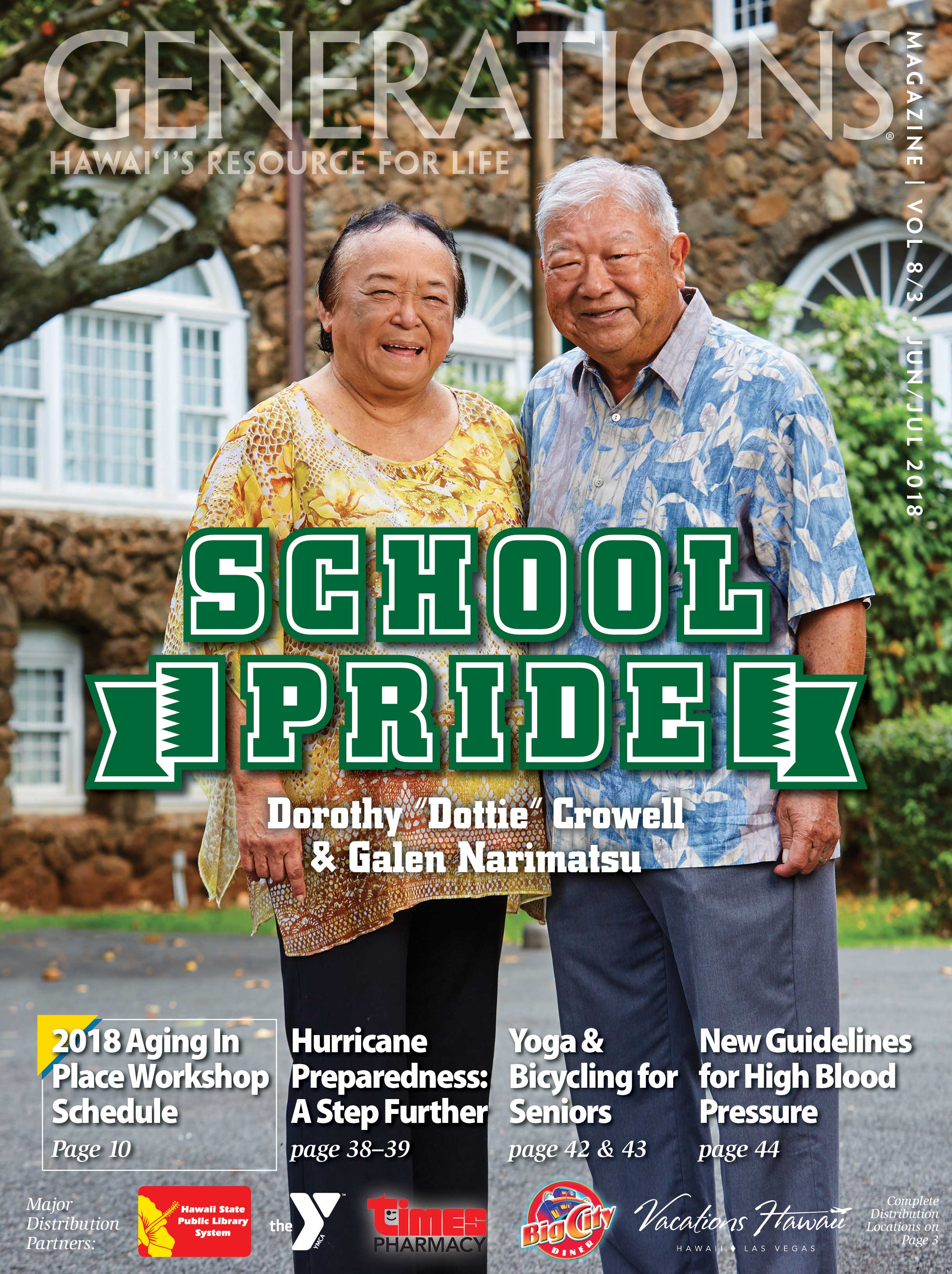
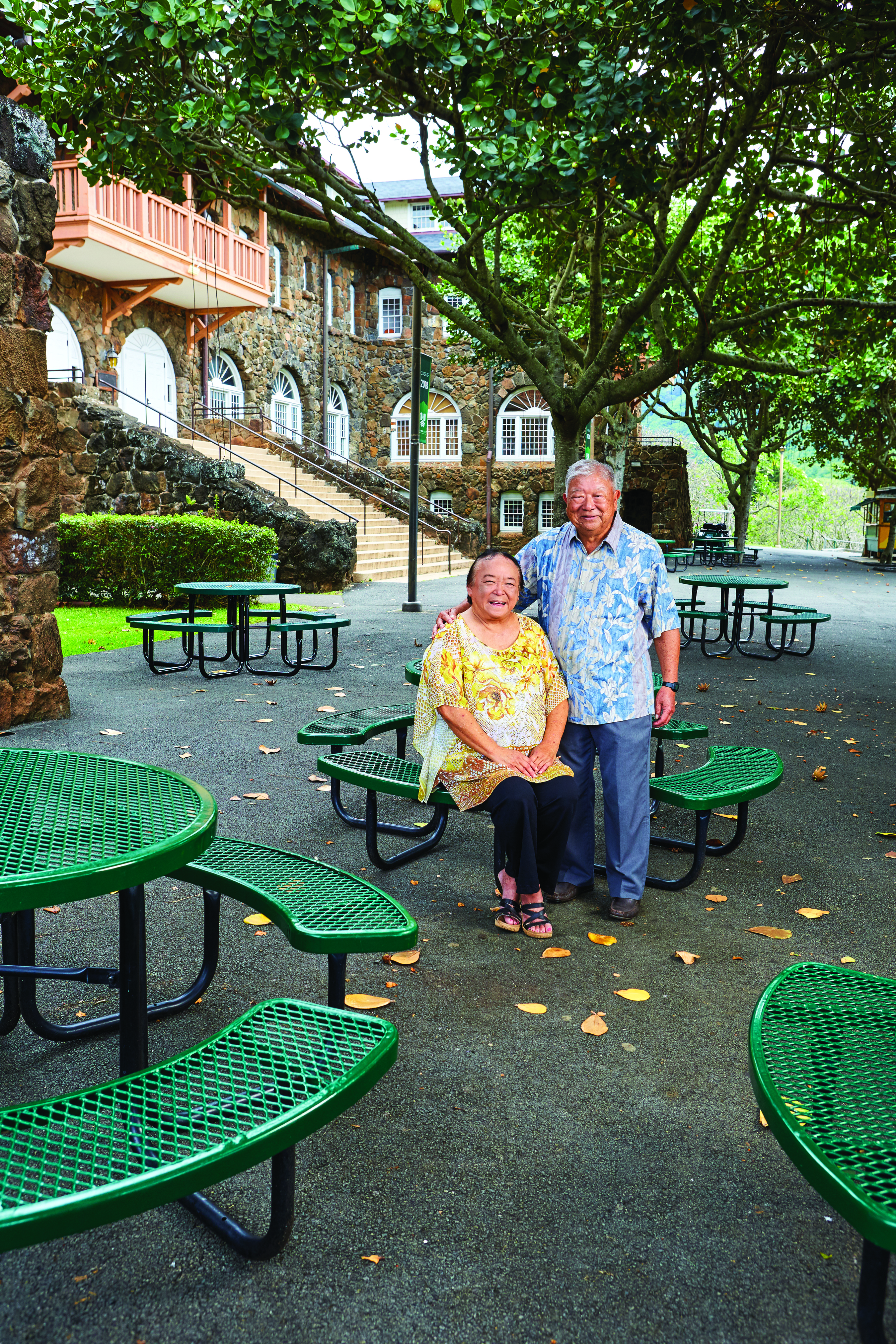
    Dottie Crowell and Galen Narimatsu in the courtyard of historic Kawaiha‘o Hall. The Hall was built in 1908 when the Kawaiha‘o Seminary for girls and the Mills Institute for boys moved to their new joint campus in Ma¯noa, known as the Mid-Pacific Institute.
    Dottie Crowell and Galen Narimatsu in the courtyard of historic Kawaiha‘o Hall. The Hall was built in 1908 when the Kawaiha‘o Seminary for girls and the Mills Institute for boys moved to their new joint campus in Mānoa, known as the Mid-Pacific Institute.

    Giving back to your high school or college allows you not only to rekindle warm memories of school days but also to help the school prepare today’s students for a successful future.

    Generations Magazine celebrates “school pride” with the stories of two retirees who volunteer their time to support their school and its alumni family. If you grew up in Hawai‘i, you probably graduated with some of the same students that you first knew in elementary school. Neighborhoods were small, and families didn’t move around much. Classmates depended on one another like a baseball team: all practice the fundamentals, but in the game, each one has a position to cover. If one does not perform, the whole team suffers unless the others step up and pull out a win. Camaradarie and good performance builds trust in the clutches, and deep friendships that last a lifetime. So students all add to the ultimate success of their class.

    As you might guess, expressing school pride is more than wearing school colors at the game, or sharing stories of back in the day. These are great fun, but the foundations, disciplines and fresh horizons shared with us by teachers, administrators and classmates — tools and habits that later served us well as adults — these are the gifts that make us proud to be called alumni.

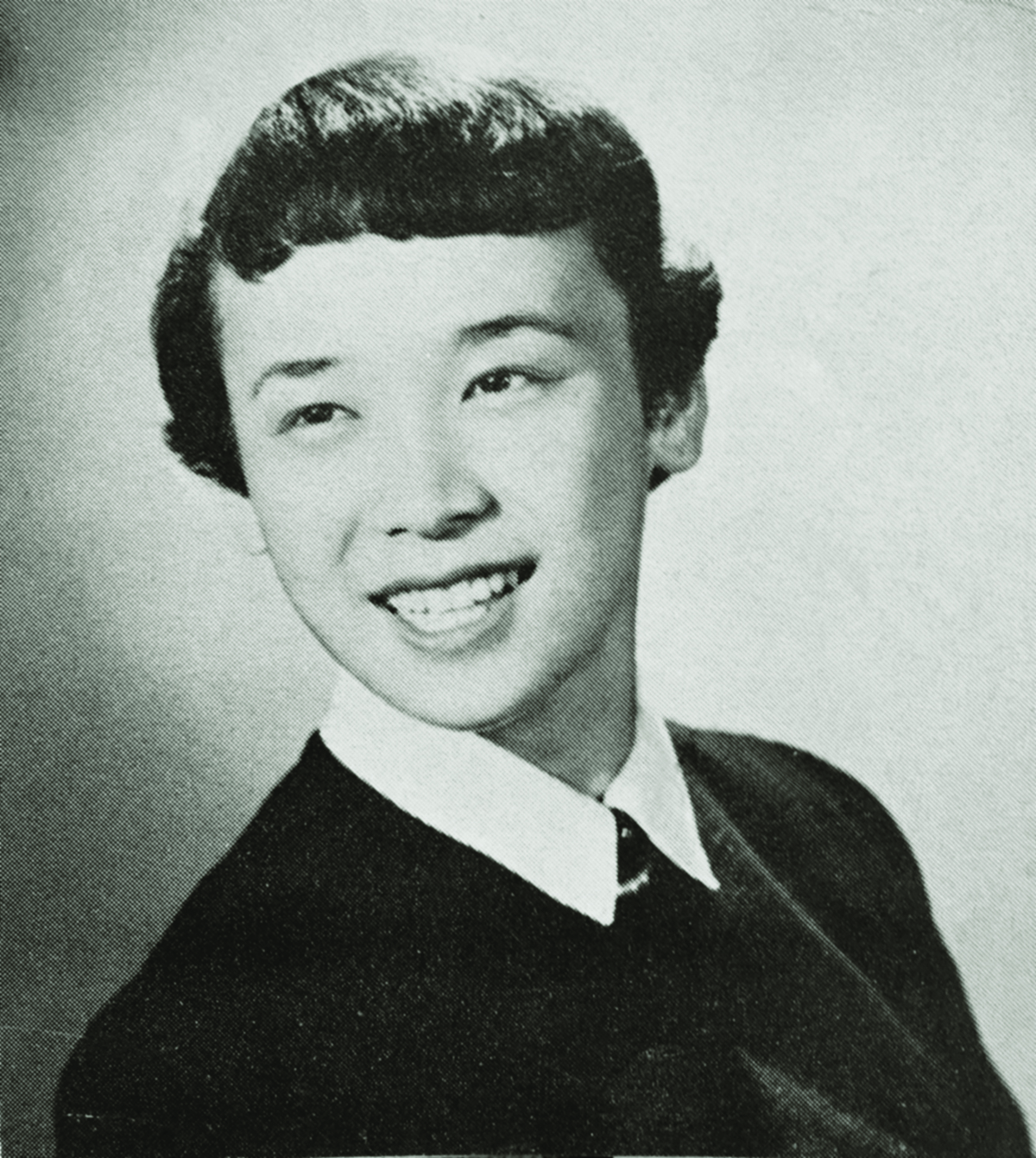
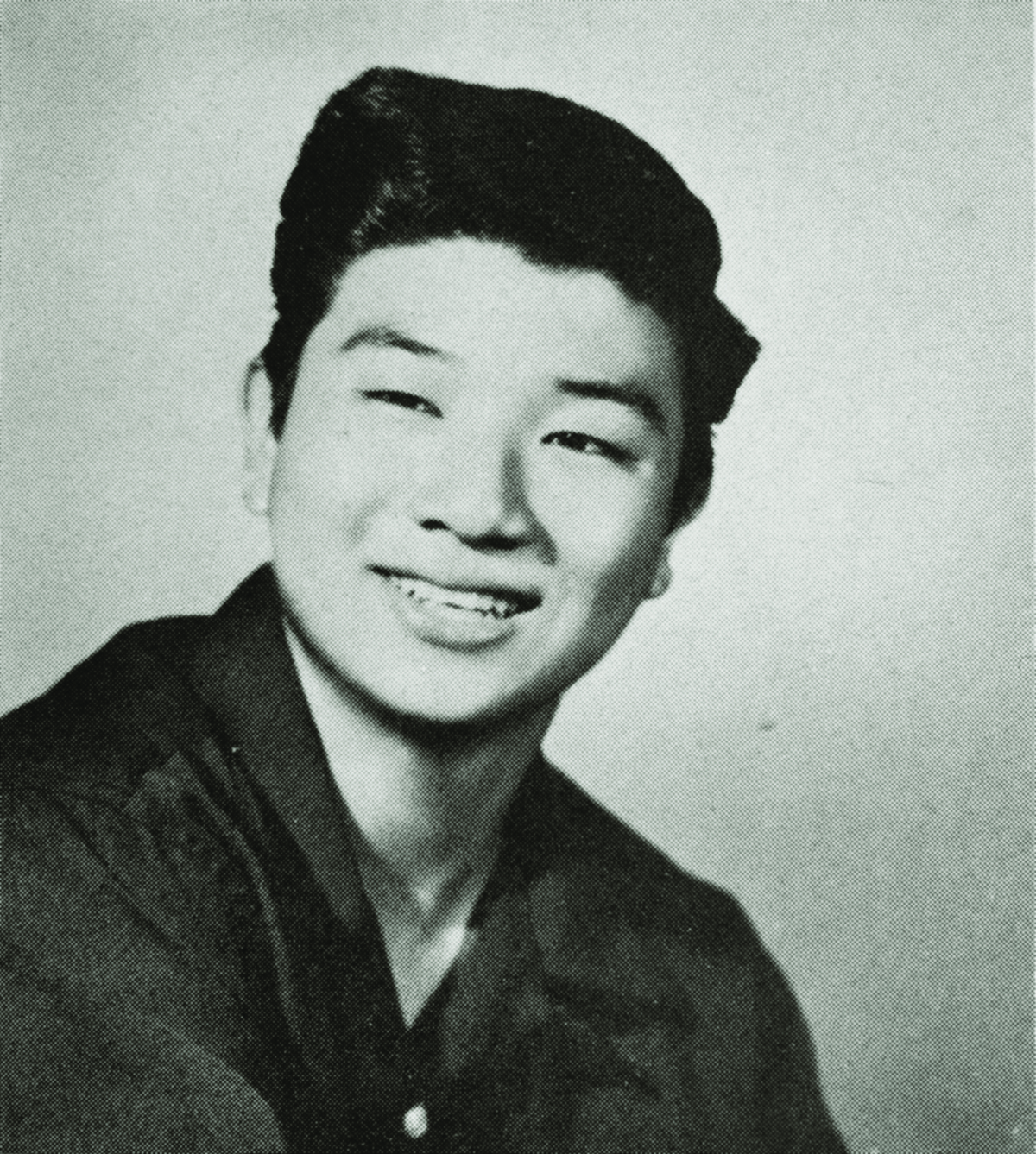
    Cousins Dottie Crowell and Galen Narimatsu graduated from Mid-Pacific Institute in 1955 and are still actively involved with supporting their alma mater. They are still friends with their roommates, classmates and team members. You will see them at home games, cheering on the Owls; on campus, helping on alumni projects; and working with alumni of all ages on student events and projects.

    What is the source of this love and admiration for their school? As they tell their stories, you will hear the facts and history of Mid-Pacific Institute in the 50s, but between the lines you will sense the gratitude Dottie and Galen have. They are not only thankful for what they learned, but for the process. The academic bar was set very high. They were eighth graders away from home for the first time — eager to please their parents, unsure of what the future would hold, and not quite sure if they had “the right stuff” for college.

    But they were not alone or without suppport. And what they achieved in high school prepared them for meaningful, successful lives. This is a story retold many times in post-WWII America.  May the stories of Dottie and Galen inspire you to remember your school days, look up classmates and express your gratitude and your school pride. We have much for which to be grateful.

    Dorothy “Dottie” Crowell, Former Director of Admissions, Mid-Pacific Institute, Class of ’55
    Dorothy “Dottie” Crowell, Former Director of Admissions, Mid-Pacific Institute, Class of ’55

    Dorothy “Dottie” Crowell

    Dottie Crowell graduated from MPI in 1955 and began working there in school administration. No one knows more Mid-Pacific alumni than Dottie because, for nearly 30 years, she and a committee of faculty and deans made decisions about which students would be accepted. She delights in connecting graduates to one another and the school. Graduates are always looking her up. Her devotion and pride for her school can be summed up as a big mahalo to her parents, teachers and principals who encouraged her to pursue higher education.

    “I was a naïve, back-country eighth grader in Ha‘ikū, Maui, who had no idea how high school would be. My parents told me I was going to a high school in Honolulu, and I just accepted it. My class of 35 boys and girls grew to 65 by graduation. We were not sophisticated like the students of today, but we were all away from home, so we followed the rules and did well. On weekends, we saw the big city of Honolulu. I still keep up with my roommates, Lenora and Junette. A whole world opened up to us with class members from Japan, Korea and the Marshall Islands. Two years of foreign language were required: French or Latin. Today, MPI also offers Spanish, German, Japanese, Hawaiian and Mandarin Chinese,” says Dottie. But her favorite subjects were Mathematics and English because she liked the teachers.

    Today, Dottie Crowell volunteers her time to work on the Alumni Archives Research Project. Growing public interest in family history and her own school pride spurred alumna Tomiko “Koco” Conner to reorganize the MPI school yearbooks and academic records for easy access. Archival records going back as far as 1904 had never found a permanent home while Mid-Pacific campus was growing. Now they are housed in a climate-controlled area, and two days a week, Dottie and alumna volunteer Bobbi Sakamoto manage the collection and fulfill requests for information from the families of graduates. Historical requests come from family members looking for pictures of their parents or ancestors — what activities they enjoyed in high school or who their friends were. “Sometimes it is alumni I knew. Mid-Pacific grads are close.

    “While helping others, I discovered that my grandfather’s sister, Reba Hanamaika‘i, from Maui, attended school here in 1904 and 1905 when this campus was Kawaiha‘o Seminary for girls,” says Dottie. Mid-Pacific Institute was founded officially in 1908 when Mills Institute for boys, located in downtown Honolulu, moved to Mānoa. From that time, this small college preparatory boarding school slowly grew from less than 100 students to a current student body of more than 1,500. The boarding program was discontinued in 2003.

    As we flipped through the yearbooks, Dottie showed us the roots of her school pride. One was the MPI headmaster who recruited Dottie in 1951, Joseph Bakken. He taught Dottie’s parents English at Maui High School, so her parents trusted his decision that Dottie was college material, and they sent her by boat to high school in Honolulu.

    Mid-Pacific Institute was structured to protect and support every student and assure his or her success. An upperclassman “brother” or “sister” helped them get accustomed to dormitory life and the scholastic rigor of a college preparatory curriculum. Dorothy remembers that the dormitory had a live-in nurse, two “dorm mothers” to supervise activities and two senior class “Senators,” who acted as counselors, tutors and representatives of the student government. Teachers lived in cottages next to the dormitories and were available 24/7 in emergencies. The entire school staff encouraged students to become one close family and assist one another.

    “One time I was walking to the dining hall, and Mr. Bakken caught up alongside me and asked how I was doing. I told him that I was homesick. He didn’t say anything more to me, but that evening, my aunty from Honolulu showed up at my door because Mr. Bakken had called and asked her to come and see me. The school was that caring for my classmates, and me,” says Dottie.

    The MPI mandatory 2.5-hour study hall every evening helped students make the grade; even  after study hall, when the lights went out, they continued their studies with flashlights under their blankets. Hard work was a given; everyone was college-bound. Students were only allowed off campus on Saturday and Sunday and were responsible for keeping their dorm rooms clean at all times. If they failed room inspection, they were assigned “penalty work” chores. The discipline of dorm life paid off in later life too.

    Today, Dottie is proud to be helping alumni and supporting students. She attends as many “Owls” games as she can, and delights at greeting returning graduates. “We are all one ‘ohana,” says Dottie — with always a fond memory.

    Galen Narimatsu, MPI Alumni Association Board Member and Past President, Class of ’55
    Galen Narimatsu, MPI Alumni Association Board Member and Past President, Class of ’55

    Galen Narimatsu

    Galen Narimatsu also remembers being interviewed by Mr. Bakken. He is Dottie’s cousin, and grew up in Hale‘iwa and Honolulu. The sugar and pineapple plantations were still the main employers in Hawai‘i. After graduating from the ROTC program at Mid-Pacific in 1955, he studied Public Administration at University of Hawai‘i at Mānoa and worked at Mid-Pacific as a dormitory supervisor. His pay was room and board. He also worked at the university bookstore. After graduating from UH, he began his career as an officer in the United States Army and did two tours in Vietnam. After Galen retired from the military, he started volunteering with the Mid-Pacific Institute Alumni Association, became a board member, and has served five terms as its president. Galen served on the MPI Board of Counselors and, in 2015, won the prestigious Volunteer in Philanthropy Award from the Association of Fundraising Professionals, Aloha Chapter.

    Galen remembers being interviewed by Joe Bakken in 1951. “He used to travel around to all the public schools in Hawai‘i interviewing and recruiting good students. I didn’t know who this man was and he was asking touchy-feely questions like ‘What kind of a person are you?’ I must have done OK because he asked my parents to enroll me. My dad was a schoolteacher and had a side business selling silverware to Japanese families in the camps. He especially wanted me to further my education so that I would have opportunities beyond the plantations,” says Galen.

    “When I got to Mid-Pacific, I was happy to find that some of my Waialua classmates had been selected too,” says Galen. He was able to room with two of them — another way the school helped freshmen transition to boarding school life. It was a big change from home, where kids were free to swim, fish and play after chores were done. At Mid-Pacific, everything was regimented. Galen says the discipline and restrictions provided structure and a level playing field that helped him succeed.

    All Mid-Pacific alums agree that scholastics were at a higher level than the public schools they left. They also regard mandatory study hall as necessary for their academic achievements. Academic discipline is a cornerstone of their attachment to Mid-Pacific and a reason they want to help today’s students be successful. They know how Mid-Pacific prepared them for the real world challenges they faced after graduation. “We learned
    academics, teamwork, citizenship and leadership — which helped us succeed in all our endeavors,” says Galen. “And the friendships we made here have lasted the tests of fickle fortune.”

    Galen is a great fan of MPI Baseball, and you will often see him in the stands. He was on the baseball team, under Coach Harry Kitamura, but didn’t get to play center field much, “because we had such great players in my time — still do.” Galen also ran the quarter mile for MPI Track Team. School athletics were a source of fun and teamwork. But Galen’s favorite subject was History.

    “In my senior year,” says Galen, “I was a Senator. We were strict and it was for the good of the students. We looked out for the younger students and maintained discipline, but we also hooked them up with a tutor when they needed academic help. I saw the military as a good career option. Because of the draft system in the 1950s, every family had someone who served in the military. Dorm life at MPI prepared me for military training too. Serving my country was my way of giving back. It worries me today that the younger generations don’t think about what they are going to give back and young men don’t even consider serving their country.”

    The MPI Alumni Association offers graduates many ways to support the school, express their gratitude and demonstrate school pride. “We support community events throughout the year. Tuition only pays for about 80 percent of what it costs the school to educate a student for one year. We try to bridge that gap by raising funds with the annual Chicken Sale and a golf tournament. Graduates love getting together, and all the events are times to share and catch up.

    “Every July we hold our annual reunion, called ‘The Pā‘ina,’ and help out at the Ho‘olaule‘a Festival and Graduation. We award grants for student projects, and organize our MPI class reunion, which alternates between California and Las Vegas every other year. Every event, from ball games to fancy affairs makes us proud to be helping the students, the same way we were helped years ago. I guess the best thing about school pride is that it brings all the alumni together. Regardless of how old or young we are, we all share the Mid-Pacific experience and take pride in the successes we achieved with the gifts our teachers, alumni and classmates gave us.”

    Generations encourages our readers to reach out to your schools and volunteer or find a program to donate to. Put your school pride to work and help prepare today’s students for success.

    Generations Magazine celebrates “school pride” with the stories of two retirees who volunteer their time to support their school and its alumni family. If you grew up in Hawai‘i, you probably graduated with some of the same students that you first knew in elementary school.

  • Puakea Nogelmeier – Ascending to the Future

    Puakea Nogelmeier – Ascending to the Future

    A living and vibrant culture rests on two bedrock foundations: a living language, and land that reveres places connected to the history, beliefs and hopes of its people. One of the people at the nexus of language revival in Hawai‘i is Dr. Marvin Puakea Nogelmeier, PhD, Professor of Hawaiian Language at the University of Hawai‘i, Mānoa; Po‘o/Director of The UH Institute of Hawaiian Language Research and Translation; the Director of UH Sea Grant’s Center for Integrated Science, Knowledge, and Culture; and the Executive Director of Awaiaulu. He calls himself an “unlikely” person to have become a Hawaiian cultural expert, but his works say otherwise. His life work has built mightily on the foundations that his mentors lovingly shared with him; his many students are equipped to steward the language and knowledge into the future.

    Hawaiian Cultural Renaissance

    By 1970, there were so few fluent speakers that the language was in danger of becoming extinct within a generation. The Hawaiian Dictionary, by Pukui and Elbert, “Hawaiian Astronomy” by Professor Rubellite Johnson, and histories by S.M. Kamakau and J.P. ʻĪʻī and others were archival reference materials. The oral tradition had been all but lost, and schools were teaching “about” the Hawaiian language.

    A movement to teach children to speak Hawaiian resulted in Pūnana Leo preschools, Hawaiian Immersion Schools (K-12), and cultural reference materials like Māmaka Kaiao: A Modern Hawaiian Vocabulary, through University of Hawai‘i Press. Some of us have been fortunate to hear a kupuna mānaleo (native-speaking elder) fluently tell the story of his birthplace and recite the genealogy of his ancestors, but soon their voices will be heard only on audio tapes.

    Is the revival strategy working? A couple of weeks ago, in a local restaurant, I sat next to a large table of college students celebrating a birthday. Their joyful conversation was entirely in Hawaiian, although the group was ethnically diverse. Yes, Hawaiian language is growing again! Immersion school teachers now instruct the children of their first students, who speak Hawaiian at home!

    Climbing up from near extinction required bold moves by dedicated elders, linguists and teachers — with the cooperation and resolve of many students and volunteers. In 1972, 18-year-old Marvin Nogelmeier was on a walkabout trip to Japan, stopping on O‘ahu for the weekend — and 46 years later, this self-described “optimist” has built upon and freely shared the knowledge, wisdom and culture that his mentors and teachers entrusted to him. The result is the ascendancy of Hawaiian culture for all of us.

    Puakea – White Flower and Fair Child

    Dr. Nogelmeier is not Hawaiian, but his resonant baritone voice narrates significant documentaries about Hawaiian culture. When we ride TheBus in Honolulu, he announces every stop along the route. His fluency and clear pronunciation reach out to a broad public base, and his translation and interpretation projects are quietly moving the language renaissance to a new level.

    He says that being a Haole has both disadvantage and advantage. “Sometimes I am isolated,” he says with a smile, “but with that comes a certain kind of freedom and flexibility. In a sense, I got to pick my own ‘family’ of mentors and we all get along.”

    The story of his mentors and how he applied the knowledge that they shared is quite remarkable. Young Nogelmeier first found work in Wai‘anae as a goldsmith and quickly made friends among local crafters and cultural practitioners. His affinity for the arts and native curiosity led him to join Mililani Allen’s first men’s class in her hula school, Hālau Hula o Mililani.

    “Hula was life-changing for me. The girls’ class was an hour long but the boys’ class lasted four to five hours. We were empty calabashes that Mililani wanted to fill with knowledge of the songs, chants and motions we performed. She opened the doorway for us to learn Hawaiian ways, including language, chant and beliefs. Mililani’s teacher, Aunty Maiki Aiu Lake, gave me one of her own names, Puakea, which means white flower and fair child,” he says.

    Before long, Nogelmeier was learning to chant under the tutelage of two icons of Hawaiian Studies, Aunty Edith Kawelohea McKinzie, author of Hawaiian Genealogies and Aunty Edith Kanaka‘ole, Kumu Hula, chanter, and Nā Hōkū Hanohano award composer.

    Discovering Mentorship — The Hawaiian Teaching Method

    “I remember one day in the middle of chant presentation an older man came over and spoke to me in Hawaiian. When I apologized that I didn’t speak the language, he then asked, ‘You are saying the words correctly, but how do you know what you are chanting? How can you know how well you did?’

    “Uncle Luka Kanaka‘ole’s compliment and question made me want to learn Hawaiian. Auntie Edith McKinzie offered to teach me and some other chant students basic language in a weekly back-porch session. Soon after, I found someone to study under. June Gutmanis, a researcher in Hawaiian culture, had Mr. Theodore Kelsey living with her, a Hawaiian speaker who helped June with her translations and interpretation of Hawaiian writings. Kelsey was born in Washington state in 1891 and his mother, hired as a teacher, brought him to Hilo in 1892. ‘Ōlelo Hawai‘i was still in common use for business, government and daily life, and as Mr. Kelsey said, ‘If you wanted to have friends, you learned to speak Hawaiian.’”

    When Nogelmeier asked Mr. Kelsey to teach him Hawaiian, Kelsey replied, “No; I am not a teacher.” His main interest was to translate and interpret the “Kumu Lipo,” an expansive Hawaiian creation and genealogy chant that takes many hours to recite.

    The next week at June’s house, Nogelmeier greeted Mr. Kelsey properly with, “Aloha kāua,” and Kelsey responded with some long sentences in Hawaiian.

    “I didn’t get it all, but answered what I could,” says Nogelmeier. “For Hawaiians, protocol and how things are approached are as important as the message. By simply attempting to ‘talk story,’ I had demonstrated my intention to learn and opened the door to a mentoring relationship that lasted nearly a decade.”

    Nogelmeier calls all his teachers “mentors,” because this one-on-one coaching method is the Hawaiian model for teaching. Learning and teaching depend on social relevancy and “chemistry” that encourage a flow of knowledge and insight. When teacher and student find one another through a shared interest or goal, the outcome is positive.

    Nogelmeier attributes his deep interest and skills as a translator to Theodore Kelsey, whom he describes as a Victorian gentleman.

    “He would not translate for June any passages that he considered sexual, political or vulgar, but he would go through them with me. I would then share them with June for her research. It was a working triangle that preserved the literature as it was written. Mr. Kelsey was also a fine photographer who documented Lili‘uokalani’s funeral in 1917. His love for language and history led him to dedicate his life to preserving important Hawaiian literature — documenting, translating and interpreting became his life mission,” says Nogelmeier.

    Becoming a Kumu ‘Ōlelo Hawai‘i (Hawaiian Language Teacher)

    In 1978, Nogelmeier was 25 years old and learning Hawaiian from one of the then-rare fluent speakers. His friends could not understand his interest in Hawaiian culture, but he pursued a degree at Leeward Community College, where he studied under Noelani Loesch. She strongly encouraged his work with Mr. Kelsey, linking it into the university classroom.

    Dr. Nogelmeier’s Awaiaulu translation project uses Skype to connect O‘ahu, Moloka‘i, Maui, Hawai‘i, and Aotearoa/New Zealand. L–R: Ha‘alilio Solomon, Keawe Goodhue, Ka‘iuokalani Damas, Puakea Nogelmeier (standing), Kamuela Yim, Kalikoaloha Martin.
    Dr. Nogelmeier’s Awaiaulu translation project uses Skype to connect O‘ahu, Moloka‘i, Maui, Hawai‘i, and Aotearoa/New Zealand. L–R: Ha‘alilio Solomon, Keawe Goodhue, Ka‘iuokalani Damas, Puakea Nogelmeier (standing), Kamuela Yim, Kalikoaloha Martin.
    Two out of 100 newspapers published in old Hawaiian. Two out of 100 newspapers published in old Hawaiian. Background photo was photographed from The Collection of the Hawai‘i State Archives.

    “There were so many who taught me along the way, but the discipline learned under Theodore Kelsey’s tutelage allows me to do my work today. We would spend the first hour translating a passage of chant, but many more hours researching all the places names, mythical references, connotations of words and phrases, and the personal aspects of author style and story line. For Mr. Kelsey, a complete interpretation required deep analysis.”
    Puakea excelled at language and for three and a half decades, he has been teaching the Hawaiian language at the university level. Many of the Hawaiian Immersion teachers who trained under him are now training new teachers.

    Unlocking the Gate to Hawaiian History

    A revived Hawaiian language began to grow in the university and in charter schools throughout Hawai‘i. Words for modern developments were coined, like lolo uila (electric brain) for “computer” and leka uila (electric letter) for email. But all the Hawaiian literature written in the 1800s by authors who knew the stories of the great chiefs was difficult to access, even by Hawaiian speakers. Less than 3 percent had been translated into English, and there were only a few Hawaiian trained translators. While language teachers were fluent in modern classroom language, they had never been encouraged to develop the skills to translate old writings. And translation is a full-time job that requires intense focus.

    “The other issue is that Hawaiian language we use today in the university setting is different from the language written down 150 years ago. We do not speak English the way our grandparents did. Hawaiian is the same,” says Nogelmeier.

    The Hawaiian Newspaper Initiative

    In 2001, the Hawaiian Newspaper Initiative was born. Although the Hawaiian language was an oral tradition before 1820, the Sandwich Isles Missionaries worked with Hawaiians to codify the Hawaiian alphabet, learned the language, and joined in teaching Hawaiians to read and write. By mid-century, Hawai‘i was one of the most literate nations on earth. Between 1834 and 1948, 100 different Hawaiian-language newspapers published over 125,000 pages, 76,000 of which were preserved, archived and indexed on microfilm. The deteriorating microfilm could not be searched by keyword. Therefore, the newspaper initiative sought to transcribe all the newspaper stories and ads into searchable Hawaiian-language digital print files. The body of literature was immense — equivalent to more than 1 million letter-sized pages of copy. The transcription process of typing each page was slow going.

    In 2011, a huge public awareness campaign called “‘Ike Kū‘oko‘a: Liberating Knowledge,” recruited 7,500 volunteers in 12 countries to transcribe newspaper pages. The Office of Hawaiian Affairs also provided funds to have newspapers electronically scanned, so by the end of 2012, all the extant newspaper archives were digitized and searchable, by Hawaiian keyword. Nevertheless, only a few Hawaiian-speaking researchers were able to read and understand primary source records like these. Others were relying on poor English translations because that was all they had.

    Preserving Knowledge

    In 2003, while finishing his Ph.D., “Mai Pa‘a i Ka Leo,” (don’t restrict the historical voice) Nogelmeier was asked a profound question by his former student Dwayne Nakila Steele, owner of Grace Pacific Corporation: “Are we preserving language or preserving knowledge?” Obviously, the two are connected. Language expresses knowledge, and knowledge is the basis for the ideas language expresses. Nakila was really asking, “Does preserving the language do enough? Don’t we have to preserve the historical ideas and knowledge so that the modern language has a cultural foundation to rest upon?”

    Puakea Nogelmeier approaches challenges in much the same way ancient Hawaiians did: Problem-solving is an intellectual sport — melding tried and true methods with creative alternatives to produce a practical outcome. He looks for simple answers, never takes his eye off the goal, and delights in the process along the way. This time, he applied Hawaiian mentoring to the problem of developing a large team of translators.

    Nakila’s Dream: Awaiaulu: Hawaiian Literature Project

    In 2004, Puakea and Nakila collaborated to create a stable of skilled Hawaiian translators who could, over time, confidently translate nearly all the Hawaiian newspaper body of literature.

    Mentoring takes an extraordinary commitment by both mentor and student. Puakea created the program as a stand-alone nonprofit organization and began mentoring two interns, who would learn a method of translation and interpretation he distilled from Kelsey and others like Sarah Nākoa and Kamuela Kumukahi. Nakila funded the interns for two years. Candidates had excellent language skills with demonstrated work in the Hawaiian language. Their training now focused on the process of translation and interpretation of small chunks of the huge literature archive. Interns graduated to became “resource people,” qualified to both translate and also mentor more interns.

    Four years ago, Kalei Kawa‘a of Moloka‘i Hawaiian Immersion School and Kamuela Yim, a teacher who is now with the DOE’s Office of Hawaiian Education, became translator trainees for Awaiaulu.

    “When they tackle a story, trainees may spend one hour drafting a line-by-line translation of a selection written by Samuel Manaiakalani Kamakau, and then work four more hours smoothing and contextualizing the story,” says Nogelmeier.

    Although Hawaiian vocabulary is quite precise, words may have different connotations or meanings depending on how they are used within a sentence pattern. Translation relies heavily on context. Analyzing word choice, sentence construction and references to places, nature, persons, practices and legends are critical. To add to the complexity, Hawaiians prized authors who crafted double meanings, wordplay and poetic references. Translators must explore all levels of meaning and note them for the reader. When you read a Hawaiian story, always read the editor’s notes.

    “From these small beginnings we now have 18 people mentoring trainers, training translators or learning how to be a translator,” says Nogelmeier.

    A Legacy of Knowledge and Language

    Now, the number of translators and persons skilled at presenting newly-translated Hawaiian literature is increasing exponentially. Many famous stories about pre-contact Hawai‘i were published in Hawaiian newspapers as weekly or monthly columns. When a full story is translated, Awaiaulu publishes it as a book, available to the public. Nogelmeier’s translation of Ka Mo’olelo O Hi’iakaikapoliopele: As Told by Ho’oulumahiehie was published in 2013 and earned several literary awards. See all their publications at www.Awaiaulu.org. 

    The successful mentoring program at Awaialua is preserving Hawaiian literature and knowledge for our entire community.

    Dr. Nogelmeier recalls the time when Mr. Kelsey, then 89 years of age, said to June Gutmanis, ‘I think Puakea will carry on my work.’”

    If Samuel Kamakau, prolific author of 19th century Hawaiian nūpepa articles, were alive he might close this story this way:

    Oh reader, whether you interpret the great translator’s statement as wishful thinking, a sideways request or a prophetical vision, the outcome and manifestation are clear. No more will the stories, legends and myths — nay, the stories of our great chiefs that thrilled our great-grandparents’ hearts — be hidden away. Our children will delight in the celebrations, political intrigue, dirges and simple stories of farmers and fishers who loved this ‘āina before them.

    Pīpī holo ka‘ao. (So the story goes)

    2018: Year of the Hawaiian

    This year is a good time to read a Hawaiian story, or learn Hawaiian language. Ask your local immersion school about community adult classes, or inquire at your local senior center. It’s a fun mental exercise for brain health, and a way to learn the history and culture of the land we love.

    A living and vibrant culture rests on two bedrock foundations: a living language, and land that reveres places connected to the history, beliefs and hopes of its people. One of the people at the nexus of language revival in Hawai‘i is Dr. Marvin Puakea Nogelmeier, PhD, Professor of Hawaiian Language at the University of Hawai‘i,…

  • Romancing the Dance

    Romancing the Dance

    Romancing the DanceFaith and Benny Agbayani celebrated their 49th wedding anniversary this year, and both agree that the success of their partnership is doing things together. Maintaining a close relationship is more than saying, “I love you;” it’s taking on challenges as a team, mastering new skills and learning together. Overcoming obstacles in life requires commitment, sacrifice and a willingness to cooperate. The Agbayanis do all these things well, but simply call it “sticking together.”

    The Agbayanis serve as Dance Director and Associate Dance Director of the Hawaii Ballroom Dance Association (HBDA), which has chapters throughout Hawai‘i where people may learn ballroom dances and participate at social dances at their Dance Studio or Balls at the Ala Wai Golf Course Palladium in Honolulu. Faith and Benny began at the HBDA Pearlridge Chapter. Then they became dance instructors with Arthur Murray Dance Studio in ‘Aiea, and competed in ballroom dancing competitions in Las Vegas. Later, they returned to HBDA as Rotating Instructors — demonstrating new dances to all the HBDA chapters. Now, they direct 53 volunteer Telemark instructors, who encourage ballroom dancing students throughout Hawai‘i to reach for the stars.

    “Telemark” is the name of a fundamental turn used in Waltz double-reverse turns and Foxtrot reverse turns. Mastery of the telemark is so essential to ballroom dancing that HBDA uses “telemark” to brand its Telemark Corps of Instructors, annual Telemark Ball and Telemark Queen.

    HBDA students normally start with the Foxtrot and Waltz, but before long, they step up to a full repertoire — Merengue, Rumba, Paso Doble, Argentine Tango, Mambo and West Coast Swing — to name a few.

    The Agbayanis successfully waltzed through many projects and challenges before they knew anything about ballroom dancing. Says Faith, “I think it’s the power of love and partnership that makes our marriage strong and helped us raise our family.”

    Benny agrees. “When you make sticking together a priority, you are going to stay together and enjoy a nice life,” he says.

    Ballroom dancing is partnership — an activity that can only be done perfectly when both partners work together, focus on every step and synchronize to the beat of the music. One leads, and the other follows. Both roles must be performed expertly. Mastery means learning the steps, working out the kinks, and lots of practice.

    Benny and Faith at the Arthur Murray Showcase 1983, at Princess Kaiulani Hotel
    Benny and Faith at the Arthur Murray Showcase 1983, at Princess Kaiulani Hotel

    How did Faith and Benny first get involved in dancing? We might imagine them coming from society families who danced at grand parties and taught their children to dance. Not so.

    They both came from big working families. Faith is part Portuguese, German, Samoan, Chinese and part what Benny calls “poi.” Benny’s family is Filipino and Spanish. They learned the necessity for hard work, teamwork, cooperation, and helping with family chores.

    Benny grew up on an animal farm in Wahiawā and never even attended his high school prom. Farm work prevented him from participating in sports after school. At 17, he joined the U.S. Marine Corp Reserves and tried his hand at non-farm jobs — gas station attendant, fry cook. In 1967, he became the manager of Heights Drive Inn and Coffee Shop (now The Alley at Aiea Bowl). One of his first hires was a counter girl named Faith. She was a good worker. Benny took up bowling and softball in his off hours and found out that he was pretty good at athletics.

    Faith and Benny had a good work relationship based on mutual respect. One day, Benny asked, “Eh, can you count money?” Soon Faith was doing the daily accounting as well as serving food in the coffee shop and drive-in.

    Benny left the coffee shop for a maintenance mechanic job with the U.S. Coast Guard but kept coming back to visit Faith. On their first date in 1968, a drive-in movie and dinner, Faith asked Benny to swing by her home to meet her father.

    “I was a little nervous; then her dad showed up at the door with a pipe wrench in his hand! It kind of spooked me,” says Benny.

    Faith’s dad had been trying to unclog the kitchen sink, and Benny offered his assistance. “Faith’s mom liked me right away, and I was OK with her. I hoped he would like me too,” says Benny.

    Before long, he and Faith were making plans for the future. “I remember telling Faith that with my Coast Guard job we would be ‘all set.’” They were engaged in 1968 and married at Kawaihao Church on April 3, 1971.

    In the ’70s, Benny organized a bowling league at Aiea Bowling Center with guys from the U.S. Coast Guard. Faith was secretary for the Monday night “Tired Weekenders” league, which grew from 10 to 24 teams. Organizing groups became the first step for this couple’s dance through life.

    Faith and Benny choreographed the HBDA Pearlridge Chapter Rumba Group Formation Dancers, Anniversary Ball, Sheraton Waikiki.

    One day in 1979, Faith told Benny that she knew of a fun activity that they could do together. Sticking together was their way of doing things, so Benny asked, “Yes, Honey. What is it?”

    Faith said, “Ballroom dancing.”

    “Whoa!” said Benny, “Dancing is not for me!” He was fine with any athletic sport or game, but not dancing. Despite his protest, he attended the first class.

    “I still didn’t think much of it until I saw a Telemark Instructor demonstrate professional dancing and all I wanted to do was learn how to do that. So I kept going to class and began to figure it out. We joined the Hawaii Ballroom Dance Association (HBDA) classes, directed by Eugene Ichinose. He and his wife Harriet founded the association in 1959. Ichinose was a serious man, a shogun, an able director and a perfectionist. I could relate to that. Sports take precision and mastery. You have to practice to learn how to cook, pitch, bowl, even how to run fast. Dancing took a lot of energy too, and I got into it.”

    Arthur Murray Showcase 1984, Waltz/Tango Formation, Princess Kaiulani Hotel.
    Arthur Murray Showcase 1984, Waltz/Tango Formation, Princess Kaiulani Hotel.

    Faith and Benny had been a team for a decade: working out plans, negotiating roles and responsibilities, and reaching their goals with perfect synchronization. Benny was leading, Faith was following, and outcomes required both of them to perform. But this time, Faith chose the game.

    When the boys came along, Benny and Faith encouraged them to play the team sports that Dad was never able to play when he was young.
    Faith was all in. “My boys were active rascals; they loved releasing energy on the ball field.”

    Aiea National Little League games became social events for all the parents. Benny says, “It was a pleasant family atmosphere in those days, and we bonded over potlucks at the field after the games. The men enjoyed a couple of beers at the park before going home. Can’t do that anymore.”

    Support and Assistance In every relationship some circumstances of life cause one partner to pause. It may be a setback, a change in responsibilities, or a time of preparation for a promotion, move or retirement. At these times, the other partner lends support and assistance to keep the relationship healthy. Circumstances are neutral, but how we react to them can make them negative or positive. Support from our partner can allow us to find comfort, joy and assurance in the pauses and low spots of life. Here we see a pause step in the waltz called an “Over Sway.” HBDA Assistant Dance Director Mark DelaCruz supports his wife Patty, Rotating Instructor, for a dramatic pause in the dance. With Mark’s assistance, Patty can relax into the dip and enjoy the freedom of movement.
    Support and Assistance – In every relationship some circumstances of life cause one partner to pause. It may be a setback, a change in responsibilities, or a time of preparation for a promotion, move or retirement. At these times, the other partner lends support and assistance to keep the relationship healthy. Circumstances are neutral, but how we react to them can make them negative or positive. Support from our partner can allow us to find comfort, joy and assurance in the pauses and low spots of life. Here we see a pause step in the waltz called an “Over Sway.” HBDA Assistant Dance Director Mark DelaCruz supports his wife Patty, Rotating Instructor, for a dramatic pause in the dance. With Mark’s assistance, Patty can relax into the dip and enjoy the freedom of movement.

    The Agbayanis’ organizational skills came into play again when the boys got interested in baseball and soccer, where Benny coached in the Aiea National Little League, AYSO and HYSA; Faith was the Business Manager and team mother. When Benny Jr. and Brendyn were at Saint Louis School, Benny coached intermediate baseball and Faith became the Saint Louis Division Mother for the Class of 1993. This is a family sticking together.

    During the years when son Benny played major league baseball for the New York Mets was a valuable clutch hitter in the 2000 National League Division Series and World Series, Faith and Benny and the family became proud cheerleaders.

    Ballroom dancing only looks easy because the couples practice hard to make it look that way. Every graceful movement represents focused learning and endless rehearsal with the music. Togetherness and respect have to be strong enough to survive the hard work of learning and executing each step perfectly. On the dance floor, your partner’s moves are your moves.

    Leadership - Good partnerships rely on leadership. The role of leader may alternate from partner to partner, based on the challenges ahead or the skill sets of each partner. In ballroom dancing, the partners spend time rehearsing their steps together and ironing out cues and clues they will use to communicate their intended actions. We can take a lesson from ballroom dancing, particularly when issues require us to change direction. As HBDA Senior Instructors Martin and Leona Powell dance the Foxtrot, they move to an open promenade position. Martin expertly communicates to Leona through body movements; Leona follows his physical lead and other visual cues to maintain perfect rhythm.
    Leadership – Good partnerships rely on leadership. The role of leader may alternate from partner to partner, based on the challenges ahead or the skill sets of each partner. In ballroom dancing, the partners spend time rehearsing their steps together and ironing out cues and clues they will use to communicate their intended actions. We can take a lesson from ballroom dancing, particularly when issues require us to change direction. As HBDA Senior Instructors Martin and Leona Powell dance the Foxtrot, they move to an open promenade position. Martin expertly communicates to Leona through body movements; Leona follows his physical lead and other visual cues to maintain perfect rhythm.

    Soon after joining the Hawaii Ballroom Dance Association, the Agbayanis were instructing other students. “Eugene Ichinose asked us to be Rotating Instructors, teaching at all the O‘ahu chapters. We declined because Faith and I both felt that we should first learn more dance skills, traditional dance terminology and steps. So we joined an Arthur Murray dance class and paid for lessons for the next eight years.”

    Their Arthur Murray instructors encouraged them to compete in a national ballroom dancing competition at Las Vegas, Nevada. “In 1980, we won several medals, gold, silver and bronze! In 1982, we came back with gold, silver, bronze again!” says Benny.

    Independence – Opposites attract, so partners have to find ways to work together for mutual benefit. Often, playing different roles helps us accomplish more. The “double time” music played at Portuguese and Spanish bullfights is the inspiration for a ballroom dance called the Paso Doble, where the man plays the matador and the woman, his cape. While the partners each have completely different roles, they must execute their steps and positions flawlessly and quickly to keep up with the lively beat. Here HBDA Assistant Dance Director Melvin Camut “unfurls his cape,” Rotating Instructor Susan Masumoto, who “drapes” on his arm with a flutter of her skirt. The matador and cape play independent roles, but they flow together with precision.

    In the ’90s, “Mr. Ben and Miss Faith” were Arthur Murray instructors in ‘Aiea, and when the studio moved to Florida, they returned to HBDA, with full credentials. Eugene Ichinose was happy to have the Agbayanis back, now with the confidence to share their knowledge with others. His only advice to Benny was to be a “little less agreeable.” He said, “Benny, as director, you have to have a thick skin and cannot say yes all the time.”

    There isn’t much Benny could do about his amiable temperament, but with help from Faith he found a way to be more firm. “When disputes arise, Faith talks to the people and finds out what the problem is. She understands Hawai‘i cultures, personalities and how things work. After she and I discuss the issue quietly, I can kindly say no if I have to. Working together is what we do best,” says Benny.

    HBDA has eight chapters throughout the State. Its mission is to provide dance experience for the people of Hawai‘i that is fun, affordable and promotes healthy minds and bodies. The association’s performance venue is the Palladium, an 11,000 square-foot polished eucalyptus dance floor upstairs at the Ala Wai Golf Course clubhouse. Each month, on the 1st Saturday, HBDA has a dinner dance event at the Palladium. Monday through Thursday, from 7 pm to 9 pm, Basic Bronze I/II, Bronze II/Silver intermediate and advanced students gather at the Dance Studio to practice an extensive repertoire of dances including Tango, Swing, Samba, Rumba and Merengue. Classes for Novice Beginner students are held at The Dance Studio in ‘Aiea Saturday mornings, from 8 am to 10 am. Line Dance/fitness/Hot Hula takes place at The Dance Studio Saturday, from 10 am to Noon.

    Showmanship and Promotion - Love often urges us to put the spotlight on our partner; a common goal may require us to promote our partner’s skills. Togetherness takes a different shape when we must lead from behind, or face the public on behalf of our partner in the wings. The “Shadow Position” seen in many ballroom dances and in couples figure skating, represents this kind of relationship. The man dances behind the woman for several measures of music. The couple holds hands as a way of keeping balance and communicating. Senior Instructors David and Lea Twigg demonstrate the “Shadow Position” as David shows off Lea and they both express a deep enjoyment of the dance and each other.
    Showmanship and Promotion – Love often urges us to put the spotlight on our partner; a common goal may require us to promote our partner’s skills. Togetherness takes a different shape when we must lead from behind, or face the public on behalf of our partner in the wings. The “Shadow Position” seen in many ballroom dances and in couples figure skating, represents this kind of relationship. The man dances behind the woman for several measures of music. The couple holds hands as a way of keeping balance and communicating. Senior Instructors David and Lea Twigg demonstrate the “Shadow Position” as David shows off Lea and they both express a deep enjoyment of the dance and each other.

    For seniors, ballroom dancing has many benefits: aerobic exercise, mental exercise and socialization all improve and sustain good health. Learning new dances and keeping to the rhythm of the music are proven to support thinking and mood. And dancing is fun — laughter is a powerful medicine!

    Every November, HBDA holds the Telemark Ball, a fundraiser that supports the HBDA’s Telemark corps of non-salaried volunteer instructors. Proceeds from event ticket sales will fund annual membership dues for the instructors. This gala event qualifies as a “three-shirt” event for the men, counts as low-impact aerobic exercise. The reigning Telemark Queen of 2017–18 is Rotating Telemark Instructor Elsa Navares. She and her escort, Romeo Navares, thrilled the guests by dancing the Viennese Waltz.

    If you are thinking, “I want to dance like that,” the Telemark instructors
    at HBDA will act as mentors, instruct you, and give you an opportunity
    to practice so that you and your dance partner may develop confidence and experience the joy of dancing.

    Benny recently celebrated his 75th birthday, and looks forward to seeing the grandchildren graduate. At HBDA, Benny and Faith are proud of the students and grateful for the instructors, who are his backbone, and the legacy of Eugene and Harriet Ichinose. Sticking together leads to success and happiness. The Agbayani secret is out!

    Trust and Confidence - Knowing each other over a long period of time and under challenging circumstances develops trust. As couples take on small challenges they learn more about one another’s temperaments, strengths and weaknesses. As they learn to communicate, they are able to tackle bigger goals, build confidence and reliance. HBDA members Chris and Becky Prendergast know each others’ skills well. Here they demonstrate a Side Leg Lift where Becky shifts her weight to one foot and bends her outside knee as Chris pulls her into his hip in a modified lift. Becky leans in full confidence that Chris will gracefully maintain her balance and lead her to the next step. Lifts and successful landings are common in Jazz Dancing, and in successful partnerships.
    Trust and Confidence – Knowing each other over a long period of time and under challenging circumstances develops trust. As couples take on small challenges they learn more about one another’s temperaments, strengths and weaknesses. As they learn to communicate, they are able to tackle bigger goals, build confidence and reliance. HBDA members Chris and Becky Prendergast know each others’ skills well. Here they demonstrate a Side Leg Lift where Becky shifts her weight to one foot and bends her outside knee as Chris pulls her into his hip in a modified lift. Becky leans in full confidence that Chris will gracefully maintain her balance and lead her to the next step. Lifts and successful landings are common in Jazz Dancing, and in successful partnerships.

    Faith and Benny Agbayani celebrated their 49th wedding anniversary this year, and both agree that the success of their partnership is doing things together. Maintaining a close relationship is more than saying, “I love you;” it’s taking on challenges as a team, mastering new skills and learning together. Overcoming obstacles in life requires commitment, sacrifice…

  • Five Views on Caregiving

    Five Views on Caregiving

    Aging with dignity is a major public health issue for the state of Hawai‘i. People of all ages work with and advocate for the elderly by providing educational resources for families and brainstorming private and public health solutions for the growing needs of kūpuna. All generations offer experience and expertise.

    By 2029, over 70 million baby boomers in the United States will be over 65. The fastest-growing demographic is seniors over 85, numbering over 40,000 in Hawai‘i.

    The blessing of longevity has two downsides: Declining health and mobility, and eventual dependence on caregivers.

    Greatest Generation members, born before the great crash of 1929, lived through the Great Depression and World War II and are now in their late 80s to mid-90s. They had to be frugal, and they treasured work. They fought and volunteered for freedom, cared for elders with respect, attended school, learned a trade and respected authority. They also saw the arrival of Model T autos, jazz and aircraft.

    Members of the Silent Generation were born between 1925 and 1945. Some fought in WWII and the Korean Conflict. They adopted the traditions and work ethic of their parents and kept their feelings to themselves. They enjoyed a robust post-WWII economy and a high school education. Many attended college on the GI Bill. They watched the rise of communism and shaped 20th-century pop culture, rock ‘n’ roll, TV and mainstream media.

    After WWII, over 76 million baby boomers were born between 1946 and 1964. They are the wealthiest, healthiest and best-educated generation yet. As “hippie” teens, they protested against the traditional values of their parents. Their midlife “yuppie” lifestyle was adopted globally. They became experts in their fields. Cold War nuclear “detente” and recessions led them to distrust big government. They are deep thinkers, optimistic and respond to civic calls for action.

    Children of baby boomers are Generation X and millennials. Generation X, born between 1965 to 1984. learned early independence as latchkey kids of working parents. Rocked by divorce and economic downturns, Gen X-ers are pragmatic, problem-solvers who adapt well to change. Technologically adept, they learn by discussion and case study. They value experience over wealth and tend to be skeptical. Generation X is less motivated than boomers to make a difference or to leave a legacy.

    Millennials, born from 1985 to 2004, outnumber boomers in the U.S. workforce. They have more college degrees than any other generation; they smoke less and tend to count on friends and public welfare in tough times. They learn by trial, error and collaboration. They carry college and lifestyle debts, frequently change jobs, save less and own fewer assets than previous generations. They marry late and anticipate six decades in the workforce.

    We bring you the wisdom and advice of five notable persons who have laid the foundation for eldercare and public policy for aging issues in Hawai‘i. Collectively, their ages span almost eight decades, but each has a different perspective and approach to meeting the needs of the elderly; their approaches are related to the generation into which they were born. All are “paying it forward” so that we all may age well, with dignity.

    Anthony “Tony” Lenzer is a member of the Greatest Generation and a paragon of hard work. Besides HPGS, he serves on the boards of several aging advocacy groups. Tony taught gerontology (the study of old age) at The University of Michigan School of Public Health before joining the faculty at the University of Hawai‘i in 1969. He helped develop a gerontology program at the UH School of Public Health. In 1988, he served as a volunteer training coordinator for AARP Hawaii and spent several legislative sessions as aging adviser to Sen. Les Ihara Jr.

    As a member of the Greatest Generation, he grew up learning how to do a lot with little and focused his energy on productive projects that would help the entire community.
    “I am very proud of the work we did to expand the number of professionals focused on aging,”

    Tony says. With other dedicated faculty, he created two gerontology certificate programs. Many of the 150-plus students who are certified in aging now lead nonprofits and government agencies that provide services for seniors.

    Tony recently taught a five-session weekly workshop, “Aging and Dying With Dignity,” at UH’s Osher Lifelong Learning Institute, but his current focus is to increase the population of caregivers.

    “There is a need to educate and support family caregivers within their cultural context,” Tony says. “Parallel to education is a need to develop agencies and services on all islands to deliver care in homes and facilities.” He advocates immigration policies that favor experienced caregivers from abroad and supports the initiation of caregiver training programs in colleges.

    “I believe caregiving is a profession, and the state should proactively create tiered certifications to facilitate a career ladder. When caregiving blossoms as a career, it will stimulate other services —
    equipment, nutrition, treatments, etc.”

    He urges banks to target young wage earners for savings plans that will encourage them to build financial assets for their elder years. He also has advice for boomers:

    “Many baby boomers have not accumulated or protected enough assets to pay for the rest of their retired life. They continue to work because they must. If older people are going to stay in the workforce, they need work opportunities. Other seniors who are inspired to community service will need training in skill building, leadership, consulting and advocacy.”

    Tony invites his guests to pour their own coffee, joking that he is not a mover and a shaker, but “moving shakily” these days. When asked to predict the future, this member of the Greatest Generation quips, “I just want to see my 88th birthday!” If tackling difficult problems, finding solutions and cultivating a quick humor are good for the brain, Professor Lenzer will be advocating for years to come.

    Chris Ridley is a luminary in the Alzheimer care community. Like others in her generation, she sees community needs and enlists others to join in the cause to address them. In college, she chose mental health social work as a profession and honed her skills. But in 1984, she moved to Hilo to care for her father to undergo the life-changing, on-the-job training we call caregiving.

    “The most critical thing I learned was to be a care partner instead of a care “giver.” My dad was not comfortable with all my care choices and displayed his frustration. I thought I knew what was best for him. When he became unable to walk, I was upset that he rejected the “Mercedes” wheelchair I selected and chose to scoot around on the floor. It was difficult, but I discovered that he slept well on
    a mattress on the floor. He eagerly ate his meals from a Japanese chabudai table, and I washed the floor every day for him so his environment was clean. I learned that caregiving is not making our loved ones “normal” or “happy” but keeping them comfortable, building their self-esteem and protecting their dignity — on their selected path. This is respectful caregiving.”

    Chris’ answer to needs of seniors and the elderly — especially home care for people with dementia — is community education and activation. She travels through Hawai‘i County helping families form care teams for their loved ones who want to age in their own homes.

    In 1999, she founded the Early Signs Health Fair, where everyone can come for free health screening—blood pressure, sugar, kidney function, bone density, dental consults, chiropractic exams and adjustments, exercise and activity classes and presentations by physicians. Her proudest achievements are her work with Life Care, Early Signs Health Fair and increasing public awareness for Advanced Care Directives.

    Chris would like to see Hawai‘i become a dementia-friendly community where we witness and honor our elders’ choices and provide help to keep them on their chosen paths.

    “I was called to evaluate an elderly woman whose neighbors could not convince her to go see a doctor. The neighbors knew one another and were friends with the lady. One neighbor was taking her to the bank and grocery store. The man next door was mowing her lawn. A third was bringing in her newspaper and mail every day. The whole neighborhood was respecting her wish to stay in her home! I signed her up for services like Meals on Wheels and doctor transport. And then I offered a talk-story for all the neighbors, who had become a care team without even knowing it. I showed them which agencies can help and told them who to call in an emergency.

    “This neighborhood is a blueprint for helping Hawai‘i kūpuna stay in their homes as long as possible — not taking advantage but respecting the elder’s wishes — each neighbor helping a little.”
    Chris is a baby boomer who is a change agent for her community. Her legacy will be to educate Hawai‘i’s residents about home caregiving for elders with dementia and to help foster new attitudes toward elders within the community.

    “My dream is that agencies and nonprofits who provide in-home caregiving services to our kūpuna will adopt a seven-day schedule to improve the consistency of care for clients who are aging in place,” she says. Consistency is a hallmark of her ability to change lives and significantly help others in need.

    Jerry Correa is at the tail end of the baby boomer generation, planning for eventual retirement and breathing a sigh of relief that the children of boomers are striking out on their own. Around the corner looms the responsibility of caring for their elderly parents.

    Jerry became president and chief executive officer of St. Francis Healthcare System of Hawaii in 2012. With the blessings of the Sisters of St. Francis and the St. Francis Healthcare System’s board of directors, coupled with support from his leadership team, he is moving full speed ahead to meet the needs of seniors and family caregivers.

    As the first lay leader of St. Francis Healthcare System, he received valuable advice from the sisters: “Give the ku¯puna and caregivers what they tell you they need.”

    Jerry says, “We faced some hard decisions in order to reinvent ourselves. We needed a strategic plan to carry forward the values, mission and success of the sisters of St. Francis, so I studied how they organized and administered their ministries.” His information technology background compelled him to take a systemic, logical approach to the planning process.

    Giving kūpuna what they want meant replacing the traditional medical care model with a broad range of home- and community-based services for Hawai‘i’s growing population of seniors who want to stay healthy and age in place.

    While St. Francis’ kūpuna services in the community continue, Jerry and his team are transforming the Lilihā campus into the St. Francis Kūpuna Village, a one-stop center for health and wellness services, adult day care, caregiver services, and assisted living and skilled-nursing facilities. “This model gives kūpuna and their families easy access to all services at one location and maintains their ties to friends, family and community,” he says.

    In April 2015, the Lilihā campus welcomed the addition of a skilled-nursing facility. In 2018, active kūpuna and caregivers will be able to enjoy a full array of health and wellness services on the Lilihā campus. A team of social workers who understands cultural traditions, family dynamics and critical needs for emotional and spiritual support will coordinate all healthcare services.

    While the St. Francis kūpuna Village is under development, St. Francis is giving seniors and caregivers a taste of what is to come with caregiving classes, fitness classes for seniors and other services. And, as the needs of the community change, St. Francis Healthcare System will continue to offer new services and programs.

    The best is yet to come!

    As the Lilihā campus and programs gradually become available, Jerry keeps kūpuna posted with inspiring weekly messages on the St. Francis website’s news page (www.stfrancishawaii.org/news).
    He keeps listening to what seniors say and need.

    Jackie Boland, a familiar friend of kūpuna, directs AARP’s community events and educational resources for Hawaii residents over age 50. She relies on an army of volunteers, who are AARP members themselves, to help plan and implement programs that appeal to everyone across the board — from those in the workforce to frail seniors nearing end of life. “In Hawai‘i, we have a rapidly aging population that can look forward to greater longevity and health than on the mainland. Therefore, we approach our work from two directions: Helping those who are healthier to access tools and resources that can help them experience their possibilities, and helping frail ones in need of assistance and advocacy. For those in good health, my challenge is to develop ‘Fun with Purpose’ activities that engage people in stimulating activities, disrupt aging and redesign our communities. People over 50 have so much to contribute to the community and to themselves,” she says.

    Older adults who are not in the workforce are a great resource for our community.Jackie says that society has to catch up and change the way we think about retirement. Many retirees want to contribute and maximize their skills to maintain their healthy productive years. They are a talented volunteer force for community activities because of their lifetime of experience and self-knowledge.
    Boland points out that the elderly population (over 85) is growing fast. Nearly all of them want to age at home, and this is only possible when they receive help from family and friends. One in four of Hawai‘i’s adults is a caregiver of parents or spouses, and AARP is working hard to support them with educational resources and workshops.

    “We feel passionate about helping family caregivers. Without them, our kūpuna would be reliant on government programs, and neither we as a community or they as individuals can afford that. We work hard to link caregivers to resources, teach them how to care for themselves while caring for family members and advocate for them in the Legislature.

    “I have a passion for helping women because they live longer and often take on the work of caring for family, putting their own needs aside. Many women stop working or work less, with the result that they earned less and accrued less savings and Social Security. Therefore, their financial resources and benefits are lower in old age. They often outlive their family caregivers and their resources, adding to their mental and physical stress in old age. Our women’s scholarship program has helped so many up-grade their skills and get training and education otherwise not available to them.

    “I want to reach everyone over 50 and let them know about the many AARP programs and educational resources here to help them live their best lives. That’s why we collaborate with many partners like Generations Magazine, to provide educational resources for seniors. If everyone can learn to make good choices to plan for their later years, then growing older can be FUN,” Jackie says.

    Let’s take her advice and start by learning and planning now. We can talk with our families to make sure we have sufficient resources to live with dignity and be productive community members for life. All the answers to our questions, and needs, are there if we only reach out.

    Mapuana Taamu is a busy and productive millennial. Her passion and drive are focused on helping our aging population. She balances multiple jobs: Nursing care in a facility that specializes in memory care, and home care training and services through her own company, Memory Friends, which uses Positive Approach® to Care (PAC) curriculum to teach family caregivers empathetic techniques for giving care. Taamu attends Kapi‘olani Community College (KCC), pursuing an associates of arts degree in accounting and business. She also works part-time for Generations Magazine, managing social media and writing resource articles for you.

    Her passion for healthcare and dementia care, in particular, stems from seven years as a volunteer with Hospice Hawai‘i, Project Dana, Kokua Mau and Hale Kū‘ike in Kāne‘ohe. She attends Kupuna Caucus, is an advanced care planning speaker for Kokua Mau and is an active member of the Kahalu‘u Lions Club. In a short time, she has accumulated a lot of experience in aging.

    “I look like a person you would label a millennial — with tattoos, who enjoys attending meetings in skinny jeans and a white tee,” says Mapuana. She is quick to promote her accomplishments and independent, pragmatic approach to life. Like many millennials, she places a high value on experience and is comfortable collaborating with teams where she can apply her honed skills and the skills of others toward results.

    She counts on her “amazing EQ,” or emotional quotient when working with patients and their families. Like IQ tests, EQ tests measure your capacity for knowing and expressing your emotions and reading emotional expressions of others. “Dementia primarily affects the left half of the brain, the center of language, comprehension and vocabulary. Therefore, non-verbal behaviors say more than words. Reading facial expressions and body language becomes a necessary care skill.

    “Memory Friends is my homecare service for forgetful seniors and their families. We teach Caregiver Action Network (www.caregiveraction.org) programs that train caregivers how to interpret the challenging behaviors and body language of their loved ones with dementia. We help clients adapt a routine of simple exercises that improve health, clarity and attitude,” she says.
    She is majoring in caregiving through first-hand experience and minoring in business on the typical route — college.

    “If only other health professionals could see past my young age and place as much value on my experience as they do on higher educational degrees, then I, and many others, could begin working on these issues and finding the answers.”

    Mapuana has a message for her generation: “Everyone can make a difference. Healthcare is a great career path with many rewards. I invite other millennials to attend meetings, get involved and let your ideas be heard. Let’s collaborate and lead our generation.”

    AGING IS WALKING IN A CIRCLE
    We live in a world with more aging persons than previous generations. Although each generation has its own “personality” and ways of facing challenges, we walk the circle of life together — from dependent childhood and productive midlife, to retirement and dependent old age. As we try to meet the growing challenges of aging in the 21st century, all generations have much to offer. The Greatest Generation laid the foundation for all the services and public programs we now have for the elderly. Baby boomers are working to support and multiply these services for their parents and themselves.

    They have accumulated wealth and assets and developed public awareness about aging. The technologically skilled, independent thinkers of Gen X and the compassionate, problem-solver millennials are applying their skills and logic to improve community support for their parents. They’re planning for their own elder years, which will be longer and more productive yet. Where are you in the circle of aging? Are you actively planning for your elder years? What can you do to make the future even better?


    ARTICLE RESOURCES

    AARP Hawaii
    1132 Bishop St., #1920, Honolulu, 96813
    808-545-6024https://www.aarp.org/states/hi.
    AARP is a national, nonprofit group for adults over age 50. The Hawai’i chapter advocates for financial resilience, safe housing, healthy lifestyles, long-term care, livable communities and more.

    Hawaii Pacific Gerontological Society
    P.O. Box 3714, Honolulu, 96812
    www.hpgs.org | 808-722-8487
    The nonprofit HPGS strives for the well-being of seniors in the Pacific Islands. Annual events include job fairs, conferences and fundraising.

    University of Hawai’i – Mānoa, Center On Aging
    Gartley Hall, 2430 Campus Rd., Honolulu, 96822
    808-956-5001 | www.hawaii.edu/aging/
    COA is the “catalyst of academic excellence in gerontology” for aging groups in the Pacific Islands. It comprises experts in medicine, law, sociology, disability and family resources, nursing and more.

    Life Care Center of Hilo
    944 W. Kawailani St., Hilo, 96720
    808-959-9151 | www.lifecarecenterofhilo.com
    The second-largest nursing home in Hawai’i, this facility has an Alzheimer’s and dementia unit, patient rehabilitation and 24-hour nursing care.

    Alzheimer’s Association
    1130 N. Nimitz Hwy., Ste. A-265, Honolulu, 96817
    808-591-2771 | www.alz.org/hawaii/
    One of 70 branches nationwide, the AA Aloha chapter advocates for Alzheimer’s care, support and research, and hosts caregiver meetings on Hawai’i Island, Kaua‘i, O‘ahu and Maui.

    St. Francis Healthcare System of Hawaii
    2226 Liliha St., Honolulu, 96817
    808-547-6500 | www.stfrancishawaii.org
    St. Francis offers hospice, adult day care, personal care, senior education and a retirement community in Ewa. Phases 2 and 3 of Ku¯puna Village are scheduled to be completed in 2018 and 2019.

    Hospice Hawai‘i
    860 Iwilei Road, Honolulu, 96817
    808-924-9255 | www.hospicehawaii.org
    Hospice Hawai’i offers end-of-life care in the patient’s home or chosen setting. Interpreters in 15 languages are ready to help.

    Project Dana
    2720 Nakookoo St., Honoulu, 96826
    808-945-3736 | www.projectdana.org
    Project Dana is a volunteer-based program for
    elderly people and their caregivers. Services include visits, home-safety evaluations, respite,
    light housekeeping, home repairs and errands.

    Kokua Mau
    P.O. Box 62155, Honolulu, 96839
    808-585-9977 | www.kokuamau.org
    Kokua Mau is a professional group for hospice, advanced-care planning and palliative care. Meetings, workshops and webinars are available.

    Hale Kū‘ike
    95 Kawananakoa Pl. | 595-6770 (Kalihi)
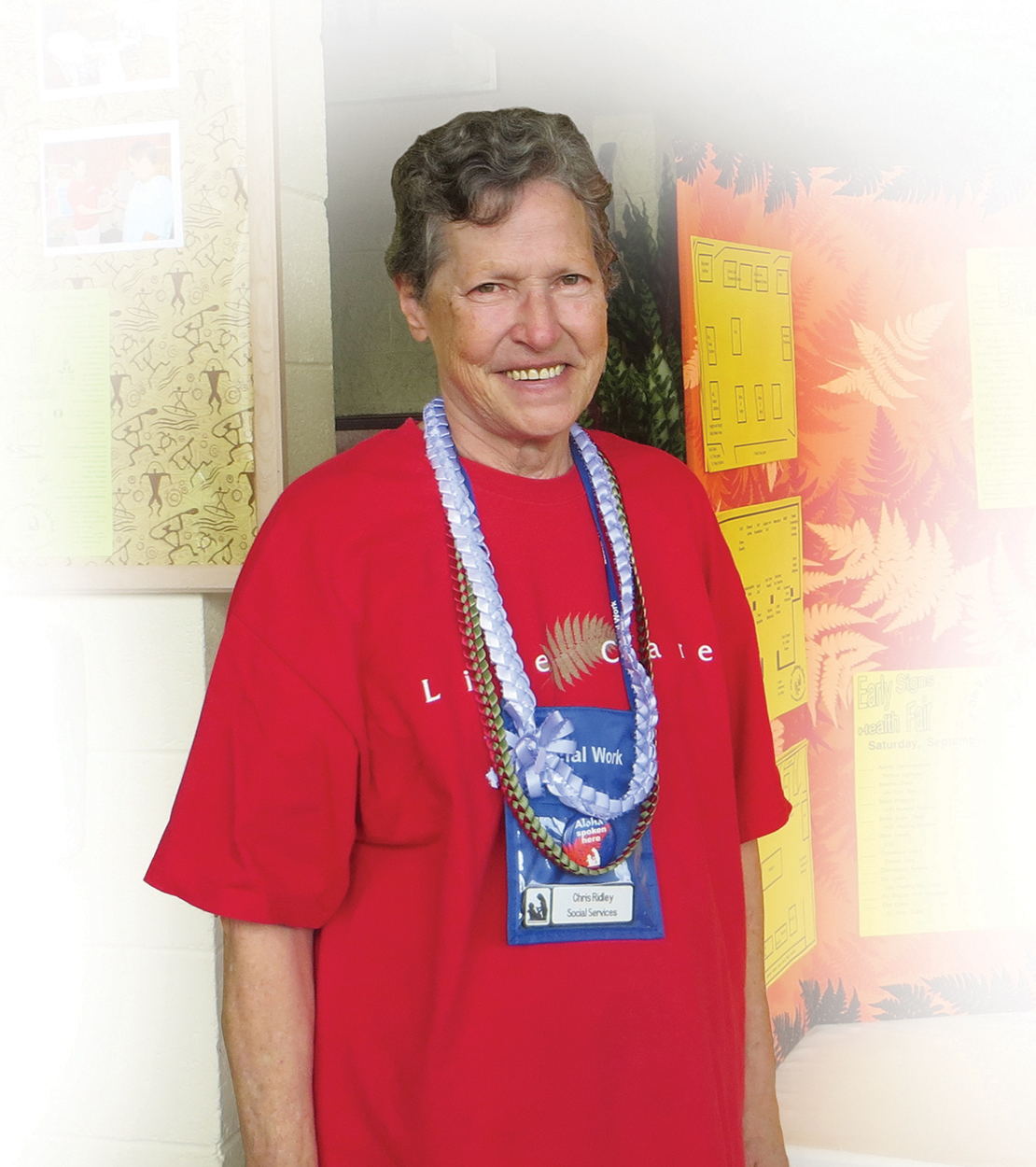
    45-212 Kāne‘ohe Bay Dr. | 808-235-6770 (Kāne‘ohe)
    www.halekuike.com
    Hale Kū‘ike, a residential-home group specialized in Alzheimer’s disease and dementia, employs staff trained in the Positive Approach to Care® model.

    Aging with dignity is a major public health issue for the state of Hawai‘i. People of all ages work with and advocate for the elderly by providing educational resources for families and brainstorming private and public health solutions for the growing needs of kūpuna. All generations offer experience and expertise. By 2029, over 70 million…

  • Project Dana – Small House, Big Services

    Project Dana – Small House, Big Services

    Dana House personnel photos
    Project Dana co-founder and Executive Director Rose Nakamura and her headquarters staff coordinate services to assist more than 1,200 elders. (L–R) Susan Kuwahara, Cyndi Osajima, Maria Morales, Lorraine Mow and Mike Hirano. (Bryson Ho not pictured)
    Little blue house of project dana photo
    The little blue house of Project Dana

    The little blue and white house in Mō‘ili‘ili, where Project Dana started an interfaith volunteer caregivers program has never closed! This headquarters was once the home of the late Kuniyo Nakamoto, who was helped by Mō‘ili‘ili  Hongwanji Mission and Project Dana. She was so grateful for the compassion extended that she willed her home to Mō‘ili‘ili Hongwanji Mission. Volunteer painters, carpenters and electricians helped turn this home into offices, from which this Faith in Action project today serves over 1,200 older adults and seniors. If you have never volunteered, donated or received the services of Project Dana, it’s time you get acquainted.

    1989 members of Moiliili Hongwanji Mission
    In 1989, members of Mō‘ili‘ili Hongwanji Mission began supporting Shimeji Kanazawa and Rose Nakamura in a small Faith in Action ministry to elderly people in their neighborhood. Now Project Dana partners with 32 missions and churches across Hawai‘i, selflessly giving their time to help the elderly.

    Dana is not someone’s name, but a Sanskrit word that means, “selfless giving, an act of compassion.” Buddhists practice dana and teach this prized virtue to their children. Compassionate volunteers of all religions come to Project Dana with a desire to help seniors in need. Soon they discover that their small investment of time provides much more — the healing balm of social, emotional and spiritual support.

    “Shim was an advocate and worked with large organizations — even on the mainland, like the National Federation of Interfaith Volunteer Caregivers,” Rose said. “I wanted to help the seniors, so I said ‘Yes.’ I was 61 at the time, but in good health and very active. My husband, Paul, was living then and helped me set up an organizational plan.”

    Besides Mō‘ili‘ili Hongwanji Mission, other churches in the area joined in: Church of the Crossroads Caring Ministry and St. Mark’s Episcopal Church Aloha Ministry. A total of 32 churches and organizations partner with Project Dana and represent a wide variety of different faiths.

    “We started with a handful of seniors and 15 volunteers,” Rose giggled at the memory. “The mission thought it was a big program. There are Project Dana sites on the Big Island, Maui, in California and Japan, and we coordinate with more than 150 public and private agencies. The “Persons in Need” Fund from the Hawaii Community Foundation provides assistance to homebound seniors for assistive devices, clutter clean-up, respite care and transportation needs. Personal Emergency Response System (PERS) is provided free through State of Hawai’i and Honolulu Police Community Foundation grants for one year to seniors living alone. We offer training to volunteers to assist families caring for elders with memory loss and dementia. In 2019, Project Dana will celebrate 30 years of service!”

    Dana Begins with Volunteers

    Kainoia Akiona photo
    Kainoa Akiona studies
    Dietetics at UH Mānoa and takes his clients
    grocery shopping.

    Kainoa Akiona is studying dietetics and nutrition at the University of Hawai‘i at Mānoa and one of the requirements of his scholarship is to volunteer in the community. Project Dana asks volunteers to give just one or two hours a week; it sounded easy. Kainoa had a vehicle, so Project Dana matched him with an 82-year-old senior who needed transportation to do her food shopping.

    “We became friends, and it has become fun,” Kainoa said. “I just go by her house once a week, pick her up, and we go to whatever stores she needs to visit. Today, my kūpuna needed to go shopping! We went to Foodland, two banks and Safeway. I’ve been volunteering for a year, but I am continuing.”

    “I also provide transportation for a young guy with a rare disability,” he added. “He’s very mindful on eating very healthy, so we shop at Down to Earth on King Street.”

    Kainoa said he has grandparents, so he is used to talking with older people, and works in the food industry where he has to relate to all age groups. He said making conversation with seniors is fun and they like to tease him.

    He is considering continuing his studies and becoming a clinical dietitian or a physician’s assistant. His Project Dana experience has given him a better understanding of his special gift for helping others.

    Volunteer Training Opens the Door

    Melanie Van der Tuin-Oka of HCC
    Melanie Van der Tuin-Oka, a professor at HCC, enjoys spending time with her new friend, Virginia.

    Melanie Van der Tuin-Oka teaches full-time at Leeward Community College and volunteers one hour a week.

    “I have to volunteer early in the morning before my first class, but my client rises early,” she said. “I knew Rose Nakamura and Cyndi Osajima through the temple, but I never worked with the elderly, so Project Dana gave me a half-day of training and formally introduced me to my kūpuna and her daughter. The volunteer coordinator led the conversation so we could become more comfortable. I went back alone the next week, and all my concerns about getting started melted away. I could not have done it on my own, but Project Dana made it easy.”

    Melanie said friendship is “organic”
    because her new friend has a lot to share and she is very curious about Melanie’s life, too.

    “I never really had a grandma, so now I am getting the stories, insights and wisdoms I missed — it is a very sweet relationship,” Melanie said. “As a volunteer, I can always bring cheerful, positive energy and I feel appreciated because when I am visiting, the daughter gets a break. If I discern a need, my Project Dana coordinator can help find resources to take care of it. I just have to pass on the need request. We are fortunate to have many resources for elders in Hawai‘i.

    “I would recommend that readers call Project Dana and volunteer. It is an interfaith nonprofit but it’s not about religion—it’s about compassion. The volunteer work will bring them great joy.”

    A Safe Home is A Happy Home

    Project Dana provides social support to elderly, disabled persons and family caregivers that ensures their well-being and enables them to enjoy continued independence with dignity in the environment of their choice. Among them are home visits, telephone visits, respite care, light housekeeping, minor home repairs and transportation for medical appointments, shopping, care home visits and religious services. They also provide “Caring for the Caregiver” support group for family caregivers and home safety assessments.

    Client Jane Kiuchi is 86 years old and lives independently. She is very grateful for the careful inspection, recommendations and improvements to her home — all initiated by Project Dana.

    “I recommend that seniors have their homes inspected — before they fall!” Jane said. I did it after my fall, but now all the obstacles in my home are gone and I won’t fall again.

    “First, Mr. Mike Hirano came and found places where I needed grab bars and pointed out a list of things I had missed like a clothes rack that was too close to my bedroom door,” Jane said. “If you have to squeeze through a door, the handle can snag your clothing and pull you over.”

    “He told me to put grab bars in the bathroom so I would not hold onto the towel bars, which will not support your weight when you fall,” Jane said. “Then he helped me set up a licensed installer to put three grab bars in the bathroom and five outside my house, too. Now I can walk all the way from my door to TheHandi-Van without my walker. They also got me a PERS button that I can use to call my son and daughter-in-law or 911 if I fall and can’t get to a phone. I feel so much more secure and comfortable in my own home. Everyone who came to work on this project was so compassionate, patient and kind. Please call Project Dana for a free home safety assessment.”

    Dana is for Caregivers, Too

    Jackie Toma tells GM writer Katherine the details of her caregiver support group experience with Project Dana.
    Jackie Toma tells GM writer Katherine (left) the details of her very positive caregiver support group experience with Project Dana.

    Two years after her father passed, Jackie Toma’s mom began going downhill. Jackie had lived in Seattle for 37 years and had herself suffered a stroke but was still working part-time. She returned to Hawai‘i to help her brother care for their mother. Even though they had paid home care, Jackie called on Project Dana.

    “When my father was still living but no longer driving, Project Dana volunteers took my parents to their doctors’ appointments,” she said. “I remember that the volunteer would take them into the office and wait until they were finished and drive them home! It was such a big help.”

    “I was fortunate to have paid home care for Mom, but I was feeling isolated,” Jackie said. “One day, the Project Dana volunteer driver told me that I could join Project Dana’s support group that meets twice a month. To tell you how thoughtful Project Dana is, they offered to send a volunteer to sit with Mom but at that time, she could manage herself at home. How nice of them to think of everything.”

    “The first meeting is educational and you learn a lot!” Jackie said. “Education is provided by experts in physical therapy, assistive devices, Medicare, family mediation, legal issues, Hospice care, to name a few. The second meeting of the month is a combination ‘Rap Session’ and potluck. We all share experiences and learn from one another. It’s tough to deal with frustration and to problem-solve every time your parent’s condition deteriorates. When I was fresh out of ideas, my group came up with answers.

    “I was astounded that ‘graduate’ caregivers would keep coming to our meetings after their loved ones passed. But after my mom passed, I decided to continue attending my support group. I want to mentor others in the same compassionate way I was helped.”

    Rose Nakamura and staff
    After 28 years of organizing, coordinating and service, co-founder Rose Nakamura passes on the office of Executive Director to Cyndi Osajima at the end of October. The dana they practice inspires all their staff and volunteers.

    Rose Nakamura: The Spirit of Dana

    The success of an organization is its ability to continue when the founders pass the mantle to
    a new generation of volunteers. Visionary Shimeji Kanazawa died in 2014 and Rose Nakamura continued as administrator, raising up successors and mentoring new leadership with the same spirit of compassion that led her first to organize Project
    Dana. In August, Rose announced her retirement and Operations Manager Cyndi Osajima is stepping up to executive director starting October 1. The organization will be in friendly capable hands, ready to serve and share compassion.

    This fall is a happy time for Rose, who sees the fruits of her labor in waves of compassion flowing out from the little blue house on Nako‘oko‘o Street and the tides of gratitude returning to encourage her volunteers.

    Selfless Giving Begets Selfless Giving

    Generations Magazine Photographer Brian Suda and his wife, Pamela Cunningham, were caregivers for two decades. When Brian’s dad, Sakae, became frail in the ’90s, Project Dana provided support. Two years ago, when his mom, 97-year-old Tokiko, developed dementia, Project Dana again helped. The gratitude that the Sudas have for Project Dana is the best testimony to this marvelous, gracious community outreach:

    After spending the last 20 years as family caregivers, we sometimes look at each other and say, “How did we survive?” It wasn’t always easy; there were plenty of good times and lots of laughter to ease the complexities of taking care of Dad and Mom. Through both of our caregiving journeys, Project Dana provided us with “scholarships” for much needed respite. A little time off meant that someone else realized how difficult caregiving could be, not just physically but emotionally as well. We used our scholarships to help provide additional days for both Dad and Mom at the day health programs that they attended. We knew that they would be safe and we didn’t need to worry about them.
    It’s hard to put into words the gratitude that we feel for Project Dana, Rose Nakamura and Cyndi Osajima. They and the program will always be close to our hearts and we can never repay them for helping us through the hardest and most rewarding jobs of our lives, but we will try. For now, all we can say is “Thank You, Project Dana.”

    If you want to say “thank you” to Project Dana,
    mail them a note and include a donation to:

    Project Dana
    902 University Ave., Honolulu HI 96826
    808-945-3736 | projdana@hawaiiantel.net n

    The Services of Project Dana

    It is never too early to plan for your own needs or to reach out to others in need. Project Dana volunteers are working throughout Hawai‘i, on the mainland and in Japan to help the frail elderly, persons with disability and family caregivers. Familiarize yourself with their services and share this resource with family, neighbors and friends.

    Caregiver Support Group

    Project Dana’s Caregiver Support Group (CGSG) program is unique in its concept because it is the only support group that provides three consecutive meetings every month during the course of one year. Attendees receive help in the form of education, rap sessions and a fun outing to help alleviate the stress that may come with continuous caregiving responsibilities for someone who is 60 or more years of age.

    Meetings are held on the second, third and fourth Wednesdays of each month from 9 am–1pm unless otherwise specified at the Honpa Hongwanji Betsuin (1727 Pali Highway) in the Social Hall located downstairs of the main temple structure. Parking is available in the front and back of the main temple. All participants are requested to arrive on time.

    Educating the caregiver is of prime importance. During the education session, speakers from different agencies and organizations within and outside the community present topics on health, safety, and understanding of the various issues related to the aging process. The focus is on how these factors can impact both your care recipient and also you, the caregiver. A continental breakfast and a light lunch are served

    The second support component is called the Rap Session. Here, participants are given the opportunity to “talk story.” Joy and frustrations, as well as issues and concerns are often expressed in reference to the daily experiences of caring for a loved one. With this sharing, caregivers explore potential solutions among themselves and from their experience. Participants are asked to bring a dish to share in a potluck luncheon.

    Finally, planned outings are offered to provide the caregivers “free time” to engage in total relaxation — breathing and nurturing the mind, spirit and body with healthy socialization. Discovering new places, and reacquainting oneself with sources outside the realms of everyday caregiving feed the soul. Some outings may require a small fee for participants. If there are any shared costs, participants will be notified in advance with the notice of date, time and theme.

    Project Dana relies on a grant through the Older Americans Act of 1965, Title III E Funds, administered by the Hawaii State Executive Office on Aging through the Elderly Affairs Division, City and County of Honolulu. Monetary donations and other contributions are greatly appreciated to supplement the Caregiver Support Group and maintain the quality of the program.

    In 2008, CGSG program received the Outstanding Support Group award by the Hawaii Family Caregivers Coalition and the once-aired KHON2 Elderhood Project.

    Home Safety Program

    Don’t become one of these statistics!

    In Hawai‘i:

    • 51 percent of deaths among elders are caused by falls occurring in the home.
    • 61 percent of the elders who fall are women.
    • Most falls occur between 9 am and 1 pm
    • People who are 85 years or older are 10 times more likely to fall than those who are between the ages of 65–69.
    • Falls inside the home commonly occur in the bathroom, bedroom and kitchen areas.

    Nationwide:

    • One out of three people 65 years and older will fall each year; most are women living alone.
    • 90 percent of all hip fractures that occur each year are due to falls.
    • Only 25 percent of hip fracture patients will fully recover; 40 percent will require nursing home care; 50 percent will need a cane or walker; and 24 percent over age 50 will not survive more than 12 months after they fall.
    • 60 percent of all falls occur at home.
    • The goals of the Home Safety Program are :
    • To increase awareness of home safety.
    • To create a safe home environment.
    • To allow participants to continue living independently at home.
    • To help ensure quality of life for our seniors.
    • To improve the well-being and enrich the lives
      of our older adults and their families.
    • To identify all potential injury risk factors in
      the home.

    The Home Safety Program provides:

    • An initial home assessment visit
    • Educational information on home safety
    • Recommendations for possible home modifications and/or repairs
    • A follow-up home assessment

    Possible suggestions for home modifications might include: nightlights, grab bars, non-slip mats, non-skid strips, shower seat, portable tub rail, commode, raised toilet seat, replace light bulbs, phone or power cord arrangement, etc.

    Persons in Need (PIN) Funds Available

    Project Dana continues to announce a special fund for seniors 65 years and older. Grants are available through the Gwenfread Elaine Allen Fund and administered by the Hawaii Community Foundation. This PIN Grant supports Hawai‘i’s frail elderly to “age in place” at home, in their community and with their family caregivers.

    The PIN grant at Project Dana is in its fifth year. Assistance is provided through services already offered in three specific areas: transportation, respite and decluttering. Applications will be accepted through October.

    A brief explanation of services follows:

    ✦ Transportation

    Transportation assistance is available to frail elders for medical appointments, shopping requests and legal services such as banking, federal, state, city and county offices. Your safety and well-being are of concern regarding transportation needs. Funds for taxi fares may be offered for special medical appointments.

    ✦ Respite

    Assistance is available to family caregivers whose elders attend adult day care/day health centers or who pay for respite care from a home health agency that goes beyond the two hours provided by a Project Dana volunteer. A one-time-only stipend, up to $600 per family caregiver, may be considered. A new component is assistance for family caregivers for overnight respite. Family members may apply for a one-time-only stipend, up to $150 per family.

    ✦ Decluttering

    Project Dana’s volunteers provide free assessments for home safety and fall prevention. They also help seniors declutter and schedule appointments with professional organizers.

    Volunteers

    Project Dana would not be possible without support from a corps of trained volunteers guided by the principle of dana, a Sanskrit word that means selfless giving and compassion without desire for recognition or reward.

    Project Dana recruits and trains volunteers across the state to assist the frail and elderly with their various needs. Volunteers are sensitive to diverse cultures and traditions and will receive initial and continuing training and education from the project coordinators and specialists. All Project Dana partner organizations and congregations are managed by trained volunteer coordinators.

    For details on any of the program services, a free Home Safety Assessment (ask for Mike Hirano), or if you are interested in volunteering and being a part of Project Dana’s mission of service to the elderly, frail and people with disability, call 808-945-3736 or email projdana@hawaiiantel.net.

    Project Dana Affiliated Locations:

    O‘ahu: Aiea, Honolulu, Mililani, Kāneʻohe, Waianae, Pearl City, Kailua
    Hawaii Island: Keaʻau, Kailua-Kona, Hilo, Honoka‘a, Pepe‘ekeo, Captain Cook, Papa‘ikou
    Maui: Lāhaina, Pukalani, Kahului, Wailuku, Makawao
    Kauai: Līhuʻe

    The little blue and white house in Mō‘ili‘ili, where Project Dana started an interfaith volunteer caregivers program has never closed! This headquarters was once the home of the late Kuniyo Nakamoto, who was helped by Mō‘ili‘ili  Hongwanji Mission and Project Dana. She was so grateful for the compassion extended that she willed her home to…

  • Pour on Laughter, Love & Hope

    Pour on Laughter, Love & Hope

    by Katherine Kama‘ema‘e Smith
    Cover & feature photography by Brian Suda

    It is said, “love conquers all.” And the riveting story of Roy Sakuma’s life and his outreach to at-risk youth proves that the lasting power of love can heal hearts and change minds.

    We all recognize Roy as the ‘ukulele master artist and teacher who founded the annual ‘Ukulele Festival Hawaii that recently celebrated 47 years at Kapiolani Park. Roy also hosts the popular concert series every summer surrounded by the animals at the Honolulu Zoo stage. He and his wife, Kathy, run four music studios where kids and adults learn the joy of playing ‘ukulele. Today, you will learn how Roy came to be Hawai‘i’s foremost ‘ukulele teacher and proponent of the instrument, and the powerful role love has played in his success.

    I Want to Play That Song

    In the 1960s, before Jake Shimabukuro or Israel Kamakawiwo‘ole, the ‘ukulele was regarded by most people as a novelty, according to Roy. Aside from virtuosos Herb “Ohta-San” Ohta and Eddie Kamae, the little Portuguese instrument was popular at the beach and backyard parties but seldom featured by Hawai‘i’s serious musicians, who preferred guitar, steel guitar, piano and even vibes. Mainland rock and roll was king, with electric guitar, bass, saxophone and lots of drums.

    Roy Sakuma and Ohta-San performing together at the 39th Annual ‘Ukulele Festival in 2009.
    Photography by Wendal Au.

    “One weekend, I was riding in an older kid’s car and heard Ohta-San playing Sushi on the radio,” said Roy. “I fell in love with the song. A couple of days later, I saw a classified ad for ‘ukulele lessons with Ohta-San and went right over.

    “Playing the ‘ukulele grabbed me,” Roy said. “After 18 months, Ohta-San encouraged me to go on my own. He said that he had taught me what it took him five years to learn and the rest was up to me. ‘Go out and develop your own style,’ he said. So, I kept playing and the better I got, the more I realized how great my teacher was.”

    “Ohta-San encouraged me to go on my own. ‘Go out and develop your own style,’” he said.

    Roy soon began helping out at Ohta-San’s studio every weekend. When Ohta-San booked a two-week concert tour in Japan, he asked Roy to teach in his absence.

    “I cannot teach,” answered Roy.

    “Just do what I do,” said Ohta-San.

    Roy was just 18 and he practiced all week to stand up in front of 25 adult students.
    “I was very nervous until I began; then, the words just spilled out,” said Roy. “After Ohta-San returned, he asked me, ‘How did you like teaching my students?’ When I said I loved it, he told me to keep teaching them. Ohta-San continued his stellar performing career here and in Japan. And me — wow — after that, all I wanted to do was teach!”

    Roy opened Roy Sakuma Ukulele Studios in 1974 and ran his own classified ad. Over 40 students signed up; four were youngsters — Jason Mitsunaga, Dean Guzman, Milton Chun and Michael Ganab.

    “I wanted these kids to have fun so we started a group called ‘The Termites,’” Roy said. “They were terrific young musicians, and their success and Orange Exchange TV commercial inspired children to learn the ‘ukulele. That grew into four studios and now we are teaching the kids or grandkids of our early students. At our studios, we not only teach music but we also teach love and respect. We care about our staff, and mentor them to treat the students with the same love and respect they receive from us. My philosophy is to put love on top of everything.”


    Sad Hanabata Days

    This joyful man with a deep abiding faith in the power of love, who mentored generations of ‘ukulele players, said he never understood love until he was in his 20s. When Roy was a child, his family struggled with mental illness and isolation. His mother suffered from schizophrenia. His father cared for her at home. A burdened but faithful provider, he overcome his sadness every evening at a local bar. Roy’s older brother also developed schizophrenia and once attacked Roy with a kitchen knife. “I remember sitting at the table watching my mother and brother talking to themselves. My daydreams gave me hope. There was little to eat, except sandwiches my father brought home from the tavern. The one bright light was my older sister, Faye, who was always there to watch over and protect me.”

    Roy was born in 1947. One of his ears was half normal size. Adults would snicker at him and school children would ask, “What’s wrong with your ear?” When he asked his mom, she told him “Blame Buddha for making you like this. Look at all the people; they don’t like us.”

    He became paranoid about his ear and avoided school. “When you are not in school, you find trouble. At age 6, I began smoking. At nine, I was drinking beer. Bad habits lead to mischief.”

    Like most children, Roy was very honest. He told his dad that he was drinking. His father disapproved and punished him, but Roy continued smoking and drinking.

    By age 10, Roy said he was holding “little balls of hurt” inside him. He learned how to tease other kids — to crush them with words and insults before they could make fun of him. “My best friend asked me, ‘Why do you always tease me? Roy, your words hurt!’ That comment hit me hard. I knew how much words hurt me, and apparently my own words also carried anger and hurt. I was amazed to find that after I had stopped teasing my friend, he stopped teasing me. Words turned out to be more horrible than I had imagined. This new knowledge also held a threat. If it is true that ‘What goes around, comes around,’ then a lot was going to come back to me.”

    Still, his sister, Faye, was there for him. Roy recalls one of his fondest memories of their childhood: “When Faye was in the ninth grade, she went to her first social dance at a girlfriend’s house and gave me the number in case I needed her. Being alone at home, I started crying and called her. She came home to be with me. It’s a treasured moment that I have never forgotten.”

    “From ages 10 to 15, I was convinced that it was impossible for me to fit in,” said Roy. “Full of hurt, I thought maybe I should have been born on Mars so that I could live all alone — by myself. My behavior became reckless. I didn’t like my life. Flirting with suicide touched my stone-cold emotions and offered brief relief for my pain. One day, I took a dare to swing on an old withered vine hanging off a big old monkeypod tree. The tree grew on the edge of a 200-foot cliff. I grabbed the vine and jumped off the cliff. Suddenly, I could not feel the vine in my hands anymore and I got scared. When the kids pulled me in, I was hyperventilating. I will never know what made that stunt different from all the others, but it made me stop doing things to put my life in danger… but I was still hurting inside.”

    Roy and Kathy’s first annual ‘ukulele festival opened in Kapiolani Park in 1971. Since then, the ‘ukulele has been brought back into the mainstream of entertainment and the festival has reached popularity worldwide.
    Roy and Kathy’s first annual ‘ukulele festival opened in Kapiolani Park in 1971. Since then, the ‘ukulele has been brought back into the mainstream of entertainment and the festival has reached popularity worldwide.

    “I didn’t finish high school, but at age 20, I was lucky to get a job as a groundskeeper at Kapiolani Park,” said Roy. “I was so grateful for that job and did all they told me — and more. Working hard was never a problem. I liked working alone; hand-raking the whole park was my favorite job. Of course, I had learned social behavior — smiling, joking and nice teasing, but inside I was insecure and hurting. I never talked down to others because I didn’t want them to speak badly about me; instead, I bit my lip to protect myself. I never spoke of feelings or love. I did not know what the word ‘love’ meant. Even as I was still struggling with a crushed spirit. I picked up my ‘ukulele and a tune spilled out:

    I am what I am;
    I’ll be what I be
    Look, can’t you see
    that it’s me, All of me

    Copyright: Roy Sakuma Productions, 1970

    “This song would become a theme for my life,” said Roy. “Once we doubt who we are and forget that we are special, bad things can happen.

    Love is Patient and Kind

    “In my early 20s, I met Kathy, the first girl I ever wanted to date,” said Roy. “I got up my nerve to ask her out to see the Harlem Globetrotters, who were coming to town. Thank goodness for the Globetrotters!

    “From then on, Kathy and I dated once every couple of weeks, and I wanted to hold her hand, but I was afraid for her to touch me,” Roy admitted. “Hugging and other expressions of love were foreign to me and scared me. One time, we attended the Punahou Carnival, and to avoid getting separated in the crowd, I had to grab her hand. Holding hands wasn’t so scary after all.

    “At our studios, we not only teach music, but we also teach love and respect.”
    “At our studios, we not only teach music, but we also teach love and respect.”

    “A year later, I told her that I loved her and asked her to marry me,” Roy said. “She said, ‘yes!’ I went home so happy. But the next morning, I woke up crying — I knew that I must let her go. I didn’t deserve her and she would be better off without me. This love thing was beyond me.

    “The next day, I asked her to meet me,” said Roy. “I asked her to please listen. I told her the truth about my fears — that my ear makes me hate looking in the mirror when I comb my hair, that I am paranoid and hate to see my body , that I am so ugly I don’t belong here; I am so ashamed that I could never make her happy.

    “My philosophy is to
    put love on top of everything.”

    “Kathy listened. I did not want her to pity me; I wanted her to walk away and find a better man. Finally, she said, ‘I don’t see these things as your weaknesses. I see them as your strengths.’

    “I was stunned. I just told her all my imperfections and failings — and she still loves me! Her love released me from the prison of my pain. It was like a gust of wind that cools the face. I had shared everything with her, and I could never go back there by myself. She loved me! Her love allowed me to reveal everything and to heal.”

    Soon they married and became a team.

    Love Rejoices in Truth

    Since 2007, Roy Sakuma has been sharing his story with elementary and high school students — not as a music teacher — but as an inspirational speaker. His deep, intimate message touches youths who might be hurting like he was — troubled, isolated from their families, or struggling with thoughts of suicide. Roy doesn’t offer them advice; he doesn’t criticize their ideas or behavior. His story strikes a familiar chord.

    “When I share my story, I ask kids who are hurting to raise their hands,” said Roy. “Hands go up and it is their way of reaching out.”

    They recognize that he endured deep hurt and can understand their pain. They listen because he does not pity them. Instead he offers them the same key that unlocked his chains — love. And he points them to the richest source of love, their parents and teachers.

    Listen With Love

    Roy’s message of love over hurt is not only for youth but also for adults.

    “Once kids fill up with hurts and shut down, responsible adults that they respect can help,” said Roy. “Adults can listen to them with love — with an open heart and mind.

    “Kids really want to talk to their parents, but they are so afraid,” Roy continued. “They think that their parents are not interested, won’t listen or don’t understand them. Kids believe their parents: ‘won’t understand me, don’t love me, ignore me, don’t care, always get mad at me…’

    “Parents often compliment and criticize their kids in the same breath. ‘Kimo, you did a great job, but…’ A hurting kid who can’t process their feelings will reject your encouragement as soon as they hear ‘but.’ They are bursting with so much hurt that they have difficulty seeing beyond it. Try giving compliments and then just listening.”

    Love Endures All Things

    “If you found a good way to deal with your feelings, share that with your kids,” said Roy. “Help them process their feelings with family and other trusted adults. Most of all, recognize that your child’s feelings are real and honest.

    “Love your teens with the same unconditional love and forgiveness you gave them when they were 1-year-old toddlers. Parental love is forever. Put love on everything before you say it.

    “In our music studios, we teach with love,” said Roy. “‘Ukulele music takes away stress and music crosses all emotional barriers. For some, the lesson is the highlight of their week. For us, it is an opportunity to share love, laughter and hope.”


    ROY SAKUMA ‘UKULELE STUDIO
    3555 Harding Ave., Honolulu HI 96816
    808-732-3739 | www.roysakuma.net


    It is said, “love conquers all.” And the riveting story of Roy Sakuma’s life and his outreach to at-risk youth proves that the lasting power of love can heal hearts and change minds.

  • Mo’ili’ili Family Ties

    Mo’ili’ili Family Ties

    by Katherine Kama‘ema‘e Smith
    cover & feature photography by Brian Suda

    The traditions and language of the original Japanese immigrants to Hawai‘i in the late 1800s survived because they taught their children to venerate and value the culture of the homeland. In over six subsequent generations of American Japanese, no single organization has nurtured language and culture more than Mo‘ili‘ili Community Center on O‘ahu. In addition to supporting a thriving Japanese Language School for children, the center opens its doors five days a week to 300 to 500 senior members who come to participate in a wide array of arts, activities, educational programs and adult day care. This private nonprofit organization is the traditional bedrock of Mo‘ili‘ili families.

    Executive Director Nadine Nishioka told Generations Magazine about the 115-year history of the center. In the 1890s, children of plantation worker families in Mo‘ili‘ili attended Japanese language school in the private home of Kihachi Kashi-wabara. Mo‘ili‘ili was a large marshland area at the bottom of Manoa Valley, behind Ala Wai (then a river) and Waikiki Beach flats. Lands adjacent to the many ponds and Kapaakea Springs were cultivated with rice, lotus and various vegetables. Along the dirt trails of this farming community were small shops and businesses, and wood-framed houses. Beside the homesteads, small plumes of smoke rose from wood stoves used for ofuros and cookhouses. Customs, foods, religious beliefs and common interests knit the residents of Mo‘ili‘ili into a harmonious community.

    The Center’s Heritage

    In the late 1800’s, when the sugar barons of Hawai‘i wanted to expand their plantations, they recruited farm workers and engineers from Japan. The men came first and soon brought in their wives. Freedom and work opportunities in Hawai‘i offered hope to young Japanese from a homeland ravaged by decades of war with China. Chinese invaders outlawed the practice of Japanese cultural traditions and Japanese language, so schools and temples were important features of a new life in Hawai‘i. For Japanese immigrants, plantation camps promised a second chance for success. In Mo‘ili‘ili, the community drew together and in 1928, purchased the language house and land that became the community center.

    During WWII, the Mo‘ili‘ili community founded a formal council association. At that time, mainland Issei and Nisei were being interned in war camps, but in Hawai‘i, the Nisei first joined the civilian volunteer brigade and later entered the U.S. Army. The council was a hub for the community to gather and support one another. After the war, in 1945, they were awarded an official charter, and 20 years later, in 1965, this private nonprofit organization was formally named “Mo‘ili‘ili Community Center.”

    ADULT DAY CARE AND SENIOR ACTIVITY CLASSES AT MOILIILI COMMUNITY CENTER; COVER PHOTO OF BOARD MEMBERS, SENIOR AND CHILDREN ATTENDEES OF MOILIILI COMMUNITY CENTER; PHOTOS FOR GENERATION MAGAZINE
    ADULT DAY CARE AND SENIOR ACTIVITY CLASSES AT MO’ILI’ILI COMMUNITY CENTER; COVER PHOTO OF BOARD MEMBERS, SENIOR AND CHILDREN ATTENDEES OF MO’ILI’ILI COMMUNITY CENTER; PHOTOS FOR GENERATION MAGAZINE

    The Center Today

    The business model for today’s center is simple and very successful. “Our members pay an annual membership fee that covers our overhead, salaries and operating expense,” said Nadine. “Next year, the fee will go up to $40 from $35 per person,” said Nadine. “Some seniors add a cash gift with their membership because they can afford it and they appreciate the benefits they are receiving here. For some seniors, the fee seems high but it all works out. We never turn away any seniors who may have difficulty paying the fee.” Professional planners say that successful community programs are designed and resourced at the grassroots level. Nadine agrees. She places the success of the center squarely on its members. “Our seniors know the programs they want and we just listen to them,” said Nadine. “They want mahjong, and they want it early in the day when they are alert and have a better chance of winning. They organize the games and find the prizes. Senior center staff members make sure the room is ready and oversee their plans. Mahjong starts at 7:30 am, and is so popular that our seniors are lined up and waiting in front of the door at 7 am.”

    “Whenever MCC members have an idea for an activity or event, they make a plan and find the resources to put on the program,” said Nadine.

    “We provide the space and scheduling and our members ensure the program or event’s success.”

    One of the most popular weekly sessions is Rhythm & Life held every morning. This award-winning Japanese exercise and stretching program is designed for elders and choreographed to Japanese music. Rhythm & Life invites both actively mobile seniors (standing) and less mobile seniors (seated) to better fitness and improved blood circulation. The packed room is filled with intently engaged and happy faces as the participants work out to the beats of various rhythms and tunes. Other active options include outcome-based exercise, Zumba, classic tai chi and a special tai chi class for seniors with im-paired balance who want to rehabilitate themselves. This one is important for preventing falls. “I think one beauty of our center is that seniors who have lost a spouse or no longer live in their old neighborhoods may come here and socialize while they participate in healthy activities for body, mind and soul,” said Nadine. “We offer physical exercise, mental stimulation and ways to learn and participate, but socializing combats isolation and loneliness. Members have the opportunity to spend happy times with people who share memories of earlier times and traditional values.”

    This benefit was certainly obvious to Generations staffers, who saw members chatting before and after yoga class and senior Zumba.

    A display of the impressive artwork and handicrafts produced by MCC members proudly hangs in the center. It demonstrates the wonderful skills seniors can learn here. Traditional kumihimo is the art of braiding cords and ribbons. In ancient times, the samurai braided decorative laces for their armor; today, ties on haori jackets or obi kimono sashes are often crafted with kumihimo. When combined with beading, kumihimo art produces intricate and elegant bracelets. and festive dancing to enka music. Each year, Japanese teachers bring different traditional arts and crafts.

    Art classes abound, with origami, shodo calligraphy and festive dancing to enka music. Each year, Japanese teachers bring different traditional arts and crafts.

    Japanese Language at the Center

    Language is the foundation of culture, and today, children are still learning Japanese at Mo‘ili‘ili. The intensely interactive program includes plays and performances that delight the whole family. The original mission of passing on the Japanese language to the next generation was a budding flower of the old Mo‘ili‘ili community. Today, the branches of that flowering plant produce a bouquet of family-based activities, arts and expressions. A few of the directors on the center’s board actually attended Japanese language classes at MCC when they were in grade school!

    Today, K-5 children attend Japanese after-school classes every weekday and practice speaking Japanese with their parents, who learned it in the same facility. The whole family is able to speak Japanese with the grandparents. While many MCC programs are geared to elders, the center itself is oriented to fulfill the needs of  the entire family, interacting across age groups as they do at home.

    The Teens in Action program gives young volunteers in seventh grade or higher an opportunity to work as aids in the many children’s programs at MCC: After-school A+, Early Morning Care, and programs for school intercession, holidays and summer break.

    Senior Programs at the Center

    Cultural and community outreach events of MCC are all organized, planned and resourced by staff and member volunteers. Everyone pulls together to make the center a vibrant place where members can be proud of all they accomplish. Their volunteer work results in fun, satisfaction and benefits the community.

    “Our members love singing karaoke, and performing both ‘auana hula and Japanese dance; when they learn a dance well, they like to perform it at homes for the elderly,” said Nadine.

    “They recently organized performances at various senior daycare centers and nursing homes. We provide the transportation, they make their own costumes, and delight in bringing beauty and enjoyment to the other elders.” Another community service for which MCC recently became a partner is a version of Meals on Wheels. Instead of delivering meals to seniors’ homes, MCC drivers go out and bring elderly to the MCC dining hall for a hot meal. Coming to the center gives them the opportunity for socialization and conversation in a safe, happy environment. The new program is working very well. Nadine regrets that MCC does not have more space and staff for their very popular Kupuna Support Program. This adult daycare program is for frail as well as not-so-frail seniors who can use the restroom with very little assistance. They participate in a number of fun, healthy activities geared to stimulate their minds, bodies and souls. Palolo Chinese Home Catering provides a healthy lunch, which is included in the Kupuna Support Program fee — $55 a day.

    “We always have a waiting list,” said Nadine. “The need for good adult care is so great that families are willing to be ‘on call’ for an opening of just one or two days when one of our regular clients is sick or traveling.”

    By the end of Generation Magazine’s tour of MCC, it was clear that we could fill two issues with program details and still not cover every offering at this wonderful community center—transportation and escort services, excursions, counseling, special events and more.

    Become a Center Member

    If you are over 60 and live in Honolulu between Ward Avenue and Hawai‘i Kai, you are within the city area serviced by Mo‘ili‘ili Community Center. However, MCC also welcomes participants from all areas of O‘ahu. To learn more about the organization and its many programs, please visit www.moiliilicc.org.

    This year, Mo‘ili‘ili Community Center is celebrating 115 years as a place of learning, health and enrichment. For many generations, the center has served families and created family ties throughout a broad community. MCC’s important work continues due to the generosity of many donors, grants and the Aloha United Way. If you wish to help them with a cash donation, remember that all donations to MCC support the programs, not the administration. Donations are tax deductible and every dollar helps the beneficiaries of the center.


    MO‘ILI‘ILI COMMUNITY CENTER
    2535 S King St., Honolulu HI 96826 Hours: M–F 8 am to 5 pm
    808-955-1555  |  Fax: 808-945-7033 | office@moiliilicc.org  |  www.moiliilicc.org

    The traditions and language of the original Japanese immigrants to Hawai‘i in the late 1800s survived because they taught their children to venerate and value the culture of the homeland. In over six subsequent generations of American Japanese, no single organization has nurtured language and culture more than Mo‘ili‘ili Community Center on O‘ahu.

  • Senator Akaka & NKFH: Creating a Healthier Hawai‘i

    Senator Akaka & NKFH: Creating a Healthier Hawai‘i

    The National Kidney Foundation of Hawaii (NKFH) is aiming high with a new clinical community resource center. It broke ground in July and Sen. Daniel Kahikina Akaka wants all of us to support the last bit of fundraising. The new center in Kapolei will house many clinical community programs to help people at risk of chronic kidney disease get early screening and teach them how to stay healthy.

    At 92, Sen. Akaka is still working to help the people of Hawai‘i. His warm, sunny smile continues to encourages us to celebrate goodness with gratitude for all we have. He retired several years ago, but while in Washington, he learned how many persons in Hawai‘i suffer from chronic kidney disease (CKD). Since he came home, he has been helping NKFH tackle this disease.

    “I was astounded that kidney disease was such a big problem for us,” Sen. Akaka said. “Hawai‘i has 30 percent more kidney disease than other states; Native Hawaiian, Pacific Islanders, Filipino and Japanese communities are most affected — a major segment of our community. When I retired from public service, I made the Kidney Foundation of Hawaii the focus of my continuing community work. The need is so great and NKFH has many successful programs that help people stay healthy. If we can help get the word out, they can help more people at risk for kidney disease.” One person can’t solve such a big problem alone, so Sen. Akaka is asking all of us to learn more about CKD. We can help involve our families and mo‘opuna in healthy habits that protect our kidneys. We can encourage them to get screened for early signs of diabetes and high blood pressure — the two disorders that often lead to CKD. Currently, NKFH offers free educational materials, health programs and community screening events at various locations throughout the state every year.

    Above: An artist’s rendering of the Sen. Daniel K. Akaka Community Center in Kapolei. Left: Sen. Akaka with NKFH Senior Director Diana Benningfield at U.S. Renal Care West Oahu Dialysis.

    Chronic Kidney Disease
    The chronic or long-term decline of kidney function may start after a urinary tract infection or occur as a result of other disorders. Because kidney disease often starts “silently,” persons losing kidney function will not notice any symptoms until it is too late to save their kidneys.
    The best way to know if your kidneys are healthy is to undergo simple urine and blood tests. Patients who already have mild chronic kidney disease may be able to slow the progress by testing their “numbers” regularly and adopting lifestyle habits that are healthy for their kidneys.
    We met up with Sen. Akaka and NKFH Senior Director Diana Benningfield at the U.S. Renal Dialysis facility in Kapolei, which provides dialysis services for people whose kidneys no longer function. Here’s what we learned: Most dialysis patients have had diabetes or high blood pressure for some time. Eventually, these disorders damage the tiny filters inside the kidney called glomerular units that transfer waste products and toxins from the bloodstream to the urine. Eventually, the kidneys stop funtioning, causing toxins and am monia buildup in the blood and patients develop the symptoms of end-stage kidney disease.

    Early detection with simple screening tests can help slow down the advance of chronic kidney disease.

    Without treatment, persons in kidney failure will die. Dialysis machines can keep patients alive, but the treatments may be very challenging for patients and their families. Dialysis machines pump a patient’s blood over membrane filters to remove waste products and ammonia, and return clean, filtered blood back into the patient. Each treatment may take several hours and may have to be repeated up to three times a week. A dialysis treatment schedule requires a lot of energy, and between treatments patients have to watch what they eat and how much fluid they drink.

    Another option for patients with kidney failure is organ transplant. However, not all patients are candidates for a kidney transplant, and those who do qualify must join a waiting list until a healthy kidney donor with a good immunological “match” may be located. in Hawai‘i, patients may not have dialysis units nearby their homes and may have to face a long waiting list to receive dialysis treatment.

    Sen. Akaka Community Center Promotes CKD Prevention
    “Finding a cure for diabetes or high blood pressure goes on,” said Sen. Akaka, “but until then, we need to prevent diseases, not just find cures.”
    To this end, the senator is raising funds to build the Daniel K. Akaka Community and Kidney Clinical Resource Center that will also house a new array of NKFH programs and services at Kapolei. The center will invite the community to a place where they can participate in health and wellness programs that support the prevention of chronic kidney disease.

    Creating awareness for regular screening has been a major outreach project for NKFH for many years. The goal of the foundation’s publicity and innovative clinical programs is to screen as many adults and keiki as possible in order to detect kidney disease before dialysis is required. With early detection and health skills management, patients can work with their doctors and NKFH to control and slow the progression of CKD. Screening and education allow many people with kidney disease to maintain a robust quality of life and avoid going on dialysis.

    The new clinical community resource center will also offer the public and patients with CKD a hub where all may learn and master new habits that will keep their kidneys healthy—such as cooking classes. Families can come to the center for screening tests, attend health classes, participate in healthy exercise and learn how to manage life with CKD. Nonprofits will be invited to the center to use its meeting rooms for gatherings and special activities.

    “Aside from the teaching kitchen, where people learn how to cook healthy meals, we also plan to have a commercial kitchen for creating new healthy food products,” said Glen Hayashida, president and CEO of NKFH. “When people ask us, ‘What can I eat now?’ we want to provide useful resources. Our cookbooks are popular and great for homemakers, but many new patients don’t know how to cook. We want the center to be a vital health resource.”

     Everyone should seek education about kidney disease, regardless of gender or age.

    Health Maintenance Skills Are a Necessity
    Sen. Akaka supports the NKFH’s programs because he knows that a healthy lifestyle has positive benefits for ku¯ puna.

    “The body needs exercise,” he said. These days, he goes to the gym every day, usually using the weight machines. Although he uses a cane to assist in walking, gym equipment allows him to exercise his upper body, lower body and core muscles.

    With the help of his family, he began choosing healthier foods about 15 years ago, when he was 77. His wife, Millie, and daughter, Millanne Akaka Matson, started buying foods without preservatives. They said it used to be difficult to eat out because they could not be sure menu items were appropriate or healthy. Most of their food had to be homemade. But now, more restaurants offer healthy choices.

    Earlier this year, the senator started a no-salt diet to reduce water retention.

    Other health maintenance programs slated for the new center will be diabetes training classes, high blood pressure classes and fun, outcomebased physical fitness programs.

    Right Kind of Learning for Hawai‘i’s People

    “We need a facility with people who will work with patients and look at the culture of the people of Hawai‘i,” says Sen. Akaka. “There are many ways to deliver information and care. People receive guidance in different ways based on their upbringing and beliefs.”

    Pukui, Haurtig and Lee researched the powerful connection between cultural traditions in Hawai‘i and how patients relate to healthcare in Na¯na¯ I ke Kumu: Look to the Source. The book is the basis for Sen. Akaka’s comment. He understands that resource center professionals must provide services to the community with cultural sensitivity and in a way that is acceptible to patients and their families. Getting individuals to accept their disease, comply with treatment and modify their lifestyles to achieve better health requires a comfortable “conversation.” Talk story takes time. We live in a land where the sitting down for a chat requires getting to know each other sharing a snack and telling stories of our past. The community center can draw people in and create an environment that encourages the way we learn in Hawai‘i.

    A Little More Fundraising for the Clinical Community Resource Center


    In July 2016, community leaders ceremonially broke ground for the new NKFH headquarters, a prime location to serve more than 40,000 West O‘ahu residents suffering from kidney disease. The ground floor of the $12 million, three-story building will house the Senator Daniel K. Akaka Community and Kidney Clinical Resource Center, including a library of his papers and books. The upper floors will have room for NKFH’s clinical and educational programs and services. Any additional space will be available for lease.

    “I look forward to this kidney wellness center minimizing the impact of CKD for people who now suffer from the disease. It will be the source that eliminates the disease for future genertions,” said Sen. Akaka. “We have raised three-quarters of the funds already. Our grand opening is slated for January 2018.” Humble as ever, he said that he’s just playing a small role: It’s coming together because so many hardworking people are attached to it. “I’m just here to help,” he said.

    L–R: Ray Soon, Ernie Soon, Steve Kelly, Danny Kaleikini, Ty Cullen, Glen Hayashida, Sharon Har, Kim Marcos Pine, Mike Gabbard and Lois Mitsunaga at the NKFH groundbreaking in Kapolei.

    “You can help, too, in a number of ways,” he said. “Just visit our website at www.kidneyhi. org to see how you can get involved — we always appreciate your kind support and kokua.”

    Human and Financial Costs of CKD

    The statistics for CKD in Hawai‘i are a big concern for our state. More than 168,000 people are already diagnosed with CKD and another 100,000 are at risk for kidney disease because they have diabetes or high blood pressure.

    Of the 450 patients on the organ transplant waiting list, over 90 percent are waiting for kidneys. Most will die before they have the opportunity to get into a dialysis treatment program or to receive a kidney transplant operation. End-stage kidney failure is heartbreaking and reinforces the need for prevention and health maintenance.

    For Sen. Akaka, funding the very high healthcare costs of dialysis and kidney transplants is a big concern for our state. NKFH programs are the best option for reducing the costs of CKD in Hawai‘i.

    Sen. Akaka remembers his third-grade teacher at Pauoa Elementary engaging her students in mathematics with a piggy bank. She used it for several lessons, “teaching us math by counting the money,” he said. Then the teacher asked them to write down what they would buy with the money. “That was our composition lesson,” he said. For young Daniel, the practical application of mathematics to accounting would serve him well in life.

    Many years later, he applied the piggy bank lessons to his work in Congress. While serving on the Senate Committee on Banking, he developed the consumer advocacy portion of the Dodd-Frank Wall Street Reform and Consumer Protection Act. The legislation was created in response to the financial crisis of 2008 and ensuing Great Recession. It brought new regulations and consumer protection initiatives to the financial industry.

    A Matter of Hawaiian Values

    Sen. Akaka frames his work with NKFH in terms of Hawaiian cultural values, which some call “plantation values.” He grew up farming taro on kuleana land in Pauoa Valley, the youngest of eight children. Working the land in a side valley up Nu‘uanu and managing the chores of a large family encouraged cooperation, shared responsibility, reciprocity and peacekeeping. “I was the niele (questioning) one,” he said, “I always wanted to know things.” Akaka, a Chinese name, came from his father, Kahikina Akaka, who was hapa Hawaiian and Chinese. His mother, Annie, was fullblooded Hawaiian.

    Volunteers are an essential part of CKD awareness programs.

    “Spirituality and faith carried our family,” he said. The Akaka family way of life was daily prayer, with daily morning and evening devotions and Sunday services at Kawaiaha‘o Church. Righteousness was expected. Doing things “pono”— justly, with integrity and for the common good — was Daniel’s way of honoring the deeply held values that his parents taught him.

    After attending Kamehameha Schools, he joined the Army Corps of Engineers during World War II from 1943 to 1947, first training at Schofield Barracks and then serving in the Central Pacific at Eniwetok in the Marshall Islands, and Guam and Saipan in the Marianas. After the war, he graduated from UH Ma¯noa to become a high school social studies and music teacher. He went into school administration and became the chief program planner for the state.

    After winning his first congressional election in 1976, Daniel K. Akaka served 13 years as a U.S. Representative and then another 19 as a U.S. Senator. He always lived by the rule of “pono” righteousness, saying, “the just things [you accomplish] will remain constant through the times.” He is most famous for the Akaka Bill, which would have established a process for federal recognition of Native Hawaiians. Although the bill never passed, his vision is still part of every discussion and action that furthers self-governance for Native Hawaiians.

    Another cultural principle that guides all his work is aloha. “I think the mission for Hawai‘i is to help the world know aloha,” he said. “If the world could live and have relationships like the people of Hawai‘i, the world would be a much better place.”

    The Future Looks Bright

    This community center approach to prevention has strong support. There is a good probability that community access to lifestyle training and support will help a large number of patients and their families at risk for CKD. Hawai‘i’s people will have a better opportunity to maintain their health and slow the onset and progression of the disease.

    Every day is a new day of progress, education and hope for families struggling with CKD. Let’s help Sen. Akaka and NKFH find a cure, and also support our families and neighbors until the time when a cure is found.

    The National Kidney Foundation of Hawaii (NKFH) is aiming high with a new clinical community resource center. It broke ground in July and Sen. Daniel Kahikina Akaka wants all of us to support the last bit of fundraising. The new center in Kapolei will house many clinical community programs to help people at risk of…

  • Jeff Apaka: Compassion in Action

    Jeff Apaka: Compassion in Action

    cover-story
    “ I didn’t really choose Waikīkī — my feet were already permanently planted here in the sands of my ancestors. Waikīkī is my kuleana and it makes me whole.” — Jeff Apaka


    Hawai‘i greets the rest of the world at Waikīkī. Each year, millions of tourists compare their Hawai‘i brochures to the first impressions they get from the world’s most famous beach community. Jeff Apaka grew up there, entertains there, works as community relations director for Waikīkī Community Center and sits on the Waikīkī Neighborhood Board No. 9. He is a serious advocate for his community.

    Hawai‘i operates on a delightful mix of pragmatism and altruism. We are very practical people who can make something from nothing, solve problems and find a way to do whatever is needed. We don’t think about rewards as much as we care about helping others. The highest praise is when a kūpuna says we are “nice.” That one word means we manage our kuleana (responsibilities) well, respect our community and try to make decisions that help people around us feel more comforted, happy and secure.

    Jeff Apaka is nice. He is part Hawaiian, part Chinese and a few more parts; he embodies the finest Hawaiian traits. In his roles as a professional “showman” and a compassionate community leader, he taps into his gift of kindheartedness and uses his innate talents to make life in Hawai‘i a little better for everyone.

    cover-story
    Alfred Apaka, 1919 –1960

    It wasn’t easy getting to where he is. Jeff’s father, renowned romantic baritone Alfred ‘Aholo Apaka, died at age 40 when Jeff was just 13. Besides a career as an entertainer and producer, Jeff had a family kuleana to care for two of his elders. Blending his gift of compassion into his entertainment talents led him to a long career with Waikīkī Community Center as a community relations director. Now in his own kūpuna years, Jeff is a protector of his beloved Waikīkī community, and the elders who live there.

    cover-story

    His early life was split between Hawai‘i and Beverly Hills. When he was 6, the movies and TV drew the Apaka family to Beverly Hills with the help of Bob Hope. Billboards, neon lights and Hollywood glitz fascinated little Jeff, with bigger-than- life director, actor and studio executive “neighbors” like Caesar “Butch” Romeo and The Andrews Sisters. Beverly Hills High School schoolmates included Rob Reiner, Rick Dreyfus and Albert Brooks.

    Alfred Apaka’s crossover career was hot. From his start at Don the Beachcomber (now The International Marketplace), his records began selling on the mainland. Postwar thirst for Hawaiian music was driven by a hundred thousand veterans who had fallen in love with the romantic, soothing airs of steel guitars, ‘ukulele and island tunes sung by luscious Hawaiian voices like Apaka’s. In the ’50s, aloha shirts were the rage and the “Hawaii Calls” radio show broadcast around the world. Sellout crowds at The Lexington Hotel’s Hawaiian Room in New York City clamored for the tunes of Alfred Apaka, “the darling of Manhattan;” Mahi Beamer; John Kameaaloha Almeida; Haunani Kahalewai; Nina Keali’iwahamana; Clara Inter (Hilo Hattie); and the Ray Kinney band.

    cover-story

    Jeff’s dad appeared on “The Ed Sullivan Show” and “The Dinah Shore Show.” Bob Hope helped him get a contract to help Henry J. Kaiser popularize his new Hawaiian Village Hotel in Waikīkī. The sky was the limit.

    Fame often takes its toll on families. When Jeff was in the fourth grade, his parents divorced and he returned to Honolulu with Mom. He began exploring his own performing talents. During eighth grade at San Rafael Military Academy, tragedy struck — Alfred’s heart suddenly failed during a game of handball — and Dad was gone.

    cover-story
    Alfred Apaka teaching his son, Jeff, the ‘ukelele as Mom watches. Above, auntie shows Jeff some hula.

    Jeff took it hard. He spent two years at a Jesuit seminary in Canada before returning to Beverly Hills High School, where he graduated in 1964. He went alone to his audition for the American Academy of Dramatic Arts in New York City, and joined a class with Danny Devito and Melanie Safka. He also took acting classes at Fordham University and in 1968, he was singing the mainland nightclub circuit when he had an offer to debut in Honolulu with his own show at the Monarch Room of the Royal Hawaiian Hotel. Things started to happen; he was signed to Capitol Records. Among all the Waikīkī entertainers, Jeff was always the baby; the youngest.

    In performing arts, Jeff is his own man. “My voice is like my dad’s but not as romantic — my strength is as a song and dance showman. I had piano and violin lessons when I was young and I love music, but Dad wanted to be a physician, not a singer. He encouraged me to do well in in my studies, but creating live productions is my passion; I can do almost anything onstage.” Jeff also writes skits, directs and produces. His creativity, eye for detail and organization skills make him a talented event producer and manager.

    From 1979 to 1983, Jeff starred with Audrey Meyers in the popular “Here is Hawai‘i” stage show written by Keola Beamer and produced by the late Tom Moffatt at the Maui Surf Hotel (now The Westin Maui Resort & Spa).

    “That was my favorite gig. We had live rain, snow, an erupting volcano and falling stars onstage. For the “Honolulu City Lights” number, a big moon glowed over a silhouette of the Honolulu skyline as the lights came on in the buildings. A great show transports the audience to their deepest emotions: love, longing, joy and laughter. That’s why we had so much fun doing it and audiences loved it,” said Jeff. “Smiling and laughter is so important to health and longevity, and nothing brings more joy to people than live shows.”

    After the Maui show, Jeff returned to Waikīkī to become a caregiver for his maternal grandmother and paternal grandfather. Nobody ever gets training for family caregiving. When the time came, he had the right stuff to honor his kūpuna and keep himself going — compassion and lots of energy.

    After his kūpuna passed, Jeff built a career, first entertaining passengers as a cruise director on The Independence and The Constitution. Later, he produced the shows.

    “During this time, I was also the chief barker for Variety Club: A Children’s Charity. On Christmas Eve, 1928, a club for entertainers in Pittsburgh found a baby abandoned in their theater and took her to raise. Today, Variety Clubs in many states aid children,” said Jeff. The chief barker (club board president) organizes fundraising events. Jeff’s success with Variety Club of Hawai‘i impressed the late Gerri Lee, who then recruited him to run fundraising events for the Waikīkī Community Center.

    Compassion and Business

    cover-story

    On the flip side, Jeff Apaka is a community leader. In the tradition of Hawaiian performers, his “day job” is critical for residents of Waikīkī. Last month, he celebrated 25 years as community relations director for the WCC on Paoakalani Avenue. In his spare time, he has been serving on the Waikīkī Neighborhood Board No. 9 for the last 18 years. Waiki¯ki¯ residents often see Jeff strolling with Ponoli‘i (the righteous one), his 13-year-old Chihuahua—a kūpuna “puppy.”

    “When I grew up on Launiu Street, homes had gardens, hedges, coconut trees — no highrises. The Waikīkī neighborhood was full of Hawaiian families. Local kine beach boys ruled the beach and tourism was just beginning to boom. Later, mainland surfers moved in and brought drugs with them. The stretch from Liliuokalani Avenue to Kapahulu Avenue came to be called ‘The Jungle,’ a pejorative description that portrayed our home as tenement housing for kānaka maoli.”

    “That was not the truth. Hawaiian seniors residing in this moderate- living community wanted nothing to do with addicts, who not only ran the streets but also renamed old shore breaks so that the Hawaiian names eventually became lost.

    cover-story

    In 1977, Sen. Hiram Fong Jr. and Gov. George Ariyoshi founded the WCC by putting Gerri Lee’s Waikīkī Senior Program in the old St. Augustine parochial school buildings and Dr. Chong’s Waikīkī Health in the vacant convent. Today, WCC also includes the Early Learning Center for preschoolers and an active thrift store.

    The board members, staff and donors of WCC developed a very successful nonprofit, offering Waikīkī residents senior health, wellness and prevention programs, and individual case coordination services for frail seniors at risk for homelessness. Caroline Hayashi, president of the nonprofit, said, “Our workshops, activities and educational programs meet the physical, cognitive, social, emotional and well-being needs of our kūpuna. We have over 70 different activities for seniors every month, from exercise to leisure interests — and free parking for all our
    activities.”

    May 8, 2017, is the 25th anniversary of the WCC fundraiser, The Duke Kahanamoku Beach Challenge (formerly, the Ala Wai Challenge). Jeff built this paddling race around some of Hawai‘i’s most celebrated watermen — Tommy Holmes, Blue Makua, Michael Tongg, Nappy Napoleon and the late Myron (Pinky) Thompson. Now, this huge public event is held at Hilton Hawaiian Village on Duke Kahanamoku Beach, where the lawn comes alive with crafters and live entertainment. Canoes bring in dignitaries to the mauka end of the lagoon for a traditional Hawaiian welcoming protocol to bless the spirited competition and fun!

    “When I was new at WCC, I wondered how I could pull off something like this, but the strength and inspiration of my kūpuna and my friends in the community led the way to success,” said Jeff. “It’s a great cause because we help so many kūpuna and keiki.

    “Helping is fun. I like escorting seniors on travel tours to outer islands twice a year. At Thanksgiving, I plan a buffet dinner for kūpuna who have no family here or on the mainland. The Waikīkī Beach Marriott Resort & Spa and my musician friends help with food, beverage and entertainment.”

    Jeff’s roots in Waikīkī are deep. “We all crave identity. I knew my middle name, ‘Aholo,’ was connected to Dad’s Hawaiian lineage, but our ties to Queen Lili‘uokalani explain my deep affection for Waikīkī and Maui’s red carnations. Actually, I did not really choose Waikīkī — my feet were already permanently planted here in the sands of my ancestors. Waikīkī is my kuleana and it makes me whole.”

    cover-story

    Princess Lili‘uokalani adopted Jeff’s grand-aunt, Lydia Ka‘onohiponiponiokalani ‘Aholo, when she was 7 days old, after her mother died in Lahaina, Maui. Lydia played in the princess’s gardens on Wainani Way, Waikīkī, when Lili‘u’s land, Hamohamo, was an open meadow stretching across Paoakalani Street and the Ala Wai Canal to Kapahulu and out to the beach. Lydia attended Kawaiaha‘o Seminary School for Girls. She was the first graduate of Kamehameha School in Kalihi and its first Hawaiian language instructor. Lydia’s father, Luther ‘Aholo, taught at Lahainaluna Seminary. “Aunty Lydia ‘Aholo told Alfred Apaka to honor Queen Lili‘uokalani by wearing a double lei of sweet, tiny red carnations that grew in Luther and Keahi’s yard on ‘Aholo Road in Lahaina. Today, whenever Jeff performs, he wears white to set off the traditional ‘Aholo double red carnation lei — and his father’s jade ring.

    cover-stroy
    Lydia Ka‘onohiponiponiokalani ‘Aholo

    Jeff talks about the future with the same energy and compassion that he puts into all his work. “I wish all kids could experience the mainland living. It would help them relate better to visitors, and allow them to better appreciate Hawai’i Nei. The ‘āina connects everything and we must do what we can to protect it. Waikīkī ahupua‘a extends up Mānoa Valley. A lot of the kingdom is underneath the concrete of Waikīkī.”

    cover-story

    Jeff recently finished five years starring in and producing a Hawaiian show at the Hilton Hawaiian Village. “Visitors still come to Hawai‘i to hear live Hawaiian music,” he said. He is looking for a permanent theater home in Waikīkī for an updated live show.

    Jeff worries about Waikīkī kūpuna on fixed incomes, and especially those who are being displaced by high-rise condominiums. “Just a small increase in the cost of living forces seniors to make choices about what they can afford to buy. Sometimes the choice is between rent and food.

    cover-story

    Every little thing we can do for them that saves them money helps them keep going and stay in their homes. I hope everyone who reads this article will support the Waikīkī Community Center. I hope Waikīkī families will seek WCC services, participate in our programs, volunteer or donate.”

    Feeling pity doesn’t help others; action does, but requires a lot of courage. Jeff does not shrink from his desire to help others. He finds a way to get things done, like the Hawaiians of old.

    “Mahalo to all the community leaders and people who have worked with me through the years; I know your love for this place.”

    Jeff makes me think of one Alfred Apaka lyric, “Keep a smile on your lips, brush the tears from your eyes…” Jeff energizes his deep compassion to help kūpuna, keiki and their families — and dry up their tears. It’s a powerful talent. Perhaps Jeff’s recipe for success is worth a try.


    Lend Your Support for a USPS Alfred Apaka Stamp

    cover-story

    Jeff is leading a campaign for a commemorative stamp in 2019, Alfred Apaka’s 100th birthday. The U.S. Postal Service counts on the Stamp Advisory Committee to decide who gets honored. We need thousands of letters from the entire Hawai’i community to win their attention. Write a short note today and send it to:

    Citizen’s Stamp Advisory Committee
    475b L’endant Plaza SW, Rm. 3300
    Washington, DC 20260-3501

    Sample Letter:

    Aloha to All Committee Members,

    Please consider commemorating Alfred Apaka (1919–1960) on a U.S. Postal Service stamp in 2019.

    Before jet travel, the romantic voice of Alfred Apaka broadcast throughout the world live on “Hawaii Calls,” “The Ed Sullivan Show” and “The Dinah Shore Show,” making fans everywhere dream of visiting the Hawaiian Islands. In the dynamic years leading to statehood, Apaka’s popularity drew audiences to all Hawai‘i entertainers and a new genre of American music.

    Mahalo for your kind consideration!

      Hawai‘i greets the rest of the world at Waikīkī. Each year, millions of tourists compare their Hawai‘i brochures to the first impressions they get from the world’s most famous beach community. Jeff Apaka grew up there, entertains there, works as community relations director for Waikīkī Community Center and sits on the Waikīkī Neighborhood Board…