Tag: aging in place

  • Helping Kūpuna Age Safely at Home

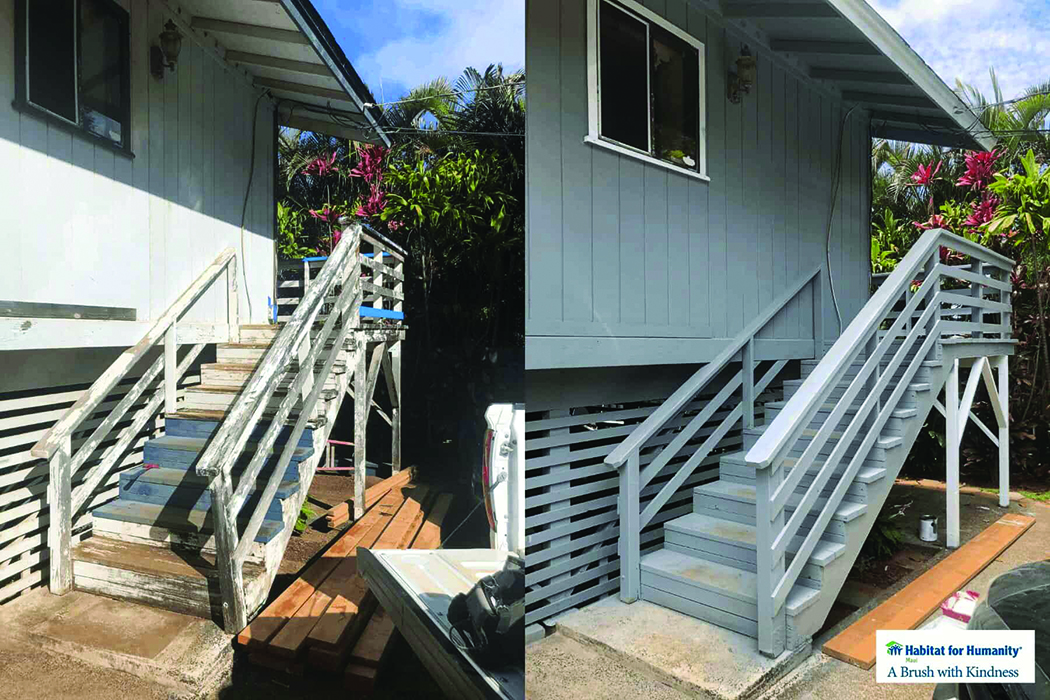
    Aging is a natural part of life, but it often comes with challenges, especially for our kūpuna who wish to remain in their own homes. Maintaining a safe and comfortable living environment can become increasingly difficult with age, but programs like “A Brush with Kindness” are stepping in to provide invaluable support.

    This Habitat for Humanity Maui initiative focuses on home preservation and aims to assist low-income homeowners with essential home repairs, maintenance and improvements at no cost.

    The program offers more than just home repair. It’s a lifeline for many kūpuna who might otherwise struggle to remain in their homes. By addressing critical home maintenance needs, the program helps prevent accidents, reduce the risk of illness and enhance overall well-being. Additionally, having a safe and well-maintained home means more than just physical security. It’s about dignity, independence and peace of mind, ensuring they can age in a safe and supportive environment.

    As we look toward the future, it’s essential to continue supporting such initiatives. We need to remember the profound impact that a helping hand can have on all of our lives — but especially the lives of our beloved kūpuna. For them, your impact is priceless.

    HABITAT FOR HUMANITY MAUI (nonprofit)
    1162 Lower Main St., Wailuku, HI 96793
    808-242-1140 | info@habitat-maui.org
    habitat-maui.org

    Aging is a natural part of life, but it often comes with challenges, especially for our kūpuna who wish to remain in their own homes. Maintaining a safe and comfortable living environment can become increasingly difficult with age, but programs like “A Brush with Kindness” are stepping in to provide invaluable support. This Habitat for…

  • Seminars Explore Smart Homes, Brain Health

    Remember those kitschy “Clap on! Clap off!” commercials of the 1980s? (See one below). Who would have guessed that “The Clapper” device they advertised to turn your lights on and off with a clap of your hand was ahead of its time?

    Now we have entire homes with smart devices and voice assistants. Instead of clapping, we say, “Hey, Alexa,” “Hey, Google” or “Hey, Siri.”

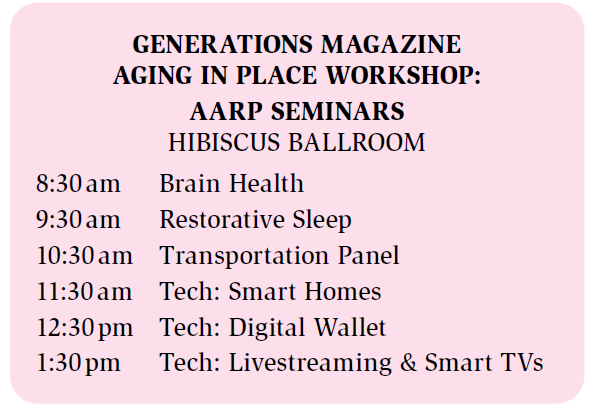
    If you’re still stuck in the ’80s and clapping to turn on a light or manually using light switches, AARP is offering a free seminar just for you at the Generations Magazine Aging in Place Workshop on Aug. 3, Saturday, this year.

    An instructor from Senior Planet, an AARP affiliated charity dedicated to helping older adults thrive in today’s digital age, will teach participants about smart homes and how they can help caregivers and kūpuna age in place. Smart homes can do so much more than just control your lights. Using technology, you can monitor your body health, visit with doctors and nurses through telehealth, detect falls or wandering, detect fires or unsafe situations and call for emergency assistance.

    Other seminars AARP is offering will cover the importance of sleep in keeping your brain healthy and strategies to fight insomnia, streaming and smart TVs, how to use a digital wallet, transportation alternatives and more.

    There’s no pre-registration and seating is first come, first served. You don’t have to be an AARP member, nor of AARP age to attend the Aging in Place Workshop or AARP’s seminars.

    Learn more about Senior Planet classes and resources: Seniorplanet.org.

    AARP HAWAI‘I (nonprofit)
    1001 Bishop St., #625, Honolulu, HI 96813
    808-545-6000 | hiaarp@aarp.org | aarp.org/hi
    AARP is a non-partisan organization dedicated to empowering
    Americans 50 and older to choose how they live as they age.

    Remember those kitschy “Clap on! Clap off!” commercials of the 1980s? (See one below). Who would have guessed that “The Clapper” device they advertised to turn your lights on and off with a clap of your hand was ahead of its time? Now we have entire homes with smart devices and voice assistants. Instead of…

  • 15th ANNUAL AGING IN PLACE WORKSHOP

    Generation’s Magazine’s 15th annual Aging in Place Workshop was held on Saturday, August 12 at the Ala Moana Hotel.

    Thanks to everyone who attended and those who participated as volunteers and sponsors. Your help was greatly appreciated.

    If you attended and would like to leave us a comment, please fill out our comment form by clicking on the QR below:

    Generation’s Magazine’s 15th annual Aging in Place Workshop will take place on Saturday, August 12 at the Ala Moana Hotel. Everyone is invited – there’s no admission fee and no reservations are required. For details, call 808-234-3117.

  • Assisted Living Facilities Strive to Adapt

    An interview with Tricia Medeiros, Chief Operating Officer of The Plaza Assisted Living

    What brought you into the caregiving field?

    I took a job as a business office manager at an assisted living community while I was in college. My major was accounting and I fully intended to become a CPA. But by the time I graduated, I knew I wanted to be an  administrator at an assisted living community. I felt good about what we did and loved the residents. There was no way I could leave.

    Has the perspective on residing in an assisted living community changed over the years?

    There was a time when there was a stigma attached to moving into an assisted living community. Residents were labeled as “old;” adult “drop-off,” similar to a childcare facility, was implied. Now, the derogatory labels are far from true. Moving into a senior community is now looked at as a way to live independently, not depending solely on family or others. The lifestyle is an opportunity to enjoy yourself and not be burdened with household chores. It is a much favored option these days.

    What are the most common reasons a senior moves or is moved to assisted living?

    Assisted living is the perfect combination of living in an independent apartment while receiving the assistance to allow that to happen. Assisted living also provides an opportunity to socialize with peers. Residents can have dinner guests or enjoy a cup of coffee with a friend any time. Peers are readily available for exercising, playing mahjong or creating arts and crafts projects together.

    Do residents move to assisted on their own or are they placed there by their families?

    Ultimately, everyone moving into assisted living agrees with the transition. Oftentimes, adult children help and research options, but in the final analysis, every resident has to make the choice to move in or not. The only exception is residents with memory issues. In those cases, a family member or loved one will need to facilitate the process.

    What challenges do facilities face?

    The most recent challenge for assisted living is COVID-19. The pandemic underscored the vulnerability of the senior population and the importance
    of the role an assisted living facility must provide to ensure the safely of its residents.

    Most assisted living communities moved quickly and put protocols in place to protect residents. Staff was screened and equipped with personal protective equipment (PPE). Residents were being carefully monitored.

    It is important that residents, families and team members know that most assisted living facilities have become a safer environment than some of the alternatives at home.

    What precautions should assisted living facilities put in place to protect their kūpuna?

    Senior living facilities should protect their kūpuna during the pandemic. This is certainly a time to put safety first. They have the responsibility of screening everyone that enters the community to ensure that no one is sick, has a fever, recently traveled or has been in contact with anyone with COVID-19. Steps should be taken to include the resident in a cohort to minimize spreading of the virus. The facility must also be equipped in case the virus does enter the community. The facility must have plans already in place in order to care for infected residents and minimize the spread.

    How is the industry preparing for the future?

    The industry is preparing for the “new norm.” The previous focus on hospitality must shift to safety. Protocols and screening will remain in place for visitors and staff alike. Safety will be prioritized and assisted living facilities will continue to be the safest places for seniors to live.

    I took a job as a business office manager at an assisted living community while I was in college. My major was accounting and I fully intended to become a CPA. But by the time I graduated, I knew I wanted to be an  administrator at an assisted living community.

  • Emmet White at the Arcadia… life care without walls

    Emmet White at the Arcadia… life care without walls

    Emmet White—local attorney turned retirement community CEO—offers us insight into the business of aging in Hawai‘i. At Arcadia Retirement Residence he sees firsthand the costs and benefits of senior care.

    You may know Emmet White from his previous life as a local attorney, board member of Central Union Church or Colonel in the Hawai‘i Army Reserves; however, most know him for his work as President and CEO of Arcadia Community Services, the holding company for Arcadia Retirement Residence, Craigside Retirement Residence, The Arcadia Foundation, Arcadia Edler Services and Arcadia Home Health Services.

    Emmet explains The Arcadia Family of Companies’ approach to senior care, including its future plans for “life care without walls”—or homebased care—a concept that combines services so that residents can age in place at home.

    In addition to what retirement communities such as Arcadia are doing to serve seniors, Emmet says that ‘seniorhood’ as a whole needs to be reshaped. Times are changing. The demand for senior care is exceeding supply, and the effects of Health Care Reform are yet to be known. He says that smart use of technology, medical care and education are critical for successful health care in Hawai‘i. However, he cautions, on a personal level, each of us needs a shift in attitude about saving for our senior years. It’s up to all of us to bear the cost of our own senior care, as best we are able, to ensure quality of life in our later years.

    GM: With your family on the East coast, why did you decide to move out to Hawai‘i? Having been here for 40 years, are you here to stay?

    EW: I had roomed for a year in college with a fellow from Hawai‘i, and gorgeous warm weather all year round was very appealing to me. In 1971, I talked with my wife of 1½ years, Betty, about going to Hawai‘i and seeking jobs. With some hesitation and misgivings she said, Okay. When we arrived in Hawai‘i in late 1971, my former college roommate’s family was very welcoming and supportive to Betty and me. As fate would have it, I passed the Hawai‘i bar exam and was hired by a small law firm. Betty was initially hired as a parttime history teacher at Sacred Hearts Academy (she is now the Head of School). We haven’t had anytime to look back since!

    GM: What do you love most about Hawai‘i?

    EW: I love the beauty of Hawai‘i’s weather and the people who live here, as well as the opportunity to raise a family and work all these years with Betty at my side.

    GM: What is something people don’t know about you?

    EW: For 10 years, in my youth, I was a drummer in a summer community band on the New Jersey shore, which gave weekly concerts on the boardwalk. I enjoyed this “gig” very much!

    GM: What is your favorite restaurant? EW: Betty and I have three favorites: Paesano’s in Ma¯noa when we have a yearn for Italian; Ruth’s Chris at Restaurant Row when I have a yearn for a good steak; and, Panya at Ala Moana Center when we’re alone, hungry and worried about eating too much!

    GM: You and your wife Betty White of Sacred Hearts Academy must have very busy lives. What do you guys do for fun?

    EW: Betty and I like to be quiet together when we’re not on the go—we both enjoy reading, or a special trip with just the two of us! I also enjoy an occasional round of golf. We enjoy entertaining—I do the food shopping and Betty does the cooking. Much of our free time is spent with three grandsons, all under the age of 3 years old.

    GM: What is a good day for just you?

    EW: Our Arcadia companies are devoted to providing quality care and services for our seniors. During the day I see a cheerful outlook and many little acts of love and kindness by, between and among our staff, residents and our families and friends. As I reflect on the day, usually during my drive home, I say a short prayer of thanks, and believe that life is good!

    GM: Any hobbies other than work?

    EW: For years I enjoyed playing softball in the lawyer’s league on Saturdays (I’m long retired), and, for now, keeping an eye on our young grandboys when their parents are busy is the hobby of choice!

    GM: What motivated you to go from the legal field to working with seniors, and how was the transition?

    EW: In 1995, Arcadia, on which I had served as a board member from 1983, was at a crossroads needing new leadership and direction. Based on discussions with the Directors, and after conversations with my family, I decided to give this leadership role a try. The small law firm of which I was a member, was disappointed, but was supportive of my move from the active practice of law to my working at Arcadia. The transition from law practice to a leadership role in senior living and health care services was quick and with no regrets or second-guessing. Over the last 15 years we have honed our senior care skills and developed six related companies to provide vital services for our kuˉpuna.

    GM: What have you learned from your residents that inspires you?

    EW: I have found that when you sit quietly, listen and ask good questions, you will find in each senior resident, participant or client a unique past with wonderful experiences, insights and a special brand of wisdom that produces volumes of valuable and enjoyable knowledge for you and your fellow workers. I am also inspired daily by the great devotion to each other I witness in the couples that reside at Arcadia.

    GM: Any favorite stories or residents that you can share?

    EW: Indeed, there are volumes of stories, but one that is emblazoned in my memory is that of a beautiful, very petite, 95-year-old resident, whom I had known for years. She had finally agreed to be with us in our Health Care Center. Cancer was taking its toll. When I came to visit with her a few days after her move, she informed me that she had only $50,000 left. Taken back by her direct comment, I remember asking, “What, Marge, do you want to take it with you?” We both had a hardy laugh, and I told her that we would not speak of money again. Then, with her piercing wide and deep blue eyes, looking up at me with a look that at once combined wonderment and joy, she asked, “Emmet, what do you think Heaven will be like?” A host of thoughts cascaded through my mind, as I knew Marge, a wonderful person and friend, would soon be embarking on her journey beyond. I remember saying to her, “All I know, Marge, is that if St. Peter gives you any trouble, I’m doomed to purgatory forever.” A couple of months later Marge passed. But, her query always flashes before me when death is addressed, and her expression, as the start of her journey neared, has always been an inspiration to me for what awaits us beyond our life on Earth.

    GM: What do your residents love most about Arcadia?

    EW: There are many reasons that seniors reside at Arcadia. I believe one of the initial reasons people chose to reside at Arcadia is the promise of lifetime care, including long-term assistance, should the need ever arise. But, I think that what most residents come to love about Arcadia is being a part of a caring community where dignity, companionship and the environment bring joy and good quality to life everyday

    GM: Are you planning to, or could you see yourself, living in Arcadia later on in life?

    EW: With the average age of entry for Arcadia at 80 years of age, in a nutshell, if I live that long and Betty sees the value at the time, Arcadia (and 15 Craigside)—if affordable for us—are very attractive options for Emmet’s and Betty’s “very” senior years!

    GM: Do you see more retirement communities like Arcadia coming in the future?

    EW: No doubt. On the Mainland, there will be more retirement communities similar to Arcadia in the future. And, while the metrics suggest that Hawai‘i needs more senior living facilities, the cost, as well as the government permit and development processes in Hawai‘i, may be too prohibitive for the design, planning, construction and operation of a new Continuing Care Retirement Community (CCRC), especially for that amorphous middle class of Hawai‘i seniors who are too poor to be rich, and too rich to be poor.

    GM: What is your opinion on the new Medicare reforms?

    EW: The 2010 Medicare reforms come with a substantial price tag:

    ■ higher/new taxes on the well-to-do

    ■ taxes on annual health insurance plan premiums that are more than $10,200 per individual (e.g. 40% of that cost)

    ■ new fees on the health care industry (supposedly because they’re getting new customers)

    ■ cuts in Medicare spending

    While these reforms promise better coverage, the “redistribution” of benefits may not produce overall satisfactory results.

    Of course, change and adjustments in senior health care and services are inevitable. I do think that people need to adjust ambivalent attitudes about devoting personal wealth and assets to one’s care in their senior years. We also need to embrace the smart use of technology, medications and clinical care. Adjusting attitudes will have a lot to do with the future success of our huge and expensive health care system.

    GM: What is your vision for health care in Hawai‘i?

    EW: The smart use of technology, medications, and medical and clinical care are critical to future successful health care in Hawai‘i, as is consistent and continued education on health care programs and services for seniors and their families. There needs to be a major change in consumer attitudes regarding the responsibility for personally bearing much greater costs for our own senior care and long-term care. Senior long-term care and services are not and cannot be a government entitlement program.

    GM: Obviously not everyone will be able to live in Arcadia even if they wanted to as there are not enough beds. In your opinion what is our future look like for long-term care?

    EW: Statistically, long-term care is a possible factor in every senior’s future. But, no one knows, and the data is unable to tell us specifically, who will need it and for how long it will be required. Private enterprise and government must work in close collaboration with each other to maintain a strong safety net for those less fortunate. Nursing facilities are, and will be, needed to deal with the more intense sub-acute care required for indigent nursing home residents, as well as private pay nursing home residents, which home- and community-based programs cannot reasonably and responsibly handle.

    GM: Home-based care is where most families have the challenge to care for their loved ones, is there any easy fix?

    EW: There is no “easy fix” for home-based senior care. The Arcadia Family of Companies’ approach to senior care and senior services in the greater community has been evolving. We are pursuing the concept of “life care without walls.” This business concept involves the need to develop the right combination of the following elements for residents who are aging in place in their homes and apartments:

    (1) a reasonable financial posture

    (2) a reasonable and comprehensive cost schedule

    (3) a care coordinator

    (4) home/apartment inspections with appropriate maintenance for a senior’s safety and convenience

    (5) at least, personal annual geriatric assessments and acceptable health planning and focus

    (6) an emergency response system

    (7) appropriate in-home assistance with one’s activities of daily living

    (8) transportation, as needed

    (9) meals, as needed

    (10) access to a location with social and wellness programs, including programs and therapies at Arcadia and 15 Craigside

    (11) companions, as needed and as planned

    (12) referral to sub-acute facilities, as may be required.

    Another part of the “fix” is the recognition that one has to assume personal responsibility for the cost of a better quality of life in one’s senior years. The government may provide some help, but, generally, the lion’s share for senior care and services should, and must be borne by the senior.

    GM: Do you plan or want to live to 100?

    EW: It isn’t my call on reaching 100! If I am given the privilege of a longer life (at 64, I think I’ve just embarked on “those senior years”), I hope my quality of life will be good, so I prepare for the future by trying to adhere to the sound and popular core values we share at the Arcadia companies, as well as saving some money for the “senior costs” Betty and I might face!

    GM: Thank you for this wonderful interview. How would you like to sign off to this?

    EW: Thank you, Percy, and Generations Magazine for the opportunity to talk about thinking, learning, and planning with our families and loved ones for our anticipated walk into an exciting and rewarding “senior” future.

    Emmet White—local attorney turned retirement community CEO—offers us insight into the business of aging in Hawai‘i. At Arcadia Retirement Residence he sees firsthand the costs and benefits of senior care.

  • Affordable Adult Day Care

    Often, families don’t know where to turn when a loved one suddenly needs constant care. Insurance and Medicare plans may cover very few long-term care expenses — or none at all. In the past, nursing homes were the only option for care outside of the family home. However, now there are many home- and community-based services that help support aging in place.

    In Hawai‘i, adult day care services, home care and respite services are available. One of the most cost-effective options is adult day care. Programs provide eight to 10 hours of supervised care in a group setting facility licensed by the Hawai‘i Department of Health. Participants are engaged in exercises, music, arts and crafts, enabling them to socialize with their peers. This interaction reduces the clients’ loneliness and isolation, and also provides peace of mind and respite for families.

    Day care fees range from $65 to $100 per day and include snacks and a meal. Some centers accept long-term care insurance, Medicaid and/or may be contracted with the state Kūpuna Caregiver Assistance Program. To find an adult day care center near your home or work place, contact the Aging and Disability Resource Center (ADRC) at www.hawaiiadrc.org or 808-643-2372 toll-free.


    LIVE WELL AT IWILEI by Kahala Nui
    888 Iwilwi Road, Ste. 105, Honolulu, HI 96817
    808-218-7777 | www.livewellhi.com

    Often, families don’t know where to turn when a loved one suddenly needs constant care. Insurance and Medicare plans may cover very few long-term care expenses — or none at all. In the past, nursing homes were the only option for care outside of the family home. However, now there are many home- and community-based…

  • 3 Tips to Help Discuss Aging in Place

    There is no perfect time to discuss end-of-life care. Most seniors would prefer to age in place at home, as independently as possible. But too few take the time to discuss their preferences with their family, leaving family caregivers
    stressed and scrambling. The most important thing any family can do to prepare for a loved one to live at home is to talk about it today.

    Here are three tips to keep in mind as you discuss and plan how to spend those precious golden years.

    Tip #1: Don’t wait for a perfect moment. Bring up the topic casually at family dinners and get-togethers, so everyone is present to hear your wish.

    Tip #2: Be alert for behavior and lifestyle changes. If you notice changes, have a conversation with a medical professional about what kind of caregiving support might be needed.

    Tip #3: Have the conversation by age 60, at the latest! This is a natural age when retirement, healthcare and financial planning conversations are happening. Include aging-in-place planning in that mix.

    Above all, consider working together with caring professionals to help your kūpuna live long, independent, and comfortable lives.


    HOME CARE BY ALTRES MEDICAL

    808-591-4930  |  homecare@altres.com
    www.altreshomecare.com

    There is no perfect time to discuss end-of-life care. Most seniors would prefer to age in place at home, as independently as possible. But too few take the time to discuss their preferences with their family, leaving family caregivers stressed and scrambling. The most important thing any family can do to prepare for a loved…

  • The AIP Workshop: Sharing Expertise & Aloha

    The 12th Aging in Place Workshop held on August 18 at the Ala Moana Hotel brought our readers and their friends and family in contact with Generations Magazine’s partners in a vibrant atmosphere of sharing and learning. More than 60 exhibitors and 20 presenters informed and encouraged attendees in their quest for knowledge about how to successfully navigate this stage of life. Mahalo to the Hawai‘i Lions and Leos of District 50, who welcomed and assisted them!

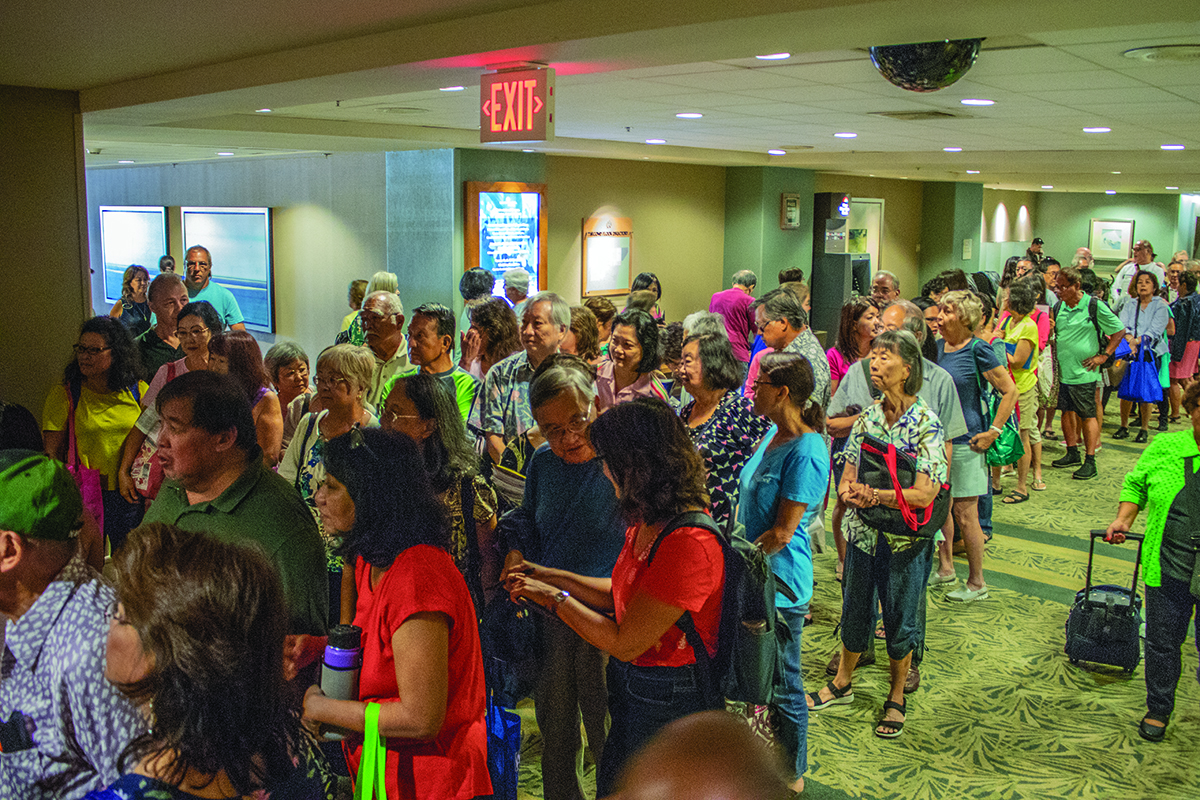
    With attendance high, many of the most popular talks drew large crowds, eager to learn more about the topics.

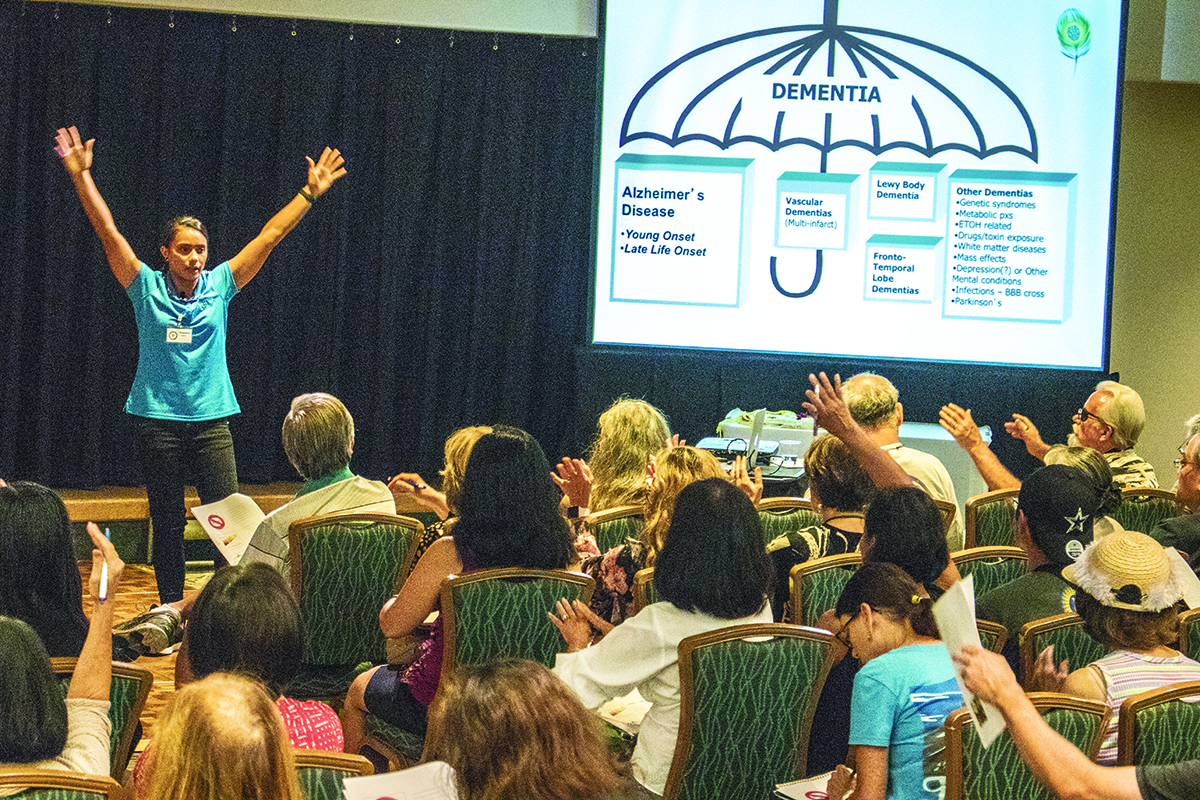
    Presenters who are experts in their field covered everything from keeping fit to caregiving to retirement planning.

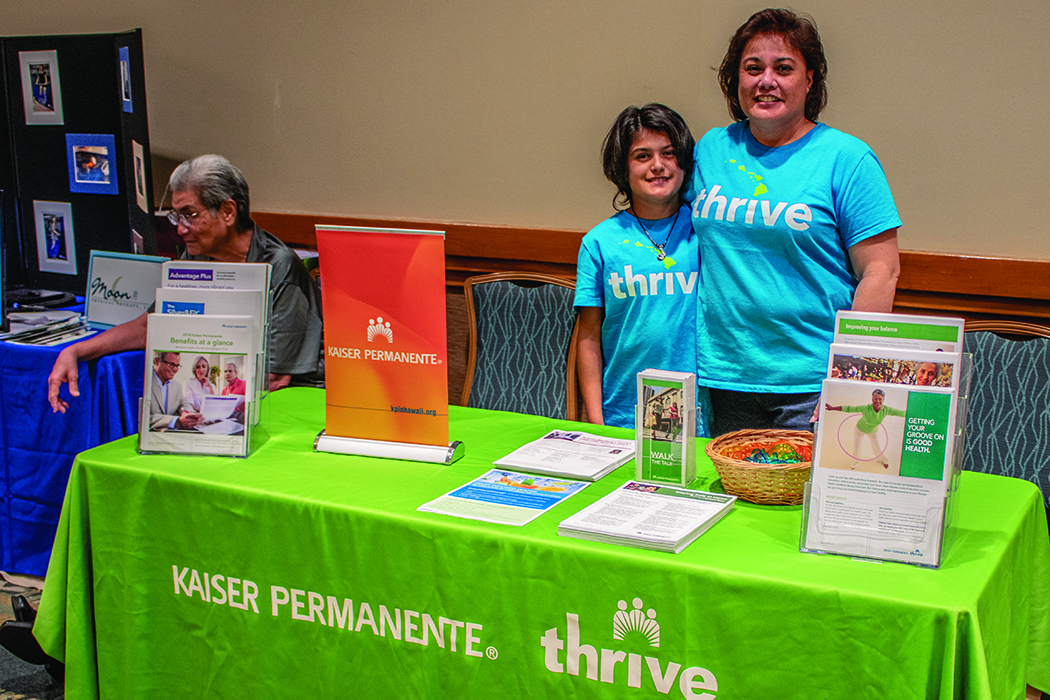
    Kaiser Permanente’s Brandy Ching and her assistant, Sophia.

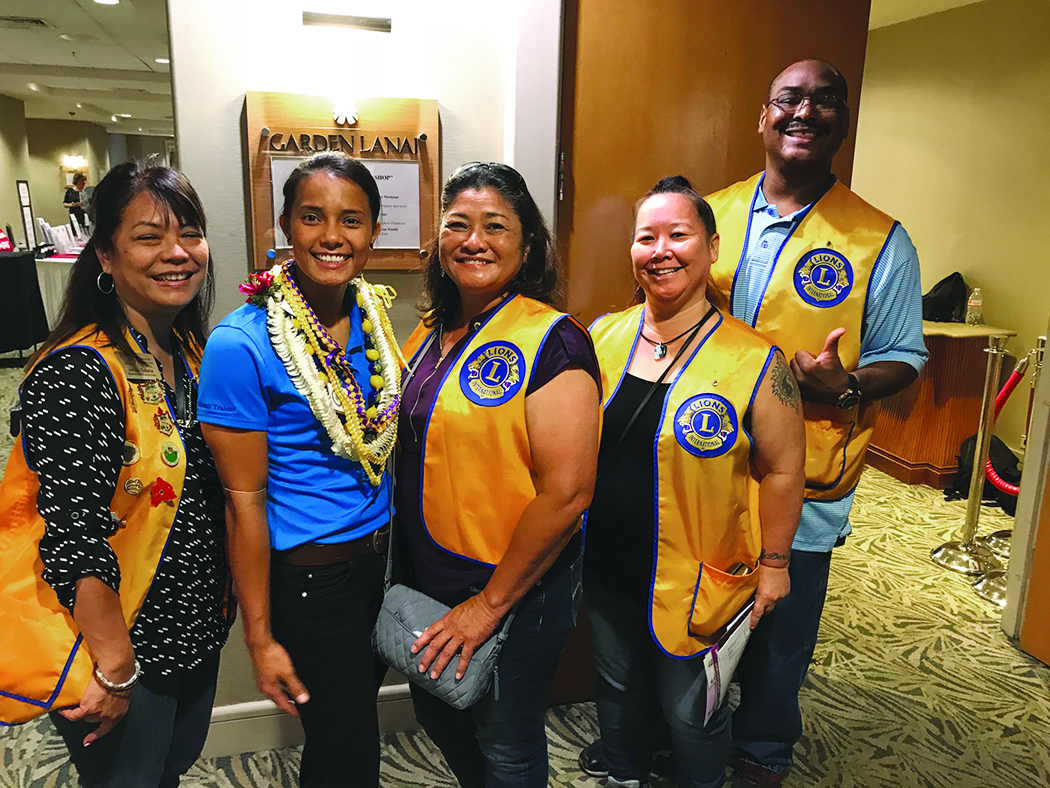
    (L–R) Jackie, Mapuana, Gina, Lisa and Kenny from D50 Hawai’i Lions.

    Denise Anderson assisted attendees at the Vacations Hawaii exhibit.

    The 12th Aging in Place Workshop held on August 18 at the Ala Moana Hotel brought our readers and their friends and family in contact with Generations Magazine’s partners in a vibrant atmosphere of sharing and learning.

  • Aging in Place: Community Strategies

    Older adults typically want to live in their own homes for as long as possible. A 2012 report from AARP showed that only 65 percent of persons aged 60-70 and only 43 percent of those aged 70 and older find it very easy to live independently. Besides making physical environments age-friendly, what needs to happen to enable older adults to safely age in place?

    Optimize existing communities

    Some communities with high concentrations of older adults were designed from scratch to address their needs. However, most age-dense neighborhoods or apartments/condominiums were not; residents have simply grown older and aged in place. The density of older residents in some could allow economies of scale and also ease the provision of in-home services for providers.

    Natural helping networks

    The strength of grassroots Aging in Place models or strategies relies on the potential for “natural helping networks” to develop and provide informal support to complement more formal health and social services. Informal support from peers typically entails help with “small services,” such as checking up on a neighbor, initiating a “buddy system,” keeping each other updated on local events, providing companionship, or even developing a volunteer corps of peers to address locally defined needs. Engaging in natural helping networks can transform an older adult from a “passive service recipient” to an active contributor to the wellbeing of neighbors and the community.

    Natural support systems

    For Aging in Place strategies to flourish, we need to develop ways to foster natural support systems in age-dense neighborhoods and apartments or condominiums, and to develop partnerships among the stakeholders of those settings. Such partnerships would include older residents, their peers, volunteers, family, friends, service providers, and building owners and managers. A number of residential managers of local public housing and condominiums in Hawai‘i are taking important first steps by attending brief workshops on various aspects of aging, thus learning to provide more supportive environments for their residents who are aging in place.

    A little extra help is often all that is needed for an older resident to age in place. Aging in Place models advocate the use of local peer networks to provide that extra help, to be supplemented by more extensive formal in-home services as needed. Such a community-based approach could result in an affordable and client-based system to keep older persons in their homes and avoid costly and undesired relocations.

    Grassroots social support models

    Grassroots social models of support such as the Village Model, Cohousing, and Age-Friendly Cities and Communities represent some of the latest efforts to strengthen social environments to allow older adults to live in their homes for as long as desired.

    Learn more

    The Village Model
    www.bit.ly/CreatingAVillage

    Cohousing
    www.bit.ly/WhatIsCohousingAbout

    World Health Organization
    www.bit.ly/AgeFriendlyWorld 


    CENTER ON AGING — University of Hawai‘i at Mānoa
    2430 Campus Road, Gartley Hall, 201B, Honolulu HI 96822

    808-956-6124  |  map3@hawaii.edu
    www.hawaii.edu/aging/

    Older adults typically want to live in their own homes for as long as possible. A 2012 report from AARP showed that only 65 percent of persons aged 60-70 and only 43 percent of those aged 70 and older find it very easy to live independently. Besides making physical environments age-friendly, what needs to happen…

  • WARNING: ‘Aging in Place’ Homes

    Many seniors are aware of the Long-Term Care Ombudsman Program and its role as their advocate if they have a problem or concern regarding a nursing home, adult residential care home, assisted living facility or community care foster family home.

    What they may not know, however, is that if they choose to live in what is called an “aging in place” facility, residents are very much on their own. The Long-Term Care Ombudsman Program does not have access to these facilities, and their “renters” are not protected by federal or state regulations that govern licensed settings.

    There is some debate as to whether or not these homes are actually “unlicensed” care homes taking advantage of loopholes in the current law. But there is no debate that AIG Homes have:

    • No annual inspection by the Department of Health.
    • No public posting of the inspection by the
      Department of Health.
    • No TB clearance requirements for the caregivers or staff.
    • No building or fire code requirements or plans regarding emergency evacuations.
    • No access to the Ombudsman or consumer protection.

    Since these homes are not licensed, and don’t want to be licensed, another significant concern is this: Why would a social worker, case manager, doctor, nurse or other professional make such a recommendation? Do they bear some liability if the person is abused, mistreated or neglected?  Would healthcare providers, such as Kaiser or HMSA, place a patient in an unregulated, unmonitored home?The Long-Term Care Ombudsman Program has already received complaints about loved ones being denied access. A man called complaining that his relative was in an “aging in place” home, and every time he visited, she would have new, mysterious bruises. He complained to the caregiver, but to no avail. Then he noticed the caregiver started covering up the bruises in various ways to hide them. He took pictures and sent them to the person with the placement responsibility over his relative who, unfortunately, didn’t live in Hawaii. That person forwarded the pictures to the caregiver, and she immediately banned the man from visiting. He called our Office to request help, as he is the only relative on the island and hasn’t been allowed to visit since April.

    He wanted to know if I could do anything to lift the ban. Sadly no. Our Office can’t do anything because the home is unlicensed. Representatives from our Office could be arrested for trespassing on private property.

    Most of us believe if you are taking care of someone in your home for a fee — and that person is not related to you — then you need to be licensed by the state, so we can try to ensure your safety. Licensed facilities are regulated by laws, which allow the state to do what is necessary to ensure the safety and security of our residents through compliance with building and safety codes, health inspections, emergency plans, care plans, medication management, and training and experience for caregivers.

    The “aging in place” model is not licensed and doesn’t allow for these safeguards. Until they do, they should be shut down.


    DO YOU HAVE COMPLAINTS AND QUESTIONS?

    Please call John G. McDermott, the State Long-Term Care Ombudsman, at 808-586-7268 or refer to the Department of Health’s website at www.health.hawaii.gov/ohca/state-licensing-section/.

    Many seniors are aware of the Long-Term Care Ombudsman Program and its role as their advocate if they have a problem or concern regarding a nursing home, adult residential care home, assisted living facility or community care foster family home. What they may not know, however, is that if they choose to live in what…

  • Deborah Stone-Walls: Sailing Forward

    A storm of aging is raging in America: Waves of retiring baby boomers on a tide of super seniors in need of ever-increasing care; a torrent of requests swamping eldercare agencies and charities; and financial gales battering seniors and their families as they try to shelter in place.

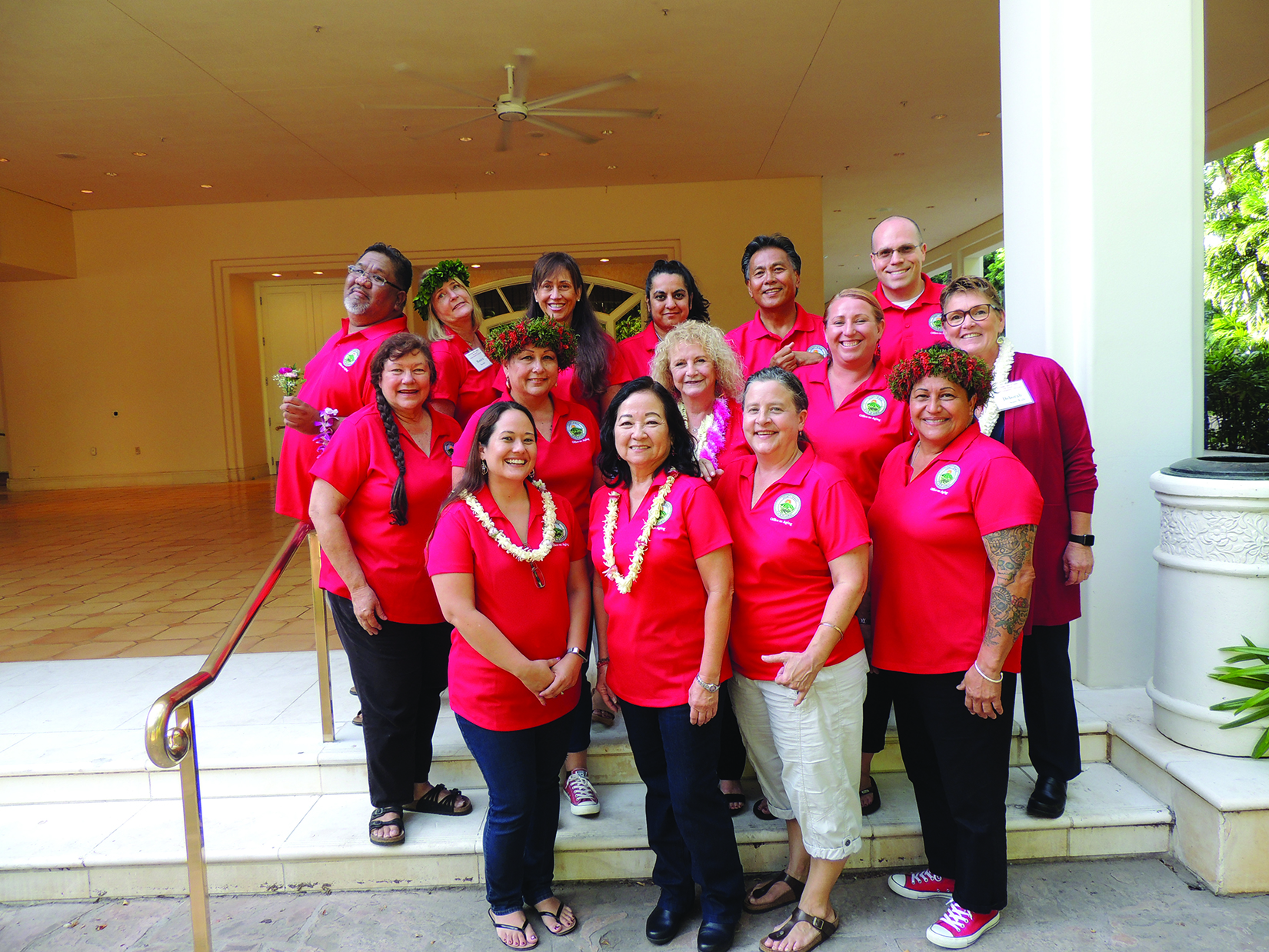
    Deborah Stone-Walls and the MCOA staff optimizes support for seniors and shares their recipe for success.
    Deborah Stone-Walls  (above) and the MCOA staff (below) optimizes support for seniors and shares their recipe for success.

    Deborah Stone-Walls, Maui County Office on Aging (MCOA) executive, is optimistic as she “sails through the perfect storm.” Her peers throughout the United States recently elected her as first vice president of the National Association of Area Agencies in Aging, aka “n4a.”

    On Maui, Deborah and her crew successfully optimize programs for active seniors, frail super seniors and family caregivers. They coordinate with nonprofits, county and state programs through a virtual electronic ADRC (Hawai’i Aging and Disability Resource Center) with an 800 number to intake seniors in need.

    “The County of Maui allowed me to almost double the ADRC staff,” she says. “Soon, my staff came to me with new opportunities to help seniors. I never said ‘No’ but looked for a way to move forward and fill the needs.

    “Traveling to a central location is difficult for Maui seniors. Our programs and services have to reach out to kūpuna. We took EnhanceFitness™ results-oriented exercise program to places where seniors gather — churches, assisted living facilities and clubs — and partnered with them. It worked, and seniors are getting stronger.

    “Like all caregivers, Maui families need support when loved ones come home from the hospital. My staff loved the Care Transitions Intervention (CTI) program, but flying in trainers to certify local coaches was too expensive. We invested $5,000 to certify a Maui CTI trainer who can train as many coaches as we need.”

    Innovation continued. Deborah’s staff figured out a way to assist rural seniors and their families who live beyond the reach of home care agencies. Once strict eligibility requirements and assessment standards are met, a Community Living Program (CLP) coach helps the family chart a plan. It may be as simple as installing a dog door and run for a homebound senior, or a walk-in tub. Again, the answer is listening, never saying ‘no,’ and delivering exactly what people need.

    In the future, Deborah says aging professionals will have to promote an easy, attractive process for staying healthy, teach chronic disease self-management and believe that people can get stronger at any age. She encourages seniors to stay healthy and use their assets to pay for their own healthcare, as a way of blessing their children. Around the corner, Deborah sees new products like debit cards that give seniors nontechnical access to Uber and Lyft, and renal or diabetic diet meals, shipped directly to your door.

    Healthcare innovator, eVillages, recently selected Flint, Mich., and Maui as two pilot communities in the U.S. Doctors at these sites will be connected via internet to extensive medical information and consultation by eminent physicians at over 300 locations around the world.

    Deborah Stone-Walls is in line to lead n4a. She shares her “never say no” recipe for success on the national level and brings fresh ideas back to Hawai‘i. She charts a course, collaborating with peers, county and state government, ADRC staff and thousands of volunteers. We all benefit from  their work. As the storm rages, we rest assured with Deborah Stone-Walls at the helm.


    MAUI COUNTY OFFICE ON AGING

    Maui: 808-270-7774  |  Moloka‘i: 808-553-5241
    L
    āna‘i: 808-565-6818  |  www.mauicountyadrc.org

    A storm of aging is raging in America: Waves of retiring baby boomers on a tide of super seniors in need of ever-increasing care; a torrent of requests swamping eldercare agencies and charities; and financial gales battering seniors and their families as they try to shelter in place. Deborah Stone-Walls, Maui County Office on Aging…

  • Message from the Editor – Aug / Sep 2012

    Welcome to all of you attending this year’s Senior Fair and enjoying the great exhibitors and presentations, full of resourceful information and contacts to living well. We all should thank the producer of this—the largest event of the year dedicated to our senior community— Mike Rossell and his associate Barbara Garofano who coordinates just about
    everything.

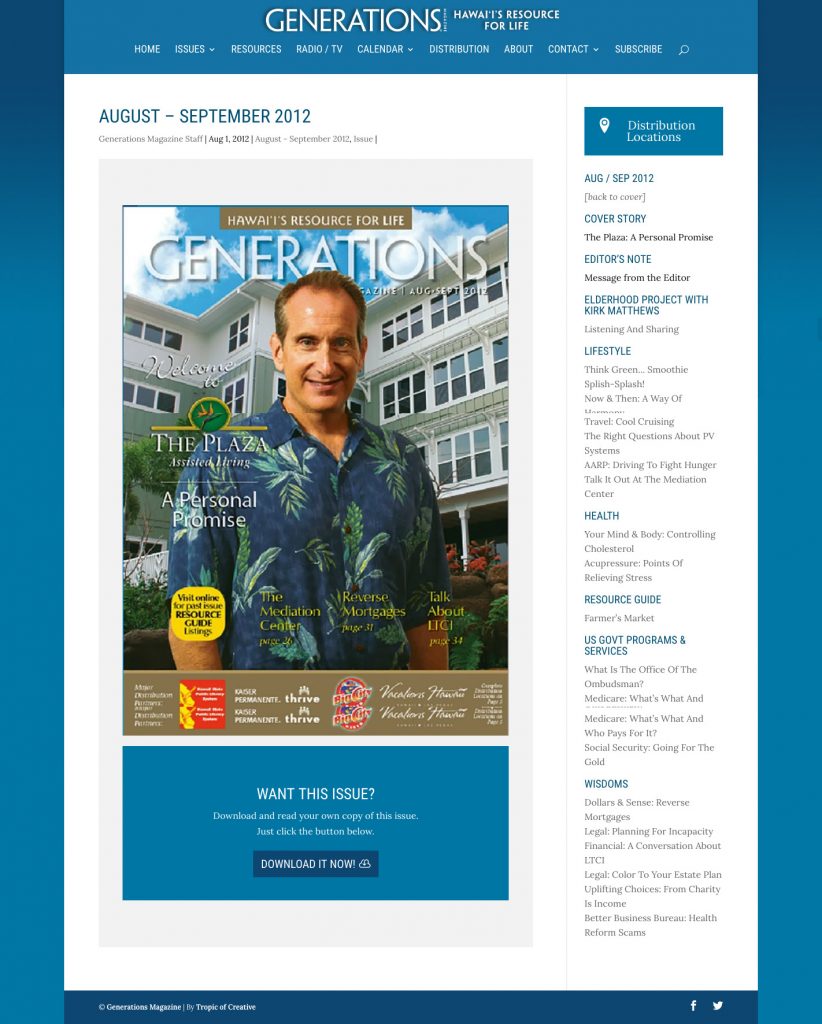
    This month’s cover story features the story of The Plaza Assisted Living Properties, its commitment to the retirement community and its growing list of residences. We thank you Steve Metter and Mike Wood for their commitment to providing the much needed rental option to retirement living and providing the needed care for our growing Alzheimer’s and related dementia population.

    Website - Generations Magazine - August - September 2012I have recommended to hundreds of families that we all need to have the talk with our family members on “aging in place” and the options to where we want to live the rest of our lives or at least for the foreseeable future. The Plaza Assisted Properties offer one of the options that our middle class will and should seriously take a visit and check out the benefits of living in a comfortable and safe place. Developer Steve Metter made a significant comment that we must think of it as a major benefit for our loved ones that “most residents who were previously living alone in their own homes have improved health after moving into an assisted living community. This usually occurs due to improved nutrition, socialization with peers, better exercise, health monitoring and medication management.”

    And we also want to thank the many who have visited us online for their own personal knowledge and research and to view the many events posted on our calendar. The numbers are growing and we continue and support that aspect of our technologically-savvy readers.

    Live Well

    Generations - 2014-12-01 - Editors Note - Image 02

    Percy Ihara, Publisher / Editor

    808-368-6747 | Percy@Generations808.com

    Welcome to all of you attending this year’s Senior Fair and enjoying the great exhibitors and presentations, full of resourceful information and contacts to living well. We all should thank the producer of this—the largest event of the year dedicated to our senior community— Mike Rossell and his associate Barbara Garofano who coordinates just about everything. This month’s cover…