Tag: AARP Hawaii.

  • Kathy Jaycox’s Mission to Give Back

    After more than 40 years teaching at secondary and post-secondary schools in Illinois and Hawai‘i, Kathy Jaycox is now dedicated to volunteering for nonprofits. The work touches her heart and soul, she says.

    Kathy believes that “To whom much is given, much will be required (Luke 12:48).” This line of Biblical wisdom reminds us that we are held responsible for what we have. If we have been blessed with talents, wealth, knowledge and time, it is expected that we use them to benefit others.

    Past affiliations include service as a board member and president of Faith Action for Community Equity, and the Windward O‘ahu branch of the American Association of University Women, where she continues as a member.

    Kathy says she feels rewarded when she sees volunteer actions lead to positive change. The most outstanding, she said, was the passage of Act 102 in 2017, which provided financial support to family caregivers so that they could hire respite workers and not need to give up their own employment.

    Currently, Kathy serves on the executive council of AARP Hawai‘i doing outreach. She teaches, speaks to groups and helps in whatever capacity is needed. Her role on the board of directors for the Hawaii Pacific Gerontological Society includes serving on the workforce development, publicity, newsletter, and website committees. Kathy is also a member of the Kupuna Caucus, a volunteer at St. John Vianney Church and on the board of St. John Vianney School.

    After more than 40 years teaching at secondary and post-secondary schools in Illinois and Hawai‘i, Kathy Jaycox is now dedicated to volunteering for nonprofits. The work touches her heart and soul, she says.

  • Hawai’i CARE Act Coalition

    Caregiving became a full-time responsibility for Lahaina resident Montella Lopez in her mother’s final years. In the six times her mother was discharged from the hospital, Lopez said she received little or no instruction on how to care for her mother at home.

    As Hawai‘i’s population ages and the number of people with chronic conditions increases, pressures on unpaid caregivers mount. Thousands of Hawai‘i caregivers like Lopez are providing complex care for which they are unprepared— such as medication management and wound care.

    In response to this urgent need, a group of advocates and elder-support agencies are calling on state lawmakers to approve legislation requiring Hawai‘i’s hospitals to offer family caregiver instruction—at the time of discharge. The Hawai‘I CARE Act Coalition wants all hospitals to recognize and support the critical role of family caregivers to ensure safe hospital-to-home transitions.

    This summer, a Legislative Family Caregivers Working Group has held monthly meetings to assess the role of family caregivers in hospital discharge procedures. Working Group members are reviewing proposed CARE Act legislation that features three commonsense provisions:

    Allows patients to designate a family caregiver, and put that person’s name in the hospital record.

    Notifies the family caregiver prior to the patient’s discharge from the hospital.

    Requires hospitals to offer caregiver instruction— at discharge — for medical tasks they need to provide for the patient at home.

    Hospitals opposing the proposed legislation say they already follow federally established guidelines for patient discharge. Advocates emphasize that guidelines only require discharge instruction for patients—not family caregivers who may be required to carry out those instructions.

    New research on family caregivers in Hawai‘I has created greater urgency for legislative action in support of an estimated 154,000 relatives, partners, friends and neighbors who assist older loved ones at home. According to the AARP Public Policy Institute report, family caregivers statewide provided unpaid care worth $2.1 billion in 2013.

    In the past two years 17 other state legislatures passed bills providing for greater involvement and instruction of caregivers at the time of hospital discharge. Hawai’i seems to be falling behind.

    It’s time to support our family caregivers who make it possible for their parents and grandparents to live more independently and remain in their homes and communities. Given our rapidly aging population and prohibitive cost of paid eldercare in the islands, Hawai‘i should be leading the way in support for caregivers — not falling behind.

    Residents are urged to support the CARE Act in Hawai‘i by signing an online petition at action. www.tinyurl.com/AARPISupportCAREAct.


    AARP Hawai‘i state office:
    808-545-6006 | Toll-Free: 866-295-7282
    www.aarp.org/hi | facebook.com/AARPHawaii
    twitter.com/AARPHawaii

    Caregiving became a full-time responsibility for Lahaina resident Montella Lopez in her mother’s final years. In the six times her mother was discharged from the hospital, Lopez said she received little or no instruction on how to care for her mother at home. As Hawai‘i’s population ages and the number of people with chronic conditions…

  • Identifying Needs of Older Residents

    Generations Magazine-  Identifying Needs of Older Residents-Image 01A survey of 45-64 year-old adults on O‘ahu ranks affordable home health care and housing the greatest needs facing Honolulu seniors. The 2014 AARP Livable Communities Survey in Honolulu, Hawaii of Adults Age 45+ identifies needs of older residents as well as gaps in community services.

    Of all environmental, economic and social factors in eight key areas or domains, survey respondents rated community and health services most important. They gave reliable emergency ambulance service, well-maintained hospitals and health care facilities, and affordable health services the highest priority. Affordable home health was the greatest gap in community services.

    This survey offers the latest evidence that residents are troubled by the high cost of nursing care. As adult children assume responsibility for the care of their older loved ones, many prefer to care for them at home. This places a greater burden on family caregivers, who look for help from paid home health aides, a workforce in seriously short supply. That’s why 9 in 10 respondents say that affordable home health care is either not available or they don’t know where to find help.

    Most survey respondents are home owners who say they would prefer to age-in-place, so top housing issues relate to home repairs that would allow them stay in the home. Nearly all said affordable home repair and having many home contractors to choose from are extremely or very important. Over four in five residents say affordable assisted living is important — another indication that caregiving and long-term care are key concerns.

    The survey also identifies housing as the greatest need facing Honolulu’s older residents — with affordable home prices rated highest. Other in-home needs include various aging-in-place options, like a no-step entrance, wider doorways, grab bars in bathrooms, and first floor bedrooms and bathrooms. Well-maintained, low-income housing also came up as a community need.

    These survey findings will be used as a baseline to help city policymakers and planners develop an action plan for the Age-Friendly City initiative, a partnership between the City and County of Honolulu, AARP Hawai‘i, and the World Health Organization’s Global Network of Age-Friendly Cities and Communities. Announced by city officials in March 2014, this initiative is intended to promote health, encourage civic engagement, and sustain economic growth in Honolulu, as our population grows older.


    AARP Hawai‘i state office:
    808-545-6024 | Toll-Free: 866-295-7282
    www.aarp.org/hi | facebook.com/AARPHawaii
    twitter.com/AARPHawaii

    A survey of 45-64 year-old adults on O‘ahu ranks affordable home health care and housing the greatest needs facing Honolulu seniors. The 2014 AARP Livable Communities Survey in Honolulu, Hawaii of Adults Age 45+ identifies needs of older residents as well as gaps in community services. Of all environmental, economic and social factors in eight…

  • Better Support for Family Caregivers

    Hawaii’s family caregivers are starting to get the support they need. These caregivers are among the 247,000 sons, daughters, husbands and wives who help loved ones stay independently at home for as long as possible — providing help with everyday tasks.

    In mid-April nearly 500 Hawaii residents joined elder advocacy groups and resource providers in paying tribute to family caregivers at an event at the Japanese Cultural Center. The event was to recognize the extraordinary contributions they make, highlight helpful community resources and provide an update of recent legislative efforts to support caregivers and their families.

    During the 2014 legislative session AARP supported a measure that would allow family caregivers be more involved in the patient healthcare process. Senate Bill 2264 (the CARE Act) was a Kupuna Caucus bill backed by many House and Senate legislators and community groups. It was intended to give caregivers the instruction needed to safely care for loved ones when they’re discharged from the hospital.

    AARP believes caregivers should be informed and recognized for their role in coordinating the care of loved ones transitioning from hospitals to home. Research found that family caregivers are under pressure to provide increasingly complex medical tasks — like wound care, injections, and medication management — when loved ones return home from the hospital. Caregivers often receive little or no training to provide care and are often the only option available to families, who may not be able to afford professional home care.

    How serious are the challenges facing Hawaii’s caregivers? The answer may be found in personal stories of caregivers like Keri Yamamoto, a caregiver and occupational therapist, whose uncle was admitted twice last year to a local hospital. She was “highly dissatisfied” with the discharge procedure. She testified in Support of SB 2264. On Maui, caregiver Michele Paularena, also supported the bill when her husband was discharged from the hospital without adequate instructions on how to administer the medications prescribed.

    While SB 2264 did not survive this session, the House Finance Committee passed a concurrent resolution (HCR 78) that calls for the establishment of a family caregiving working group to examine and assess the role of caregivers in the hospital discharge process. AARP welcomes the opportunity to work with hospitals and community stakeholders to ensure caregivers are properly instructed in the care of loved ones at discharge.

    Hawaii needs coordinated care putting patients and families first. As our population ages, it’s essential that family caregivers are supported and our community recognizes the limits of what they can do on their own.


    AARP Hawai‘i state office:
    808-545-6024 | Toll-Free: 866-295-7282
    www.aarp.org/hi | facebook.com/AARPHawaii
    twitter.com/AARPHawaii

    Hawaii’s family caregivers are starting to get the support they need. These caregivers are among the 247,000 sons, daughters, husbands and wives who help loved ones stay independently at home for as long as possible — providing help with everyday tasks. In mid-April nearly 500 Hawaii residents joined elder advocacy groups and resource providers in…

  • Hawaii Connector Must Be Consumer Friendly, Accountable and Sustainable

    Beginning in January 2014, Hawai‘i residents who are without health insurance, small businesses, and those who are self-employed will be able to be covered by insurance purchased through an online marketplace known as the Hawaii Health Connector. The Connector was established by the state Legislature in 2011 to offer health plans to the public under the Affordable Care Act.

    After more than $200 million in federal dollars, the Hawaii Connector was last in the nation to provide plan information. It has a long way to go to become the reliable and consumer-friendly organization that Hawai‘i deserves. Equally important, it must be able to sustain operations without federal funds in 2015 — just 14 months away.

    AARP wants the Connector to succeed, but as of the beginning of November its website was minimally functional. Navigation is cumbersome and tools consumers need are lacking. To be consumer friendly, the website needs to add major features such as:

    • tools to assist in understanding plan choices
    • quality of care information, including quality ratings for hospitals, physicians and other providers
    • patient experience information that allows patients to rate their providers
    • complaint data

    Accountability and transparency are major concerns. The Connector was created by the Legislature as the only private, non-profit exchange in the nation. It allowed HMSA, Kaiser, and Hawaii Dental Service to have voting board members despite clear conflicts of interest. The concept was championed by Sen. Roz Baker of Maui. Arguments were that a private entity, freed of the restraints of government bureaucracy, would be more nimble and cost effective.

    But as a private entity, the Connector is not subject to the State Sunshine Law. In an attempt to remedy this lack of openness, Sen. Les Ihara introduced SB 830 that would have required the Connector to comply with open meeting and notice provisions. The bill was held in the Consumer Protection Committee, chaired by Sen. Baker, and it never saw the light of day.

    During the informational briefing to the Legislature on October 9, there were lots of outreach anecdotes. Consumer outreach and education is critical. The Connector Board should take the lead on a specific outreach plan to reach Hawai‘i’s 100,000 uninsured residents.

    The deadline for all exchanges in the nation to be self-sustaining is rapidly approaching. Sustainability is a federal mandate and the Connector needs to deal with it quickly. An early Connector estimate put its 2015 operating costs at nearly $16 million. It needs to identify revenue to match. The Connector Board needs to provide the direction and pull out all stops to become sustainable. There must not be any last-minute surprises. The Connector has to come through. After a huge investment in federal tax dollars, Hawai‘i’s taxpayers must not be asked to pay the difference in 2015 and beyond or — worse yet — bailout the Connector by making it a state agency.

    Generations Magazine - Hawaii Connector Must Be Consumer Friendly, Accountable and Sustainable - Image 01

    Beginning in January 2014, Hawai‘i residents who are without health insurance, small businesses, and those who are self-employed will be able to be covered by insurance purchased through an online marketplace known as the Hawaii Health Connector. The Connector was established by the state Legislature in 2011 to offer health plans to the public under…

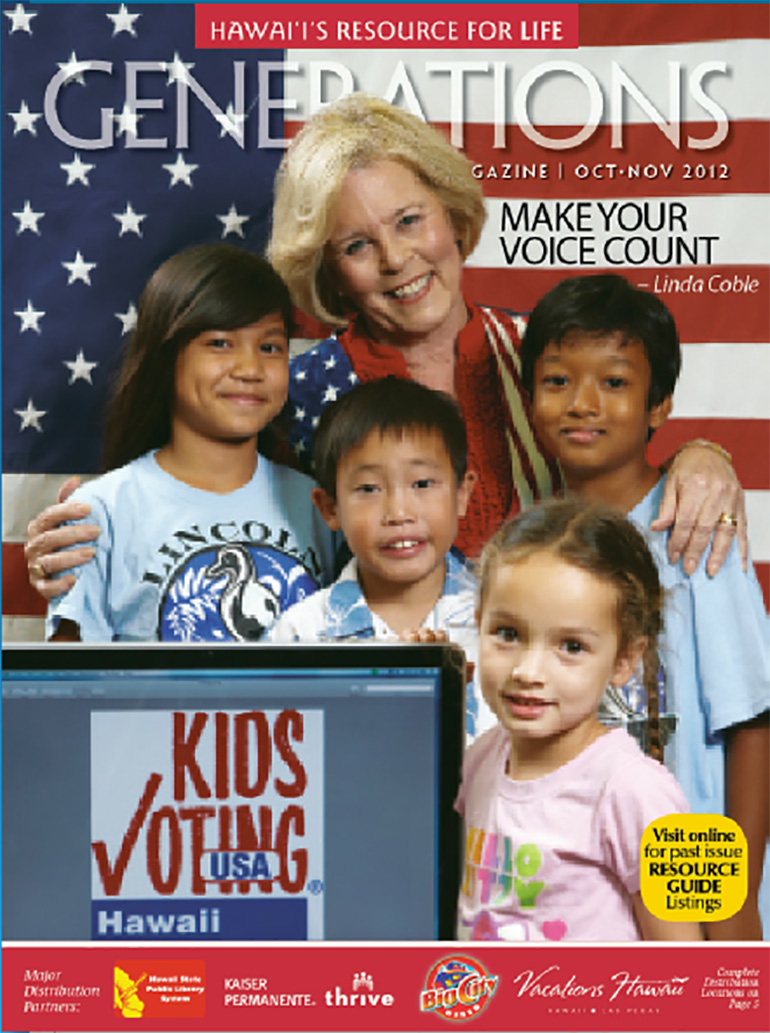
  • Make Your Voice Count

    Make Your Voice Count

    Former broadcaster, Linda Coble, says all voices are meant to be heard.

    COVER-Make-Your-Voice-Count_image1
    Linda Coble and students of Abraham Lincoln Elementary, Honolulu

    As a budding broadcaster in the 1960s, Linda Coble struggled to have her voice heard in the news business.

    In those days, women were not on the air. Yet, Hawai‘i offered her something that the Mainland couldn’t — a foot in the door atLinda Coble as a newsroom secretary. She quickly moved from making coffee to reporting the news. In fact, she later became the first female TV news anchor in Hawai‘i.

    She worked at ABC’s Channel 4 for a couple of years before being lured to KGMB by Bob Sevey, where she reported the news for 15 years.

    By the mid-1980s, Coble was a well-established broadcast journalist and a household name in the Islands. She was invited to join the Rotary Club of Honolulu, which was newly opened to women due to a U.S. Supreme Court ruling in 1987. In 2000-2001, Coble became the statewide governor of Hawai‘i’s Rotary clubs, the first woman to 
hold the post.

    Soon thereafter, she left TV news for morning radio on KSSK to work with Michael Perry and Larry Price. Radio allowed her to comment on the news, rather than simply report on it. This gave her the freedom to promote community organizations such as Kids Voting Hawai‘i, which is supported by Rotary Clubs statewide.

    COVER-Make-Your-Voice-Count_image2Kids Voting Hawai‘i is a non-profit, nonpartisan, grassroots organization. Its mission is two-fold: to prepare schoolchildren for a lifetime of voting, and to encourage adult voter participation.

    Actually, Hawai‘i’s seniors set a great example for young voters. According to AARP Hawai‘i, 90 percent of local seniors said they voted in 2010, and seniors cast 1 out of every 3 ballots in state. They are a big force in voting. Since many seniors have been around since statehood, they take voting seriously. They know what there is to gain … and what is at risk.

    Coble, 65, has been a glass-ceiling breaker and community volunteer since arriving in Hawai‘i in 1969. This month, we talk with Coble about how she found her voice on the air and in the community.

    GM: We know that you moved out to the Islands in your 20s, but where did you grow up? What is your background?

    LC: I was 2 years old when my parents moved from urban New York to earthy Portland, Oregon. I’ve been told that I was terrified of grass … I was truly a city girl. I guess my dad missed the concrete jungle, because he walked out when I was 5 and my sister was a baby. I still remember holding the door for him. Mom held us together, working as a mural artist/interior designer with a woman, who eventually became our step-grandmother. I’m convinced mom’s example of determination made an enormous difference in the success of her girls.

    Later came my brother, and we moved to interracial Northeast Portland, where neighborhoods and schools were mixed. Our African-American neighbor (the principal of my grade school) built a fence when we moved in next door. I learned to get along with people of all races at an early age … an experience that was invaluable, especially once 
I was living in Hawai‘i and working in the media.

    GM: So, what brought you to Hawai‘i and kept you here?

    LC: When it was time to declare a major at the University of Oregon, I had to face the fact that I wasn’t a good speller, so I finally surrendered my journalistic fantasies and turned to broadcast journalism.

    I received an Oregon Association of Broadcasters scholarship that enabled me to continue studies and graduate with a degree that I proudly flashed during interviews at TV stations throughout Oregon.

    During one interview, a manager at the CBS affiliate in Portland told me, “Come back when you have had more experience, and a sex change operation.” I was devastated. My grandmother sympathetically sent me to Hawai‘i for a week to visit a girlfriend in Pearl City.

    While on Oahu, I tracked down Jim Manke, the president of the Hawai‘i Association of Broadcasters. Manke was also the news director at the ABC station. He gave me a job as the newsroom secretary in 1969 (on the same day we landed a man on the moon!)

    Hawai‘i became my new home. I was so happy when my sister, Cameron Maheras, soon followed and became a force in the fashion world here.

    Eventually, I was reporting stories and became the first female TV news anchor in Hawai‘i. Bob Sevey noticed and hired me away to KGMB a couple years later.

    COVER-Make-Your-Voice-Count_image3GM: Did you have a mentor in broadcasting?

    LC: I would say that every reporter and anchor at KGMB considered Bob Sevey as a mentor. What an ethical, accurate, fair newsman! And he genuinely cared about his team. I was at KGMB for 10 years, until my stepfather died in 1981. During that time, the CBS affiliate in Portland, KOIN TV, was recruiting for its first female anchor. Sevey generously said he would ‘hold the chair’ for me here, while I went to Portland to be with mom and apply at KOIN TV news. (Yes, the manager who had suggested a sex change operation was still there! I should have walked in and said in my deepest voice, I’m baaaaak.)

    When I arrived at KOIN, a man stopped me in the parking lot. He shared with me that the women reporters upstairs were upset because they wanted that job. He went on to share the culture of the newsroom, ballpark figures on how much my male co-anchor was earning, along with other insights. I asked, Why are you telling me all this? He joked that I was taking his job. (In fact, he was just filling the evening news chair until a female co-anchor was hired). For whatever reason, he was moved to give me the inside scoop before I went upstairs to sign-on. That was how I first met Kirk Matthews. The station had a January birthday party the next year, and Kirk and I discovered we were born on the same day—the same year. We fell in love.

    Ratings were great, but I was so homesick and longed for Hawai‘i. Engaged, Kirk and I moved back to the Islands.

    Sevey walked me down the aisle in 1984, during our double wedding ceremony with my sister Cammy and Bill Maheras. Sevey was not only a professional role model, he was like a dad to me.

    GM: What was your most favorite interview or story?

    LC: I was fortunate to cover entertainment icons and U.S. Presidential visits. When President Gerald Ford was here for a packed day of activities, ending with a Pearl Harbor ceremony, I was the only reporter who managed to talk my way into the motorcade. My cameraman and I scooped the others, every stop along the way. In fact, I was the only reporter who got an interview with the President.

    The interview was on the tarmac, just before he departed. I was hunched over trying to untangle the microphone cord and when I stood up, I nearly knocked the President’s teeth out with the top of my head. Microphone in hand, I asked Mr. Ford about his experience at the Arizona Memorial.

    When I returned to the station bursting with pride, Sevey admonished me for not following the ‘protocol’ and demanded that I share the film with the other stations. That was the first and last time my mentor and I didn’t see eye to eye.

    GM: If you had one wish to interview someone in this world, or cover an event, who or what topic would this be?

    LC: I would like to be with the world’s leaders when they announce that the crippling disease Polio has been eradicated. Rotarians around the globe have been fighting polio for three decades. We are nearing the finish line.

    COVER-Make-Your-Voice-Count_image4
    Students statewide, K-12, have the opportunity to log on, learn about the candidates and vote at www.kidsvotinghawaii.org.

    GM: What drives you to community service?

    LC: I love the advice John Wooden shared with his UCLA basketball team: Be more concerned about your character than your reputation, because your character is what you really are, while your reputation is merely what others think you are.

    I was in a profession where reputation — and ratings — ruled. At first, I joined boards and organizations because it was a good thing for the station to have my name on a letterhead. But over time, community service became more of a motivation than a motive.

    As a person (not a media personality), I care about the prevention of child abuse, the need for a Big Sisters organization, foster kids and the civic education of our youth.

    COVER-Make-Your-Voice-Count_image6In 1987, when Rotary International raised the ‘testosterone curtain’ and allowed women to be inducted, I joined the Rotary Club of Honolulu. It was a year before leaving TV news to head to KSSK to work with Michael Perry and Larry Price every morning. With radio, I found an avenue for ‘service above self’— a way to make a difference with wonderful, dedicated businesses and community leaders.

    GM: Kids Voting Hawai‘i is one of your volunteer passions. Why is this organization very important to you?

    LC: Kids Voting Hawai‘i, an affiliate of Kids Voting USA, grooms our youth to be informed voters and civically engaged, responsible citizens. It prepares 
students to get into the habit of voting, and inspires the adults in their families to vote.

    COVER-Make-Your-Voice-Count_image7In 1995, when I was serving as the first woman President of the Rotary Club of Honolulu, Lyla Berg brought the Kids Voting idea to the club, and we ran with it. Rotarians statewide staffed the adult polling sites, where K-12 students went with their folks to cast their own paper ballots. By 2002, Kids Voting Hawai‘i shifted to cyberspace, and Hawai‘i students were the first in the nation to vote statewide by computer, thanks to the cutting-edge Internet technology of Commercial Data Systems.

    COVER-Make-Your-Voice-Count_image8Kids Voting Hawai‘i continues to provide K-12 students with curriculum and classroom activities that address civic responsibility and compliment the Hawai‘i State Social Studies Standards. Our youth are inspired to explore the candidates and student issues, and engage their peers and parents in discussion. This hands-on experience in democracy is made possible by volunteers, including retired educators with Alpha Delta Kappa.

    In the last Presidential General Election, nearly 120,000 students cast their ballots online. From October 22 through November 6, students will have the opportunity to go online and cast ballots anywhere there is an Internet connection.

    COVER-Make-Your-Voice-Count_image9Everywhere I go, I invite folks my age, who are retired, talented and looking for meaningful ways to spend their time to find a need and fill it. Your experience is a gift. Your knowledge will rub off on younger generations. You will set an ideal example for your friends, who also may have some time on their hands that can be spent wisely.

    During my career, I never got closer to the movers and shakers than the length of my microphone cord. With Rotary membership, I have the opportunity to share weekly fellowship at meetings and roll up my sleeves to work side by side on community projects with wonderful friends who are making a difference in the community.

    Over time, community service became more of a motivation than a motive. ~Linda Coble


    Kids Voting Hawaii

    Students statewide, K12, have the opportunity to log on, learn about the candidates and vote atwww.kidsvotinghawaii.org.

    To vote from October 22 through November 6 (election night), students need:

    • Student password
    • Family’s precinct
    • District number

    This will gain students access to virtually the same ballots you adult voters will see at the polls. Ask your children or grandchildren if they are voting online. If they haven’t received a student password from their teacher, please encourage the school to provide the opportunity to their voice be heard and vote.


    You Snooze, You Lose

    The state Office of Elections and county clerks can register voters. You must re-register if you have changed your name or your address.

    To register you must be 18, a citizen of the United State and a legal resident of Hawai‘i.

    All election information, including polling places, can be found at www.hawaii.gov/elections.com.

    How to Register to Vote?

    • In Person: Visit the Office of the City or County Clerk where you reside to complete an Affidavit on Application for Voter Registration.

    • By Mail: Mail the completed Affidavit on Application for Voter Registration to the Office of the City or County Clerk where you reside. Voter Registration Forms are available at your:

    • Satellite City Hall
    • Public libraries
    • U.S. Post Offices
    • Phone Directory
    • State services agencies
    • University of Hawai‘i System
    • Office of Elections: www.hawaii.gov/elections
    • The major political parties also sponsor voter registration online at www.gophawaii.com and www.oahudemocrats.org.

    Questions?

    Office of Elections: 808-453-8683
    City & County of Honolulu: 808-768-3800
    County of Hawai‘i: 808-961-8277
    County of Maui: 808-270-7749
    County of Kauai: 808-241-4800

    Upcoming Important Events

    Oct. 30: General election absentee applications must be received by the City/County Clerk where you reside no later than 4:30 p.m.

    Nov. 6: General Election (Polling place hours: 7 a.m.– 6 p.m.)

    Voter Turnouts

    Hawai‘i general election turnout has been dramatically slipping. It has gone from a high in 1959 of 93.6 percent (or 78.1 percent a little more than 20 years ago in 1990) to a low 52.7 percent in 2006.

    As a budding broadcaster in the 1960s, Linda Coble struggled to have her voice heard in the news business. In those days, women were not on the air. Yet, Hawai‘i offered her something that the Mainland couldn’t — a foot in the door…

  • Message from the Editor – April / May 2012

    I’d like to welcome our new readers and the many new website visitors. Generations Magazine has been updating and tinkering with its website to better serve you with resources and important events that may be of interest to you and your family. Go to www.generations808.com to view all our past issues and resource guides, current events, support group meetings and regular columns such as Social Security, AARP Hawaii and Dr. Ritabelle.

    This issue’s cover story features famed UH baseball coach Les Murakami. We talk about his early days on Kaua‘i and how he became the first full-time head baseball coach for UH, plus his recovery nearly 12 years after his massive stroke.

    His doctors call him the “miracle man” because at 75 he works out nearly every day and goes to therapy to improve his speech and mobility. Thank you Coach and Mrs. Murakami for sharing your story with our readers. You are the best. Keep it up, Coach.

    Some other wonderful stories in this issue include the Sakura House, a unique adult day center focusing on Japanese speaking clients, a health and fitness article about 90-year-old superwomen Joannie and ATRC, one of the most resourceful agencies catering to the physically challenged.

    Lastly, don’t forget our 6th annual Aging in Place Workshop, May 26th, at the Ala Moana Hotel

    Live Well,
    Generations - 2014-12-01 - Editors Note - Image 01
    Percy Ihara, Publisher & Editor

    Generations - 2014-12-01 - Editors Note - Image 02

    I’d like to welcome our new readers and the many new website visitors. Generations Magazine has been updating and tinkering with its website to better serve you with resources and important events that may be of interest to you and your family. Go to www.generations808.com to view all our past issues and resource guides, current events, support group…

  • AARP: Hawai`i’s Not Ready for Care Needs

    In 2008, the state Legislature established the Long-Term Care Commission to assess Hawai‘i’s system of care for the elderly and recommend improvements. Nearly four years later, the Commission is ready to share its findings with lawmakers - and the report is not encouraging.

    Describing the state’s long-term care system as “broken,” the Commission concludes that neither the state nor most of its residents are prepared to deal with the high cost and complexity of care. The report says that lack of public awareness and fragmented state oversight of programs and providers make for an increasingly dangerous combination as Hawai‘i ages.

    “Hawai‘i’s people have not put aside sufficient savings to deal with the risks of aging, and that’s something that could come back to haunt all of us,” said Long-Term Care Commission Chair Stuart Ho, who also serves as State President of AARP Hawai‘i. “Most of our residents are both unaware of and unprepared for the looming financial costs associated with long-term care. The problem is compounded by state government’s fragmented management of the current system, which leaves families confused about the services available to them.”

    The Commission finds that most residents - and state government itself - are unprepared to cope with the increased demand for long-term care services. As the need for services increases, many families are shocked to learn that Hawai‘i nursing home costs are among the highest in the country and are already at full capacity.

    Meanwhile, Hawai‘i is home to one of the fastest aging populations in the United States. Between 2007 and 2030, the number of residents age 85 and older will increase by almost two thirds (from 29,000 to about 48,000). As our population ages, the Commission says that either government will need to spend substantially more for long-term care or other sources of funding will have to be found.

    The Commission report, ready for delivery to the Legislature in January, includes eight recommendations for consideration. Three are listed below.

    • Launching a long-term care public awareness campaign
    • Establishing a mandatory public insurance program
    • Consolidating state departments responsible for long-term care into a single agency for greater efficiency and coordination

    To read the report and the complete list of recommendations, visit the University of Hawai‘i Public Policy Center online at publicpolicycenter.hawaii.edu/ltcc.

    In 2008, the state Legislature established the Long-Term Care Commission to assess Hawai‘i’s system of care for the elderly and recommend improvements. Nearly four years later, the Commission is ready to share its findings with lawmakers - and the report is not encouraging. Describing the state’s long-term care system as “broken,” the Commission concludes that neither the…