

Judge Daniel R. Foley, formerly an Associate Justice of the Hawai’i Court of Appeals, by his representation of three same-sex couples in the Hawai‘i court case of Baehr v. Lewin, moved to overturn the then hard-fast belief that marriage should be reserved to opposite-sex couples. Judge Foley’s legal strategy and courageous action changed the world, leading to the legalization of same-sex marriage in other parts the world.
What prompted Judge Foley to take on such Herculean task, in great part, alone? As a boy, Judge Foley explains, “I was always the new kid in school. I went to six different schools before high school. I was identified with the outsiders. I always detested bullies. When a bully would taunt defenseless classmates, I would stand up for the classmates, which often resulted in a fight. I regarded the government’s treatment of members of the LGBTQ community as a form of bullying.”
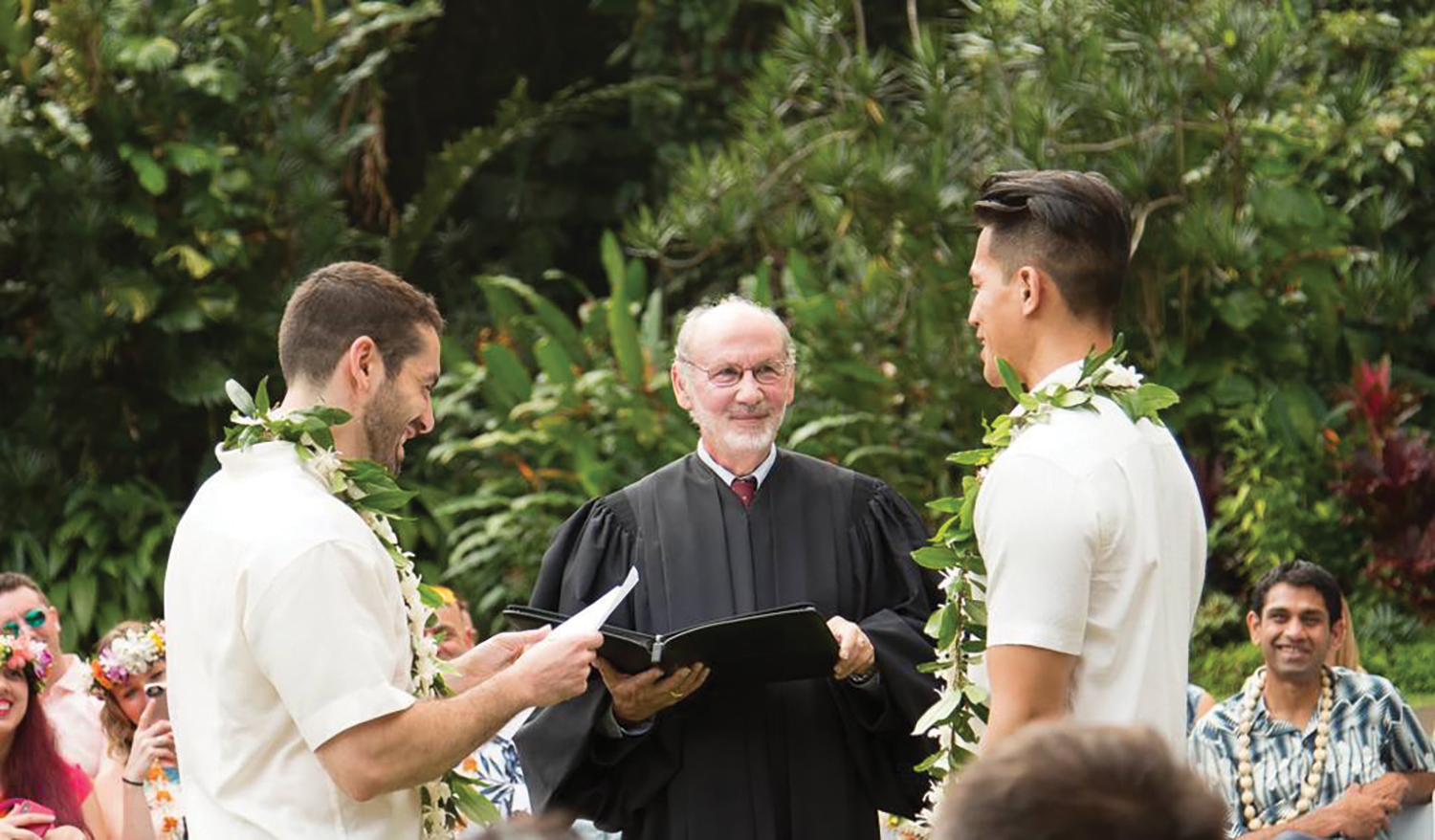
Judge Foley has had an interesting career that included diverse experiences in remote places. After college, he joined the Peace Corps and was assigned as an agricultural extension officer in Lesotho, southern Africa. After law school, he served as a legal adviser to emerging governments in Micronesia, writing constitutions and other laws as these governments achieved independence from the US. He has served as an Associate Justice of the Supreme Court of Palau. He drafted the Rules and Regulations of the Hawai‘i Civil Rights Commission, chaired the Hawai‘i’s Access to Justice Commission and has taught civil rights litigation at the University of Hawai‘i Richardson School of Law.
In the Hawai‘i legal community, Judge Foley was known as a lawyer who represented unpopular and controversial clients and causes. For instance, he successfully represented a Miss Gay Moloka‘i Pageant after an official refused to grant a permit to allow a hula to be performed at a carnival.
On Dec. 17, 1990, three gay couples applied for marriage licenses at the Hawai‘i Department of Health, but they were told that their applications would be held until the State Attorney General could rule on their applications. Within five years, the US Supreme Court permitted the right for gay and lesbian couples across the nation to be legally married. In the 2015 Supreme Court ruling, Associate Justice Anthony Kennedy cited Hawai‘i’s pivotal same-sex marriage decision.
Judge Foley says, “Same-sex marriage is a right protected by the Equal Protection Clause in both the US and Hawai‘i Constitutions. I believed there should be no discrimination against persons of the same sex who apply for a marriage license. I was raised as a Catholic and attended a Jesuit university in San Francisco. I was aware of the traditional biblical view of marriage, but what controlled it was the Equal Protection Clause.”
Judge Foley is married to a Japanese-Chinese-Hawaiian woman. After marriage, he converted to Buddhism. Earlier in San Francisco, he had studied Zen Buddhism and Tibetan Buddhism. He has studied renowned Zen Master Daisetz Suzuki. He meditates early in the morning and later in the day.
His spirituality is deep and profound. He says, “The spirituality of life is very important to me. I try to be good person and treat others with respect and compassion. I believe that our acts have an immediate impact on ourselves and those around us in this life and in the hereafter. I believe that our karma determines our afterlife. We should be true to our values. Our values shape our character and guide us in our decision-making.”


Leave a Reply