Category: January – February 2026

  • Kaua‘i Libraries Offer Fun for Everyone!

    Exciting, free events are happening at Hanapēpē and Līhu‘e Public Libraries on Kaua‘i! The public library is the place to be for all ages, keiki to kūpuna, say Līhu‘e Branch Manager Kristen Hillman and Branch Librarian Mindy Gipson.

    Līhu‘e Public Library strives to offer programs that support the needs of library users of all ages. First Thursday Memory Catchers meetings are held on the first Thursday of each month at 4pm. The monthly meeting of the Kaua‘i Live Poets Society happens on the first Monday at 4:30pm. The Mom’s Support Group convenes every first Wednesday at 5:30pm. And the Early Literacy Center is for our youngest patrons.
    The Coloring Cafe offers a low-key atmosphere where adults can create and converse. The Friends of Līhu‘e Library provides self-serve coffee. “Usually thought of as a children’s activity, coloring has recently been recognized for its potential mental and physical health benefits, especially for adults facing stress, anxiety and dementia,” says Kristen.

    Hanapēpē Public Library, a community hub in Kaua‘i’s West Side, offers many free, fun activities for keiki, such as the Mokihana Berry Read-Aloud Club and Tunes, Tales and Twirls Keiki Storytime. Its adult events are also impressive, and above all, fun!
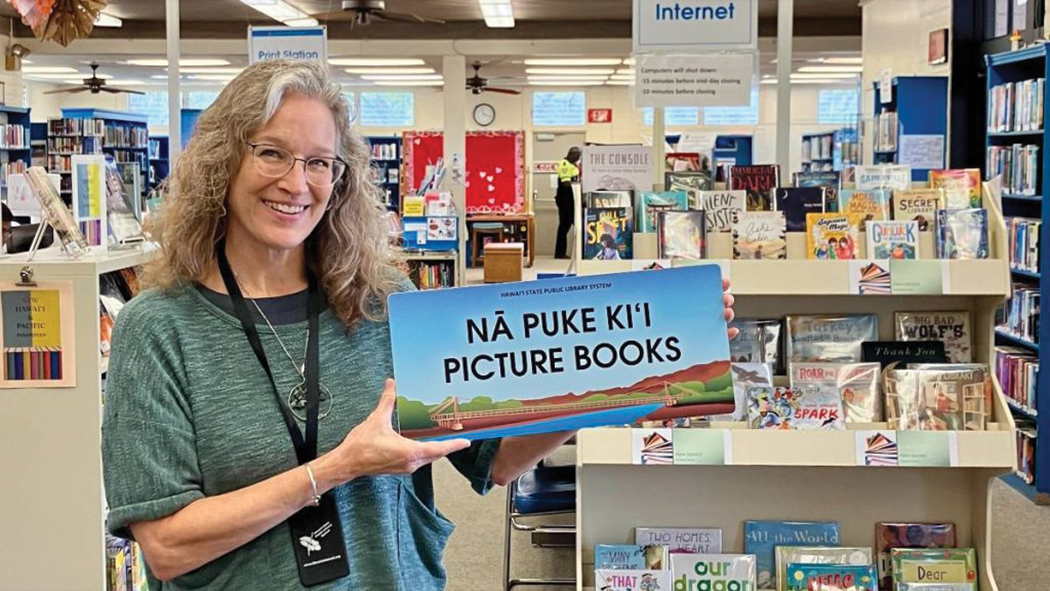
    Hanapēpē Public Library Branch
    Librarian Mindy Gipson poses with new library
    locations signage in Olelo Hawai‘i
    and English. Hanapēpē Public Library
    celebrated its 75th anniversary with a 1950s-style

    swing dance last February.

    “We had a remarkable turnout for our monthly Game and Puzzle Night on the last Thursday of the month,” says Mindy. “Families and individuals are returning to connect with others in the community to play chess, bridge, work puzzles and create with Legos.”

    A growing number of enthusiasts join together from 2 to 4pm for 4-Player Games: bridge on Tuesdays and mahjong on Wednesdays. The library has created the space for young adults and kūpuna alike to enjoy these brain-healthy games that provide a stimulating mental challenge. Game & Puzzle Nights are held the last Thursdays of the month from 5 to 7pm.

    “We are very grateful to the Friends of the Hanapēpē Public Library who fund the purchase of card tables and other furnishings, plus literacy developmental toys, storytime props and musical instruments to support our children’s programs,” says Mindy. “They also fund refreshments for many of our special events. The friends meet weekly in our meeting room creating oshibana (pressed flower) cards and other crafts to fund- raise for the library.”

    Learn more about Hawai‘i library events at tinyurl.com/HIPublicLibraryEventsCalendar.


    HAWAI‘I STATE PUBLIC LIBRARY SYSTEM
    Līhu‘e Public Library
    4344 Hardy St., Lihue, HI 96766
    808-241-3222 | kristen.hillman@librarieshawaii.org
    librarieshawaii.org
    Events Calendar:
    tinyurl.com/HIPublicLibraryEventsCalendar
    Exciting, free events are happening at Hanapēpē and Līhu‘e Public Libraries on Kaua‘i! The public library is the place to be for all ages, keiki to kūpuna, say Līhu‘e Branch Manager Kristen Hillman and Branch Librarian Mindy Gipson. Līhu‘e Public Library strives to offer programs that support the needs of library users of all ages.…

  • Papa’s Sapasui

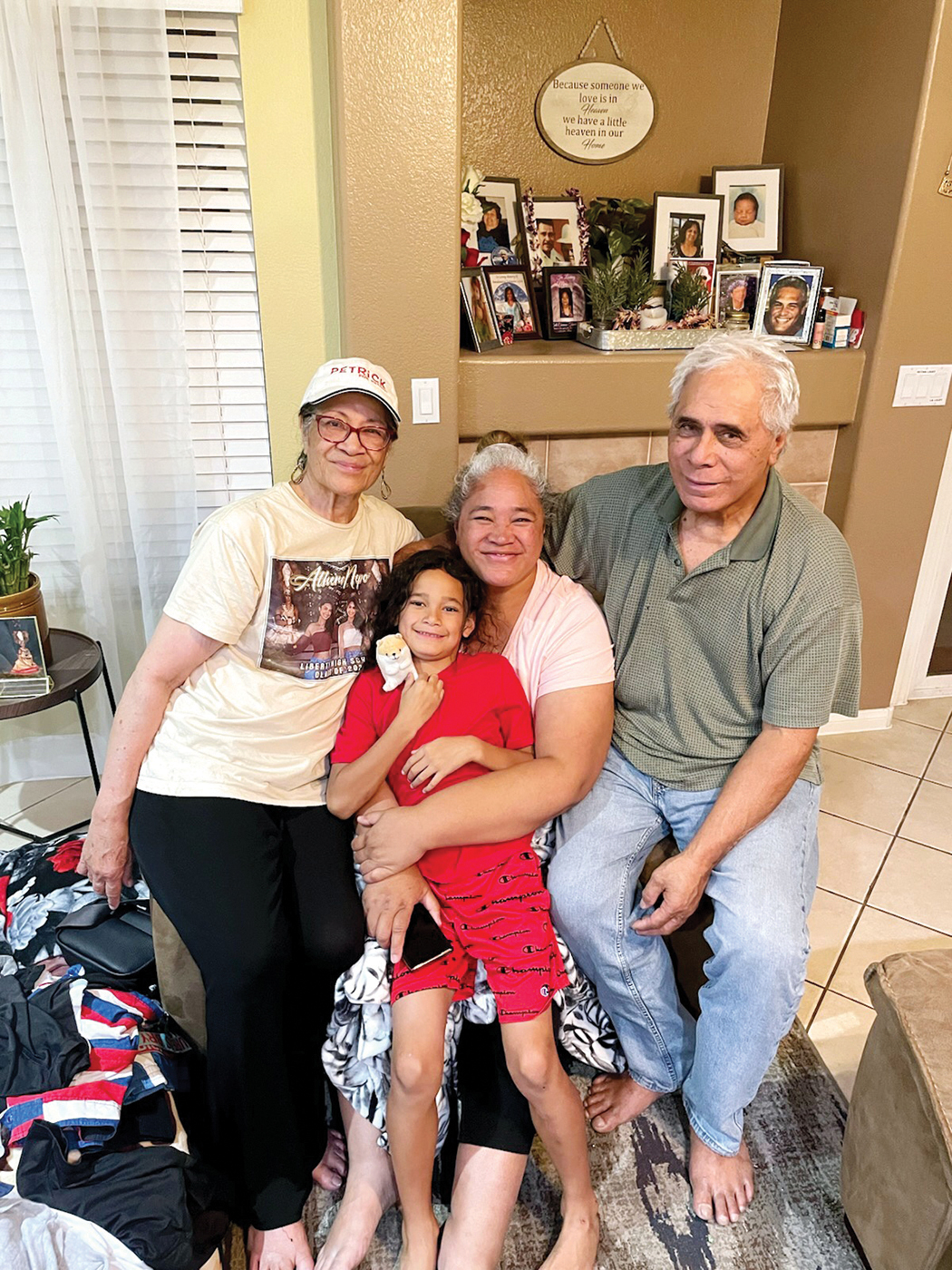
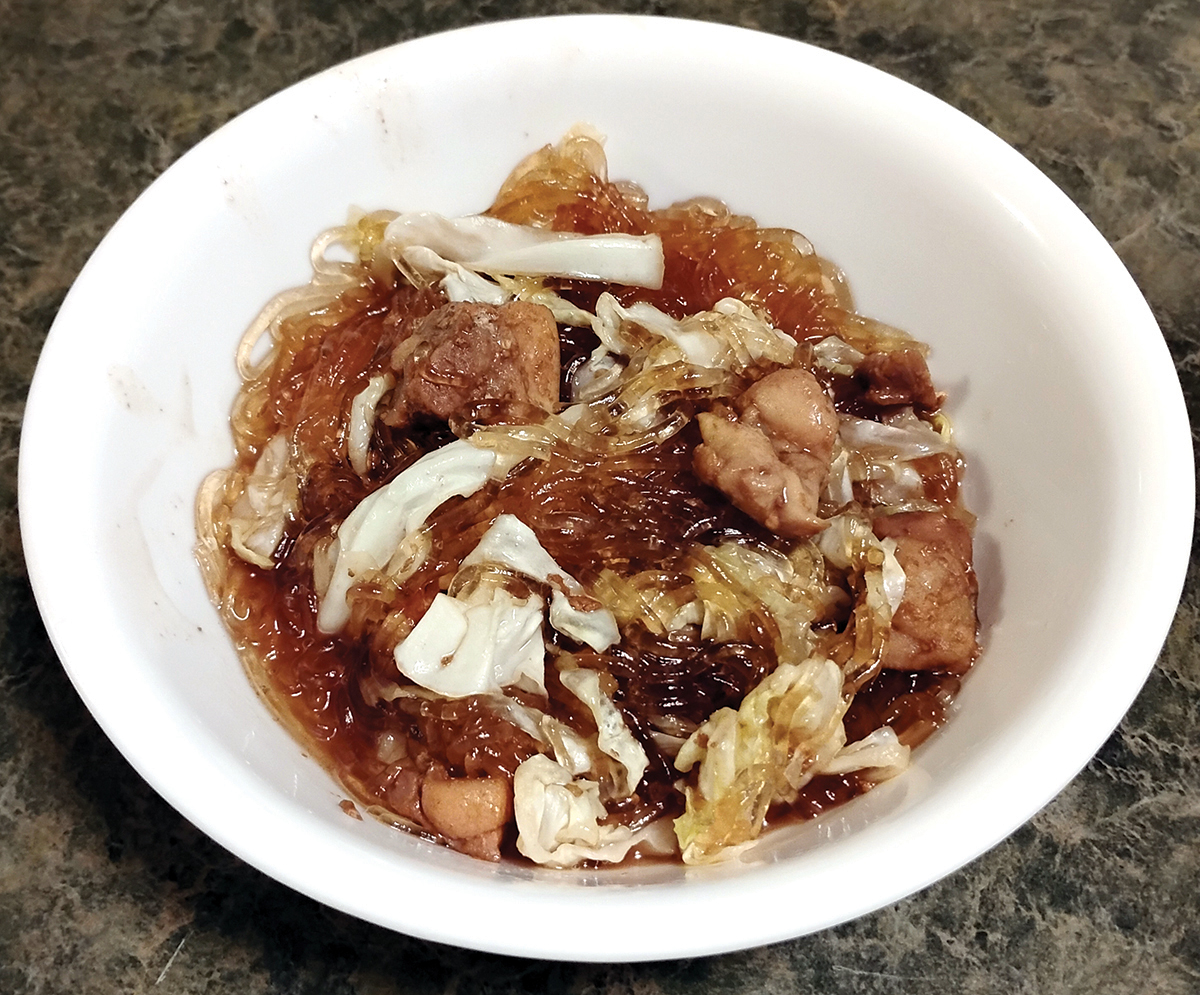
    When we were looking for a family dish to pair with our Samoan culture theme, the first person I thought of was one of my best friends, Fina Nepo. We’ve been friends for over 25 years and her family always has great food at their get-togethers. She is sharing one of their favorite meals with all of us! This family favorite was always made by Fina’s father, Salei Nepo (Papa).

    Sapasui is the popular Samoan adaptation of Chinese chop suey. Even the name “sapasui” is a Samoanized version of “chop suey.” This saucy dish is a staple at Samoan family gatherings and feasts. Fina and her family enjoyed many sapasuis at big and small gatherings. I made it myself and my own family enjoyed it with rice, but Fina said they usually pair it with fa‘al ifu fa‘i (green bananas cooked with coconut milk).

    Enjoy this wonderful Nepo family favorite!

    Ingredients:
    1 lb. boneless chicken, beef chuck or 2 cans of palm corned beef
    2 tbsp. vegetable oil (for frying garlic, onion and ginger)
    1 large onion
    2–3 cloves garlic
    1–2 tbsp. ginger
    1/2 cup shoyu (may need to add more for flavor and color)
    1 cup water or beef/chicken stock (use stock for more flavor)
    1 package vermicelli or glass noodles
    salt and pepper to taste
    1 medium cabbage

    Preparation:
    Cut the meat chicken or beef chuck into bite-sized pieces. No need to cut the corned beef.
    Chop or mince garlic and ginger. Chop onion.
    Prepare noodles by following the instructions on the package. After draining, cut the noodles into 3- to 4-inch pieces.

    Cooking Instructions:
    1) Preheat a wok or pot over medium heat, then
    add the oil.
    2) Add garlic, onion, ginger and meat.
    3) When almost halfway cooked, add the shoyu
    and cook for 10 more minutes.
    4) Keep stirring until the meat is almost fully
    cooked. If using corned beef, reduce cooking time
    to 30 minutes.
    5) Add water—or stock for richer flavor.
    6) Add noodles. Stir well. Simmer for 10 minutes.
    7) Add more shoyu to taste.
    8) Add chopped cabbage.
    9) Stir, mixing all ingredients thoroughly. Turn
    the heat to low and cook for another 10 minutes,
    stirring occasionally to prevent the ingredients
    from sticking to the pan.
    Serve on a large platter or in a big bowl. Enjoy!
    Prep & cook time: 45–60 minutes
    Serves: 6–8 servings

    Recipe by SALEI NEPO


    Do you have a favorite recipe and story to share? For consideration, include a photo and mail them to Generations Recipe, PO Box 4213, Honolulu, HI 96812, or email them to Cynthia@generations808.com.

    When we were looking for a family dish to pair with our Samoan culture theme, the first person I thought of was one of my best friends, Fina Nepo. We’ve been friends for over 25 years and her family always has great food at their get-togethers. She is sharing one of their favorite meals with…

  • Celebrating the Samoan Culture

    Since more than 1,500 years ago, Kānaka Maoli (Native Hawaiians) have welcomed immigrants from every corner of the globe, cultivating and perpetuating a tapestry of diverse cultures. In the sixth article in this ongoing series on the many cultures that comprise Hawai‘i, we will focus on the Samoan, how the people arrived in the Hawaiian Islands, the culture and celebrations such as the We Are Samoa Festival.

    Samoan Arrival in Hawai‘i

    An ocean of islands, it is common speculation that the Pacific was settled from west to east, with people from Southwest Asia settling in Samoa and Tonga from 1600 to 1200 BC. Samoan and Tongan navigators discovered and settled Tahiti-nui, Hiva (Marquesas Islands) and Tuamotus, among others, in 300 BC. A few hundred years later, these voyagers discovered and settled in Hawai‘i. By the time Europeans sought to explore the Pacific in the 1500s, almost all of the islands had been inhabited for several centuries.

    Samoans have migrated to Hawai‘i for almost 2,000 years. Many immigrated from American Samoa after the Immigration and Nationality Act of 1952. Today, about 44,000 people in Hawai‘i are of Samoan descent, making them the second-largest group of Pacific Islanders after Kānaka Maoli.

    Culture and Tradition

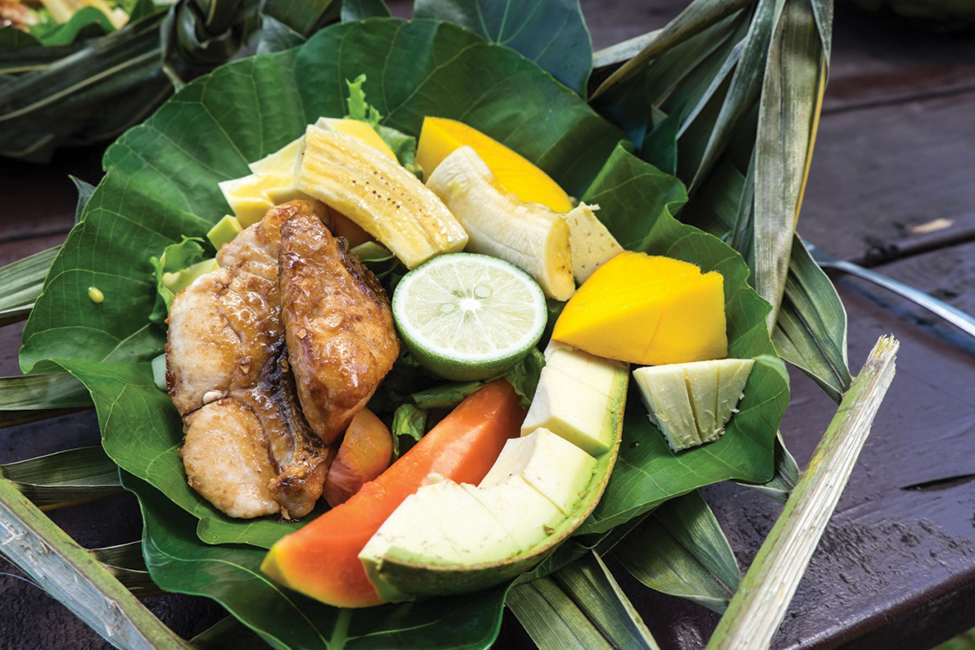
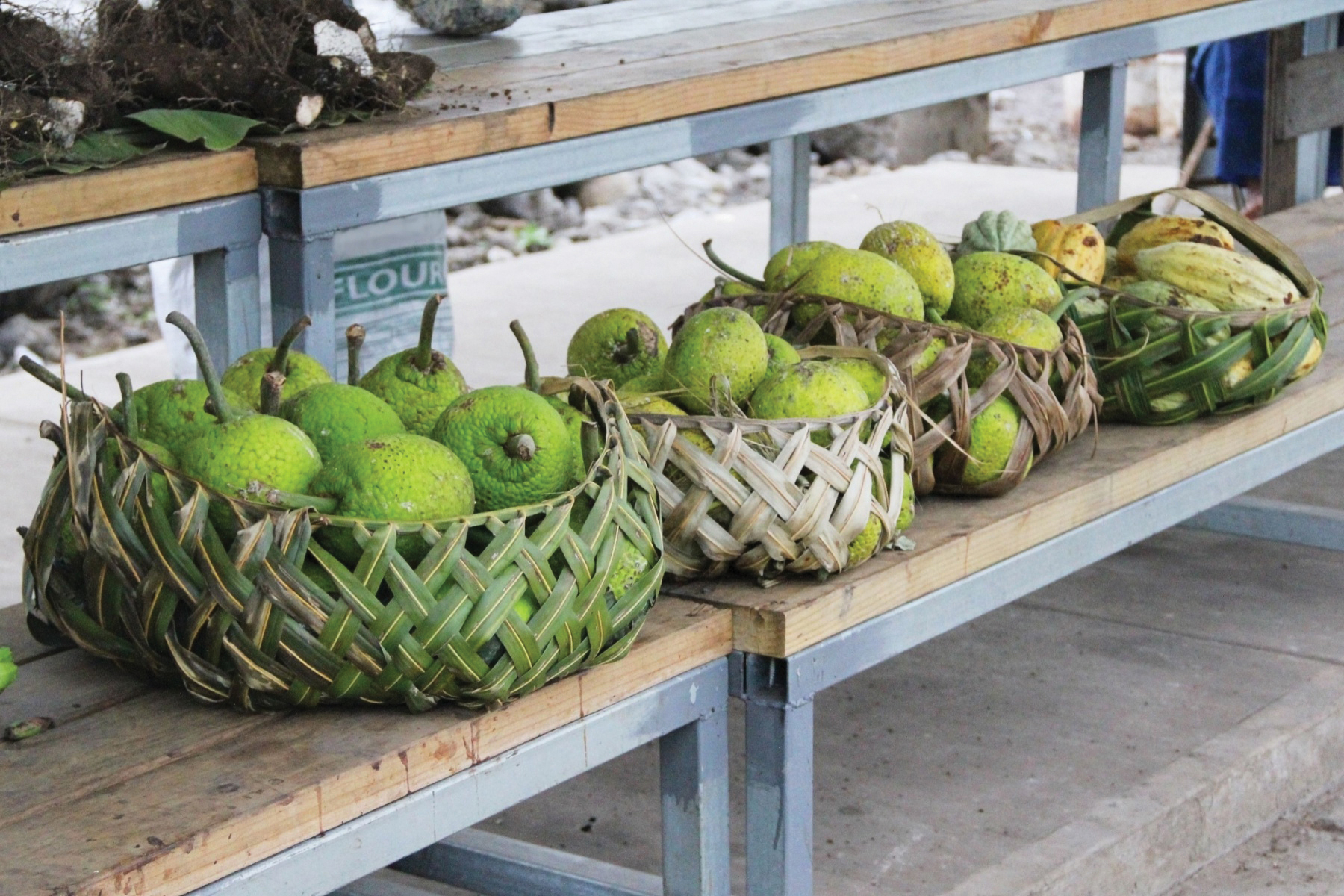
    Because of their geographical and ancestral proximity, Samoan culture shares many similarities with other Polynesian islands—Aotearoa (New Zealand), Hiva, Tonga and Hawai’i, to name a few. Historically, artifacts such as fishhooks, lures and records of vegetation/wildlife gesture to similarities, as these island populations shared strengths in fishing and farming.

    Fa‘a Samoa (the Samoan way) prioritizes ‘aiga (family/community), lotu (church) and alofa ( love). Some traditions include the rite of ‘ava, where the ceremonial beverage is shared to mark significant events and tatau (Samoan tattoos), a 2,000-year-old art form that affirms Samoan identity and adulthood. Lot u Tama i t i (White Sunday) is a Samoan holiday (also celebrated in Tonga and Tokelau) held on the second Sunday of October, when communities celebrate children.


    Celebrations

    The We Are Samoa Festival is Hawai‘i’s largest Samoan cultural fête, centering the ailao (traditional warrior’s knife dance) via the World Fireknife Championship. The festival is typically held in early May. Another celebration, the Samoan Heritage Festival, a widely practiced celebration that takes place during the summer all over the US , came to Hawai‘i in 2023.

    For more information, visit the We Are Samoa Festival website (worldfireknife.com/we-are-samoa-festival) as well as Generations Magazine’s FaceBook page (facebook.com/genmag808) and website calendar (generations808.com/calendar) for community events and opportunities.


    The next article in this series will feature the influences of Korean culture in Hawai‘i.

      Since more than 1,500 years ago, Kānaka Maoli (Native Hawaiians) have welcomed immigrants from every corner of the globe, cultivating and perpetuating a tapestry of diverse cultures. In the sixth article in this ongoing series on the many cultures that comprise Hawai‘i, we will focus on the Samoan, how the people arrived in the Hawaiian…

    1. Bridging the Generation Divide

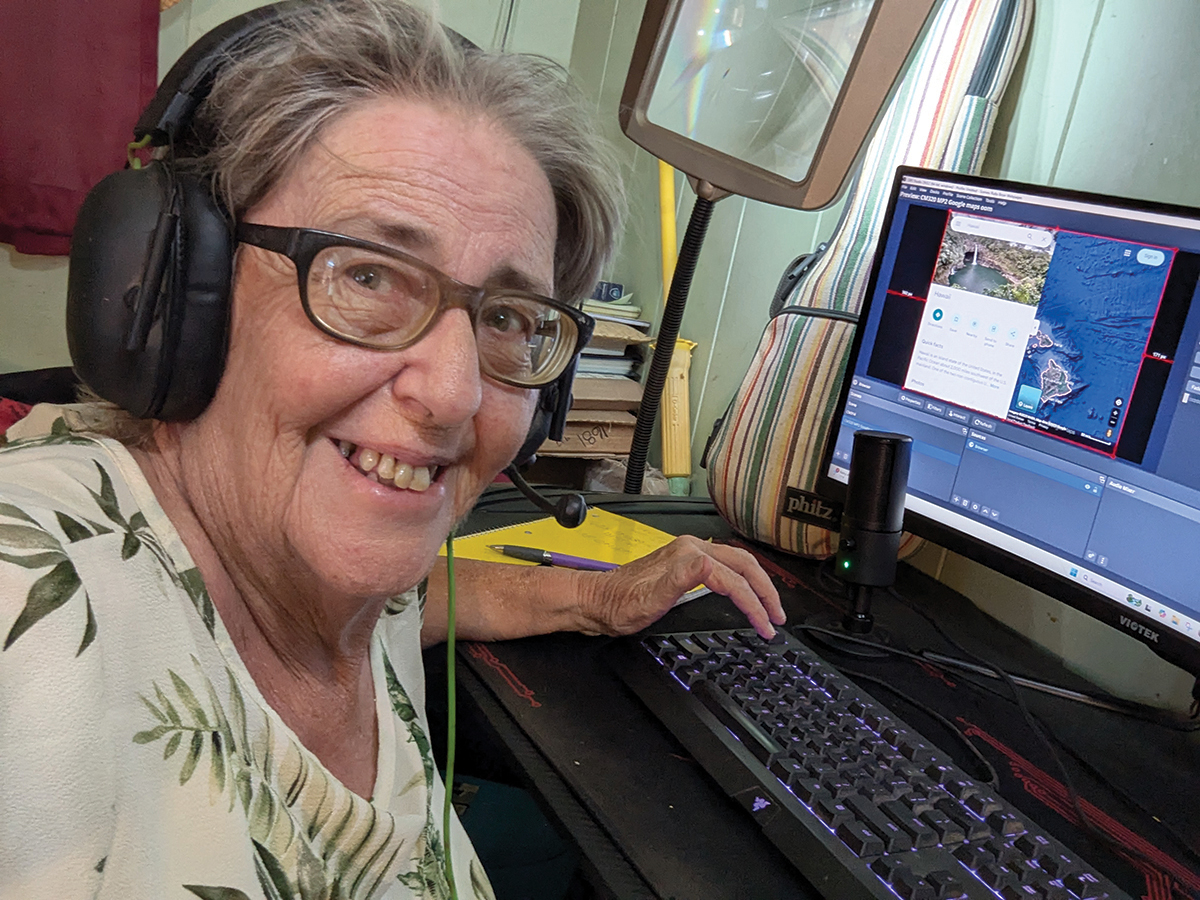
      Last year, I was a “senior” senior at the University of Hawai‘i (UH) West O‘ahu. My learning adventure began in the fall of 2019 when I enrolled in a basic Hawaiian language course at the Moloka‘i Education Center at age 67. It is a satellite campus of UH Maui College and our classes were conducted via a Skybridge video link to the classroom on Maui. I also enrolled in a Hawaiian music class that was taught in-person. I continue exploring those interests through the ‘Ukulele Kanikapila and ‘Olelo Hawai‘i Papa offered here on Moloka‘i by Kaunoa Senior Services, a division of the County of Maui’s Department of Human Concerns.

      Eligible for financial aid, I was able to become a full-time student at UH Maui College and UH West O‘ahu. It was a blessing in so many ways to be immersed in campus life—even at a distance. Being surrounded by young minds eager to forge a pathway to their future career was energizing and inspiring. No less inspiring were the students who were returning to college while working and caring for family, but still found time to attend class, complete assignments and participate in collaborative projects.

      I soon discovered that collaboration was the skill I most needed to learn. Students and faculty all put me at ease and I learned by their example how enriching—and fun—collaboration can be! It was time to set aside my “wise elder” hat and listen with respect and compassion, keeping my mind open to views that hadn’t even existed when I was their age. It was a two-way street because some of the things I’d experienced and brought to the table were ancient history for today’s students. I strove to enrich my fellow students’ learning treks and greatly appreciated that I was never made to feel like a dinosaur!

      Other skills I learned were how to give presentations and how to use the many apps available today to create written and audiovisual material. Encouraged by the supportive learning environment, I developed the confidence to share these skills in my local community. I volunteered to proofread the computer-created transcripts of documents scanned into Moloka‘i’s Digital Repository, Moe‘a, and created an Instagram post as my contribution to a Hawai‘i Tourism Authority community session on Moloka‘i.

      If you live on O‘ahu, you can attend classes for free with the instructor’s permission. The UH System, comprised of three universities, seven community colleges and community-based learning centers across Hawai‘i, is committed to promoting lifelong learning, active aging and intergenerational community-building through its Nā Kūpuna program at UH Mānoa and the Senior Visitor programs at UH West O‘ahu and the Leeward, Windward and Kapi‘olani community colleges. You won’t get a grade, but you can fully participate in course activities. (For enrollment information, see below.)

      It is well-known that being engaged socially and intellectually enhances the well-being of seniors: My experience as a student attests to that. Being constantly challenged and encouraged to keep going forward despite early stumbles and uncertainty was a great confidence-booster. I highly recommend pursuing higher education in your golden years!


      SENIOR CITIZEN VISITOR PROGRAM
      NĀ KŪPUNA PROGRAM–UH MĀNOA

      808-956-4642 | nakupuna@hawaii.edu
      tinyurl.com/NaKupunaProgram

      Last year, I was a “senior” senior at the University of Hawai‘i (UH) West O‘ahu. My learning adventure began in the fall of 2019 when I enrolled in a basic Hawaiian language course at the Moloka‘i Education Center at age 67. It is a satellite campus of UH Maui College and our classes were conducted…

    2. Legal Warrior for Social Upheaval

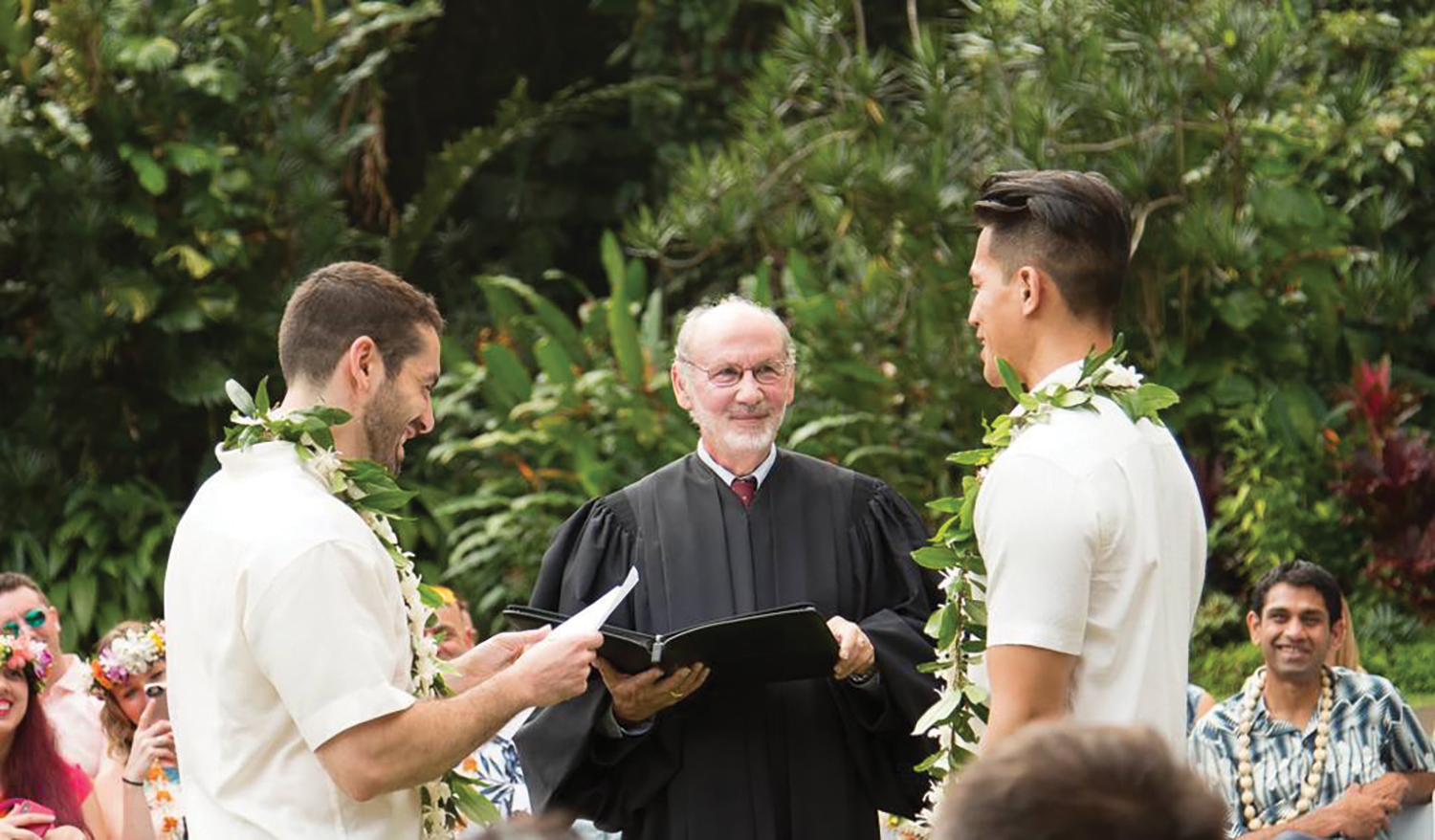
      Judge Daniel R. Foley, formerly an Associate Justice of the Hawai’i Court of Appeals, by his representation of three same-sex couples in the Hawai‘i court case of Baehr v. Lewin, moved to overturn the then hard-fast belief that marriage should be reserved to opposite-sex couples. Judge Foley’s legal strategy and courageous action changed the world, leading to the legalization of same-sex marriage in other parts the world.

      What prompted Judge Foley to take on such Herculean task, in great part, alone? As a boy, Judge Foley explains, “I was always the new kid in school. I went to six different schools before high school. I was identified with the outsiders. I always detested bullies. When a bully would taunt defenseless classmates, I would stand up for the classmates, which often resulted in a fight. I regarded the government’s treatment of members of the LGBTQ community as a form of bullying.”

      Judge Foley has had an interesting career that included diverse experiences in remote places. After college, he joined the Peace Corps and was assigned as an agricultural extension officer in Lesotho, southern Africa. After law school, he served as a legal adviser to emerging governments in Micronesia, writing constitutions and other laws as these governments achieved independence from the US. He has served as an Associate Justice of the Supreme Court of Palau. He drafted the Rules and Regulations of the Hawai‘i Civil Rights Commission, chaired the Hawai‘i’s Access to Justice Commission and has taught civil rights litigation at the University of Hawai‘i Richardson School of Law.

      In the Hawai‘i legal community, Judge Foley was known as a lawyer who represented unpopular and controversial clients and causes. For instance, he successfully represented a Miss Gay Moloka‘i Pageant after an official refused to grant a permit to allow a hula to be performed at a carnival.

      On Dec. 17, 1990, three gay couples applied for marriage licenses at the Hawai‘i Department of Health, but they were told that their applications would be held until the State Attorney General could rule on their applications. Within five years, the US Supreme Court permitted the right for gay and lesbian couples across the nation to be legally married. In the 2015 Supreme Court ruling, Associate Justice Anthony Kennedy cited Hawai‘i’s pivotal same-sex marriage decision.

      Judge Foley says, “Same-sex marriage is a right protected by the Equal Protection Clause in both the US and Hawai‘i Constitutions. I believed there should be no discrimination against persons of the same sex who apply for a marriage license. I was raised as a Catholic and attended a Jesuit university in San Francisco. I was aware of the traditional biblical view of marriage, but what controlled it was the Equal Protection Clause.”

      Judge Foley is married to a Japanese-Chinese-Hawaiian woman. After marriage, he converted to Buddhism. Earlier in San Francisco, he had studied Zen Buddhism and Tibetan Buddhism. He has studied renowned Zen Master Daisetz Suzuki. He meditates early in the morning and later in the day.

      His spirituality is deep and profound. He says, “The spirituality of life is very important to me. I try to be good person and treat others with respect and compassion. I believe that our acts have an immediate impact on ourselves and those around us in this life and in the hereafter. I believe that our karma determines our afterlife. We should be true to our values. Our values shape our character and guide us in our decision-making.”


      Judge Daniel R. Foley, formerly an Associate Justice of the Hawai’i Court of Appeals, by his representation of three same-sex couples in the Hawai‘i court case of Baehr v. Lewin, moved to overturn the then hard-fast belief that marriage should be reserved to opposite-sex couples. Judge Foley’s legal strategy and courageous action changed the world,…

    3. Tips for Smarter & Safer Buying This Year

      If you are planning on making high-trust purchases in 2026, such as home improvements or a new vehicle, consider these three ways to make smarter buying decisions:

      1. Build confidence before you buy.
        Before purchasing, spend five minutes on research (bbb.org/search?find_country=USA). Confirm the business is legally registered, properly licensed for its trade and has a history of delivering on promises.
      2. Use tools that make research convenient.
        Keep your research habits focused and simple by using a trusted research tool (BBB.org) that allows you to investigate and get trusted, free quotes (bbb.org/get-a-quote). BBB business profiles show a business’s rating, BBB accreditation, reviews and complaint history.
      3. Have a plan if things go wrong.
        If your purchase/project doesn’t go as promised, communicate directly with the company. If that fails, involve a neutral third party like BBB (bbb.org/file-a-complaint). You can also seek guidance from industry associations or authorities. As a last resort, legal action may be necessary—but most issues are resolved faster and at little to no cost through BBB’s mediation and arbitration services.

      BETTER BUSINESS BUREAU GREAT WEST+PACIFIC (nonprofit)
      800-460-0910 | info@thebbb.org | thebbb.org
      Ad or company clarification: bbb.org
      Report a scam: bbb.org/scamtracker
      File a complaint: bbb.org/file-a-complaint

      If you are planning on making high-trust purchases in 2026, such as home improvements or a new vehicle, consider these three ways to make smarter buying decisions: BETTER BUSINESS BUREAU GREAT WEST+PACIFIC (nonprofit)800-460-0910 | info@thebbb.org | thebbb.orgAd or company clarification: bbb.orgReport a scam: bbb.org/scamtrackerFile a complaint: bbb.org/file-a-complaint

    4. Food Stamps Are a SNAP for Seniors!

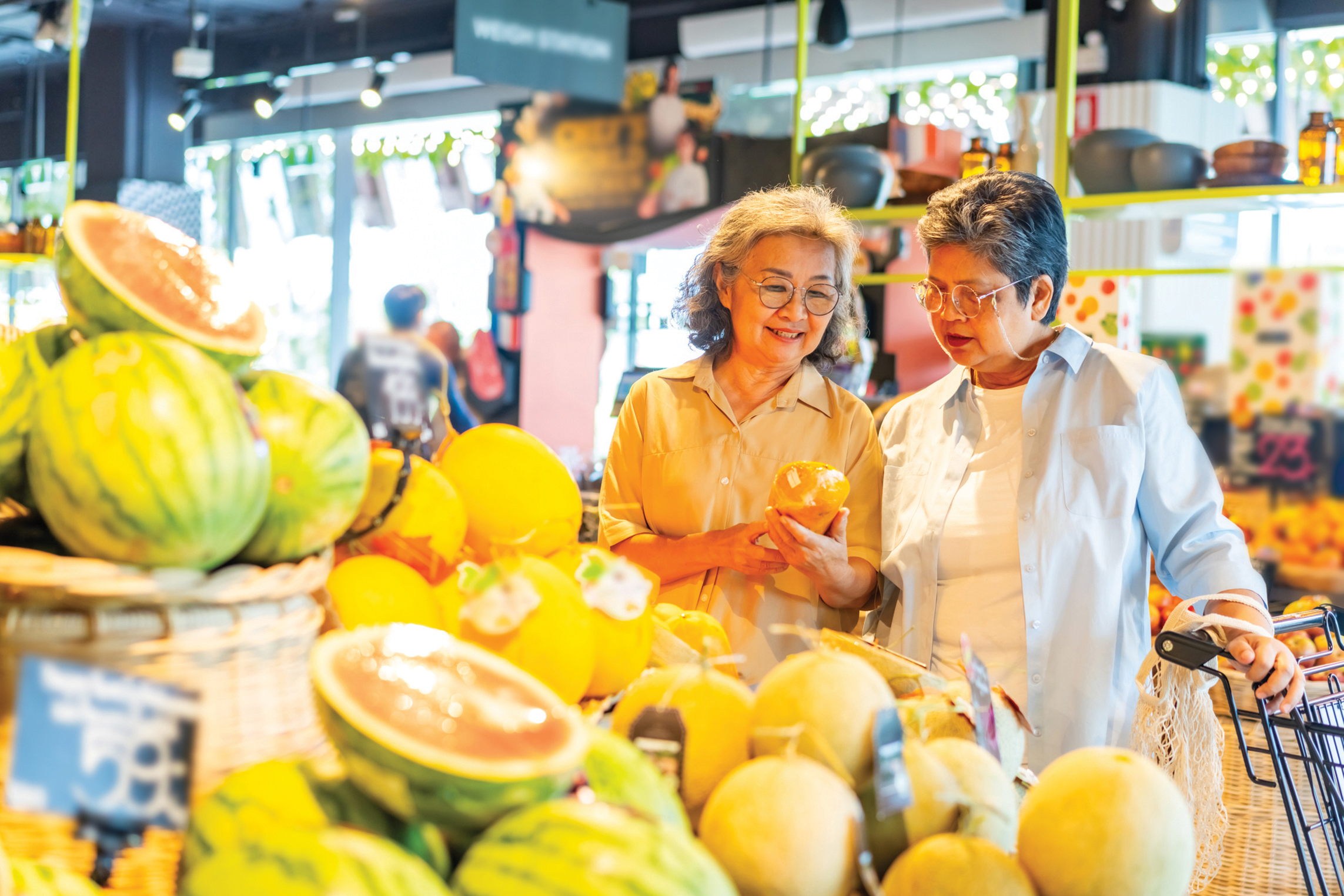
      One of the things about growing older is that it happens gradually. When I retired from Hawai‘i Meals on Wheels last year at age 72, I didn’t realize I was already a dozen years into what is legally defined as “senior”—60 years old or older—by many government program standards. I had already started receiving early Social Security at 62 and had seamlessly transitioned my medical coverage at my workplace to Medicare at 64.

      Retirement for many means living on less income and I remembered reading somewhere that the governor had done something to make Supplemental Nutrition Assistance Program/Electronic Benefits Transfer (SNAP/EBT) more available for Hawai‘i seniors. I wondered what the qualifications were. It took some digging to find out.

      I applied online at Hawai‘i’s Department of Human Services (DHS) website (humanservices.hawaii.gov), qualified and received my EBT Kokua Card (Hawai‘i’s name for the EBT card) in about a month. If you don’t know if you qualify or not, go ahead and try. Nothing bad will happen if you don’t qualify and all the information is confidential.

      In case you are wondering, “SNAP,” “EBT” and “Food Stamps” refer to the same thing. I use the term “EBT,” which is the tool we use to use our SNAP benefits. Your monthly SNAP benefits are loaded onto the EBT Kokua Card. “Food Stamps” is an old-school term for the same thing.

      SNAP is a federal program funded by the US Department of Agriculture, administered here by the State of Hawai‘i. It helps American farmers. If we spend EBT dollars in Hawai‘i, it helps local businesses and local farmers if we buy local. And it certainly helps us seniors.

      You can use EBT to buy food at the market, but you can’t buy medicine, vitamins, tobacco, alcoholic beverages or hot, prepared food (although you might qualify for a meals-on-wheels type service from other nonprofit organizations in Hawai‘i).

      If you qualify, your benefit amount will vary according to your income.

      Some surprising benefits come with your EBT card. Before I even received my Kokua Card, I received a DaBux card. What is DaBux? It’s a Hawai‘i program that gives EBT users a 50% discount off local produce at most local supermarkets and online at Farm Link Hawai‘i (farmlinkhawaii.com). And that includes “name-brand” organic produce. You double your EBT bucks with DaBux.

      With your EBT card, you can even get seeds for vegetables and herbs at a discount from participating retailers so you can grow your own. You can’t get fresher than that.

      Need Help?

      Not all seniors are computer savvy, so I made a short instructional video about the new rules and how to apply online. You can find my 14-minute YouTube video that further explains the process on at tinyurl.com/HowToApplyEBT.

      For those seniors who are not online at all, a local nonprofit organization can help you apply for SNAP/EBT and let you know about your eligibility for other senior programs.

      Call Catholic Charities Benefits Enrollment Center on O‘ahu at 808-527-4777. Other islands can call 808-521-4357.

      For SNAP application, interview and recertification updates, visit humanservices.hawaii.gov/bessd/updates.


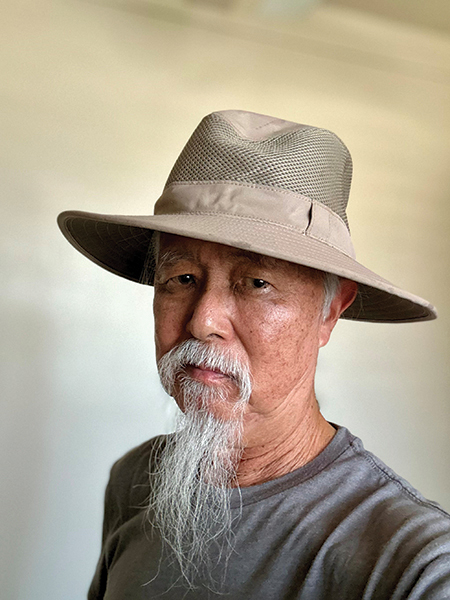
      H. Doug Matsuoka was born in Hilo, Hawai‘i, and lives in Honolulu. Now retired, his career spanned social service nonprofits, including Volunteer Legal Services Hawaii. He recently retired from his 10 years with Hawaii Meals on Wheels, where he started as a part-time driver and became the IT director. He is a social activist, author and co-founder of Hawaii Guerrilla Video Hui.

      If you have a story to share, email the editor: debra@generations808.com.

      One of the things about growing older is that it happens gradually. When I retired from Hawai‘i Meals on Wheels last year at age 72, I didn’t realize I was already a dozen years into what is legally defined as “senior”—60 years old or older—by many government program standards. I had already started receiving early…

    5. Cryptocurrency ATM Scams

      The latest scam tool that international criminal gangs use to take money from kūpuna is likely in your neighborhood supermarket or convenience store.

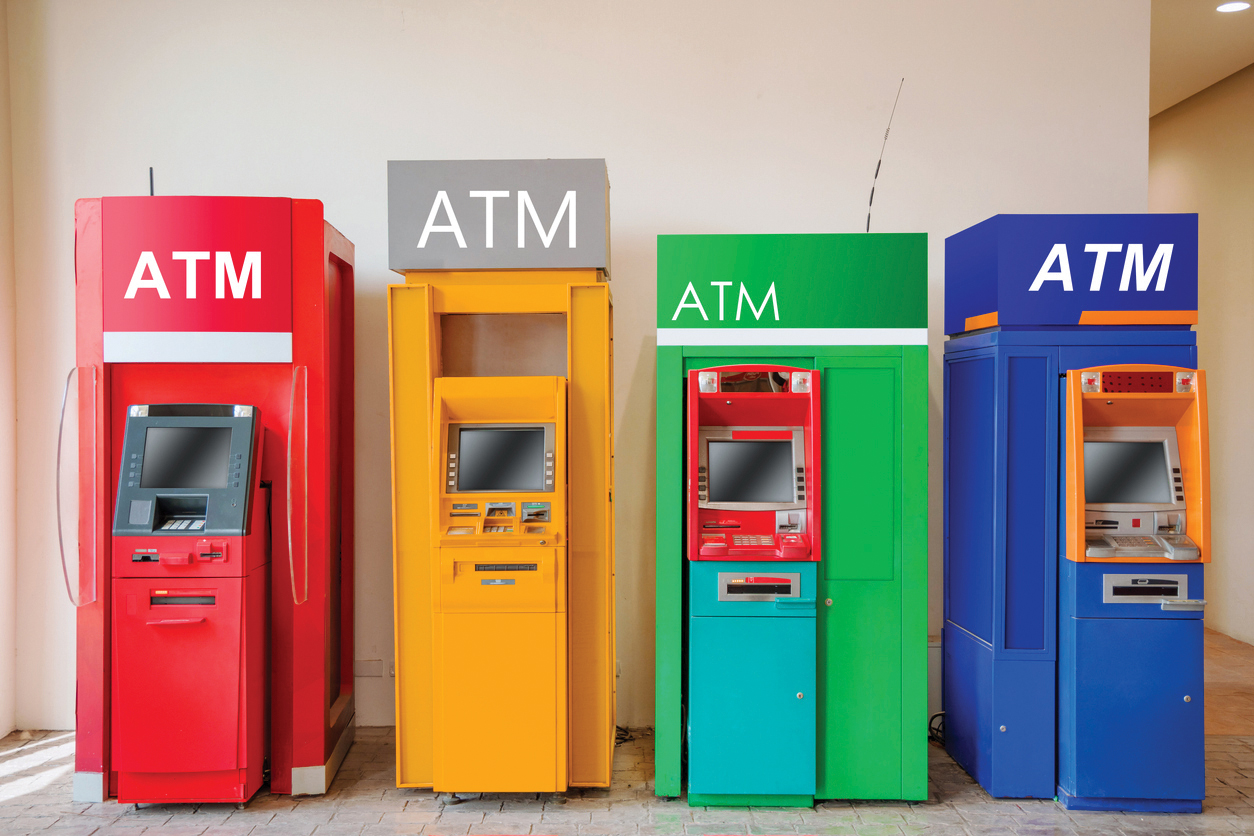
      Bitcoin ATMs, which look similar to bank ATMs, have become commonplace sitting next to regular ATMs, alongside the DMV registration machine and video rental box. There are nearly 100 of them in Hawai‘i and more keep getting added.

      The FBI said that reported crimes involving cryptocurrency ATMs almost doubled last year with nearly 11,000 complaints and losses of about $247 million in 2024.

      The scammers target kūpuna who may not be familiar with bitcoin and cryptocurrency. The Federal Trade Commission says people 60 and older are three times more likely to report being a victim of cryptocurrency ATM fraud.

      The scams often involve a phone call from a fake government or bank official who convinces the consumer that their money is in danger and they need to transfer it to a safe place. Sometimes they call cryptocurrency ATMs a “federal safety locker.” Sometimes it’s a variation of the grandparents or romance scams; the consumer is told to pay into a cryptocurrency ATM to get their grandchild out of jail or to invest in cryptocurrency by someone they have been persuaded to trust.

      What can be done?

      AARP Hawai‘i is pushing for commonsense legislation to limit cryptocurrency ATM transactions to $2,000 per visit, which could limit fraud losses. We’re also lobbying for better fraud warnings and in some cases refunds to consumers.

      Be aware that only scammers demand payment with cryptocurrency. The government never accepts cryptocurrency. Also, if you see someone, especially kūpuna, feeding money into a crytocurrency ATM who looks distressed and may be on the phone with someone directing them, let store authorities or even the police know.

      If you have been a victim of cryptocurrency ATM fraud or know someone who has lost money, let AARP Hawai‘i know by emailing us at the address below. We need to educate lawmakers about this fraud trend and hearing from constituents will help us pass legislation that could save kūpuna from losing their life savings.


      AARP HAWAI‘I (nonprofit)
      1001 Bishop St., Ste. 625, Honolulu, HI 96813
      866-295-7282 | hiaarp@aarp.org
      aarp.org/hi | facebook.com/aarphawaii

      The latest scam tool that international criminal gangs use to take money from kūpuna is likely in your neighborhood supermarket or convenience store. Bitcoin ATMs, which look similar to bank ATMs, have become commonplace sitting next to regular ATMs, alongside the DMV registration machine and video rental box. There are nearly 100 of them in…

    6. First Scammed, Then Murdered

      Thousands of seniors every year receive the scam message, “Congratulations! You’ve won the lottery!” For one man, however, that call didn’t just drain his savings, it cost him his life.

      Abe was a trusting 67-year-old retiree who had been receiving calls for months from a scammer claiming he had won a multimillion-dollar lottery. Like many victims, he believed the caller when they said he only needed to pay “taxes” and “processing fees” to release his prize. He paid hundreds, then thousands, then tens of thousands of dollars to secure his life-changing grand prize… a grand prize that never existed.

      More unfortunate, Abe was not the only one who believed this fantasy. Dee Dee, is live-in girl- friend, also fell for these lies. She saw the outgoing wire transfers, the frantic calls and the promises of a jackpot “about to arrive.” She “knew” a huge fortune was coming—a fortune she believed she deserved, as well. When the money did not appear, Dee Dee thought Abe was hiding the payout from her. When she confronted him, he told her he didn’t have any more money to send for the taxes and processing fees and that he hadn’t received anything at all. Upon hearing this, she thought he was lying and attacked Abe, fatally injuring him. The “lottery winnings” that never existed had destroyed two lives: his and hers.

      This case highlights how deeply and dangerously criminals manipulate their victims. Scam artists know exactly what they’re doing—they build trust, create emotional dependence and manufacture hope. Victims often hide the scam from family out of embarrassment. Loved ones watching from the outside may misunderstand the situation, misinterpret the victim’s behavior or become entangled in the false belief that money is on its way.

      Scams don’t just empty bank accounts. They destabilize homes, relationships and mental health. This case shows that the consequences can become deadly when fear, delusion and financial strain collide.

      But there are ways to protect yourself and those you care about.

      * In Hawai‘i, it is impossible and illegal to win a foreign lottery. Also, no legitimate lottery contacts winners by phone, text or social media. If you didn’t physically enter a contest, you didn’t win. Period.
      * Be aware that you never need to pay money to receive prize winnings. Taxes, fees, customs charges—all fake. Requesting payment is the No. 1 giveaway of a scam.
      * Keep communication open with trusted family. Scammers isolate victims by urging secrecy. If a loved one suddenly becomes secretive about finances, check in compassionately.
      * Watch for sudden financial stress in a household. Unexplained withdrawals, new credit card debt or abrupt behavioral changes may signal a scam.
      * Do not confront scammers or escalate disputes at home. If someone in your household is being scammed, contact police or Adult Protective Services.

      Lottery scams are designed to destroy lives — emotionally, financially and, in rare cases, physically. The best defense is knowledge, honest conversations and early intervention. No jackpot or prize is ever worth a life.


      HAWAI‘I STATE BAR ASSOCIATION
      Senior Counsel Division
      Alakea Corporate Tower, 1100 Alakea St., Ste. 1000
      Honolulu, HI 96813
      808-537-1868 | SCD@HSBA.org | HSBA.org

      Thousands of seniors every year receive the scam message, “Congratulations! You’ve won the lottery!” For one man, however, that call didn’t just drain his savings, it cost him his life. Abe was a trusting 67-year-old retiree who had been receiving calls for months from a scammer claiming he had won a multimillion-dollar lottery. Like many…

    7. Kupuna Connection

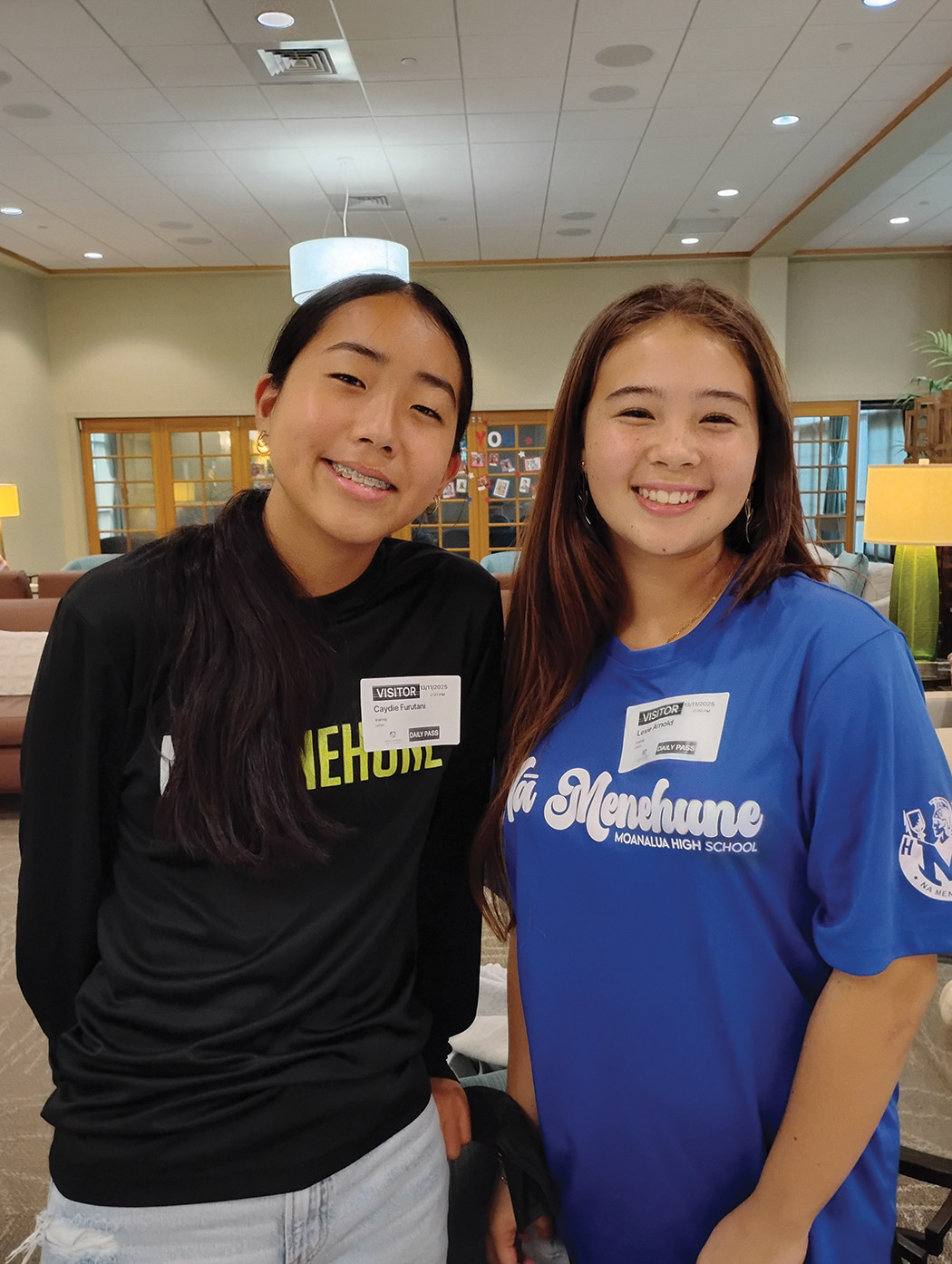
      Caydie Furutani and I are 9th graders at Moanalua High School on O‘ahu. For our social studies project, our teacher asked us to identify ways in which we could positively impact our community on a local or national level. We brainstormed and came up with three different ideas. Eventually, we chose to focus our attention on our local kūpuna community. Our project centered on efforts to improve the mental and emotional health of our kūpuna.

      Because some kūpuna may not have grandchildren near them, we came up with the simple idea to hang out with them, play games, talk story and bring them homemade snacks, in hopes that socializing with fun young people would make them feel happy and less lonely. And it would be fun for us to engage with the older generation.

      When I was born, my mom, Cynthia Arnold, was working to help seniors downsize and move to senior living facilities. She helped many move into 15 Craigside Retirement Community, which had just opened. She continues to this day.

      My mom told me that when I was little, she brought me there every Christmastime and we’d give out homemade cookies and treats to all her past clients. Some of them remembered me as a little one, but all I remember is this was the home where all the GGs (great-grandparents) lived. This is the reason that 15 Craigside Retirement Community was the perfect location for our social studies project.

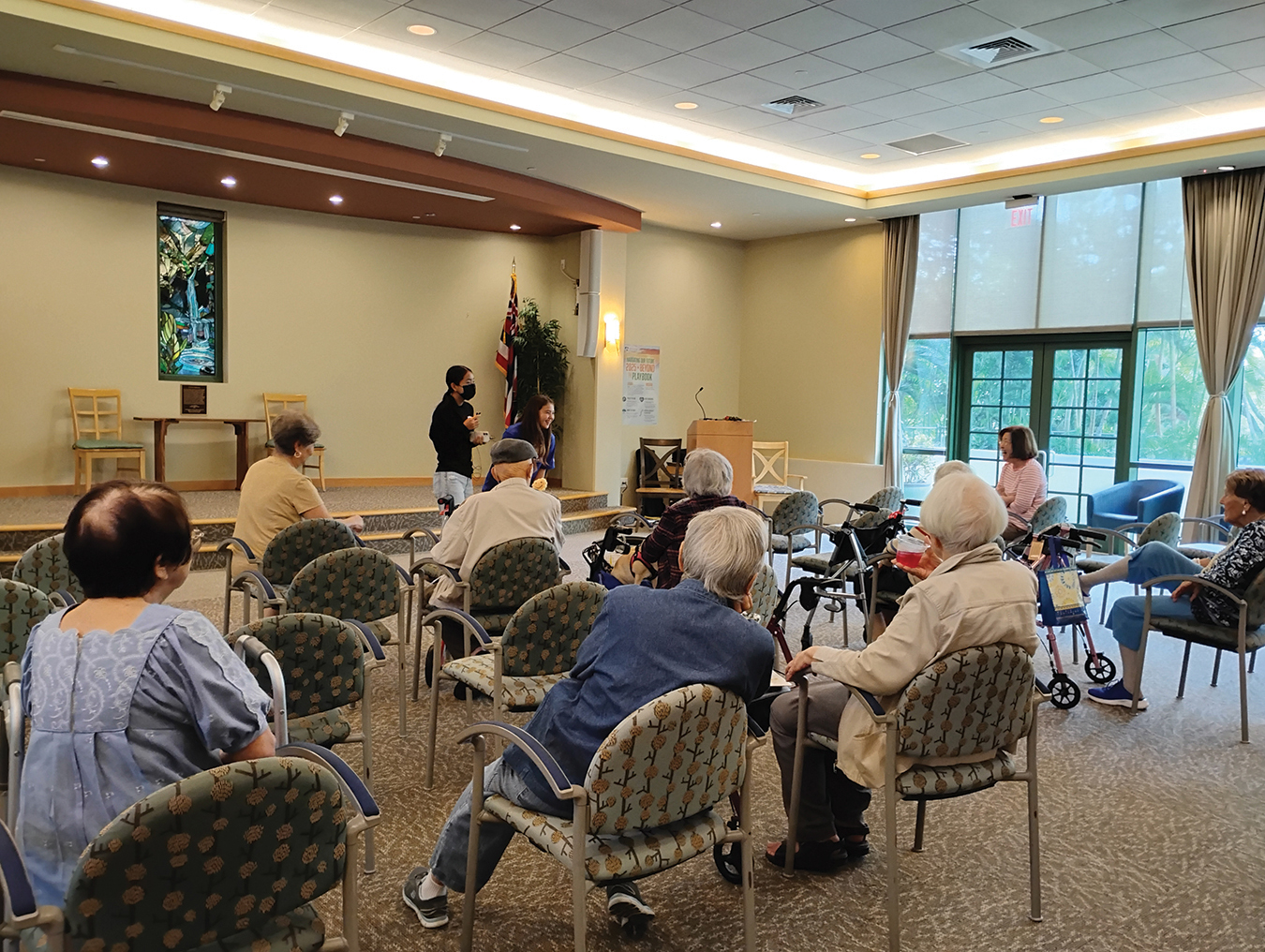
      We brought them homemade brownies, broken glass jello and manju. We talked and played “Thanksgiving Catch Phrase” to stimulate their minds in a fun and friendly environment. Some of the residents were surprisingly competitive, but everyone laughed and had a great time. And all the treats were eaten by the end of our visit.

      While talking story with them, we found out what they had done for a living and how they are now enjoying their later years. Some even gave us some life lessons, such as, “take the negativity out of your life” and “do yoga to keep looking young!” It was a great time of laughing and learning.

      Besides getting an “A” on our project, we took away many happy memories we can share with others. We want to go back again soon!


      Lexie Arnold is a 9th grader at Moanalua High School and the daughter of GM Publisher Cynthia Arnold. She loves to dance and play softball, hang out with her friends and volunteer for organizations on the island.

      If you have a story to share, email the editor: debra@generations808.com.

      Caydie Furutani and I are 9th graders at Moanalua High School on O‘ahu. For our social studies project, our teacher asked us to identify ways in which we could positively impact our community on a local or national level. We brainstormed and came up with three different ideas. Eventually, we chose to focus our attention…