Category: March 2011

  • Donating with Care

    Hawai‘i’s residences are often targeted by door-to-door solicitors asking for donations. Here in Hawai‘i, we are a generous people. We take pride in living the Aloha Spirit, but we must exercise caution as well. We must know the basic things about charitable giving in the event that anyone tries to take advantage of our good nature. Hawai‘i’s Better Business Bureau (BBB) suggests that you:

    • Find out how your charitable contributions are being used.
    • Beware of appeals that bring tears to your eyes but tell you little about what the charity is doing about the problem it describes so well.
    • Watch out for statements such as “all proceeds will go to the charity.” This can mean that only the money left after expenses, such as the cost of written materials and fund raising efforts, will go to the charity. These expenses can be high, so check carefully.
    • Check with Hawai‘i’s BBB for information on local charities and solicitors operating in Hawai‘i. Let the BBB’s resources work for you. Check out a business or charity at www.hawaii.bbb.org

    Give with the knowledge that those soliciting have an obligation to be transparent to the public. Be assured that you are making informed decisions, and have the confidence that every donation you make is positively impacting lives. When in doubt about any charity or organization, contact Hawai‘i’s Better Business Bureau for more information.


    Bonnie Horibata is vice-president of Hawai‘i’s Better Business Bureau. BBB provides objective advice, business and charity reports, and information about topics affecting marketplace trust at www.bbb.org

    Hawai‘i’s residences are often targeted by door-to-door solicitors asking for donations. Here in Hawai‘i, we are a generous people. We take pride in living the Aloha Spirit, but we must exercise caution as well. We must know the basic things about charitable giving in the event that anyone tries to take advantage of our good…

  • Meaningful Legacies

    What are you leaving behind? This is a question that all too many of us fail to address before it’s too late. It’s not just a question about money, but about the entire heritage that you want to pass on to future generations—to those in your family and even to society as a whole.

    When mapping out your legacy plan, there are many things to think about: your current assets and debts, tax implications, income, expenses … and the list goes on. While it might seem like a lot to sort through—especially once you tack on the emotional aspect of planning for your own end of life—the reward of proper planning is knowing you’ve done all you can to enhance the well being of your beneficiaries.

    Here are a few issues to consider:

    • Taxes: The federal estate tax has been eliminated for individuals who passed away in 2010 (barring action from Congress to reverse the situation), but this was just a temporary change to the law. The estate tax is scheduled to reappear by 2011, possibly affecting estates as small as $1 million (compared to the previous law with a $3.5 million tax exemption level). Even now, estate and inheritance taxes may still affect many on a state level.

    In addition, beneficiaries may not escape income taxes. Those who inherit a traditional IRA, for example, will have to pay applicable income tax on distributions. An alternative is to convert a traditional IRA to a Roth IRA, which requires that the income tax be paid currently. This will allow beneficiaries to enjoy tax-free distributions for years to come.

    • Managing the Estate: Will anybody manage your money with the care and conviction that you practice today? Not likely, unless you make your wishes clear. A will allows you to specify who will administer your estate, and how your property will be distributed. If you have minor children, a will can also identify to whom their guardianship will be transferred. Be sure to put a comprehensive will in place and revisit it on a routine basis, or whenever major life events occur.

    Depending on your situation, you may also want to consider setting up a trust, or other type of ownership arrangement, to provide some structure to the management and disposition of assets.

    Careful planning is all the more crucial for small business owners who need to determine the future of their company, including who will take charge and the financial implications of business succession. If your business provides products or services that others have come to rely on, it is important to plan ahead to maintain normal business activity in your absence.

    • Protection: Keeping assets protected from potential creditors or the impact of future lawsuits is another important aspect of legacy planning. In some states IRAs, annuities and insurance can be useful tools to help minimize the potential exposure. This is an issue regardless of the size of the estate but should only be done in consultation with your legal advisor.
    • Organization: One of the greatest gifts you can leave behind is a set of well-organized records. Good documentation of all assets and debts, where everything important can be found and key contact names will go a long way toward the proper disposition of your estate. You can also leave a letter, separate from a formal will, outlining specific wishes regarding matters like organ donations or the conduct of your funeral, as well as how specific items you own should be distributed to others—but the rules on this vary state to state.

    Seek the advice of tax, legal and financial advisors to protect the legacy you’ve been working to build.


    Michael W. Yee is a financial advisory practice of Ameriprise Financial Services, Inc. As a financial advisor, Yee’s customized advice is anchored in a solid understanding of client needs and expectations. For more information, please contact Michael W. Yee at (808) 952-1240. Advisor is licensed/registered to do business with U.S. residents only in the states of Hawaii. Brokerage, investment and financial advisory services are made available through Ameriprise Financial Services, Inc. Member FINRA and SIPC. Some products and services may not be available in all jurisdictions or to all clients.© 2010 Ameriprise Financial, Inc. All rights reserved.

    What are you leaving behind? This is a question that all too many of us fail to address before it’s too late. It’s not just a question about money, but about the entire heritage that you want to pass on to future generations—to those in your family and even to society as a whole.

  • Internet-Drafted Estate Plans Don’t Save Money

    If you want to, you can devise your own estate plan without the benefit of lawyers or other trained advisors. All you need is a credit card, a computer, a printer, and access to the Internet. With those tools, you can come up with a set of documents that may or may not accomplish your goal. The problem is that you will never know. The ultimate success or the failure of an estate plan is rarely revealed during the lifetime of the “planmaker.” (No, planmaker is not a real word, but you know what I mean.)

    You have seen the commercials. You have heard the radio ads. But before you go to a website to have your estate plan constructed by a computer program, be sure to ask yourself this: Do I really believe that a brilliant lawyer, or a highly-paid radio personality who hawks these kinds of programs, would trust a website to come up with an estate plan for himself and his family? If it’s not good enough for them, why would it be good enough for you?

    You may not have as large of an estate as Mr. Fancy Shmancy lawyer or Mr. Radiobucks, but everything you own is everything you own, and it makes a difference to you whether it goes where you want it to go after you are gone. It also makes a difference to you who will make decisions on your behalf if there is ever a time when you can’t make them yourself. Do you want your hand-picked decision-maker talking with your doctor when you’re unable to speak, or are you willing to leave it to chance as to who steps up to the plate?

    The problem with computer-driven estate plans is that in the real world, more often than not, they don’t work. An effective estate plan involves far more than a set of documents, even very well drawn documents, that would stand up in any court in the land. For one thing, wouldn’t it be better to have an estate plan that will help you and your family stay out of court altogether? Going to court is not the end of the world, but it can be a royal pain. It would be better for you and your loved ones if you get your plan right the first time. It should also continue to work according to your wishes in light of changes in your health, your “stuff,” the law, and the list of people you like and trust.

    Bottom line: There is a lot of really good information on the Internet. There is also a lot of misinformation. Do you have the training and background to tell one from the other when it comes to putting your estate plan in order? If so, knock yourself out, Professor. If not, there is something to be said for working with live professionals instead of an impersonal website that cares more about your credit card authorization than about what happens to you and your family. For more information about creating an estate plan that works, check out www.est8planning.com.


    SCOTT MAKUAKANE is a lawyer whose practice has emphasized estate planning and trust law since 1983. He hosts Est8Planning Essentials, a weekly TV talk show which airs on KWHE (Oceanic channel 11) at 8:30 p.m. on Sunday evenings. For more information about Scott and his law firm, Est8Planning Counsel LLLC, visit www.est8planning.com.

    If you want to, you can devise your own estate plan without the benefit of lawyers or other trained advisors. All you need is a credit card, a computer, a printer, and access to the Internet. With those tools, you can come up with a set of documents that may or may not accomplish your…

  • Chef Michi’s Recipe: Waldorf Salad

    Salad:

    • 1 head romaine lettuce
    • 1 bunch local watercress (3 cups chopped)
    • 2 whole Fuji apples or ripe pears
    • ¾ cup walnuts
    • 4 oz. crumbled feta or Gorgonzola cheese
    • ½ cup dried cranberries
    • 2 Tbs. honey or pancake syrup
    • 1 Tbs. brown sugar
    • Parmesan cheese
    • Fresh ground black pepper, to taste
    • Non-stick spray

    Dressing:

    • ¼ cup balsamic vinegar
    • 1 cup prepared light ranch style dressing

    To prepare “candied” walnuts, pre-heat oven to 325 °F degrees. In a small bowl, combine walnuts and syrup, toss in brown sugar to coat. Line a baking sheet with foil, spray with a nonstick spray and layer the prepared walnuts in a single layer. Bake for about 12-15 minutes, or until golden brown. Set aside to cool.

    Cut romaine into bite-size pieces, chop watercress into 1-inch pieces and toss together in a large salad bowl. Slice apples and/or pears into bite-size pieces, and add to salad. Add feta or Gorgonzola, candied walnuts and cranberries.

    For the dressing, combine ingredients to make the creamy balsamic vinaigrette. Take care to lightly dress the salad and toss gently. Season with fresh ground pepper and sprinkle generously with Parmesan cheese. For an attractive presentation, use a vegetable peeler to scrape wide curls of Parmesan and place on top of tossed salad.


    Chef Michi has more than 12 years of experience as a “casual gourmet,” cooking for family and businesses. Her catering company, Michi’s Fresh Cooking For You, was founded three years ago. Since then, Chef Michi has become a recipe developer for KTA Superstores on the Big Island. All recipes center on healthy yet easy to prepare dishes that are packed with flavor. Visit www.cookingfreshforyou.com or contact Michi at cookingfreshforyou@gmail.com or (808) 286-6484

    Here are all the ingredients and the directions to make a yummy Waldorf salad. Enjoy!

  • Franciscan Vistas ‘Ewa

    “Aging in place” is not just a trendy buzzword for St. Francis Healthcare System of Hawai‘i. It’s something the nonprofit organization is making a reality for older adults who want to live independently yet they are on fixed incomes.

    Franciscan Vistas ‘Ewa, a brand new, 149-unit affordable senior independent living community in burgeoning West O‘ahu, is changing Hawai‘i’s senior housing landscape. A total of six apartment buildings are targeted for completion by May 2011. Tenants will be moving into the first completed apartment building this month, and more residents are expected to occupy the units as the buildings are completed.

    “Franciscan Vistas ‘Ewa is a model community where affordable housing meets wellness,” says Pamela Witty-Oakland, chief administrator of St. Francis Residential Care Community, who is overseeing development of the project. “Older adults at Franciscan Vistas ‘Ewa will be able to enjoy the health and wellness amenities of condo-living.” Plantation-style architectural features pay homage to the area’s rich history. In addition, the needs of older adults were kept foremost in mind throughout the development process. Designed by the architectural firm Alakea Design Group, the units have open floor plans and are ADA-adaptable.

    Each unit includes conveniences such as a fully equipped kitchen with easy-to-reach cabinets and appliances, roll-in shower, split-level air conditioning and private lanai. Each two-story building includes an elevator and a laundry room with coin-operated washers and dryers. The apartments encircle a garden courtyard, creating a sense of community that encourages residents to meet their neighbors and to look after each other.

    A number of environmentally sustainable applications were also integrated into the project. Energy-efficient Energy Star refrigerators and front loading washers; fluorescent lights; high-efficiency shower heads, faucets and toilets; and solar water heating are some of the features that were selected for Franciscan Vistas ‘Ewa not only to support environmental stewardship, but also to help keep the utility costs down for the seniors living there.

    “We wanted to take senior living to a whole new level, while making it affordable for Hawai‘i’s growing number of older adults,” Witty-Oakland adds. “With 127 years of health care experience in Hawai‘i, the Franciscan Sisters recognized the need for a healthy community that fosters a healthy lifestyle to help people remain independent for as long as possible.”

    Social isolation is also a thing of the past for those living at Franciscan Vistas ‘Ewa. A one-story, 5,000-square-foot community center serves as a gathering place for the senior residents, offering cultural, social and recreational activities. The community center has a kitchen, fitness center, hair salon, learning and activity center with Internet, an adjoining conference room and swimming pool. Stanford Carr Development LLC, which is serving as the development consultant to St. Francis, has provided its expertise in all phases of real estate development, including securing land use approvals, community design, permits and affordable housing financing.

    “St. Francis Healthcare System understands the needs of the community and brings together the resources to develop innovative solutions. The St. Francis team transformed vacant land into a beautiful place seniors can call home,” says Jesse Wu, vice president of special projects for Stanford Carr Development. “Every detail for this model community center was carefully planned to be senior-friendly. Franciscan Vistas ‘Ewa has definitely raised the bar for independent senior communities throughout Hawai‘i.”

    Franciscan Vistas ‘Ewa is located at 91-1471 Miula Street in ‘Ewa Beach, in close proximity to stores, restaurants, churches, medical facilities and TheBus lines. Rental units are for households with incomes up to 60 percent of the City & County of Honolulu’s area median income as determined by HUD. Initial monthly rents are $745 for 530-square-foot one-bedroom units and $885 for 750-square-foot two-bedroom units. All individuals in the household must be 62 years and older. Prudential Locations, LLC serves as the property manager.


    For more information, please call (808) 681-4000 or visit www.stfrancishawaii.org

    “Aging in place” is not just a trendy buzzword for St. Francis Healthcare System of Hawai‘i. It’s something the nonprofit organization is making a reality for older adults who want to live independently yet they are on fixed incomes.

  • Tax-Aide for Seniors

    Tax season is officially under way, and Hawai‘i residents can count on AARP Tax-Aide volunteers to help reduce tax stress. Beginning Feb. 1, AARP-trained and IRS-certified volunteers will be available at 45 locations throughout the state to help taxpayers prepare basic federal and state forms.

    AARP Tax-Aide is the nation’s largest, free, volunteer-run tax preparation and assistance service for low- and moderate-income taxpayers, with special attention to people age 60 and older. The program helps the most vulnerable people build and protect their assets through free income tax preparation. Since 1980 the program has operated under a cooperative agreement with the U.S. Internal Revenue Service. Last year in Hawai‘i more than 200 AARP Tax-Aide volunteers helped more than 10,000 taxpayers across the state. They join more than 35,000 volunteers across the country, helping millions of taxpayers each year.

    AARP Tax-Aide volunteers can also provide counseling services to people who are unable to leave their homes. In Hawai‘i last year, volunteers visited home-bound residents, including individuals in nursing homes. One-on-one, on-site tax counseling is available now through April 15. Foreign language assistance is also available at select locations.

    AARP Tax-Aide is a service of the AARP Foundation, AARP’s affiliated charity. Foundation programs provide security, protection and empowerment for older persons in need. ■


    For locations and times, please call 843-1906 or visit the Information Center on O‘ahu at 1199 Dillingham Blvd, #A106, Honolulu, HI. To find the site closest to your home, call toll-free 1-888-AARPNOW (1-888- 227-7669) or visit www.aarp.org/taxaide.

    Tax season is officially under way, and Hawai‘i residents can count on AARP Tax-Aide volunteers to help reduce tax stress. Beginning Feb. 1, AARP-trained and IRS-certified volunteers will be available at 45 locations throughout the state to help taxpayers prepare basic federal and state forms.

  • Body-Proofing II – Motion is Lotion

    Last month, we emphasized the importance of exercise to combat the natural aging process. Specifically, exercises like Pilates, Tai Chi and Yoga provide coordinated full body workouts with an emphasis on core muscle strengthening, balance and fluidness of movements. But what if you have pain in your knees or back making even simple movements like walking difficult? Thank your lucky stars because here in Hawai‘i, you are surrounded by the perfect modality—water.

    Physical therapists have been utilizing the unique properties of water to rehabilitate patients for decades. We call it Aquatic Therapy. By submerging the body partially in water, it creates weightlessness and takes the pressure off our knees, hips and spine. This is especially useful for patients with arthritis, healing fractured bones, or who are overweight. By decreasing the amount of joint stress it is easier and less painful to perform exercises.

    Once submerged, the viscosity of water provides resistance so you can build strength without using additional weights. Slow controlled movements like leg lifts and arm circles under water can be very effective for strengthening your legs, arms and back. Even simply walking in chest-height water can improve leg and back strength, balance and cardiovascular fitness.

    Another important feature of aquatic therapy is hydrostatic pressure, which is the evenly distributed pressure that is exerted on the body when it is submerged under water. This pressure provides joint positional awareness. As a result, your proprioception, the sense of where your body is in space, is improved. This is important as proprioception naturally declines with age, beginning at around 40, and is critical factor for balance reactions. Hydrostatic pressure also allows for pain free movements by decreasing swelling caused by injury or arthritic disorders.

    For rehabilitation purposes, Aquatic Therapy is often done in a heated pool, which helps to increase circulation and allow muscles to relax and stretch safely. However, if your goal is fitness and not rehabilitation from injury, any pool will do.

    Many facilities have “water aerobics” for a more structured program. Hawai‘i’s beaches are superb for aquatic fitness too. The calm waters at Magic Island are ideal. Simply walking in waist to chest-high water is an excellent workout and the gentle currents will help improve balance. As always, use good safety precautions at the beach.

    Physical therapists like to say, “Motion is lotion,” the more we move, the easier it will be to keep moving!


    Teresa Wong is a physical therapist, certified Pilates instructor and manager of the Rehab Hospital Of the Pacific Nu‘uanu Clinic. The clinic provides state-of-the-art rehabilitation programs for individuals recovering from injuries and illnesses. Visit online at www.rehabatnuuanu.org; email, twong@rehabhospital.org.

    Last month, we emphasized the importance of exercise to combat the natural aging process. Specifically, exercises like Pilates, Tai Chi and Yoga provide coordinated full body workouts with an emphasis on core muscle strengthening, balance and fluidness of movements. But what if you have pain in your knees or back making even simple movements like…

  • Your Mind and Body: The Breakdown on Bone Loss

    What is Osteoporosis?

    Osteoporosis (porous bones) is a bone disease that involves thinning of the bone tissue and loss of bone density over time. This weakens the bones and increases a person’s risk for fracture. Women are four times more likely to have osteoporosis as compared to men.

    In 2005, osteoporosis was responsible for two million fractures and $19 billion in costs. Breaking a bone is a serious matter for seniors as it can lead to disability. Active seniors who wish to maintain their independence for as long as possible need to get screened for osteoporosis. If you are diagnosed with osteoporosis, your doctor can prescribe medication and supplements.

    What are the risk factors for osteoporosis?

    Some factors increase your chances of developing osteoporosis. Some you can change, others you can’t.

    Things You Can Change

    • Increase the amount of calcium in your diet
    • Stop smoking
    • Treat eating disorders such as anorexia or bulimia
    • Exercise and lead an active lifestyle
    • Stop drinking alcohol. More than two alcoholic drinks a day prevents your body from absorbing calcium Things You Can’t Change
    • Being a woman
    • Getting older
    • Race: You’re at greatest risk if you’re of Caucasian or Asian descent
    • Family history
    • Being very thin or having a small frame size
    • Certain medical conditions, procedures and drugs

    What foods are rich in calcium and vitamin D?

    Food rich in vitamin D include dairy food such as milk, yogurt and cheese; vegetables such as broccoli, kale and collard greens; proteins such as beans, tofu and salmon; fruits such as orange, figs and rhubarb. Fish and fish liver oils are the best sources of vitamin D.

    See your doctor for a more complete, and perhaps more appetizing, list of calcium-rich foods. And, of course, sunlight is a major source of vitamin D, however, most of us in Hawai‘i get enough rays.


    Dr. Ritabelle Fernandes, MD, MPH, FACP is Clinical Associate Professor at the Geriatric Medicine Department of the John A Burns School of Medicine, University of Hawai‘i. She is board certified in Geriatric medicine, Hospice and Palliative Medicine, Internal Medicine and Home Care. She is a practicing physician at the Kokua Kalihi Valley and Kalihi-Palama Health Center

    Osteoporosis (porous bones) is a bone disease that involves thinning of the bone tissue and loss of bone density over time. This weakens the bones and increases a person’s risk for fracture. Women are four times more likely to have osteoporosis as compared to men.

  • The Art of Pressure

    Have you ever instinctively held your forehead or temples when you’ve had a headache? Everyone at one time or another has used their hands to hold tense or painful places on the body. This is the healing touch of acupressure.

    Acupressure is an ancient Chinese healing art that uses the fingers to press key pressure point to release muscular tension and promote blood circulation and the body’s natural healing abilities. Acupuncture and acupressure use the same points, but acupuncture employs needles, while acupressure uses the gentle but firm pressure of hands (and even feet).

    Foremost among the advantages of acupressure’s healing touch is that it is safe to do on yourself and others. There are no drugs involved. And the only pieces of equipment needed are your own two hands. You can practice acupressure therapy any time, anywhere.

    My acupressure clinical experiences over the past 18 years have shown me that acupressure can be effective in helping relieve headaches, eyestrain, sinus problems, neck pain, backaches, arthritis, muscle aches and stress tension. Acupressure can also be used to relieve ulcer pain, menstrual cramps, lower back aches, constipation and indigestion.

    Alice, one of my older clients, had limited mobility in her neck with severe arthritic neck pain that radiated down her shoulders into her arms as well as up into her head. After her first acupressure session, she not only felt less discomfort but also had greater flexibility in her neck. For the first time in years, she was able to move her head freely without pain.

    After several weeks, Alice realized that she could help herself by using the points underneath the base of her skull to relieve both her neck pain and stiffness. Recently she told me that whenever the pain “creeps up on her,” she practices self-acupressure.

    There are many great advantages to using acupressure as a way to balance the body and maintain good health. By relieving stress, acupressure strengthens resistance to disease and promotes wellness … using the power and sensitivity of the human hand.

    For more information, self-healing books, CDs and DVDS, visit www.Acupressure.com


    Michael Reed Gach, Ph.D., author and Acupressure Institute founder, is a foremost expert on Acupressure Therapy and self-care techniques. His seven books and instructional DVDs have sold more than a half million copies, bringing healing to thousands. Dr. Gach directs the Acupressure.com website of articles, self-healing books, CDs and DVDs available online. Gach received his PhD. from Columbia Pacific University in Health & Human Services. He authored Acupressure’s Potent Points and Acupressure for Emotional Healing.

    Have you ever instinctively held your forehead or temples when you’ve had a headache? Everyone at one time or another has used their hands to hold tense or painful places on the body. This is the healing touch of acupressure. Acupressure is an ancient Chinese healing art that uses the fingers to press key pressure…

  • Retirement FAQs

    Q: How do I show proof of my Social Security benefit amount?

    A: There are several ways to do this:

    • Use your SSA-1099 form as proof of your income
    • Use your annual notice that tells you your benefit amount for the year
    • Go online and request a Proof of Income Letter at www.socialsecurity.gov/bene
    • Call Social Security’s toll-free number: 1-800-772-1213 (TTY 1-800-325-0778) 7 a.m.–7 p.m., Monday–Friday

    Q: I understand that by 2013 I will no longer be able to receive my Social Security payments by paper check. What are the benefits of using direct deposit?

    A: The benefits of using direct deposit are:

    • It’s safe, secure and convenient;
    • There are no checks to be lost;
    • You are in control of your money; and
    • You will get your benefits on time, even if you’re out of town, sick, or unable to get to the bank.

    You choose the account where your Social Security payment is deposited. If you don’t have a bank account, you can use the Direct Express (www.godirect.gov) prepaid debit card to receive Social Security, Supplemental Security Income (SSI), and other Federal benefit payments. With this card, you can make purchases, pay bills and withdraw cash.

    Q: How does a blind or visually impaired person choose how Social Security communicates with them about important information?

    A: Blind or visually impaired beneficiaries can receive information from Social Security in different ways. To learn about notification options:

    • Visit www.socialsecurity.gov/notices and go to the page, “If You Are Blind Or Visually Impaired—Your Choices For Receiving Information from Social Security”
    • Call toll-free at 1-877-708-1776 (TTY 1-800-325-0778)
    • Contact your local Social Security office
    • Contact the U.S. Embassy or Consulate if you live outside the United States

    Q: What is a disability trial work period?

    A: The “trial work period” allows Social Security disability beneficiaries to test their ability to work for at least nine trial work months within a 60-month period. During the trial work period, you can receive full benefits no matter how much you earn, as long as you remain disabled and you report your work activity. For more information about work incentives see our publication Working While Disabled—How We Can Help at www.socialsecurity.gov/pubs/10095.html.

    Q: What are the “Parts” of Medicare?

    A: There are four (A-D) Medicare parts:

    • Hospital insurance (Part A) helps pay hospital bills and some follow-up care. The taxes you or your spouse paid while working finances this coverage, so it’s premium free. For those who are not “insured,” coverage may be purchased.
    • Medical insurance (Part B) helps pay doctors’ bills and other services. There is a monthly premium you must pay for Medicare Part B or you may refuse this coverage.
    • Medicare Advantage (Part C) plans, which generally covers the same benefits as a Medigap policy, such as extra days in the hospital after you have used the number of days Medicare covers. People with Medicare Parts A and B can choose to receive all of their health care services through one of these provider organizations under Part C. There might be additional premiums required for some plans.
    • Prescription drug coverage (Part D) helps pay for prescription drugs. Anyone who has a Medicare Part A, Part B, or Part C is eligible for prescription drug coverage (Part D). Joining a Medicare Part D plan is voluntary and you pay an additional monthly premium for the coverage. To learn more about Medicare benefits, read our publication, Medicare, at www.socialsecurity.gov/pubs/10043.html.

    Q: I can’t get health insurance because of my pre-existing condition. Is there anything I can do?

    A: You may be eligible for the new Pre-Existing Condition Insurance Plan—a program for people who have a pre-existing condition and have been without health insurance coverage for at least six months. For more information, call toll-free: 1-866-717-5826 (TTY 1-866-561-1604), 8 a.m.–11 p.m. (Eastern Time). Or visit www.pcip.gov and select “Find Your State” to learn about eligibility and how to apply.

    Q: How do I show proof of my Social Security benefit amount? A: There are several ways to do this:

  • March into Medicare

    Hawai‘i’s Sage PLUS (SHIP) counselors are often asked, “What is Medicare, and how does it affect me?”

    Medicare is the United State’s federal health insurance that is available to those 65 years and older, and to people at any age with certain disabilities.

    You can choose to use the government’s Original/Traditional Medicare, or a commercial Medicare Health Plan or a Medicare Supplement (also known as “Medigap” insurance).

    Sage PLUS is a Medicare Counseling Program, nationally known as the State Health Insurance Assistance Program (SHIP) and it is a volunteer-based program. Many of the volunteers started with the program to learn more about Medicare for their families and have been with us for more than 10 years. If you have specific questions about your circumstances, or you would like to volunteer, please call 1-888-875-9229 or visit www.hawaiiship.org.

    Have you recently enrolled in Medicare and aren’t sure what to do next? Here are a few tips to give you a jump start on a healthy future:

    Step 1: Sign up for the “Welcome to Medicare” physical exam.

    Call your doctor and schedule your “Welcome to Medicare” physical exam today. It’s an easy way for you and your doctor to get an accurate benchmark of your health.

    During the exam, you and your physician will review your medical and family history, assess current health conditions and prescriptions, and conduct health screenings to establish a baseline for care.

    You will also have an opportunity to talk about short- and long-term goals to improve your health and overall well-being. For example, your physician will provide you with a plan of action that may include referrals for other services, including preventive services such as cancer screenings, flu shots, routine vaccines and diabetes tests. Many of these services are free to most Medicare beneficiaries as a result of the Affordable Care Act.

    At the end of your appointment, be sure to schedule an annual “Wellness Exam” for the following year. Thanks to the Affordable Care Act, Medicare now covers a yearly check-up. The “Welcome to Medicare” and annual “Wellness Exam” are great ways to assess changes in your health and catch any health issues early.

    Step 2: Register at MyMedicare.gov

    Register at www.MyMedicare.gov for easy access to your health information. This free, secure online service provides access to personalized information regarding your Medicare benefits and services. If you don’t have a computer, ask someone you trust, like a family member or the administrator at your local senior center, to help you sign-up and regularly review your information.

    Step 3: Take advantage of all your Medicare resources.

    Medicare offers a number of resources to help you get the most out of your benefits. If you are a new enrollee, check out the New to Medicare? section of www.medicare.gov.


    Review your Medicare & You 2011 handbook; or call 1-800-MEDICARE (1-800-633-4227). TTY users should call 1-877-486-2048. If you need help in a language other than English or Spanish, say “Agent” at any time to talk to a customer service representative. More information is available at www.healthcare.gov, a new web portal from the U.S. Department of Health and Human Services. ■ This information prepared by the U.S. Department of Health and Human Services.

    Hawai‘i’s Sage PLUS (SHIP) counselors are often asked, “What is Medicare, and how does it affect me?” Medicare is the United State’s federal health insurance that is available to those 65 years and older, and to people at any age with certain disabilities. You can choose to use the government’s Original/Traditional Medicare, or a commercial…

  • Heavyweight Volunteer: Stuart Ho

    Heavyweight Volunteer: Stuart Ho

    The men in Stuart Ho’s family have been heavy weights in business for three generations. His father, legendary developer Chinn Ho, turned the ‘Ilikai into the state’s first high-rise luxury resort in the 1960s. Stuart served on the boards of such notable companies as Aloha Airlines, Gannett Co., and Pacific Resources in a long and successful career as state legislator, attorney and executive. Today, son Peter Ho is continuing the family tradition of business stewardship as president and CEO of Bank of Hawai‘i.

    At 75, Stuart is busier than ever in retirement. “There was a time when retirement meant the beginning of declining health and slower pace. Nowadays, when your reach the age of 50 you’re just beginning the second half of your life and hitting your stride,” he grins. “The 50s, 60s and 70s are a chance to reinvent yourself, whether you want to keep working, change careers, spend time with family or search for a new adventure. But good health and financial security are the keys.”

    Stuart practices what he preaches. He hits the gym six times a week, plays golf regularly and remains one of Hawai‘i’s most influential community leaders. And he’s dedicated to making Hawai‘i a better place by taking up important social causes such as making health care and long-term care reform more affordable and accessible. As volunteer State President of AARP Hawai‘i, the non-profit member organization for people age 50-plus, he’s in a good position to do just that.

    GM: Your father started his business in Hawai‘i more than a half century ago. What can you tell us about that time?

    SH: The center of town was Fort and King, and the flying time to San Francisco was a long 9-1/2 hours. Doctors made house calls. We ate dinner at 5 o’clock, and didn’t lock our front door at night. No one dreamt tourism would replace sugar and pineapple. The Boeing 707 changed all that, of course. You could say the 707 and the GI Bill changed everything.

    GM: The name Chinn Ho is iconic in Hawai‘i. How did your father influence your career direction?

    SH: By providing my siblings and me the best education he could afford. We really didn’t see much of him. He worked 24/7. But I was able to absorb what was going on around him: what he was thinking; whose advice he valued; and eventually the odd realization that some of the best help and advice he got was from people on the Mainland who had scarcely heard of Hawai‘i let alone dealt with a Chinese-American who spoke fractured English.

    GM: How did growing up the son of Chinn Ho influence your view of tourism’s growth and the future of Hawai‘i?

    SH: Dad was a very early believer that Hawai‘i’s future lay with tourism. He sensed from the start what the jet plane could do for Hawai‘i. But one piece of wisdom that has stuck with me all these years actually came from the late Henry Walker. Henry was chairman of Amfac and a big sugar guy. I remember him saying, “The best asset Hawai‘i has is its good weather.” You have to travel to a lot of places to realize how true that is—and how much people are willing to pay for what we take for granted. Our good weather has made tourism the cornerstone of our economy. Despite a lot of wishful thinking to the contrary, I think tourism is the only practical means we have of growing our economy—if we have the good sense to allow that to happen.

    GM: Looking back at your career as a legislator, an attorney and a businessman, is there a single accomplishment you’re proudest of?

    SH: A lot of people will disagree with me on this, but I’m proudest of leading the floor fight in the State House on the abortion bill in 1970. The bill easily passed the Senate, but passage was really in doubt in the House. I felt very strongly that we had to have such a law. I deeply admired Gov. John A. Burns, a devout Catholic, for leaving his private views out of it, and I was grateful to Speaker Tadao Beppu for his steady support. But as the majority floor leader I had the problem of stitching the votes together, one-by-one. It was very close, but we did it.

    GM: You could do anything you want in retirement. Why did you take on the role of AARP Hawai‘i’s top volunteer?

    SH: A few years ago my aunt appointed me as her guardian, and that introduced me to the world of long-term care. Frankly, I was appalled by what she had to experience. At the time I was the CEO of Rehabilitation Hospital of the Pacific, and while Rehab was not a long-term care provider, it somewhat familiarized me with the problems in health care … my aunt’s experience brought it all home. One day AARP’s Hawai‘i Director Barbara Kim Stanton dropped by after visiting a patient upstairs. Barbara was up to her eyeballs in long-term care policy challenges. We commiserated about our problems, and she suddenly popped the question: Would I be interested in being the volunteer state president of AARP? After learning more about AARP I realized that with its 150,000 members in Hawai‘i and more than 38 million members nationally, the position could be a tremendous opportunity to promote positive social change. So I enlisted.

    GM: What kinds of changes are needed and why?

    SH: To answer that question we have to look at the challenges and opportunities related to longevity. A child born in 2000 will live about 30 years longer than one born a century ago. That’s great, but in order to live your best life you need to be both healthy and financially secure, and many Hawai‘i residents need help in both areas.

    GM: Let’s start with health. Why are health care changes needed?

    SH: Because the rising cost of health care threatens the financial security of individuals, families and businesses. That’s why AARP supported the health reform law Congress passed last year. It provides important health benefits that will improve health care for older Americans—and reduces the federal deficit by $143 billion over the next 10 years. It protects Medicare’s guaranteed benefits, and it stops insurance companies from denying coverage to people if they’re sick.

    GM: Can you cite an example of the impact of the law in Hawai‘i?

    SH: In 2009 about 16,500 Hawai‘i seniors with Medicare prescription drug coverage fell into the coverage gap known as the “doughnut hole” where out-of-pocket expenses skyrocket. This year, the new law gives these beneficiaries a 50% discount on brand-name prescription drugs. The law eventually eliminates the coverage gap entirely. That will provide financial relief to a lot of seniors.

    GM: Let’s take a closer look at financial security. How important is Social Security to Hawai‘i seniors?

    SH: Protecting Social Security is critical. There are more than 220,000 Social Security beneficiaries in Hawai‘i, about 160,000 of whom are retirees receiving an average monthly benefit of about $1,080 a month. Social Security accounts for a whopping 90% of the family income of 15% of our residents age 65 and older. It makes up more than half of the income for 30% of older residents.

    GM: Is Social Security in danger of going broke?

    SH: No. Even if no changes are made, Social Security can pay out full benefits until 2037 and nearly three-quarters of promised benefits after that. As a national leader on Social Security, AARP will continue to work in a non-partisan way to ensure reform of the program to achieve long-term solvency. Future generations can count on it being there for them.

    GM: Does AARP support raising the retirement age?

    SH: We listen carefully to our members on all issues, and AARP members have serious reservations about proposals to raise the retirement age, now or in the future. In part, that’s because they know how difficult it is for older Americans to find and keep jobs into their mid and late 60s.

    GM: In addition to your volunteer work with AARP, you’re also chairman of the Hawai‘i Long Term Care Commission. What is the Commission working on?

    SH: In 2008, the Long Term Care Commission was created to review Hawai‘i’s current system of long-term care and make recommendations for improvement to the state Legislature. It’s a complex challenge rooted in the rapid growth of our elderly population and the absence of affordable care options. Statistics show that about two-thirds of people age 65 and older will need some form of care assistance in their lifetimes. The trouble is, we pay among the highest private nursing home rates in the country and our care facilities are at full capacity. That’s putting tremendous pressure on Hawai‘i families, including family caregivers who provide unpaid care to loved ones at great physical, emotional and financial cost to themselves.

    GM: What are the possible solutions?

    SH: The Commission will make its recommendations to the state Legislature in 2012, and it would be unfair of me to speculate what they will be at this point. AARP Hawai‘i is advocating at the Legislature to support programs like Kupuna Care, which provides personal grooming, chore services, hot meals and other services to Hawai‘i seniors in their homes. Evidence suggests that it’s cheaper to care for people in their homes than in institutions. Besides, home is where most people want to be as they get older.

    GM: As you mentioned earlier, at age 50 many of us are just hitting our stride … the kids are grown, our careers are set. How would you recommend capitalizing on this time of life?

    SH: We all have a lot to offer our community— regardless of age. For example, I’m volunteering with AARP to advocate for important causes and help people live their best lives after age 50. I encourage anyone interested in staying healthy to stay engaged in our community by volunteering in some way. Such as with AARP’s upcoming Annual March for Meals and Kupuna Care Rally on March 29. We welcome the public, including your readers!

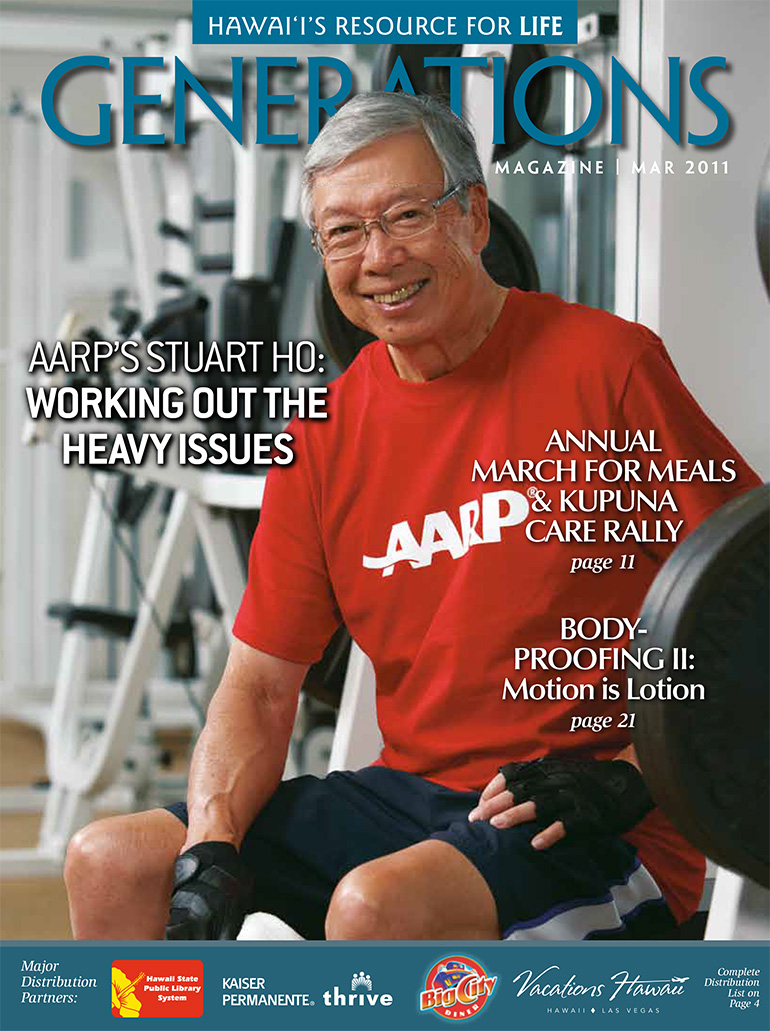
    The men in Stuart Ho’s family have been heavy weights in business for three generations. His father, legendary developer Chinn Ho, turned the ‘Ilikai into the state’s first high-rise luxury resort in the 1960s. Stuart served on the boards of such notable companies as Aloha Airlines, Gannett Co., and Pacific Resources in a long and…