Category: Programs & Services

  • Senior Resources During the Holidays

    A close-up of a senior woman sitting at home at Christmas time.The holiday season is a joyful time to spend with loved ones. However, it can be challenging or seniors who are alone or on limited income. Getting to the market or medical appointments is difficult when you have few transportation options. For those on a limited income, it may involve making a tough choice — using their funds to buy food or pay monthly bills.

    Loneliness, social isolation, limited transportation and lack of adequate financial resources are often realities of life, not just during the holiday season, but also on a daily basis.

    We can help. Catholic Charities Hawaii (CCH) offers Phone-A-Friend, a program that matches volunteer callers with isolated seniors via scheduled phone calls. CCH’s Transportation Services helps seniors access health, nutrition and social services. CCH’s Benefits Enrollment Center (BEC) assists Medicare beneficiaries struggling financially to maximize their public and private benefits for their basic needs. Benefits may include the Supplemental Nutrition Program (SNAP) to help get food on the table, Medicare subsidies or Medicaid to help with medical care, Low Income Energy Assistance Program (LIHEAP) to help cover utility expenses, and more.


    CATHOLIC CHARITIES HAWAI‘I (501(c) 3 nonprofit)
    1822 Keeaumoku St., Honolulu, HI 96822
    808-527-4777
    peter.reyes@catholiccharitieshawaii.org
    CatholicCharitiesHawaii.org

    The Benefits Enrollment Center program of Catholic Charities Hawai‘i is made possible through grants from the National Council on Aging (NCOA) and the Walmart Foundation. Medicare recipients can contact the Benefit Enrollment Center at 808-527-4777 to learn more.

    The holiday season is a joyful time to spend with loved ones. However, it can be challenging or seniors who are alone or on limited income. Getting to the market or medical appointments is difficult when you have few transportation options. For those on a limited income, it may involve making a tough choice —…

  • Medicare: New Regulations Start This Fall

    Medicare and Medicaid agents are scheduled to begin recording calls and providing a new disclaimer at the beginning of phone calls this fall during the Medicare Annual Enrollment Period. These changes directly result from new compliance rules from the Centers for Medicare & Medicaid Services (CMS).

    Agents will be required to record calls with customers who want to discuss Medicare Advantage and/or Part D prescription drug plans. Recordings are retained for a  minimum of 10 years. Agents must also recite a new, required disclaimer within the first 60 seconds of a call.

    “We do not offer every plan available in your area. Any information we provide is limited to those plans we do offer in your area. Please contact Medicare.gov or 1-800-MEDICARE to get information on all of your options.”

    These new regulations were implemented to help protect you, the Medicare beneficiary. Please ask the licensed agent you work with if they comply with these new rules and if the recordings are stored on a HIPAA-compliant system to ensure security of your Personal Health Information (PHI). This will help provide you peace of mind by ensuring that your information is protected.


    COPELAND INSURANCE GROUP
    1360 S. Beretania St., Ste. 209, Honolulu, HI 96814
    808-591-4877 | Fax: 808-589-2399
    margaret@copelandgroupusa.com
    copelandgroupusa.com

    Medicare and Medicaid agents are scheduled to begin recording calls and providing a new disclaimer at the beginning of phone calls this fall during the Medicare Annual Enrollment Period. These changes directly result from new compliance rules from the Centers for Medicare & Medicaid Services (CMS).

  • Beware of Holiday Charity Scams

    If you are considering a donation to a charity during this season of giving, Senior Medicare Patrol (SMP) Hawaii warns you to be wary. Charities use the phone, face-to-face contact, email and the internet — and so do scammers. The Federal Trade Commission, an SMP partner, offers these tips to keep you safe from scammers:

    • Ask for the charity’s exact name, address and phone number.

    • Research the organization online — especially with the word “complaint(s)” or “scam.”

    • Call the charity to confirm that it has people soliciting donations.

    • Ask if the caller is a paid fundraiser. If so, ask the name of the charity they represent and the percentage of donations that go to the charity.

    • Keep a record of donations.

    • Never send cash. Pay by check made payable to the charity or by credit card.

    • Never wire money to someone claiming to be a charity. Scammers often request donations to be wired because wiring money is like sending cash: once you send it, you can’t get it back.

    • Never give your credit or check card number, bank account number or any personal information until you’ve thoroughly researched the charity.

    • For more information, visit ftc.gov. To learn more about Medicare fraud and scams, visit SMP online.

    Fifty-four SMPs in the nation empower and assist beneficiaries, families and caregivers to prevent, detect and report healthcare fraud, errors and abuse through counseling, outreach and education. Contact SMP Hawaii for free presentations, counseling and how to protect yourself against scammers. This volunteer-based program depends on caring, qualified and professional volunteers to help kūpuna against falling victim to Medicare fraudsters and more. Join our team and make an immediate and lasting difference in our community!


    SENIOR MEDICARE PATROL (SMP) HAWAII
    Department of Health — Executive Office on Aging
    250 S. Hotel St., Ste. 406, Honolulu, HI 96813
    808-586-7281 | Toll Free: 1-800-296-9422
    info@smphawaii.org | smphawaii.org

    This project was supported in part by grant number 90MPPG0053 from the US Administration for Community Living (ACL), Department of Health and Human Services, Washington, DC, 20201. Grantees undertaking projects under government sponsorship are encouraged to express freely their findings and conclusions. Points of view or opinions do not, therefore, necessarily represent official ACL policy. The Hawai‘i Department of Health – Executive Office on Aging has administered SMP Hawaii since 1997.

    If you are considering a donation to a charity during this season of giving, Senior Medicare Patrol (SMP) Hawaii warns you to be wary. Charities use the phone, face-to-face contact, email and the internet — and so do scammers. The Federal Trade Commission, an SMP partner, offers these tips to keep you safe from scammers.

  • Navigating Mental Illness

    One in five people are affected by mental health conditions each year. Since the pandemic, that number has been on the rise. NAMI Hawaii, the National Alliance on Mental Illness, is the state organization that supports our community’s mental health and gives them hope.

    NAMI is the nation’s largest grassroots mental health organization, with over 600 affiliates in the US and four affiliates in each county in the state. NAMI’s mission is to provide support, education, advocacy and awareness so that all  individuals and families can build better lives.

    NAMI provides free programs across the state on Zoom and in person. Family-to-Family is a free, eight-session educational program for family, significant others and friends of people with mental health conditions. NAMI provides support for families and caregivers..

    Peer-to-Peer is a free, eight-session educational program for adults with mental health conditions who are looking to better understand themselves and their recovery.

    NAMI also provides connection recovery support groups, a speakers’ bureau, crisis intervention team training and workshops for law enforcement, Ending the Silence for youth, and general help and information.

    In September, NAMI National will release its first book, called, “You Are Not Alone” (zandoprojects.com/books/). The book is the “NAMI Guide to Navigating Mental Health — With Advice from Experts and Wisdom from Real People and Families… resource for individuals and families seeking expert guidance on diagnosis, treatment and recovery, featuring true stories from real people from across the country — including the Aloha State.”

    On Dec. 10, attend NAMI Hawaii’s You Are Not Alone event. Enjoy a free breakfast with NAMI and hear National Medical Director Dr. Ken Duckworth, discuss the book’s amazing stories.


    NAMI HAWAII (501(c) 3 nonprofit)
    5240, 770 Kapiolani Blvd., # 613, Honolulu, HI 96813
    808-591-1297 | info@namihawaii.org
    namihawaii.org

    One in five people are affected by mental health conditions each year. Since the pandemic, that number has been on the rise. NAMI Hawaii, the National Alliance on Mental Illness, is the state organization that supports our community’s mental health and gives them hope.

  • The Benefits of Medicare Advantage

    A recent study concluded that beneficiaries enrolled in Medicare Advantage Prescription Drug plans (also known as MAPD) spend almost $2,000 less per year on their healthcare costs when compared to those with Original Medicare (Parts A and B) and a stand-alone Medicare Prescription Drug plan (Part D). Maybe the savings are because of the valuable extras that MAPD plans offer their members.

    Medicare Advantage plans are required by law to cover everything that Parts A and B cover, but typically, these MAPD plans add numerous benefits that Original Medicare doesn’t offer. These might include vision, hearing and dental coverage as well as discounted chiropractic and acupuncture. Sometimes they offer free transportation, over-the-counter (OTC) products, gym membership and even a complimentary fitness tracker. Some Medicare Advantage plans value healthy activities to the extent that they are willing to reward members with gift cards for completing preventive screenings or exercising. Also, many MAPD plans charge a lower drug deductible than a stand-alone prescription drug plan. The truly surprising part is that these Medicare Advantage plans often have $0 monthly premiums.

    Check with an expert to see if one of these plans might be beneficial to you.


    THE MEDICARE GEEK
    1221 Victoria St., #3103, Honolulu, HI 96814
    808-724-4993 | robin@themedicaregeek.com
    themedicaregeek.com

    A recent study concluded that beneficiaries enrolled in Medicare Advantage Prescription Drug plans spend almost $2,000 less per year on their healthcare costs when compared to those with Original Medicare (Parts A and B) and a stand-alone Medicare Prescription Drug plan (Part D).

  • Newborns & Social Security Numbers

    Getting a newborn a Social Security (SS) number is important for his or her future. Feel free to share this time-saving information with prospective parents.

    If the child is born in a hospital, the easiest way to apply for a SS number is right at the hospital. When information for the child’s birth certificate is given at the hospital, parents will also be asked whether they want to apply for a SS number for the child. If the parents say “yes,” they will be asked to provide both of their SS numbers, if possible. Even if the parents don’t know both of their SS numbers, they can still apply for a number for their child.

    There are many reasons why a child should have a SS number. For example, a SS number is needed to claim a child as a dependent on income tax returns. A child may also need a number if parents plan to do the following for the child:

    • Open a bank account.
    • Buy savings bonds.
    • Get medical coverage.
    • Apply for government services.

    Read Social Security Numbers for Children at www.ssa.gov/pubs/EN-05-10023.pdf.

    Applying at the hospital will allow parents to focus on the new family member.


    800-772-1213 (TTY 800-325-0778) M–F, 8 am–5 pm
    SSA Office Locator: www.socialsecurity.gov
    Advance Designation FAQ: www.ssa.gov/faq (Other Topics)
    Representative Payees Information: blog.ssa.gov

    Getting a newborn a Social Security (SS) number is important for his or her future. Feel free to share this time-saving information with prospective parents. If the child is born in a hospital, the easiest way to apply for a SS number is right at the hospital.

  • Help Protect Our Kūpuna Against Crime

    Every year, Hawai‘i residents are swindled out of money through many forms of crime. The Federal Trade Commission estimates that 2.4 billion robocalls made every month. Over 3,500,000 older adults are swindled out of nearly $5 billion in personal savings each year. The average loss is $34,200-plus for every senior who falls victim to a scam. More than $17 million per year are lost to internet crimes (2021) — and cases are expected to rise by 10 percent this year. During the first two years of the pandemic, the US Office of the Inspector General received over 1,500 COVID-related complaints. In addition, Medicare loses $70 billion per year to fraudulent claims.

    Senior Medicare Patrol (SMP) Hawaii aims to mitigate those losses through the help of volunteers who educate and empower kūpuna and their ‘ohana before they become victims of healthcare fraud or another scam.

    You can help protect our kūpuna by becoming a volunteer. You can choose to be a counselor, presenter, information distributor, fair exhibitor or provider of clerical support. Training is available and volunteers learn at their own pace.

    Gaining satisfaction from helping others without ever leaving home is just one of the benefits of becoming an SMP volunteer. Becoming a volunteer also offers the opportunity to stay informed of latest scams, such as phony government agencies, fake tech support, family or friends imposters, online shopping gimmicks,  romance scam artists… the list goes on. Volunteers can also sharpen their computer skills to become a tech savvy senior, and learn about Medicare and community resources while having fun and making new friends who also have an interest in championing a worthy cause.


    SENIOR MEDICARE PATROL (SMP) HAWAII
    Department of Health — Executive Office on Aging
    250 S. Hotel St., Ste. 406, Honolulu, HI 96813
    808-586-7281 | Toll Free: 1-800-296-9422
    info@smphawaii.org | smphawaii.org
    This project was supported in part by grant number 90MPPG0053 from the US Administration for Community Living (ACL), Department of Health and Human Services, Washington, DC, 20201. Grantees undertaking projects under government sponsorship are encouraged to express freely their findings and conclusions. Points of view or opinions do not, therefore, necessarily represent official ACL policy. *Sources: Star Advertiser, March 27, 2022; Consumer Affairs, Nov. 25, 2021; Comparitech, Jan. 11, 2022

    Every year, Hawai‘i residents are swindled out of money through many forms of crime. The Federal Trade Commission estimates that 2.4 billion robocalls made every month. Over 3,500,000 older adults are swindled out of nearly $5 billion in personal savings each year. The average loss is $34,200-plus for every senior who falls victim to a…

  • Credit Unions: People Helping People

    Those same members collectively own and control their credit unions. Every member gets an equal vote on the election of board of directors at their credit union,  Regardless of their deposits. Like banks, credit unions operate for the benefit of their shareholders. But unlike banks, a credit union’s shareholders are the members and vice versa — they’re both members and owners.

    Credit unions aren’t a new idea. The first one popped up in Germany in the late 1800s. The first American credit union opened in 1909. In 1934, the Federal Credit Union Act was signed into law, authorizing credit unions in every state. To this day, Oct. 20 is celebrated as International Credit Union Day. But despite the worldwide appeal, credit unions are decidedly local institutions.

    Most credit unions operate in a specific geographic area and that’s the same source for their members. For example, Gather Federal Credit Union operates branches across Kaua‘i. It offers membership to anyone who lives, works, worships, attends school or operates a business on Kaua‘i or Ni‘ihau. Members’ immediate families are all eligible as well. In that sense, credit unions work to strengthen communities by helping to build financial security for all members.

    Credit unions are nonprofit organizations and members benefit from similar protections as banks. Credit unions generally offer products and services similar to what banks offer, as well, including checking and savings accounts, loans, ATMs, debit and credit cards, IRA shares and certificates, money transfers and online banking. Some credit unions may also offer financial planning and counseling services. Members’ credit union accounts are federally insured by the National Credit Union Administration up to $250,000. Members also typically benefit from lower fees, competitive loan rates, higher dividend rates on deposit accounts and a more personal approach to member service.

    There’s lots more to learn about credit unions. A great place to start is at www.MyCreditUnion.gov.

    But, more than anything, the most important thing to remember about credit unions is their shared philosophy: “People Helping People.”


    GATHER FEDERAL CREDIT UNION
    Kukui Grove, Līhu‘e, Kapa‘a, Kōloa, ‘Ele‘ele, Waimea
    808-245-6791 | info@gatherfcu.org
    www.gatherfcu.org

    There’s an old saying about money that sums up why credit unions have flourished: “We make a living by what we get, but we make a life by what we give.” Credit unions are unique in the world of finance, and for lots of people, that’s exactly why they choose to become members.

  • SSA Survivors Benefits

    We are here for surviving family members when a worker dies. In the event of your death, certain members of your family may be eligible for  survivors’ benefits. These include widows and widowers, divorced widows and widowers,  children and dependent parents.

    The amount of benefits your survivors receive depends on your lifetime earnings. The higher your earnings, the higher their benefits. That’s why it’s important to make sure you {Play}r earnings history is correct in our records. That starts with creating a my Social Security account at www.ssa.gov/myaccount. A my Social Security account is secure and gives you immediate access to your earnings records, Social Security benefit estimates and a printable Social Security Statement. The statement will let you see an estimate of the survivors benefits we could pay your family.

    Visit our “Benefits Planner for Survivors” at www.ssa.gov/planners/ survivors to help you better understand Social Security protections for you and your family as you plan for your financial future.

    Please visit www.ssa.gov or read “Survivors Benefits” at www.ssa.gov/pubs/EN-05-10084.pdf for more information. You can also help us spread the word by sharing this information with your family and friends.


    800-772-1213 (TTY 800-325-0778) M–F, 8 am–5 pm
    SSA Office Locator: www.socialsecurity.gov
    Advance Designation FAQ: www.ssa.gov/faq (Other Topics)
    Representative Payees Information: blog.ssa.gov

    We are here for surviving family members when a worker dies. In the event of your death, certain members of your family may be eligible for  survivors’ benefits. These include widows and widowers, divorced widows and widowers,  children and dependent parents. 

  • Hawaiian Humane Society

    The mission of the Hawaiian Humane Society (HHS) is to promote the human-animal bond and the humane treatment of all animals. Listed below are some of the ways you can assist or benefit from the services that HHS offers.

    PROGRAMS & SERVICES
    (See below for contact information)

    Seniors for Seniors Adoption Program: If you are 55 or older and adopt a dog or cat that is at least 6 years old, the adoption fee is waived. “Senior pets make wonderful pets,” says Jessica Tronoski, communications manager for the HHS. “They already usually know the basic commands like ‘sit and stay.’ They’re typically potty trained and have lost their kitten and puppy ways, so it’s a little bit more manageable.” All pets available for adoption receive a full medical examination and the appropriate vaccinations, de-wormer, flea and tick treatment, sterilization surgery and a microchip. The HHS also partners with many local veterinary clinics that offer your first visit free of charge.

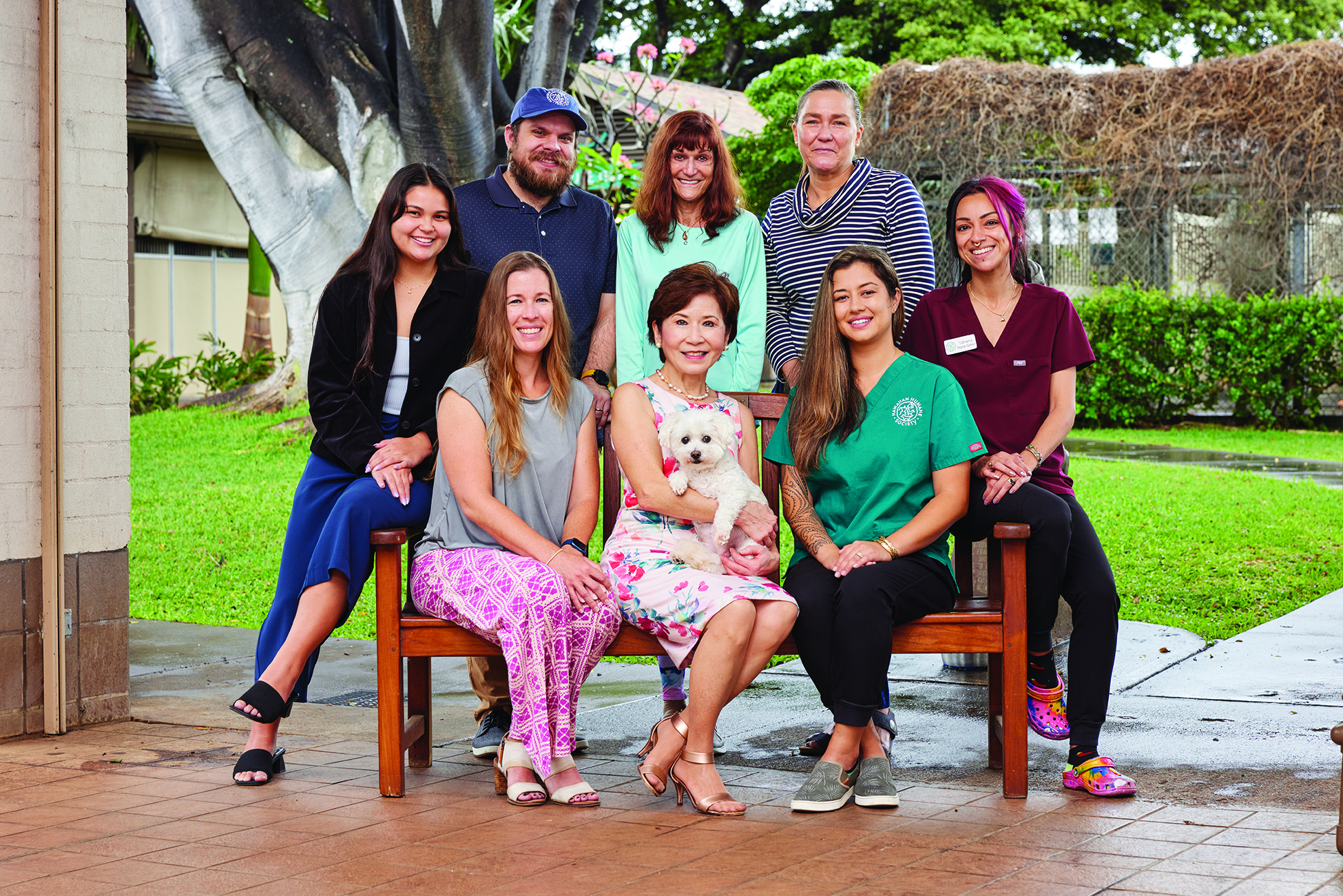
    (L–R, front row) Anna Neubauer, President & CEO; Ginny Tiu, Board Member; Kailani Romero, Community Spay/Neuter Center Coordinator (back row) Anne Mukai, Education Programs Coordinator; Thomas Hanns, Communications Coordinator; Karen Scharff, Cat Enrichment Volunteer; Stephanie Kendrick, Director of Community Engagement; Tatiana Reyna-Gomez, Veterinary Services Manager
    (L–R, front row) Anna Neubauer, President & CEO; Ginny Tiu, Board Member; Kailani Romero, Community Spay/Neuter Center Coordinator (back row) Anne Mukai, Education Programs Coordinator; Thomas Hanns, Communications Coordinator; Karen Scharff, Cat Enrichment Volunteer; Stephanie Kendrick, Director of Community Engagement; Tatiana Reyna-Gomez, Veterinary Services Manager

    Alternatives to Pet Surrender: For those who need to downsize or move, the HHS maintains a list of pet-friendly housing available on O‘ahu. If your need is temporary, there is a similar list of pet boarding and sitting resources. The entries on both lists are voluntarily supplied by providers; the HHS does not audit the locations, but keeps the lists up to date (see “Resources” dropdown).

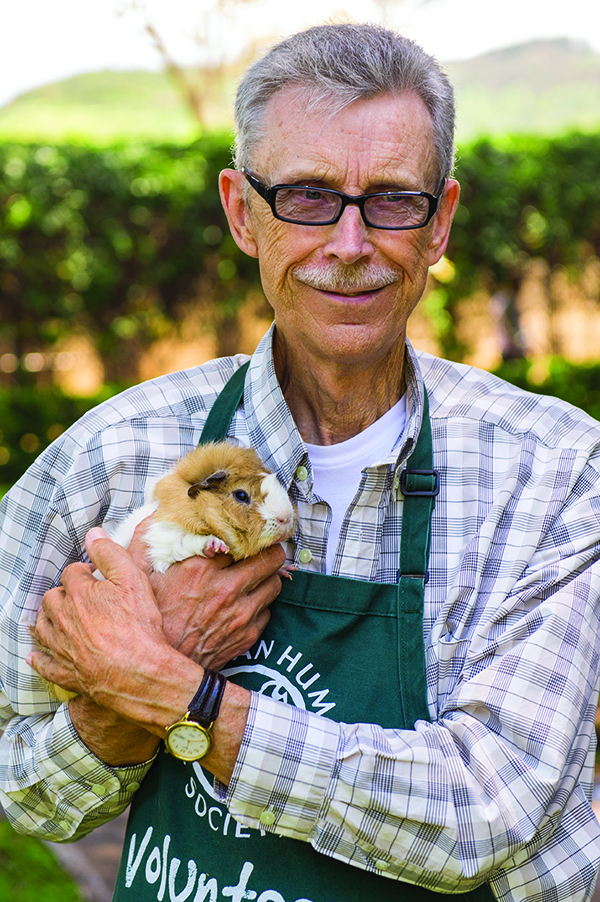
    Volunteering: One of the volunteer activities that seniors find particularly rewarding is dog walking. “It provides  companionship and enrichment to the animal and exercise for volunteers out in the fresh air,” says Jessica. There are different levels of dog walking. Another activity is enrichment, which involves playing with cats or other small animals. Doing laundry is another opportunity, but the biggest need is for Pet Food Bank volunteers. Pet Food Bank: If you’re unable to volunteer, you can donate food or money instead. The Pet Food Bank runs solely on donations and volunteer power — from the community for the community,” Jessica explains. “Any donations we receive are turned around almost within the day and given out to community members in need.” The food bank is run by the HHS’s Pet Kōkua program, which also accepts donations of collars, cat litter and reusable bags.


    HAWAIIAN HUMANE SOCIETY
    2700 Waialae Ave., Honolulu, HI 96826
    808-356-2200 | info@hawaiianhumane.org
    www.hawaiianhumane.org
    Adoption Program:
    808-356-2218 | www.hawaiianhumane.org/adoptions
    Volunteering:
    808-356-2216 | www.hawaiianhumane.org/volunteer
    Pet Food Bank:
    808-356-2222 | www.hawaiianhumane.org/pet-kokua

    The mission of the Hawaiian Humane Society (HHS) is to promote the human-animal bond and the humane treatment of all animals. Listed below are some of the ways you can assist or benefit from the services that HHS offers. PROGRAMS & SERVICES (See below for contact information) Seniors for Seniors Adoption Program: If you are…