Category: Articles

  • Just Beet It!

    Like cilantro, beets are one of those foods that spark strong feelings. Whether you think they taste like dirt or you love their earthy sweetness, most people know that beets are healthy — and now there is science to back that up.

    Recent studies show beets are high in nitric oxide, which helps to naturally dilate our blood vessels, increasing blood flow and circulation. Other things high in nitric oxides are dark, leafy greens, garlic and walnuts. Nitric oxide isn’t the only benefit of beets, the brightly colored bulbs are also high in antioxidants, potassium, fiber and vitamin C.

    Beets come in a delightful variety of colors (red, white and yellow) and are remarkably versatile. Not only can they be eaten raw, juiced, pickled or roasted, they are also an excellent addition in sandwiches, salads, pasta, hummus — and even as a secret sweet ingredient in vegan cupcakes!

    The possibilities are endless! Here’s an easy and delicious recipe to try at home:

    GINGER BALSAMIC BEETS

    Ingredients:

    • 6–8 small/medium whole beets
    • 1 tsp. olive or coconut oil
    • 1–2 Tbsp. grated ginger
    • 2 Tbsp balsamic vinegar
    • (to taste) salt/pepper

    Directions:

    Preheat oven to 400 degrees. Scrub each beet and wrap them in foil or parchment paper. There’s no need to peel them.

    Roast for about 30 to 45 minutes, depending on how big they are. The beets are done when a knife goes through them easily.

    When they have cooled down, push down on the foil or parchment paper and the skin will come right off. It will stain your skin and your clothes, so be careful.

    Heat oil over medium-low temperature. Add ginger and cook one or two minutes. Keep the heat low so it doesn’t burn. Add the beets and cook two or three minutes. Add balsamic vinegar and cook another minute or so until it turns into a light glaze. Salt and pepper to taste — and enjoy!

    Photo of three varieties of beets
    Three varieties of beets
    Beet Hummus
    Beet Hummus
    Juiced beets
    Juiced beets


    Like cilantro, beets are one of those foods that spark strong feelings. Whether you think they taste like dirt or you love their earthy sweetness, most people know that beets are healthy — and now there is science to back that up.

  • Boomers’ Declaration of Independence

    When a dear friend got dizzy and fell, she agreed to go to the ER. We tried to help her, but we couldn’t find her insurance card, primary doctor’s name or her spare house keys.

    If something happens and you are in need of help, will your family and friends be fumbling at a time when every minute counts?

    Do they know where you keep your keys, computer passwords, bank account numbers, meds, medical directives, will and estate plan?

    It is critical for baby boomers to gather their documents into one file and let trusted family and friends know the location of this important information. Caregivers can be more effective when they know what you want and have the power to carry out your wishes.

    Too many times, I have witnessed frustration, sadness, loneliness and depression when clueless but well-intentioned families misinterpret their loved ones’ wishes and needs because they were not made clear in advance.

    Ensure they know your plans by organizing your important documents and let someone know about them for the benefit of all concerned.


    LIVING AND CARING MĀNOA
    Adult Residential Care Homes (ARCH) since 2001
    Call for a complimentary tour:
    Todd Pang, Sr. VP | 808-779-8871

    If something happens and you are in need of help, will your family and friends be fumbling at a time when every minute counts? Do they know where you keep your keys, computer passwords, bank account numbers, meds, medical directives, will and estate plan?  

  • It’s a Special Relationship: Tūtū and Me

    When someone says the word “preschool,” you might think of drop-off centers, where dozens of children are offloaded to bustling classrooms with strictly scheduled snack times, naps and play. Such an image couldn’t be farther from reality with Partners in Development Foundation’s Tūtū and Me Traveling Preschool.

    Since 2002, the Tūtū and Me Traveling Preschool program has helped families across the Hawaiian Islands prepare their keiki for school success. It’s a program for children up to 5 years old, and requires parents and caregivers to attend with their keiki. Tūtū and Me equips caregivers with knowledge and resources, and provides opportunities to actively participate in a multi-generational set of activities with their keiki.

    “The Tūtū and Me Traveling Preschool was created specifically to meet the early education needs of Hawaiian extended and multi-generational families,” says Jan E. Hanohano Dill, the president and founder of Partners in Development Foundation (PIDF). He illustrates how in families such as these, the kūpuna, or elders, are usually tasked with the care of younger children.

    This presence and influence of elders on young children is vitally important, but often, kūpuna may not be prepared to fulfill the needs of young keiki. Through its two-generational approach, Tūtū and Me imparts the skill sets necessary to guide early childhood development. Each Tūtū learns techniques that help develop their grandchild’s cognitive, motor and executive skills.

    “I’m grateful for Tūtū and Me because it’s a good curriculum,” says Yvonne Martinez, a Tūtū at the Pāhoa site in East Hawai‘i Island. “It’s a balance of art and science, we celebrate birthdays and they have a lot of singing, and it teaches the children to all get along together. It’s good diversity. It’s an extraordinarily wonderful program.”

    Over the years, Tūtū and Me has worked with thousands of families, equipping kūpuna to be a child’s first and best teacher. This model has also been applied at over 100 YMCAs on the mainland and even overseas in the East African country of Tanzania, serving as the basis for the First Teacher Group initiative of global development organization Project Concern International (PCI).

    Jessica Samura and her ‘ohana were part of Tūtū and Me for the last four years. She says that the traveling preschool program has helped both her kids with their confidence, social skills and preschool skills. Jessica also describes the opportunities she had to meet with other parents and grandparents as highlights of the program. She says the adults are able to discuss, share with and advise one another on early childhood parenting life.


    TŪTŪ and ME TRAVELING PRESCHOOL (501(c) 3 nonprofit)
    A Program of Partners in Development Foundation — Hawai‘i
    2040 Bachelot St.
    Honolulu HI 96817
    808-595-2752 | www.pidf.org | www.facebook.com/PIDFoundation

    When someone says the word “preschool,” you might think of drop-off centers, where dozens of children are offloaded to bustling classrooms with strictly scheduled snack times, naps and play. Such an image couldn’t be farther from reality with Partners in Development Foundation’s Tūtū and Me Traveling Preschool.

  • FREEDOM: Working in New Ways

    For the past few months, I have been introducing you to the concept of working in new ways beyond the old, familiar routine of working a regular, full-time job in an office.

    Now, many ask how to optimize their independence from the old, familiar world of work. How are they doing good, making money, overcoming feelings of isolation and having a healthy lifestyle?

    Let’s begin a new journey by addressing freelancing — i.e., working for yourself.

    • The Freelancers Union predicts that over 50% of the U.S. population will be freelancing full-time in 10 years.
    • Today that number hovers over 30%
    • What started out as “gigs” has become the preferred way of working for many — and if ever there was a perfect landing spot for a prepared mature workforce, freelancing is it.

    What I have been repeatedly asked is: “Does freelancing confine you to working from home?” The answer is no.

    Option 1: Collaborative Workspaces

    Have you heard of it? This is the fastest emerging way of how, why and where to work. There are now a couple of dozen shared office spaces throughout the islands. While I have not visited all these shared spaces, I am very familiar with two in Honolulu. Box Jelly is a co-working space that offers monthly memberships as well as meeting and event space for members and non-members alike. The Impact Hub near the Whole Foods main downtown store is handy and the parking is easy. Both offer a Wi-Fi connection and a collaborative atmosphere where people share ideas and knowledge. Thus, the need for collaboration and social interaction are met.

    Option 2: On-Location

    While we like working from home some of the time, half of us spend some work time in our clients’ offices. We bond with full-time teams. We integrate into several of the daily experiences others share. But we get a break from the daily grind, and often, this break is just what we need — especially at traffic time on a highway anywhere in Hawai‘i.

    Option 3: Off-Location

    Quite frankly, working anywhere is possible. Have you been to your favorite coffee shop lately? Look around. Or worked at the corner library? Come on; you’re only limited by the past. This is now. Define your time and space.


    NEW WORKFORCE HAWAII
    Carleen MacKay
    916-316-0143 | carleenmackayhi@gmail.com | www.newworkforcehawaii.com
    Contact Carleen via her website and receive New Ways to Work, a free PDF book co-written with Phyllis Horner.

    For the past few months, I have been introducing you to the concept of working in new ways beyond the old, familiar routine of working a regular, full-time job in an office. Now, many ask how to optimize their independence from the old, familiar world of work. How are they doing good, making money, overcoming…

  • Time to Honor the 100th Battalion

    Punchbowl was once used as a lookout for Hawaiian warriors. Now, it’s one of only two national memorial cemeteries in the USA — the other is Arlington, Virginia. It is the final resting place for those that have courageously served in the U.S. Armed Forces.

    For the 14th year, the 100th Infantry Battalion Club 100 members invite the public to help decorate 1,000 heroes’ graves with flowers Saturday, Sept. 28, from 8 to 11am.

    Then on Sunday, Sept. 29, from 9:30 to 10:30 am, the public is also invited for a joint memorial service in honor of our Nisei soldiers of World War II, including the 100th Battalion (Purple Heart Battalion), the 442nd (Go For Broke Battalion), Regimental Combat Team, the Military Intelligence Service (MIS) and the 1399 Engineer and Construction Battalion.

    Sgt. Shigeo “Joe” Takata
    Sgt. Shigeo “Joe” Takata

    Why Sept. 28? It was on this date Sgt. Shigeo “Joe” Takata was hit by shrapnel and fought death long enough to point out the location of the enemy. He was the first combat casualty for the 100th Battalion and will be honored.

    Parking is free and open to the public, except for the reserved spaces on Mall Drive. This memorial event is sponsored by the Nisei Veterans Legacy; its mission is to preserve, perpetuate and share the legacy of these Nisei soldiers


    NISEI VETERANS LEGACY
    Japanese Cultural Center of Hawaii
    2454 S. Beretania St, Ste. 302
    Honolulu HI 96826
    808-942-0881 | inquire@nvlchawaii.org | www.nvlchawaii.org

    Punchbowl was once used as a lookout for Hawaiian warriors. Now, it’s one of only two national memorial cemeteries in the USA — the other is Arlington, Virginia. It is the final resting place for those that have courageously served in the U.S. Armed Forces. For the 14th year, the 100th Infantry Battalion Club 100…

  • 2019 Outstanding Older Americans Awards

    Gov. David Ige proclaimed May as Older American’s Month this year. Every May, the Administration for Community Living leads our nation in observance of Older Americans Month. The 2019 theme, “Connect, Create, Contribute,” encourages older adults and their communities to:

    • Connect with friends, family and services that support participation.
    • Create by engaging in activities that promote learning, health, and personal enrichment.
    • Contribute time, talent and life experience to benefit others.

    The Hawai‘i Outstanding Older Americans Awards Ceremony was held on June 7. Family and friends from across the state gathered for the awards ceremony and luncheon generously served by the staff at 15 Craigside Retirement Home, part of the Arcadia Family of Companies.

    As each honoree was introduced, they were presented with a special lei, an engraved medallion and a certificate from the governor. As their biographies were read, attendees were reminded of how much older Americans really do contribute to our society. These honorees were well deserving of these awards and Generations Magazine congratulates them for their accomplishments.

    (L–R) Rep. Gregg Takayama; Maui County awardees Dorothy Tolliver; Juliana Patao and Christina Eckhart, the daughters of Mrs. Louise Corpuz (deceased); and Kimokeo Kapahulehua.
    (L–R) Rep. Gregg Takayama; Maui County awardees Dorothy Tolliver; Juliana Patao and Christina Eckhart, the daughters of Mrs. Louise Corpuz (deceased); and Kimokeo Kapahulehua.
    (L–R) Rep. Gregg Takayama; Kaua‘i County awardees Jean M. Dobashi; Neil F. Brosnahan; Kealoha Takahashi, Kaua‘i EOA; and Dr. Bruce Anderson, DOH.
    (L–R) Rep. Gregg Takayama; Kaua‘i County awardees Jean M. Dobashi; Neil F. Brosnahan; Kealoha Takahashi, Kaua‘i EOA; and Dr. Bruce Anderson, DOH.
    (L–R) Adele Rugg, Lenny Fabro, Kathy Wyatt, Wanda Anae-Onishi, Jim Cisler and John McDermott.
    (L–R) Adele Rugg, Lenny Fabro, Kathy Wyatt, Wanda Anae-Onishi, Jim Cisler and John McDermott.
    (L) Hawai‘i County awardees Lora Akase-Nagle and James Waddington.
    Hawai‘i County awardees Lora Akase-Nagle and James Waddington.
    O‘ahu County awardees Mary Miyawaki, received by Wanda Anae-Onishi, O‘ahu EOA; Dominador Macatumbas.
    O‘ahu County awardees Mary Miyawaki, received by Wanda Anae-Onishi, O‘ahu EOA; Dominador Macatumbas.

    Gov. David Ige proclaimed May as Older American’s Month this year. Every May, the Administration for Community Living leads our nation in observance of Older Americans Month. The 2019 theme, “Connect, Create, Contribute.”

  • Don’t Be Duped By a Text Message

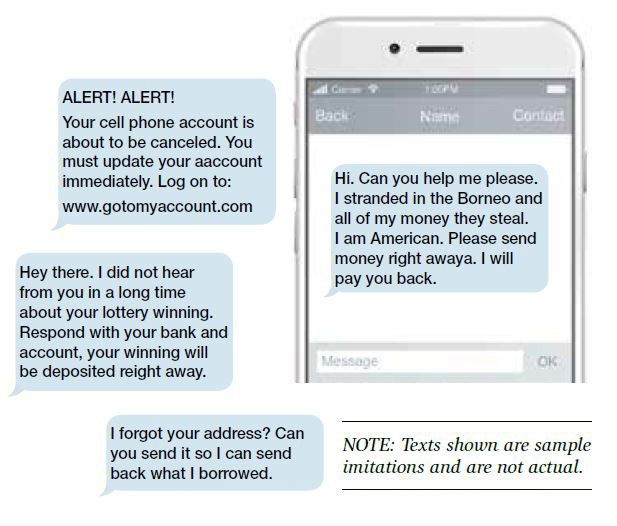
    There’s been a marked increase in text messages with a spoofed Caller ID that ask the recipient to click on a hyperlink — that’s always the objective of this type of scam. It is their methodology to hijack your device.

    Graphic showing examples of spoofed text messagesTwo Major Risks

    1. The recipient does not know who really sent the message.
    2. The hyperlink may redirect the message recipient to a website where malicious software may compromise the recipient’s cellphone.

    These programs may allow “spying” on your calls and text messages, and stealing personal and financial information and passwords. The program may even take control of the cell phone’s functions, such as the camera and/or microphone.

    Signs of Caller ID Spoofing

    • If the message is written using bad grammar and/or misspelling.
    • The message creates a sense of urgency and demands an immediate response.
    • The Caller ID is not in your address book — a big red flag!

    You should never respond to a text message from an unknown sender.

    Prevention Tips

    • Keep your address book current to include financial services you use regularly.
    • If you receive a text message with a hyperlink, do not click on it until you can determine it is legitimate. Use Google to determine the validity of the web address in the text message. Do the same with the Caller ID of the sender.
    • If neither is legit, do not reply to the sender and/or click on the hyperlink.
    • If it is legit, contact the sender of the message through other means; do not reply to the text message. If it is a company, find its contact phone number and call them to verify that they sent the message.

    THE DEPARTMENT OF THE PROSECUTING ATTORNEY
    1060 Richards St., Honolulu HI 96813
    808-768-7400 | Office hrs: Mon – Fri, 7:45 am – 4:30 pm
    www.honoluluprosecutor.org/contact-us/

    There’s been a marked increase in text messages with a spoofed Caller ID that ask the recipient to click on a hyperlink — that’s always the objective of this type of scam. It is their methodology to hijack your device. Two Major Risks include: The recipient does not know who really sent the message; and…

  • Stealing Home: An Ultimate Betrayal

    The term “stealing home” is associated with baseball. It occurs when a runner is on third base and uses guile, speed and luck to make a dash for home plate to score a run. This usually happens when the runner takes advantage of the pitcher being distracted.

    In the Elder Abuse Unit, however, my team has come to know the term in a different context. We have seen situations when a homeowner literally has had their residence stolen.

    The first time I saw this happen was when I got a call from Mark (story real; names changed) about what his brother, Tony, had done to their mother, Alice. Tony asked if she could co-sign on a loan for him. Given that Tony seemed responsible and had a job, she agreed. The two of them went to an office downtown and Alice was presented with many papers to sign. She didn’t think any more about it, assuming that she would have heard if he defaulted on the loan.

    Years later, when Mark and his mother began to plan her estate, they discovered that Alice was no longer the owner of her house. She had signed it over to Tony without realizing it. Tony even let his mother continue paying the mortgage as to not tip her off to what he had done. Tony committed the felony crime of Theft in the First Degree by Deception. Alice was in such shock over this betrayal of trust that she did not know what to do — and that is when Mark made the call to our office for help.

    I wish I could say that Alice’s story is an anomaly, but I have seen houses being stolen by caregivers using powers of attorney and con men using illegal contracts that promise help with foreclosures and debt, only to instead transfer ownership to these charlatans.

    I have seen families misuse monies from reverse mortgages and adult children draining bank accounts of home equity loans, leaving the parents to face financial uncertainty and foreclosure.

    Your house is the single largest investment you’re likely to make. And the equity in your home (or your actual house itself) is very attractive to others who see it as “free money.” It’s like an amber light at night, attracting mosquitoes, but this time, the bloodsuckers could be family members, or “helpful” friends or even strangers.

    When presented with any legal papers to sign, read them carefully or have someone else look them over. You may feel embarrassed asking to do this, but you will feel even more embarrassed if you lose your house. Also, tell your trusted family members and friends, and bring them along. Swindlers hate questions from protective loved ones. If these papers are so good for you, why keep this deal a secret?


    If you have questions about elder abuse, call or email: 808-768-7536 | ElderAbuse@honolulu.gov

    The term “stealing home” is associated with baseball. It occurs when a runner is on third base and uses guile, speed and luck to make a dash for home plate to score a run. This usually happens when the runner takes advantage of the pitcher being distracted. In the Elder Abuse Unit, however, my team…

  • Spam, Eggs and Rice

    A few years ago, I created the Heartfelt Advance Care Plan booklet to provide my clients with a tool to improve their end-of-life care, to honor their choices and to reduce conflict and guilt among surviving family members. Those who do fill it out usually comment about how difficult yet rewarding it was to complete.

    Asking and answering detailed questions about end-of-life wishes, regardless of how difficult it may be, is tremendously helpful to both the dying and their survivors.

    Photo of eggs, spam and riceFor example, a wife and husband discussed in detail his wishes during his last days, as well as what he would like to see happen after he passed. The husband, who was usually not a humorous man, answered the uncomfortable questions with a sense of playfulness and humor. In response to one of the questions about his last meal, he said he would like spam, eggs and rice — and so she prepared this last meal to enjoy with her family. To onlookers, this may appear to be a rather minor thing. To his family, it was profoundly meaningful.

    After he passed, she followed his instructions and planned the funeral in accordance with his wishes. She was able to carry out his expressed wishes, allowing him to take control of his life, the end of his life and thereafter, through his answers to the hard questions.

    She was able to be by his side during his waning days, fully present and at peace because she knew what he desired during this transitional period of life.


    STEPHEN B. YIM, ATTORNEY AT LAW
    2054 S. Beretania St., Honolulu HI 96826
    808-524-0251 | www.stephenyimestateplanning.com

    A few years ago, I created the Heartfelt Advance Care Plan booklet to provide my clients with a tool to improve their end-of-life care, to honor their choices and to reduce conflict and guilt among surviving family members. Those who do fill it out usually comment about how difficult yet rewarding it was to complete.…

  • HELOC Growth Rate

    In recent years, financial planners have shown the effectiveness of using a reverse mortgage line of credit to supplement a retirement portfolio. But while a line of credit can be a strategic part of a retirement income plan, there are often misconceptions related to how the credit line grows.

    In yet another Forbes article focused on reverse mortgages, *Wade Pfau, Ph.D., CFA, professor of retirement income at The American College, sets the record straight with an in-depth analysis of how a Home Equity Conversion Mortgage (HECM) works, grows and stands to benefit borrowers.

    “The ability to have an unused line of credit grow is a valuable consideration for opening a reverse mortgage sooner rather than later,” Pfau writes. “It is also a detail that creates a great deal of confusion for those first learning about reverse mortgages, perhaps because it seems this feature is almost too good to be true.”

    Pfau speculates that the motivation for the government’s design of the HECM program is based on the underlying assumption that borrowers would spend from their line of credit sooner as opposed to later.

    “Implicitly, the growth in the principal limit would then reflect growth of the loan balance moreso than the growth of the line of credit,” Pfau writes. “In other words, designers assumed the loan balance would be a large percentage of the principal limit.”

    The line of credit, however, grows at the same rate as the loan balance, which if left unused, could become quite large.

    “There was probably not much expectation that individuals would open lines of credit and then leave them alone for long periods of time,” he writes. “However… the brunt of the research on this matter since 2012 suggests that this sort of delayed gradual use of the line of credit can be extremely helpful in prolonging the longevity of an investment.”


    RETIREMENT FUNDING SOLUTIONS
    A Mutual of Omaha Bank Company
    808-234-3117 | percyihara@hotmail.com
    *Pfau, W. (2016, March 1). How Does The Line of Credit For A Reverse Mortgage Work? From http://www.forbes.com/sites/wadepfau Synergy One Lending Inc. dba Retirement Funding Solutions, NMLS 1025894. 3131 Camino Del Rio N 190, San Diego, Calif. 92108. These materials are not from HUD or FHA and the document was not approved by HUD, FHA or any government agency. Subject to credit approval. www.nmlsconsumeraccess.org

    In recent years, financial planners have shown the effectiveness of using a reverse mortgage line of credit to supplement a retirement portfolio. But while a line of credit can be a strategic part of a retirement income plan, there are often misconceptions related to how the credit line grows. In yet another Forbes article focused…

  • When Should I Review My Estate Plan?

    Unless you keep up with critical changes, your estate plan will become ineffective and maybe even become harmful to you and your ‘ohana. What kinds of changes are we talking about?

    Changes to your HEALTH

    If you lose the capacity to sign legal documents, your family may be stuck with an under performing estate plan that cannot be fixed. The general trend of your health and your ability to make decisions will usually not improve over time, so don’t put off updating your estate plan. You should dust it off and talk about it with your trusted advisors at least once a year for as long as you are in your right mind.

    Changes to your ASSETS

    All of your assets must be properly titled in order for your estate plan to work properly. If you have a revocable living trust, just about all of your assets should be owned by your trust. If the status of one major asset changes, your whole estate plan could be thrown off course.

    Changes to your FAMILY SITUATION

    Whenever there is a marriage, divorce, birth or death in your family, you should consider how those events could affect your estate plan. That is unless you are okay with your assets ending up in the hands of someone you would
    prefer did not receive them, such as your ex-son-in-law.

    Changes to your WISHES

    Over time, you will change your mind about who you trust and where you want your assets to go, and your estate plan must reflect those changes. If you do not state your wishes in writing, they will not be carried out.

    Changes to the LAW

    The law has changed dramatically over the past several years, and while those changes have generated uncertainty, they also give rise to opportunities. You will never seize those opportunities if you ignore them. Not only that, but the law will not always change in ways that benefit you and your loved ones. Especially when “bad” changes happen, you need to be on top of them and adjust your estate plan accordingly.

    Review your estate plan at least once a year so you can stay on top of changes and make the updates that could make a huge difference for you and your ‘ohana. Estate planning is an ongoing process, not an event.


    SCOTT MAKUAKANE, Counselor at Law
    Focusing exclusively on estate planning and trust law.
    www.est8planning.com | 808-587-8227 | maku@est8planning.com

    Unless you keep up with critical changes, your estate plan will become ineffective and maybe even become harmful to you and your ‘ohana. What kinds of changes are we talking about?

  • The Key to Financial Advisor Acronyms

    Professionals in many industries tout their education and professional experience as a way to demonstrate their expertise and set themselves apart. The financial industry is a prime example. With almost 200 professional credentials available, advisors can sharpen their ability to serve clients well. If you are searching for a financial advisor and seeking clarity on what the acronyms after each professional’s name means, below is a primer on eight of the most commonly used designations.

    Photo showing financial planning in progressAccredited Estate Planner® — Advisors seek the AEP® designation to learn more about designing an estate plan focused on the accumulation, conservation, preservation and transfer of an estate in a way that also helps individuals achieve their estate and wealth management goals.

    Accredited Portfolio Management AdvisorSM — Individuals who hold the APMA® designation have completed a course of study to learn more techniques to create and maintain portfolios for clients. The coursework includes client assessment and suitability, risk/return, investment objectives, bond and equity portfolios, modern portfolio theory and investor psychology.

    Chartered Advisor in Philanthropy® — The CAP® designation provides professionals in the nonprofit and financial services fields with the knowledge/tools needed to help clients reach their charitable giving objectives while also helping them achieve their estate planning and wealth management goals. The curriculum addresses the advanced design, implementation and management of charitable gift techniques and strategies.

    Certified Divorce Financial Analyst® — The CDFA® designation is growing in popularity because it helps financial and legal professionals support clients going through or managing assets after divorce. Those with this credential are trained to evaluate the tax implications of dividing property, settlement options for dividing pensions, marital property, awarding of child and spousal support and to help determine the financial needs and outcomes for couples after divorce.

    Certified Financial Planner™ (CFP®) and Chartered Financial Consultant® (ChFC®) — Advisors with either or both credentials have studied key financial planning topics in-depth — including risk management, tax planning, retirement and employee benefits, estate planning and insurance — to help develop well-balanced financial strategies for their clients.

    Certified Long-Term Care® — The CLTC® program is independent of the insurance industry and is designed to provide financial service professionals with expertise and tools to address long-term care planning with their clients.

    Certified Retirement Planning CounselorSM — A financial professional seeks the CRPC® credential to learn the finer points of helping clients implement financial strategies to cover pre- and post-retirement needs, asset management and estate planning. Coursework touches on the entire retirement planning process using models and techniques from real client situations.

    A professional’s education background is just one factor to consider when deciding who is right for you. For more designation explanations, check out FINRA’s (a financial service industry regulator) website: www.finra.org/investors/professional-designations.


    MICHAEL W. K. YEE, CFP
    1585 Kapiolani Blvd., Suite 1100, Honolulu HI 96814
    808-952-1222, ext. 1240 | michael.w.yee@ampf.com
    Michael W. K. Yee, CFP®, CFS®, CLTC, CRPC ®, is a Private Wealth Advisor, Certified Financial Planner ™ practitioner with Ameriprise Financial Services, Inc. in Honolulu, HI. He specializes in fee-based financial planning and asset management strategies and has been in practice for 31 years. Investment advisory products and services are made available through Ameriprise Financial Services, Inc., a registered investment adviser. Ameriprise Financial Services, Inc. Member FINRA and SIPC. ©2019 Ameriprise Financial, Inc. All rights reserved. File #2450617

    Professionals in many industries tout their education and professional experience as a way to demonstrate their expertise and set themselves apart. The financial industry is a prime example. With almost 200 professional credentials available, advisors can sharpen their ability to serve clients well. If you are searching for a financial advisor and seeking clarity on…