Rosa Barker

  • A Hāna Tradition of ʻOhana & Integrity

    Four generations sharing their community’s values

    When brothers Shoichi and Saburo Hasegawa opened their general store in Hāna in 1910, there was no legendary Road to Hāna. Goods and people traveled by boat to the wharf in Hāna Bay. The bustling sugar plantation town was just one of several on the east coast of Maui, from Ke‘anae to Kīpahulu, each with a sugar mill, stores, churches and recreational amenities such as movie theaters and pool halls. Travel from one end of the district to the other could take days by horse or mule. A lot has changed since then, but fourth-generation general store operator Neil Hasegawa continues his family’s tradition of serving both locals and tourists with grace, humor and a strong sense of deep-rooted responsibility a small-town business fosters that helps the surrounding community retain its character, prosper and thrive.
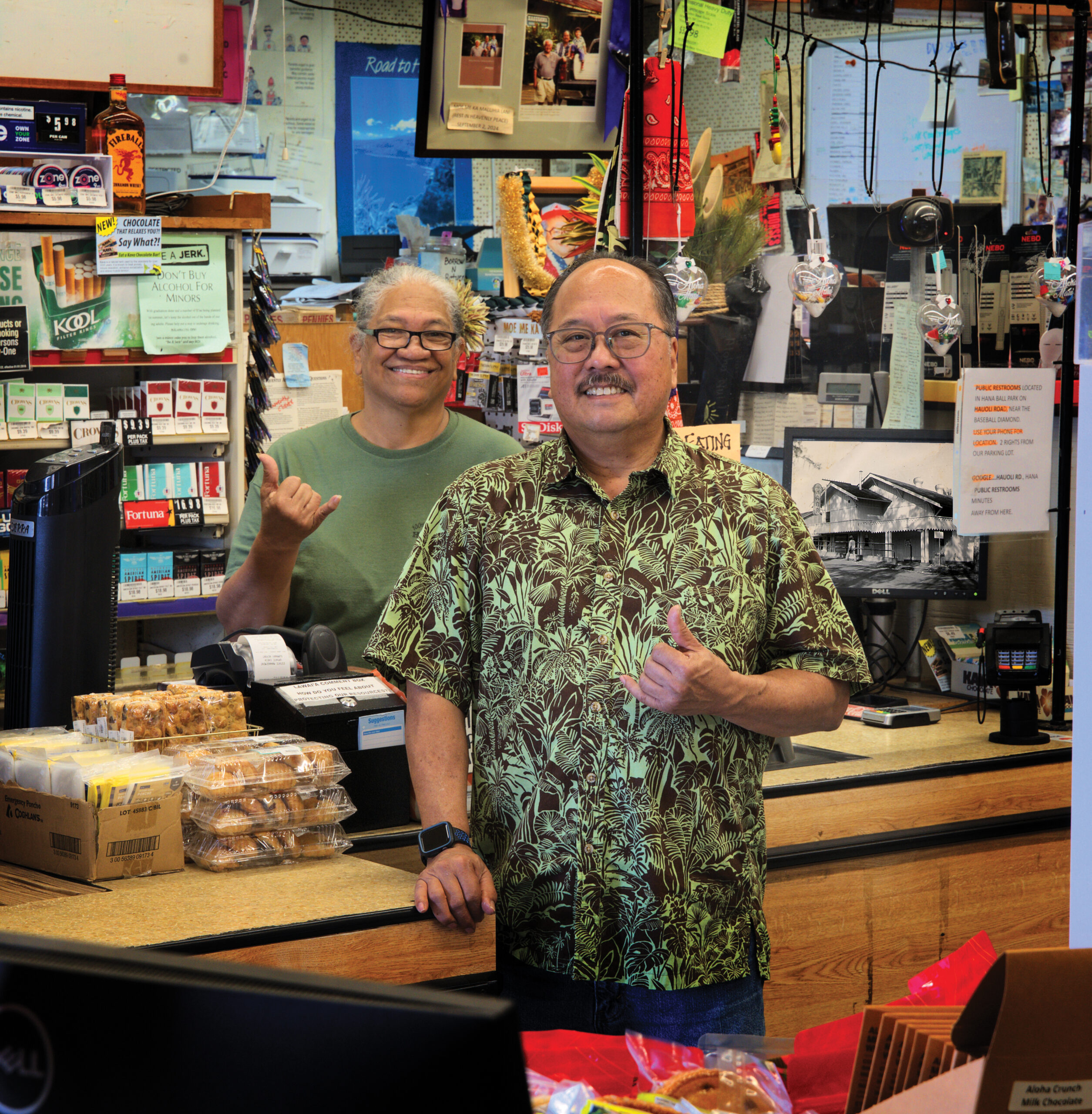
    Carol Oliveira, seen here with Neil Hasegawa, was born and raised in Hāna and has lived there all her life. She’s worked at the store going on 16 years. “It’s a good job. I like it. I cashier and sometimes stock the shelves in the store. The atmosphere is good; everybody gets along.” She enjoys interacting with customers, both locals and tourists.

    Shoichi and Saburo Open Original Store

    In 1886, representatives of His Majesty the King of the Hawaiian Islands and His Majesty the Emperor of Japan signed a convention that stipulated that a representative from Hawai‘i be based in Yokohama to facilitate the signing of work contracts no more than three years in length. The immigrants would also be granted “free steerage passage, including proper food, from Yokohama to Honolulu in first-class passenger steamers.” This is likely how the Hasegawa brothers arrived, voyaging on from Honolulu to Hāna Bay.

    The Hāna District had a population of 3,241 when Shoichi and Saburo opened their store in 1910. It was a family affair, with the children helping out from a very young age. Toshimasa was born that same year to Shoichi and Kiku, but in 1919, they took him and their other children back to Japan, leaving Saburo’s family to run the business. Then, in 1926, Saburo and his oldest son Kengo, went to Japan to ask Toshimasa if he would come back and help them with the store.
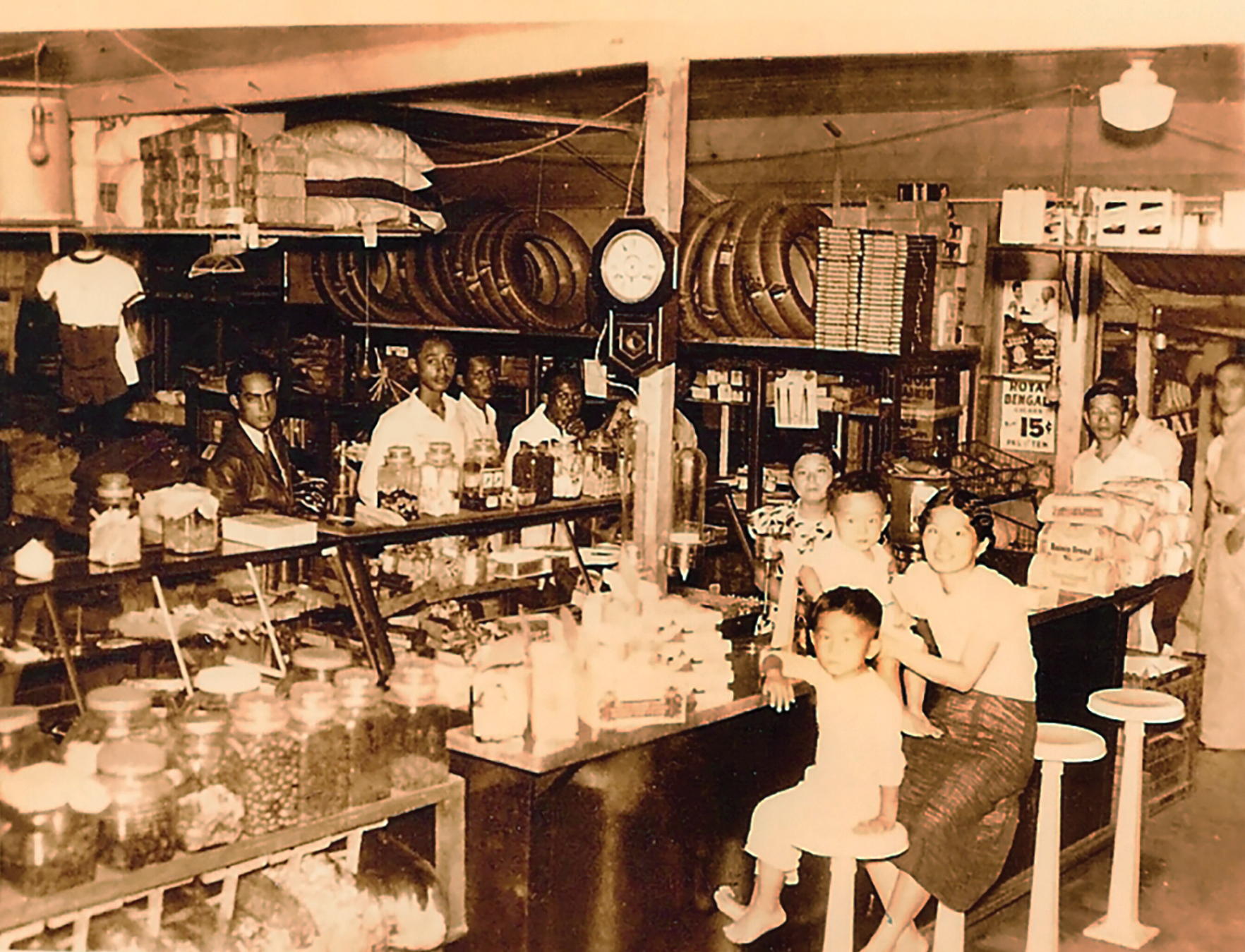
    Toshimasa photographed the original Hasegawa General Store in 1938. In the foreground is Harry
    and his mother, Shizuko. His brother, Ed, is seated on the counter, and a cashier stands behind him. The sugar plantation era in Hāna lasted from 1849 until 1947. All the district’s freight came via Hāna Bay wharf during that time, and bagged sugar left that way. The wharf and its facilities were destroyed by the 1946 tsunami. The last East Maui sugar mill ceased operations that same year. The road to Hāna wasn’t completely paved until 1962.

    Photos taken by Toshimasa in 1938 illustrate the store’s extensive and eclectic range of goods. Although the road from Kahului to Hāna had been completed a decade before the photos were taken, it was extremely rugged, necessitating a huge inventory of tires. The interior featured a long lunch counter, cabinets with various household items and hardware, and food staples like rice.

    Toshimasa and Shizuko Take Charge

    Toshimasa wed Shizuko Hirose in 1932 and they took over store operations when his uncle Saburo returned to Japan in 1933. With the winding down of the plantation era from the 1920s onwards, population numbers declined by 1950 to about 1,000 still living in the Hāna District. Those remaining people still needed the necessities of life and the Hasegawa family continued to provide them through long hours of work. Improvements to the road linking the town to Kahului, a major arrival hub for tourists, as well as the area’s natural beauty, brought transient customers to the store. It was within this context that Toshimasa built a new brick store with gas pumps in 1958. Toshimasa, an avid photographer, also added a photo developing studio.

    Toshimasa and Shizuko had a house behind that store. Neil has fond memories of his grandparents’ home. As children, he and his two sisters spent the most time with them—his cousins lived on O‘ahu and in Southern California, so he and his siblings had them all to themselves. “I had a really good relationship. I’m the first-born grandchild and I’m a man. In Japanese culture, that’s a double whammy!” He and his sisters had chores in the store, weeded around the house and helped Shizuko in the hothouse behind the walk-in freezer at the back of the store. “She was really smart. She’d make friends with some of the hotel guests that would come on a regular basis and she would give them anthuriums, orchids, flowers and so forth. I think that was her way of marketing—a frequent-shopper kind of program!”

    Toshimasa and Shizuko retired to a new home in Kahului, where he took up painting and pottery, and she continued nurturing plants with her green thumbs. He passed away at age 90 in 2000 and Shizuko followed him in 2009 at age 95.
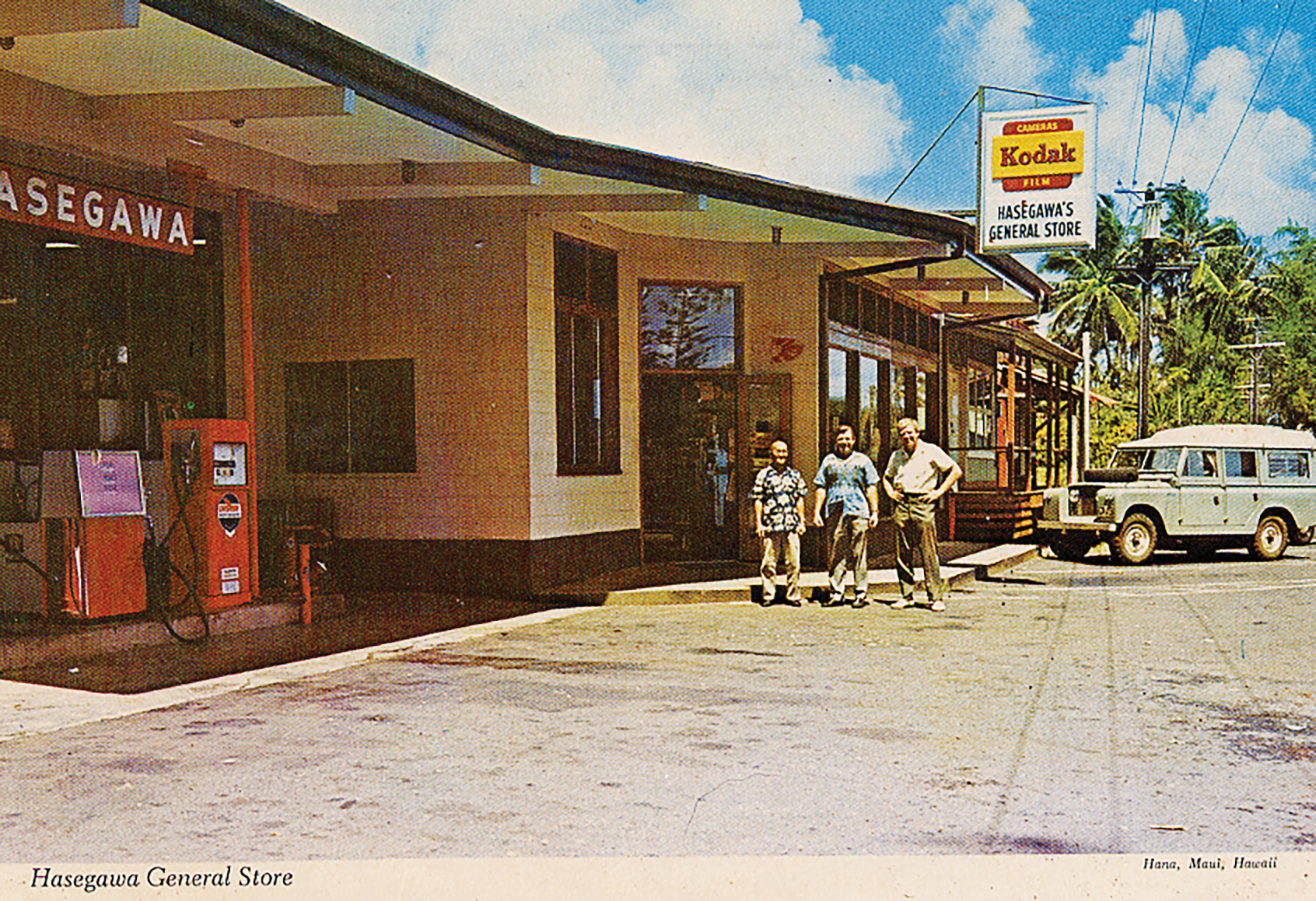
    [L–R] In this image of a 1970s promotional travel agency postcard, Toshimasa Hasegawa, visiting radio personality Arthur Godfrey and local marine biologist Tad Pryor stand in front of the general store built in 1958.

    Harry Takes the Reins

    During the 1970s, their first-born son, Harry, took over running the store. His parents ensured he got a good education by sending him to Mid-Pacific Institute in Honolulu for high school and the University of Colorado in Boulder, where he majored in accounting. In the 1950s, he completed his military service, working in the accounting department at Tripler Army Medical Center. He and his wife, Nita, made their home in Hāna after their marriage in 1962 and they both worked in the store, taking it over when his parents retired.

    In 1961, Paul Weston wrote “The Hasegawa General Store,” a song about the huge variety of goods available there. It became popular when Pua Alameida sang it on the radio show Hawaii Calls and was later recorded by many different artists. Capitalizing on the publicity the song brought, Harry and Nita began selling Hasegawa General Store T-shirts and related merchandise. And each year, they would go to a trade show on the continental US to help ensure the hardware inventory was the latest and best they could provide their No. 1 customer—Hāna locals.
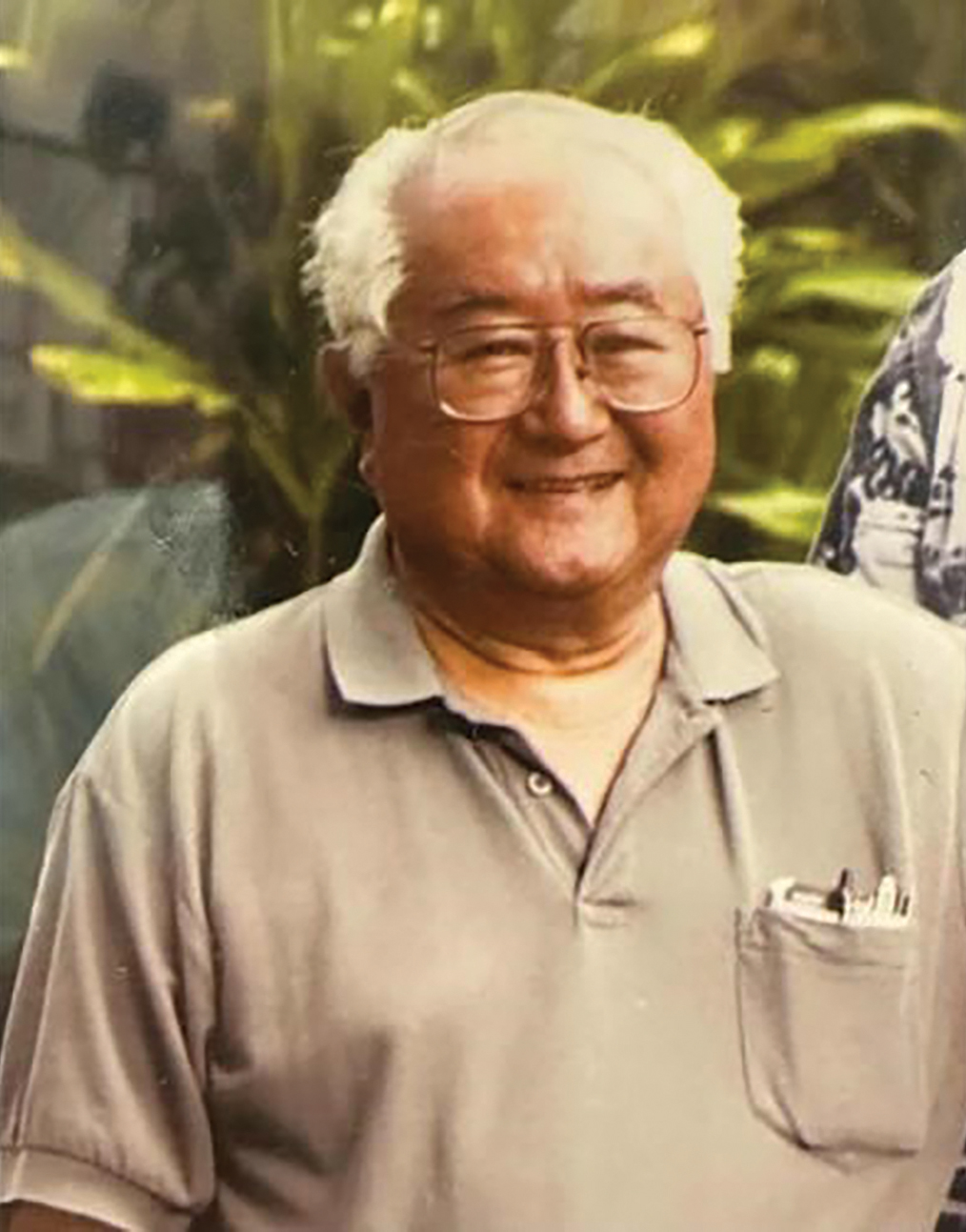
    Harry Hasegawa

    This customer-centered ethos passed on to Harry by his parents is also exemplified perfectly in an anecdote told by one of the store’s visitors. He and his wife had neglected to fill their car with gas before embarking on the road to Hāna on a sight-seeing day trip. They didn’t have enough gas to get back to Kahului and they also didn’t have enough money to pay for a night’s accommodation in Hāna. When they told their tale of woe to the waiter at the restaurant where they were having dinner, he re-told it to Harry, who was dining there with his family. So Harry opened up the gas station and even provided them with some snacks for the long drive back.

    Had they needed a document notarized, Harry could have done that, too. He became a notary public when he realized the community didn’t have one. He also served on planning boards and the Hāna Maui Trust, providing scholarships to local students and grants to help community members from 1970 to 2018. During his 20-plus years as president, the trust’s outreach to the Hāna community grew exponentially. In a 1988 KHET TV documentary about Hāna, Harry shared his feelings about the town: “I think of Hāna as a very rural Hawaiian place and I’d rather live in that type of setting, so I’d like to set my life in those terms. I think everybody has that in mind when they come to Hāna. As the other parts of the island build and become more like a city, Hāna can remain as it is—rural and not over-developed. I think our value is increased and I think that is what we should be looking for.”
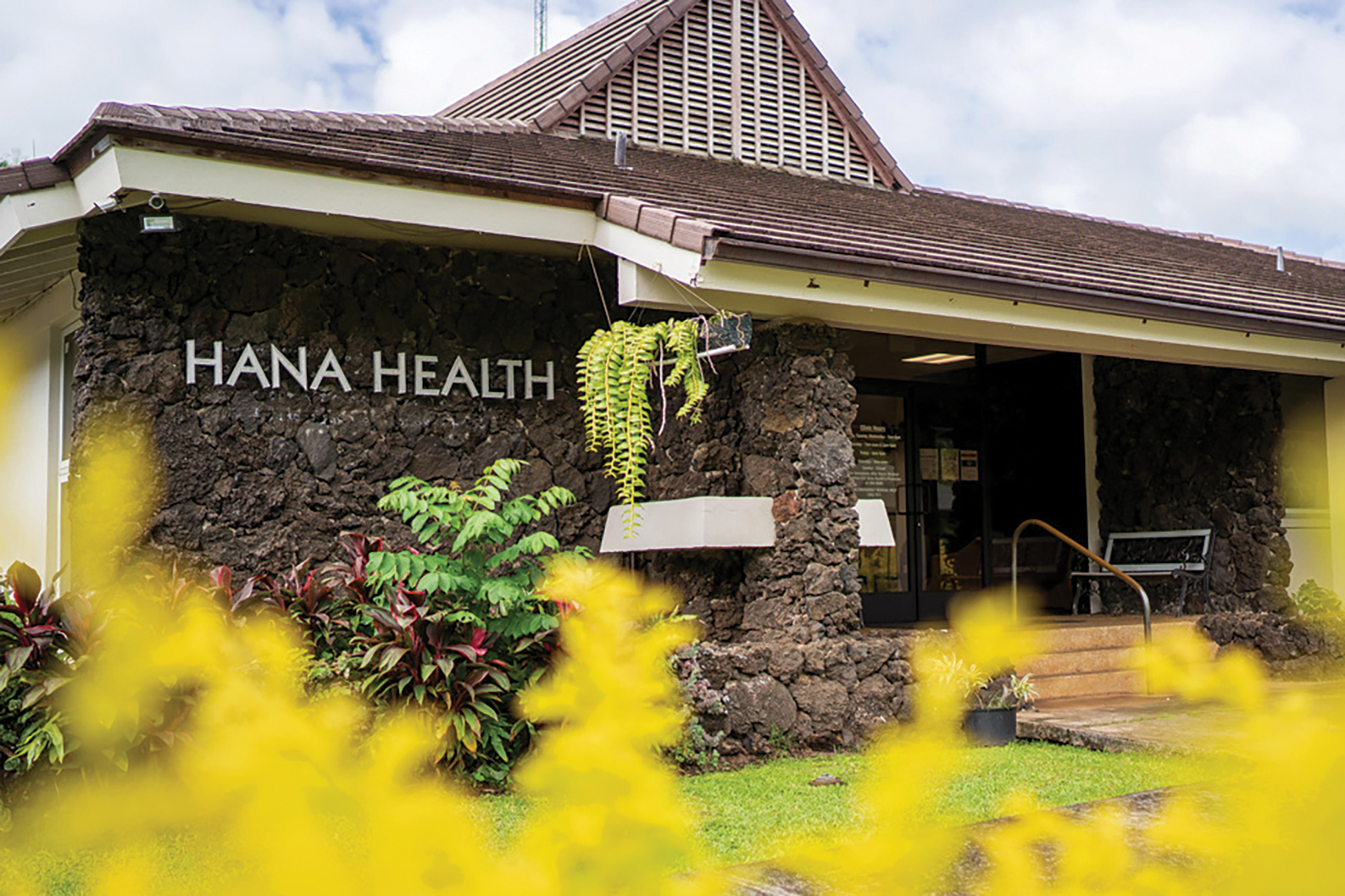
    Hāna Health, the only healthcare provider
    in the Hāna District, serves the primary
    healthcare needs of residents and visitors
    alike. Harry Hasegawa was a key
    figure in establishing the center when
    the state closed its clinic there.
    Providing a full range of primary healthcare,
    Hāna Health emphasizes preventive care.
    The Hāna Fresh Farm behind the center
    sells its produce, herbs and traditional
    Hawaiian medicinal crops from a
    nearby farm stand.
    Photo courtesy of Hana Health

    Harry passed in September 2024 at age 90 in an assisted living home in Kahului. For about three years “my Mom and I would go there every Thursday, spend the night, have lunch with him Fridays and then return,” says Neil. He lives next door to his mother and is her caregiver, making sure she’s comfortable and has all she needs.

    Neil Returns

    Like his father, Neil went to college on the mainland, studying business administration, marketing and management at the University of Redlands in Southern California. Upon graduating in 1988, Neil returned to Hāna to live with his parents and help run what he now calls the “old store.” That’s because, in August of 1990, the Hasegawa General Store was set ablaze. There was minor damage to the gas pump area, but everything inside the store was lost. Harry and Neil said a friend came to Harry’s home in Hāmoa at 4:30am to tell them the store was on fire. By the time they got there, it was completely gone. Fire investigators concluded it was arson, but the culprits were never found. “I felt really hurt that someone would do this to us,” said Neil.

    What happened next is proof that the Hasegawa family’s sense of responsibility to their community is no one-way bridge. “When the store burnt down, several people in the community—and this was before GoFundMe—started soliciting donations for us and for our employees,” says Neil. “I thought that was a great gesture, especially coming out of that situation where I was so bitter. I had a really negative feeling about human nature at that point. Then the realization hit me, ‘You know what, if you’re gonna be that sour the rest of your life, that’s not going to be a good life. That negativity surrounds you. Let the police handle the investigation and all of that stuff. How can we continue in a good way?’”

    They were able to get the gas station running again and built a film studio in part of the old building so they could develop pictures as well. Keola-Hana Maui, owners of Hāna Ranch at that time, offered the family the use of Hāna Ranch Theatre. Its last movie showing was in 1979. “A lot of our guys helped renovate the theatre,” says Neil. “We had a general contractor who came in and we were his crew. It made a lot of sense doing it that way.” All their staff remained employed and the new store opened for business in August, 1991. You can still see the holes for the projectors high up on the back wall. In 2008, plans to rebuild on the old site fell through, so it is now used as a food truck lot by local entrepreneurs.

    Neil and his wife, Mitzi, have two adult children, Brayden and Caelyn. Caelyn worked in the store as a cashier one summer, but when Neil wanted to give his 15-year-old son a job there, he wasn’t able to because the minimum age to get a liquor card is 16. He laughs when recounting his conversation with the liquor commission when he said that he’d been working in the store since he was 10. “They go, ‘Mr. Hasegawa, that was a long time ago!’” Brayden and his wife, Sydney, both graduates of the University of Nevada, Las Vegas, live and work there. “They’re living their life up there. If they feel like they want to come back and run the store, that’s their decision. I don’t want to force anybody.” Caelyn is majoring in kinesiology at Missouri Southern State University.

    Community Needs Remain the Priority

    It’s easy to take for granted the items we see on store shelves in urban and less isolated rural areas. “Normally, product merchandisers for companies like Meadow Gold come in and stock up, pull expired product, give credits and so on. We do everything on our own,” says Neil. He places the orders and a private trucker based in Hāna goes to Kahului to pick them up. Redo Trucking & Hauling is another multi-generational business. It was started by Valentine Redo as Redo Express in 1973 and is now run by his grandson, Sam Aina. Neil remembers Valentine “dropping stuff off at the old store to my dad and grandpa.”

    An example of how local businesses put the needs of the community ahead of dollars and cents comes from when the Maui Nui Venison company began giving out free ground venison in 2024. They called Neil and asked if he wanted to be part of the giveaway and Neil called Sam to see if he would bring it down for free: “Yeah, no problem.” Maui Nui drops off cartons of the 1-pound packs of venison at VIP, a family-owned food distribution company in Kahului that provides chilled and frozen products to restaurants and businesses. “They accept the Maui Nui venison, put it on the pallet, Sam comes by, picks it up every other Thursday, brings it to us and then we put it in our freezer. People will just come and pick up. Maui Nui told me it’s two per family, per day, so use your discretion. It is such a big help to the community.” Previously, Hasegawa General Store had acted as a distribution point for free produce brought to them by a produce house “on the other side. People could just pick up the boxes and we’d keep track of the names. We did it for three or four months and then the grant ran out.”

    When Hāna locals speak of “the other side,” they’re referring to the other side of Haleakalā, the dormant volcano. Its lower slopes cradle the 52-mile road to Hāna, with its 620 curves—some of them hairpin bends—and 59 bridges, most of them one-way. The drive can take from two to four hours. Extreme weather events, wildfires or road and bridge repairs can mean it’s closed altogether. If the electricity grid gets shut down, as well, Hāna has several emergency generators for the community. Nowadays, of course, electricity is vital for store operations. Harry had the vision to computerize the store’s paper-based systems and replace the manual cash registers with electronic equipment. “It saved him time,” Neil explains—time that Harry could allocate to serving the community.

    A Rising Tide Lifts All Boats

    Hāna Health is a private, nonprofit, federally qualified health center. Neil explains: “That was Harry’s baby. We’re a small community. We just weren’t getting the attention that we need. Especially in healthcare, you can’t be ‘the leftovers.’ He was the one who created a committee, got funding and brought in an executive director to help organize everything.” In 1995, the state-run Hāna Medical Center was on the verge of closure. Harry spearheaded the advocacy for Act 263, which was passed in 1996. It provided for the transfer of the state-run medical center to the new nonprofit organization. Harry was a board member and president for several decades. Hāna Health offers primary medical, dental and behavioral healthcare, and 24-hour urgent care to all Hāna District residents, regardless of their economic circumstances.

    Neil recalls how his father was very involved in the community. “We all are. He instilled in me, ‘the rising tide lifts all boats. The more you can do for Hāna, the better Hāna will become.’ Whether it be volunteering… just making it better.”

    Neil’s “baby” is the Festivals of Aloha. “Festivals of Aloha was called ‘Aloha Week’ back in the ’60s. There’s a lull in tourism in October and O‘ahu businessmen wanted to create a destination event that would share Hawaiian culture with tourists.” The event spread to all the islands, but over the years was reduced to three days or a weekend. Hāna is the only community in the entire state that still has a weeklong festival.
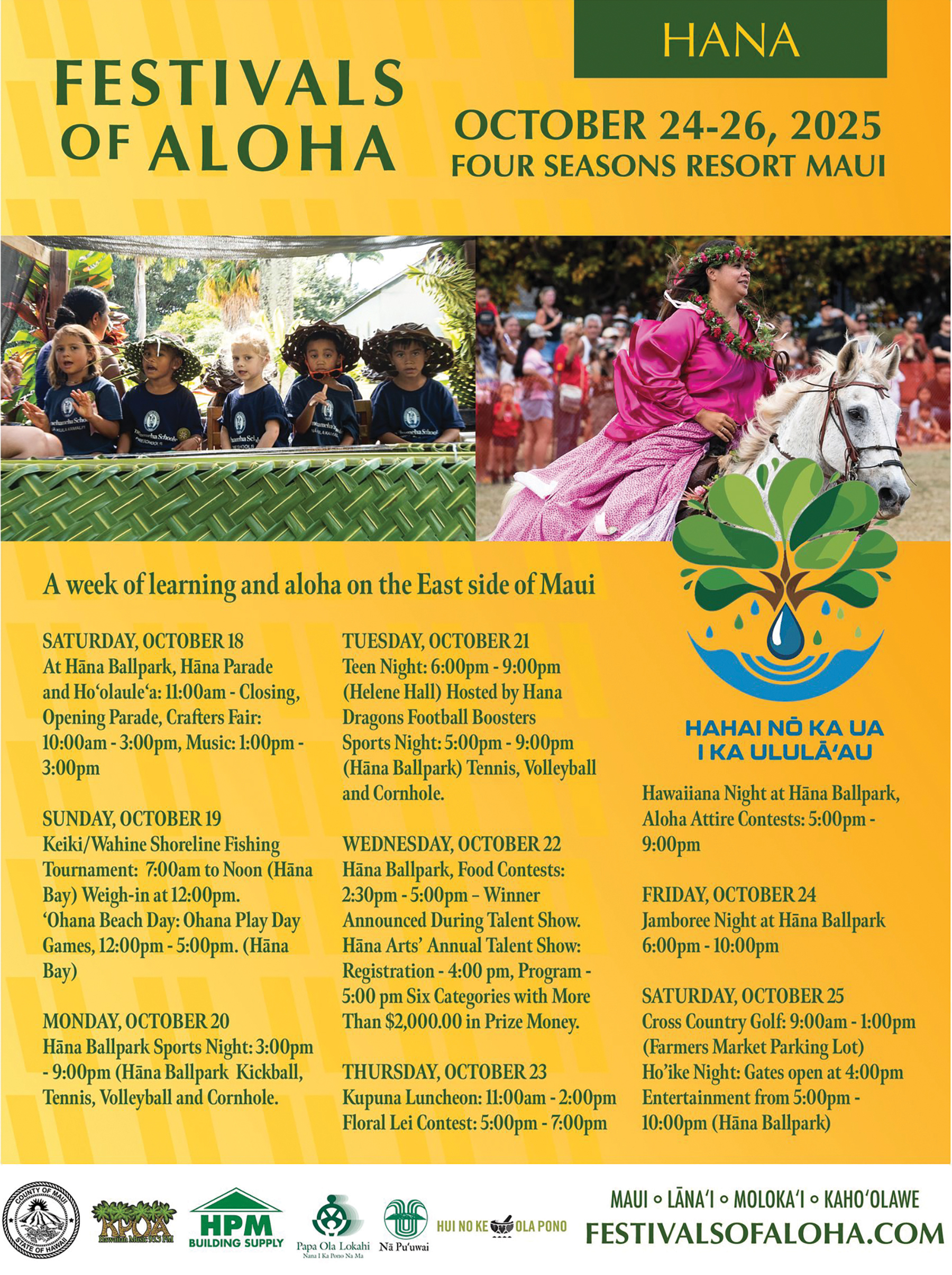
    The whole community gets involved, with individuals volunteering their time to help out at the events and small businesses donating and providing certificates and cash prizes. The festivities kick off with a parade on Saturday and end with Ho‘ike Night lū‘au with entertainment and food.

    “We’re trying to work with the hotel to create a destination event for Hāna,” says Neil. “Fill up the hotel, fill up the vacation rentals, have tourists come, spend a week with us and get that there’s a strong Hawaiian culture presence.”

    Hawaiian culture isn’t just lū‘au, lei and aloha. There’s also the wave. When Neil’s cousin, Mark Hasegawa, retired to Hāna from Maryland, he bought Harry’s truck. “Small town, everybody knows everybody’s vehicles. They’ll wave. Just wave back,” Neil advised. “So tourist cars, any car… he’s just waving!” Mark grew up in Southern California and visited over the summer as a teenager.

    That’s a typical pattern, not just for the Hawaiian diaspora, but also for families living on other islands. Most of Neil’s employees were born and raised in Hāna, a lot of them coming from large families that have spread out across the state. When visitors come into the store and say they know a Hāna local, staff and visitors often find family connections.

    Kukui Nuts, Cold Cuts, Surfer Pants and Papaya Plants

    Paul Weston’s lyrics in the song that made the Hasegawa General Store famous (youtube.com/watch?v=-dqbGR3Gkbwg) are no less true today than they were back in 1961, when it was first recorded. “You just name it, they’ve got it there.”

    “I’m pretty much the specialist… I do the orders for hardware, fishing, liquor and beer,” says Neil. His office manager takes care of accounts payable. Several other people take care of buying. One of his assistant managers does the buying for different areas in the store, like health and beauty aids. “We have a lot of part-timers working as cashiers. We have a small crew… maybe 10 people.” Neil tries to source fresh produce locally so that he is both supporting the community and keeping prices down. The store also acts as a pickup point for FedEx and UPS customers. “It’s in line with what we do: try to service the community wherever we feel we can be of help.”

    A Reflection of the Community

    In 2008, the Small Business Association’s Family-Owned Small Business Award for the County of Maui went to Neil. “Despite a fire that destroyed the store in 1990,” the award said, he has shown “resilience and determination by reopening the store in the old Hāna Theatre with new services and an improved mix of products that contributes to its continued growth, and remains Hāna’s one-stop shop.” In 2010, the store’s 100th anniversary year, Harry and Neil received the Mayor’s Lifetime Achievement Award for small businesses.

    “The key to owning a business in Hāna, or any small town, is the relationship you have with the community and the decisions you make,” says Neil. “A lot of times, ours are not dollars-and-cents decisions. There’s an underlying responsibility we have so we can best serve our community.”
    Four generations sharing their community’s values When brothers Shoichi and Saburo Hasegawa opened their general store in Hāna in 1910, there was no legendary Road to Hāna. Goods and people traveled by boat to the wharf in Hāna Bay. The bustling sugar plantation town was just one of several on the east coast of Maui,…

  • Bridging the Generation Divide

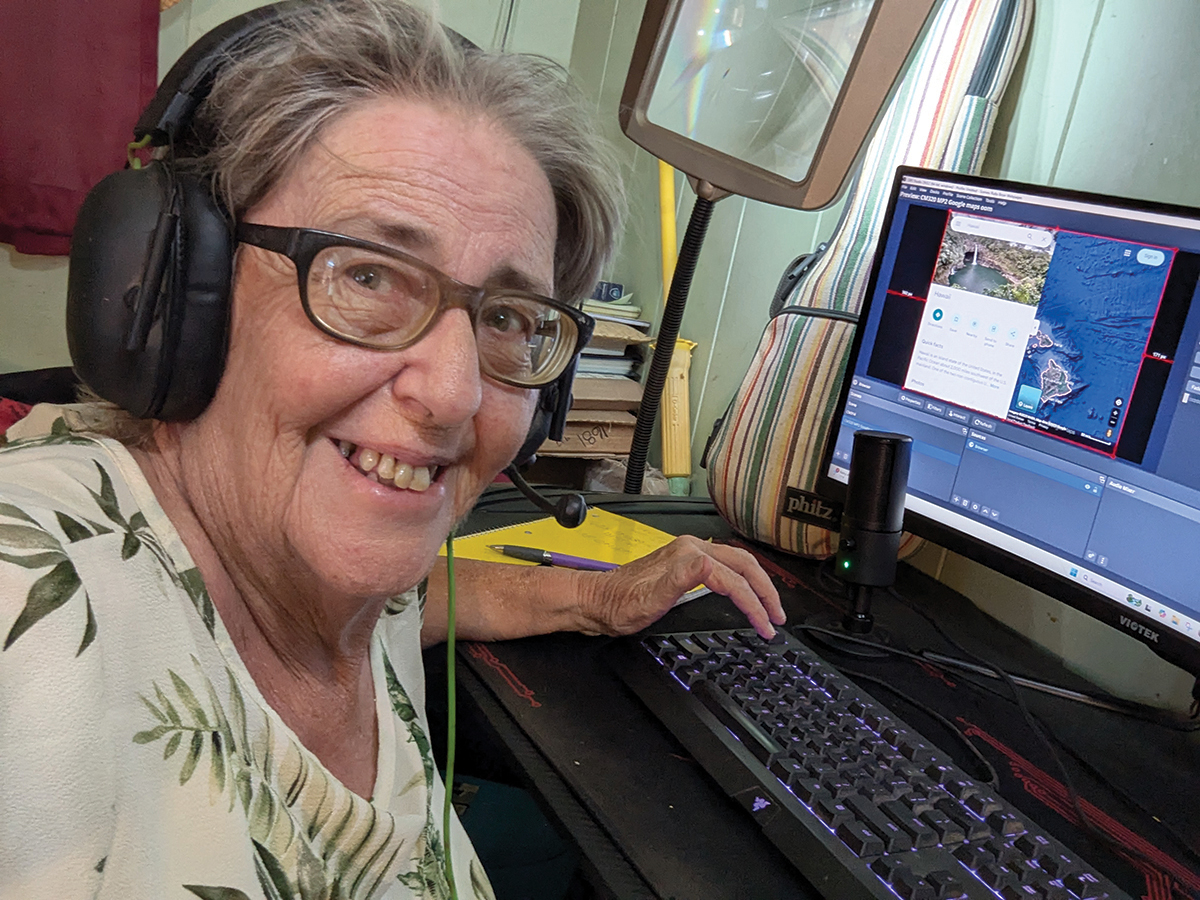
    Last year, I was a “senior” senior at the University of Hawai‘i (UH) West O‘ahu. My learning adventure began in the fall of 2019 when I enrolled in a basic Hawaiian language course at the Moloka‘i Education Center at age 67. It is a satellite campus of UH Maui College and our classes were conducted via a Skybridge video link to the classroom on Maui. I also enrolled in a Hawaiian music class that was taught in-person. I continue exploring those interests through the ‘Ukulele Kanikapila and ‘Olelo Hawai‘i Papa offered here on Moloka‘i by Kaunoa Senior Services, a division of the County of Maui’s Department of Human Concerns.

    Eligible for financial aid, I was able to become a full-time student at UH Maui College and UH West O‘ahu. It was a blessing in so many ways to be immersed in campus life—even at a distance. Being surrounded by young minds eager to forge a pathway to their future career was energizing and inspiring. No less inspiring were the students who were returning to college while working and caring for family, but still found time to attend class, complete assignments and participate in collaborative projects.

    I soon discovered that collaboration was the skill I most needed to learn. Students and faculty all put me at ease and I learned by their example how enriching—and fun—collaboration can be! It was time to set aside my “wise elder” hat and listen with respect and compassion, keeping my mind open to views that hadn’t even existed when I was their age. It was a two-way street because some of the things I’d experienced and brought to the table were ancient history for today’s students. I strove to enrich my fellow students’ learning treks and greatly appreciated that I was never made to feel like a dinosaur!

    Other skills I learned were how to give presentations and how to use the many apps available today to create written and audiovisual material. Encouraged by the supportive learning environment, I developed the confidence to share these skills in my local community. I volunteered to proofread the computer-created transcripts of documents scanned into Moloka‘i’s Digital Repository, Moe‘a, and created an Instagram post as my contribution to a Hawai‘i Tourism Authority community session on Moloka‘i.

    If you live on O‘ahu, you can attend classes for free with the instructor’s permission. The UH System, comprised of three universities, seven community colleges and community-based learning centers across Hawai‘i, is committed to promoting lifelong learning, active aging and intergenerational community-building through its Nā Kūpuna program at UH Mānoa and the Senior Visitor programs at UH West O‘ahu and the Leeward, Windward and Kapi‘olani community colleges. You won’t get a grade, but you can fully participate in course activities. (For enrollment information, see below.)

    It is well-known that being engaged socially and intellectually enhances the well-being of seniors: My experience as a student attests to that. Being constantly challenged and encouraged to keep going forward despite early stumbles and uncertainty was a great confidence-booster. I highly recommend pursuing higher education in your golden years!


    SENIOR CITIZEN VISITOR PROGRAM
    NĀ KŪPUNA PROGRAM–UH MĀNOA

    808-956-4642 | nakupuna@hawaii.edu
    tinyurl.com/NaKupunaProgram

    Last year, I was a “senior” senior at the University of Hawai‘i (UH) West O‘ahu. My learning adventure began in the fall of 2019 when I enrolled in a basic Hawaiian language course at the Moloka‘i Education Center at age 67. It is a satellite campus of UH Maui College and our classes were conducted…

  • The Power of Kākou

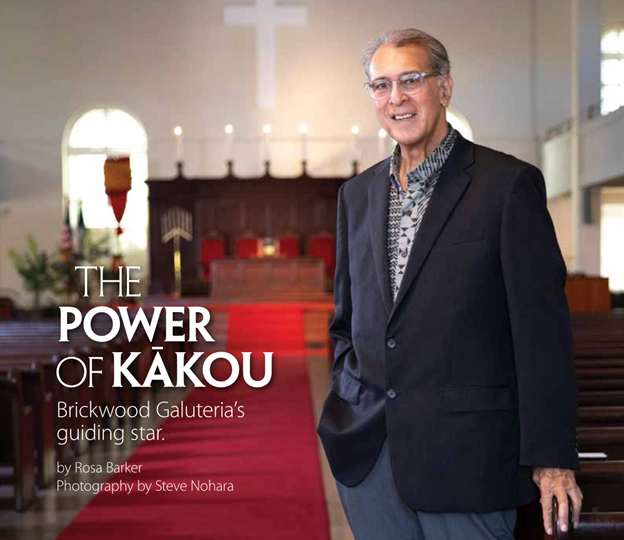
    Grounded by what he learned in his neighborhood church, Brickwood Galuteria embodies a life of public service dedicated to nurturing the well-being of Kānaka Maoli (Native Hawaiians), kūpuna and those with special needs. When “Kūpuna Power”—his TV program created to educate and empower Hawai‘i’s elderly—was relaunched in 2020, Brickwood said in a Ka Wai Ola interview that “It’s a kākou thing.” “Kākou” is an all-inclusive pronoun, equivalent to the English we.” But it’s also all-inclusive in another sense: We’re all in this together and we need to be connected to our community, working together to make the world a better place in which we all can thrive. It is the guiding principle of his heart and life’s work.

    At ease interacting with people of all ages from all backgrounds, Brickwood’s “kākou thing” includes serving the public as a senator and in his current role as an Office of Hawaiian Affairs (OHA) trustee. The skills he learned as a tour guide, musician, and radio and TV host underpin his roles as a kūpuna advocate and his success promoting mail-in voting for the Office of Elections. You may remember him as an entertainer, but he is much, much more than that.

    A ‘mixed plate’ heritage

    Brickwood was born and raised in the Kaka‘ako district of Honolulu. The family home was where Kaka‘ako Gateway Park is now, but back in the 1950s, it was an industrial area with housing behind it. Because of the plantation workers who had moved there in search of better jobs and housing, Kaka‘ako was comprised of various “camps.” The area where the Galuterias lived was known as Japanese Camp. Despite the name, it was a “mixed plate” kind of place where people from many different cultural backgrounds raised their families.

    Brickwood’s father, Arnold Galuteria, was one of nine children born to Pedro Galuteria from the Philippines and Rose Galuteria Rodrigues—of Portuguese descent—from Maui.

    Arnold married Juliette Kauhi from Kapahulu in back of Waikīkī Beach. Her parents, Joseph and Susie Nani Kauhi (nee Hussey), were from Hawai‘i Island. Their only other child—Brickwood’s uncle—was renowned musician Richard Kauhi, who introduced four-part harmony and jazz piano into Hawaiian music. Brickwood’s paternal grandma, Rose, raised him while his father worked at United Airlines and his mother worked for the City and County of Honolulu.

    There’s an interesting story behind Brickwood’s unusual first name. His father served in the Army and was best buddies with fellow soldier Brickwood Cummins. They made a pact to name their first-born sons after each other. Even more interesting is the story behind Brickwood’s middle name. “On my birth certificate is Maikaaloa, but my mom or grandmother purposefully changed it to Malihinimaika‘āina‘e. ‘Malihini’ means ‘visitor or stranger;’ ‘mai ka ‘āina a’e’ means ‘from afar.’ You combine all the different nationalities—Hawaiian, Filipino, Portuguese, English—and it’s like ‘stranger from afar.’”

    Church & school

    As a child, Brickwood spent a lot of time at Kawaiaha‘o Church, which is right across from Honolulu City Hall. Established under Kuhina Nui (Queen-Regent) Ka‘ahumanu I in 1820, it is affectionately known as “the Mother Church” of Hawai‘i. “That church is basically where we grew up and hung out. My love of performing music came from there. Mom was in the church choir. My two grandpas were deacons at the church. I spent a lot of time there!”

    Brickwood also appreciates what the church gave him culturally. “It kind of grounded my concept of kānaka. Even the political perspective— I learned so much on how to approach my politics through church politics. It got me ready, in a sense, for my service. There are different ways to serve. Ultimately, I was able to become a public servant and impact quality of life stuff by shaping policy when I was in the Senate.”

    He attended Kamehameha School from kindergarten through high school, graduating in 1973. In an interview for a “Keep It Aloha” podcast in 2024, Brickwood says that “Kamehameha embedded in me the Native Hawaiian ethos, if you will, and informed my decision-making—and it still does.” His time there also led directly into his career as a musician. In high school, he was part of the Concert Glee Club and during his senior year they were recruited by Kalani Cockett, who worked for the O‘ahu Visitors Bureau producing shows promoting Hawai‘i.

    Cockett organized the club’s tour of Canada and the continental United States, which gave Brickwood “a taste for the business of show.” When they returned, he and classmates Ken Makuakane, Chris Keliiaa, Miles Kahaloa and Wes Kitaoka formed a musical group called “Na Leo o Kamehameha.” It was during this time that he connected with Marlene Sai—the Grand Dame of Hawaiian music—who worked in administration at Kamehameha and was featured during the tour along with other wahine stars back in the day—Nina Keali‘iwahamana, Emma Veary, Penny Wells and others.

    That led to his later becoming part of the orchestra for Marlene Sai’s show at the Monarch Room at the Royal Hawaiian Hotel. This set the “stage” for a musical career.

    Radio & the evolution of Hawaiian music

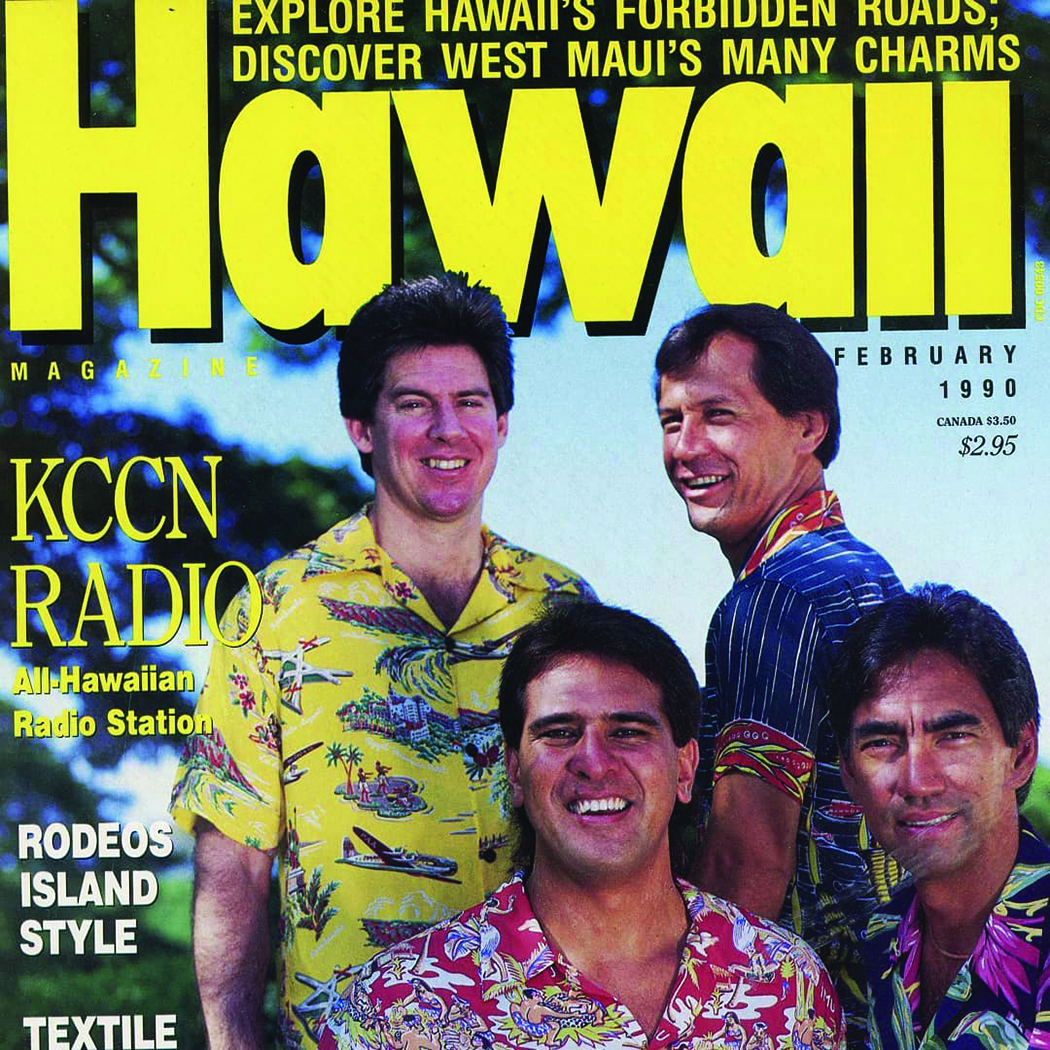
    The Four Horsemen of Station ALOHA,
    1420 AM KCCN: (clockwise) Harry B.
    Soria Jr., Kimo Kaho‘āno, Keaumiki
    Akui and Brickwood Galuteria. Kimo
    and Brickwood were the “Aloha Morning
    Show Boys,” while Harry and Keaumiki
    were known as the “Territorial Boys.”

    After graduating from high school, Brickwood briefly attended Pacific University in Oregon but returned home and started a family. To support them, he worked as a tour director and played guitar in show bands. Brickwood met his wife, Lehua, when she was a hula dancer and he was playing in the band they performed with. “She knocked over my music stand during the performance—and that was the end of that! This was when Waikīkī was just really cooking! Don Ho, Danny Kaleikini, Al Harrington, Dick Jensen, Jimmy Borges and others we emulated all had showrooms. Tavana was at the Moana Hotel. Tihati’s Polynesian Revue was at the Beachcomber. Our aim as tour directors was to provide a memorable visitor experience and to just have some fun. That was the important thing.”

    Brickwood’s transition into his career as a radio host stems from a specific moment in 1979. His band played on the top floor of the Oceania Floating Restaurant and Don Ho’s original backing band, The Aliis, played the showroom on the second floor. “I went down to listen to The Aliis and Sam Kapu, who worked with Don Ho and also had a show on-air, asked if I’d be interested in doing radio. I said, ‘I have no compelling need to be behind a microphone on radio, but yeah, sure.’”

    The program director at KCCN1420AM was one of Brickwood’s schoolmates, Jackie Rossetti, the Honolulu Skylark. The station’s handle was “The Hawaiian Music Station” because it fore fronted local bands. He was given the traditional time slot for newbie DJs—10pm to 2am. He created a theater of the mind called “The Biggest Little Nightclub in Town.” “We had canned applause and I served as host: ‘Ladies and gentlemen, let’s go back to the stage with more music…’

    “We were there when the music was really evolving into different spaces in the post-Don Ho era. As an example, you had The Sunday Manoa—Peter Moon and Robert and Roland Cazimero. They added really cool for-the-young-people kind of instrumental work and their appeal to the younger crowd stuck. There were more different forms evolving. Hawaiian music was really on the cutting edge with all these hybrid genres.”

    One of those hybrid genres was a Hawaiian-style reggae that went on to have its own category in the Nā Hōkū Hanohano music awards: Jawaiian. “I was on the table the day that word was coined,” Brickwood says. “That just stuck with us and we took it to the maximum effect.”

    It was during his 1980–90 stint as a KCCN radio host that Brickwood himself won two Nā Hōkū awards: Male Vocalist of the Year and Most Promising Artist in 1985. As part of his life of service, in 1990, Brickwood became a board member of the Hawaiian Academy of Recording Artists, which produces the Nā Hōkū awards. He served as its president from 1992 to 1995 and returned as a board member in 2022.

    Connecting keiki & heritage

    In May 1990, KCCN General Manager Michael Kelly launched a sister Hawaiian music station: KCCN-FM100. Brickwood co-hosted the “Aloha Morning Show” with Kimo Kaho‘āno on that channel and then on Hawaiian KINE-FM105. In 1992, this resourceful duo became part of the Pacific Voyaging Society’s (PVS) “Voyage for Education: No Nā Mamo, For the Children.”

    As the PVS web page explains, the navigators and crew members “reached out to thousands of school children in Hawai‘i through a long-distance education program. During the voyage, students tracked the canoe on nautical charts, learned about their Pacific world and used the canoe and its limited supply of food, water and space to explore issues of survival, sustainability and teamwork” (archive.hokulea.com/holokai/1992/no_na_mamo.html).

    The “Aloha Morning Show” was part of that effort, with live hook-ups between the studio and the Hōkūle‘a voyaging canoe to receive daily reports of weather conditions, coordinates, etc. Brickwood shared that “Prior to the sail, PVS secured a GPS system under the hull of the wa‘a, communicating its location directly to Hawai‘i, with no communication given to the members on deck above so as not to compromise the wayfinding. After the first leg from Hawai‘i to Tahiti was completed, I joined the crew in Tautira for the next leg to Rarotonga and resumed the daily radio reports with Kimo here at home.”

    That leg of the journey lasted from Sept. 1 to Oct. 25. Three days later, in a TV studio at the University of Hawai‘i (UH) at Mānoa and using the UH Peace Satellite, Brickwood and teacher Patty Miller co-hosted a three-way conversation between the studio, the Hōkūle‘a and the space shuttle Columbia as it passed over the Hawaiian Islands. One of the shuttle astronauts, Charles Lacy Veach, was from Hawai‘i. The link-up was broadcast as a Department of Education Distance Learning Technology TV Special (link at the end of article). This was no mean technical feat and the video shows how adept Brickwood was at navigating the technical difficulties inherent in satellite communications.

    It also demonstrates his ability to step back and allow others to hold the floor. As well as the co-hosts, in the studio were four school students, plus there were two open phone lines so that students could call in their questions from their schools on O‘ahu and neighbor islands. Brickwood acted as a facilitator of the dialogues between all the different participants, creating a bridge between land, sea and sky. This opportunity to enhance the cultural understanding of the upcoming generation resonated deeply with his commitment to Kānaka Maoli values.

    Empowering through policy

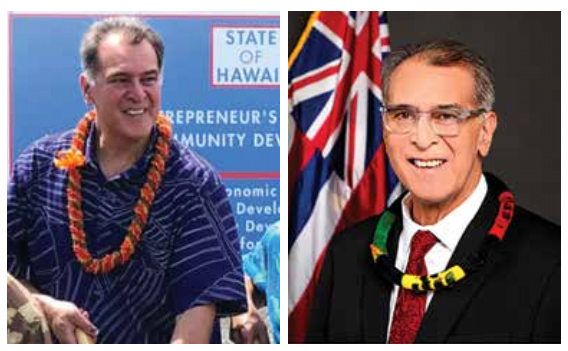
    L: Sen. Galuteria at the groundbreaking for the Hawai‘i Techno-
    logy Development Corporation’s Entrepreneurs’ Sandbox in
    Kaka‘ako in 2018. R: As an OHA Trustee in 2025, Brickwood is
    chair of the Beneficiary Advocacy & Empowerment Committee.

    Building upon his childhood introduction to politics in his church, Brickwood turned his attention to the political arena. He served as the state chairman of the Democratic Party of Hawai‘i from 2004 to 2006 and as the state senator for District 12 from 2008 to 2018, at one point serving as Senate majority leader. Brickwood’s ability as a bridge-builder was particularly useful when it came to his relationship with the Senate Minority Leader Sam Slom, aka “The Lone Ranger” because of his firm convictions, which didn’t necessarily jibe even with his own party members. Slom was the only Republican in the Senate in 2018.

    The Office of Hawaiian Affairs

    After leaving the Senate in 2018, Brickwood continued his service to the Native Hawaiian community as a member of the O‘ahu Island Burial Council. Then in 2022, he became an at-large trustee of the Office of Hawaiian Affairs, where he is currently chair of the Committee on Beneficiary Advocacy and Empowerment. it “focuses on OHA’s legislative and advocacy efforts, as well as programs that address issues relating to health, human services, economic stability, education, native rights, housing, land use, environment and natural resources.”

    In April 2025, he wrote “Sustainability Through a Native Hawaiian Lens” for OHA’s newspaper, Ka Wai Ola: “Historically, Hawaiians exemplified sustainable living through the ahupua‘a system, a land division model extending from mountains to sea. This system ensured long-term abundance through collective responsibility.

    Today, these principles remain relevant as Hawaiians navigate political, economic, social and environmental challenges.”

    Voting by mail campaign

    In 2020, he had received a call from the Hawai‘i State Office of Elections asking him to help “ensure a sense of confidence with kūpuna, who were more comfortable with going down to the ballot box in person. He created a network of partners by contacting all of the leaders of nonprofits and other entities that already had strong connections with that demographic. The turnout for the 2020 primary election was 51.2% of registered voters, 98% of the votes being cast by mail. In the General Election it was 69.6%, with 95% of those votes being cast by mail. Furthermore, 60% of those who voted were over the age of 50, including 32% aged 65-plus.

    ‘Kūpuna Power’ returns!

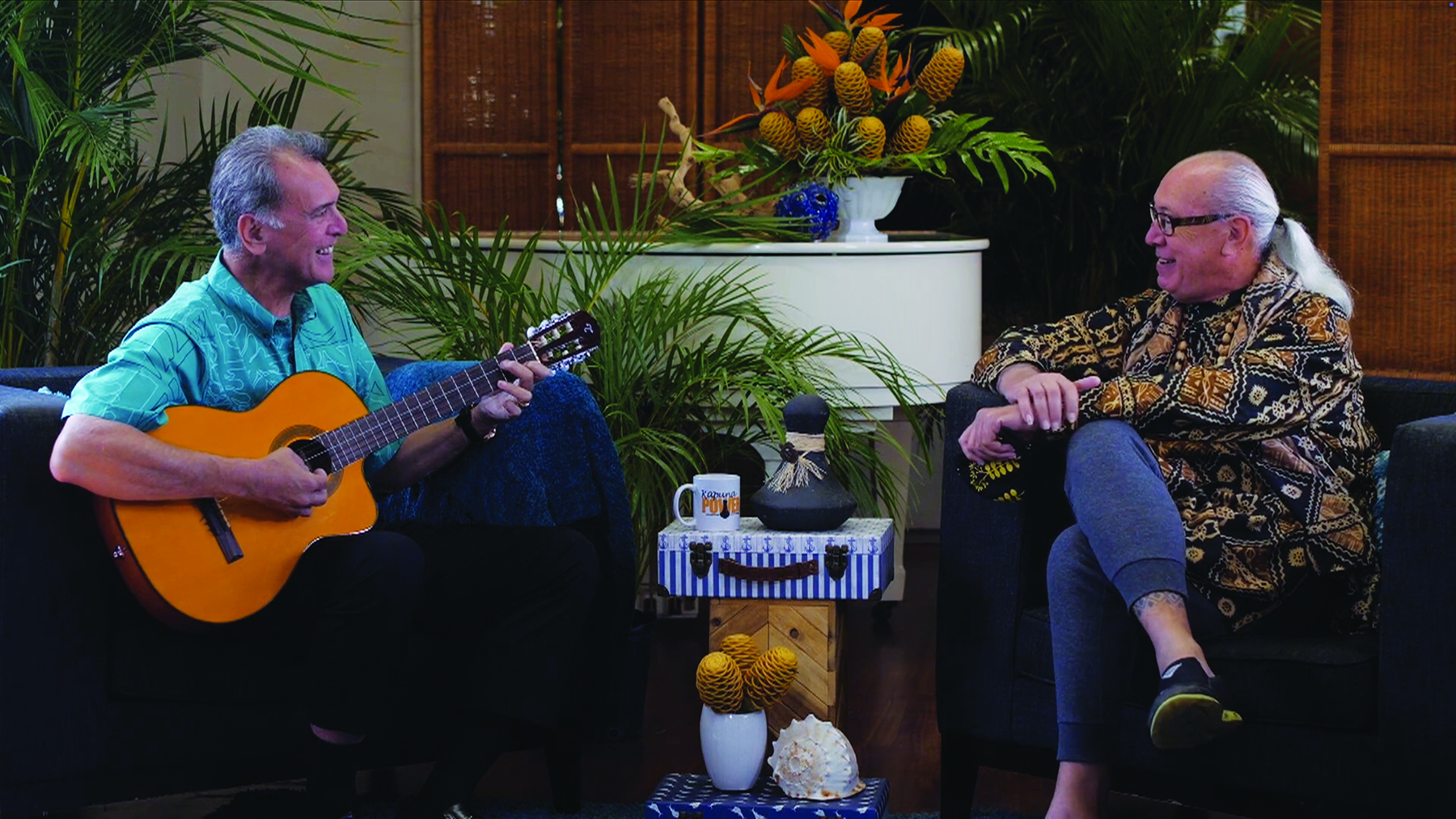
    “Kūpuna Power” guest Kumu and Kahuna Kawaikapuokalani Frank
    Loea Lehua Hewett joins host Brickwood Galuteria in 2020, sharing
    stories of growing up and learning from his own kūpuna.

    The principle of “collective responsibility” includes everyone who lives in Hawai‘i, not just Native Hawaiians. It also involves collective action in the form of advocating for change.

    While serving in the Senate, Brickwood’s mom asked him to check on her best friend, one of his church aunties. He discovered that fraudsters accompanied her to the bank and drained her account. The immediate concern was that Aunty’s electricity had been cut off and she was using candles, which could have accidentally started a fire.

    In his “Keep it Aloha” podcast interview, Brickwood explains how he went back to his office and said to his staff, “Let’s start something called ‘Kūpuna Power!’ What is kūpuna power? It’s a lively, meaningful way that celebrates Hawai‘i’s kūpuna. Kūpuna power is about empowerment and knowing the resources that help us make responsible decisions and become self-advocates. We started by doing a resource fair at the state capitol in April each year.” Each April, the conference committee of each legislative house considers the bills generated in the other house and decides if they progress to being enacted before the legislative session ends in May. Besides connecting kūpuna to resources and organizations that could help them with their needs at the fair, Brickwood and his staff would encourage them to go to their representative’s office to speak with them directly.

    He also took the idea to ‘Ōlelo TV, a nonprofit community Public, Education and Government access provider created in 1989 “to empower the voice of the community.” Brickwood had previously been a moderator on ‘‘Ōlelo’s “In-Touch” show in the 1990s, and had also hosted or co-hosted shows on ESPN and KHON TV. From 2011 to 2014, Brickwood was the producer and host for “Kūpuna Power TV” on ‘Ōlelo. In 2020, following his exit from the Senate, he relaunched “Kūpuna
    Power” as a half-hour show on KGMB/KHNL/K5, but stopped when he was elected to OHA, unsure of what time commitment would be required.

    “After about a year at OHA, I decided I couldn’t also produce a half-hour show once a week. It was too labor-intensive.” Instead, he, Mike Kelly (from his KCCN radio days) and some friends “went to bat” for a short-form version of “Kūpuna Power,” a five-minute segment in KITV’s “Island Life Live” show. It airs once a week on Thursdays at 4:30pm. Since early May of this year, KITV has also been airing “The Best of Kūpuna Power,” reruns of many of the earlier half-hour shows.

    In addition, there will be some new one-off shows on specific topics like digital literacy and fall prevention and he plans to use footage he and Kimo have from the 1992 Hōkūle‘a voyage as “Kūpuna Power Remembers No Nā Mamo.” He’ll also revive the tradition of the Christmas special “Kūpuna Kalikimaka.” “The Best of Kūpuna Power” airs each Tuesday on KITV at 12:30pm with an encore each Wednesday at 12:30pm on KIKU, ”Hawaii’s Multi-Cultural TV Station.”

    Brickwood and Kimo are also reigniting their co-hosting mojo with a weekly 35- to 45-minute video/radio podcast called “Hawaii Recalls.” “Podcasts are the new radio shows,” he says.

    A family man at heart

    The Galuteria family at Shawn’s 50th birthday celebration: (L–R, back row) Bric (son), Rebecca and husband Mana (son), Kawehi (daughter), Sommer (daughter),(front) Brickwood, Lehua (wife) and Shawn (son).

    Brickwood’s time as a young person was lived largely in the public spotlight, as a musician, radio DJ and television personality. But he was also a family man. He and Lehua have five children and 10 grandchildren. “And for us, the diaspora is real, because three of our five children live on the continent. Five of our 10 grandchildren live on the continent, too. We can’t argue with them for wanting a better quality of life for their families, but we’d love to find a pathway back for them.”

    One of their sons lives with them, or as Brickwood says, “We like to say we live with him. Shawn is our gift from God. He has Down syndrome. When he was born, we were told that kids like him had a length of life only into their 20s, especially as they have a propensity for heart conditions. He had to have major surgery for a hole in his heart at the age of three. We had a big celebration for him recently when he turned 50! He brings a centering to our lives that is just unconditional.”

    Having Shawn in the family contributed to Brickwood’s decision to add the special needs community into his life of service as a board member for Hawai‘i Special Olympics and the Hawai‘i Association of Retarded Citizens, which is nowadays known simply as ARC. Although it is common to use the term “disability” and “special needs” when speaking of people like Shawn, Brickwood expresses the belief that he has “different abilities” and that we all have special needs. Those terms should not be used to exclude this community of people from the activities we all enjoy as part of our daily lives.

    It’s a kākou thing…

    KŪPUNA POWER
    info@wearekupuna.com | wearekupuna.com
    “Kūpuna Power” 5 min. segments
    KITV “Island Life Live”: Thursdays, 4:40pm

    “The Best of Kūpuna Power” (replays of TV shows)
    KITV: Tuesdays, 12:30–1pm
    KIKU: Wednesdays, 12:30–1pm

    Youtube videos:
    Hokūle‘a Talks to Space Shuttle Columbia
    bit.ly/HokuleaTalksToShuttle
    Hawaii Recalls
    bit.ly/KupunaPower-HawaiiRecalls
    Keep it Aloha podcast, Brickwood Galuteria: From entertainment to politics, and empowering Kūpuna
    bit.ly/KupunaPower-KeepItAlohaGaluteria

    Grounded by what he learned in his neighborhood church, Brickwood Galuteria embodies a life of public service dedicated to nurturing the well-being of Kānaka Maoli (Native Hawaiians), kūpuna and those with special needs. When “Kūpuna Power”—his TV program created to educate and empower Hawai‘i’s elderly—was relaunched in 2020, Brickwood said in a Ka Wai Ola…

  • Ikebana – A Conversation With Nature

    By Rosa Barker
    Photos courtesy of Barbara & Roger Tinius

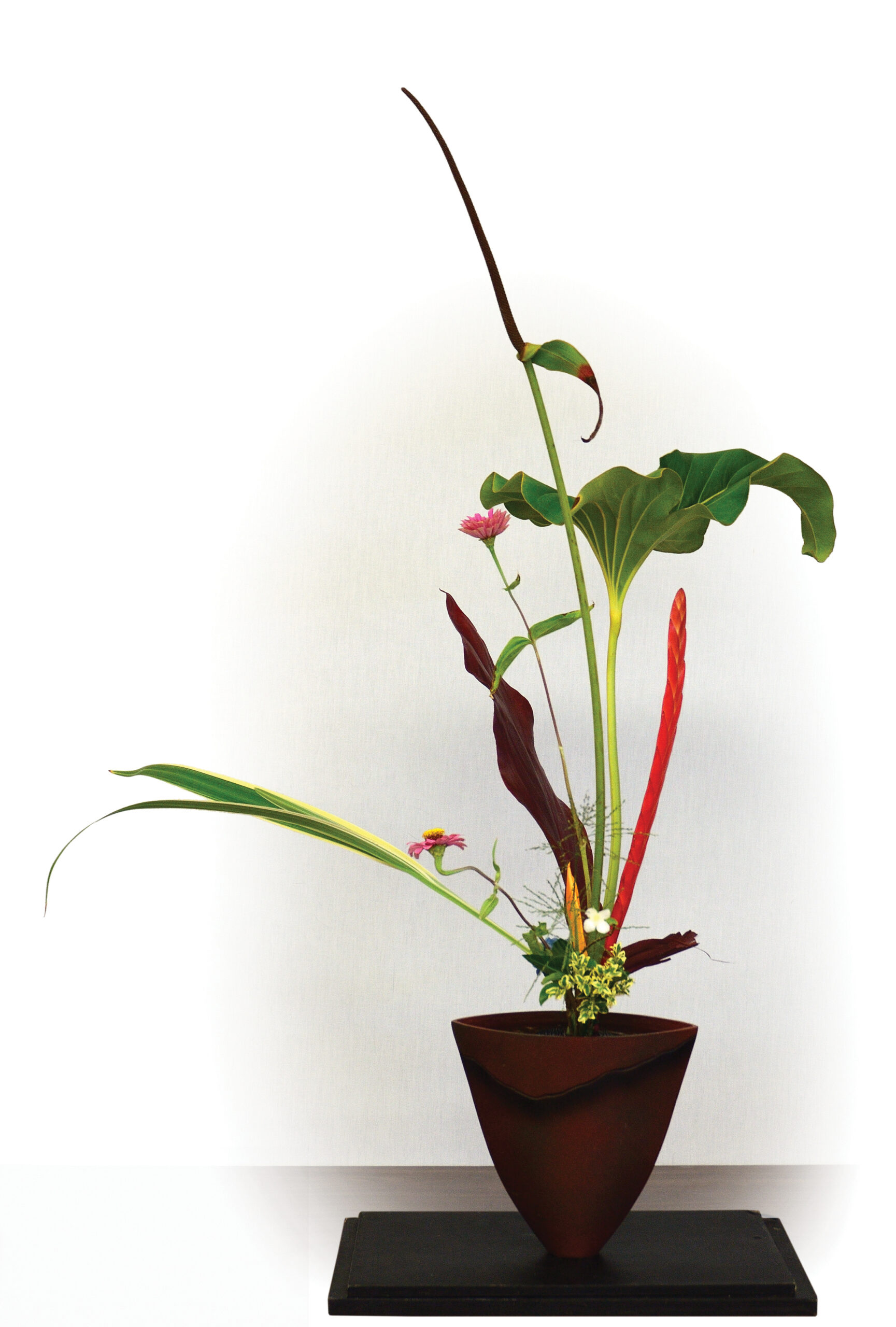
    Kida-Sensei’s Rikka Shimputai

    Ikebana is instantly recognizable as a Japanese style of floral art, no matter where in the world it is created. One thing that sets it apart as a style is that the arrangement is simple and uncluttered. But that simplicity is full of deeper meaning, dating back many centuries, when an Ikenobo priest taught that “With a spray of flowers, a bit of water, one evokes the vastness of rivers and mountains.”

    Ikenobo Ikebana
    Ikenobo Ikebana is the original school of ikebana in Japan. The school’s headquarters are in Kyoto, close to the art’s origins at the Rokkakudo Temple, which was founded nearly 1,400 years ago. Priests who made floral offerings at the temple’s Buddhist altar lived near a pond (ike) in a small hut (bo). The priests became known as “ikenobo,” and people came to watch and learn from them. The Buddhist name “Senkei Ikenobo” first appeared in historic records as “master of flower arranging” in 1462.

    In the mid-16th century, Senno Ikenobo established the philosophy of ikebana, completing a compilation of Ikenobo teachings called “Senno Kuden.” He taught that “Not only beautiful flowers but also buds and withered flowers have life, and each has its own beauty. By arranging flowers with reverence, one refines oneself.” As the Ikenobo Ikebana Japan website explains, the spirit of Ikenobo Ikebana is embodied in the idea that “arranging flowers and finding beauty in them is linked to a heart that values nature and cares for other people.” Flowers are not only beautiful but they can reflect the passing of time and the feelings in the heart of those who arrange them.

    Ikenobo Ikebana Styles
    Ikenobo Ikebana has three main styles: shoka, rikka and jiyuka (Free Style). The first two have both traditional (shofutai) and more modern (shimputai) variations. The modern variations and the jiyuka style were all introduced during the current Kyoto headmaster’s term. He based these “new” styles on old scrolls showing materials being used in a simpler manner.

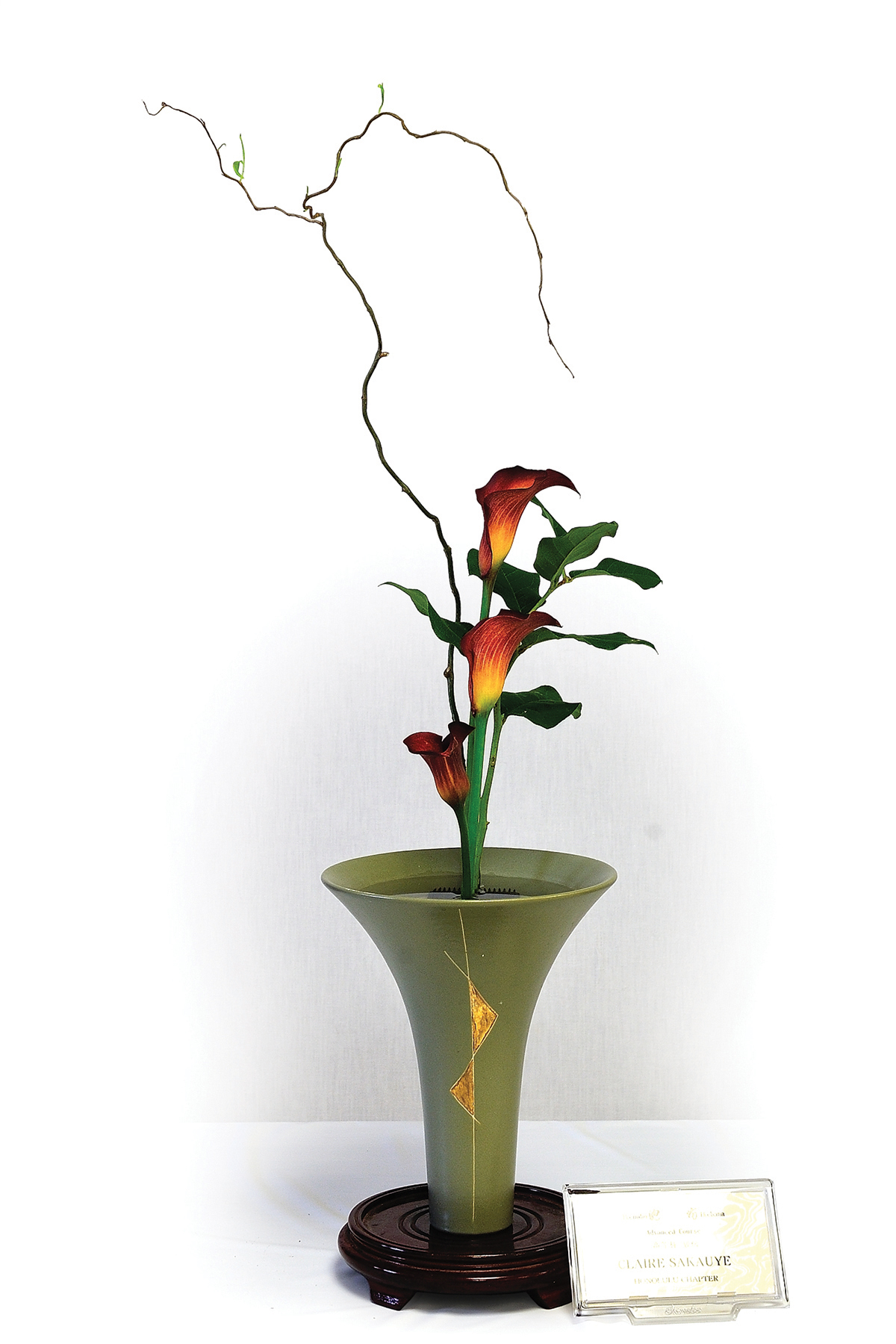
    SHOKA uses no more than three kinds of floral materials and is the most dignified flower style among the three, created originally during the mid-Edo era (18th century) for placement in the tokonoma (alcove) of a traditional Japanese tatami room. It has only three main components that can represent past, present and future, or heaven, man and earth. This style expresses the longing for nature.

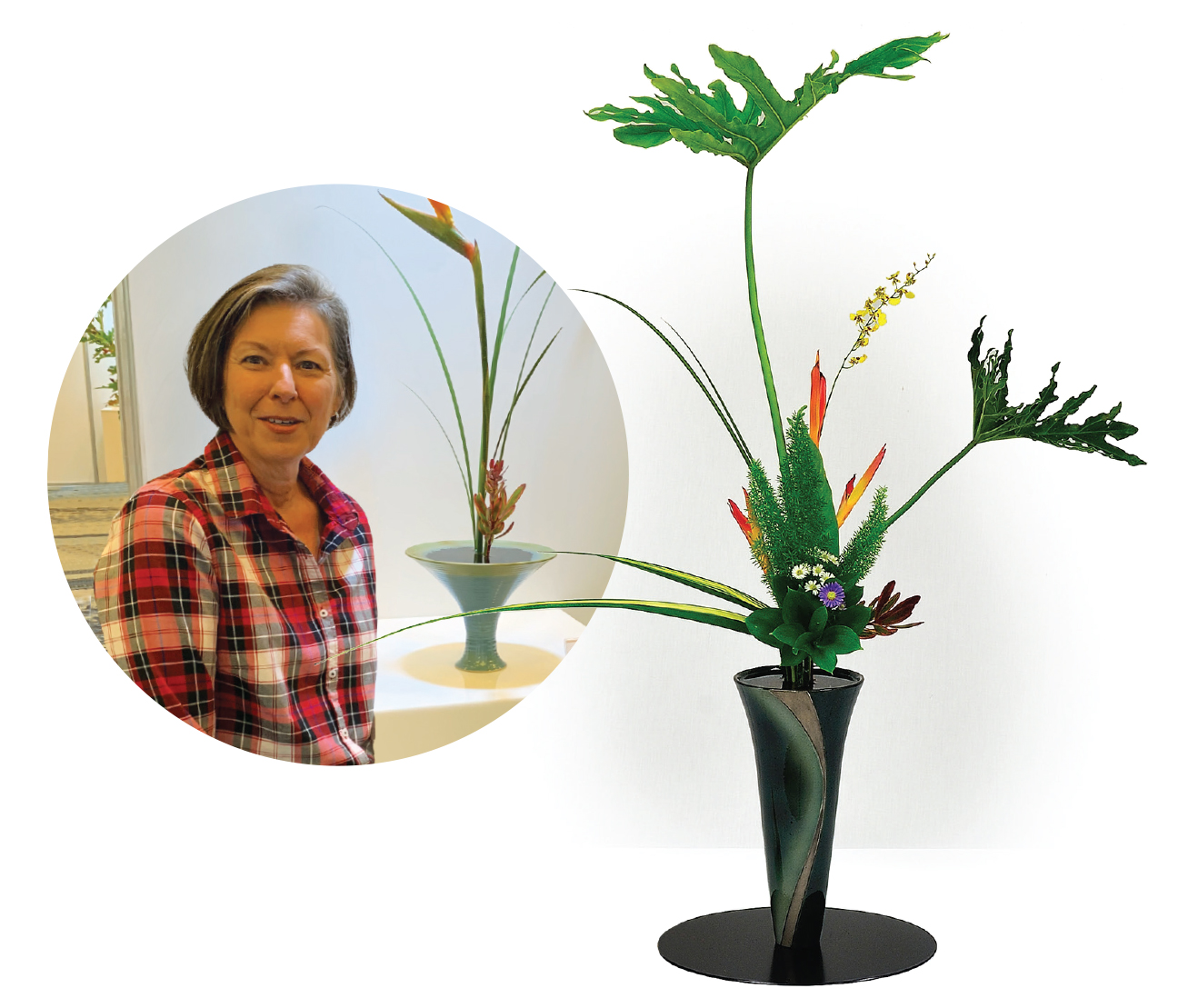
    Shoka Shimputai by Claire Sakauye

    RIKKA is the most classical ikebana style, having been handed down since the 16th century, during the Muromachi Era (approximately 1336 to 1573). Because it represents “a harmony of a wide variety of plants in the natural world,” this style is more elaborate and more challenging to create than shoka. It expresses grace of tradition and magnificent landscape and has nine main components with optional additional parts to fill in or round out the arrangement.

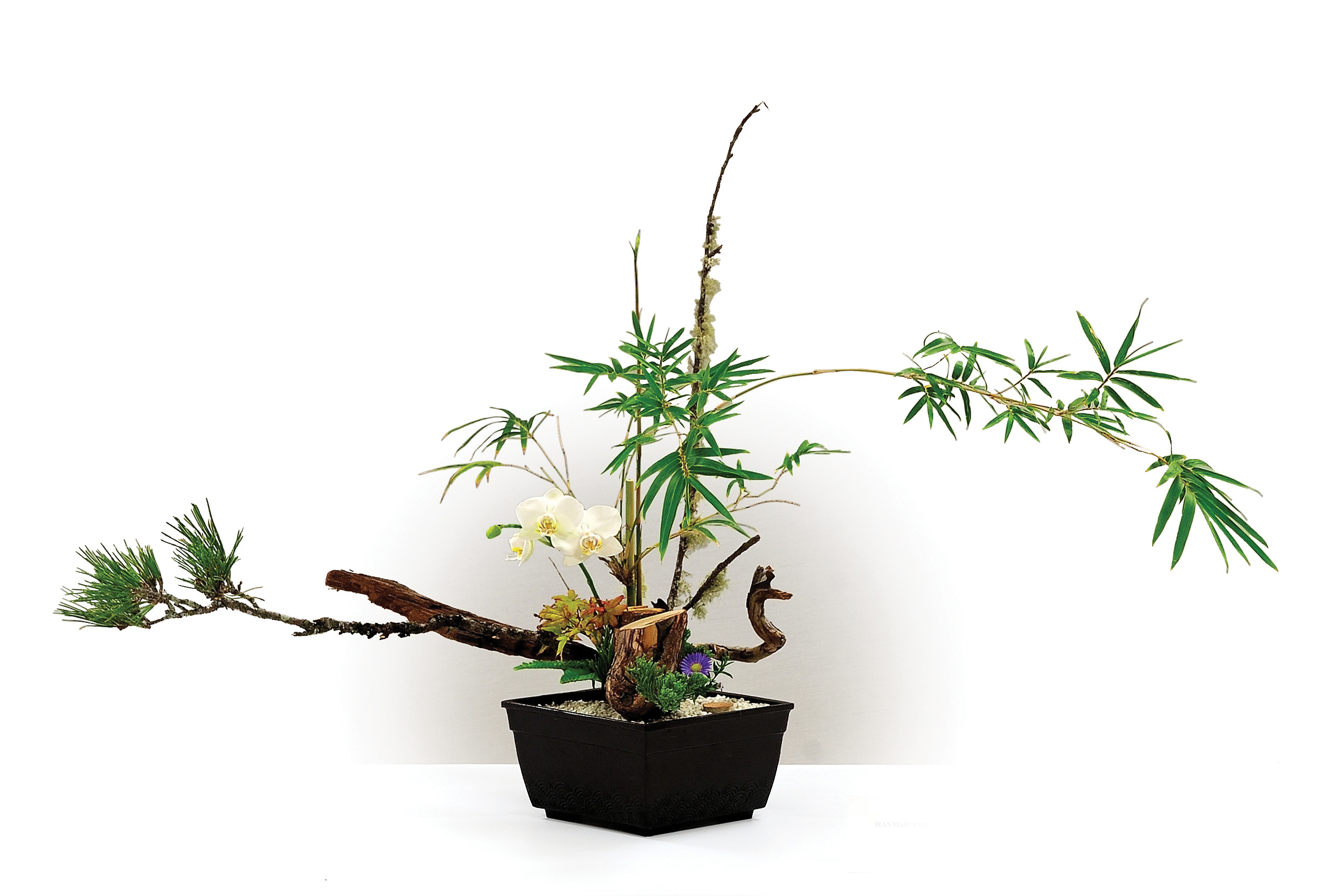
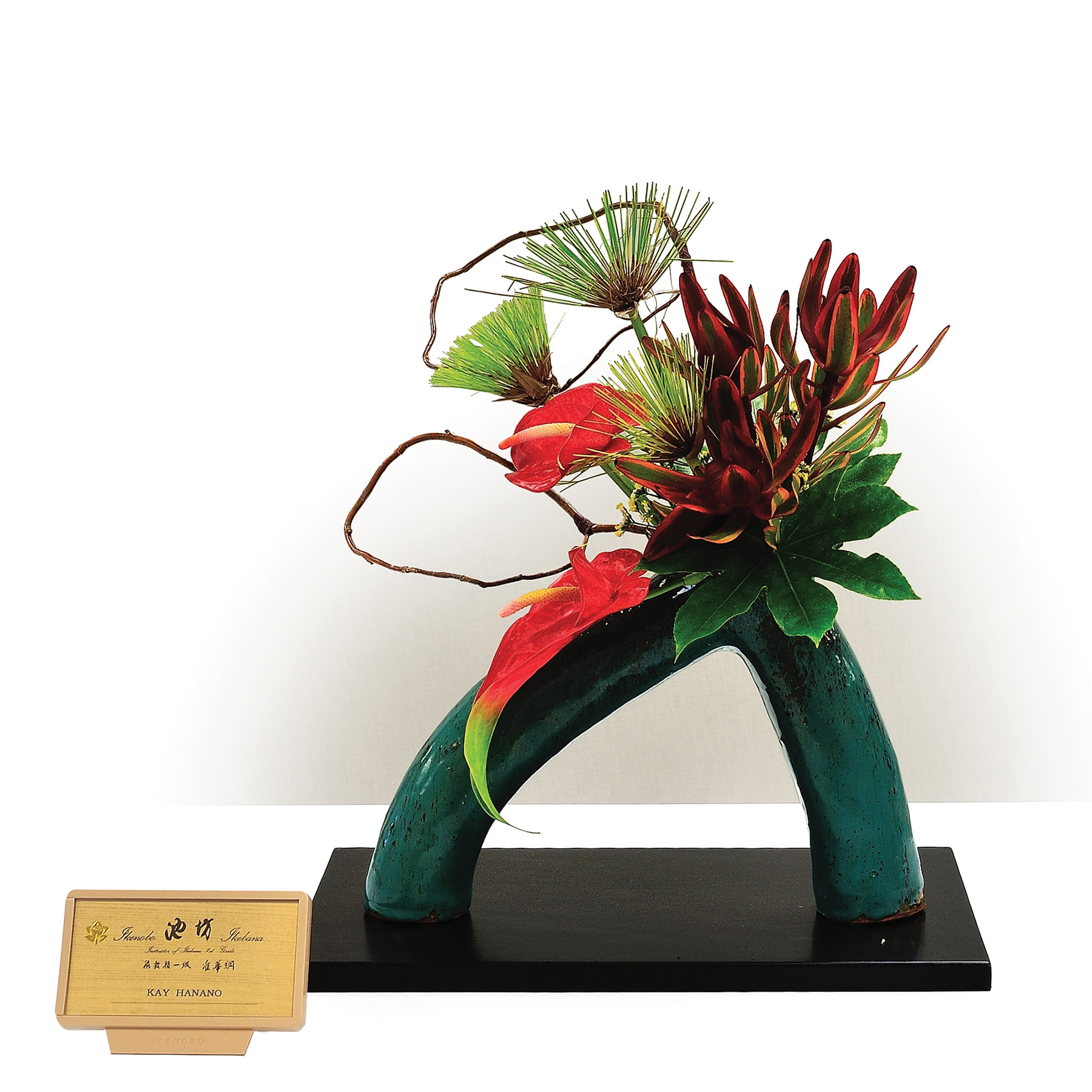
    JIYUKA has no specific pattern or set of rules but falls into two basic categories: naturalistic and designed, in which materials are used in a less natural manner. The creator has complete freedom to express their personal inspiration. The finished arrangement might hang on a wall like a picture or be suspended from the ceiling like a lamp. Very few modern homes have an alcove or a tatami room, and this style was introduced in response to that architectural change.

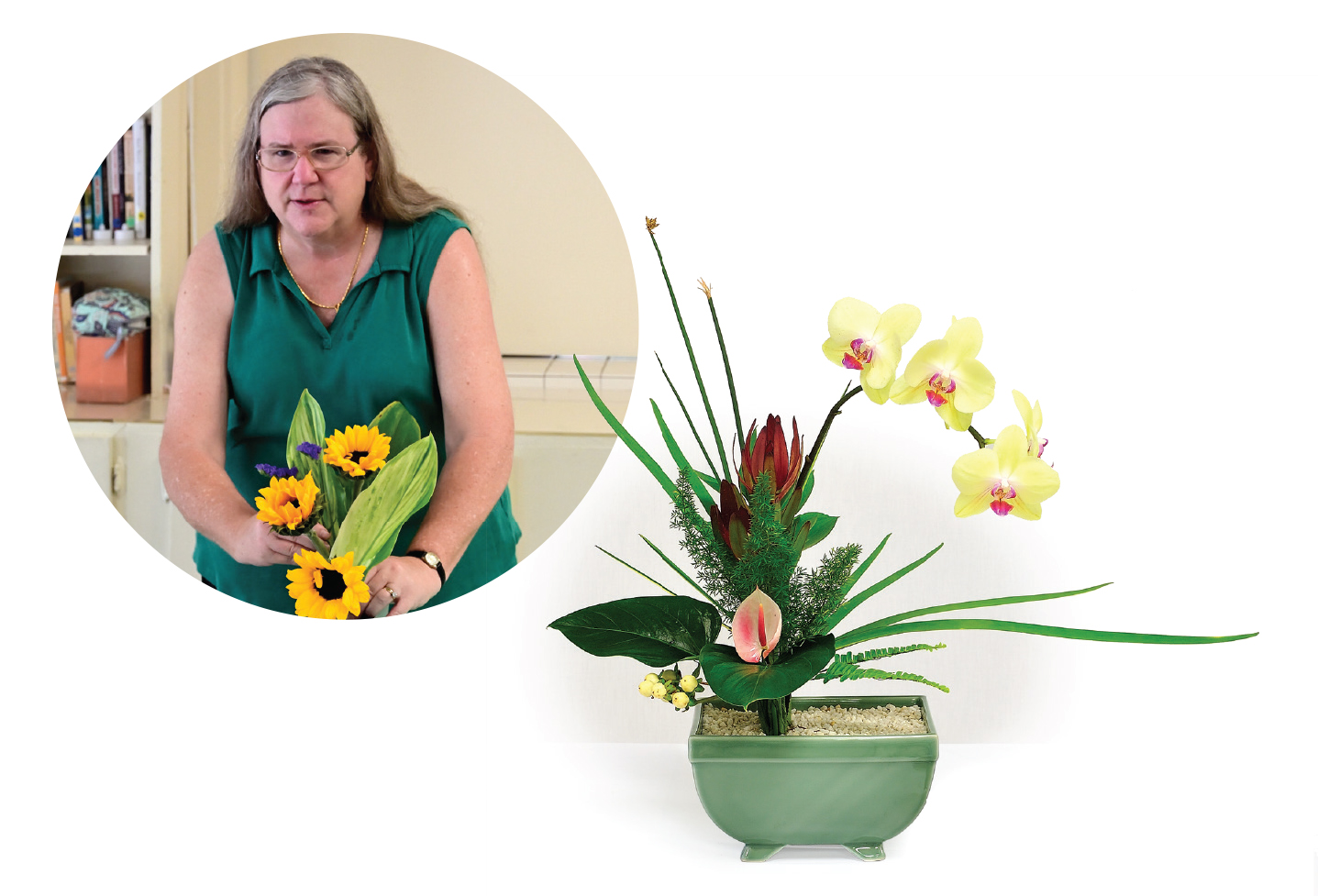
    Sunanomono by Jean Marutani
    Jiyuka by Kay Hanano

    From Kyoto to Hawai‘i Kai
    Beryl Ono and Diana Salansky are both long-time members of the Ikenobo Ikebana Society Honolulu Hawaii Chapter, one of 41 chapters worldwide. For both of them, the relationship between the teacher (sensei) and the student is key to what kept them wanting to learn more. Diana’s sensei here in Hawai‘i always told her, “You can do it!”

    Her sensei’s method of teaching was to have the student first watch her create an arrangement from the materials she supplied. The student would then be left to study it. “I would draw it and list the main, secondary and filler material,” Diana says. Then the sensei would take it apart and Diana would remake it. It’s a one-on-one process with the sensei explaining what is required for the style being created, and the particular characteristics of the materials she has chosen to use and how the material itself has precedence: “You might want to show the sunny side of a branch but the material might have opposite ideas. It’s about becoming aware of what is the essence. After about six lessons, you can create the arrangement first but sensei gives you instructions to follow.”

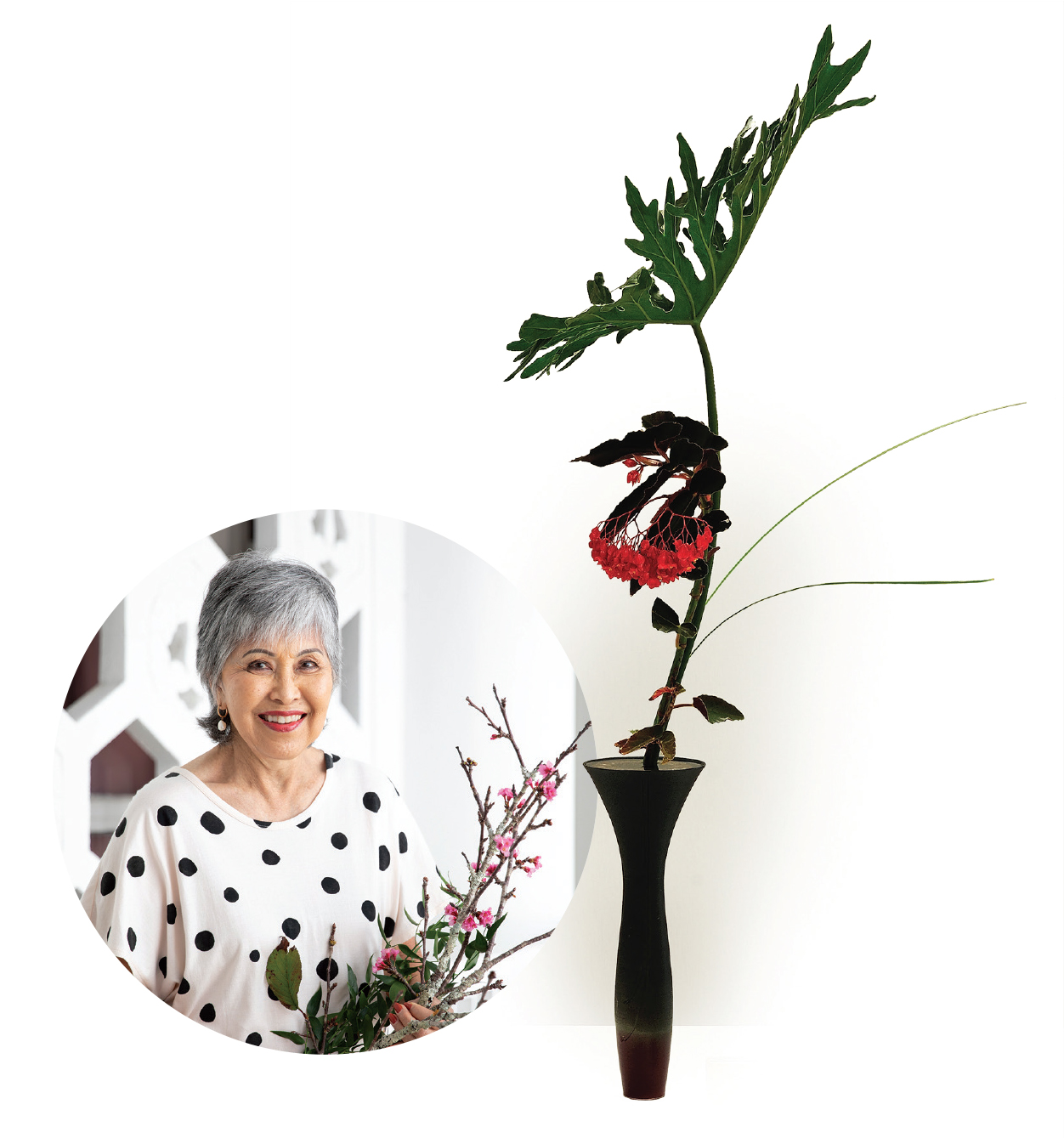
    Beryl Ono Stapleton and
    her Shoka Shimputai
    arrangement
    PC: Steve Nohara

    Beryl concurs, saying, “When you first get into ikebana, they teach the basics first.” She enjoys classes because, in a world of multitasking and deadlines, “it’s just me and my flowers and my materials for the two hours I’m there. I feel a sense of satisfaction, not so much about my arrangement, but something like others might feel at the end of an exercise class.” Beryl is the contact point for those wanting to find out more and join classes. (Visit ikenobohonolulu.org for class details.) There are eight Ikenobo Ikebana teachers on O‘ahu and classes are held at a number of different venues, twice a month. Barbara Tinius, one of those teachers, explains that students first learn a generic form of Free Style, then graduate to shoka. “In starting with Free Style, you are learning classroom protocol and how to hold your scissors and look at how the material grows without being burdened by too many rules.” Barbara and Diana, both certificated “Senior Professors of Ikebana” by Kyoto headquarters, are available for private lessons and ikebana demonstrations.

    Minimal But Meaningful
    The choice of materials used in an arrangement is key to the art’s appeal. Once the novice has gained enough knowledge to choose materials, the student takes great pleasure in finding material that expresses what they want to say in the arrangement — or they might simply let the material itself speak to them. Beryl explains: “It’s not just grabbing different materials and throwing them together. I would spend an hour at the florist looking at all the materials. You are looking for something that just grabs you. You’re talking to your material. Eventually, you start planting things that you can use. You don’t just put ornamentals in your yard.” Material can also be gathered from nature. It need not be “perfect.” A shriveled bud has a story to tell that’s as meaningful as a branch of perfect blossoms. As Sen’ei Ikenobo, the current 45th Headmaster of Ikenobo, wrote in the Ikenobo Society of Floral Art’s magazine: “What is important is to look at plants as they are with an unconstrained mind, without reflecting our own desire.”

    Diana Salansky and her Rikka Shofutai arrangement

    Zen and Wabi-Sabi
    When Yasunari Kawabata was awarded the Nobel Prize in Literature in 1968, he used the occasion of his Nobel Prize lecture to bring the attention of a global audience to the finer points of Japanese cultural expression and the practice of Zen. Ikenobo Ikebana was one of the examples he used to illustrate this. “The ancients arranged flowers and pursued enlightenment.” he said. “Here we see awakening to the heart of the Japanese spirit, under the influence of Zen.”

    Another manifestation of the Japanese spirit is the concept of wabi-sabi. It is an aesthetic that can be found in many forms of art, honoring the beauty of things that are imperfect, impermanent and incomplete in nature. Asymmetry, humility and simplicity characterize the wabi-sabi aesthetic and those qualities are integral to ikebana arrangements. In modern Japan, wabi-sabi is often understood
    as “wisdom in natural simplicity.”

    Globalizing an Ancient Tradition
    In the second half of the 20th century, ikebana floral arranging began to blossom around the world. The presence of US military personnel based in Japan provided a nurturing soil in which to plant the seeds of global growth as ikebana teachers provided classes for military wives.

    Barbara Tinius and her Rikka Shofutai Suna no mono arrangement

    Ikebana International, an organization that is present in more than 60 countries and encompasses many different schools of ikebana, was founded in 1956 by Ellen Gordon Allen, wife of a US general stationed in Japan. Her purpose in creating this organization was “to unite people of the world through their mutual love of nature and the enjoyment of ikebana.” The organization’s motto is “Friendship Through Flowers.”

    When her husband was posted in Rome (1954 to 1956), Ellen saw an opportunity to promote the art she had learned in Tokyo to a global audience. Her fascinating scrapbooks documenting her ikebana journey are digitally archived on the Ikebana International Washington DC Chapter 1 website (iichapter1.com/archives-2).

    Diana’s journey with ikebana began when her husband was stationed in Japan. For 18 months, she studied with a sensei who came to the base, and who asked her to join Ikebana International (ikebana-hawaii.org). Back in Hawai‘i, she was introduced to Sensei Keiko Fukuda of Ikenobo School. Diana was president of Ikebana International Headquarters in Tokyo from 2017 to 2019.

    The organization’s active ikebana schools in Honolulu regularly hold demonstrations and workshops. Schools, senior centers and care facilities, Japanese clubs, the University of Hawai‘i at Mānoa’s Department of East Asian Languages & Literatures, the Japanese Consulate and the Japanese Culture Center of Hawai‘i (JCCH) have all been venues, sometimes as part of a fundraising campaign for a local charity. Each week, volunteers from the Sogetsu, Ohara and Ikenobo schools provide seasonal arrangements for the lobby of the administrative office at JCCH.

    Exhibitions
    Ikenobo Ikebana is not competitive. It acknowledges progressive levels of achievement based on a set sequence of classes and workshops by awarding certificates. The number of lessons is not the only determining factor for certificates. Students also need to demonstrate an understanding of the knowledge and principles inherent to that level of achievement.

    Students get the opportunity to display their arrangements at exhibitions. “An exhibition is the stage for members to celebrate their work,” according to Sen’ei Ikenobo. “By preparing the exhibition, students can be motivated to face each leaf and flower with sincerity and work on their performance.” The exhibition that will be held in the Garden Lanai Room at the Ala Moana Hotel as part of the Ikenobo Ikebana Society of Honolulu’s 45th Anniversary Celebration is called “Creating Harmony.” The webpage for the event explains: “We chose this theme as that is exactly what we’re doing when we arrange three or more diverse materials into a cohesive artistic display.” (See the “45th Anniversary Celebration” sidebar.)

    Attendance at exhibitions is best undertaken with an open mind and an open heart. To fully appreciate an ikebana arrangement, Beryl advises that the viewer should realize they are looking at something that has come from the arranger’s heart. “There’s a three-way conversation going on between the materials, the arranger and the viewer. It’s all about feelings and the place a person happens to be in life at that time.”

    21st Century Ikenobo Ikebana
    While never forgetting its centuries-old roots as a religious ceremony, Ikenobo Ikebana warmly embraces new technologies and societal changes. Besides introducing modern forms of the two traditional styles and adding Free Style, Sen’ei Ikenobo, the current 45th Headmaster of Ikenobo, has encouraged the development of outreach efforts to Japan’s young people. Enter the Ikenoboys! About seven years ago, a group of junior professors at the Kyoto school formed the equivalent of a boy band. Either individually or as a group, they give demonstrations at schools and public events, and make TV appearances. On the “Ikebana’s Evangelist Ikenoboys” website at ikenoboys.com, you can find links to their videos and their Instagram account.

    The school also collaborates with other arts. The Kyoto Ballet Company has added ikebana to its curriculum and in January 2023 included an ikebana performance in unison with dancers as part of a welcoming event for Japan’s Agency for Cultural Affairs. “Each dancer held a flower in their hand and passed the flowers to us at the center of the stage while dancing. Receiving the flowers from the dancers, we observed each flower to find the best direction and angle to maximize its appeal, and improvised an arrangement, which conveyed the passing of the seasons,” wrote Miyuki Koike, who teaches ikebana at the Kyoto Ballet Academy, in the Ikebana Floral Arts Society newsletter.

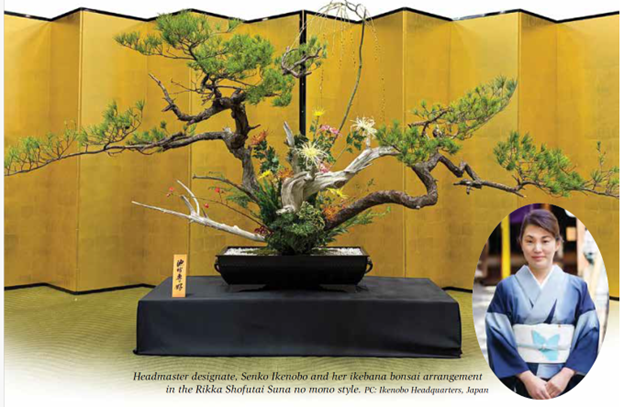
    Of all the changes that the current headmaster has made, the most far-reaching has been naming his daughter, Senko Ikenobo, as 46th Headmaster-Designate of Ikenobo Ikebana. It is the first time in the school’s history that a headmaster has named a woman as his successor. She was appointed headmaster-designate in 2015. On her Ikenobo Ikebana webpage, she writes: “To the best of my ability, I hope to promote ikebana, one of the representative aspects of Japanese traditional culture, to the next generation.”

    Senko is also active as a Japanese cultural ambassador around the globe and for international events held in Japan. She was a member of the organizing committee for the 2020 Summer Olympics and Paralympics (which were postponed until 2021 because of the pandemic), performed a floral offering ceremony at the United Nations Headquarters in New York and created ikebana arrangements for the 42nd G7 Summit in Japan. In 2024, Senko took part in a traditional maritime ceremony launching the Mitsui Ocean Fuji cruise ship in Tokyo Bay. By christening the new vessel, she has added “godmother” to her many roles. When she is here for the 45th anniversary celebration in June, Senko will be demonstrating the creation of Ikenobo Ikebana pieces at the Ala Moana Hotel.

    The event will be a wonderful opportunity for ikebana enthusiasts and those curious about this Japanese cultural practice to engage with the values at the heart of Ikenobo teachings: “We create with branches, leaves and flowers a new form which holds our impression of a plant’s beauty as well as the mark of our own spirit.”

    45th Anniversary Celebration
    Ikenobo Ikebana Society of Honolulu, Hawai‘i Chapter
    “Creating Harmony” Ikebana Exhibition
    Free to the Public
    June 14–15, 2025, 10am–3pm
    (Opening Ceremony at 10am, June 14)
    Ala Moana Hotel, 2nd Floor, Garden Lanai Room
    — Special Luncheon & Demo —
    For Registrants & Guests:
    The closing date to register and pay for the luncheon and the workshops is May 15.
    Registration & Information:
    ikenobohonolulu.org/45th-anniversary-1

    • Saturday, June 14
    • 11am: Hibiscus Ballroom opens for seating
    • 11:30am: Buffet luncheon followed by a demonstration by the Headmaster-Designate, Senko Ikenobo and a Reishiki-ike ceremony
      — Special Workshops —
      Taught by Prof. Manabu Noba
      Susannah Wesley Community Center
      1117 Kaili St., #3432, Honolulu
      (For Members and Students only)
    • Sunday, June 15
    • 9am–3pm: Shoka & Jiyuka Workshops
    • 9–11:45am: Shoka Workshop
    • 12:15–3pm: Jiyuka Workshop
      Monday, June 16
    • 9am–3pm: Rikka Shofutai Workshop

    IKENOBO IKEBANA SOCIETY of HONOLULU (nonprofit)
    ikenobohonolulu@gmail.com
    ikenobohonolulu.org
    facebook.com/IkenoboHonolulu
    IKENOBO JAPAN
    ikenobo.jp | ikenobo.jp/english/
    IKEBANA INTERNATIONAL HONOLULU
    ikebana-hawaii.org

    By Rosa BarkerPhotos courtesy of Barbara & Roger Tinius Ikebana is instantly recognizable as a Japanese style of floral art, no matter where in the world it is created. One thing that sets it apart as a style is that the arrangement is simple and uncluttered. But that simplicity is full of deeper meaning, dating…

  • Talking Story on Moloka‘i

    One of the most treasured traditions in Hawai‘i is “talking story.” This Pidgin phrase can refer to something as simple as chatting about life events and the news of the day, or as complex as passing on generational wisdom and sharing concerns and hopes for the future.

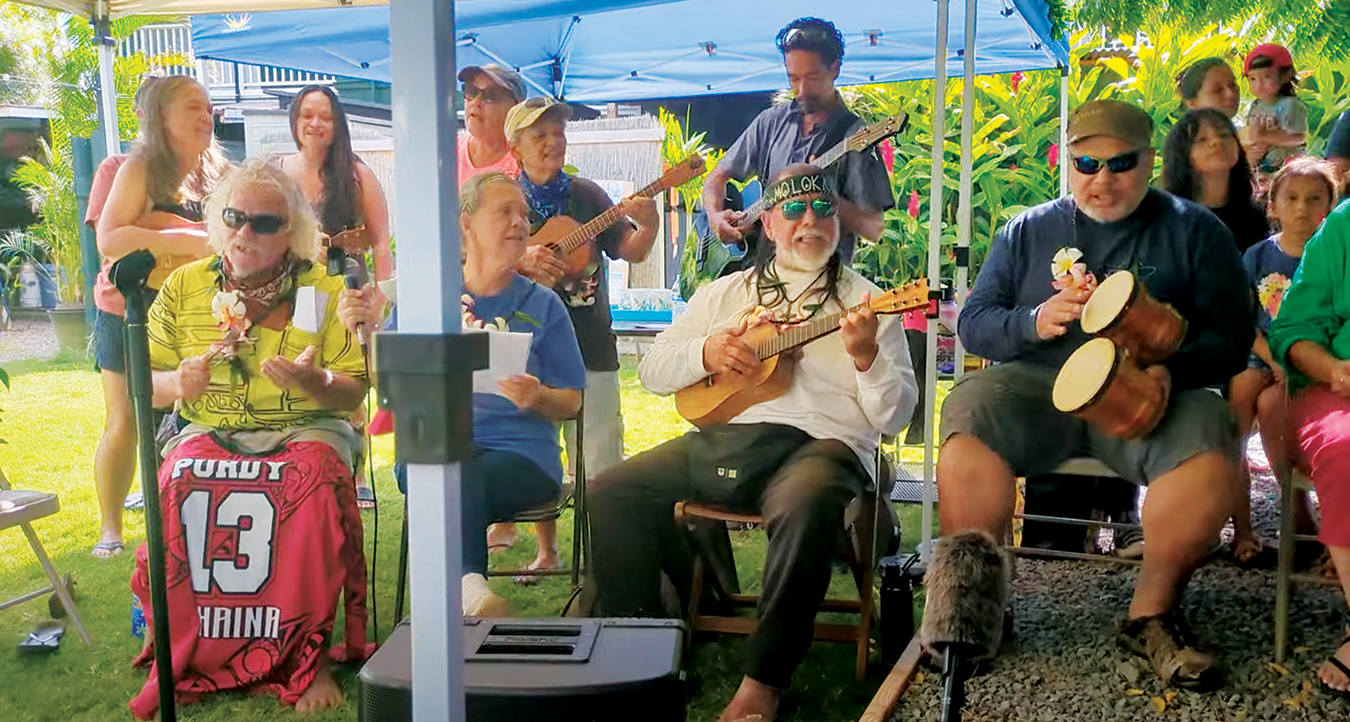
    The Purdy family shares a favorite mele in the garden of
    the Molokai History Project. PC: Rosa Barker

    The Molokai History Project (MHP) has held several Talk Story events since its opening in October 2023. Besides sharing local and Hawaiian history, these events foster a great sense of community. Housed in a storefront in Kaunakakai, MHP was envisioned by its founders — Judy Mertens and Nora Espaniola — as a place for locals to recall and reconnect with the people and places that make the Friendly Isle so special.

    ‘Inherited Legacy’

    In November last year, six generations of the Purdy ‘ohana gathered in the garden behind the MHP storefront to present “Inherited Legacy”— a talk story about their family’s history. The award of Hawaiian Homestead lands brought Emma (Lindsey) Purdy and her husband, Harry Purdy Sr., to Moloka‘i from Waimea in 1924. The Lindsey and Purdy families worked for Parker Ranch on Hawai‘i Island as paniolo (Hawaiian cowboys).

    The fun event was enlivened by family reminiscences linked to the mele that Frank Sr.’s grandchildren performed. Several tales were about the misunderstandings that arose because Frank Sr. spoke only ‘Ōlelo Hawai‘i, which they didn’t understand. They also didn’t realize that the “weeds” in his yard were used for his calling as a practitioner of lā‘au lapa‘au (Hawaiian medicine One time, the two oldest, Waipa and Fay, cleaned up his yard by pulling them all out!

    Many of his descendants actively promote the learning of Hawaiian language and traditions. As his great-granddaughter, Wailana, said, “Hearing the stories, when we get older we understand that we gotta go back to the roots. All the Hawaiian ‘ike, that’s how we were raised. And from generation to generation, we try to gather all the time.”

    What a wonderful gathering the Purdy ‘ohana shared — full of laughter and song and love.


    MOLOKAI HISTORY PROJECT
    808-283-0792 | info@molokaihistoryproject.org
    molokaihistoryproject.org
    Talk Story videos: molokaihistoryproject.org/events

    One of the most treasured traditions in Hawai‘i is “talking story.” This Pidgin phrase can refer to something as simple as chatting about life events and the news of the day, or as complex as passing on generational wisdom and sharing concerns and hopes for the future. The Molokai History Project (MHP) has held several…

  • Hilo’s Lyman Museum is Superb!

    I’m not the first to fall in love with Mauna Kea. Sarah Lyman — a missionary who came to Hawai‘i from New England in 1832 — wrote in her journal about the beauty of Mauna Kea when the clouds and rains cleared. You can hear readings of several journal entries in one of the exhibits at the Lyman Museum, not far from the old Hilo waterfront.

    The museum has two major galleries. The entrance to the Earth Heritage Gallery on the first floor is a lava tube. Following the yellow footprints on the floor takes you around the gallery, beginning with the formation of the Hawaiian Islands, followed by the arrival of life by wind, waves and wings, and then you journey through the habitats from mauka (mountain) to makai (sea).

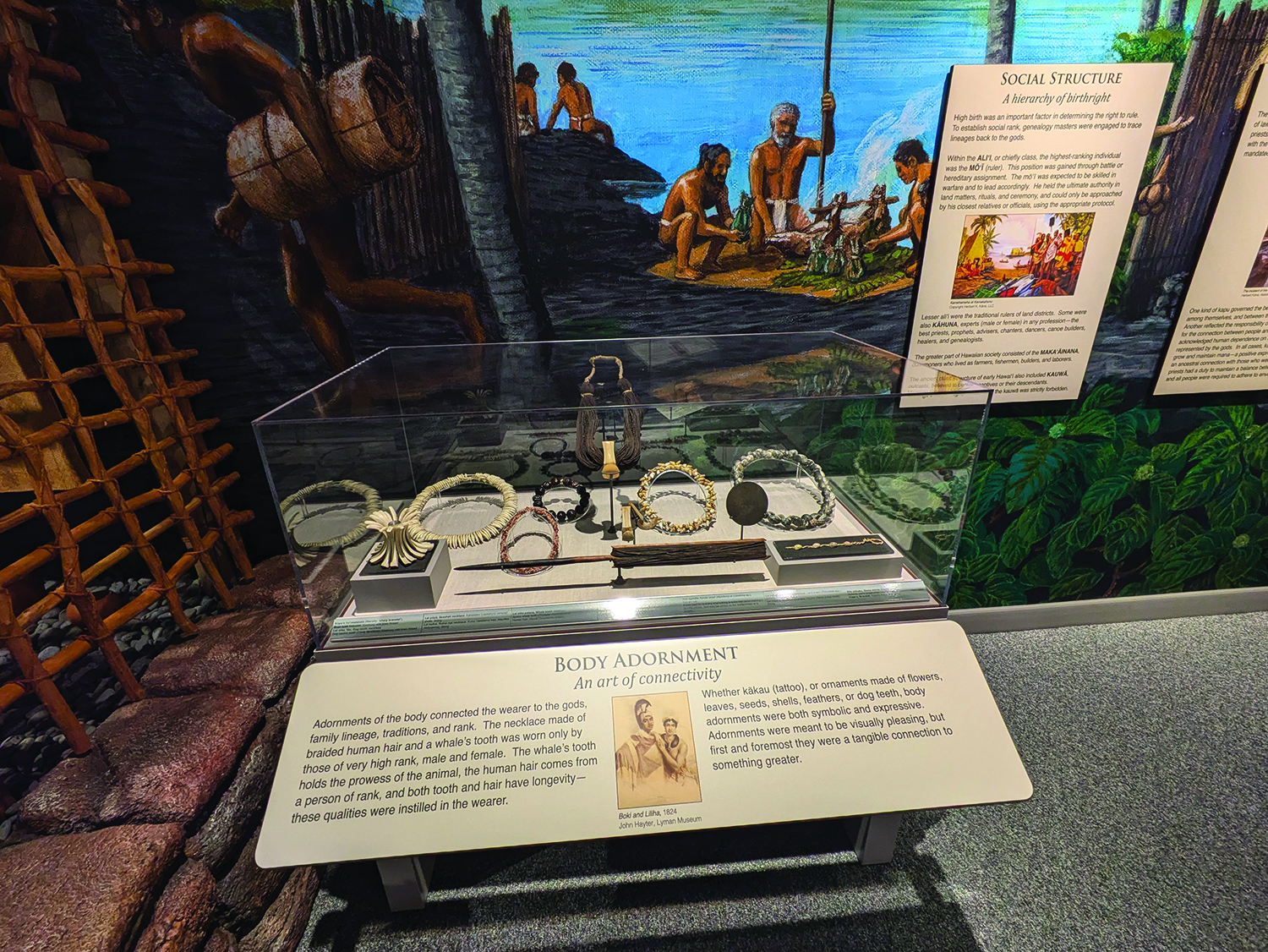
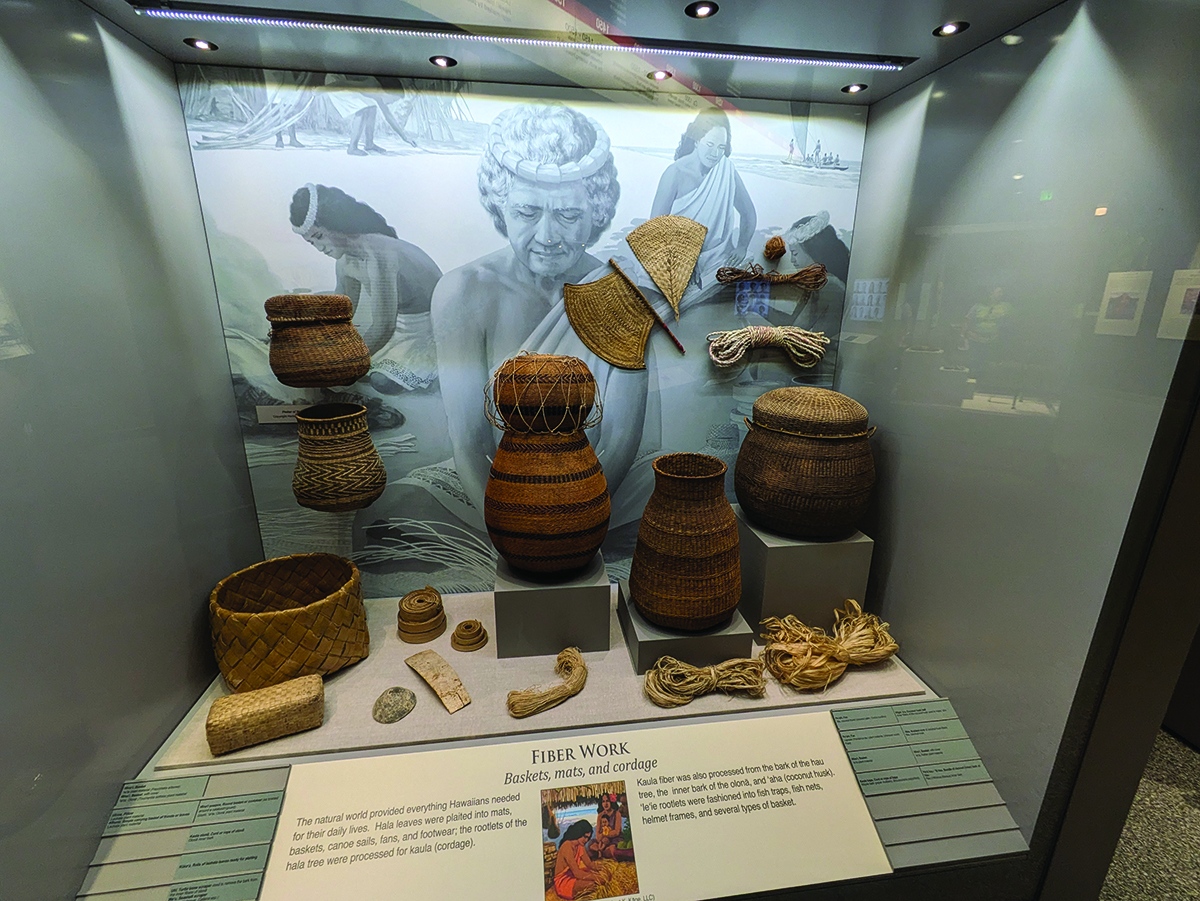
    The upstairs Island Heritage Gallery is also self-guided and starts with the arrival of the first Polynesian settlers. It is rich with exhibit cases displaying Hawaiian cultural items like stonework, kapa, feather work and drums.

    There are exhibits about European explorers, whalers, missionaries, plantations, the monarchy and statehood, and some contemporary oral history recordings. My favorite spot was the music nook, which has recordings from different eras.

    Accessibility and cost

    Wheelchairs, walking frames and mobility scooters are all allowed, but strollers aren’t. Just carry that mo‘opuna in your arms!

    A staff member or docent will happily transport you in a freight elevator if you can’t do stairs. Being taken in that elevator to the restrooms in the basement gets you the added bonus of seeing the archivist at work!

    All the entrance fees are less than $10. As a kama‘āina senior, I paid just $3 and spent a wonderful two hours there.

    This museum is top-notch — the Smithsonian has accredited Lyman’s gem collection in the top 10 in the nation. And, honestly, I found it far less daunting than the Bishop in Honolulu, but with the same amount of scholarship behind it.

    Tip: Call ahead to make a reservation to visit so that you don’t arrive at the same time as a tour group or a school field trip.

    LYMAN MUSEUM AND MISSION HOUSE
    276 Haili St., Hilo, HI 96720
    808-935-5021 | lymanmuseum.org

    I’m not the first to fall in love with Mauna Kea. Sarah Lyman — a missionary who came to Hawai‘i from New England in 1832 — wrote in her journal about the beauty of Mauna Kea when the clouds and rains cleared. You can hear readings of several journal entries in one of the exhibits…