
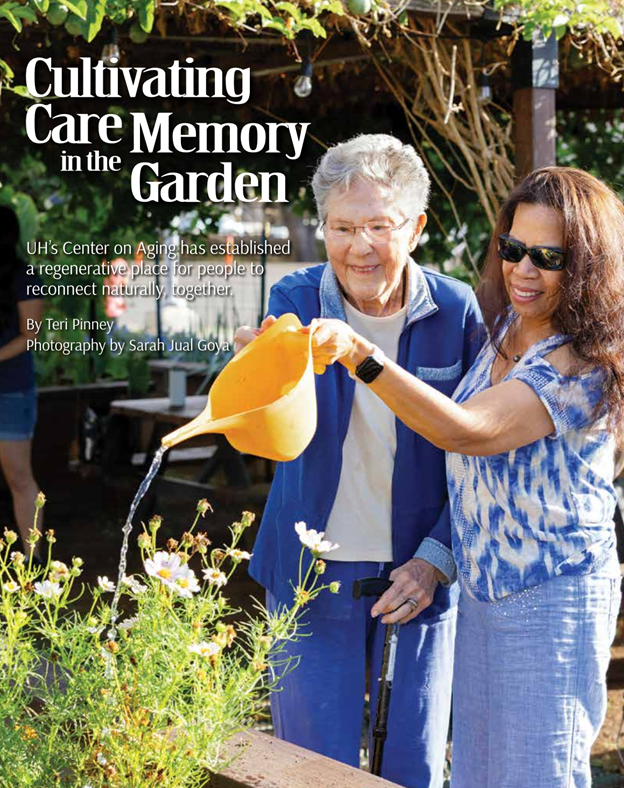
Tucked between campus classrooms near the College of Education, the leafy paths of the University of Hawai‘i’s (UH) Ho‘ōla ‘Āina Pilipili garden come alive every third Thursday afternoon. Soft laughter blends with the rustling of leaves and the hum of gentle conversation. Under the shelter of liliko‘i shade tents, a kūpuna presses seeds into the soil, a caregiver smiles from across the table and a UH student leads a memory-based activity. It’s a quiet, powerful moment when generations meet, stories resurface and healing takes root. This is the Memory Café and its garden in action. But it’s much more than a soothing gathering place. It’s what the UH Center on Aging (COA) was created to do — bring research, community and compassion into one space.
A Vision Grows into a Vital Hub
The UH COA was formally established in July 1988 after years of planning by educators and community advocates who saw Hawai‘i’s shifting demographics as both a challenge and an opportunity. By the late 1980s, the islands were already home to one of the fastest-growing senior populations in the nation.
About 311,000 seniors (aged 65 and over) live in Hawai‘i today—roughly 21.5% of the state’s 1.4 million residents, according to Hawai‘i Department of Business, Economic Development & Tourism’s summary of the US Census 2024 population characteristics.
Since its founding, COA shifted through reorganizational umbrellas and now finds its current home within the Thompson School of Social Work & Public Health at UH Mānoa. This signaled a larger vision. Aging isn’t just about health. It is social, emotional, environmental and deeply human.
Its mission remains steady: to enhance the well-being of older adults through collaboration, applied research, education and service.
In addition to measuring success by journal citations, the center quantifies its accomplishments in smiles, independence and community strength.
COA has become a hub for interdisciplinary research and hands-on community engagement that touches nearly every aspect of aging in Hawai‘i. Today, it supports dozens of projects that address issues such as dementia awareness, caregiver education, intergenerational connection and public policy for elder care. COA’s faculty and students collaborate with health systems, schools, state agencies and nonprofits to turn research into action, improving how Hawai‘i understands and supports its kūpuna.
Right now, the UH Center on Aging is behind some remarkable efforts to make life better for Hawai‘i’s older adults. Through Age-Friendly Honolulu and the Kūpuna Collective, a statewide network co-founded by the Hawai‘i Public Health Institute, they’re shaping how our cities grow—pushing for engaged and inclusive communities that welcome everyone. And with the CARE Registry (Collaborative Approach for Asian Americans, Native Hawaiians and Pacific Islanders Research and Education), they’re helping ensure that island and Pacific voices are finally represented in national studies on aging and dementia.
COA helps ensure that local voices and cultural perspectives are included in studies that shape future healthcare policies. The center also partners with the state’s Executive Office on Aging, the City and County of Honolulu’s Elderly Affairs Division and supports the Pacific Islands Geriatric Workforce Enhancement Program’s efforts to train healthcare and social service professionals across the state.
Together, these efforts reflect COA’s mission—to not just study aging, but to improve what aging looks and feels like in the islands.
Hawai‘i residents were living longer, often healthier lives, and the cultural tradition of multi-generational homes meant new kinds of caregiving needs were emerging. Families wanted to keep their elders close to home and not necessarily in institutions. COA became a bridge, linking university research to real families and real challenges.
Early COA projects explored caregiving education, senior employment and aging-in-place initiatives. As the population aged, the center expanded to address Alzheimer’s disease, dementia, and the emotional well-being of kūpuna and their families. That early foundation has grown into today’s blend of community programming, applied science and hands-on service.
Nurturing Lives Touched by Dementia
More than 30,000 people in Hawai‘i live with dementia today. It’s a group of symptoms. The most familiar and common is memory loss, which is caused by brain disease. Alzheimer’s disease is one type of dementia and accounts for approximately 60% to 80% of dementia cases.
“A dementia diagnosis is scary and overwhelming,” says Christy Nishita, PhD, a gerontologist at UH COA and the Memory Café program lead. “Unfortunately, there is a lot of stigma regarding dementia. It can make people afraid or embarrassed to go outside and engage in our community.”
Life with dementia calls for more than medical care. It thrives on connection. Both those experiencing memory loss and their caregivers benefit from strong circles of support that keep each day meaningful and full of purpose.
Staying socially active, moving the body and keeping the mind engaged through activities like conversation, gardening, music or puzzles can help lift the spirit and preserve a sense of joy, even as memory and thinking evolve.
Recently, the Alzheimer’s Association reported that Hawai‘i faces one of the most rapid increases in the number of dementia cases in the nation. With people living longer and kūpuna making up a growing share of the population, families across the islands are feeling the impact of Alzheimer’s disease and other types of dementia. Apparently, tens of thousands of Hawai‘i residents are currently living with dementia and nearly twice that number serve as unpaid caregivers.
The challenge isn’t just medical; it’s emotional, cultural and social. Many caregivers juggle full-time jobs while tending to loved ones, and families often struggle to find culturally appropriate resources that fit local ways of living and caring.
That’s where UH’s COA plays a vital role. Through community-based programs, caregiver training and research partnerships, COA helps families navigate the complexities of dementia with compassion and knowledge.
The center is also a partner in the Hawai‘i Dementia Initiative (HDI), which promotes public awareness, professional training and memory support services statewide. And through projects like the Memory Café and garden, COA offers a model of social connection that restores dignity and joy to those living with memory loss.
Together, these efforts help make Hawai‘i not just a place where people live longer, but where they can live better, surrounded by care, understanding and aloha.
Ground Preparation: Establishing Partnerships With Purpose
COA is built on connection. Faculty, students and local leaders work hand-in-hand with city agencies, nonprofits and health systems. Their goal is simple but profound—to make Hawai‘i a place where aging feels supported, not feared.
One of the most impactful collaborations is with Age-Friendly Honolulu, a long-term partnership with the City and County of Honolulu that reimagines how the city supports residents as they grow older. This initiative brings together City and County of Honolulu departments and community organizations to create neighborhoods where seniors can stay active, connected and independent.
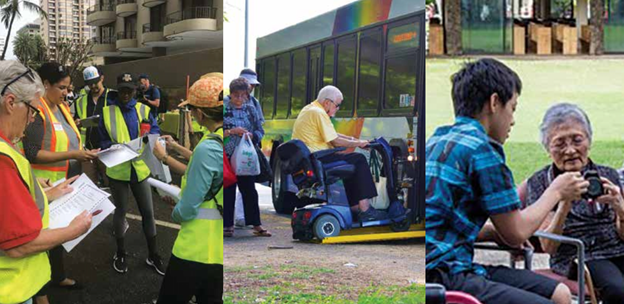
Through surveys, walk audits and community trainings, the project has promoted more accessible spaces and engagement of kūpuna in community life. What began as a pilot has now become part of Honolulu’s citywide strategy for livable, age-friendly communities, shaping how the islands plan for accessibility and inclusion for years to come.
Planting a Dementia-Friendly Garden
The dementia-friendly garden and Memory Cafe are UH COA initiatives. Research by Melody Halzel, PhD candidate in Public Health, under the direction of Dr. Nishita, complements these initiatives by examining how outdoor spaces like the Ho‘ōla ‘Āina Pilipili Garden at UH Mānoa—can be designed to support people living with dementia and their caregivers. Melody’s research evaluates how accessible, safe and engaging these environments are, aiming to create practical guidelines for developing dementia-friendly gardens that nurture memory, comfort and social connection across Hawai‘i’s diverse communities.
Dementia Friends Hawai‘i is part of the Age-Friendly Honolulu initiative, which is also coordinated by UH COA in partnership with the state’s Executive Office on Aging and other community organizations. The center trains volunteers and community partners—healthcare workers, students, local businesses and faith groups—to host Dementia Friends Hawai‘i sessions across the islands.
The Retired and Senior Volunteer Program (RSVP) plays a meaningful role in extending the reach of UH COA’s community work. RSVP volunteers—many of them kūpuna themselves—bring decades of experience, empathy and local knowledge to the center’s initiatives. They assist with events like the Memory Café and garden, and support outreach activities that connect older adults and caregivers with resources.
Their participation adds a powerful layer of peer-to-peer connection. When RSVP volunteers share their time and stories, it helps build trust and encourages other seniors to stay active, engaged and informed.
For COA, it’s a win-win. The program gains capable, community-minded helpers, and volunteers gain renewed purpose by giving back in ways that directly improve the lives of fellow kūpuna across Hawai‘i.
Another key initiative is the CARE Registry, which invites Asian American, Native Hawaiian and Pacific Islander residents to participate in national aging studies. Historically, these groups have been underrepresented in research. CARE 2.0 helps close that gap and ensures local families see themselves reflected in data and solutions.
The COA is involved in dozens of projects and partnerships—too many to list or fully explain here—all designed to improve the lives of Hawai‘i’s seniors and their caregivers. From statewide policy work to neighborhood-based initiatives, each effort reflects the center’s deep commitment to community well-being.
Among its many programs, one in particular has captured the heart of that mission—the Memory Café and garden, where connection, compassion and learning come together in the most down-to-earth way.
Research Meets Heart at the Memory Café & Garden
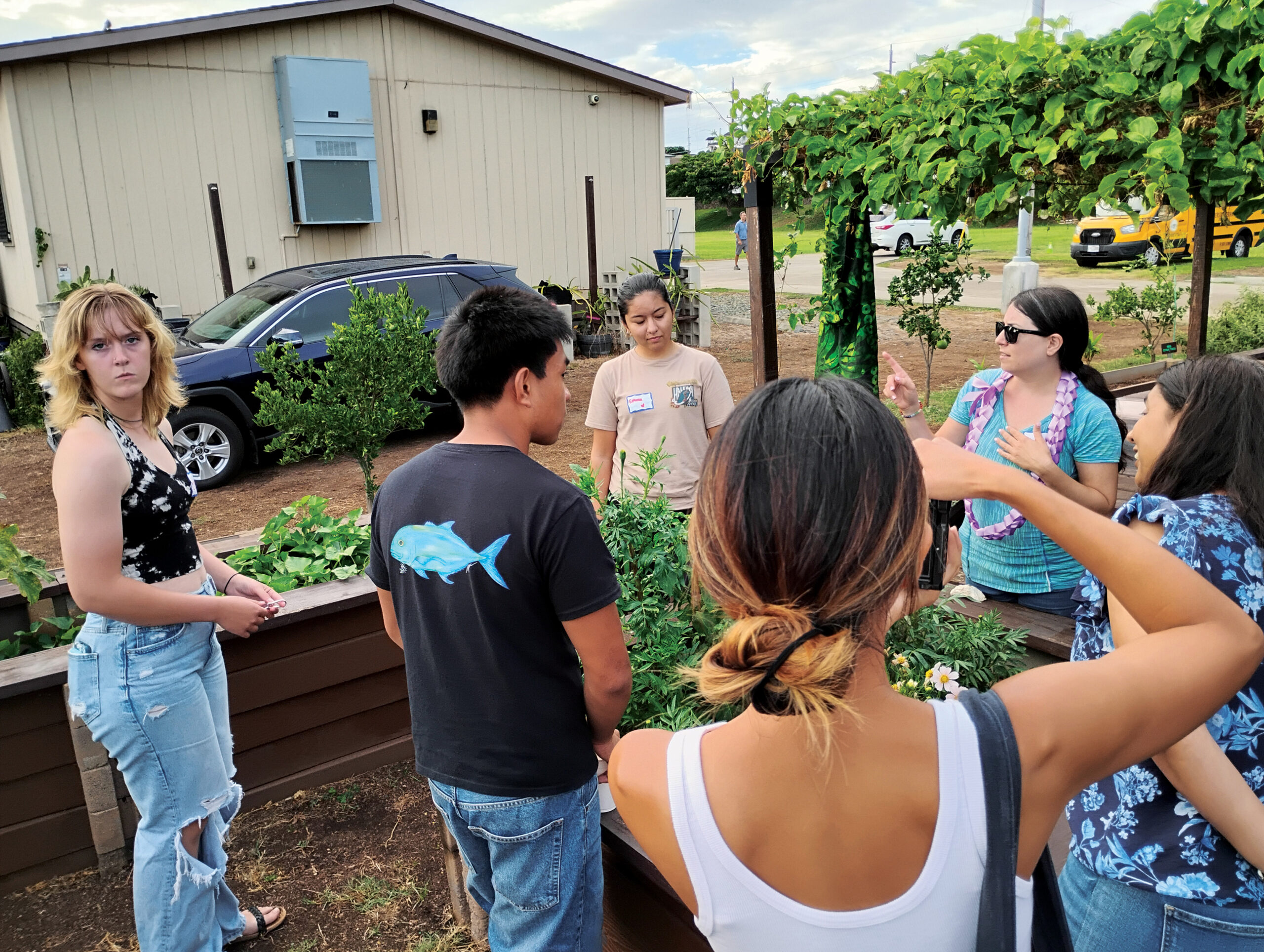
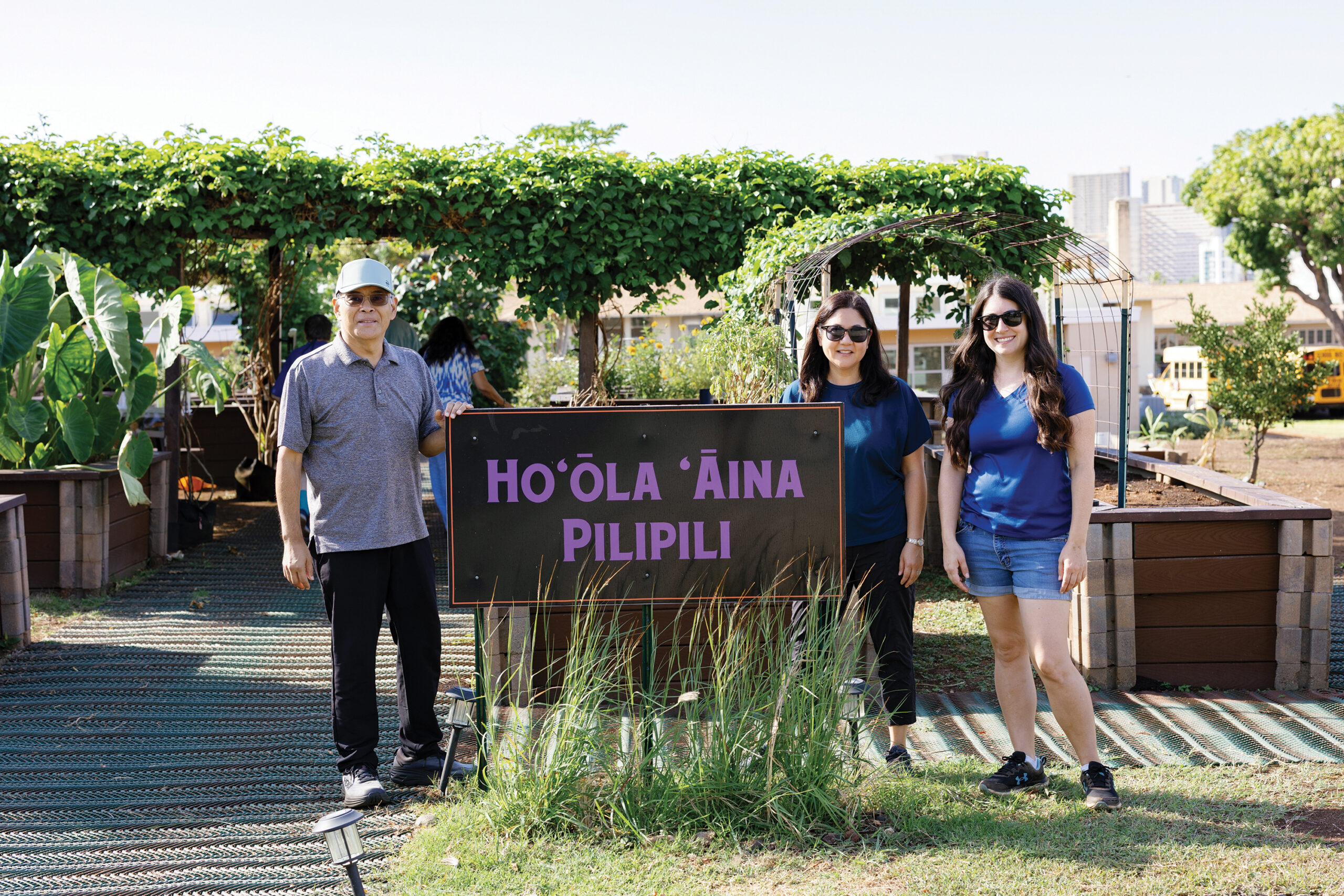
A dementia-friendly garden, situated on an underutilized space within the UH campus off Metcalf Street, now flourishes with plants like mamaki (a Native Hawaiian tea plant), kalo, ‘ōlena, rosemary, liliko‘i, cherry tomatoes, basil and more. It features elevated planter boxes, resting areas and wide pathways, all designed with accessibility in mind.
Monthly gatherings at the garden welcome people of all ages and abilities, including those living with dementia, along with their caregivers and friends. Supported by COA staff and student volunteers, participants connect through shared, nature-based activities that nurture both body and spirit. The space is thoughtfully designed for comfort and inclusion, featuring shaded seating, raised garden beds and nearby restrooms—ensuring everyone can take part and feel at ease.
“ ‘ Ho‘ōla ‘Āina Pilipili’ translates as ‘restore/regenerate, to bring life back,’ to ‘āina—the land which feeds,” says Melody, the garden’s co-founder and Memory Café program coordinator. “And ‘pilipili’ refers to the name of the smaller land division (ili), where the garden is located. Together, it means ‘to restore and bring life back to the land.’ ‘Pili,’ such as ‘pilina,’ is for close relationship between people and connection to nature.”
Often called the person with “the heart behind the project,” Melody finds it deeply rewarding to see how much it’s grown. “It’s wonderful to bring back to life and regenerate unused land,” Melody says. “The garden has become a place for people to reconnect—with nature, with each other and sometimes with themselves.”
Last April, the garden and its caretakers welcomed dozens of visitors who helped pilot a new Dementia-Friendly Garden Checklist, developed by Melody as part of her dissertation research. The project evaluated how outdoor spaces could better support people of all ages and abilities.
The garden also serves as a living classroom for ‘āina-based learning and community connection.
Summer Maunakea, garden co-founder and associate professor of curriculum studies in the College of Education, incorporates it into ‘āina-based education courses, while the COA continues to guide its growth as a model that supports engagement of older adults, particularly persons with memory loss and caregivers.
The Memory Café and garden have grown into the living heart of the UH COA’s mission—where research meets compassion. “The program has a lot more engagement now… digging right in and maturing nicely,” says regular garden visitor Gary Simon, state volunteer president of AARP Hawai‘i. The garden’s steady growth mirrors the café itself—vibrant, welcoming and deeply rooted in community connection.
It’s not therapy in the traditional sense, but it is healing. Under shaded tents, laughter drifts through the air as kūpuna and students plant seedlings, paint stones or simply talk story. On one recent afternoon, 100-year-old Doris Inouye attended her first session with her 77-year-old daughter, Kathy Umemura. “They enjoyed being outdoors and intermingling with other people of all ages,” a volunteer shared. Moments like these show that joy and connection don’t fade with age, they just take new forms.
The garden itself was designed for inclusion. Wide paths, shaded seating and adaptive tools make it easy for anyone to join. Everything is provided, from gloves to refreshments, so participants can simply show up and fellowship together. Each session ends with quiet reflection and feedback that helps COA keep improving what matters most—that human connection.
“The café is like a family gathering,” one participant said. “We come, we talk, we plant and we leave feeling lighter.”
Planting the Next Generation
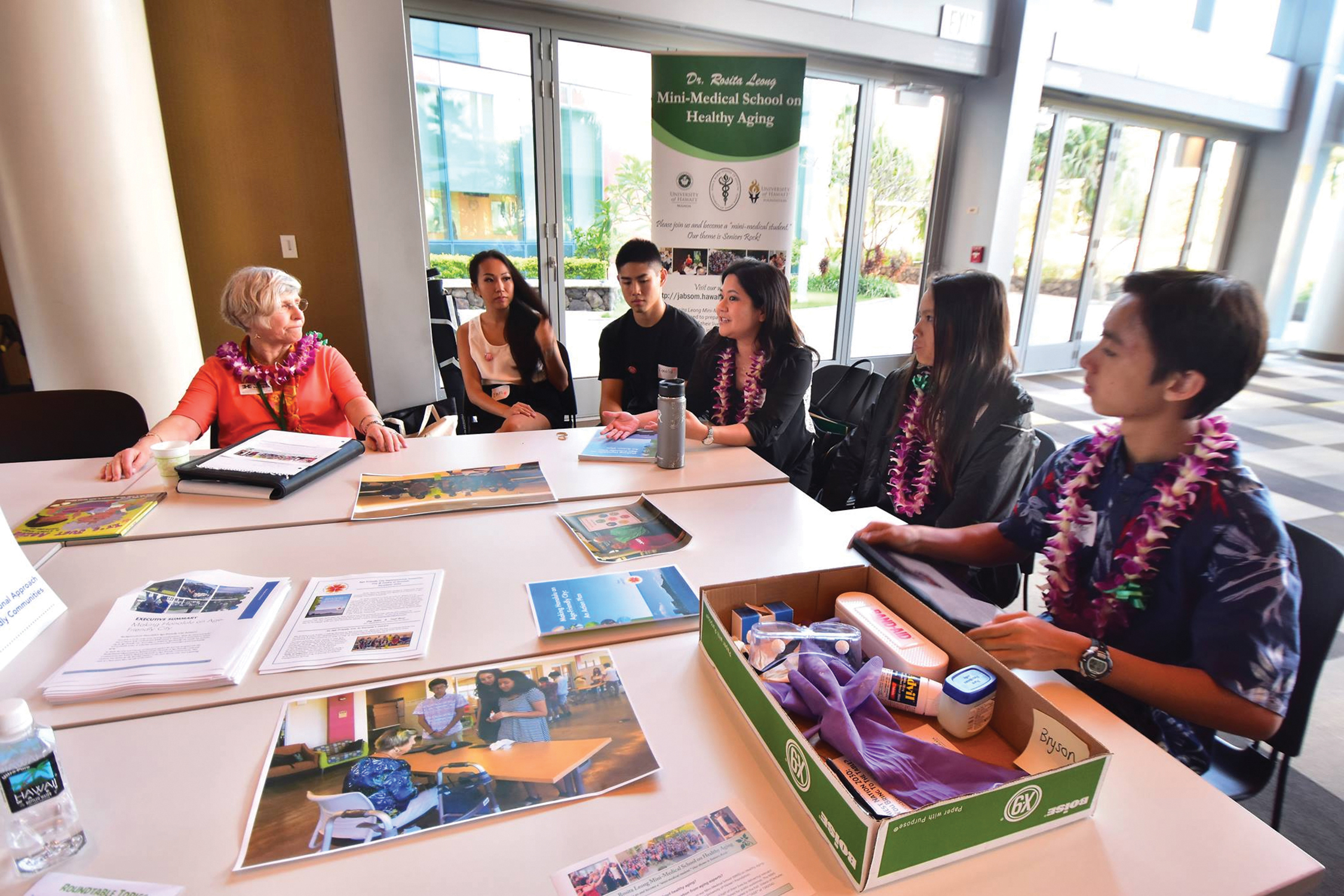
If the seniors are the roots, the youth are new shoots. At the COA, youth involvement is guided in part by Kevin Y. Kawamoto, PhD, a gerontological social worker, whose work bridges students and kūpuna through shared learning and service. Dr. Kawamoto describes COA as giving young people a chance to learn by doing—to sit beside elders, listen and serve with empathy.
Students who volunteer at the Memory Café and garden gain firsthand experience working with older adults and caregivers. Through conversation, gardening and shared laughter, they build the kind of intergenerational understanding that strengthens both community and workplace relationships. These connections go beyond volunteer hours—they nurture compassion and respect across generations.
Among those students is Brayden Jadulang, an 18-year-old UH biology major. “I’m interested in healthcare and sustainability,” he says, crediting his parents for inspiring his volunteerism. Students like Brayden show up at the garden to volunteer and cultivate not only plants, but empathy, the kind of insight that will shape Hawai‘i’s future caregiving workforce. And he does this without any expectation of college credit.
“Many students volunteer simply to help kūpuna, but its also a wonderful educational opportunity that will ideally drive more students to careers in aging.” She goes on to state that the café thrives because of the sincerity of those volunteer youth who show up. Their kindness turns research into relationships and classrooms into communities. “Our youth need to learn about aging,” she adds. “When generations connect, they build bridges of understanding and find common ground.”
Through the CARE Registry, students also serve as ambassadors, helping to recruit participants and share information across island communities. Others lend their voices to social media campaigns promoting brain health or storytelling projects that connect generations. To promote careers in eldercare, Dr. Nishita has partnered with ‘Iolani School and other public high schools to promote awareness, foster empathy and provide intergenerational programming. This approach reflects one of COA’s long-held goals, which is to develop a workforce that values and understands aging. The Memory Café is where that vision takes root—students learning the human side of healthcare, while seniors rediscover purpose through mentorship and friendship.
Deepening Community Roots
What happens when a university research center steps off campus and into the heart of neighborhoods? For the COA, it means transformation on both sides. The university learns from lived experience and the community gains access to knowledge, tools and relationships once tucked away in academic buildings.
Because the center is based in Hawai‘i, it naturally embraces the islands’ cultural mix—Native Hawaiian, Asian, Pacific Islander and immigrant families—all with a deep respect for elders. That cultural awareness makes every project more personal, more local and more grounded in aloha. From neighborhood workshops to ‘āina-based gatherings, COA’s work reaches people where they live, work and talk story.
Programs like Dementia Friends Hawai‘i and the CARE Registry open doors to understanding and inclusion, helping residents learn how to better support those living with memory loss, while encouraging participation in research that reflects Hawai‘i’s diverse voices. The CARE Registry, in particular, helps researchers across the nation understand how culture, language and community shape the aging experience—insights that may one day influence how healthcare, caregiving and mental wellness are approached across the Pacific.
These community partnerships don’t just educate—they strengthen ‘ohana connections and restore confidence in aging with grace. They give kūpuna opportunities to share wisdom and remind younger generations what compassion and continuity look like in everyday life.
But numbers and studies tell only part of the story. At the heart of it all is something that can’t be measured—dignity. Whether through an awareness session, a volunteer’s kind word or a quiet chat in the garden, the goal is always to remind seniors that they matter, that their stories still shape Hawai‘i’s future and how every generation has something to give and something to gain.
Cultivating a Successful Future
While the laughter in the garden is real and immediate, COA’s leaders are also thinking about the future. The center hopes to expand Memory Café gatherings to neighboring islands and to develop partnerships with local hospitals and nonprofits to reach more caregivers. There’s also talk of blending technology with tradition—perhaps introducing virtual garden sessions for those unable to travel.
Dr. Nishita envisions Hawai‘i becoming a model for aging in place—where kūpuna can live independently, surrounded by support, culture and community. “Aging is something we all share,” she often says. “It’s a journey we take together.”
COA’s ongoing research on dementia-friendly design is another seed for the future. As cities across the Pacific look for ways to make public spaces more inclusive, UH’s work may help guide how communities everywhere design for dignity.
The story of the UH COA isn’t about numbers or programs. It’s about people. It’s about kūpuna like Doris, students like Brayden and visionaries like Melody, who see potential where others see wilderness. It’s about finding joy in the soil and meaning in the shared act of caring.

Growing Together for a Bountiful Harvest
As a kūpuna myself, I visited the garden and spoke with those who gathered there. What I witnessed was more than a program—I saw and experienced a sense of belonging.
Students laughed alongside elders, caregivers shared stories and the simple acts of planting and conversation bloomed into connection. For this kūpuna-writer, it was a reminder that aging is not about slowing down. It’s about staying rooted in purpose, community and aloha.
Each seed planted in the garden reflects the center’s larger mission, to cultivate a community where learning, service and compassion thrive side by side. Here, research blossoms into relationships and the wisdom of one generation nurtures the promise of the next.
In every way, UH COA continues to prove that the best kind of growth happens when generations work together—listening, laughing and helping life take root in the spirit of aloha.
If you would like more information about the University of Hawai‘i Center on Aging, the Memory Café and garden or for inquiries about volunteering, visit manoa.hawaii.edu/aging.
Leave a Reply